“SOLD” OUT
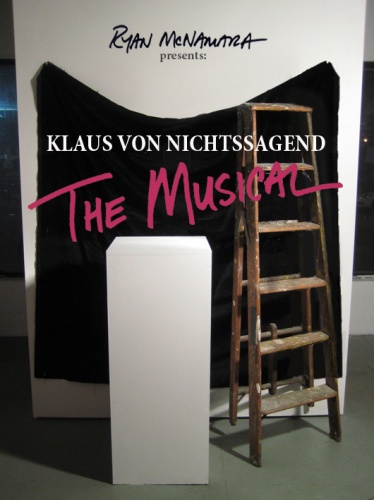
Klaus von Nichtssagend is putting on a show tonight, three in fact. Actually the show is being mounted by Ryan McNamara and “his accomplished troupe of actors, singers and dancers”, in the gallery’s description. They will be describing the story behind the legendary Klaus von Nichtssagend, answering the questions, “Why did he open this space? And why are we all singing?”, in “Klaus von Nichtssagend: The Musical“.
But all three performances, at 7, 8 and 9 tonight in Williamsburg, are already sold out (actually, they are free), so unless you’ve already reserved, you’re out of luck. For fans of the growing phenomenon of arts performance, Jacques Vidal and Noel Anderson offer an alternative in Chelsea. Unfortunately it’s going to be impossible to make both.
We’re definitely in the midst of a period of transition in the visual arts, and it’s only partly related to the economy going belly up. Plenty of institutions have survived, and there probably aren’t a lot more people creating things this year than the last, but artists aren’t waiting for galleries, museums or curators to find them and let them in.
They are creating art which is not just composed of objects – or even mere concepts. I don’t know what to call it but it’s not just “performance art”, because while it owes much to the breakthrough phenomenon associated with the 1960s, it often goes much further. It’s definitely not minimal; it loves props; it’s virtually a given that recycling of some kind is involved; it will go almost anywhere to put on a show; it sometimes involves large numbers of people who may not be aware of their participation; it doesn’t mind leaving behind some objects which, yes, can treated as commodities (product); and it almost always incorporates real humor, even riotous fun. This time around the younger artists are also a much larger genuine community, and they have killer communication tools.
Most lovely for all of us, as in the 60s, this art is free – in every respect.
I love it. I love the energy, the intelligence, the courage, and the infectious wit. I love the community. We may only be passing through a cultural corridor; what will follow is unimaginable to us today, but in the meantime we have these shows – and their enigmatic constructions and relics, the remnants, (and their documentation on gazillions of tiny cameras) to guide us.
[image from Klaus]
Category: NYC
the Guggenheim, Frank Lloyd Wright, and the rest of us
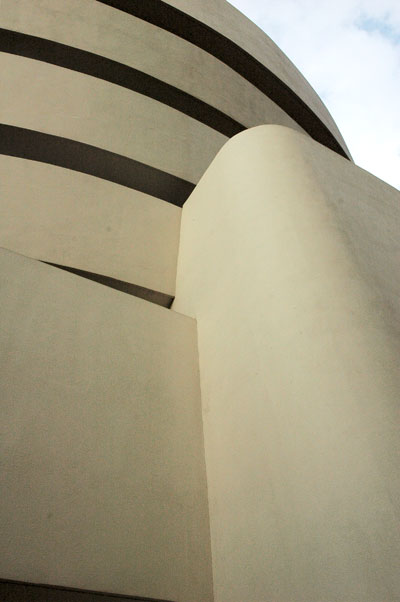
color: it only looked really white in bright sun; when we left at 6 it actually was more of an eggshell
Barry and I almost missed another show which we had decided long before was a must-see. But yesterday we headed for the Guggenheim, where the newly-restored museum’s fascinating exhibit, “Frank Lloyd Wright: From Within Outward“, closes tomorrow, Sunday.
The show is part of the Guggenheim’s celebration of the 50th anniversary of its landmark Frank Lloyd Wright-designed building, whose exterior renovation was completed last year.
I’ve been a fan of Wright’s almost from the moment Hilla Rebay and Solomon Guggenheim first approached the great man to design a permanent home for the Museum in 1943. I’m pretty familiar with his work, and not blind to his inadequacies (or those of the Guggenheim: “The Art of the Motorcycle“?), but I was often surprised by what I learned from the materials assembled for the show, and my criticisms of certain of Wright’s obsessions have been somewhat blunted after my progress down the Guggenheim’s ramp. Yes, we took the elevator up and walked down the ramp, which is how I always experience this museum (and what I understand Wright himself thought was the proper approach), even though we soon realized this exhibit is clearly arranged, chronologically, to suggest a progress up from the bottom.
I go back and forth on which of Wright’s work excites me more, the private houses or the public designs. Although it actually doesn’t really matter, even to me, this handsome retrospective didn’t resolve my ambivalence. Until we got down to the second-level annex we saw not one house design. While I was very much aware of this, and mentioned it to Barry, for almost two hours I was pretty much lost inside the grand schemes of his larger projects (which I was happy to be reminded had actually included apartment houses). Then we were suddenly looking again at the brilliance – and the variety – of his plans, over seven decades, for single-family dwellings – some specifically designed for pretty modest budgets.
My favorite new discovery within this part of the exhibition was the beautiful small unattached house which was a part of the architect’s “American Ready-Cut Houses” project. It was represented by a pencil drawing on a single sheet of paper of an elevation and plans for two floors of what Wright described as “small town house – plastered 1912-1913”. There seemed to be another (half?) floor below the first, which had a sun room and a small balcony, and a roof terrace above the second, bedroom floor. Lovely.
Thinking now about Wright’s sketched plan for the first floor, which included furniture outlines, I’m reminded of how here and in most of his other living room plans, even though there’s an eating area off of the kitchen, a handsome collection of table and chairs dominates the floor area of the room, unless the client can afford a particularly large living space. Our own apartment has a conventional living room arrangement, and we’re lucky to have a dining gallery as well, but I think that I would be quite content with entertaining people sitting around a dining-height table. There food, drink and anything else which could be spread out might be shared along with the conversation. I could pretty much do without a lounge area altogether. It’s very much how we live now, whether we have guests or not.
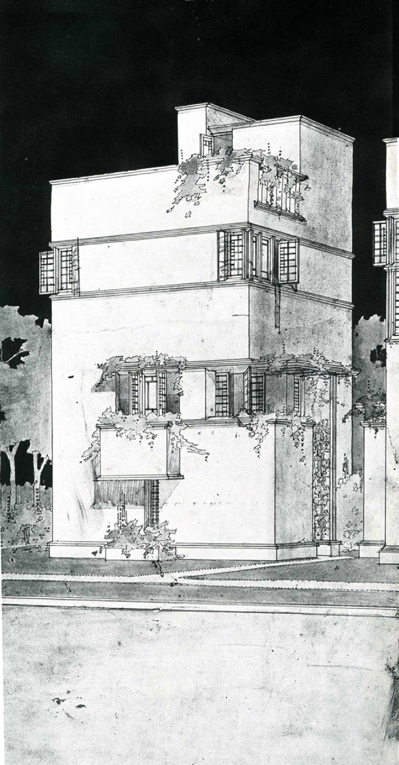
elegantly sufficient, sufficiently elegant still today
The visit would have been worth the trek uptown on a sweltering day, the long line, and the cost of the tickets, just for the look into a few of Wright’s more iconic designs alone. For me the most amazing, and melancholy, almost-discovery was his huge body of work devoted in 1957 to “The Plan for Greater Baghdad“, intended for an undeveloped island in the middle of the Tigris and of the city, sadly, unbuilt of course.
Although there are plenty of other candidates for an appreciation of his genius, I’m thinking especially of the 1913-1922 Imperial Hotel, and of course The Illinois of 1959 (unbuilt), Wright’s magnificent, plant-like, utopian (he would probably eschew “visionary“, since he believed it was totally practical) skypenetrator which has captivated me for half a century:

I swear I saw gold leaf near the very top, probably intended to show the sun blessing the hero’s tower
Did I mention the line? We were both aghast at the appearance of the ground floor lobby when we first walked into the museum. It was Friday, a weekday, and the time was 2:45:
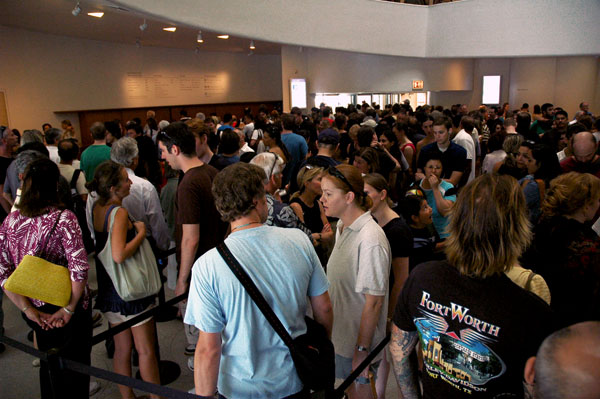
at least there’s no door person at the end, ready with a thumbs down if your look’s not up to snuff
These people are slowly advancing between row after row of ropes in order to get to the desk to pay for admission ($18, students and seniors $15, or order on line for a little more). It took us a full half hour to get to the head of the line, although this being New York there was good humor and a certain amount of eye candy for entertainment while we shuffled back and forth.
[image of “The Illinois” from the website of Rich Hilliard; that of “a small town house” from savewright.org]
the High Line, but this time on a slow day

I couldn’t stand looking at it any more, even if it shows a tweaked image of the Whole Foods logo, one which now serves as the symbol of a national boycott. I’m referring to my last, melancholy post, “Whole Foods’ John Mackey wants us unwholesome“. So, thinking I might not be the only one so depressed, I decided to upload a picture of some flowers I snapped up on the High Line at around 4 o’clock on this warm, sleepy afternoon. I was walking back from Buon Italia in Chelsea Market, a really, really, wonderful sort-of-smallish, genuine food emporium for anyone interested in Italian food, now destined to become an even more important part of my food shopping rounds.
Then, remembering how few people I saw up there today, I thought about how the beautiful slim park, which has quickly become the site of a documented neighborhood passeggiata, manages to look very different at various hours and on various days of the week. Here are a couple images showing just how popular it is on weekends. Both of them were taken on the first of August, a Saturday.
These pictures remind me of why I decided years ago that I had to move to New York permanently: Weekends here seemed to have been arranged mostly for visitors, and they still are, although back in the early 80’s I was thinking of Downtown music, theater, dance bars and performance, which were always much more interesting on school nights.
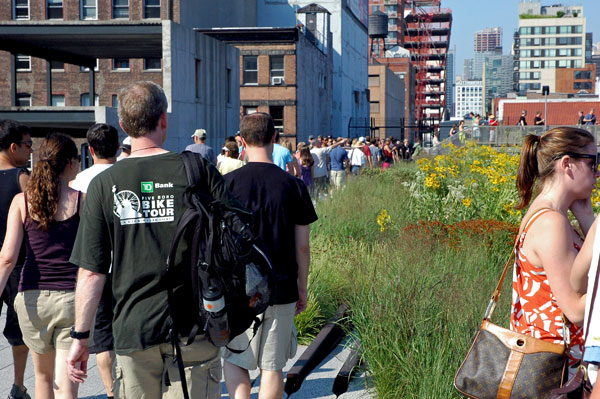
take a number
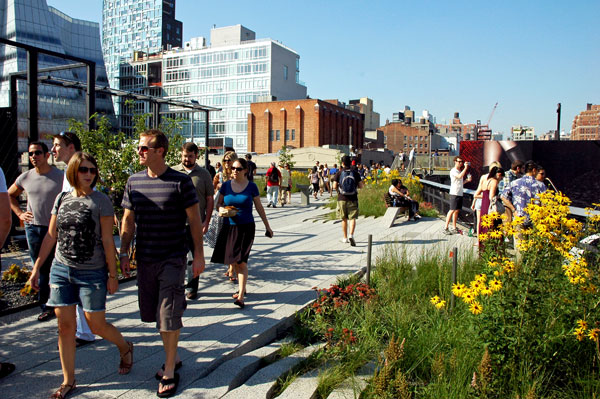
but it can look like a commercial travel brochure
Whole Foods’ John Mackey wants us unwholesome

I’d love to find some excuse to continue shopping at Whole Foods, but I just couldn’t live with myself if I went with anything I can come up with.
I am a serious cook, I make a real dinner for Barry and myself virtually every night, sometimes including friends as well, and I take my food sources very seriously. I was delighted to learn around nine years ago that a branch of Whole Foods was going to be opening at the end of our block. We already had Garden of Eden on 23rd Street, about the same distance away, and I could easily visit the Union Square Greenmarket, Citarella in the VIllage, Balducci’s on 14th Street and Buon Italia and the other shops in Chelsea Market. I could reach just as many more good food outlets if I ventured a little further, and I often did.
I immediately found Whole Foods very convenient, and I had a certain amount of confidence in the quality of what they sold, perhaps buying too much into its own hype and the excitement of its fans. The store became a very big part of my hunting and gathering activities. I soon began to think of the store as almost indispensable. It didn’t hurt that since it was only a few hundred feet from our apartment I could walk out my door at 9 in the evening or even later, having no idea of what I was going to buy, and still get back in time to make a proper dinner for the two of us.
But Whole Foods has been out of my life since last Thursday (except in the telling of this story). I’m going to have to make some adjustments and I’m definitely going to be planning ahead from now on. I regret having to make the adjustment, but I may be more disturbed about the fact that it took me too long to get to this point.
I suppose I shouldn’t be surprised that for a long time I found it convenient to ignore what I began to hear early on about the Whole Foods management preventing its employees from unionizing (I did not then know the extent of its larger political involvement fighting the union movement, including opposing the Employee Free Choice Act). And then late last week the news broke about co-founder, Chairman and CEO John Mackey’s Thursday Wall Street Journal op-ed on health care, “The Whole Foods Alternative to ObamaCare“. I could no longer ignore the fact that my money was supporting reactionary politics (the agent of the transaction was boldly broadcasting it to the world). Mackey opened his odd, obsessional piece with an ignorant, plainly specious quote* from scary Margaret Thatcher, and went on to argue against President Obama’s health reform proposals. In fact he railed against any government involvement in the regulation of health care, positing instead eight of his own ideas for reform.
My favorite:
Revise tax forms to make it easier for individuals to make a voluntary, tax-deductible donation to help the millions of people who have no insurance and aren’t covered by Medicare, Medicaid or the State Children’s Health Insurance Program.
From its beginnings this food chain, anointed (with some justification) as more wholesome than any of its competitors, has assiduously cultivated an image of social responsibility. But it’s an image which is, at the very least, at odds with much of its social and political conduct, especially because of the activities of the increasingly-eccentric John Mackey. The long arm (money, power, influence) of this very successful, wealthy corporation now manages to touch the lives of everyone, even those who have never entered one of its stores.
Even if the expected (and already dramatic) negative reaction of Whole Foods customers to the revelation of Mr. Mackey’s Right-wing adventures isn’t enough to frighten the corporation’s investors, I would be surprised if they haven’t already started to question his judgment, his ability to perform his job. Any competent CEO is well-advised to avoid political activities which offend and damage the best interests of his firm’s clients and customers – or at least avoid being discovered or outed as an extremist nut.
I’m not going to pretend that my decision to no longer darken the threshold of the Chelsea Whole Foods outlet is of much consequence in the grand scheme of things, but I know I’m not alone in wanting to see John Mackey relieved of his duties. Stranger things have happened, and corporations are not known for courage, or preferring stupidity over the bottom line.
Should he be removed, John Mackey, the free market libertarian, should be able to appreciate the irony of the marketplace deciding that it had to be.
*
“The problem with socialism is that eventually you run out
of other people’s money.”
[image from gezellig-girl’s Flickr photostream]
Duke Riley’s “Those About to Die Salute You”
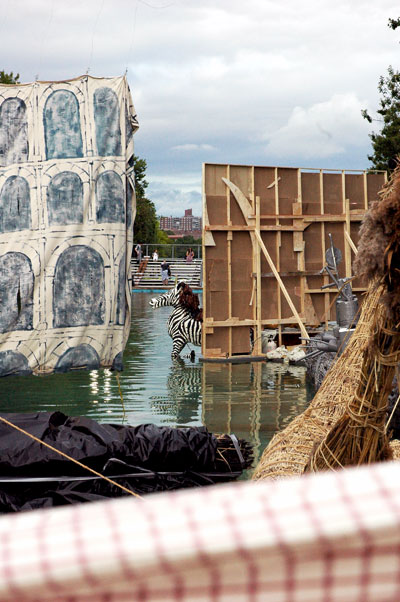
backstage at 6 pm: the battleships await their crews
Duke Riley’s rich, seriously-ambitious, aggressively-unprecious but still whimsically-theatrical large-scale piece of interactive art, “Those About to Die Salute You“, unfolded across the plains and the seas of Flushing Meadows on Thursday night, managing to exceed all expectations, probably including those of the artist himself.
The Queens Museum of Art commissioned the work from Riley earlier this year and this resourceful, heterodox (and genuinely-communal institution) got just about exactly what we saw described in the event’s press release:
Those About to Die Salute You, a battle on water wielded with baguette swords and watermelon cannon balls by New York’s art dignitaries, will take place on Thursday, August 13, 2009 at 6 pm in a flooded World’s Fair-era reflecting pool in Flushing Meadows Corona Park, just outside of the Queens Museum of Art. Various types of vessels have been designed and constructed by artist provocateur Duke Riley and his collaborators: the galleons, some made of reeds harvested in the park, will be used to stage a citywide battle of the art museums in which representatives from the Queens Museum of Art, the Brooklyn Museum, Bronx Museum of the Arts, and El Museo del Barrio will battle before a toga-clad crowd of frenzied onlookers.
And the people came.
No words can do more than begin to describe what they saw – and what they contributed themselves. There are already enough images posted around the blogosphere to make anyone who wasn’t there feel a bit like what now seems to have been the handful of people who didn’t get to Woodstock forty years ago. I missed Bethel myself, but, especially since I had been following Riley’s projects for several years, I wasn’t about to miss Corona Park, only one transfer away on the subway. Besides, as a student of the classics, I just couldn’t, and if I had given it a pass, when could I expect another invitation to a Naumachia?
Barry and I got there a bit before 6, as all the announcements had suggested, but after we had checked out the boat yards at one end of the flooded “lake”, we learned that the sea battle itself wouldn’t begin until after 8 o’clock.
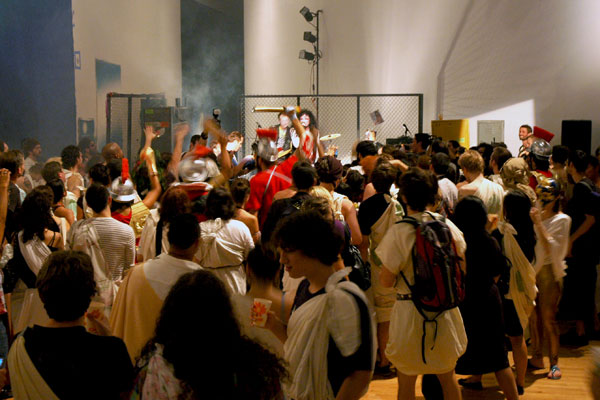
Populi entertained by Hell-Bent Hooker, including band-engineered special effects
We headed for the Museum, where an artist friend, one of Duke’s “herohelpers”, invited us to visit the now-nearly-empty and very dusty 40,000 sq. ft. “studio” where the battleships had been constructed. We stood next to an incongruously-shiny large black motorcycle with a box of cookies balanced on its seat: “Take some cookies; a nice Italian lady with her kids left these for us,” offered a long-haired gentleman with a deep, froggy voice just before he headed off to the other end of the space. I later recognized him as the lead in the metal band which was the evening’s early entertainment. We took two cookies, and they were the best: delicate, chewy macaroons.
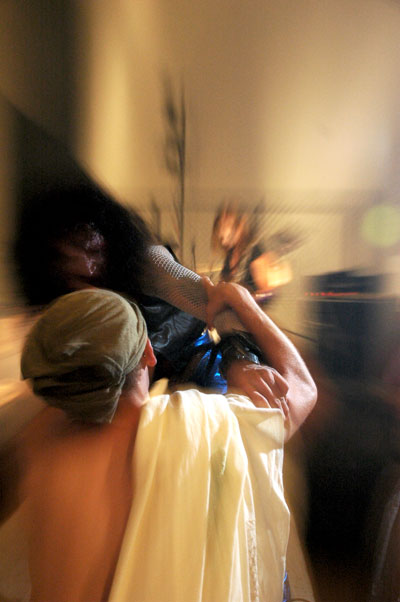
La-Vein Hooker (Hell-Bent Hooker vocals) and affectionate Roman fan
I guess we spent too much time mingling with all the Romans eating and imbibing in and around the Queens Museum and enjoying a bit of the evening serenades offered by Hell-Bent Hooker, so it was already twilight when we finally headed back to the site of the featured event (so featured that there was a box to one side, designated ESPN, where the faux anchorman for the proceedings was ensconced). There we found another huge crowd, and unfortunately all the spaces close to the water and the powerful spotlights had already been taken. In the end, while our late arrival meant I couldn’t capture any decent documentary images, it also meant that I saved my camera from encounters with water balloons, ripe tomatoes and rotten melons.
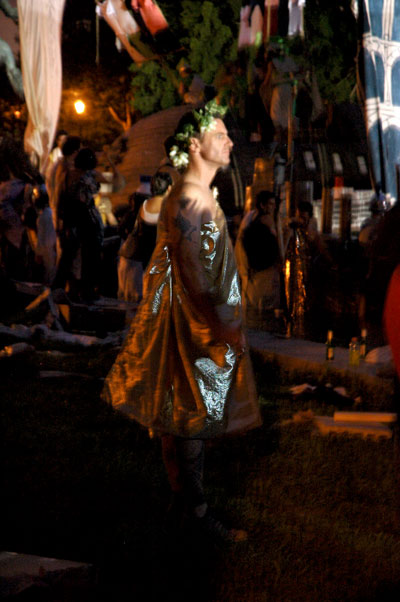
Duke-emperor, artist and prime mover, observing from the darkened wings
I’ve included a few of the pictures I took with available light while holding the camera high above my head. They’re pretty “impressionistic”, but the blurriness may convey a small bit of the excitement of the spectacle.
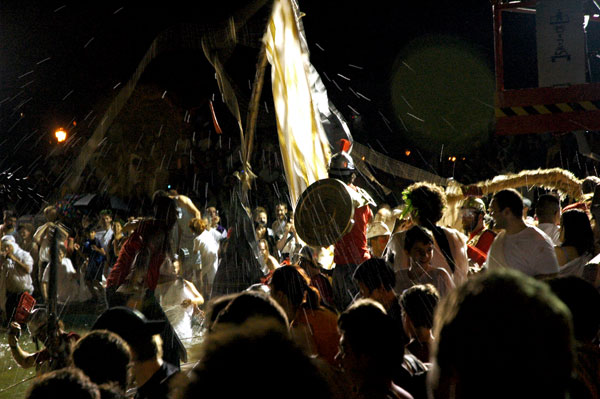
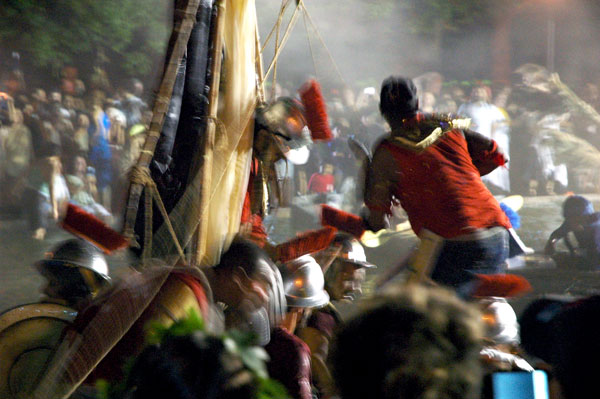
Queens Museum battleship and crew, later to be declared the victors
I’m not sure what’s going on in the next image (the camera saw much more than I did, and it can’t talk to me), but it looks a bit like a victory celebration.
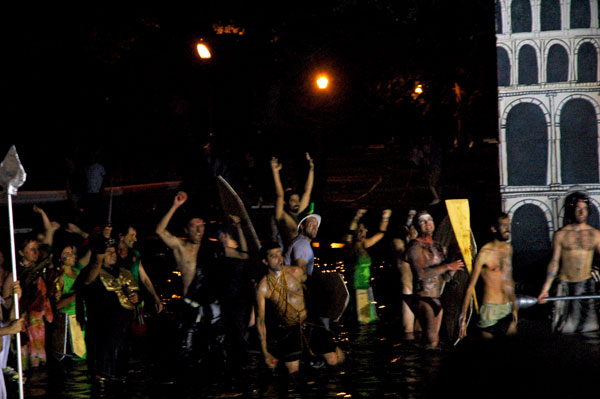
Neptune’s rowdy crew?
That whoopee came just after the sinking or withdrawal of the last manned and womanned battleships, and just before a reed-and-paper-constructed Queen Mary 2 slowly glided toward the head of the lake. Riley and the Queen have a history: When the artist tried to maneuver his one-man submarine near that vessel while it was docked in Red Hook he was arrested and his own ship was temporarily seized. Two nights ago Riley oversaw the replica go up in flames amid spectacular fireworks – turn over, and sink.
The crowd, which for several minutes seemed to be somewhat in shock and awe as they saw and heard the Roman candles going off, then went wild.
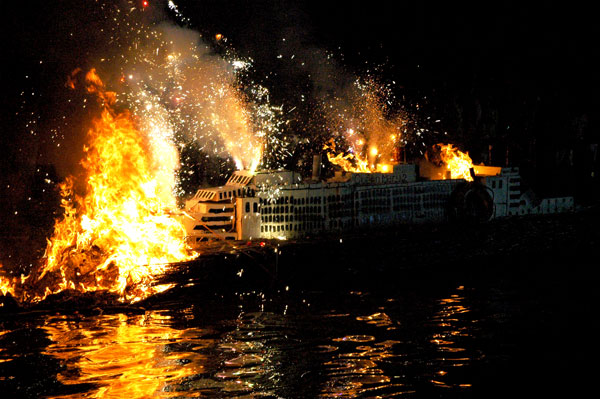
but no one’s suggesting actual sorcery is involved
of gallery Deathwatches, Dash Snow, Bruce High Quality
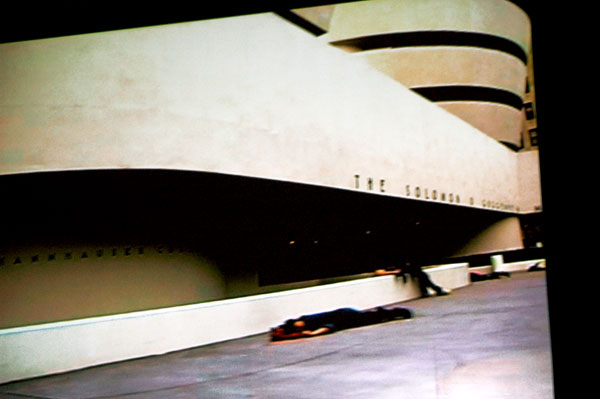
dead artists and such outside the Guggenheim, in the BHQF film, “Isle of the Dead”
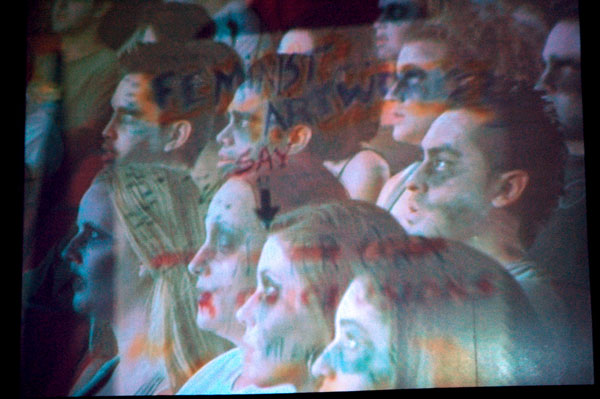
zombie artists and such recalling the summer of ’69, in the BHQF film, “Isle of the Dead”
The art world may be the middle of a continually-darkening 2009, but I’m still trying to stay well away from any ghoulish gallery deathwatches. Actually, I never understood how galleries operated/survived even in boom times, but then I never really had to; I don’t have a gallery, I am not advancing and cannot advance any money to anyone, I’m not selling art and I’ve not been able to afford to buy art for some time. Normally on this site (and elsewhere) I simply refrain from speculation, scuttlebutt, even factual news of any kind about behind-the-scenes gallery operations, except as it might impact close friends, my own blogging, the ArtCat calendar, or our ability to attract advertisers on Culture Pundits. Unless I’m standing on my virtual soapbox sharing an earnest political anger, most of the time I’m writing about art, and sharing some pictures. I can’t promise however that an occasional, particularly-colorful story might not sometimes tempt me to drop my customary constraint.
By the way, like my general habit of truthfulness, this reluctance to engage in certain conversations doesn’t seem to be have anything to do with personal virtue, but more likely stems from a consciousness that I lack the talents ordinarily required of a successful gossip, cynic or schemer; that is to say, absorption in the subject, guile, the ability to keep a story straight, and the sheer love of the game.
Anyway, I don’t pretend to be on top of the news about the regular disappearance of art galleries over the past months, sometimes unaccompanied by a notice of any kind, but after hearing today about another gallery closing, not one of the biggest spaces, but one which was a favorite of both Barry and myself, I finally confess to being deeply saddened.
While I was putting this entry together I learned of the death of the artist Dash Snow, further deepening my gloom. Barry and I were talking to William Powhida last night about the degree of interest regularly shown by much of the art world and the general public, and all forms and levels of the media, in gallery and artist prattle (as opposed to actual art news).
Today I found this sad, sweet post on Powhida‘s own blog.
The fact that we were discussing art gossip and disappearing galleries last night happens to have been only a coincidence to today’s news but it suggested some of the thoughts for this post of my own, one which was originally intended to be only a few words attached to an image or two from “Isle of the Dead”, the wonderful film by the awesome collaborative, Bruce High Quality Foundation [BHQF]. It’s playing in an old movie theater on Governors Island all summer. It’s one of the very best of the many installations spread throughout the grounds.
Thinking about the film, which I saw two weeks back, has made me feel much better, and it should work for you too. Just follow the art zombies downtown to Governors Island. Check out the trailer.
first third of the [Chelsea] High Line opens
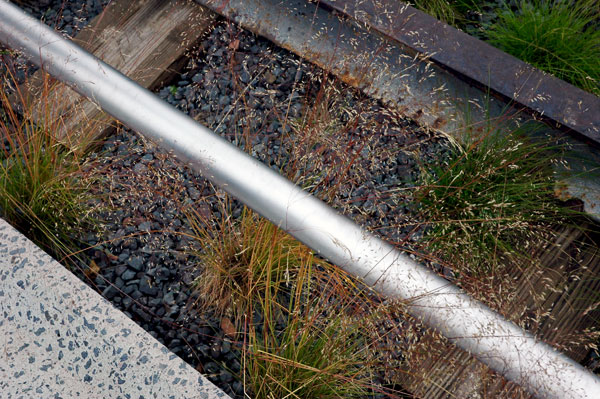
low down on the High Line
Barry and I visited the newly-opened first stretch of the High Line last Thursday, in spite of a light mist which probably reduced the crowds of the curious that afternoon. The experience was more lovely than I had dared to expect. My favorite things are its physical position (three stories above the street snaking around and through some other interesting structures, often within view of the Hudson), the handsome naturalistic plantings, and the fact that it’s only a few blocks from our apartment.
It’s a really, really wonderful thing. Its delights start even before you climb (or “elevate”) to the height of the old freight railway, with the breathtaking sight of smiling, happy people out in the open air beyond an old railing thirty feet above you, and it never stops. Actually, I think we’re both still high a week later, just thinking about it.
But I do have quibbles about some of the fancy details. I think that certain features introduced by the design team, led by landscape architecture and urban design firm James Corner Field Operations with architecture firm Diller Scofidio + Renfro, seem a bit too fussy, and their design may not age well. I’m thinking of the concrete-and-stone composite seat supports and “fingers” stretching from the path into the crushed-stone planted areas. I assume there’s a practical reason for their being there, if not in their precise configuration, and in any case nature may soon disguise or soften a lot of what now seems too much like an affectation.
The monstrous commercial Chelsea Piers operation robbed Chelsea of the kind of access to the Hudson River enjoyed by most of the communities north and south of us when the designs for Hudson River Park were approved. Chelsea is only now getting its first real park.
I’ve included only one photo here, an aesthetic and historically-referenced impression of the new High Line. It’s a detail describing some of the materials used in its construction, including the edge of the pavement, a very low steel railing, a segment of the original freight rails, and a look at the beautiful ornamental grass. I decided to hold back on any images documenting the park more thoroughly (they’re available all over the internet anyway), in order to make it easier for the reader to experience the environment visually unprejudiced.
“Then and Now” at the LGBT Center
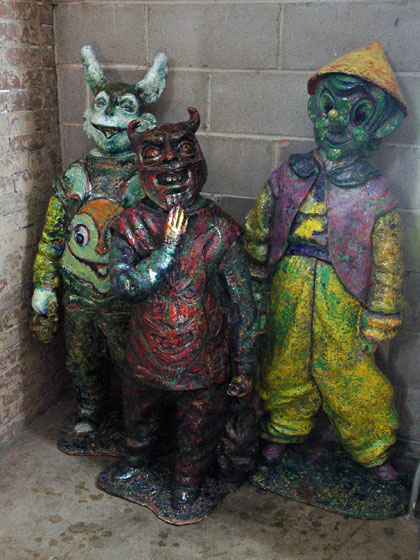
Bill Mutter Bunny Boy, Devil Boy, Pinnochio Girl (dates unknown) ceramic sculptures, dimensions variable [installation view]
I think what you see above was the most intense image I carried home in my head from the opening of “Then and Now” at the LGBT Center last night. For the longest moment, when I spotted them just as I reached the busy stair landing where these smallish (2 1/2 to 3 1/2 feet tall) figures were installed in a corner to the left, I was still almost totally distracted by a conversation with Barry about an installation we’d just seen. I absolutely didn’t know what I was looking at for a few seconds, but I remember I was almost giddy with delight and at the same time a little unbalanced by their suggestion of some kind of horror.
They seem to be children in halloween costumes, but the members of this little band clearly represent some kind of outsiders, especially when seen in the context of the building where they’ve been assembled, although in fact, like all the undisguised queers they seem to represent, they would be outsiders virtually anywhere.
I know little more about the artist than what I learned from this link, and in the last paragraph of this 1987 New York Times review of a group show.
What follows are images of a few of the other works installed on 13th Street, some of it from the 1989 “The Center Show” show and some of it chosen by the artists in that show for inclusion in this one. All works dated “1989” are works installed twenty years ago.
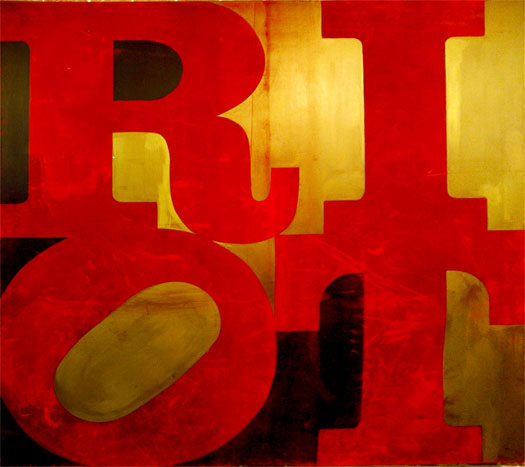
Gran Fury RIOT 1989 acrylic on canvas
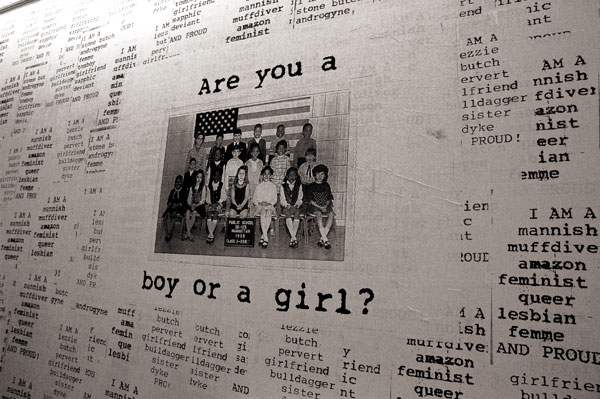
fierce pussy [title not supplied] 2009 black and white xeroxed posters on wall, dimensions variable [large detail of installation inside a multiple-toilet room marked “ALL GENDERS” on the door]
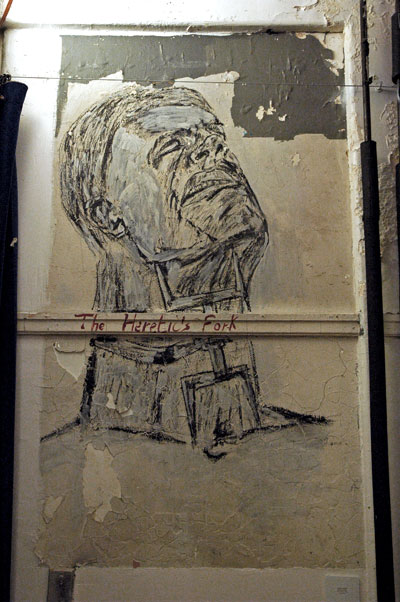
Leon Golub Heretic’s Fork 1989 oil on wall [installation view]
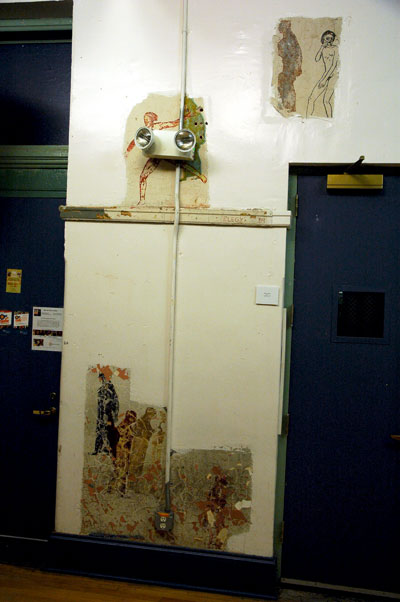
Nancy Spero Elegy 1989 acrylic on wall [installation view]
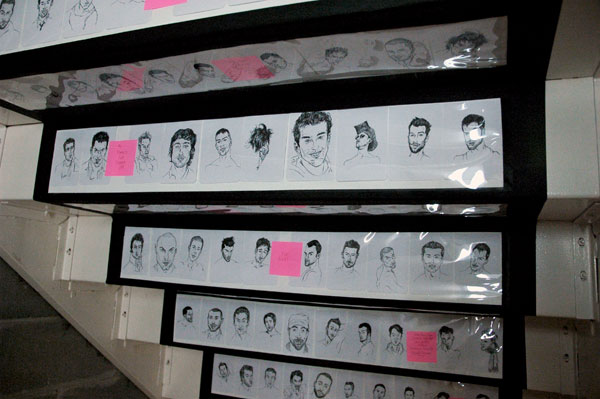
Tre Chandler A narrative of ga(y)zes 2009, 90 ink on paper drawings; 10 ink on paper post-its, dimensions variable [large detail of installation]
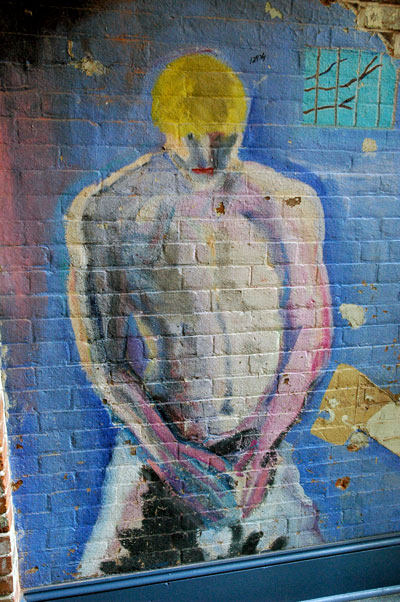
Stephen Lack Boy on Wall 1989 oil on wall [large detail of installation]
“Playing Through” in Brooklyn tomorrow
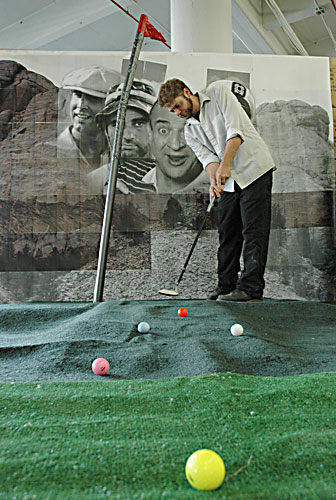
sculptor David Lukowski warming up for tomorrow’s play
For twelve hours tomorrow, beginning at noon a group of 30 or so scrappy artists will be putting on their own show, “Playing Through“, in an enormous, huge-windowed 16,000 square foot indoor space in Sunset Park, Brooklyn, just above the docks (55 33rd Street).
They describe it as an extensive mini golf course, but much more, a “carnival extravaganza”. The announcement continues:
We are eliminating greens fees and assembling a full food court featuring many local vendors. There will be a cotton candy machine and a popcorn waterfall. The course will have roaming beverage cart service. Nightfall will see the musical stage come to life, with several bands performing. In these tough economic times we’re taking care of you with an entire day of free entertainment for everyone on the Brooklyn waterfront.
As Barry writes in his blog today, we definitely hope to stop by. The concept, and the creative energy involved, would be more than enough, but the list of artists (some emerging and some quite visible), many of whose work we know and some we have written about, virtually guarantees excitement. Barry:
I was told by one of the organizers that they wanted to use an event like this to introduce the artists working there to the broader community. I particularly like the fact that they have fliers in English and Spanish!
The space is only about four blocks from the D,M,N and R (36th Street station). Here are the other details, on flyers in each language:
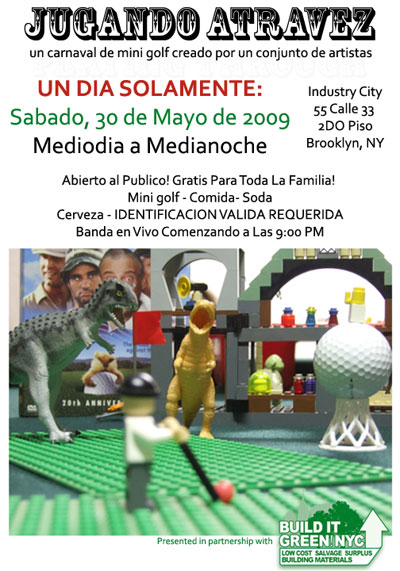
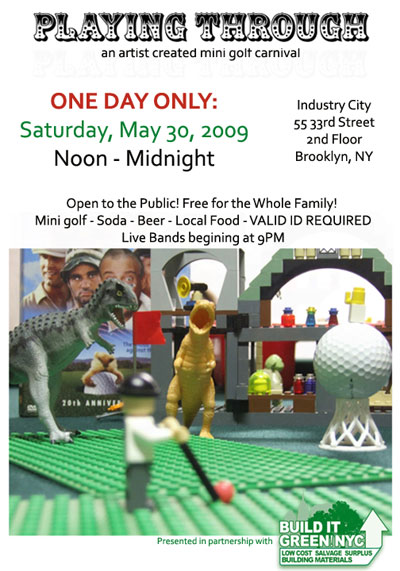
[first image via The Brooklyn Paper, the other two from Playing Through]
queer marriage: California goes both ways
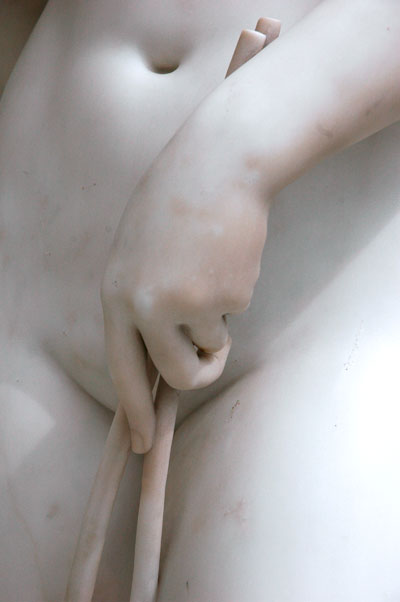
with good in one hand
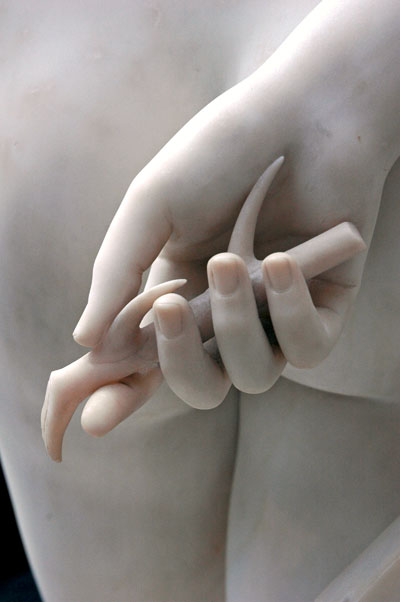
and evil in the other
Barry and I happened to be visiting the Metropolitan’s newly-reworked American Wing on the same day the California Supremes announced their decision on queer marriage. There didn’t seem to be one jot of a connection between the two events when we started out, but I eventually manged to find one.
I spent much more time with the nineteenth-century sculptures in the glass court than I might normally have expected to because we were with the artist Sarah Peters, whose work has been inspired by the milieu in which these earlier American masters flourished, and by their skills, although she finds her own space in interpreting that world anew and commenting on what the artist and his/her contemporaries thought of it through her own drawings and sculpture.
I was also eager to investigate what had inspired Holland Cotter’s terrific piece on the galleries which appeared in the Times last Thursday.
The female nude by Hiram Powers, intended as a California allegory, attracted my attention primarily for the odd props the figure was holding, especially the divining rod which she grasped so demurely before her smoothed pudendum. My mind jumped back to the news of the day when I read the note on the museum card, which reads in part:
Inspired by the California Gold Rush of 1849, Powers devised the following program for this allegorical figure: “. . . an Indian woman . . . stands in a reserved and guarded posture and with a watchful expression, holding the divining rod in her left, and pointing with it down to the earth, under a large quartz crystal, which supports the figure on the right. Quartz is the matrix of gold and the divining rod is the miner’s wand, or the sceptre of ‘California’ . . . In the right hand, which is held behind, there is a branch of thorns, to finish the allegory for she is the miner’s goddess, or ‘Fortune,’ and as it is usual to represent the Goddess ‘Fortune’ with good in one hand and evil in the other [my italics], by suitable emblems I have done so with ‘California,’ and the moral is that all is not gold that glitters. . . .”
What California gives, she also taketh away – sorta, sometimes, possibly only for a while. Maybe the queers will eventually make out, er, . . . that is, within a structure certified by the state.
BTW, it would certainly help if we could remember to call it “civil marriage” rather than “marriage”, which in this benighted land always means religion is involved. That way we might be able to get the folks over 30 to go along with the concept.
For those still interested in the allegory with which I started this post, here’s “California” in full figure:
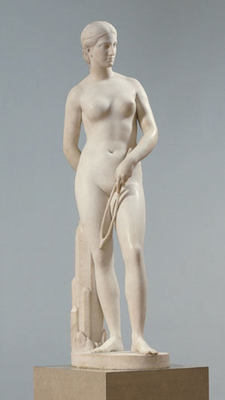
Hiram Powers California 1850�55 (this carving, 1858) marble 71″ x 18.25″ x 24.75″
[third image from Metropolitan Museum of Art]