Keith Haring’s “Once Upon A Time”, 20 years old today

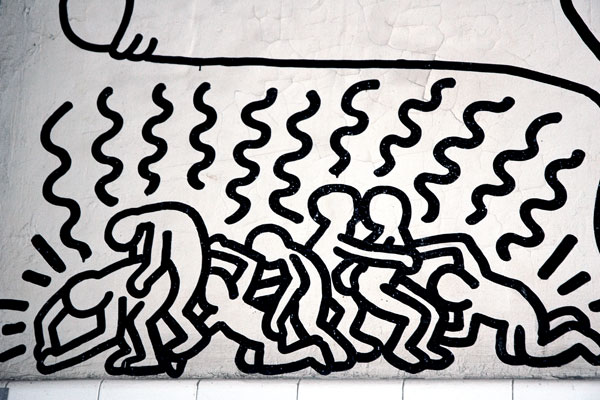
Keith_Haring_Center_orgy.jpg
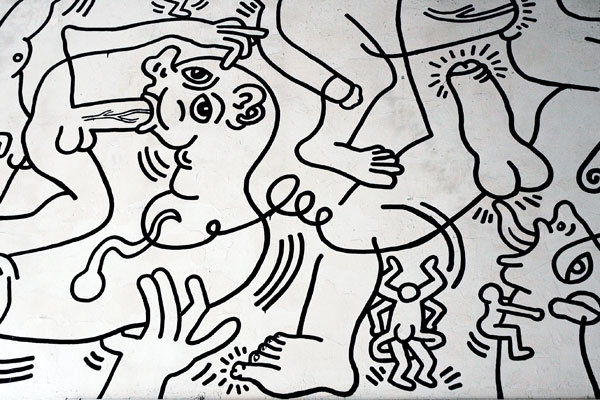
Keith_Haring_Center_appendages.jpg
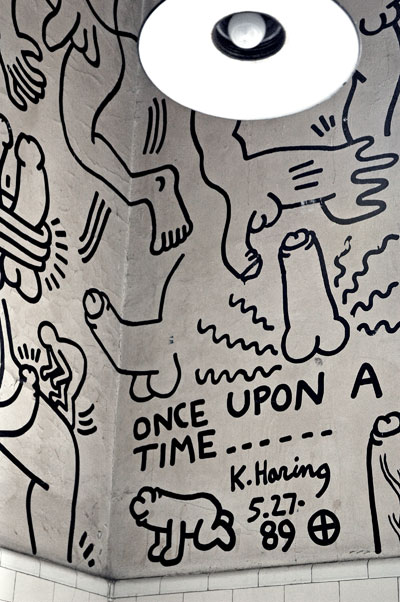
Keith_Haring_Once_Upon_A_Time.jpg

I’ve seen it described as his masterpiece; it’s almost certainly his most personal, exuberant and uninhibited expression of pure sexual jouissance.
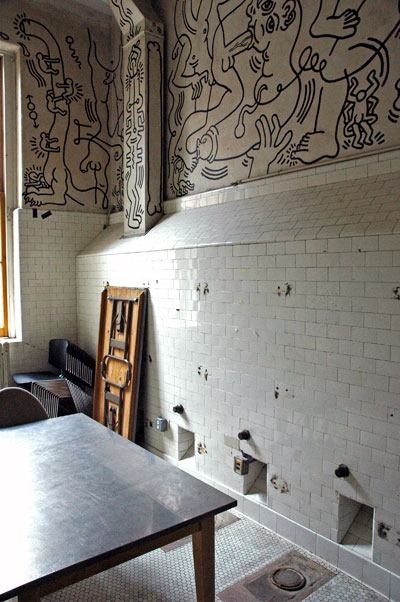
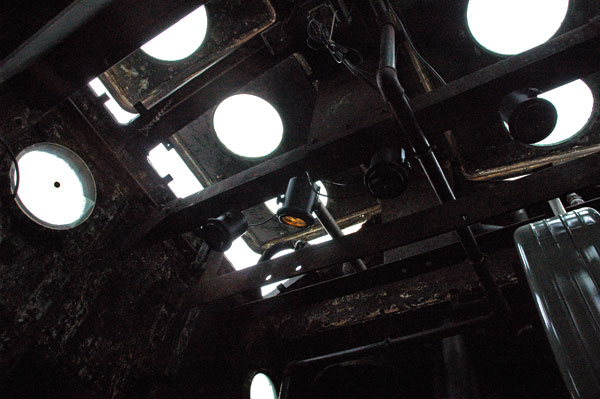
Twenty years ago today Keith Haring finished his men’s room mural, “Once Upon A Time”, on the second floor of the LGBT Community Center on West 13th Street. Then he signed and dated it. The detail shots above show that it remains there today, pretty much as he left it, with one important exception: The ancient toilet fixtures and partitions which brought both great relief and great joy to the building’s habitues over the years have long since been ripped out. Sadly, the room appears to have fallen into desuetude.
But, wait, is that actually a conference table I see in the picture below?

Keith_Haring_Center_room.jpg

While Haring’s room-size installation may have been the most extravagant, it was just one of many works included in The Center Show [see video], organized in 1989 to celebrate the 20th anniversary of Stonewall. These additional artists included, among others, Leon Golub, David LaChapelle, Barbara Sandler, Kenny Scharf, Nancy Spero, and George Whitman, and much of their work remains inside this amazing, reinvented 165-year-old school building today, continuing to enrich the dynamic energy it both encourages and shelters.
The Center is putting on a show again this year. It’s entitled “Then and Now“, and it’s intended to commemorate the 1989 events with a new installation by a new catalog of artists, although without the permanent, applied-directly-to-the-walls part of the original. It opens tomorrow, May 28, with a free reception from 6:30 to 8:30, and it will remain installed throughout the summer.
The artists invited this time around are:

Trisha Baga, The Brainstormers, Ian Campbell, Tre Chandler, Chi Peng, Abby Denson, fierce pussy, Daphne Fitzpatrick, Lola Flash, Alex Golden, Rory Golden, James Kaston, Jillian McDonald, Bill Mutter, Deirdre O’Dwyer, James Rohmberger, Jamel Shabazz, Nathaniel A. Siegel, Lori Taschler, Wu Ingrid Tsang, Forrest Williams, and Sarah Nelson Wright

Electronic Music Foundation’s “Sound in the Frying Pan”

Suzanne_Thorpe_Philip_White_Balancing_Act.jpg
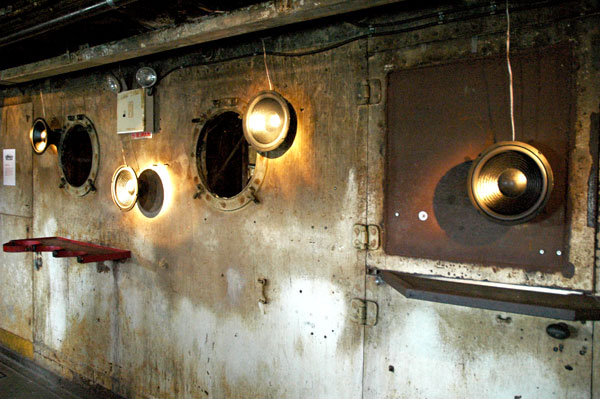
Suzanne Thorpe and Philip White created “Balancing Act”, a psychoacoustic composition which related the list of the ship to the location of the listener on the cabin deck

Richard_Garet_Inner_Outer.jpg
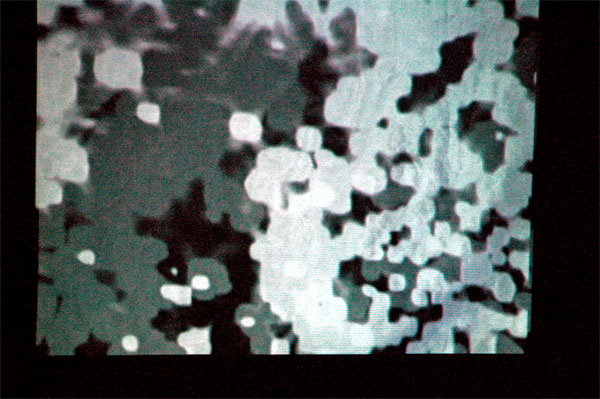
Richard Garet‘s “Inner-Outer” harmonized a video projection of the abstract, crystalline effect of light reflections bouncing on the water’s surface with a sound collage of recordings made underwater

Clarke_Owen_Takeda_Underfoot.jpg
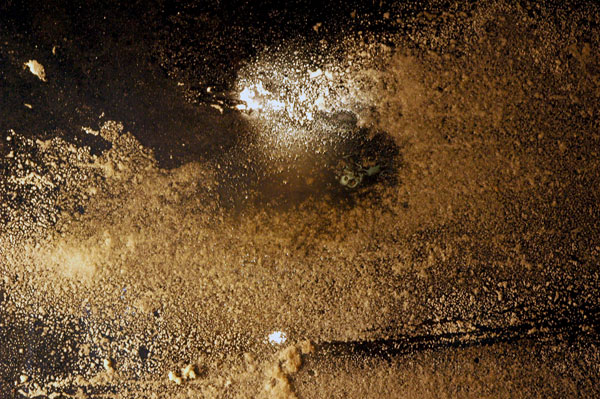
with “Underfoot”, Melissa Clarke, Ben Owen and Shimpei Takeda recreated the Hudson River bed within the ship’s bowels, using projections, sound, reflective materials composed of geographical data, and light

Bart_Bridger_Woodstrup_Gathering_Lore.jpg
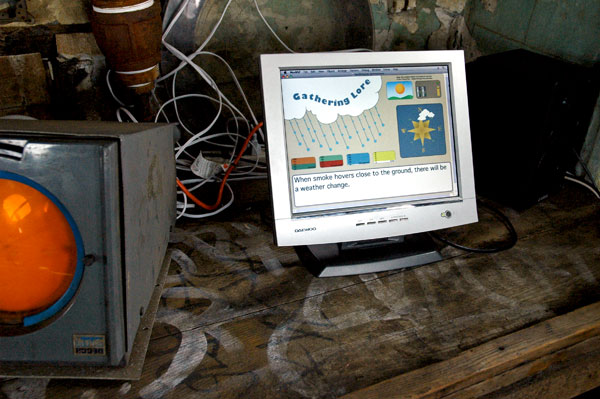
Bart Bridge Woodstrup‘s “Gathering Lore”, set up on the ship’s bridge, was a weather station which translated current meteorological conditions into sound

Jessica_Feldman_Sirens.jpg
Jessica Feldman‘s evocative piece, “Sirens”, heard throughout the ship, and beyond, reflected the ship’s original function, warning sailors, simultaneously playing with the natural seductive quality of sound

It’s not often that I get a chance to post my own images from my experience of a musical performance. Even if it might be better described as a musical “installation”, my ears and my camera both delighted in “Sound in the Frying Pan“, a remarkable project put together this past weekend by the Electronic Music Foundation in and on the “Frying Pan“, a historic decommissioned lightship moored in the Hudson River at the end of 26th Street. What you see above are a just a few bits from my collection of visual takes on the five separate site-specific compositions created by the artists or artist-collaboratives who worked on this quite literally “phenomenal” sound project, curated by Suzanne Thorpe.
This post, because of the images, may seem to be as much about the “Frying Pan” as is about the music, but I’ve been to the ship before* and yesterday it wasn’t only the squeaking of its old metal plates that I heard as it rolled gently alongside the dock, although that sound accompanied the ensemble introduced both above and below its decks; yesterday the old barnacle-encrusted veteran actually sang.

*
beginning in September 2000, in the halcyon days before Bush 2, with the appearance of Miss Kittin in the program, “BATOFAR: NEW FRENCH ELECTRONICA

[the images are mine, but the captions are partly borrowed from the press release]

scrap of Bart on Chrystie Street

Bart_torn.jpg
untitled (Bart) 2009

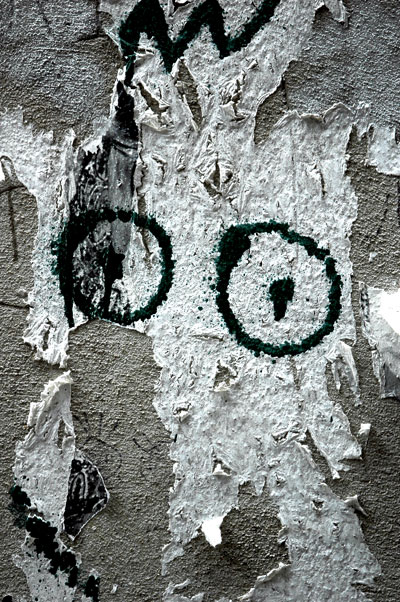
I’ve seen the way a baby, and even the smallest of animals, will always notice when it’s being looked at. We’re all attracted to eyes, and that’s true even when we know they’re attached to inanimate objects. I saw this paper remnant on a wall on the Lower East Side yesterday. It looks a bit like Bart Simpson to me, although I can’t say I really know the kid.

SchroRoWinkleFeuerBooneWildenRosenGosian Gallery

SchroRoWinkleFeuerBooneWildenRosenGosian.jpg
preparing for the ArtBaselMiamiDocumentaSiteSantaFeWhitneyBiennaleVeneziaNadaPulseScope Fair

The SchroRoWinkleFeuerBooneWildenRosenGosian Gallery, a combined project of guest curators Jennifer Dalton and William Powhida, is currently installed in the Schroeder Romero Project Space. The title of the show is, technically, “Art-Pocalypto 2012”. It’s a very successful and extremely funny satirical take on a familiar art market, one which was marked by the extraordinary extravagance of the recent past but which feels more like it’s in the midst of a death watch in the present. The artists have created this remarkable space as both a combined real and virtual representation of the fictional skeletal remains of the entire “fabled Chelsea at district” as they imagine it will look in the year 2012.
Excerpts from the press release:

Since the gallery is one of the only outlets for contemporary art related products remaining in New York�s fabled Chelsea art district, we will be exhibiting artworks by whoever we want.
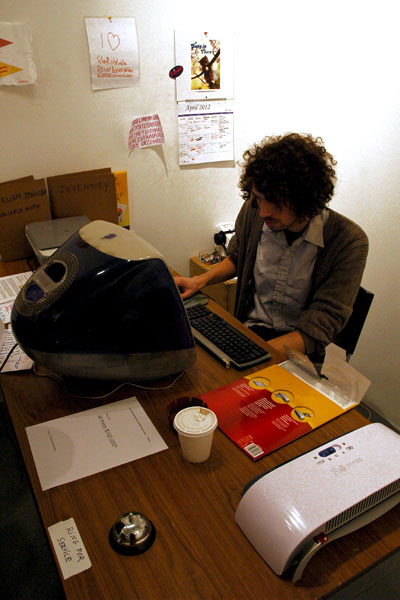
As everyone knows by now, artists have not been able to produce any new art since the crash of 2009 due to shortages of art supplies as well as basic necessities. Dalton and Powhida will therefore be exhibiting 8″ � 10″ printouts of our very large stable of artists’ pre-crash greatest hits which will be laminated on-demand. Make our day and ask if they are archival, that word helps us remember what used to pass for problems back in the day.
. . . .
Prints will be on sale for the low price of $500,000*. If we are lucky and supplies are available, we hope to be able to print in color. However, if we run out of fuel for the generator, the co-curators will make themselves available on selected Saturday hours to copy images by hand. Since child labor was decriminalized last year, we might even have the kids help out! You’d be surprised what they’ll do for a cracker. Actually, by now you probably wouldn’t.
And save the date! SchroRoWinkleFeuerBooneWildenRosenGosian Gallery will be exhibiting at ArtBaselMiamiDocumentaSiteSantaFeWhitneyBiennaleVeneziaNadaPulseScope this December.

*This is $20 in Spring 2009 dollars.

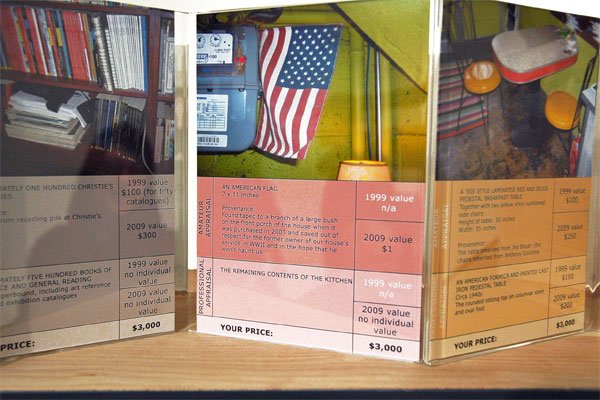
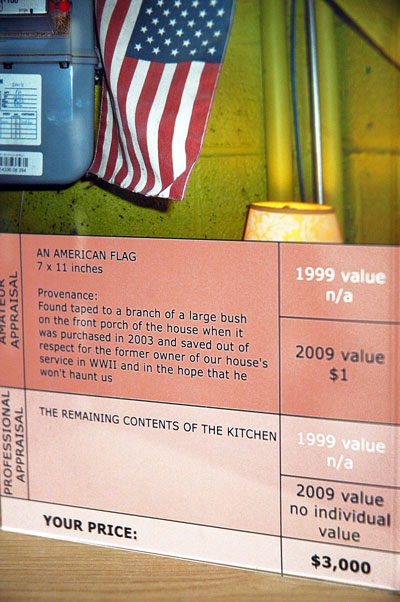
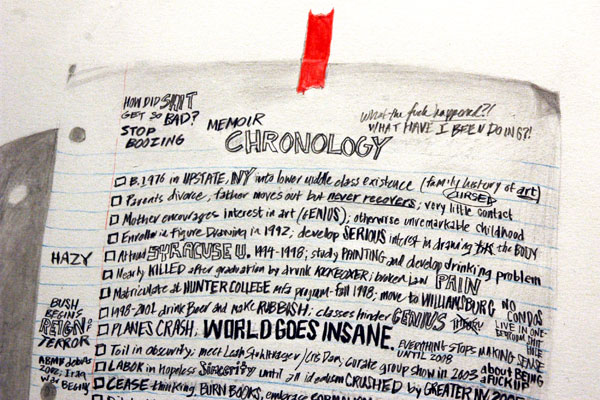
In schedules which slightly overlapped with SRWFBWRG, the two curators each enjoyed individual shows, in neighboring galleries, and neither was unrelated to their collaborative piece. In a show which closed at Winkleman last Saturday Dalton revisited her 1999 “The Appraisal” project with “The Reappraisal“, in the hope of learning something about herself and her lifestyle through an investigation into the different dollar values very different authorities might attach to both. Powhida‘s delightfully messy installation at Schroeder Romero, “The Writing is on the Wall“, is also something of a memoir, but of a more conventional sort, employing as it does both text and drawings, although for sure nothing about this artist can ever be described as conventional. Well, he is representing it as having been written “sometime in late 2009″.

Jennifer_Dalton_The_Reappraisal.jpg
Jennifer Dalton puts all her stuff on the block [tiny detail of installation]
Jennifer_Dalton_The_Reappraisal_detail.jpg
[detail of above]

William_Powhida_Chronology.jpg
a section of William Powhida’s personal chronology [detail of drawing in installation]

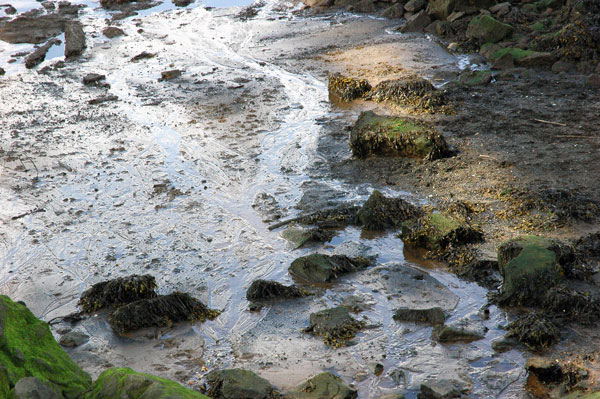
Brooklyn East River shoreline at low tide

East_River_shore.jpg
untitled (sea moss) 2009

No, it’s not Ireland, Cornwall, Nova Scotia or Iceland. It’s the Brooklyn shore of the East River just below the Manhattan Bridge. I took this picture late Saturday afternoon while Barry and I had stopped for lunch just inside the northern entrance to Brooklyn Bridge Park before we went on to visit the Marie Walsh Sharpe Art Foundation open studios.
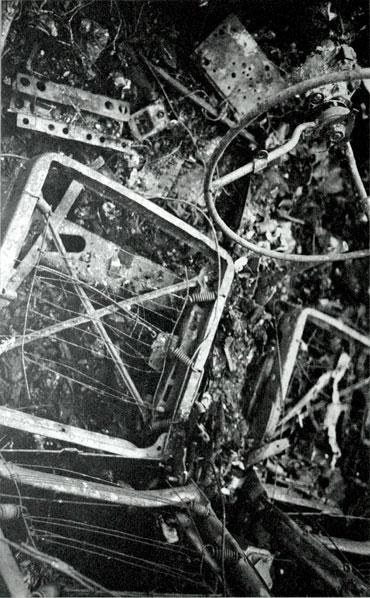
The mud, the rocks, and the sea moss were photographed as the water was still receding with the power of the tide. While we were munching on our sandwiches, sitting on some rocks only a few feet away from the water, I realized we were at almost exactly the same spot where I stood in the mid-80’s to capture an image of a burned-out car heavily-camouflaged by tons of other dumped metal. There appeared to have been a protracted battle with some pretty aggressive weed types, but by the time I got to the site, the trash had clearly gained the field.
The Brooklyn shore environment is very different now, infinitely less romantic of course, as I suppose is all of New York. The Minox 35 print was black & white (as was everything I was doing then) and today even in my memory the entire under-the-bridges landscape is pretty noir. In my mind’s eye it all looks like something inside a Jarmusch film, maybe “Permanent Vacation“.

James_Wagner_DUMBO_dump.jpg
untitled (springs) ca.1985 silver print 13.25″ x 8.5″ [digital photograph of installation (minus mat and frame) of 35mm print behind plexi, showing flash hot spot]

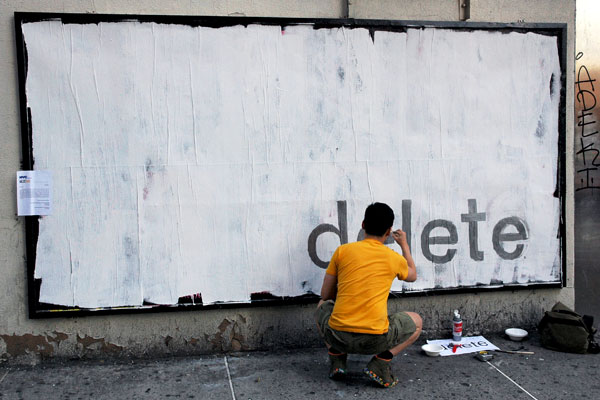
artists rubbing out illegal billboards all over New York

MLCCNYC_Ji_Lee_DELETE.jpg
deleting the offense: first the white paint, then the message, in a classic font of course

Sometimes it seems that the canker of commercial advertising won’t stop until it’s succeeded in plastering every surface in New York, but now we learn that we don’t really have to put up with all of it. Thanks to the alert folks at the Municipal Landscape Control Committee of New York City [MLCCNYC] (with the help of Eastern District, as I understand it) hundreds of illegal billboards put up all over the city by City Outdoor and NPA Wildposting have been spotted and are being rendered faceless by skilled, activist artists even as I write this.
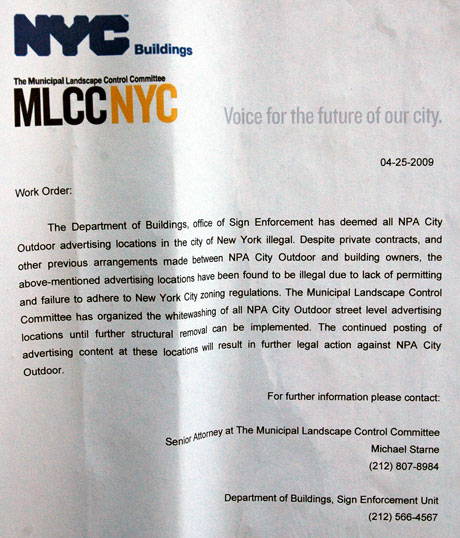
Progress at just one of the sites is documented above, in a picture taken earlier this evening. The wall shown is on the west side of Eldridge Street, just below Houston. The letter attached to the frame of the illegal billboard is copied below.

MLCCNYC_letter.jpg

While doing some searching on line just now I found this spot-on paragraph posted by Jordan Seiler on the “Public Ad Campaign” site, outlining the proper concern of any New Yorker who is not personally a business or corporation:

Outdoor advertising in public spaces transforms those locations into environments intended for commerce and thus for private agendas. Maybe the subway was once a transportation system, but today it is a carefully crafted advertising distribution system with a controlled target audience. These NPA City Outdoor ads turn our city streets into private messaging boards sold off to the highest bidder. In the process, my interest in painting political messages about the failure of our city government is criminalized and my public voice silenced.

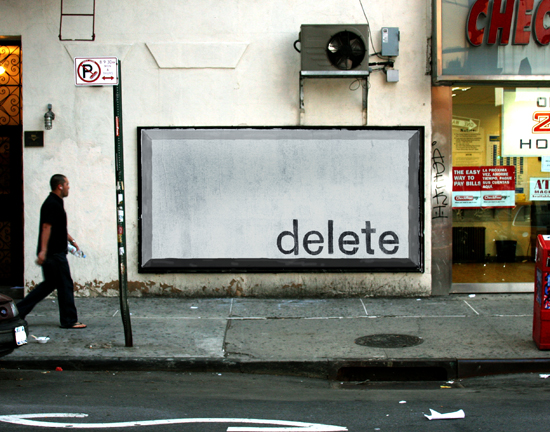
ADDENDA: The image I’m adding below shows what the wall looked like when it was completed. It’s from the artist’s own site. Ji Lee is seen painting in the picture at the top. Also, it now looks like the proper acronym for the project is to be NYSAT [New York Street Advertising Takeover], Eastern District wasn’t really part of the project itself, and a concise description of the action can be found on the Wooster Collective site.

delete3.jpg

[third image from pleaseenjoy.com]

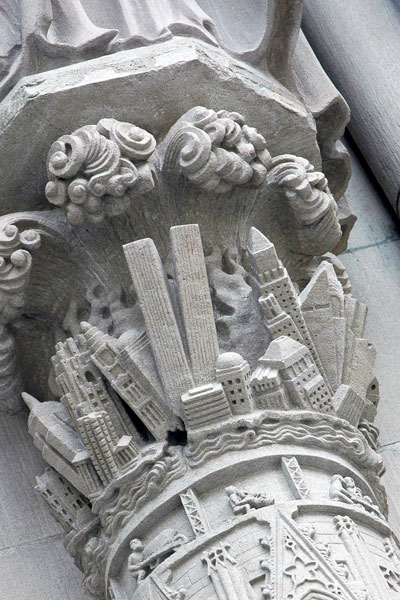
time is frozen in the stone poetry of St. John the Divine

Cathedral_St_John_Divine_Manhattan.jpg
the fire this time: the towers are are forever collapsing up above 116th Street

Each time I head uptown for something going on at the Episcopal Cathedral Church of Saint John the Divine, almost always with friends who haven’t been there before, I look for this capital above one of the massed columns surrounding one of the formal entrances on the West Front. I had come to assume that almost everyone had probably heard about this treasure, and its various companions, but after a look around Google-land just now, I found that they may not be as well known or photographed as I had thought.
Barry and I went up to Harlem once again last week with friends from the East Bay area on the other side of the country. They were former New Yorkers, visiting the city for the first time after an absence of seven years. We had decided we were all interested in a concert of ancient and modern Spanish choral music being offered that afternoon inside the cathedral’s crossing.
Naturally while we were there I showed them one of my favorite things, this stone capital, which had been completed well before September 11, 2001. It and several others were carved by workers who were a part of an apprenticeship program proposed in 1978 to serve urban youth but also intended to preserve the stone mason’s craft. During its existence one of St. John’s own twin towers managed to grow fifty feet (still 100 feet short of the height intended for both). The money ran out in the early 1990’s, and both structural and decorative work on the Cathedral was once more discontinued, for the third time in that last, very messy century of ours.
For more images of the stones, and more on the church and its Close, see Tom Fletcher’s New York architecture site, or that of the church itself.

“3 Columbus Circle”: it ain’t vinyl, but it’s still siding

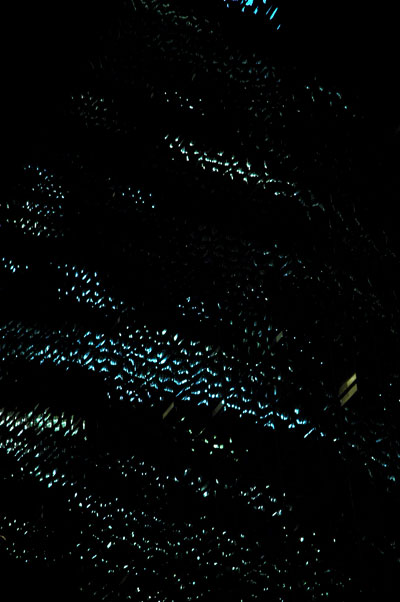
Grand_Hyatt_reflecting_Pan_Am_Building.jpg
Untitled (Pan Am) 2009
ghosts in the night: the Pan Am Building kisses the Commodore Hotel

I had originally intended to post this virtually abstract shot as an image alone, with no commentary, like I do with many of my photographs, but then I got to thinking about some of the follies that these two barely-seen structures (the Met Life Building* reflected in the windows of the Grand Hyatt Hotel) represent, and what they continue to tell us about New York’s past. Finally, during a long-anticipated visit to the new Hearst Tower last Wednesday I looked out a window in the northeast corner of one of the higher floors and I realized that some of us haven’t learned a thing. I now knew how I was going to finish this post.
Almost 30 years ago the Hyatt Hotel group demonstrated that there really are second acts in New York, but they may not always be worth staying for, or even bearable. The early twentieth-century “skyscraper” which stood on the Hyatt site, adjacent to Grand Central, was until 1980 known as the Commodore Hotel. Not surprisingly, it had been named for “Commodore” Cornelius Vanderbilt, the railroad entrepreneur who built the first Grand Central Terminal in 1871.
The Hyatt corporation’s architects retained the shape of its mass, and left most of the exterior bricks of the old hotel in place, merely covering everything with a highly-reflective glass skin.
Anyone who thinks this kind of philistine rape is a thing of the past might be advised to take a walk across town. An equal or even greater abomination is being committed between Eighth Avenue and Broadway in the upper fifties. I’m referring to what owner/developer Joseph Moinian calls “3 Columbus Circle”. Originally known as “Columbus Tower”**, when it was finished in 1928 (Shreve & Lamb, architects), the building occupies the entire block, between 57th and 58th Streets. Some will remember It once sheltered the much-missed Coliseum Books inside its southeast corner.
Last week I saw huge sections of masonry gouged out of finely-laid brick walls every few feet of the building’s surface, all destined to hold brackets for a totally-redundant glass curtain wall. I couldn’t keep looking, and, inexplicably, didn’t take any pictures. Maybe I couldn’t imagine looking at them once I got home. For those with the stomach, here’s the website devoted to the building’s transformation and marketing.
The site of this commercial-developmental obscenity is cater-corner from the bold, newly-topped-out Norman Foster Hearst Tower, which shoots out of the cast-stone facade of the six completed floors of the landmark 1928 Joseph Urban-designed New York Hearst headquarters. But it will bear a dramatically closer affinity to the new facade tacked onto 2 Columbus Circle, one block north of it, a monstrous work of destruction commissioned by the institution which I mischievously continue to refer to by its original name, the “American Craft Museum” (and not just on account of its notorious architectural crime).
The Pan Am Building may not be anyone’s favorite New York skyscraper, but at least it’s still permitted to represent something other than a shiny siding job.

*
(1963) architects: Emery Roth & Sons, with Walter Gropius and Pietro Belluschi
**
New York Times architecture critic David Dunlap has dug back even further. In a board post [with interesting pictures] on Wired New York, he writes: “For now, a palisade of three-story Ionic columns, supporting a neo-Classical entablature, surrounds the base of the structure. This is a visible vestige of the Colonnade Building, designed by William Welles Bosworth . . . .
Shreve & Lamb�s brown-brick facade was far simpler than the monumental colonnade. That incongruous combination of ornate base and spartan tower still speaks subtly � to anyone patient enough to listen � about the rise of Automobile Row in the early 20th century. But in a few months, it will be gone; another quirky corner of Manhattan that has been scrubbed, smoothed, polished, branded and lost.”

NOTE: The image is of the west wall of the Grand Hyatt, showing a few white-ish rectangular windows; the smaller, more numerous blue-ish shapes are the lighted windows in [what I normally call] the Pan Am Building, reflected on the Hyatt glass. The photo was taken from the sidewalk on the south side of 42nd Street.