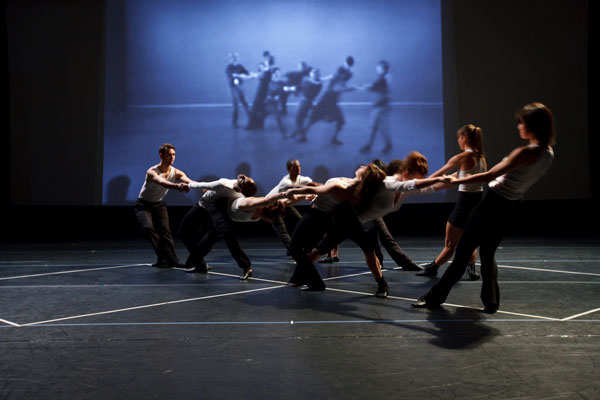
why, . . . it was just yesterday, and now it looks like tomorrow
DO NOT miss it, if you’re any where around Chelsea today, Friday or Satruday. There are still three more nights to see a (sorta) revival of David Gordon and the Pick Up Performance Company’s 1982 “Trying Times (remembered)” at Dance Theater Workshop, and Barry and I both recommend it highly. You don’t really have to bring any special equipment with you to enjoy this beautiful piece, but, especially if you’re unfamiliar with the choreographer and the company, it wouldn’t hurt to see it after: 1.) a quick study of its history, here [Gia Kourlas for Time Out] or here [Claudia La Rocco for the NYTimes]; 2.) a look at David Gordon; 3.) a peek at the phenomenal Valda Setterfield; and 4.) some background on Stravinsky’s gorgeous 1928 “Apollo“.
Deborah Jowitt (sadly, one of the only reasons still left for picking up a copy of that once-indispensable Downtown rag, The Village Voice) will also help with her review, whether you read it before or after experiencing this wonderful work.
[Steve Gunther image, of Pick Up Performance Company dancers together with dancers from the Sharon Disney Lund School of Dance at CalArts, taken from Pick UP and supplied by DTW]
Category: NYC
where the shore meets the sea (in Dumbo)
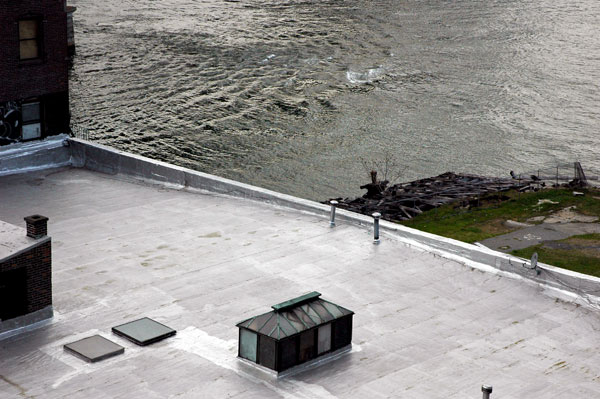
untitled (roofhouses) 2008
thirteen windows in the darkness
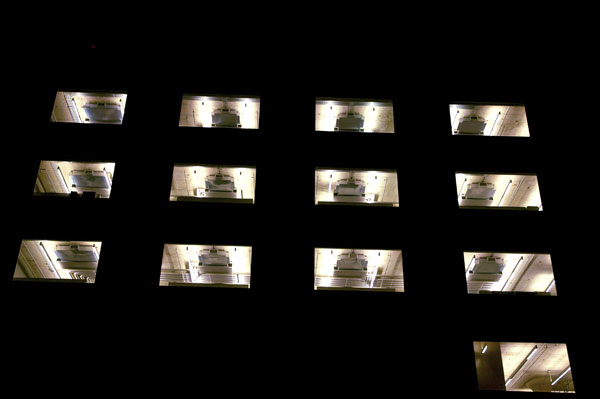
untitled (13 windows) 2008
Tracey Baran: we miss her already
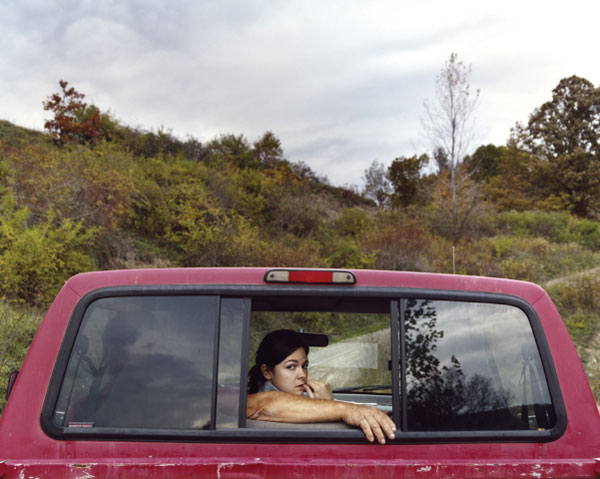
Tracey Baran No Looking Back 2005
I think it was 1997. The large color prints were lying in a stack on the bed, and they were among the most exciting things I’d seen in a very exciting fair, and now I was almost blind to everything else in this very busy room. Penny Liebman and Kathy Magnan, the two directors of what soon became Liebman Magnan Gallery, did not yet have a physical gallery space, as I remember, but they had decided to share with several other exhibitors one of the larger guest rooms in the old Gramercy Park Hotel, the original site of the Armory Show. They were showing the work of a young unknown photographer named Tracey Baran.
Barry and I bought two photographs on the spot.
We eventually ended up with several more. Very soon we had met the artist, and we regularly spoke to her at openings. At her very first show, in 1998, we were introduced to her parents, Roxanne and Joe, and several other members of her family. We didn’t get to know Tracey well, but we often asked about her and inquired about her newest work. We couldn’t help talking to others about the images – a lot. We probably talked up her art at least as often as we did any other artist whose work we’re living with.
She was an extraordinary artist and a delight to be around.
On Monday we learned from Leslie Tonkonow, who has been showing her work for years, that Tracey had died the previous week. She had been hospitalized in July after suffering seizures and she never recovered. She was 33.
Two of her best friends are hosting a gathering Saturday evening, November 22, to remember and celebrate her life. It will be from 7:00 to 10:30 at the Brooklyn Society for Ethical Culture, 53 Prospect Park West. Barry and I will be there.
Links to more images:
Leslie Tonkonow
jameswagner.com
Museum of Contemporary Photography
Arratia, Beer
artnet (scroll down half way)
artnet
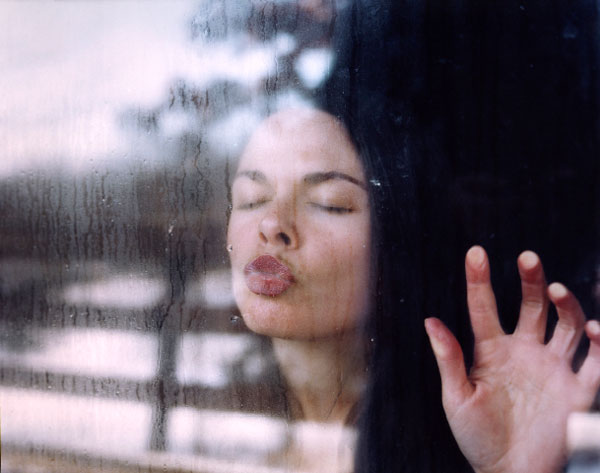
Tracey Baran I Miss You Already 2003
[images from Leslie Tonkonow]
PINTA 08
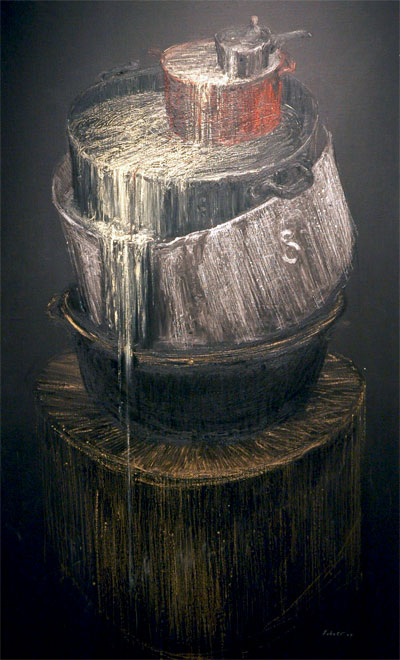
Roberto Fabelo* large oil at Habana Galeria, Havana

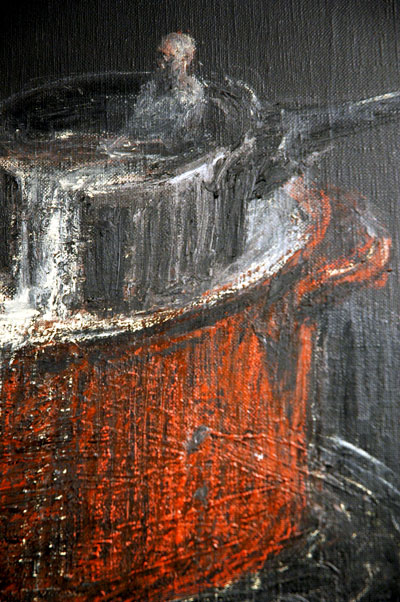
[two details]
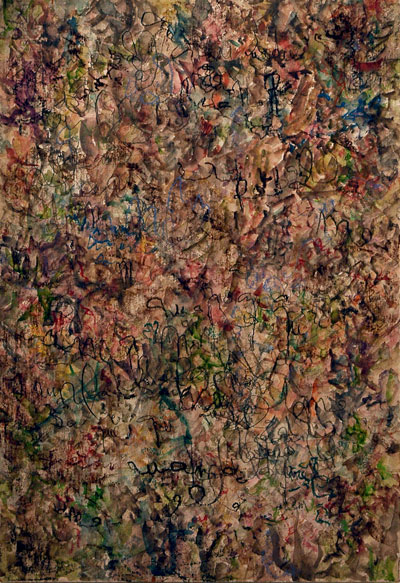
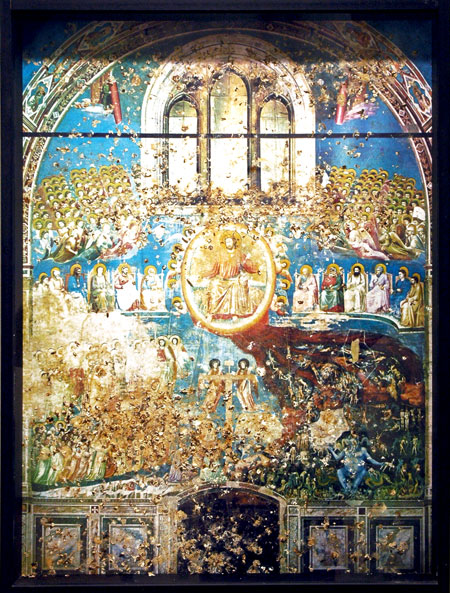
two works by Leon Ferrari, the first (text drawing, oil on wood) at Galaria Berenice Arvani, Sao Paolo; the second (print of Renaissance religious fresco used on bottom of birdcage, framed) at Ruth Benzacar, Buenos Aires
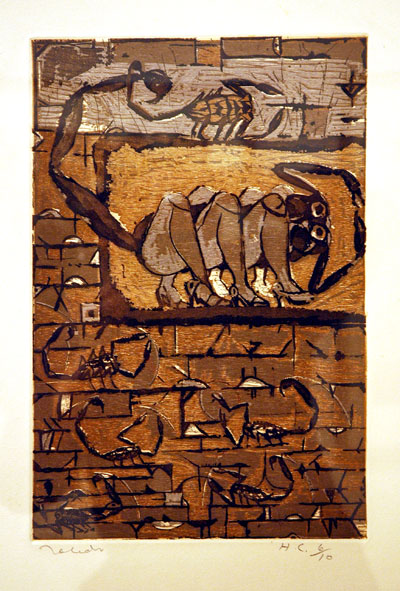
Francisco Toledo 1985 aquatint and woodcut, “a Mujer del Alacr�n” [large detail], at Poligrafa, Barcelona
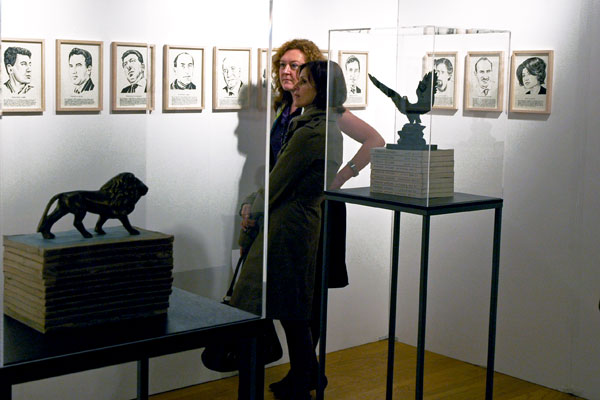
Fernando Bryce (imperial) installation at Galerie Barbara Thumm, Berlin
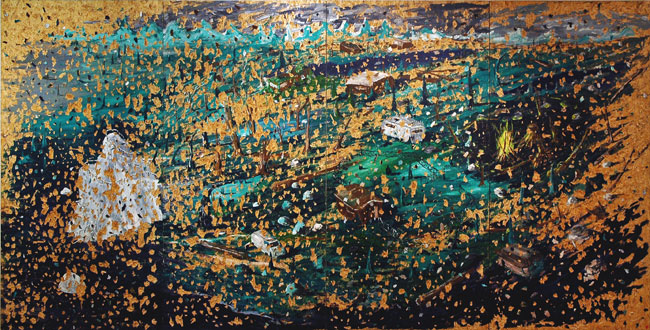
Matias Duville huge (distressed) acrylic on particle board at Galeria Alberto Sendros, Buenos Aires
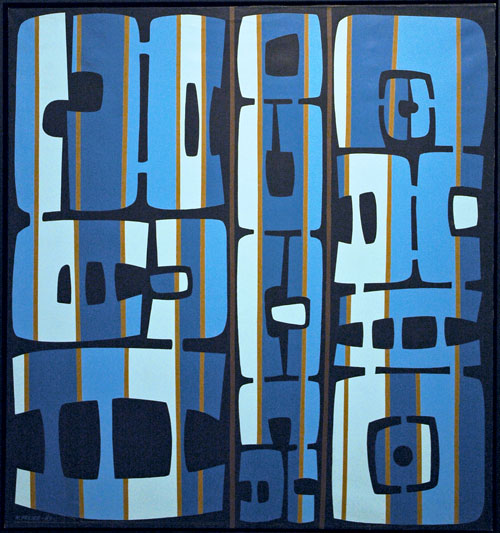
Maria Freire 1969 acrylic on canvas at Sammer Gallery, Miami
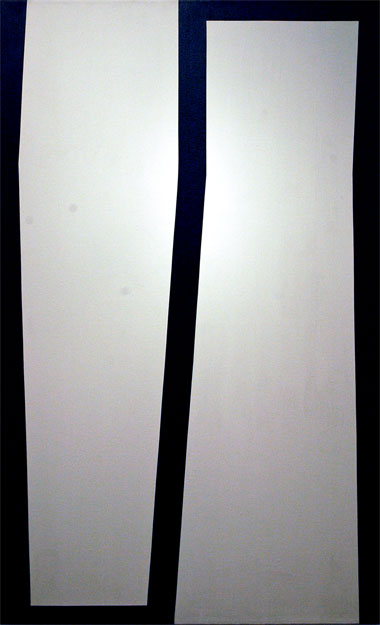
Carmen Herrera 1974 acrylic on canvas at Latincollector, New York
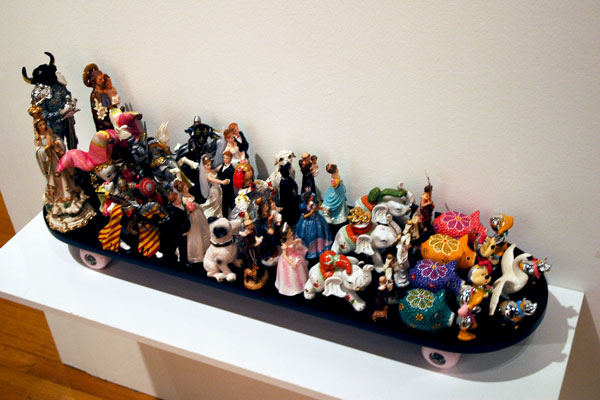
Nelson Leirner sculpture at Bolsa de Arte, Porto Alegre
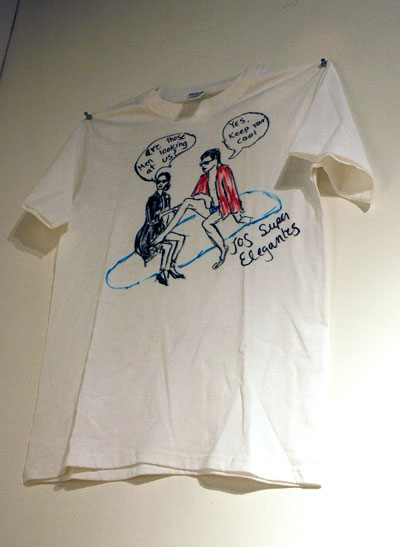
Los Super Elegantes t-shirt at de la Barra, London
PINTA 08 is going on right now, and it’s definitely worth a visit. It would be enough if we were being offered only one of its two elements, but the organizers purposely describe the fair as host to both the “modern” and the “contemporary” art of Latin America. I found some wonderful surprises, including artists and work of whom my ignorance was pretty embarrassing.
I won’t go into the question of why New York still needs separate exhibitions or events to display the work of artists living outside Europe or the U.S., or whether we will always need this separation, although I think I just gave one good answer in the preceding paragraph. In any event, on the evidence of the great, but largely unfamiliar stuff (created over the last half century or so and up to the present) being shown on 18th street through tomorrow, we absolutely do need this one.
I’m not going to say much here, because this post is time-sensitive and already overdue, but I wanted to add some installation shots of my own to those Barry has already put up, along with his comments, to suggest some of the variety to be found at this very comfortably-sized fair.
*
I expect that come January 20 we’re going start seeing a lot more art from Cuba around these parts. Okay, I have to mention that I’m also wondering about the identity and significance of the little man in the top pot in this gorgeous painting: Does he look familiar?
civil rights, yes, but gay marriage be damned
no plastic grooms
This is the definition of “marriage” from the Merriam-Webster Online Dictionary:
mar�riage
Function: noun
Etymology: Middle English mariage, from Anglo-French, from marier to marry
Date: 14th century
1 a (1): the state of being united to a person of the opposite sex as husband or wife in a consensual and contractual relationship recognized by law (2): the state of being united to a person of the same sex in a relationship like that of a traditional marriage
2: an act of marrying or the rite by which the married status is effected ; especially : the wedding ceremony and attendant festivities or formalities
3: an intimate or close union
I see no religious or sacramental reference in this definition, and I am sufficiently familiar with recorded history and primordial custom to know that “marriage” has traditionally been regarded as a state independent of any and all religions.
I’m not going to jump onto anyone’s bandwagon in a quest to join my contemporary religionists and their reactionary concept of personal relationships, and if I should end up outside City Hall tomorrow (Saturday) it will be only to stand somewhere with a simple sign suggested by my friend Bill Dobbs:
CIVIL UNIONS FOR ALL
Although I’d try to add in something about civil rights for all, since not everyone is cut out for unions.
Two nights ago Dobbs sent an email around: “39 years after Stonewall the gays in New York City say GOD LOVES GAY MARRIAGE”, and he attached an image showing that on the central banner of Wednesday’s demonstration outside the Mormon Church’s New York headquarters across from Lincoln Center.
I’m just as disgusted as Bill, but I’m old enough to actually remember Stonewall and have to ask, what’s the hell’s going on here?
It seems we’re not alone on this. See “sorry, sweethearts, still fiercely disinterested in this one” from johnny i hardly knew you.
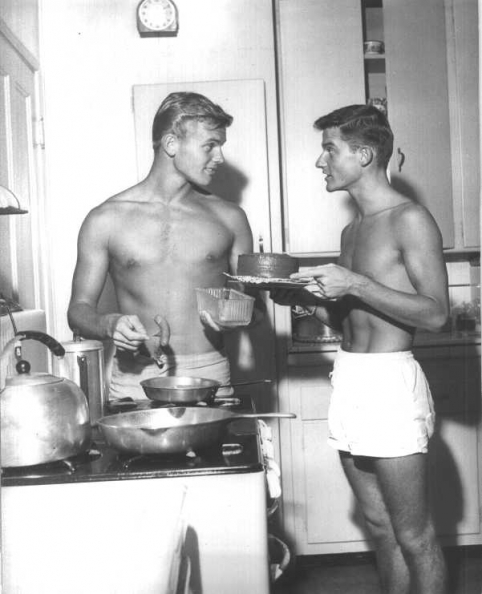
[image of Tab Hunter and Roddy McDowall from michaelprocopio]
street art sculpture in Ascenzi Square
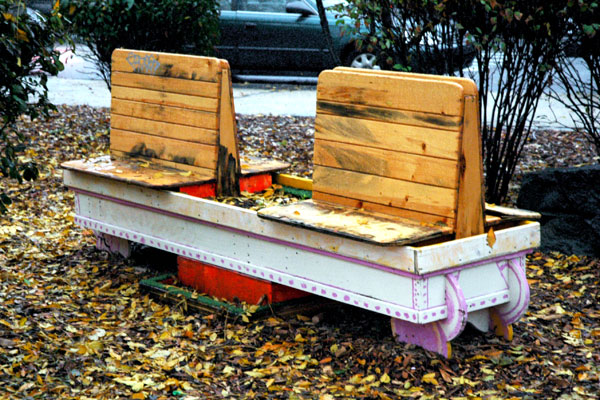
Does anyone know anything about this somewhat sequestered seating sculpture sitting in the center of Ascenzi Square?
The triangular square was named the Ascenzi family which once lived nearby. Four brothers fought and two died during the War to End All Wars. Could the four-place bench be intended for these siblings?
ADDENDUM: For those who’ve asked, Ascenzi square is located in Williamsburg, where Metropolitan Avenue is crossed by North 4th Street.
what they don’t want us to see in Iraq and Afghanistan
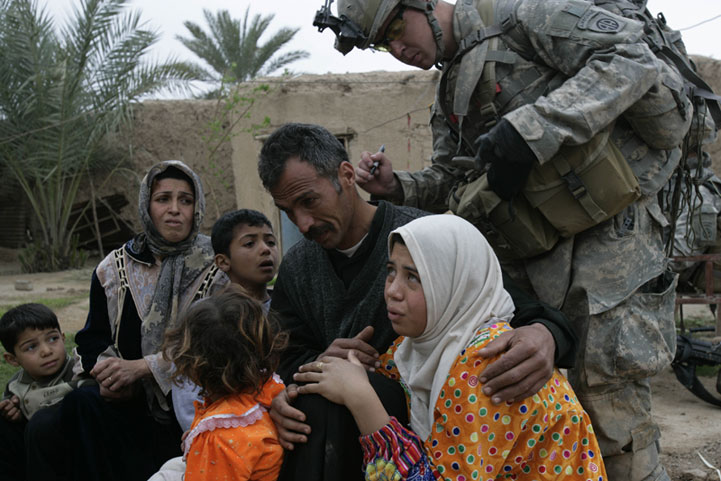
inside the gallery the caption reads: Yuri Kozyrev Iraq 2007 US forces mark Iraqis with serial numbers to track movements in and out of village
inside the gallery the caption reads: Jared Moossy Afghanistan 2007 An [sic] wounded American soldier is airlifted by helicopter in eastern Afghanistan
I really, really would like to get away from what my grammar school teachers called “current events” and what I call “matters of life and death”, and go back to posting about the fine arts, but my intentions are being confounded by both events and the art. Yesterday, after visiting the group installation “The Ballot Show“, about you-know-what, at the Front Room Gallery in Williamsburg, I headed a little further west to the Sideshow Gallery’s “Battlespace: Unrealities of War“, and there I almost lost it.
These are images by 23 photographers “embedded” with our troops in Iraq and Afghanistan. Under the terms of their being allowed there they are forbidden to publish, in their regular commercial news outlets, the more violent images of injury and death hanging on the walls in this gallery. And so the wars go on, with the citizens who sustain them easily able to ignore the worst of what is being done in their name to both American troops and the “enemy”.
People elsewhere in the world don’t have this luxury; they’ve been shown such photographs since the wars began.
While in the gallery I couldn’t quite bring myself to photograph the most obscene images of mutilations and carnage. I cannot explain why, even to myself, especially since broadcasting them is precisely the intent of the photographers and the purpose of this installation.
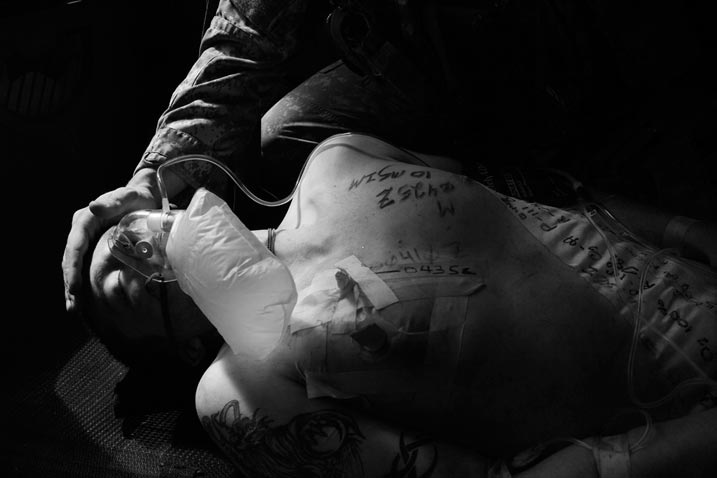
I found the Battlespace site itself only a few minutes ago, so I’m using its images rather than my own, and, hoping to redeem myself for my timidity yesterday, I’ve decided to upload below one of the most powerful images I saw, one which I did not capture with my camera. I should add that it is not the most grotesque: This body was still living, and being attended by medical personnel.
Inside the gallery on Bedford Street the wounded soldier on the table appears almost, literally, “life size”. The scale in which it appears online can barely suggest the horror of what you are actually looking at.
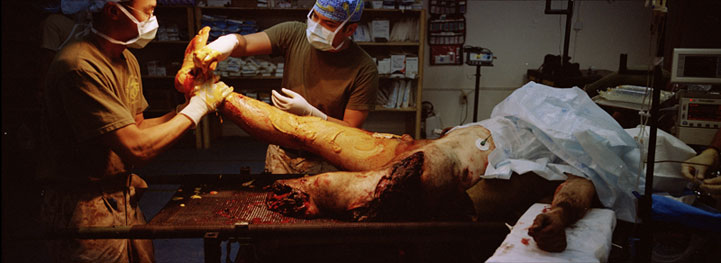
inside the gallery the caption reads: Lucian Read Iraq 2006 American soldier lies on an operating table in Ramadi after being wounded in an IED blast
Visit the exhibition itself before it closes next Sunday. You will never forget it.
[all images from Battlespace]
breezy couple with wispy Papillon in Pierrot suit
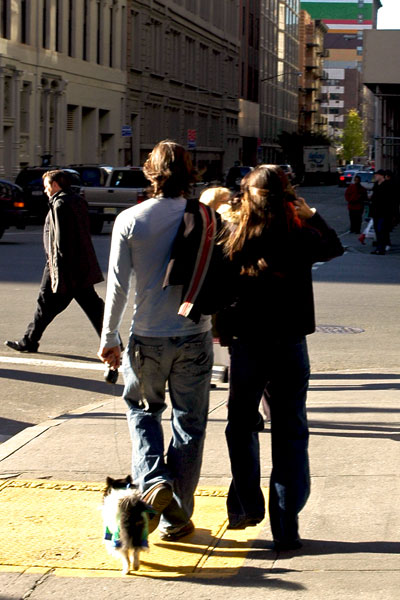
I was hauling 30 pounds of gleanings from the Union Square Greenmarket this afternoon, but I still managed to hold up my camera and capture this smart trio on West 19th Street. The Papillon is wearing a colorful silk Pierrot suit with a high collar.
Gregg Evans and more, at the NURTUREart benefit
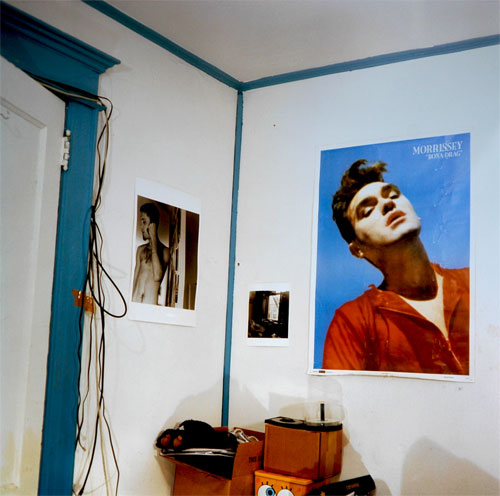
Gregg Evans Luis 10/06 2007 digital C-print 16″ x 16″
Barry and I had a terrific time at the NURTUREart benefit Monday night, and we came home with the piece by Gregg Evans shown above.
Executive Director Karen Marston tells me that the staff is pleased and relieved that there was no major drop in either sales or enthusiasm this year, in spite of our current serious economic scare! She added that even if it hadn’t been a financial success she herself would have thought all the work worthwhile for its incalculable value in energizing the volunteers, the artists (including the school kids in the Outreach Program), patrons both continuing and newly-arrived, and friends who can’t live without art.
I can only say myself that the art displayed and available was very impressive, and that the room was filled with more happy and excited people – of all kinds – than I have ever seen at an arts benefit, and I’ve been to a lot.
I think the organizers are trying to arrange a way to make the works which did not walk out of the room that night visible on line and available for purchase. I know that if we had some fat in our own wallets right now the two of us would have reduced their number quite a bit further on our own. The exhibition had been selected from offerings by NURTUREart artists through the input of a curating team which included Koan Jeff-Baysa, Lowell Pettit, Amy Rosenblum Martin, and Lily Wei. Their excellent judgment was reflected in the quality of what we saw that night. If a system for the sale of the remaining works is set up, I will be reporting it here.
The picture at the top of this post?
We had purchased a ticket which entitled us to one artwork, but, since we were also on the benefit committee and had to get back to work, we had only a few seconds to make a pick from among 150 worthy pieces hanging on the walls of the James Cohan Gallery.
Quickly comparing notes when we could both take a break, Barry and I found we had each separately and immediately zoomed in on “Luis” without knowing anything about the artist or the series of work of which it is a part. It was enough that this beautiful big print suggested a mind and an aesthetic which seemed to be worth exploring further. It turns out that the image is part of body of work in which Evans investigates the home environments of a number of his friends.
I’ve searched on line for more information and I came across these two statements, on separate pages of an Arts in Bushwick preview/profile, about his work from the artist himself:
I have a friend who often talks about photographing the people he is close with as a way of maintaining relationships. I often wonder if I agree with his logic, if the power between photographer and subject creates connection or destroys it. Can one maintain a friendship with someone they are constantly observing? If, for example, I photograph the things which gather on bookshelves in a friend�s apartment is this photograph a testament to our friendship and existence, or is it really a marker of the beginning of the end? What happens to a relationship, or for that matter, a place, when it is suddenly acknowledged as important?
My work stems from day to day life; the seemingly banal objects and spaces we overlook in a given day or week, i.e. the books on one�s bookshelves or the newspapers we leave behind on the subway. I am interested in the remnants of consumer culture, archaeology, and what our products say about us.
There’s more here, on the White Columns Registry site, and there are also two books documenting his work, one carrying the weight of the painfully-disconsolate title, “I Could Walk Away Now And You Wouldn�t Care”, the other (a zine?) tagged with the more dispassionate, “The State of Upstate”.