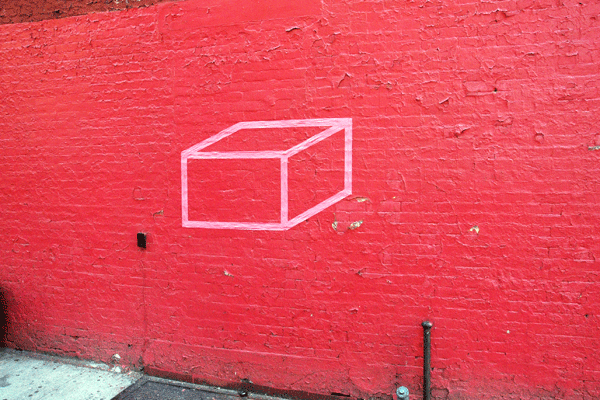
I spotted this simple, beautiful tape piece by Aakash Nihalani on the way back from a special lunch with Barry and visits to a few galleries on this very fine August afternoon.
For more on Nihalani, see Hrag Vartanian’s piece in the ArtCal Zine.
Category: NYC
Greenpoint industrial yard
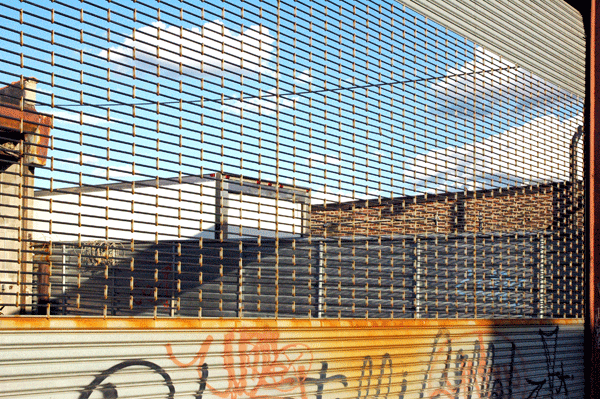
untitled (Greenpoint boxes) 2008
David Rakoff says take a walk, a proper walk

whose streets? [1980: Chris Parker* walks in Jarmusch’s “Permanent Vacation“]
The back page of the “Week in Review” section of Sunday’s NYTimes was devoted to three writers offering advice on “how to get New Yorkers moving faster”. The first two were quite serious, all about arranging cars, buses, trains and taxicabs, but they were fundamentally pretty “pedestrian” and had little of interest for anyone who already knows all the solutions (like me). However the third invited guest, the wonderful author and performer David Rakoff, offered something completely different in a piece about real pedestrians, below the delicious title,”Walk this Way“.
He begins with a reference to the period of hard economic times the City is about to re-enter:
. . New York City is about to get interesting again. Those who regret having moved here too late, having witnessed only her metastasized proliferation of glass-walled condos and cupcake purveyors, can take heart at the prospect of shuttered libraries, underfinanced schools and grimy hospitals. Those bygone days of “Midnight Cowboy” grit might soon be upon us once more. Why, if you squint just a little bit, you can almost see Verdi Square changing back into “needle park.”
In spite of the infectious New York cynicism, Rakoff has actually written a very funny column about the rules of engagement in the art of walking the streets of New York, one of life’s supreme pleasures, we both seem to agree. He also offers some exceedingly practical advice, much of it useful even to New Yorkers (you know who you are). This is one of them:
CHOOSE A LANE: Yes, there are lanes. If you see something you like in a shop window, check your blind spot and, when it’s safe to do so, shift over. (Happily, soon the stores will have closed, their windows boarded over, or smashed and empty from the latest blackout looting, rendering this rule as anachronistic as the requirement that men remove their hats in an elevator when a lady enters.)
I can survive any kind of New York, so long as I know there will be David Rakoff with me.
*
playing the perambulatory Allie, whose unhurried and unfocused persona has these defining lines early in the film:
Some people, you know, they, they can distract themselves with ambitions and motivation to work, you know, but not me. . . . . They think people like myself are crazy, you know. Everyone does because of the way I live, you know.
[image from reverseshot]
a win for free speech in New York – only five years late
 We’ll call it a win, even if the forces of reaction prevailed on the street, as they always have in this city. But silencing and intimidating an entire citizenry wasn’t the only outrage: In addition to the April 7, 2003, NYPD assault on our civil rights itself, the City’s years of delays in negotiating the civil settlement announced today helped to lock down protest everywhere in New York (abominably, during the 2004 GOP Convention), served to educate “law-enforcement” agencies fighting the fraudulent “war on terror” in other cities across the country, and cost taxpayers here plenty.
Go to this page on the site of the Center for Constitutional Rights for the complete press release, parts of which are excerpted here:
A group of 52 local activists today announced a $2 million settlement in their lawsuit against the City of New York. The activists were illegally arrested on April 7, 2003 while protesting against the Iraq war in front of a military contractor’s offices in midtown [the Carlyle Group, known for its ties to the Bush family and its extensive portfolio of holdings in the military-defense sector]. The settlement in Kunstler et al v. New York City follows the dismissal in 2003 of all criminal charges brought against these individuals and four costly years of delays by the City in negotiating an end to the civil lawsuit.
. . . .
Attorneys and plaintiffs noted, however, that the City’s decision to drag the case out is part of a long and disturbing pattern by which it attempts to “wear down” plaintiffs to avoid political damage, even at huge expense of tax dollars and City resources.
. . . .
The police tactics used that day became the model used by the NYPD during the 2004 Republican National Convention held in New York.
At that event, thousands of activists were illegally arrested, jailed and mistreated. Lawsuits related to the police conduct at the RNC are still winding their way through the courts. NYPD officials are now consulting with police departments in Denver and Minneapolis on their plans for the 2008 Democratic and Republican Conventions.
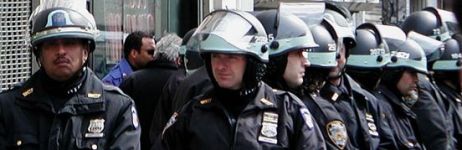
[image of riot police at March, 2005, downtown Brooklyn anti-war protest from dailyheights.com]
rising sun on LOISAIDA
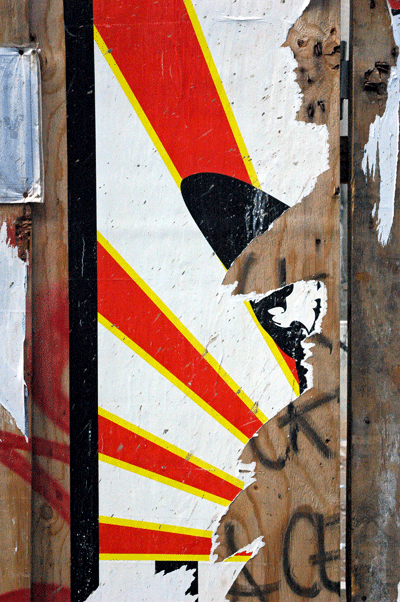
untitled (rising sun) 2008
Somewhere on the Lower East Side this sun rises all day and all night.
Hrag Vartanian’s “Re:Public” bows on ArtCal Zine
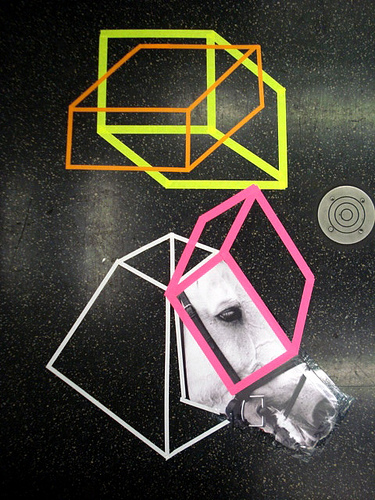
Poster Boy & Aakash Nihalani collaboration (2008 collage on subway car floor)
Hrag Vartanian has written a terrific debut piece for his column, “Re:Public”, which will be appearing regularly in the Zine section of ArtCal.
The subject of his series will be street art, most of it found in New York, most of it of the moment. Today, in “Masters of the Ephemeral” Vartanian writes about and includes images of work by Poster Boy, Aakash Nihalani and the Poster Boy/Aakash Nihalani collaboration.
Vartanian’s own excellent site should already be on the feed of anyone interested in the art and ideas of our time.
[image from Poster Boy’s Flickr site]
Chrystie Street silver
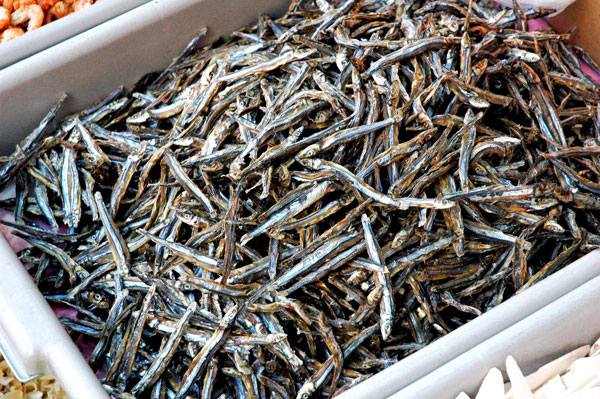
untitled (silver fish) 2008
I pass this and the many other rich, Chinese open-market landscapes of dried meat, fish and vegetables to be found on Chrystie Street virtually every time I’m in the area. I snapped this shot very quickly last Saturday, while trying trying not to get out of step, because of the crowds of serious shoppers.
size matters in New York
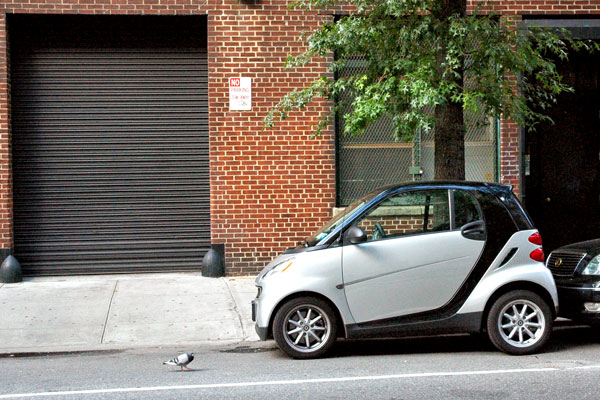
curb cut Smart
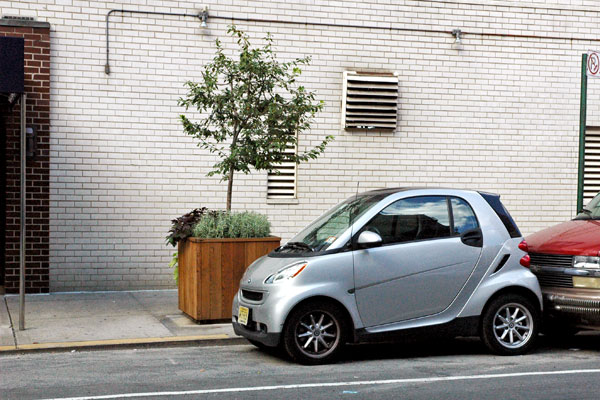
yellow line Smart
I spotted these two Smarts on the same block of West 21st Street this past Tuesday. They were both parked on the north side of the street, the front end of each safely (although barely) behind lines across which they legally cannot venture, back bumpers only a hair away from much larger vehicles parked to the rear.
These shots show that here in New York, and in Europe for ten years now, size really does matter.
dog days
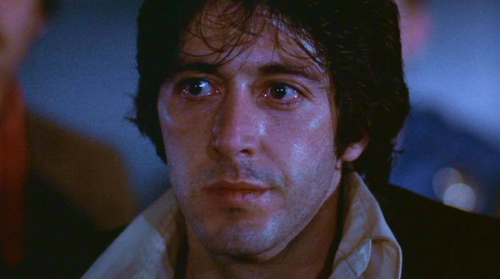
but I’m not looking for this kind of excitement
I know there have been few postings here lately, but there’s no particular reason other than the lethargy or discomfort of a warm and humid urban summer, what the Greeks and Romans, when they wanted to speak English, called the “dog days“. There was a best-seller some 200 years back, apparently considered extremely entertaining on a number of levels, called “Clavis Calendaria; or, A Compendious Analysis of the Calendar; Illustrated with Ecclesiastical, Historical and Classical Anecdotes”*. In it the author, the Englishman John Brady, described the ancient seasonal phenomenon as:
. . . an evil time when the seas boiled, wine turned sour, dogs grew mad, and all creatures became languid, causing to man burning fevers, hysterics, and phrensies.
In spite of such fearful obstacles, I really am going to try to do better soon. At the moment however, while it’s probably just coincidence, I actually seem to have come down with a cold, so I might finally almost have an excuse for not putting stuff up, even if I wasn’t asking for one. I just want to nap. Ach, there’s probably no one out there looking this way right now anyway.
Hey, tomorrow’s our 16th anniversary! I hope old Brady was wrong about the wine thing.
*
currently being offered by someone here on ebay for especially serious enthusiasts. This is a particularly timely move, because bidding is to stop one day after August 11: That is the traditional end of Dog Days, since that date (according to the Wikipedia entry) marks the ancient helical rising of Sirius, “the Dog Star”.
[image of Al Pacino/Sonny Wortzik in “Dog Day Afternoon” from lucidscreening]
the NYPD’s unlawful war on New York cyclists
another uniformed thug, saving our streets for cars
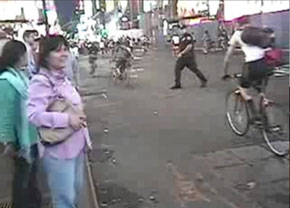
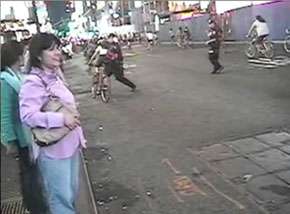
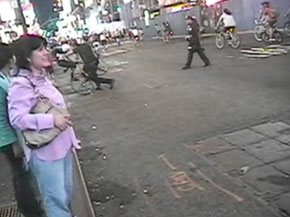
Around 9:30 on Friday night, a bicyclist pedaling down Seventh Avenue veered to the left, trying to avoid hitting a police officer who was in the middle of the street.
But the officer, Patrick Pogan, took a few quick steps toward the biker, Christopher Long, braced himself and drove his upper body into Mr. Long.
Officer Pogan, an all-star football player in high school, hit Mr. Long as if he were a halfback running along the sidelines, and sent him flying.
As of Tuesday evening, a videotape of the encounter had been viewed about 400,000 times on YouTube. “I can’t explain why it happened,” Police Commissioner Raymond W. Kelly said on Tuesday. “I have no understanding as to why that would happen.”
These are the first short paragraphs of a longer Jim Dwyer piece, “When Official Truth Collides With Cheap Digital Technology”, published on line by the NYTimes a few hours ago. The site conveniently supplies a side box, a history capsule of some recent arrests in New York City. It focuses on the dramatic discrepancies between police accounts and what was captured by cameras, and there are also links to texts and videos.
New York’s bicyclists have seen the future of the city, and they are already a part of it. Unfortunately the NYPD is operating somewhere in the early twentieth century: They may be our “[girls and] boys in blue”, but when there’s a bicycle in sight they act like Brownshirts.
See video evidence from this past Friday of the latest violent assault in the NYPD’s continuing illegal campaign against bikes here, and for more history, see this video report.
[bystander’s video stills from the New York Post]