
These crocus guys have been livening up our garden for a week or so already. Yes, the little trifoliate leaflets around them belong to our local frais de bois.
Category: NYC
play in your own yards, and leave Spitzer alone
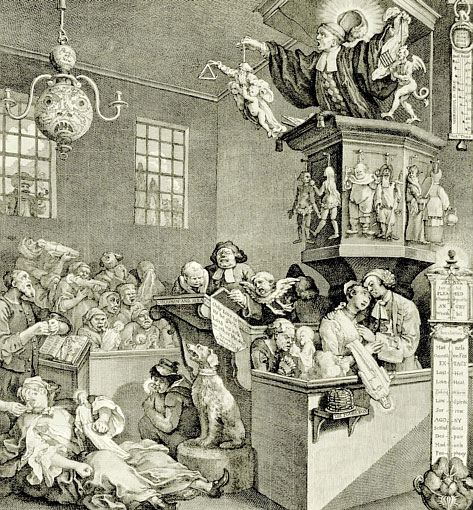
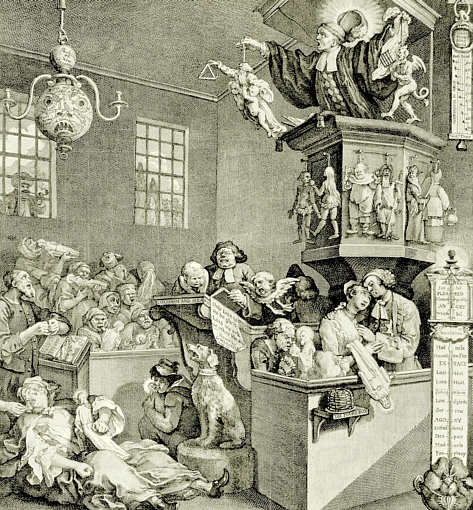
William Hogarth Enthusiasm Delineated 1761
This is stupid, if not just evil. No, I’m not talking about Eliot Spitzer. Let him deal with his family; it’s not our concern. People are screaming at the Governor about his marital infidelity and announcing or calling for the end of his career. Meanwhile, George Bush’s murder count in Iraq, already in the hundreds of thousands, continues to mount and no one will pull the plug or talk about impeachment.
I simply don’t care what kind of sex the people I vote for engage in, just as I insist that they not care about my own – or yours either. Murder and other high crimes I care about.
[image from payer.de via fortunecity]
Times Square bomblet outperforms march of a million
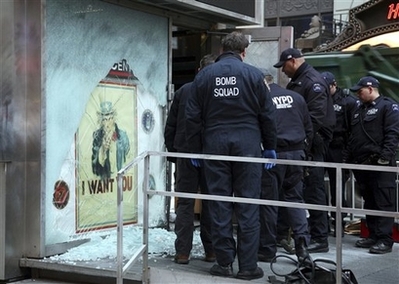
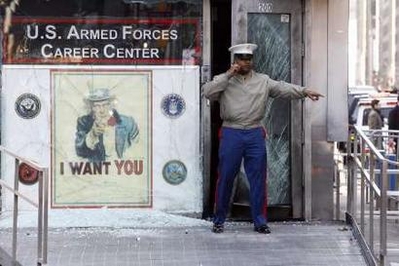
In 2003 nearly a million people marched in the streets of New York against a war (to which the majority of the country was opposed even then) only days before it began and the U.S. press hardly mentioned they were there, but last night a small explosive was detonated outside the door of the Times Square military recruiting station, presumably intended to send a similar anti-war message. This time a protest somehow manages to stir the media.
Our democratic system isn’t working; peaceful protests are not considered newsworthy. It would be nice if we could believe that the only people who are learning this lesson are those who would not consider violence a reasonable means of effecting political change.
[first image by David Karp of AP; second by Keith Bedford of REUTERS; both found on Yahoo!photos]
no, not that “Armory show”, and not Breuer’s building
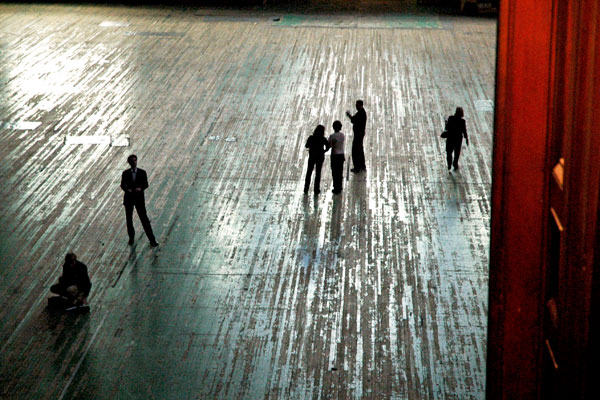
Drill Hall floor of the Armory
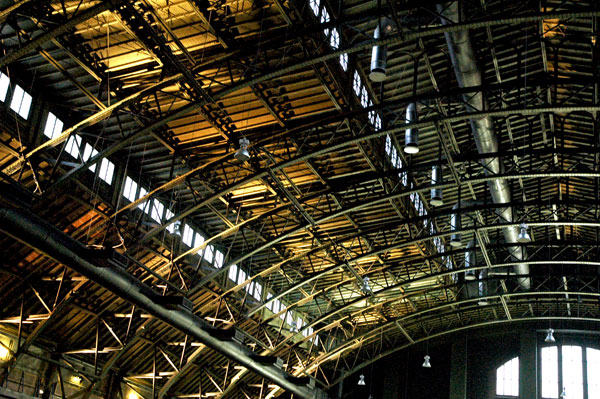
Drill Hall vault of the Armory
We were at the press preview for the Whitney Biennial this afternoon. This year the venue has been expanded to include the Seventh Regiment Armory, in whose extravagant nineteenth-century precincts many of the exhibition’s performance art elements (including some interactive experiences scheduled throughout the next month) have been assigned high-ceilinged rooms and closets.
But I as I wrote last week I always have a lot of trouble resisting the aesthetic and historical seductions of architecture like this even when there’s exciting contemporary art to be seen. So here I am writing a post preceding my observations of this year’s Biennial with a couple images of the Armory which shelters some of the installations, and to show that I’m not indifferent to the charms of Marcel Breuer’s own hall, I’m including a view of his lobby ceiling, one of my favorite details in the Whitney itself.
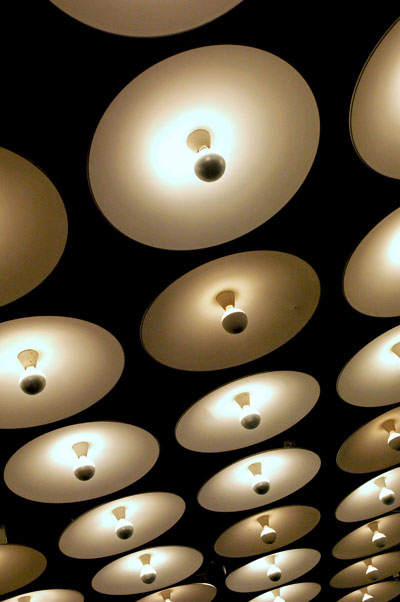
lobby ceiling of the Whitney
The Seventh Regiment Armory’s “American Aesthetic”
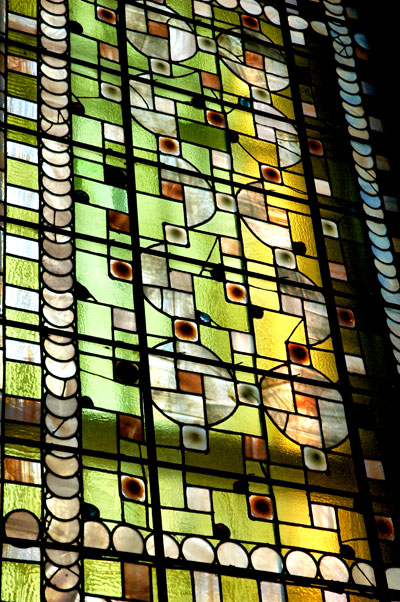
Louis C. Tiffany window in the Library of the Armory
I’ve been walking through the front doors of the Administration Building of the Seventh Regiment Armory on Park Avenue for decades, but until this past Monday I had never had a glimpse of that late-nineteenth-century monument’s most elaborate rooms, in the wing north of the monumental entrance hall. They are just about as vigorous an expression of the American Aesthetic Movement to be found anywhere, but they have been pretty much hidden from the public, their beauties increasingly neglected for the lack of funds to maintain them. Today they are being restored to their original glory by the Seventh Regiment Armory Conservancy.
I was taken by surprise that we were permitted access that during The Art Show of the ADAA, and Barry and I were also in something of a hurry that afternoon, so I didn’t have a chance to get more than a few images before having to rush out. Fortunately it was a beautiful sunny day, so the Tiffany windows and much of the rooms’ other, largely-undisturbed, ornament probably looked their best – at least for now.
When the restoration is completed these rooms will look even richer, as much of the original color and detail had been watered down or replaced by alterations over the years. For instance, the panels to the left of the window in the picture below are now covered with a dull velvet fabric, but were originally painted with a blue field behind a stenciled silver and copper chain mail [it was an armory, after all] pattern.
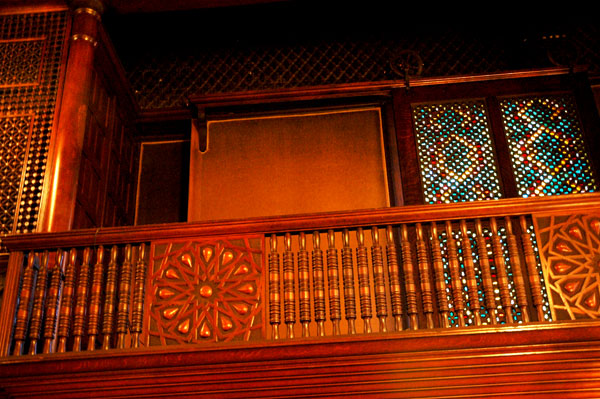
detail of the musicians’ gallery in the Veterans Room
selling off the High Line to developers – no, really!
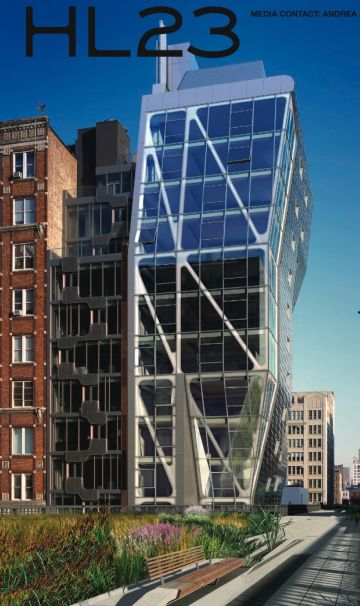
fourteen floors, most of them condos, to be built on top of our park
I admit that I’ve known about this building for some time. I’ve been quietly fuming about it (something I don’t do often – the quietly part, that is) for perhaps a year; it’s just that getting an email from the developers boasting essentially about how clever they are to have arranged this public scam put me over the top.
This isn’t the first instance in which the city has sold a part of the High Line to developers, and it may not be the worst, but it’s just about the most egregious.
Has New York been able to reverse nature’s own law, that plants need sun, even in parks? And, more importantly, are we going to have parks in this city or are we just going to have developers’ opportunities?
This text is copied directly from the press release I received today:
Denari’s HL23 will rise fourteen stories from a singularly challenging site: a 40-foot wide footprint located at 515-517 West 33rd Street, just steps from Tenth Avenue and half covered by the High Line, the historic elevated railway bed slated for transformation into one of the nation’s most lyrical urban parks. Overcoming this through-block site’s inherited restrictions while exploiting them with boldness [and the power of money and influence], Denari has conceived a building that will dramatically increase in size as it rises from its slender footing to cantilever gracefully over the rails. Made possible by a Special Authorization, comprising of seven waivers granted by the New York City Department of City Planning [my emphasis] in support of the building’s unique contribution to the cityscape, HL23’s reverse-tapering form [absolutely the reverse of New York’s historical and progressive setback zoning] will make it a local landmark while creating cinematic views and unrivaled intimacy with the High Line for residents inside.
Why not call it the Highline Tunnel? Construction is supposed to begin in a few days.
CORRECTION: I originally described it as a thirteen-story building in this post, but apparently a penthouse will comprise a fourteenth floor.
[image from triplemint]
Rirkrit, where are you? or, artists have to eat too
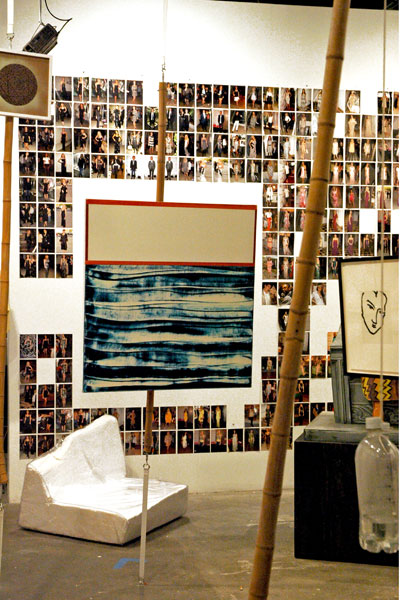
view of the gallery installation, with art suspended from bamboo poles and marine rigging in a reference to the innovative poles inside Peggy Guggenheim’s gallery, Art of This Century [Stephen Ellis’s 2000 untitled oil and alkyd canvas is in the center of the image; James Hyde’s new “Chunk Chair” sits below and behind it; Sherrie Levine’s “Untitled (after Henri Matisse)”, from 1985, hangs on the right; and a good bit of Tony Feher’s suspended bottles can be seen in the right foreground]
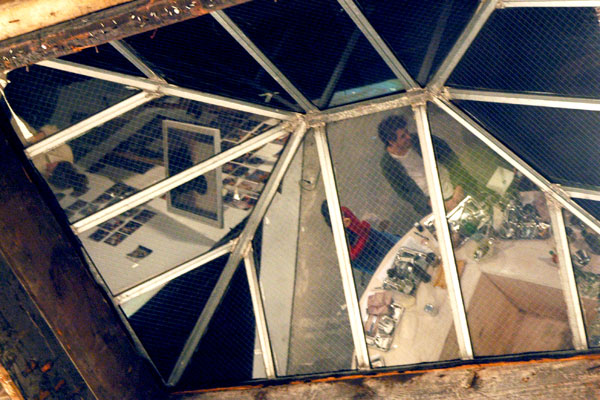
view of dinner with, and below, the stars [Mateo Tannatt’s “GERALD@*BLUE ONION LATEO”, built for the project, performing as the round table for the evenings]
It was the darndest thing. The email was from “New York is Dead”, the subject line read “Rose Colored Glasses”, and the message was signed by Joe Montgomery and Jesse Willenbring. It was an invitation from two people whose names I didn’t recognize at the time, inviting me to participate in a “potluck dinner party group [designed to] show homage to Rirkrit Tiravanija and the breakthrough 1942 modern gallery, Art of This Century.
The evening suggested for my participation was described as one of the dinners they were holding at Gavin Brown’s Chelsea space during the first two weeks of February. The email went on to say they had curated a group show of artists but they were also attempting to assemble a group of 11 guests to eat together in the gallery on each of the 11 nights the show would be up. We were told there would be spectators, and that there would be no fourth wall. We were being encouraged to share food and conversation, “and not just about art”, for an entire evening, but other than being assigned a specific food theme (different for each evening) almost everything else would be up to our imagination.
It read as a pretty bold and ambitious concept, and I was immediately attracted to the references to art and food, but it was probably the connection with Brown, the bar Passerby and the evocation of Rirkrit and Peggy Guggenheim that pulled me in. I accepted the invitation, replying on my own and Barry’s behalf before I realized it had actually come just to me. I was embarrassed when I realized my presumption, but my hosts immediately made it clear that my dual rsvp was totally in order – if not actually a huge improvement over the specificity of the original invite.
Barry and I still thought we might be taking a chance, especially since we balance a pretty full calendar and are jealous of our time off, but it sounded just quirky enough for me to want to make the commitment which, as it happened, included a little work in the kitchen for me.
It turned out to be a delight. I brought my pot, . . . er, bowl, and it became one of the dishes served to the guests at an sculptural round wooden table constructed for our sit-down dinner. We met some great people (unfortunately a flu condition kept co-host Joe Montgomery from making it the night we were there). We saw some really good art imaginatively installed, and were totally charmed by the situation, by our fellow guests and by the generosity of our very-hardworking hosts.
For more on the concept and the experience, and images from the first night’s dinner, see the ArtForum Diary post.
There were works by almost three dozen artists surrounding us and at the table itself. What follows are images of just a sampling.
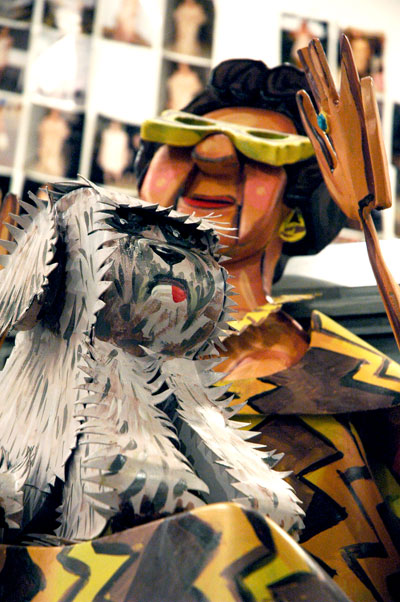
Red Grooms Queen Peggy 2004 painted aluminum 45″ x 43″ x 32″ [detail of installation]
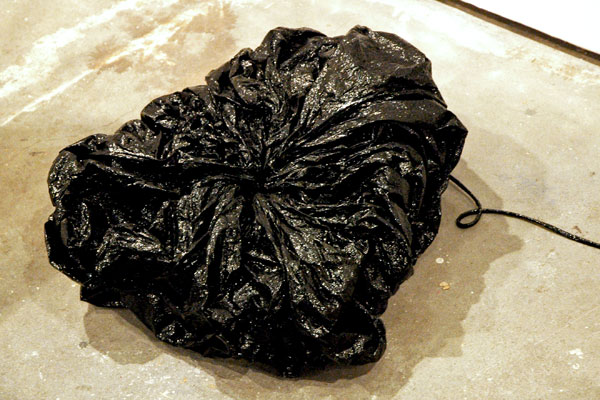
Charlotte Beckett Pit 2008 black mylar, aluminum, motor [installation view]
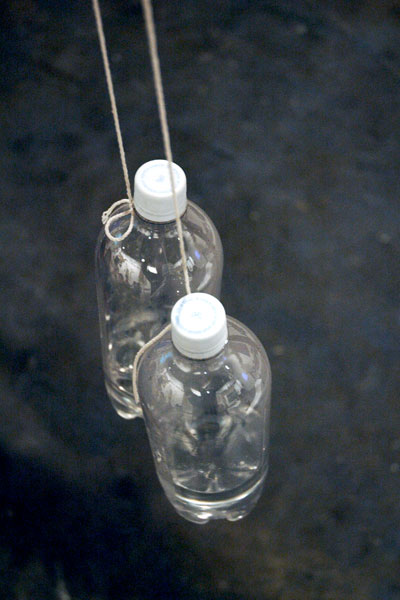
Tony Feher Untitled 2008 60″ x 7″ x 4″ [large detail of installation]
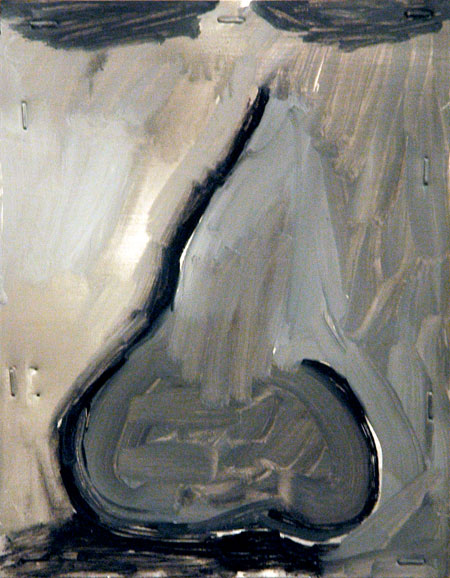
John Finneran Nose 2007 oil and stainless staples on aluminum 9″ x 7″
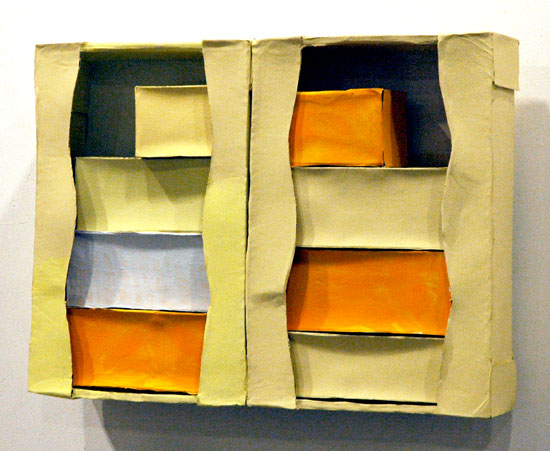
Nancy Shaver Fruit Box #1 2005 cardboard box, paper-covered boxes 16″ x 22″ x 5″ [installation view]
A list (probably not totally complete) of artists included in the project’s environment whose work is not represented in any of the images would include Varda Caivano, Brian Calvin, Nancy de Holl, Aaron Freeman, Wolf Kahn, Jake Keeler, Alex Kwartler, Virginia Lee Smith, Joshua Light Show & Pig Light Show, Emily Mason, Carter Mull, Dominic Neitz, Jesse Pearson, Amanda Ross-Ho, Cary Smith, Jennifer West, Yuh-Shioh Wong, Betty Woodman and Michael Zahn.

WAGMAG benefit at The Front Room tomorrow
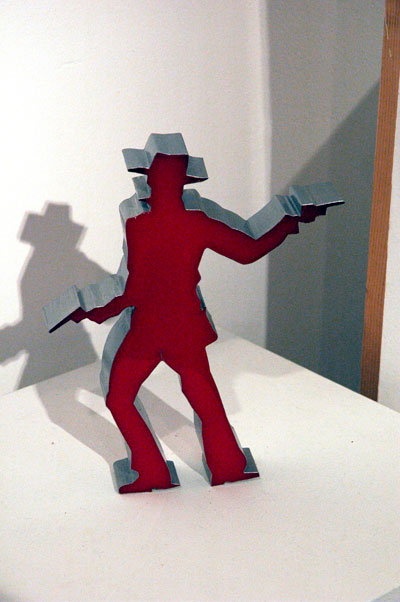
Philip Simmons’s “Study for High Noon”, one of the works included in tomorrow’s benefit
Barry and I both love art, Williamsburg and Greenpoint, Williamsburg and Greenpoint artists, Williamsburg and Greenpoint galleries, and WAGMAG, that invaluable guide to Williamsburg and Greenpoint galleries.
But like most of the best arts institutions (where “non-profit” is always an understatement) WAGMAG can’t survive on its virtues alone. Once a year the rest of us have a chance to help fund it. At the annual benefit (this year is the third) we can feel very good about ourselves, party with some terrific people, and then go home with some exciting art – created by some of our favorite friends and neighbors.
Oh, and I can’t say enough about Daniel Aycock, the generous artist host.
DETAILS:
tomorrow, February 8
at The Front Room
147 Roebling St. (corner of Roebling & Metropolitan)
admission is free
but tickets for artwork drawing are $150 (purchase at the gallery or online)
final viewing tomorrow from 1-6 (or on line)
We stopped by several days ago to see the work which had already come in, and now we’re definitely psyched.
475 Kent: the insanity of New York housing policy
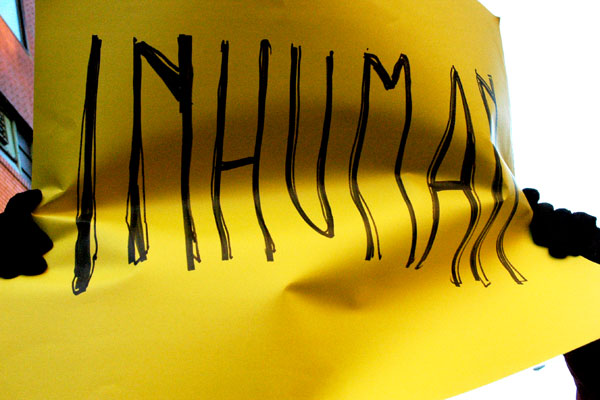
a silent cry from a witness across the street two days ago
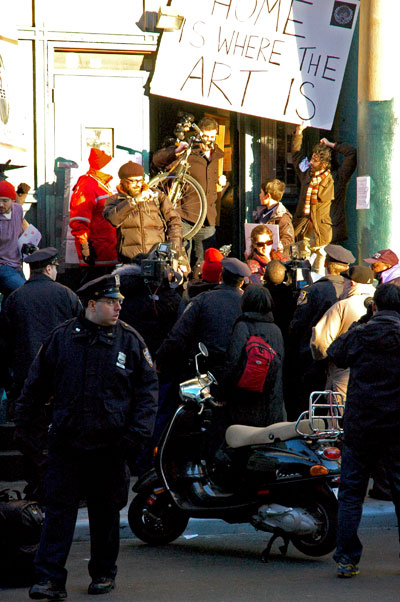
Whatever the bureaucratic, commercial or political story which lies behind the human tragedy of New York City’s dreadful and totally irresponsible eviction of over 200 men, women, children and their pets from their homes in the darkness nine days ago on one of the coldest nights of the year, if this doesn’t radicalize New Yorkers, we deserve whatever we get.
But there is no acceptable outcome to this particular tale other than the quick return of these people and a proper accounting of the official malfeasance which resulted in their removal in the first place.
Bloomberg, Markowitz, Quinn, anybody out there? We do note that that very decent local member of the City Council, David Yassky, has been with this story from the beginning, was at the scene on Sunday, and appears to be very supportive of the vibrant and creative community which has lived and worked inside this massive, 11-story Williamsburg building block for ten years.
For more on the story of 475 Kent, see Bloggy and any number of other on-line sites.
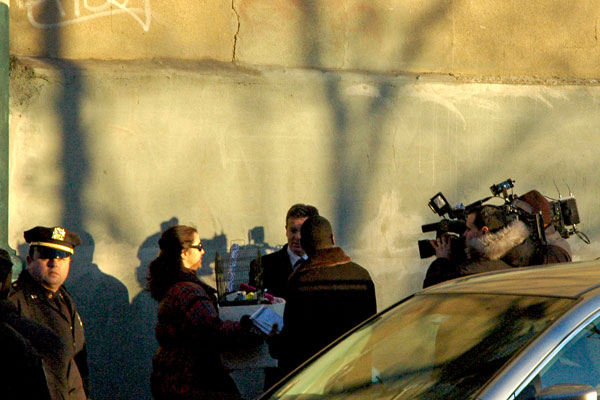
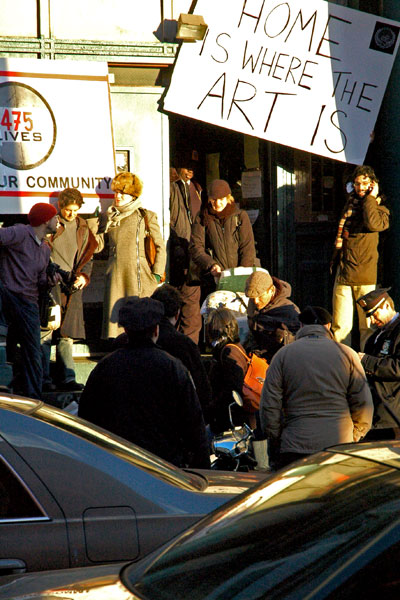
The images below were taken this past Sunday night. They show tenants retrieving their possessions (boxes, art, bicycles, baby carriages, parakeets, etc.) in the last moments before the building was finally padlocked, for a painfully-indefinite period. A large crowd gathered across the street in the bitter cold to observe the sad scene.
If you go to Barry’s flickr images, note the Police van parked on the sidewalk adjacent to the large crowd which was repeatedly pushed back from the parking lane onto that part of the sidewalk not occupied by an NYPD vehicle.
painful “Scenes of Gypsy Life”, in painful seats
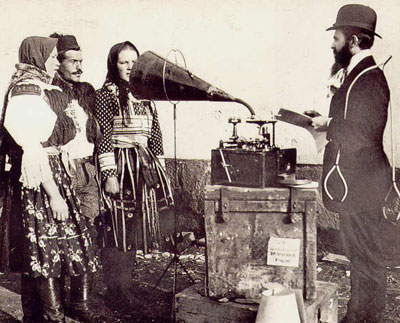
Janáček in a Slovak-Moravian borderland village a century ago, recording singers onto wax
the performance
Did anyone see either of the two performances of the Gotham Chamber Opera’s “Scenes of Gypsy Life” presented this week at the Morgan? Barry and I went on Wednesday, but at this point I’m feeling I must have imagined the experience. While the singers were not to be faulted and in fact should be commended for their courage, the production was otherwise really bad on virtually every count.
I’ve seen nothing in the media suggesting it ever happened (only pre-performance announcements). I waited almost two days before posting this because I thought that maybe I totally missed something. I was hoping to read a review which might explain what the brutal staging was all about, but now I think that reviewers who would ordinarily be inclined to support the company weren’t able to shine a better light on this weird evening than I could.
Basically, I’d like to know whether we’re the only ones who thought it was ill-conceived and incredibly ugly, not to say sadistic and shockingly racist. Neither the poets nor the composers, Antonín Dvořák and Leo Janáček, who set their words into the music heard this week, had intended a slander of the Roma people with whom they all shared a culture. They had all, in fact, intended homage.
And it wasn’t just the director’s treatment of all three gypsies as stock characters. Actually, if there were any reason for the existence of an anti-defamation organization for farm boys represented as monsters, it too would have to be interested in Eric Einhorn’s direction. The raw setup should have presumed one wholesome youth, four pretty gypsy girls, a gentle pastoral scene, music. How (or why) does this scenario become so intensely horrible?
This all seems especially weird since I’ve been to and enjoyed most of this company’s early productions and I would expect to be a part of its audiences in the future. The inspired and often masterful mounting of relatively-obscure operas, with exciting casts and designers, and presented in modest-sized auditoriums: What’s not to like?
the auditorium
I wrote just now that I expected to go back to the Gotham, but I will never go back to a performance at the Morgan library. It’s not so much the architecture of Renzo Piano’s expensive new addition, which is a mess of mall-inspired multiple planes and giant muntins in a confusing layout forced into the spaces separating several worthy late nineteenth and early-twentieth-century buildings, as if these spaces were only so many cavities which needed filling.
It’s the auditorium itself, Gilder Lehrman Hall: I had no idea the architect had retractable feet. But even such a wondrous anatomical gift couldn’t justify making those of us who don’t suffer the consequences of the shape and arrangement of the seats in his little wooden hall. The over-hyped super-star museum architect forgot that most of us ordinary mortals, even when seated, have feet attached to and extending forward from their legs.
Hey, we don’t look anything like the tiny folks for whom Carnegie Hall was designed in 1890 (and refurbished to the same specs a hundred years later); we’re the giants who showed up in 2008, and this is a totally new building!
UPDATE: The NYTimes review, by Vivien Schweitzer, finally appeared in Saturday’s edition. It praises what should be praised and at least as edited for publication almost totally ignores what I found deeply troubling. There will be no more performances, so the review cannot affect a potential audience, and in spite of the writer’s reference to a bloodstained shirt, shackles, and young women being chained up, there is little in her report which might have enlightened anyone who had actually seen the production and been disturbed by it.
[image from remove.radio]