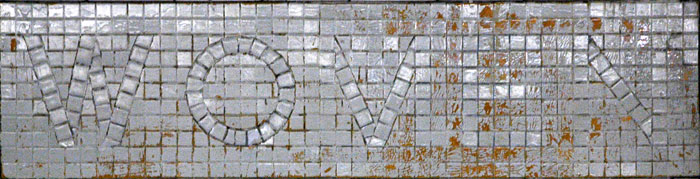
like almost every other public convenience in this city, the two facilities inside the 23rd Street/8th Avenue subway station, one of which is marked by this old whited-out tile sign, has been closed for decades
Now once again [see this 2004 news article, and note that it was certainly not the first] we’re being told that help really is on the way.
The city fathers and mothers (who must never have had to pee, once they were out and about, since some time after World War II) have been talking for years about setting up a few above-ground single-user toilet units around the city for the rest of us. Now we are being told that eventually twenty big automated toilet boxes will be spread over the five boroughs.
There are real problems with this solution which are obvious even now: They call it street furniture, but they won’t be occupying space reserved for cars but will instead be another encroachment on the space left for the increasingly-marginalized pedestrian; it looks like we’ll still have a very long walk between water closets, and a potential wait in line once one of these things is located, particularly if it’s in a high-traffic neighborhood, as I assume they all of them will be; commercial advertising (plus a quarter from each visitor) is supposed to pay for them, meaning that they will also be adding to to the visual pollution of New York’s runaway public billboard epidemic; the toilets will be open (surprise!) only from 8 am to 8 pm; and, oh yeah, they will each use 14 gallons of our precious water reserve to clean the inside of the unit every time it’s flushed (hey, do you think we’re going to be allowed inside to pee during our not-infrequent summer droughts?); finally, how often will they be out of order?
Before replacing it with something else the authorities peremptorily abandoned a system which worked, however problematically. We’ve had half a century to think about what to replace it with, and sadly this is the best they could come up with. I know this is America, but can’t we try thinking minimal once in a while?
Category: NYC
Smart on 23rd Street
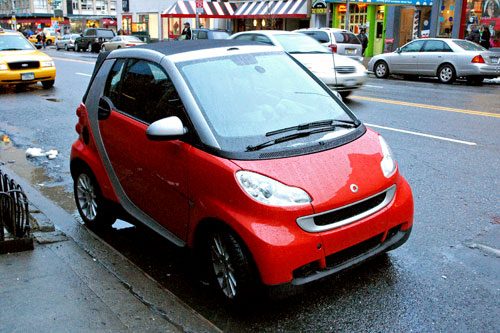
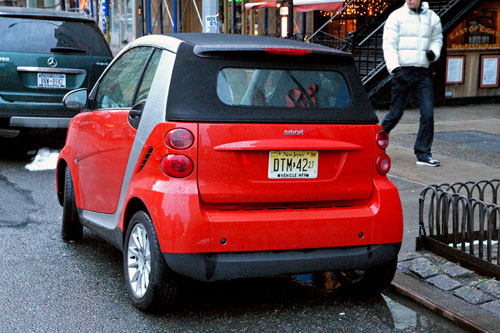
The first Smart of winter. The Mercedes Smart (yes, Mercedes) will finally be available in the U.S. by the end of January.
We spotted this little beauty (a cabriolet with manufacturer’s plates) parked across from our building as we headed out to Williamsburg and Bed-Stuy via several subway lines this afternoon. Sigh. I think I’m still hooked.
new New Museum (extra)
A few footnotes to my earlier post on the architecture of the New Museum:
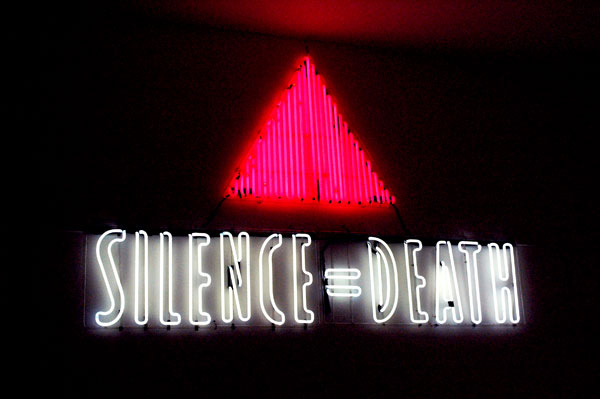
This piece was my favorite continuing thing in the old New Museum, where it hung near the front door for years. This ACT UP/Gran Fury neon icon is now part of the Museum’s permanent collection. It’s been installed on the landing of the beautiful stair which descends through glass railings from the lobby floor to the level below, where the theater and Jeffery Inaba’s installation, “Donor Hall” can be found.
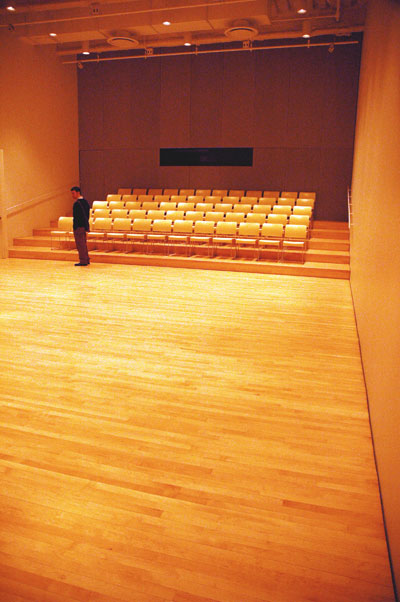
The theater in the basement looks like a minimalist high school gymnasium, but there are no hoops and no painted floor; this one is for the art and theater fags. A simple full-height movable curtain hung on a ceiling track can be snaked around the stage area to create either a proscenium or a backdrop.
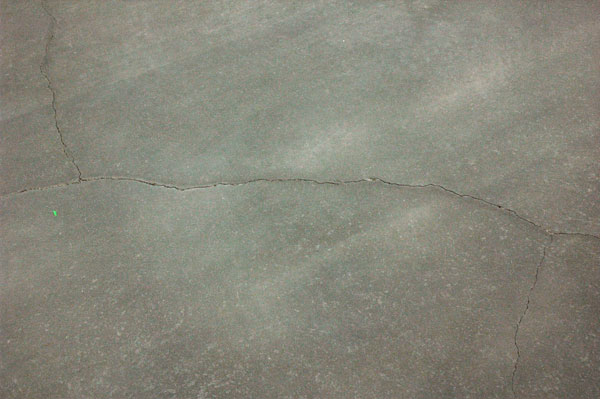
During the press preview on Thursday Barry pointed out this crack in the floor of one of the galleries. I said something about the need for expansion joints. Now I’m not so sure our assumptions were correct. Maybe we didn’t get the press packet the NYTimes got, because their architecture critic, Nicolai Ouroussoff, was able to write, “That effect [a hint of mystery] is reinforced by the rawness of the spaces exposed beams, painted white walls, cracked concrete floors [my italics].
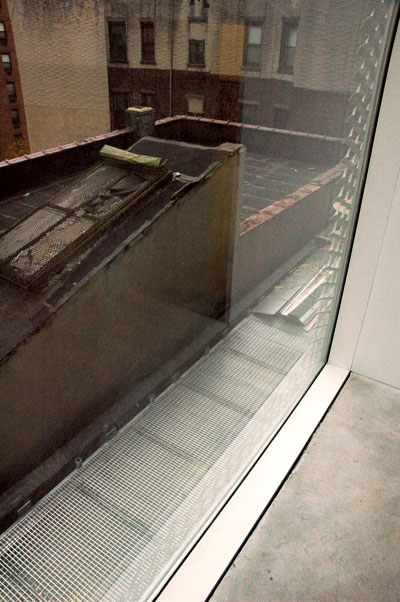
The window on the landing of the long, east-west staircase showcases a skylight in a gallery below and suggests the rich historic complexity of the neighborhood.
new New Museum building is a new New York treasure
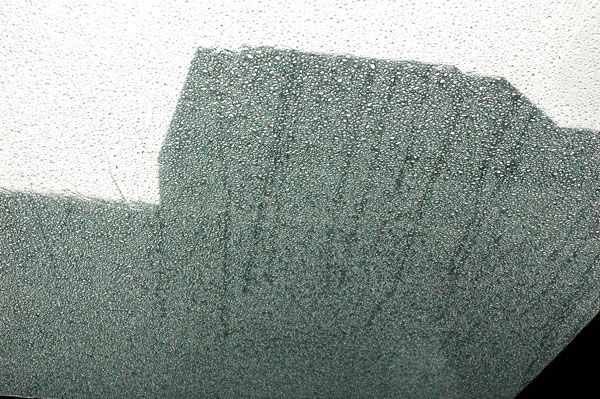
raindrops on the roof of the temporary tent at the entrance obscure the Bowery facade
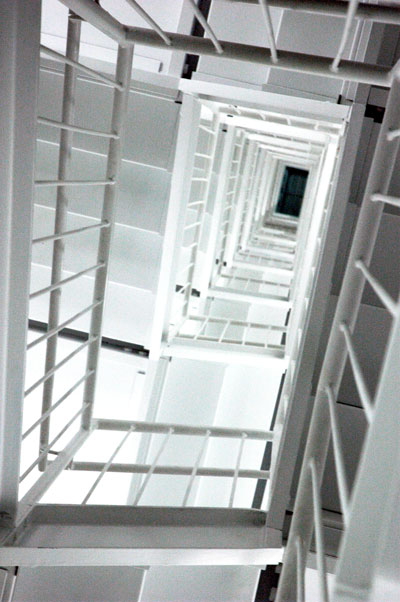
each of the building’s sets of stairs is a star, including this interior tower
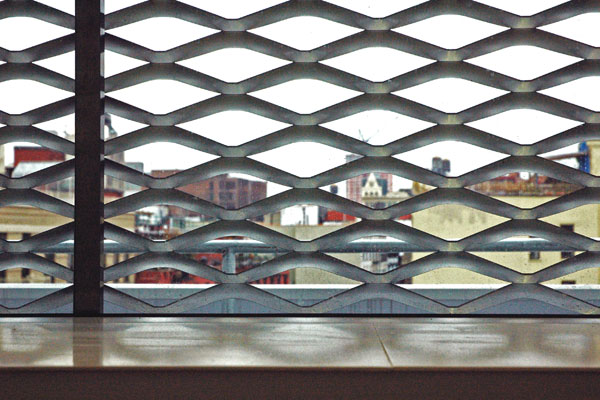
the aluminum mesh covering the facade shades this row of 4th-floor windows
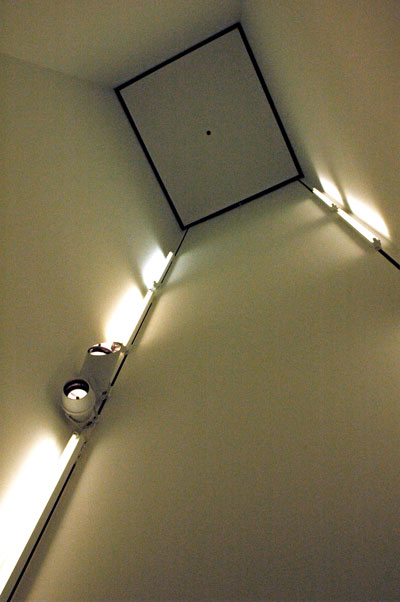
on the interior stair landing, looking up from inside a niche used for installations
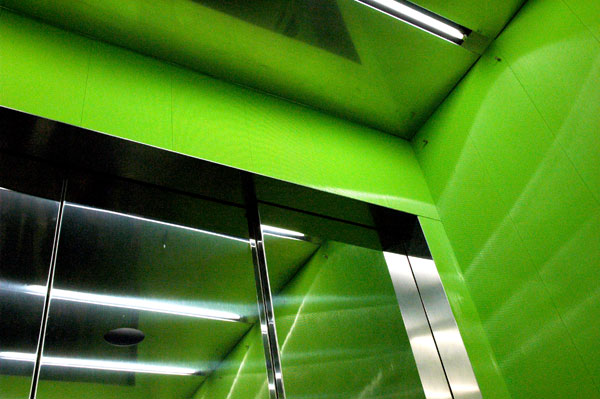
the larger elevator, a mobile color platform in the core of the tower, opens at either end
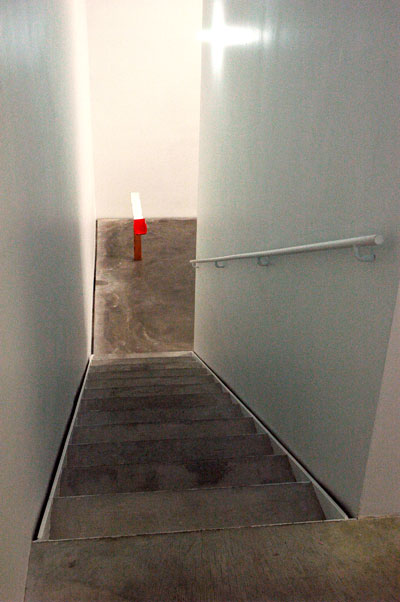
the very cool interior staircase frames or provides access to several installations
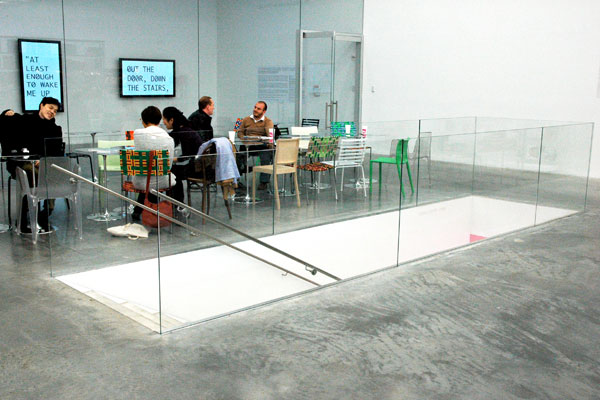
the cafe was not operating, but the light, the vantage, and the chairs were welcoming
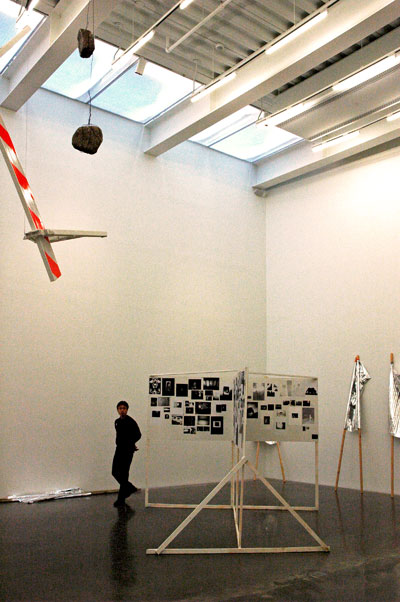
a view of the balance achieved between a building and work it briefly shelters
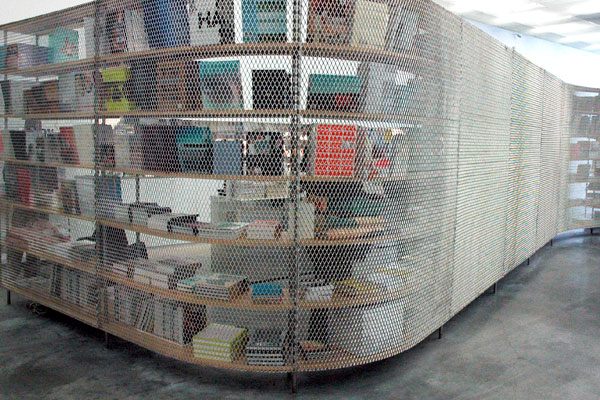
the outside curve of the bookstore wall on the south side of the ground floor
It was a thrill to welcome to the city this morning a splendid new house of art, the new New Museum. It stands on the Bowery on the Lower East Side, a neighborhood already changing rapidly but which still remains one of New York’s most interesting.
I loved the Sejima + Nishizawa/SANAA building from the moment it was presented to us as a conception. That was in May of 2003. Construction began two years later and the Museum opens to the public December 1 [meanwhile, we’re still looking at a big hole down at the World Trade Center site one mile southwest of the museum; always ask an artist, or arts person, if you want something done well]. Those who haven’t already reserved a time slot for the marathon opening, a 30-hour window of opportunity which begins at noon on Saturday, will have to hold off until the initial excitement dies down. Their people say they’ve already given out the entire number of allotted timed tickets for those free hours of admission.
It’s worth the wait. The building is as good inside as it is on the outside. There are several installations in various parts of the building, in addition to the major one. The three full-floor galleries are given over to the first wave of “Unmonumental: An Exhibition in Four Parts“. It’s a stunner.
It seems so very odd to be in a modern museum where the building itself is both very present (when presence is exciting and welcome), and discretely invisible (when invisibility is appropriate and appreciated). But what wonderful things fill these wonderful spaces! I was thrilled for to be able to experience truly contemporary art (almost emerging art) in a museum environment in New York for a change. In spite of what we’re used to being told in this city and what we have finally come to expect, all Museums don’t have to function only as warehouses for our authenticated treasures. The Smithsonian is not a proper model for the institutional treatment of the visual arts.
The founding director of the Museum of Modern Art, Alfred Barr, proposed to deaccession work the museum owned once it became 50 years old, in order to pay for the purchase of new work. Obviously MoMA has not followed through with this program. Whatever the merits of the arguments on either side, it is possible to argue that the increasing maturity of its vast treasures today has gradually caused MoMA to be distracted from its original purpose and lose its way as a leader or innovator in assembling and broadcasting the wonders of contemporary art. It’s become increasingly difficult in recent decades to think of it as an institution able to lead in recognizing developments in the art world (if not actually the newest art itself) and for introducing it to and educating both a general public and arts institutions, presumably all with lesser talents and fewer resources.
We are told that the institution Marcia Tucker founded thirty years ago displays a deliberate paradox in its name, “New Museum”, but the fact that its fans and even its critics have never really thought of it as a museum probably isn’t much related to our disappointment with MoMA. Museums really are repositories, and we’ve always known that the New Museum functions more like a European Kunsthalle, way ahead of the old guys, but maybe only one step behind the kids working the best trailblazing and innovative galleries somewhere along the front lines.
May our New Museum never bury itself under an acquired stash, no matter how worthy (I’ve heard there are plans to begin maintaining a permanent collection for the first time), and may it never grow old.
_____
I expect to do a follow-up post with images of a few installations, and even the images above don’t include all of my favorite things about the inside spaces of the building itself. I’m thinking of the neat little theater in the basement and the elegant penthouse space at the top, and the possibilities suggested by both; the beautiful stylized flowers on the tile walls of the basement restrooms; the tantalizing, open-plan bookstore; the glass-walled gallery located at the back of the ground floor and which is apparently able to isolate installations that include sound; the anticipation of the 5th-floor “Education Center” as an important international nexus for new art and new art forms; the beautiful floors; and over and over the architectural and profoundly urban pleasure of discovering an unexpected outside window, skylight or door.
Reverend Billy free this time, but the assaults never stop
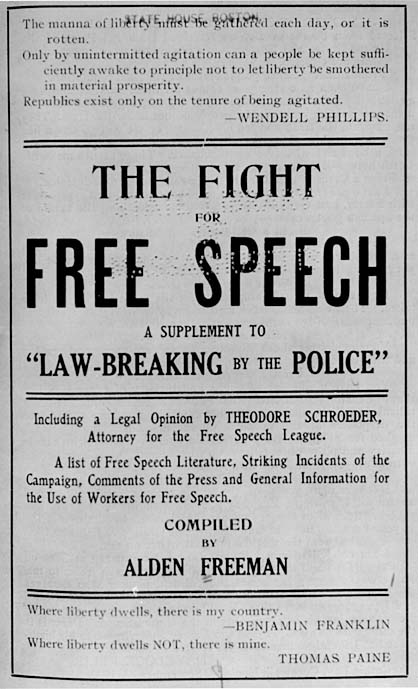
cover of a 1909 pamphlet created to protect the right of free speech at a time Emma Goldman was being prevented from speaking
How often does the NYPD have to be reminded about the First Amendment?
Two days ago all charges which the police had brought against the Reverend Billy for reciting the First Amendment to officers harassing Critical Mass cyclists in Union Square on June 29th were dropped.
New York’s guardians of [certain kinds of] law and order have once again failed to have their behavior upheld by the courts. Fortunately this time it was not the soft tissue of a citizen victim that bore the injury, but the tissue of the civil liberties each one of us shares. The escalating, accumulative record of police misconduct like this, regularly authorized and protected by Departmental and civilian municipal authorities, assaults our Constitutional protections and it may some day effect a mortal wound.
The NYTimes article by Anemona Hartocollis barely hints at what should have been a huge embarassment for the arresting officers and those who had handed them their assignment:
The Manhattan district attorney�s office quietly dropped its prosecution today of Reverend Billy, a street performer accused of harassing police officers by reciting the First Amendment at a rally in Union Square Park.
Prosecutors said today that they deliberately allowed the case to be dismissed by failing to meet a court-ordered deadline to file papers explaining why the arrest of Reverend Billy, whose real name is William Talen, was justified.
�Sometimes not making a decision is a good decision,� one prosecutor said.
Norman Siegel, Billy’s lawyer, let the Times know that the incident wouldn’t end there.
He said he would file a federal lawsuit against the city and the Police Department charging false arrest, malicious prosecution and violation of Mr. Talen�s free-speech rights.
�We call this trial by inconvenience,� Mr. Talen said, adding that between the two cases he had been required to appear in court six times and spend three nights in jail.
�There are a number of questions,� Mr. Siegel said. �Who ordered the arrest? Why put him through the system when he should get a desk appearance ticket? Who made the decision to take five months before getting the case dismissed?�
He called the case �a classic example of government abuse of power.�
The hundreds of plaintiffs suing the city and the Hudson River Park Trust over the dangerous condition of the holding pens in which they were dumped following their arrests during the 2004 Republican Convention are experiencing their own continuing abuse and hardship. A article written by Chris Lombardi, “Pier 57 cops also exposed to toxins during 2004 RNC“, which appeared in a recent issue of Chelsea Now, is interesting for many of its revelations. In it Lombard reports:
Right now, the suits are still at the deposition stage, with the 500-plus plaintiffs spending days at the federal courthouse downtown.
�They�re keeping them for eight hours at a time, sometimes,� said [Environmental Justice Law Project] co-founder Martin Stolar.
Eternal vigilance is the price of freedom, but do we have to pay for despotism too?
[image from the Emma Goldman papers, sunsite.berkeley.edu]
Asian Contemporary Art Fair
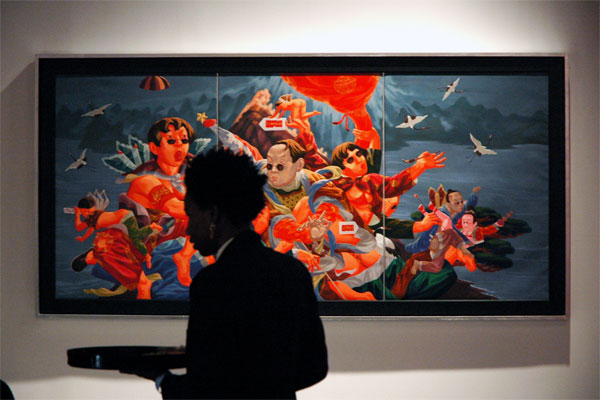
Lu Peng showed up everywhere, but this particular painting was holed up in the VIP room
We were at the preview reception of the Asian Contemporary Art Fair last night. As a veteran of just about every similar event held in New York over the last ten years I think I may say with some authority that this one is more than worthy of an excursion to Pier 92.
Right now I don’t have the time to go into even some of what I thought were the highlights (we were with family today and then decided to run off to Williamsburg tonight), but since the show exists only through Monday, I wanted to get the word out. We saw lots of really good work, both old (well, at most a few decades old) and new, and I think it means something that we spent almost four hours there without expecting to, particularly as we had hoped to fulfill two other obligations that same evening. We didn’t make either.
The work looked great, the entire fair had a very good vibe last night (no “attitude”) and the whole thing is very well run. Admission, by the way, is only five dollars for students and seniors, and Monday is free for everyone.
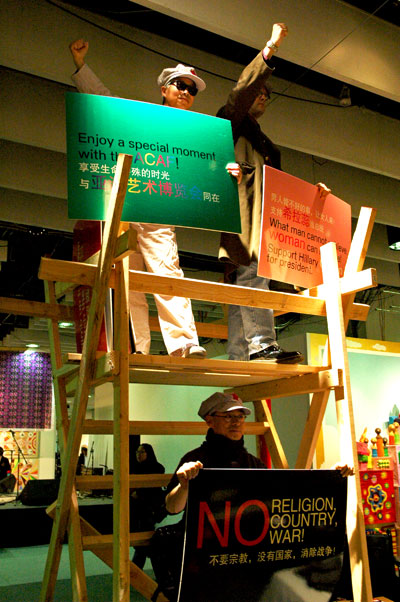
from his lofty “Watchtower“performance artist Cai Qing’s signs alternately warned us of the coming Asian invasion
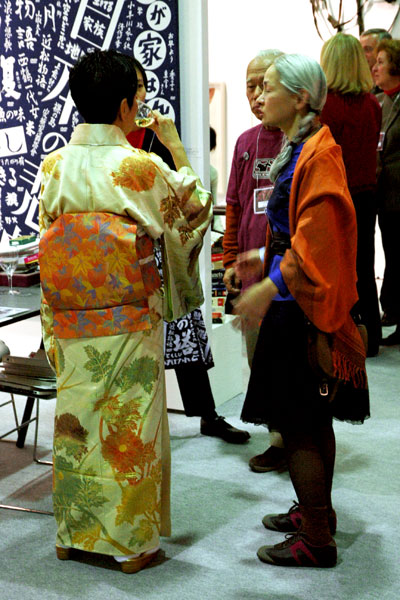
gallerist and fans converse at the booth of Gallery Yamaguchi
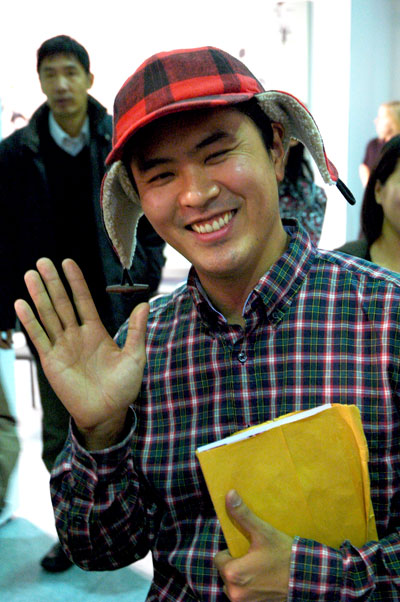
distinguished artist and teacher Hiroshi Sunairi greets admirer
Clayton Patterson at Kinz, Tillou + Feigen
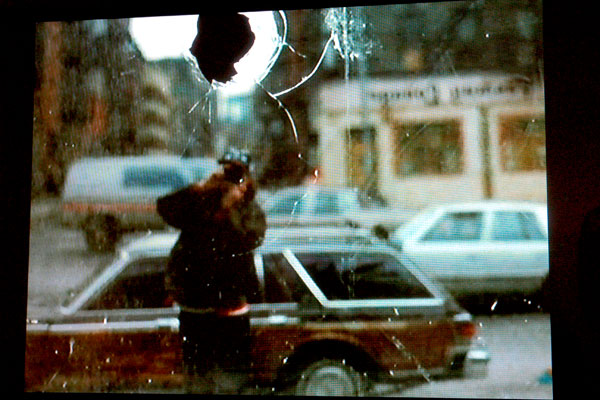
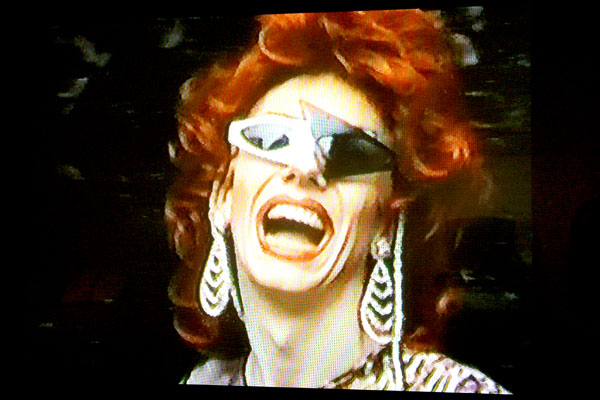
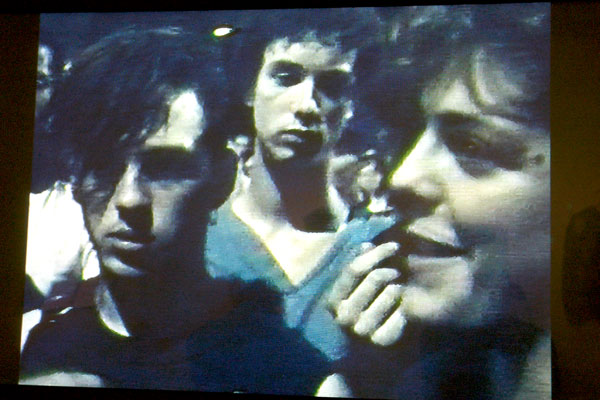
[four stills from the video installation of the film, “Captured”]
How do you write about a chronicler with a soul? How do you write about a bard with a camera? We can’t begin to understand the importance of people like this until they are gone. Maybe it has to wait until we are gone as well, but in the meantime we can give it a try.
I’d have to see this show, “The Lower East Side“, for its historical and political importance, even if the photographs didn’t have their own beauty. And they do.
Clayton Patterson (okay, it’s already the legendary Clayton Patterson) is currently represented by some of his sculpture, a tiny sampling of his enormous archive of photographs, and an excerpt from a documentary video in a show at Kinz, Tillou + Feigen, a gallery whose heritage, through Richard L. Feigen and Feigen Contemporary is itself pretty legendary.
The sculptures assembled from found materials are documents themselves, setting the entire installation in a specific time and space. The photographs are intense portraits, both candid and posed, of the Lower East Side community stretching from the early 80’s to the present. To anyone who did not know this city before the mid-90’s, or who might be unfamiliar with the neighborhood now, many will look like they must have been invented. In fact they are all perfectly true, and astonishingly intimate.
The same must be said of a film, “Captured”, shown on a television monitor in the smaller space. Its subject is Patterson and the neighborhood he calls home and which he has looked after for almost three decades. It was put together by Dan Levin, Ben Solomon and Jenner Furst, largely using Patterson’s own footage, and excerpts are being played in the gallery through the duration of the show. Patterson’s photographs can be seen on the gallery site. Here I’m only showing stills from the film, except for this one image:
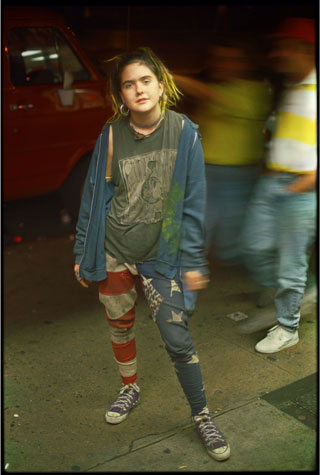
Clayton Patterson Untitled (grunge girl) 1992/2007 C-print
By the way, if you’re very young, on the street, and want to have a distinctive style, wouldn’t it make sense to find your own? That’s why I was struck by the resemblance between this 1992 “Grunge Girl” captured by Patterson, and this 2002 “Billy”, who was part of Bradley McCallum and Jacqueline Tarry’s show at Marvelli gallery three years ago (the couple is now represented by Caren Golden).
[image at the bottom from ktfgallery]
Ashley Gilbertson’s “Whiskey Tango Foxtrot”
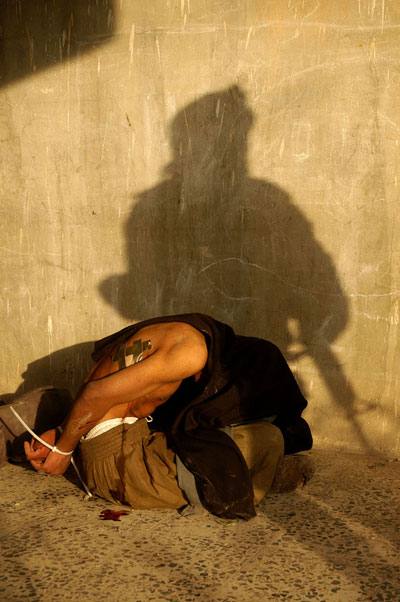
The captured fighter claimed to be a student who had gotten stuck in Falluja. A marine responded. “Yeah, right, University of Jihad, motherfucker.”
What the fuck
It’s a hot title, only partially-disguised by the military alphabet code. Ashley Gilbertson‘s “Whiskey Tango Foxtrot: A Photographer’s Chronicle of the Iraq War“, is a devastating account in photographs and text of the human tragedy of the U.S. presence in Iraq.
This book (in visual arts terms, his first solo outing, after appearances in several compilations) is also a portrayal of an infernal war engine which has destroyed a small, weak nation and threatens to waste our own. While adding to the numbers of individual Iraqi victims it continues to churn up and spit out its own people, like the profoundly-damaged veterans visited back home by Nina Berman in her book and photo exhibition, “Purple Hearts“.
In Iraq Gilbertson worked physically with dangers, artistic handicaps and challenges which Berman experienced mostly psychologically inside the U.S. through her friendships with and documentation of neglected and abused American veterans once they were deposited home – perhaps the most horrific “unintended consequences” of an insane, premeditated war. Gilbertson has spent much of the last four and a half years living virtually on his own in the chaos of Iraq armed only with his camera, its function significantly hamstrung by the guys in the white hats: The Pentagon itself imposes significant formal restraints of all kinds on any journalists who venture into a combat zone which it pretends to control, but Gilbertson also was prevented from including virtually any images of dead Americans (“Publishers Weekly” says it’s because the victims’ fellow soldiers forbade photographs). The book does however include a number of bloody and messy scenes of death and destruction, most victims already removed, and there are many images of dead or injured Iraqis.
But the combination of Gilbertson’s art and humanity, the power of both the photographs and the commentary which accompanies them, more than meets the challenges of his courageous, self-imposed assignment. These are the images which will survive the war, and which will continue to haunt and condemn a people which devised and tolerated it.
I first came across Gilbertson’s work when I was trying to locate online one of his images for a post I wanted to do on a subject illustrated by one of his photographs. I had seen the picture in the print edition of the NYTimes, but I couldn’t find it anywhere on the paper’s web site, probably because it had only appeared as an image with a short caption. I emailed the artist. He wasn’t certain which shot I was asking about, but he graciously forwarded me several jpegs, with a very short note, apologizing for its brevity with the explanation, “out in the badlands right now so can’t talk. Sorry.” I was impressed. Now I wanted to see more of his work, and I absolutely had to meet him.
The book arrived today; I get my second wish next week.
Gilbertson will be celebrating the book’s publication with a signing event and gallery opening at Gallerybar on the Lower East Side, next Thursday, October 18. The party is from 7 to 11, at 120 Orchard Street, but the exhibition of photographs from “W-T-F” continues for six weeks.
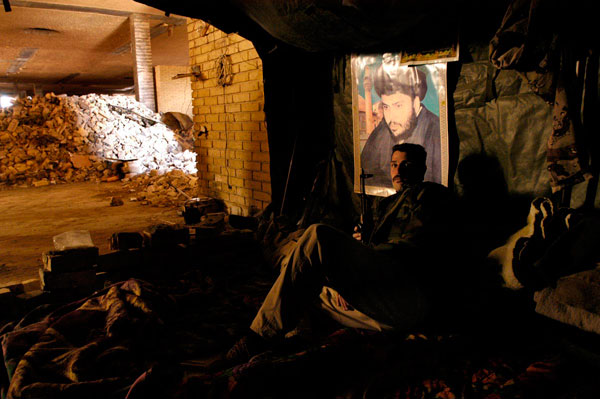
A member of the POB [Public Order Battalion] sits in front of a poster depicting Muqtada al-Sadr. he is paid and armed by the Iraqi and American governments: his allegiance lies with al-Sadr and the Mahdi army.
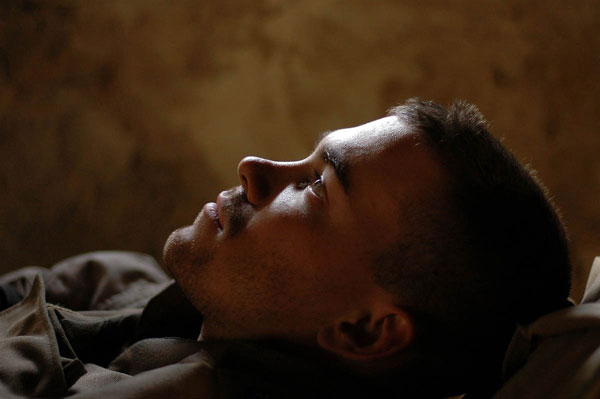
Corporal Joel Chaverri during a break in combat.
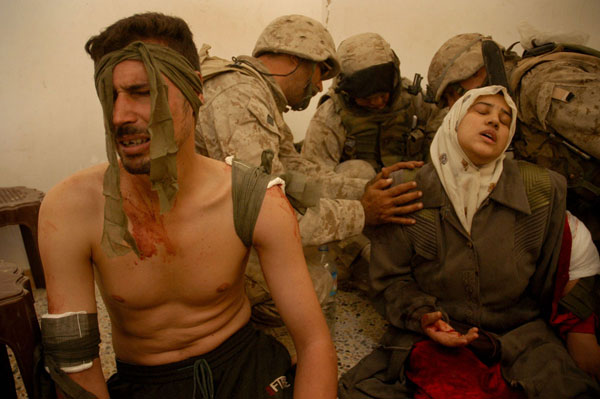
Inside the Grand Mosque, marines treat the young woman injured in the attack on her family’s car.
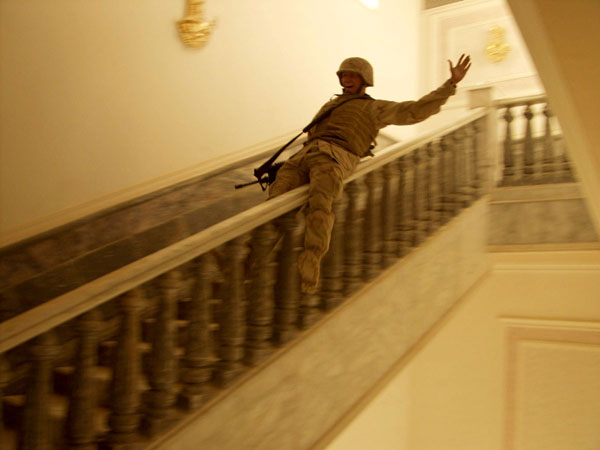
A marine slides down the marble handrail in Saddam’s palace in Tikrit.
[the captions are from “Whiskey Tango Foxtrot”; the images are from Gilbertson]
subway vellum
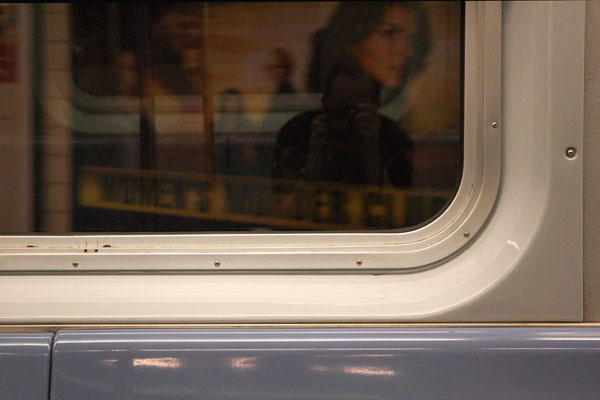
untitled (women’s) 2007
gallery photo prohibitions harass all visitors

say no to the no
Lately you may have noticed a decline in posts here about gallery shows. There’s a reason: I’m not feeling it just now.
I’m going to sound like a grouch, if not just a scold, but my concern about a recent development in the world of exhibiting art has begun to affect my disposition or mood even when I’m not looking at art or writing about it. And I don’t like it one bit.
While I don’t think visual artists themselves have a problem with visibility, it seems that some of their galleries do. It may only be anecdotal evidence, but there appears to be a growing tendency among exhibitors to restrict or prohibit photography. I have been blogging about the visual arts for nearly five years, almost always including in these posts my own images of the shows I visit.
Because of my own recent experience, and that of others, with galleries trying to control visual access to their artist’s work, for some time I have been feeling very sensitive about carrying my camera into an exhibition space, any exhibition space. I was in Chelsea yesterday when the incident which inspired this post occurred. Prior to it there was a moment in another gallery when I probably misunderstood the interest expressed by the attendant in my photographing work. I tensed for a moment, believing I was being challenged, but much later Barry told me he thought it was a totally friendly inquiry, that she only wanted to see what I might write about the show.
It did set me up for the real encounter we experienced in the gallery we visited only minutes later. Although I was now feeling a little shell shocked, I had already gone ahead and captured some images of that show when I was asked by the woman at the front desk, “This isn’t for publication, is it?”. After I explained my purpose she replied by way of an explanation of her question that she had been instructed to tell people that “images are not supposed to be used for publication”. Little more was said and everything still remained more or less unresolved when we left shortly after.
I don’t need the harassment, and no one else does either. I go to gallery shows to see art, and I bring my camera with me in order to share what I see with others who might be encouraged to pay a visit themselves or who might not be able to experience it themselves. I try to capture and upload my own image of work I see because I believe a work of art can and should be seen in many ways, and that it has nothing to lose and much to be gained from encounters with multiple and differing observations.
I have always felt comfortable around art, I have always felt comfortable in gallery environments, and I have always done what I could to help others share this comfort. I pretend no special propagative powers in the arts, and I claim no special rights of access, as an acolyte, a writer or a photographer. I believe that no casual visitor to a gallery should have to report to a desk in hopes of being able to demonstrate her or his worthiness for license to use a camera unobtrusively.
Beginning with the first two much earlier incidents, which were spaced in time at some distance from the other more recent examples, I have encountered or been told about prohibitions broadcast by the following galleries, although it is likely that there are others with similar policies:
303 Gallery (one show)
Gagosian (one show) UPDATE: it’s now all shows
Capla Kesting
Jonathan LeVine
Pace on West 22nd Street (but not Pace Prints)
Paul Kasmin
I will not be writing about shows hosted by these galleries when they maintain camera prohibitions. This saddens me almost as much as the triggering affronts discomforted me. Each of the galleries may claim to have adopted restrictions for their own good reasons, but whether a visitor is using a camera (without flash or tripod) as a personal notebook, a sketchbook, an online diary, a flickr gallery, a blog or for any other benign purpose, the effect on the artist is equally malefic, even if the fan can just walk out. Any possible malignant purpose on the photographer’s side, imagined or real, can be dealt with by other means, without directing a massive preemptive blow to the art being shown, or an enthusiasm for art.
Galleries (and museums, too) must not be converted into hostile environments.
Finally, I will say here that I absolutely do not have to be an art blogger. It consumes a huge amount of my time, no one is paying me, and I have an enormous number of other important interests. If these shortsighted camera restrictions become more general within the gallery community, I will no longer post about shows at all. I have no interest in being associated with anything which encourages more opaqueness in the display of works of visual art. In addition, if I continue to be nervous about even going into galleries (I’m almost never without my camera in my hand no matter where I am), I may decide to give up altogether a routine that once gave me such great pleasure.
HAPPY UPDATE: The gallery Pavel Zoubok had a photo-prohibition at the time this post was written, but has since changed its policy
[image from stanford recycling center]