cupcake preservation?

cupcake_trespass.jpg
cupcake as landmark?

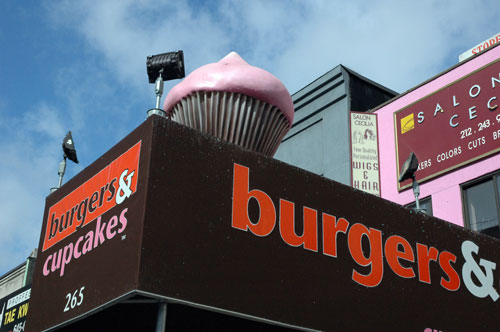
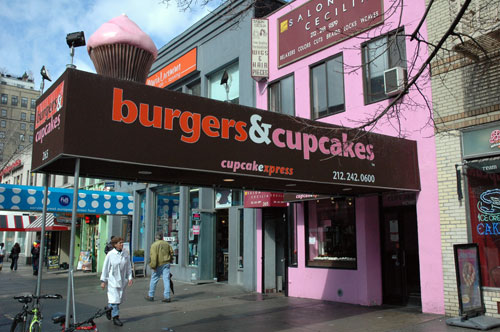
I know I’m going to regret bringing the subject up again, and not only because the additional notoriety may only be what the owners of Burgers & Cupcakes want. But I did a post one month ago reporting that the pink cupcake would come down by the beginning of April. It’s still there today, so I feel obliged to do a follow-up.
Melanie La Rocca of the office of our local City Council member Chris Quinn was told by the Department of Transportation [DOT] that the B&C owners did not have a valid permit even for a conventional framed sidewalk canopy, and that the mechanical “cupcake” mounted on the top of the unauthorized structure which is there now could not be permitted in any case, because it would be a violation of city statute. [sidewalk canopies cannot feature advertising, lights, mechanical devices or even the business’s phone number]
I was informed of this on March 2, and at that time La Rocca also said that the DOT had told her the owners had 30 days to comply with the law, meaning the cupcake would have to be removed, even if a proper permit for the canopy itself could be registered by then. I read later, in a report in a local newspaper, Chelsea Now, that the violation wasn’t actually issued until March 15 or 22 (the exact date reference wasn’t clear in the article).
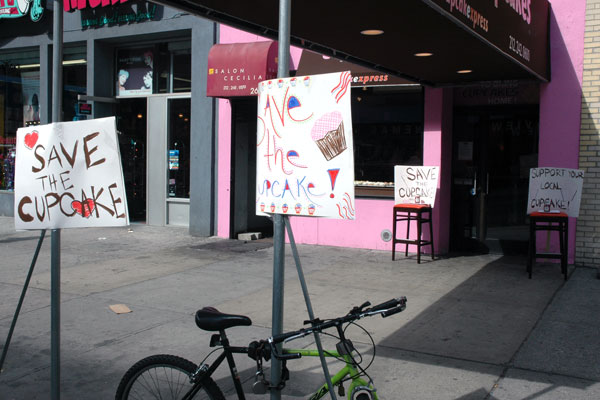
Today the owners initiated their “save the cupcake!” campaign with both cutesy hand-made signs and printed fliers outside the restaurant calling for support from anyone willing to buy something from among the scattershot reasons they give for wanting their cupcake preserved.

1.) [the DOT order is a] “beaurocratic [sic] boondoggle,”
2.) “The cupcake brightens a dreary street.”
3.) “Everyone in the neighborhood loves our cool sign.”
4.) “. . . now they are messing with a twenty thousand dollar cupcake.”
5.) “. . . loosing [sic] it will hurt our new business.”
6.) “I’m sick and tired of the city having their hands all over my business.”

I guess they think the same New York which recently wasn’t interested in saving an authentic landmark, like the former Huntington Hartford Museum, designed by Edward Durell Stone, is going to be interested in rescuing their cupcake.
Let me describe once again the reason for my interest in this admittedly less than life-and-death issue: A large lighted, revolving plastic cupcake mounted above a public sidewalk, and in fact perched virtually on the street curb, is an encroachment upon a public way. The sidewalk is part of the street, not of the building lot whose property line ends where the pavement begins. There are certainly safety issues for drivers and pedestrians as well, explaining why it’s the Department of Transportation which has responsibility here, but I’ll leave the details of addressing those subjects to the professionals. As a citizen I am most concerned with the danger of commercial encroachment and the precedent it would establish.
These are our streets; they can’t be turned over to the highest bidder.

Okay, although it is not and could not be the basis for the complaint I registered with the DOB last December, I admit that I do think the pink and brown shop and its canopy are both truly ugly. Also, unlike the B&C owners I do not think my street is “dreary”, and I believe the clutter and crude disruption created by their ugly little shop adds nothing of value to the streetscape. I repeat, these are my personal opinions and nothing more, but if we are talking about aesthetics, I believe, ironically, that it’s only the cupcake itself which might be worthy of a first, even a second look from a civilized New Yorker – if it were installed in an appropriate context.

ACT UP party tonight

Gran_Fury_tshirt5.jpg

This t-shirt was designed by the legendary activist artist collective Gran Fury 17 years ago.
Today South Africa has national health care.
A lot of people still think they can do something to help drag our own country into the [twentieth] century. Some of them know they have to ACT UP to get there. But activists also know how to party, and sometimes a little cash is needed to help make a stink, so ACT UP is throwing a $20 celebration/benefit bash this evening, and everyone is welcome.
The doors of Manhattan’s LGBT Center at 208 West 13th Street (just west of 7th Avenue) will open at 7 pm. The program will start at 8 or 8:30 and will feature readings/performances by Pulitzer-prize winning author Michael Cunningham, the notorious Church Ladies for Choice, Mark Hannay (formerly of the Hot Peaches), and fabulous downtown performance artist Penny Arcade. The evening ends with a dance party that goes until midnight.

[image via ACT UP]

ACT UP renewed, and transformed

ACT_UP_faces_sign.jpg
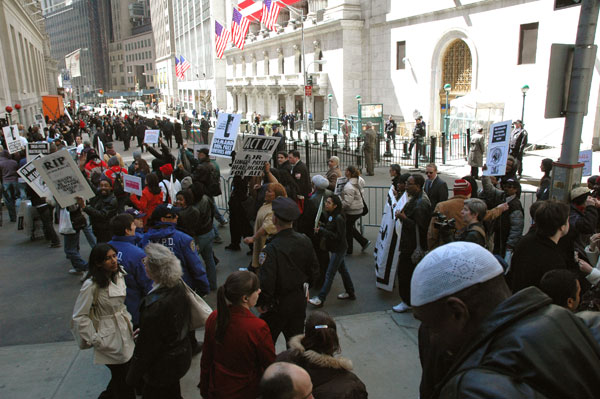
across from the Stock Exchange yesterday

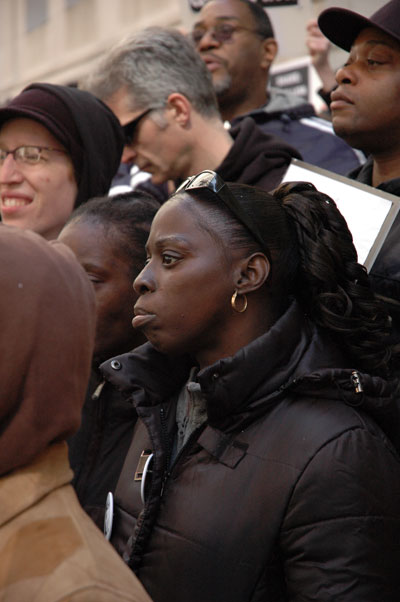
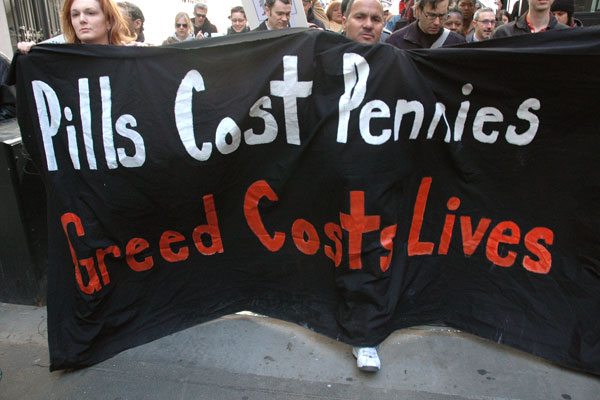
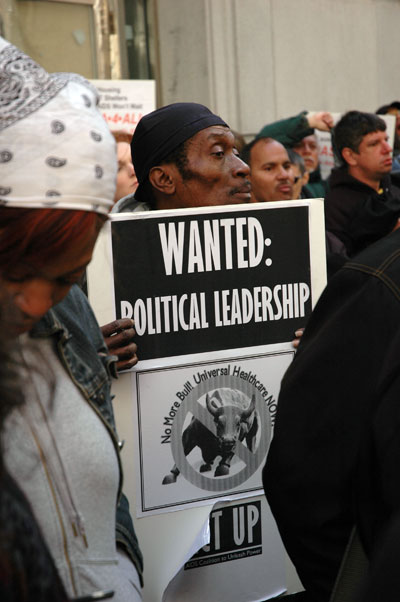
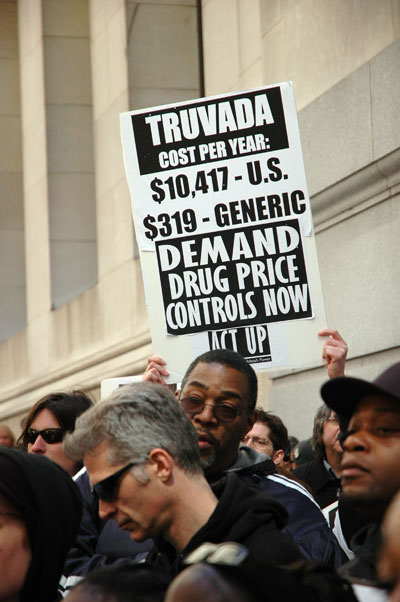
If yesterday’s ACT UP twentieth-anniversary action demonstrated anything, it was the coalition’s own renewal, and its transformation from an AIDS activist group once largely made up of young middle-class queer white males into one devoted to the this country’s larger, evolving healthcare crisis and composed of a much broader community of people who have realized we are all directly affected by both AIDS and a medical system completely inadequate to address it or other health needs.
In New York yesterday every age group and every community in this hugely-diverse city appeared to be represented in the crowd which gathered in and around the Wall Street area. They hurled chants at a powerful corporate medical, insurance and political establishment, reached out in conversations to regular passersby, they brandished both printed and hand-lettered signs addressing an aloof, fortress-minded establishment, and they carried or dragged with them some 50 bulky black body-bag props as they wound through the narrow downtown streets in a band of roughly a thousand souls. At the site of the bull statue near Bowling Green some 30 people were arrested for civil disobedience while lying down in the street amongst those bags.
The NYTimes did not consider the event worthy of a single word or image. See See Andy Humm in Gay City News for the best account of the day.
The new ACT UP appears determined to be only the nucleus [or perhaps, this still being ACT UP, really only the trigger] for re-igniting an enormous popular movement, coinciding with the run-up to the 2008 election, directed toward finally securing this nation’s adoption of a single-payer healthcare system after something like one hundred years of broken dreams and promises.
What follows are a few scenes from the struggle as renewed just yesterday.

ACT_UP_face.jpg
ACT-UP_pills-greed.jpg
ACT-UP-man.jpg
ACT_UP_Wall_St.jpg
ACT-UP_lady.jpg

ACT UP back to the Wall, this time for single-payer healthcare

ACT-UP_first_action.JPG
going back for more, 20 years later

Apparently as a nation we can accept throwing away something like half a trillion dollars (and counting), and very likely some 700,000 lives, on a remote elective war whose only accomplishment was a second term for the regime of the biggest Big Brother we’ve ever had, but we [or at least our media and our elected representatives] still think a single-payer healthcare system means handing over too much power to government.
ACT UP has always supported a single-payer health care system, and its members have always understood the role of war in thwarting its achievement. Tomorrow morning, Thursday, at 11:30 this remarkable and unfortunately still indispensable activist group of stalwarts will be marching on and in Wall Street to mark its twentieth anniversary and the beginning of its campaign to make access to healthcare for all, including single-payer insurance and drug price controls, a major issue throughout the 2008 election campaigns.
Anyone who is able to make it is welcome to join us as we gather for the march at 11 am. We will be stepping off from the Federal Building downtown, on the east side of Broadway at Worth Street, just above Chambers Street.
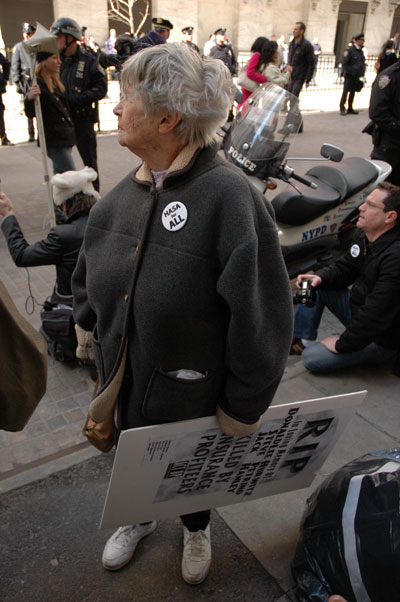
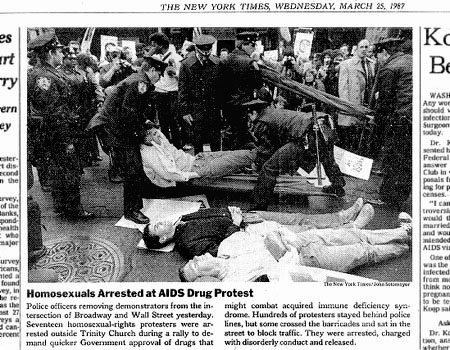
Twenty years on, the press will no longer be labelling us all “homosexuals”, as did the NYTimes in its coverage of the first action, shown in the image above, although it was exactly that powerful picture and its caption which sucked me into the group. As far as tomorrow is concerned, while it should be assumed that only those who have decided to commit some form of civil disobedience could be arrested, there is less certainty about that than there ever was in our present terrifying, and terror-stuck, political climate.
I’m bringing my camera, for surveillance purposes.
An editorial in the current issue of The Nation is an excellent tribute* to the historic accomplishment of ACT UP and a reminder that neither the role nor the actors have yet disappeared. Excerpting the last three paragraphs of the editorial:

During the years that followed, ACT UP stormed the National Institutes of Health, the FDA and the Centers for Disease Control to protest their shortcomings. On the local level, Catholic dioceses and boards of education were targeted for blocking HIV information in public schools; city governments for failing to provide care and housing; jails and prisons for setting up segregation units. Some ACT UPers set up guerrilla needle-exchange programs; others staked out the entrances to junior highs to distribute condoms directly to students. Just as essentially, ACT UP members became self-taught experts in such arcane fields as virology and patent law and in so doing rewrote the patient-doctor relationship and helped put the idea of universal healthcare–now favored by a majority of Americans–on the political map.
Along the way, ACT UP borrowed strategies from other radical movements: antinuke protesters for techniques on civil disobedience, antiapartheid campaigners for bringing political funerals to the streets. Many of its tactics–videotaping demonstrations as protection against police brutality, coordinated but autonomous affinity group actions–have become standard fare in the global justice movement, as has ACT UP’s deeply democratic tradition.
ACT UP is now a shadow of its former self, but its alums have gone on to found Health Gap, a driving force for global treatment access; the Treatment Action Group, which continues to push the AIDS research agenda; and Housing Works, which has won housing for thousands of New York City’s HIV-­positive homeless. And true to form, the organization will mark its twentieth anniversary with a march on Wall Street March 29 to demand single-payer healthcare for all.

*
including a candid apology for the progressive journal’s own historic neglect: “Though barely noticed in the pages of this publication, ACT UP would revolutionize AIDS research and treatment, as well as inject new life into the gay movement and infuse the tactic of direct action with its own style of theatrical militancy.”

[image from actupny]

the pink cupcake comes down this month

cupcake_pink_detail.jpg
going soon from your neighborhood

The giant, spinning, flood-lit pink cupcake perched above the curb on the top of an advertising canopy on West 23 Street has to be removed within 30 days. The city’s Department of Transportation [DOT], which has the authority in these things as the safety guardian of our streets and sidewalks, has found that the owners’ original permit for a conventional framed canopy expired in 2003 and that the mechanical structure appended to the awning the restaurant had built after 2003, is itself in violation of city statute.
I call it a victory for the public’s common right to the streets. It represents official recognition that there are limits to what a business operating for profit can seize from the people, even if some individual members think a particular encroachment is cute.
I won’t try to suggest that another winner here might be a decent respect for aesthetics, because New York bureaucracies are obviously not to be trusted with that kind of protection. What is to be regarded as seemly, or pretty in a huge city? I’m in love with the lively chaos of big metropolis at least as much as any of my neighbors, but New York is not Las Vegas and today’s corporate Times Square is not a reasonable model for a neighborhood. A great city must enjoy playing with itself, but it must be allowed to reveal its history and its quieter comforts and beauties as much as its essential energy.

cupcake_pink.jpg
Pepto-Bismol pink

A personal note about Burgers & Cupcakes only partly related to issues of “taste”: Even before the giant cupcake appeared late last fall I had thought the aesthetic choices made by this particular food-operation business were rather unwise, if not totally unbelieveable, for business reasons alone: Pepto-Bismol pink and wet-feces brown would not seem to be the obvious choice for a restaurant’s advertising sign and interior decor.

Ben%26Jerry_storefront.jpg
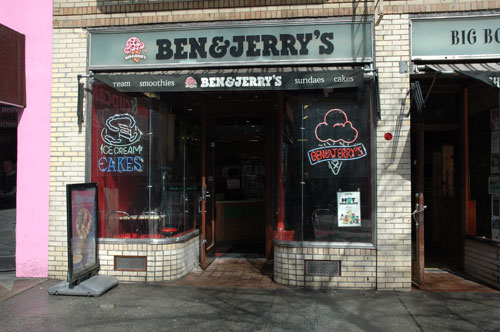
still curved after seventy years

And a note on both the historical and street context of the Pepto-Bismol building: This is one of several two-story “taxpayers” constructed on the site occupied by four early-nineteenth-century brownstones when I moved in next door twenty years ago. The landlord(s) of these once-handsome townhouses (converted eventually into rent-stabilized or rent-controlled apartments, with small stores on the ground floor) had deliberately neglected their upkeep and eventually succeeded in displacing the tenants in anticipation of some speculative boon which apparently never materialized. The buildings were then demolished and the lots left boarded up for a time, until the current structures, thrown together almost overnight with metal sticks, styrofoam and stucco, displaced hundreds of our neighborhood pigeons and untold generations of rats.
Today these jerry-built structures are an exceedingly awkward interruption of the streetscape of the north side of this Chelsea block. On their left is a large and quite handsome art-modern building (still a Woolworth store with a full lunch counter when I moved to the street, but currently a GAP branch, with a gym occupying the areas on the second floor which were originally devoted to professional offices). On the right is a large yellow-brick 1936 art deco apartment house (with eight very neat restored small storefronts on the street level. One of them is occupied by a Ben & Jerry’s boasting the original curved glass windows and period metal moldings which can’t be duplicated today. There is a restored fully-retractable awning mechanism in a pocket above the windows, and below them there are two reconstructed grilled openings ingeniously devised for ventilating the basement storage area).
This kind of love, intelligent attention, labor and sacrifice devoted here to enhancing the ambience of a cherished neighborhood in a city of eight or nine million people is of an entirely different order from the ignorance and indifference which produced the rotating pink cupcake and the several poor sheds of which it is such a part.

[thanks to Blog Chelsea for helping to keep the pink cupcake issue alive, and to Melanie La Rocca of Chris Quinn’s office for doggedly pursuing the DOT about the status of my complaint]

subway abstractions

wagner-abstraction_1.jpg
wagner_abstraction_2.jpg
wagner_abstraction_3.jpg
wagner_abstraction_5.jpg
wagner_abstraction_6.jpg
wagner_abstraction_7.jpg

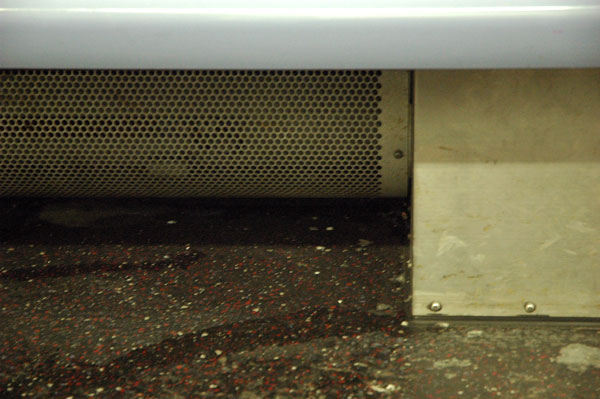
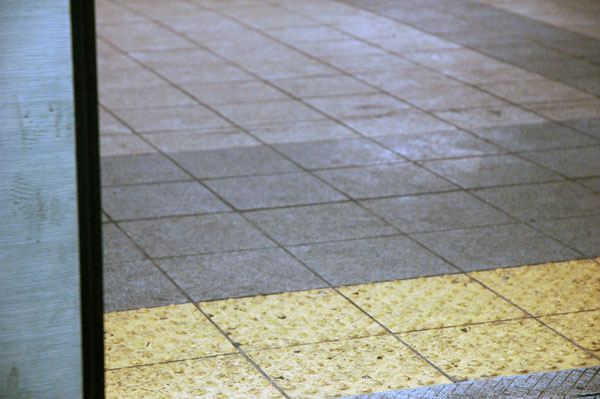
Barry had a copy of Harpers, but I had neglected to take any reading material with me today when we headed off to Williamsburg. Of course that meant that we would have an unusually long wait at the head of the line on 14th Street before the otherwise completely empty L train would get on its way east. I reached for my camera, but the digital clip was empty, so there were no older images to entertain me while I waited.
Then I decided to unleash it to see what it could make of the limited material available in sight. I just stayed on the bench and let Barry read to me from his magazine.
These are the images I retrieved when we got home.

NBC Nightly News has puppies!

puppies2X.jpg
always good for ratings

Sherry Mazzocchi, of Blog Chelsea, writes to us that she sees NBC has apparently taken for a constructive suggestion the example Barry had used to condemn the triviality of what the networks represent as news. For a look at the incredible Brian Williams’s “look at these puppies!” segment recorded last night, go to this video (you’ll have to wait fifteen seconds for the advert to run).

[image from zimfamilycockers]

Homeless Museum at home to guests this Sunday

HoMuNEWEST.jpg
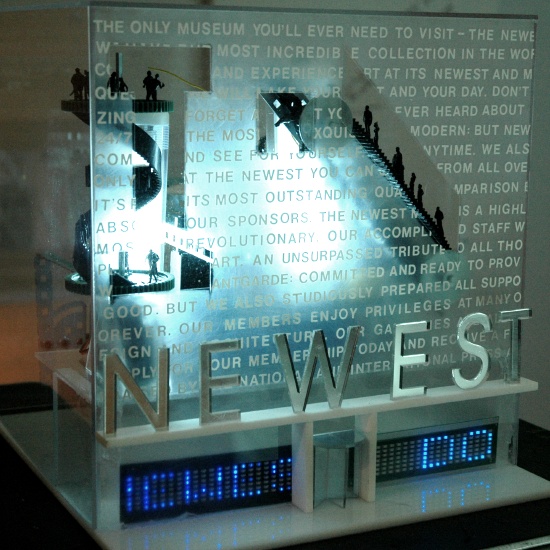
Filip Noterdaeme THE NEWEST� 2006 model (plexiglass, LED screens, figurines, remote-controlled robotic system) [installation view]*

The Homeless Museum (affectionately referred to as HoMu by both adoring fans and its own creators) will be welcoming visitors once again this Sunday. I don’t think anyone could describe this incredible institution as well as the creators themselves do on the museum’s website, and I’m certainly not going to try:

A product of New York City’s cultural decline, the Homeless Museum (HoMu) is a budget-and-staff-free, unaccredited arts organization that enables and engages cultural dialogue practiced at the intersection of the arts and homelessness.

Originally established mostly as a concept, two years ago the museum found a home in the fifth-floor walkup the founder shares with his partner Daniel Isengart. Once a month they open their doors to guests by invitation. Visitors are encouraged to email (info@homelessmuseum.org) or call (718-522-5683).
The NYTimes has found out about it and last month Dan Shaw wrote an excellent account of its mission and its work. The Believer has an extended article by Samantha Topol in the December/January issue.
I highly recommend a visit to the museum. Barry and I were there several weeks ago and we were charmed by the wit and sincerity of our hosts and delighted with the museum experience. We had first encountered what I’ll call the creative humanism of Filip Noterdaeme’s projects two years ago when we read about his campaign to shame the Museum of Modern Art (called MoMa by both supporters and critics, with little warmth from either) for its introduction of a compulsory $20 admission charge. Noterdaeme encouraged and inspired visitors to pay the entire amount in pennies, making it necessary for the museum to place buckets beside the station of each ticket clerk.
The admission at HoMu itself is determined on the basis weight (1�/lb.), cash only. The Times article describes its membership policy:

The museum raises money for the homeless with a twist on the usual cultural memberships. ”We encourage visitors to become members,” Mr. Isengart said. ”We tell them they can choose from any levels, from $5 to $125, and that they must give the money to a homeless person of their choice directly. We do it this way so that 100 percent of their donation goes to the homeless.”

NoterdaemeSpoon.jpg
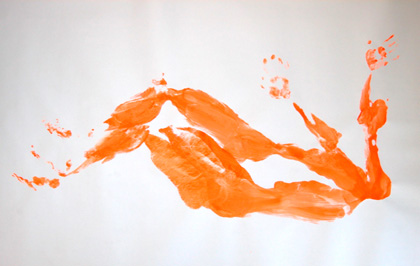
Filip Noterdaeme Spoon, 1/8 Iroquios drawing

“Spoon, 1/8 Iroquios” is in the museum’s collection. It is part of a series which represents a kind of empathetic curating concern absent from any museum of my experience. From the HoMu website:

The One-on-One Collection is a deeply felt and authentic engagement with the grim and stultifying lives of countless homeless adults who yearn for love, but instead must settle for broken dreams, abuse, and danger.
What began as a fascination with the sex lives of homeless men and how they fulfill their sexual desires has inspired this collection of body prints that are reminiscent in style of Yves Klein’s Anthropometries. Paintings on paper made by the imprint of naked bodies previously drenched in “Homeless Orange” provide a range of erotic connotations, addressing taboos such as homelessness, public sex, and homosexuality. For example, in “Spoon, 1/8 Iroquois”, two silhouettes suggest a hurried sexual encounter between two men.

What’s the tie-in between HoMu’s championing of the homeless and its critique of the museum? I think it lies in a profound awareness of the contrast between the outlandish sums of money and attention devoted to the increasingly-elaborate (and increasingly-inaccessible) temples in which we house the high-end items branded as our official cultural idols, and an incredibly wealthy society’s neglect or spurning of its own most-forsaken things and people, including its own material detritus but above all the homeless, the outsider, and the uncompromised artist. Noterdaeme and Isengart bring it all home with their phenomenal mix of minimalist panache and compassion.
The open house is Sunday from 1 to 6, on Clinton Street in Brooklyn Heights.

HoMuglycerinemuseum.jpg
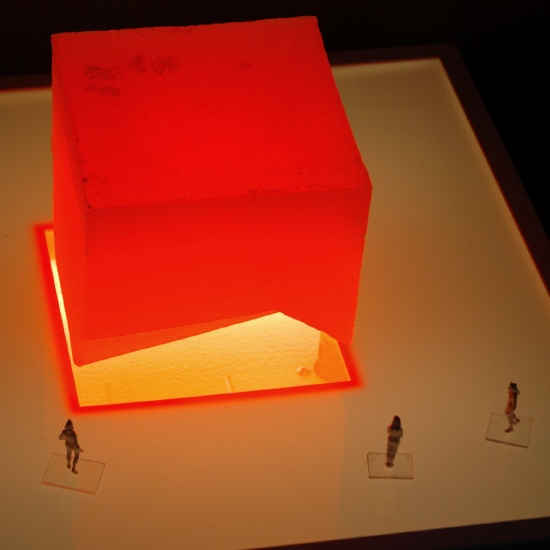
Filip Noterdaeme ISM (The Incredible Shrinking Museum) 2004-2006 model (glycerin soap) [installation view]*

*
descriptions of the two works shown in model form above, adapted from material furnished by the artist:

“The Newest�” presents itself as a new contemporary art museum. Viewed from the front, it appears to be a building that is inundated by visitors whose silhouettes can be seen moving about behind its see-through fa�ade, outfitted with several slogan-flashing LED screens. But a look behind the scene reveals the effect to be a choreographed deception: The Newest� is not a building but an oversized stage-set simulating a building front. The visitors turn out to be dummies circulating on conveyor belts and rotating platforms. The machinery is controlled from a computer operated by a single person, the museum director.

“ISM (The Incredible Shrinking Museum)” is a project for an interactive museum consisting of a sixteen-foot cube of glycerin soap. The cube is subject to constant change through exposure to the elements. In addition, visitors will be invited to exploit the structure like a mine until is it is used up, the goal being to reach out to a new audience and challenge visitors to think about their role as active participants in the shaping and destruction of culture through direct participation in the realization and, ultimately, the deconstruction of a museum.

[image of “Spoon” from HoMu]