“blogger summit”: WNBC wants in

TINYPUPS.JPG
MSM news

During the station’s introductory presentation last night at what was billed as New York’s first Blogger Summit, the host, WNBC, reported that its own advance survey revealed that zero percent of their invited blog respondents thought that local TV news was helpful to their posting. This must have come as something of a shock to the network people, although I can’t imagine why, because minutes later the station’s News and Station Manager, Dan Foreman (who later told us that he had not really expected to enter much into the discussion) asked the assembled crowd of bloggers whether in light of their responses WNBC should just shut down its TV operations and concentrate entirely on developing a blog medium.
A show of hands from the audience, after what seemed like a moment of shock in response to what seemed like a genuinely impulsive question, indicated that there was a strong affirmative response. One blogger however did cry out, “what about the old people?” In the exchange which followed, one guest described local TV news coverage as composed mostly of stories on “fires and murders”. Wow: Only two hours later, while awaiting the station’s coverage of its own “blogger summit”, I noticed that WNBC’s 11 o’clock news led with an account of a fire, followed by a report of a murder. I was visiting the site for the very first time since the early 90’s, when, because of a vested interest in the “broadcasting” of a politcal message, my friends and I would regularly scan local news coverage of our own creative theatrical actions or “zaps”.
While sitting in Studio A last night I was trying to imagine why any smart New Yorker would actually want to, or be able to, regularly wait around for a brief, fixed-schedule television news program in order to learn what was happening in the city – even if that were what was actually to be found on the little screen. At one point last night even Editorial Director Adam Shapiro admitted that the abbreviated nightly news format permitted only very limited coverage of any story.
I think that, except for those employed by NBC, few people in that studio normally watch network news of any kind. Later last night, during the local station’s on-air coverage of the summit, technology reporter Sree Srinavasan explained to viewers browsing the web as novices that they would have to be sceptical about the accuracy of the information they find on blogs. He encouraged them to look around and not to trust the face value of anything, suggesting that it would be wise to get to know the sources of the information found: This is always good advice – for both journalists and those they serve, but in this case the scepticism absolutely has to begin with the powerful MSM, best described as our mainstream corporate entertainment media. [footnote: NBC is owned by GE]
On the subject of journalistic malpractice, that most excellent community source, Blog Chelsea, says that Barry put it best, in conversation last night:

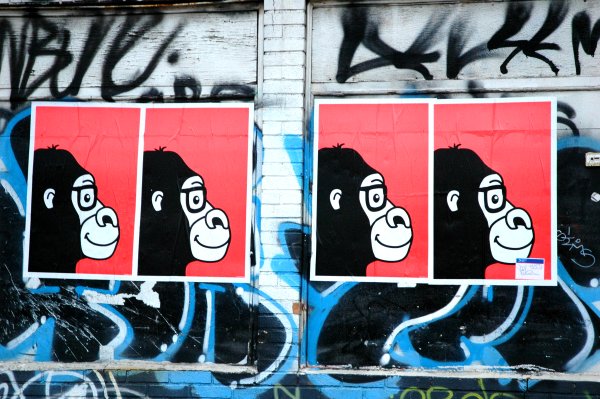
There’s a war on, but all they can say is, “Look at these puppies!” They talk about Clinton’s sex life, but not about all of the freedom that is slowly being taken away from you.

[image from diamondsintheruff]
J.T. Kirkland at J.T. Kirkland

Kirklanddrawings.jpg
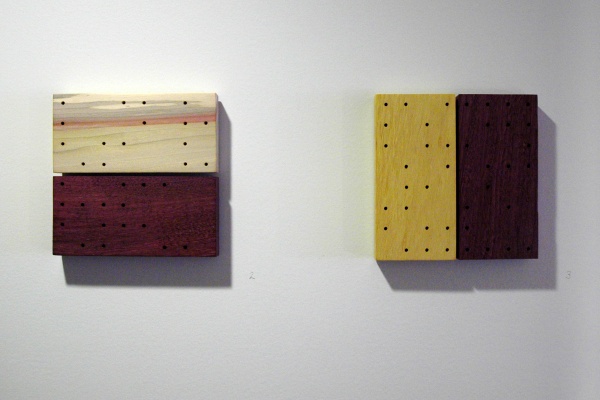
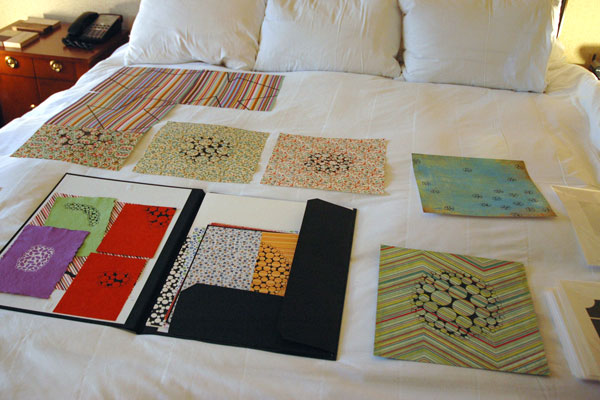
scattering the drawings – as much fun as the Gramercy – showing, among other pieces, Line IV 2006 ink on archival scrapbook paper 24″ x 24″ on the top left, Bulb I 2006 ink on archival paper 12″ x 12″ on the lower right, and Float 2006 ink on archival scrapbook paper 12″ x 12″ just above it [installation view]

It involved a lot of imagination, a lot of work and a certain amount of risk, but one excellent, under-exposed D.C. area artist has managed to arrange for a one-man show in New York this week all on his own.
J.T. Kirkland knew well in advance that his job would take him to Manhattan all this week, but he decided he wasn’t going to limit his off-hour activities to trips to Chelsea galleries looking at other artists’ work. Kirkland drove to New York with a selection of all but his largest wall sculptures packed in his car and he has installed them, along with some stunning drawings and prints, inside his downtown hotel room. The week before this he had sent invitations to friends, collectors, curators and gallerists and many have made the trip over the last several evenings.
Kirkland’s “gallery” reminded me of the fun and reward of visits to the early Gramercy Art Fairs, when dozens of the old hotel’s guest rooms were temporarily and magically transformed into something like so many “trunk shows” showing some pretty adventurous art. Sometimes you might quickly move on after a peek inside a room, but we both would have made this room a “stayer”.
The New York world of the visual arts can always use more of this kind of infectious delight in a creativity unfettered by the conventional institutional structures (which in the long run couldn’t possibly survive on their own without the continuous challenge of the excluded).

Kirklandsculpture.jpg
two small sculptures installed on the hotel room wall: Spalted Poplar, Purpleheart 2006 wood 6″ x 6″ and Purpleheart, Yellowheart 2006 6″ x 6″ [installation view]

I was already interested in the artist’s work, having found images on line last year. When Barry and I later managed to come home with a small piece he had donated to the recent Visual Aids “Postcards From the Edge” benefit we found we were hooked on these wonderful wooden devices. We had also seen the equally conceptual, minimalist drawings he shows on his site, but I wasn’t prepared for the extravagant beauty of the real thing. And the prints are really wonderful!
We had a great time this afternoon, not least for the good converstation. Oh yes, Kirkland also has a blog.

TO SEE THE WORK:

I cannot reveal the details of the hotel location here, but if anyone reading this is interested in a visit tonight on the closing day of the show, and is able to stop by there between 7:30 and 9:30, please email Kirkland at jtkirkland@gmail.com.

gone yesterday

roofwet1%3A07.jpg
untitled (vinca) 2006

This image was taken on January 6, just ten days ago, when temperatures hovered near 70 degrees and a gentle rain was falling on our roof garden outside the breakfast room window. Last night the temperature slipped below freezing with an earnestness not seen this winter until now. It finally feels like the planet may have snapped back into its proper orbit, just as we are about to obtain the second moon of a season begun last December 21.

the two Times Square demonstrations

antiwardemo1%3A11%3A07.jpg
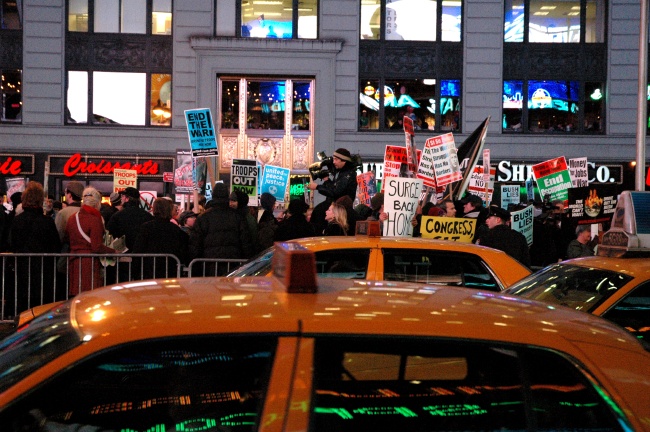
hundreds of anti-war demonstrators on the north side
antiwarapproveddemo.jpg
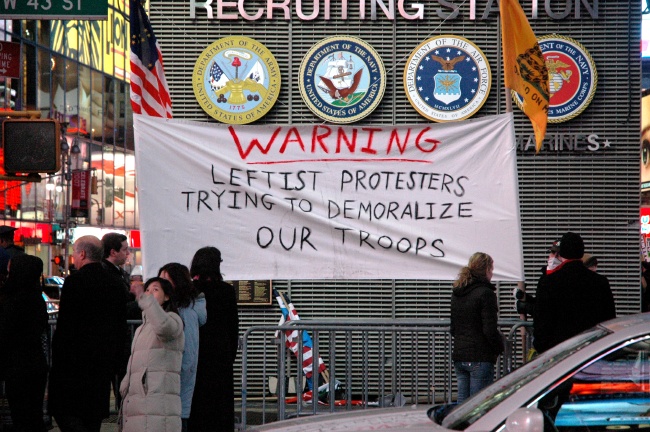
two intrepid pro-war demonstrators on the south side

New York activists were able to attract a couple of hundred demonstrators to the Times Square military recruiting station on Thursday night, responding to Bush’s announcement of the night before that he would significantly increase the count of troops in Iraq rather than reduce or eliminate the numbers already there.
On the south side of the kiosk two lone young men stood beneath a banner mounted to an American flag on one side and the Gadsden flag on the other. The man on the right wore a baseball cap with an NYPD emblem, I suppose as to indicate another allegiance, or perhaps only in the hope of gaining the cooperation of the police monitoring the demonstration site.
When I first saw the second image uploaded onto the screen on the camera back I thought the flags looked like they were attached to the recruiting station itself and I was going to go with a blog headline something like: “the government-approved demonstration”. What I can see now however the NYPD was acting very correctly, just isolating the two groups, so this time there’s no real excitement to report from jimlog quarters.
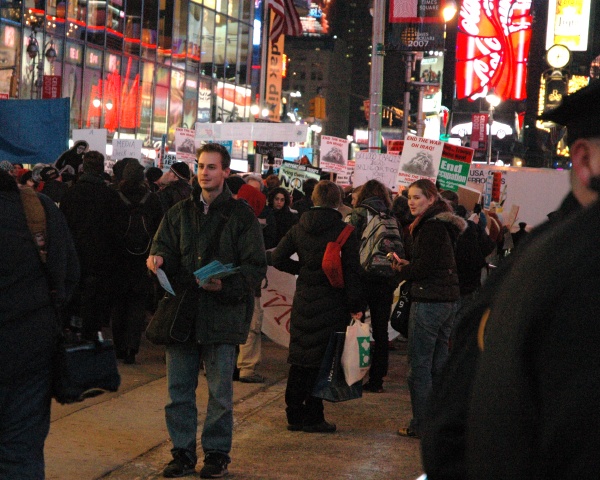
Everything was actually going very peacefully while I was there (the two militarists were vastly outnumbered and the rest of the crowd after all was out there demonstrating for peace). I will say that there was a lot more energy and excitement on the north side – and definitely a lot more smart-looking and attractive people:
antiwardemo1%3A11%3A07cutes.jpg
communication

June in January

globalwarmingmosquito.jpg

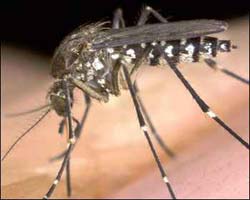
I don’t mean to unduly upset anyone not already concerned about climate change, and I know that as scientific evidence it’s merely anecdotal, but tonight while I was sitting in front of an open window checking my email I was buzzed by a mosquito. And on the roof garden just beyond the sill our large begonia bush, like all of the other plants not cleaned out of the pots last fall, seems to be thriving.
The place: Manhattan. The date: January 6.

[image from Mosquito Netting Project]

Wooster on Spring

11 Spring
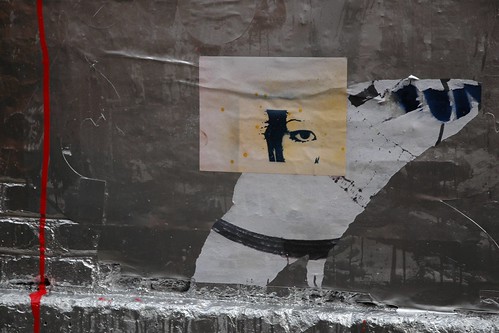
this collage is probably mostly an accident, but stunning nevertheless
[for 41 more images go to my 11 Spring photo set]

Why is it called “street art”? And does art created in the street step out of character when it steps in off the street? Where does street art fit in the hierarchy? Can street art inform the mostly housebroken art which makes it into our galleries, our homes, our museums? Does street art disappear when the street moves on? What role does commerce play in the creation and the survival of art seen in the street – or the survival of the privileged art of the salon? Is street art necessarily more political than art which originates under a roof? Can just about anyone appreciate, can everyone learn to love, the best art found on the streets? Why does street art attract a special kind of excitement, even fanaticism and almost cultish devotion to its mysteries and beauties that is almost never shared by conventional art museums? Does an artist have to love a street before she or he can use it as a “canvas”? Is there a future for street art in an increasingly-sanitized Manhattan, and nearby Brooklyn, rapidly being customized for the pleasure of millionaires and their vastly richer new neighbors?
This past weekend New Yorkers had a rare and wonderful opportunity to be provoked by at least some of these questions, and probably a lot more I left out, so long as they were willing to stand in line (yes, in the street) for an hour and probably much longer in order to gain access to the cultural and real estate phenomenon of “Wooster on Spring“. Well, admittedly the line was for a view of inside street art (inspiring some of the questions posed in the paragraph above), but the experience was almost like stepping inside the work itself. The fact that all of the art would soon be rendered invisible obviously added to the appeal of this temporary street-corner agora. 11 Spring Street is now closed and construction will soon begin on the five floors of this nineteenth-century brick and stone building in NoLIta. The grim but noble pile is slated for conversion into another representative of New York’s still growing stash of “luxury condos”.
Me, I really liked the art, but I couldn’t also help thinking of the significance of this amazing phenomenon while trying to decode and enjoy the exciting work of the 45 artists who were invited and hosted over the last few months by a few other people who clearly like art – a whole lot.
And now it’s all gone. Well, at least until the next New York renaisance, for while the outside of the building is to be cleaned and restored to something like its nineteenth-century appearance, the work inside 11 Spring is to be sealed up for the ages behind the new plasterboard walls deemed meet for the pampered sheltering of our newest professional class. If things work out better than they do in most apartment buildings, eventually there will at least be some good art showing up on those clean white walls, even if it will have to be store-bought.

I have not put captions on the Flickr images, largely because many are general or detail installation shots and because I’m not able to identify most of the artists. I’d be delighted if more knowledgeable visitors to the site could add attributions with their comments.

Target free speech

TargetFreeSpeech.jpg
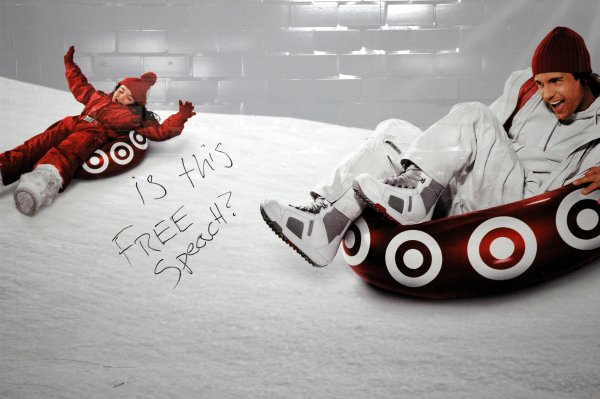
who, or what, does have the right to “speak” in public, and how much does free speech cost?

Coming home from the opening at the Whitney at Altria last night, I spotted the graffiti comment on the poster shown in a detail above.
The Times Square terminus for the S train has been turned over entirely to Target corporate images. The eponymous red logo is prominently repeated on a white ground and it’s wrapped around every column. Images of happy customers on huge shiny white posters cover almost every inch of every wall in sight.
It’s finally absolutely impossible for a fare payer to avoid the assault of advertising even while running through the station to catch a train; if you have to wait a minute or more, the pain of overload becomes acute. [This observation comes from someone who is normally almost immune to the lure of advertising campaigns in any medium.]
New Yorkers have just paid a fortune to restore or re-build their MTA stations, and public art and concerns for a decent aesthetic were both a major part of the program; who decided to sell our heritage to the highest private bidder who then would be free to corrupt a very public facility? There’s expensive new tile under those billboards, and in the image above it seems to be doing its damndest to overcome the rude advertising defacement.

rural-ish Village with a dark urban history

rosegardenJeffersonMarket.jpg
leavesJeffersonMarket.jpg

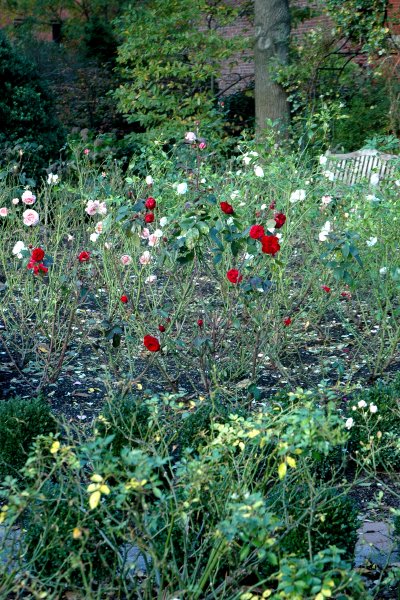
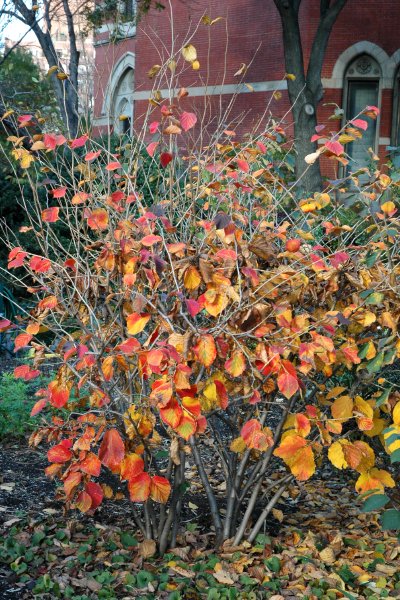
Some of the last roses and last leaves of, er . . . autumn, seen Friday through the tall iron fence which surrounds Jefferson Market Garden which, through much of the mid-twentieth century, was the site of the New York Women’s House of Detention.
The institution’s prominent location in the commercial center of a crowded Greenwich Village was apparently a perfect opportunity for the prisoners to, in the words of Wikipedia, “. . . taunt and curse people going about their business on 6th Avenue.” Ah, if the ladies could see the old grounds today . . . .
The notorious [art deco] lockup may have vanished without a trace, but the Rockefeller Drug Laws have continued and expanded its dreary commission. Today the old building’s function has been assumed by an even more forbidding-looking fortress tucked into an increasingly-upscale Chelsea gallery district. It also however sits on the very edge of the incredibly noisy West Side Highway, a site much less amenable to any inmate “taunt and curse” activities, even if contemporary cell windows could open.
More on the history of the courthouse, jail and market complex now loosely called “Jefferson Market” can be found here.