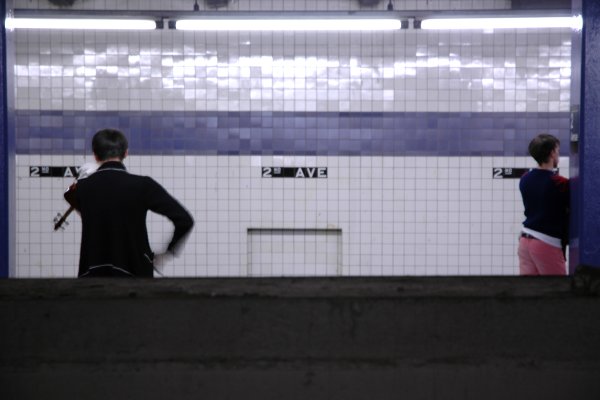
on the Brooklyn College massacre, Riverdale Press rocks!

[this editorial is too good to stay in the Bronx; Barry reformatted it from a PDF so I could upload it here]

THE RIVERDALE PRESS Thursday, May 11, 2006
———————————————————————————————
The return of the censors

In 1988, Chicago police arrested a painting; last week, New York City jailed an entire art exhibit.
In both cases, the offending art was student work on display in the year-end show that is a college art department’s equivalent of a thesis.
In both cases, the authorities acted precipitately and in violation of the fundamental right of artists to express themselves and of our fundamental right to make up our own minds.
In both cases the academic institutions that should have defended their students and the faculty that mentored them instead beat a craven retreat.
It took a federal court to rebuke the Chicago authorities for confiscating David Nelson’s mocking portrait of the city’s late mayor Harold Washington clad only in a bra and panties.
Will it take a court to stand up for the students of Brooklyn College, who, shortly after celebrating what they thought was a successful opening, saw months of work sequestered?
Last Thursday, Brooklyn Parks Commissioner Julius Spiegel abruptly locked up the war memorial in Cadman Plaza Park, which for the last five years has served as an art gallery and the venue for Brooklyn College’s year-end art exhibit.
The commissioner-turned-critic apparently didn’t like the image of a penis with homoerotic overtones or a video on Biblical themes that included sexually-charged footage of Eve in the garden. Next thing the students knew, a locksmith was changing the locks on the gallery, effectively impounding their work.
It took the college the better part of a day to decide how to respond. Then it issued a statement trying to have it both ways: “In keeping with the public nature of the space, as well as its position as an honored war memorial, Brooklyn College has respectfully decided to move the entire student exhibit to our campus. Brooklyn College has a long tradition of educating fine artists. Throughout, the administration of the College has supported our students’ rights to freedom of artistic expression. We are proud to display our student art here at the College.”
Not good enough, said the students. Told the exhibit would be moved to the college library, Marni Kotak, the students’ spokeswoman, noted that many of the 18 works were site-specific and others were too large to be exhibited effectively in the library.
“Clearly the administration of BC is thinking only of covering themselves 
 rather than taking any kind of stand at all to defend the hard work of us students,” she wrote in an e-mail. “We are generally infuriated by this tactic and are determined to either have our show reopened at the War Memorial or hold BC responsible for covering all costs for moving and reinstalling such an exhibition in another appropriate venue.”
According to city Parks Department spokesman Warner Johnston, the city had an “explicit agreement with the college that because it’s a war memorial and public space, it had to be appropriate for families.” Asked for a copy, he paused, then said there was no written agreement, but a verbal understanding. Colleen Roche, the head of a public relations firm hired by the college, refused to answer questions about the agreement and whether, if it existed, the art department or anyone in the current administration knew of it. The students say no one ever told them about it.
In any event, it is sad to see an institution of higher learning forget the lessons of the past. Only seven years ago, the city was rebuked for trying to intimidate and punish another Brooklyn institution, when a federal judge told Mayor Rudolph Giuliani that he couldn’t force the Brooklyn Museum to abandon the “Sensation” show.
The Giuliani administration then made an argument much like the one the Bloomberg administration is making now. Rejecting the contention that the museum broke its contract with the city to educate school children by showing work not fit for children to see, Judge Nina Gershon wrote, “There is no federal constitutional issue more grave than the effort by government officials to censor works of expression and to threaten the vitality of a major cultural institution as punishment for failing to abide by governmental demands for orthodoxy.”
The job of a university is to educate not only its students but the society it serves. In failing to stand up for its students’ exhibit, Brooklyn College lost an opportunity to explain the role and the nature of art. And it failed in an even more important task: to tell New Yorkers that it’s their job as citizens to judge public expression, and that no matter how provocative or potentially offensive it may be, the government has no business intruding on our ability to do so.
Brooklyn College decides sex wrong for New York public

Crain’s reports that Brooklyn College has opted to move their school MFA exhibit rather than fight the City’s shutdown.

“In keeping with the public nature of the space, as well as its position as an honored war memorial, Brooklyn College has respectfully decided to move the entire student exhibit to our campus,” said [president and Brooklyn College Provost Roberta] Matthews in a statement.

Lesson: Art is best kept locked up unless it’s really old or pretty much dead otherwise. Or: Don’t scare the horses’ asses in a tinhorn town.
[tip on follow-up story comes from Bloggy]

who owns New York?

REMYsliver.jpg
coming soon to a neighborhood which may be your own

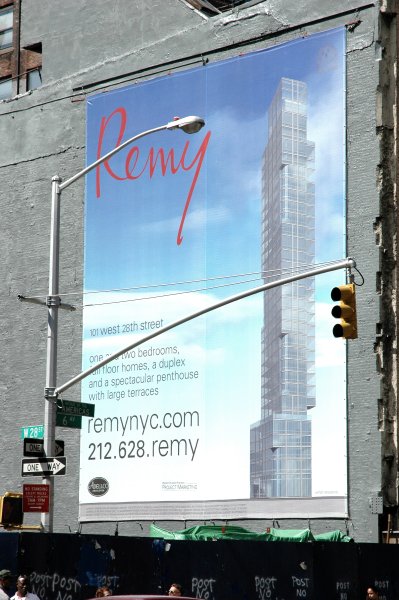
I spotted this developer’s sign hanging on the side of a building next to the [momentarily] empty lot on 6th Avenue and 28th Street.
Does the zoning department know about this thing? I thought sliver buildings had been outlawed in New York. Has anyone noticed what’s been happening to 6th Avenue above 23rd Street? Has anyone thought about what it’s going to be like down on the ground, far below “the best in contemporary living design“? I thought Blade Runner was a movie. Is my old neighborhood just raw meat?
I want my flea market back.

parrot’s back

parrotLaTaza.jpg

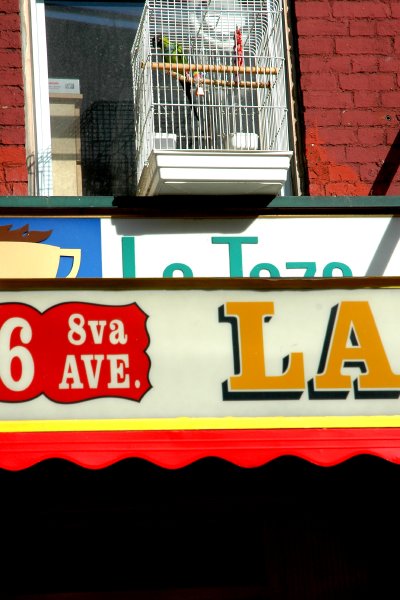
Two summers back I passed this guy’s lofty perch on 8th Avenue at least ten times a week on my way to and from the Cancer Center, but last year I never saw (or heard) him once. Two days ago I noticed his shriek, after leaving White Colums on Horatio Street, while still almost two blocks away.
The sidewalk vendor below the bodega could hardly have been indifferent to the loss of the parrot’s raucus companionship. He may not be as pleased by the bird’s return as Barry and I were. The year before last he had told me, when I asked about his colorful neighbor: “damn thing never shuts up!” Still, I’d like to think they had developed some form of comity, especially now that they’re back together.

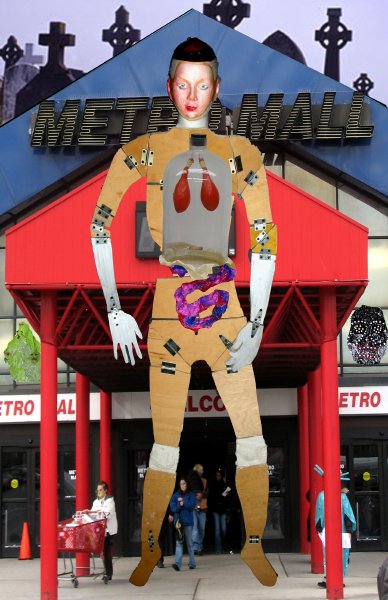
Metro Mall plays April Fool early

MetroMall2.jpg
a noble experiment

A Queens shopping center has cancelled Saturday’s Metro Mall Art and Science Fair which had been organized by Jacques Louis Vidal.
The young artist had planned a very imaginative sculpture/event along with 26 other artists and inventors to be held in what is apparently by any measure an under-utilized hall of commerce. He described his contribution as a “surrealist county fair”, but the Mall suddenly put the kibosh on all their plans this afternoon because of its displeasure with an article which appeared in the NYTimes this morning. The Mall management thought the piece was “disgusting” for its reference to the number of the mall’s store tenants which had closed, and while they apparently have no quarrel with Vidal himself, the decision was made that they would have nothing to do with the subject of the article. No Fair.
Ah, the power of the press, re-imagined. Or, better (worse?), unimagined.

[image from Vidal’s Metro Mall event site, where it appears squeezed into a different proportion]

‘Permanent Bases’ and Rachel Corrie, both in The Nation

There are few issues more important to our own survival and that of the entire world than the state of Israel and the war in Iraq. In two consecutive issues this month The Nation‘s contributors offer enlightenment in these areas to even the most knowledgeable reader.
I usually skip the many articles which only reflect what I already know or suspect, but I couldn’t do without those which highlight this magazine’s ability to reliably report or sensibly argue what what I’m unlikely to find anywhere else. These two fill that description in spades.
Unfortunately only one of these two particular reads are available on line, but you’re depriving yourself, The Nation, and the nation if you aren’t already a subscriber.
An excerpt from Tom Engelhardt’s”Can You Say ‘Permanent Bases’?“, which is not on line:

To this day, those Little Americas [at least four “super-bases”] remain at the secret heart of “reconstruction” policy in Iraq. As long as [Halliburton] keeps building them, there can be no genuine withdrawal. Despite recent press visits, our super-bases remain in policy silence. The Bush Administration does not discuss them (other than to deny their permanence). No plans for them are debated in Congress. The opposition Democrats generally ignore them.

An excerpt from Philip Weiss’s “Why These Tickets are Too Hot for New York“, which is available on the magazine’s website:

As George Hunka, author of the theater blog Superfluities, says [about New York Theatre Workshop’s cancellation of the play, “My Name is Rachel Corrie”], “This is far too important an issue for everyone to paper it over again, with everyone shaking hands for a New York Times photographer. It’s an extraordinarily rare picture of the ways that New York cultural institutions make their decisions about what to produce.”
Hunka doesn’t use the J-word. Jen Marlowe does. A Jewish activist with Rachelswords.org (which is staging a reading of Corrie’s words on March 22 with the Corrie parents present), she says, “I don’t want to say the Jewish community is monolithic. It isn’t. But among many American Jews who are very progressive and fight deeply for many social justice issues, there’s a knee-jerk reflexive reaction that happens around issues related to Israel.”

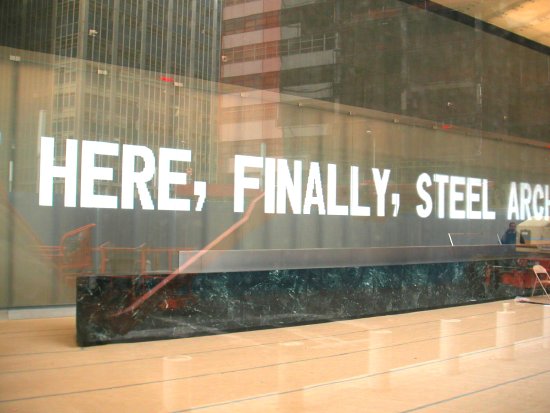
Jenny Holzer: bigger will be bigger

7WTC2Holzer.jpg
Le Corbusier* via Jenny Holzer via Larry Silverstein

Speaking of large works of art [from my March 4 post: “…the Whitney rooms are devoted almost exclusively to large works; almost everything can be seen easily from a distance.”], Jenny Holzer is completing the installation of a 65-foot-wide, 14-foot-high wall sculpture of moving text commissioned for the lobby of the new 7 World Trade Center. I was downtown this afternoon so I sneaked what looks here like a spy camera shot while I stood in the midst of the construction machinery outside the building shielding my little Minolta.
In an upbeat report in the NYTimes this morning we are told, “Though the artwork resides in the lobby, it is already visible several blocks away.”
That even beats the Biennial’s “Peace Tower” installed in the dry moat below the Whitney’s front windows.
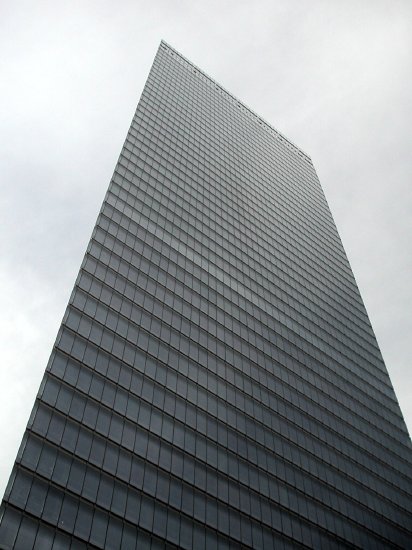
I think it will look fine, perhaps even very, very fine. At least from a distance the Childs building seems to be an improvement over the old 7 WTC, even if much of its virtue may be tied to its glassy near invisibility. I worked in the old fortress for years, and even with a lobby stocked with decent, large-scale late twentieth-century art I shuddered every time I had to walk to or from the elevators. The Lichtenstein, the Held, the Nevelson and the Bleckner [all destroyed] were all basically add-ons inside that pompous and brutally cold corporate control center lobby.
Today’s article describes some of the process of the collaboration between the artist, architect David Childs and developer Larry Silverstein. While it clearly won’t be one of Holzer’s more provocative projects (the texts which had to be cleared by Silverstein, will apparently be as close to sweetness and light as Manhattan ever gets), we may still be able to hope for more later on: “I hope to feed it again,” Ms. Holzer said. “It would be nice to keep it alive.”
For the sake of all of us, I wish her success.

*
the complete quote reads:

The George Washington Bridge over the Hudson is the most beautiful bridge in the world. Made of cables and steel beams, it gleams in the sky like a reversed arch. It is blessed. It is the only seat of grace in the disordered city. It is painted an aluminum color and, between water and sky, you see nothing but the bent cord supported by two steel towers. When your car moves up the ramp, the two towers rise so high that it brings you happiness; their structure is so pure, so resolute, so regular that here, finally, steel architecture seems to laugh… The second tower is very far away; innumerable vertical cables, gleaming across the sky, are suspended from the magisterial curve that swings down and then up. The rose-colored towers of New York appear, a vision whose harshness is mitigated by distance.

7WTChighside.jpg
the new 7 WTC: very clean, but nothing new

[it was Barry who drew the connection between what I had written earlier about the Biennial and this project when I mentioned the Times story at the breakfast table]

still sticking with snow

snowgrate.jpg
snowboughs.jpg

These two storm details were captured during a walk across West 22nd Street late yesterday afternoon.
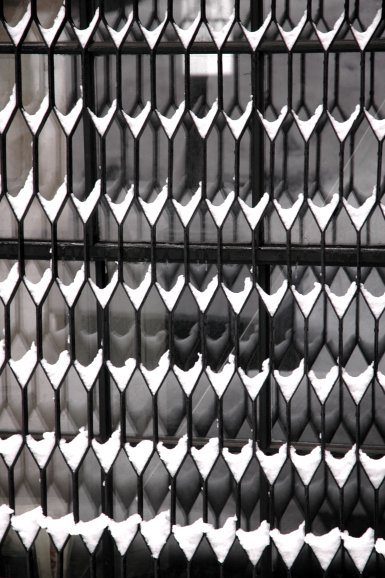
The first image reminds me that snow isn’t so fussy about spreading its largess; even man’s stuff get’s the full treatment.
The second picture makes me think of spring at the same time it describes this classic winter scene.
Oh yes, you can believe me: These are not really black and white photos. The available light was very grey.