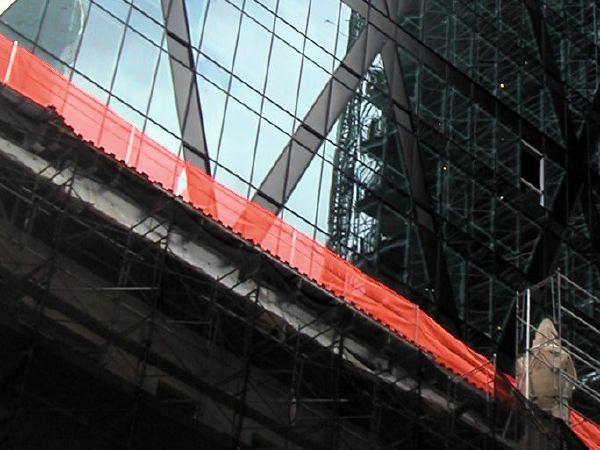
I hadn’t noticed until recently that Sir Norman Foster’s exciting project for completing the 1928 Hearst Building in midtown Manhattan includes a relatively small but significant salute, or nod, to the design of the art deco original.
In the photo above, note the chevron shapes on the stylized urns at the top of the surviving shell of the early building. These ornaments are repeated all along the parapet. Foster’s tower rises above all this, and uses its diagonal device structurally, on an enormous scale.
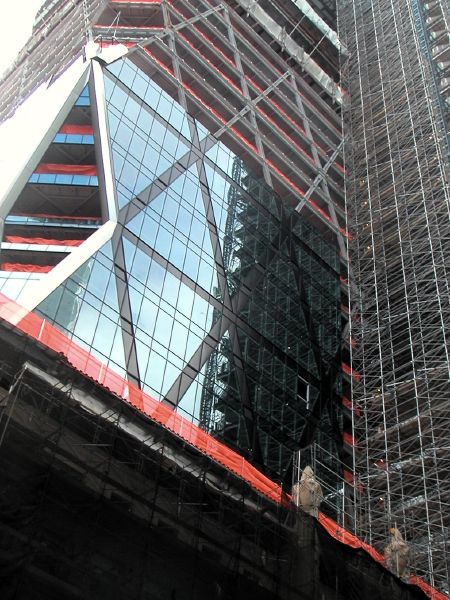
The photo below shows much of the current height of the massive new construction, and the top eight floors are still to be built. That is, otherwise imagined, there are still two layers of triangles or one full layer of X-bracing to go up beyond what you see on the street today. The completed building is going to look much larger than it appears in the architects’ renderings.
Category: NYC
one-stop shopping in Brooklyn
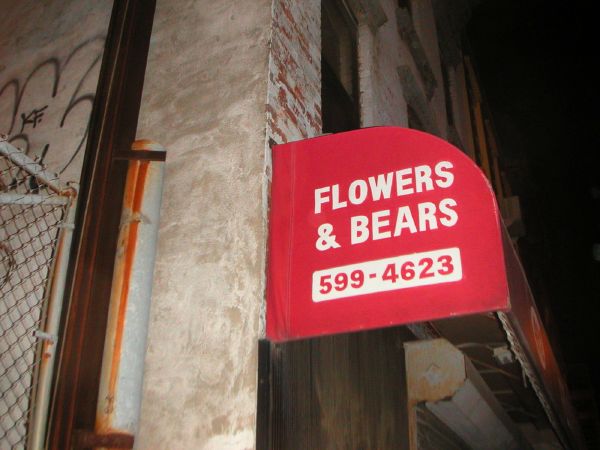
untitled (Metropolitan Avenue marketing) 2005
the Austrian Cultural Forum
GÃŒnther Domenig, on the architect’s imagination.
I love visiting the Austrian Cultural Forum building. Once you’ve greeted the very-New York concierge guy behind the desk inside the door of the narrow 24-story tower on 52nd Street, you could actually be in Wien. The two-year-old building designed by Raimund Abraham is that modern. And, yes, I really mean that about the city. The former capital of the Austro-Hungarian empire is no longer just old. Go see for yourself.
Anyway, back in New York, yesterday I stopped by the Forum’s current exhibition, âGÃŒnther Domenig: Structures that Fit My Nature,â which unfortunately offers only a tantalizing and impressionistic glimpse of the work of the interesting Styrian architect GÃŒnther Domenig. The modest spaces which occupy four levels of the building are mostly devoted to just two projects, the Steinhaus in Steindorf, KÀrnten (Carinthia) and the Dokumentationszentrum (Documentation Center) in Nuremberg, and there is precious little guidance to those (the supply of the show’s brochure had been exhausted long before I arrived).
The first structure is Domenig’s own still-evolving dwelling and offices on the shores of a vacation lake, and the second is his striking deconsecration of the notorious Nazi Party Rally Grounds.
One of the most useful (and stylish) elements of the installation was the wall-size video screen interview with the architect (edited as a monolog spliced with photographs of his work) which occupied one of the rooms. I think it should be recommended viewing for anyone who wishes to understand where truly new architecture should start. I wish I had taken notes, but Domenig says something profound about the relationship between the architecture in the architect’s head and the architecture which has to be constructed in the messy real world.
I loved the little wooden dock shown in the video; it seems to have made the transition.
The causes for his repeated exasperation, and his extraordinary perseverance in the face of enormous obstacles, helps to explain why we get almost no truly exciting buildings in New York these days. We have to insist on great patrons as well as great architects.
the dream
[GÃŒnther Domenig STONEHAUS, Relations PPP 1987 pencil and color pencil, installation view]
ADDITIONAL PROGRAMS
The Cultural Forum has some more wonderful programming lined up over the next two months. First there will be an exhibition of figurative works by Austrian artists and others called “Slices of Life: Blueprints of the Self in Painting.” It opens with a public reception on Tuesday, January 18, from 6 to 8pm. The artists include Amy Cutler, Plamen Dejanoff, Nicole Eisenman, Johanna Kandl, Elke Krystufek, Muntean/Rosenblum, Katrin Plavcak, Lisa Ruyter, Markus Schinwald, Ena Swansea, Nicola Tyson and Gregor Zivic. (I’m having fun trying to imagine which of these artists has a connection with Austria, especially if I imagine connections something other than that of birth.)
Beginning the next day there will be a number of chamber music, lieder concerts and film programs in the building’s small, two-level jewel-box theatre. Somewhat exceptionally for this institution whose expressed mission (encouraging and describing the impact of the digital world on the arts and culture at large) has meant that it has hosted some very exciting new stuff, the January and February programs are limited to composed “classical” music, although they range, almost all somehow Austrian, from Haydn and Schubert through Mahler, Berg, Schulhoff and Krenek, to PÀrt and Kurtag.
I’ll be there January 18, but I’m also going back for the music and the films. There’s always the building too, and maybe I’ll get further upstairs some day. I still haven’t seen almost 20 of those tantalizing 24 stories.
must be the rural part of the South Bronx
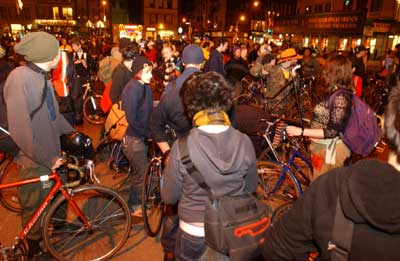
including at least one farmer and feed dealer
There’s a fairly happy story in Newsday this morning, reporting the relatively unaggressive approach of NYC police to last night’s local Critical Mass.
The monthly event promoting pollution-free transportation went off almost without incident, marking the first time since the Republican Convention in August that police did not harass the participants.*
The numbers were down from those recorded on recent Fridays, perhaps because of winter and the holiday, but more likely because many enthusiasts would have feared a repeat of unprovoked police violence, indiscriminate incarceration and illegal confiscation of bicycles. News of last night’s peace should produce larger turnouts in the [warmer] future.
After the news of the success of the ride, my favorite part of Wil Cruz’s article is the attribution of a quote near the end which criticizes ambiguous police direction. The speaker is described as “Jack Horowitz, 57, a farmer and feed dealer from the South Bronx.”
I read this to Barry and he immediately added to my own glee: “That’s why I love New York!”
*for recent history, see this September link and this one from late October.
[image by Joel Cairo from Newsday]
Susan Sontag
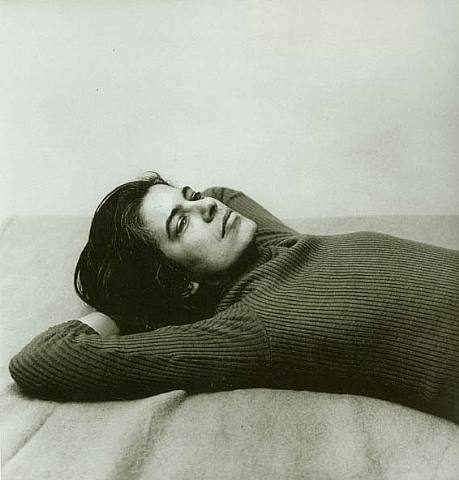
Peter Hujar Susan Sontag [1974-1975]
Susan Sontag died on Tuesday.
Beginning almost twenty years ago I had included her as a part of the homeland I had just adopted and which she had acquired at birth. Because of my profound general “otherness” and two nearly-profound early family dislocations, while it may not strictly fit the meaning of the German das Heimat, my New York City home had come to mean everything for me.
In this Manhattan Heimat Susan Sontag was my neighbor. Physically she really was my neighbor, since she owned an apartment just two blocks away from mine. For years I saw her everywhere in the city, although we never met. Her mind and what she was doing with it had already ensured that she would mean much more to me than an ordinary neighbor normally could. And then one evening I walked through the aura with which I had surrounded her.
I had already seen Edgar Reitz’s monumental first “Heimat,” (most sections twice) when I eagerly subscribed to the first American screening of the thirteen episodes of “Zweite Heimat” at the Public Theater almost twelve years ago.
After arranging myself in the first row for a double feature of two episodes, I noticed that she was only a few seats to my left. Only by coincidence, I had brought her new book, “The Volcano Lover,” with me to keep me occupied while waiting for the lights to go down. I think it was during the break that I gathered the courage to speak to her and ask if she might sign my copy.
I must have mumbled a few words, I hope not too gushing, about how much I admired both her writing and her bold social and political activism, and then we exchanged a few thoughts about the film, all of which escape me now, except that we discovered that we were both enormous fans of both epics. She signed the book, “for Barry and Jim – Susan Sontag ‘Heimat 6&7’ 7 July 1993.”
On every other day I spotted her in the audience she was totally absorbed in conversations with various companions. I was saved from embarassing myself, but I seriously regret the lost opportunities. Gosh, I wish I could have gone with her to Sarajevo, but Barry has written from the heart about how much she became a part of our New York experience, of our own shared Heimat.
She will certainly be greatly missed by many.
It’s late Tuesday night as I’m writing this. The death toll for all the shores around the Indian Ocean, the work of one wave over only a few hours, has now exceeded that of the U.S. military alone in Vietnam over a period of ten years. I’m already recalling Sontag’s unassailable morality, her creative curiosity and her courageous voice as I think about the individual and community tragedies millions of people in southern Asia are enduring at this moment. What would Sontag say about our government’s lame response? Colin Powell is absolutely wrong. We are stingy, very stingy, and we have been for decades.*
*The United States initially offered $15 million in relief to cover all of the nations affected (what we spend on the Iraq war every hour, and a fraction of the estimated cost of Bush’s January 20 Nuremberg rally). Oh sure, after being ridiculed by people in a number of other countries, we’ve now apparently upped our commitment by another $20 million, although that figure is marked as a loan.
Radically contrary to popular U.S. opinion, the amount of our foreign aid, in terms of percentage of gross national product (approximately one tenth of one percent), is the lowest of any industrialized nation in the world. Incidently, Norway’s contribution is proportionately almost ten times that of ours.
[image from Matthew Marks via artnet]
I guess this explains a lot
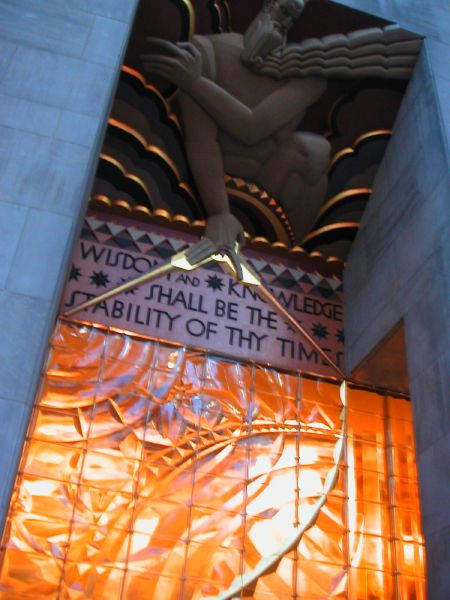
A lot has changed in 65 years. The country which built this great skyscraper now seems to have decided it can do so much better without wisdom or knowledge; we’re in for a very bumpy ride.
I took the photograph at dusk, while walking across town on Monday. The image is of Lee Lawrie’s sculpture relief above the front entrance of the RCA Building (today sometimes thoughtlessly referred to as the GE Building) on Rockefeller Plaza. According to the Rockefeller Center Visitor’s Guide, the William Blake-inspired figure represents Wisdom, who rules over man’s knowledge and interprets the laws of nature. The compass points to the light and sound waves of the cast glass screen below. The inscription is based on Isaiah 33:6
Winter Solstice
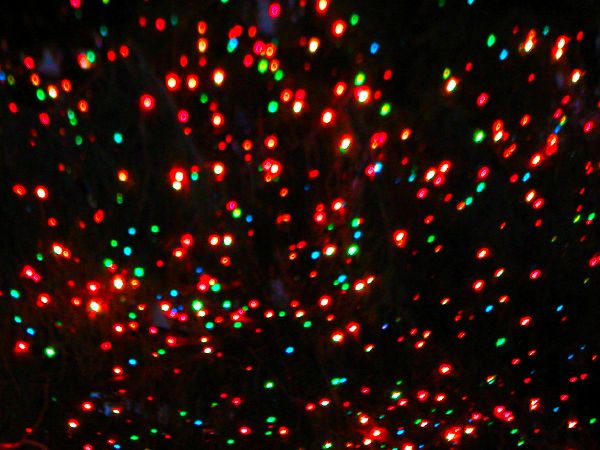
Solstice lights
Only now that my birthday has passed (even when quite old, late-December children sometimes remain pretty sensitive about their personal nativity celebratory rites) I can start to think about the pagan Saturnalia, the forest peoples’ Yule or any of the other defiantly-non-commercial celebrations of the return of the sun. I think Festivus could well be included among those observances and entertainments.
I took the image above on this very cold, windy afternoon. It’s a deliberately fuzzy representation of one of the most prominent modern manifestations of hoary early-winter tradition, the fully-lighted Rockefeller Center tree. (I prefer to think that any connection between it and Christian worship is pure invention). It’s a pretty neat sight if you could forget almost everything around it right now. I couldn’t, so I decided the shot had to be fuzzy – and dark. This huge dead tree’s penultimate resting-place environment is not a pretty thing one week before Christmas.
Of course the deco buildings are pretty fabulous, but the several rows of security barricades set up around the tree (they’re gaily painted red and green) and the offensive, vulgarly-omnipresent NBC visual promotions (even during the hours when their storefront studio lies empty) have at least temporarily erased the charm once associated, even in the last weeks of the year, with this wonderful midtown oasis. Cranky tourists and pushy shoppers (and big Christmas tchotchkes in the terraced Channel Gardens) only added to the ugliness today.
I haven’t even mentioned the scary over-amplified “holiday music,” which seems to be stressing out even the normally-unflappable pigeons around St. Patrick’s and the Olympic Tower.
Alright, I’m now back home in my warm cave, so maybe I should be quiet and think lovely thoughts. Happy Solstice everyone, and many happy returns!
today’s MTA photo ban protest
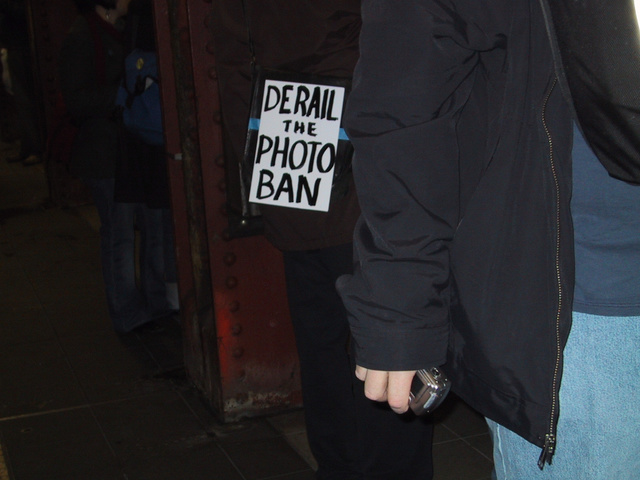
my own rather lame sign, as seen somewhere in the system this afternoon
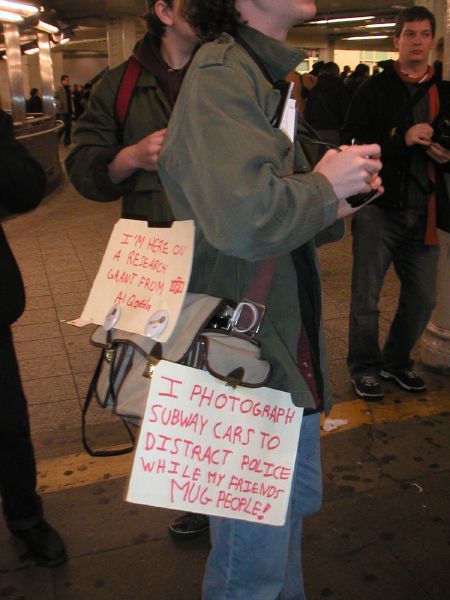
(the sign on the guy’s left reads, “I’m here on a research grant from Al Queda”)
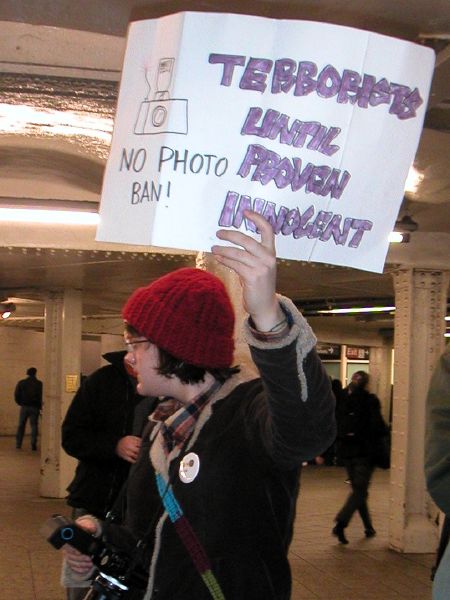
this sign became a moving beacon for today’s odyssey (the stylized font reads, “TERRORISTS UNTIL PROVEN INNOCENT”)
The second time around it had already seemed a little routine. Some of the wonder and energy which had accompanied the first MTA photo ban zap was missing this afternoon, but I have to admit there were a few sassy-sarcastic signs this time, and there was even something resembling an information handout.
We’re getting better at broadcasting the issue, but actually I’d be very happy if we never had to do this thing again. Will the MTA come to its senses?
Perhaps not, if some of the sentiments of subway users overheard today mean anything. One woman, although a little sympathetic to our argument, was seriously worried about the threat cameras pose to the privacy of riders. While she was speaking to me, standing on the subway platform, I snapped the picture below and pointed out what had attracted my attention. She had nothing more to say.
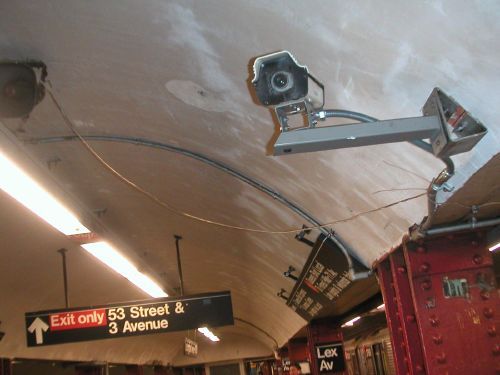
[image at the top of this post from jpreardon.com]
photographers’ ‘Flash Mob’ subway ride
REMINDER: Don’t miss being a part of the photographers’ ‘Flash Mob’ subway ride protest against the MTA proposal to ban all cameras from the entire transit system. The organizers’ plan is to meet tomorrow, Saturday, at 1 o’clock in the awesome Main Concourse inside Grand Central Terminal. Don’t forget your metro card and your camera. Bring a sign with a creative message, even a small one.
The magnificent Concourse is worth a picture even without the addition of hundreds of concerned young camera fanatics, and if the MTA has its way, this will be one of your last chances to record its spendors.
still no evidence of a Kerik nanny
But at least they’re finally looking around. The NYTimes may hope to redeem itself for sitting out the Bernard Kerik story in its first weeks. The paper’s news and editorial departments had totally ignored the developing stories about Kerik’s shady background until after he withdrew his name from consideration as Homeland Security secretary.
Maybe they’re trying to get up to speed now by cutting to the quick. This morning the Times devotes 40 column inches to the questions surrounding the mysterious nanny whose immigration and tax status was used as the reason for Kerik’s withdrawal.
Included among those questions is the fundamental one I posed early this past Sunday, whether in fact there ever was a nanny in the first place.
Last night, Mr. Kerik was told that skeptics in city government circles were questioning the very existence of the nanny, and he was pressed to provide any kind of evidence to document that she was real. But after taking time to consider the request, Mr. Kerik again decided to remain silent on the subject.
Why do I care so much about this story? It starts with the embarassment I feel for my city that Giuliani and Kerik have at least until recently been successful in conspiring with the opportunists in Washington to ensure that two locally-notorious goons came to represent or embody 9/11 and New York. The fire of my outrage about the choice of Kerik was stoked by the uninhibited enthusiasm for the nomination expressed by New York’s Democratic politicians Hillary Clinton and Charles Shumer – and the irresponsible, uncritical reporting of my hometown’s largest paper.
The lights are going out, the doors are all closing; where will we look for truth, honesty and integrity now?