does this sound familiar?

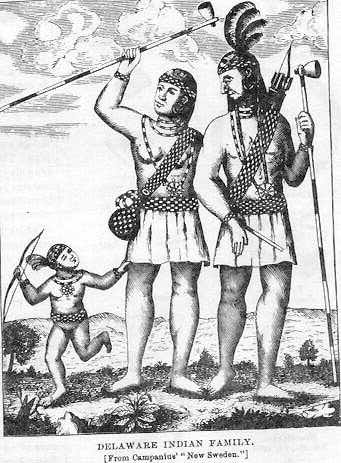
delaware indians.jpg

The story appeared in The City section of the NYTimes on Sunday. It was part of an article describing the history of the World Trade Center site. As I read it I felt that its outline seemed very familiar. It described the manipulation of the power of the state for personal gain, but while both the profit and the loss associated with two years of warfare against the Indians in New Netherland was on a much smaller scale than that of the imperial Bush wars, has anything changed much in four centuries?

Jan Jansen Damen, who came from Holland around 1630 to help set up the new colony, was more than just a simple farmer. The first European owner of what would later become part of the World Trade Center site had much greater ambitions.
Like an early Donald Trump, Damen had a thirst for land and wealth. He pushed aggressively to secure commitments from the Dutch West India Company for grants or leases of property located just north of the barricade that was Wall Street. Below this barrier was all of settled New York, the land where the pioneers had built their crude, wooden-roofed homes.
When trouble came in the form of Indian attacks on settlers, the Dutch governor turned to Damen for advice, naming him in 1641 to New York’s first local governing board, known as the Twelve Men.
The board’s chairman, David Pietersen De Vries, urged Gov. Willem Kieft to be patient, as the tiny colony, with little in the form of arms or soldiers, was vulnerable and “the Indians, though cunning enough, would do no harm unless harm were done to them.”
Damen did not agree. His land, at the edge of the settled area, was particularly vulnerable. In February 1643, accounts written at the time say, Damen and two other members of the Twelve Men entertained the governor with conversation and wine and reminded him that the Indians had not complied with his demands to make reparations for recent attacks. “God having now delivered the enemy evidently into our hands, we beseech you to permit us to attack them,” they wrote in Dutch, in a document that survives today.
DeVries tried to calm Governor Kieft: “You go to break the Indians’ heads; it is our nation you are about to destroy.” But the governor disagreed. It was time, he resolved, “to make the savages wipe their chops.”
The assault, which took place about midnight on Feb. 25, 1643, in Jersey City, then called Pavonia, and at Corlears Hook, now part of the Lower East Side, was an extraordinarily gruesome affair. “Infants were torn from their mothers’ breasts and hacked to pieces,” DeVries relates in his journal. Others “came running to us from the country, having their hands cut off; some lost both arms and legs; some were supporting their entrails with their hands, while others were mangled in other horrid ways too horrid to be conceived.” In all, more than 100 were killed.
The region’s Indian tribes united against Governor Kieft and the colonists. Damen was nicknamed “the church warden with blood on his hands,” and expelled from the local governing board. The governor was ultimately recalled by the Dutch. The colony, over two years of retaliatory attacks, sank to a desperate state.
“Almost every place is abandoned,” a group of colonists wrote to authorities in Holland in late 1643. “We, wretched people, must skulk, with wives and children that still survive, in poverty together, in and around the fort at the Manahatas, where we are not safe even for an hour whilst the Indians daily threaten to overwhelm us.”
Damen died about 1650. His heirs sold his property to two men: Oloff Stevensen Van Cortlandt, a brewer and one-time soldier in the Dutch West India militia, and Dirck Dey, a farmer and cattle brander. Their names were ultimately assigned to the streets at the trade center site. Damen’s was lost to history

We won’t be so lucky with Bush’s name.

Note: The native American peoples in Manhattan were of the group, Lenape or Lenni-Lenape, later catagorized by the Europeans as Upper Delaware.
[image from RootsWeb for Montgomery County]
Summer in the Long Island City

PS1tiredangel.JPG
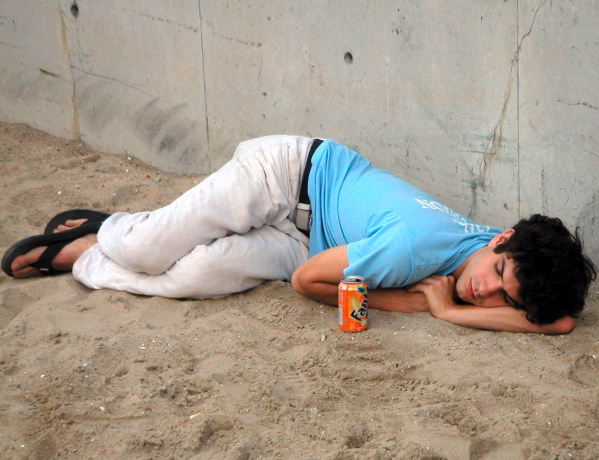
PS1 and the members of Young Architects Program, responsible for the beautiful courtyard installation, should be delighted to know that the visitor pictured above, relaxing in one of their outdoor spaces, had made the art very much his own for part of the day. (We remembered seeing him earlier inside, very intent upon the work in the Special Projects and Studio Program rooms, but he may have been inspired by the sandy images in Ugo Rondinone‘s beautiful installation, “Sleep.”)

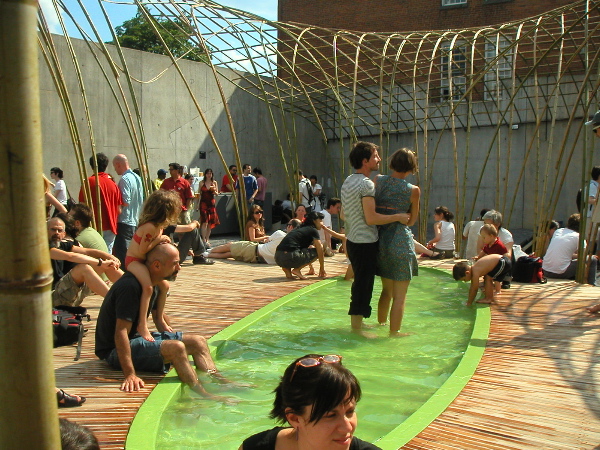
I nearly forgot to post something about our visit to PS1 on Sunday afternoon. We almost didn’t make it at all, since neither Barry and I nor our friend Karen were anxious to get the early start our day’s ambitions recommended. We started out with a pilgrimage to ATM Gallery in the East Village, hours before the current show was to be taken down. Half of the afternoon had evaporated before we squeezed into the crowd drawn to Long Island City for the Museum’s summer show, “Hard Light.”
It was a warm urban moment. Summer in the city. People were drawn by the art and maybe the music, but perhaps more than anything else, by each other.
We will have to return to get a good look at the work of some 40 or 50 artists and collaboratives installed in and around the rambling old school building, but judging from what we did manage to see, I’d say that anyone would have to be quite dead not to be delighted, surprised or challenged by much of what’s there.
The weekends on Jackson Avenue are great fun, but the weekdays are probably better for serious arties.

PS1courtyard.JPG
arties and friends having fun in the main courtyard on Sunday

UFPJ, going up 8th Avenue to the park

UfPJnewsconf.JPG
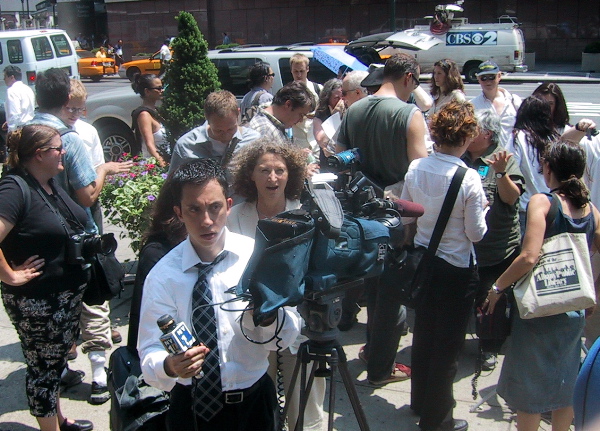
the press conference across from Madison Sqare Garden ended, some participants still linger [NY1’s Michael Scotto in front, Donna Lieberman of the NYCLU in the center, and from UFPJ, Bill Dobbs, back to camera, tall on the far left and Leslie Cagan, partly obscured, fingers spread, on the right]

Beginning last June United For Peace and justice (UFPJ) started planning a New York City march and rally for August 29, the eve of the Republican Convention. They still have no permit.
In fact, no police or park permits have been granted to any of the organizations planning protests related to the Convention, although some applications were made up to a year ago.
UFPJ has filed an application for a permit to walk up 8th Avenue from 23rd Street, past the site of the Convention, Madison Square Garden, and end up with a gathering in Central Park. The NYPD and the NY Parks Department wants them to go to Queens for their rally or, alternatively to bake in the wasteland of the West Side Highway, four long blocks left of the Convention site.
Today a number of groups planning protests related to the Convention joined UFPJ in a press conference across the street from Madison Square Garden, to describe their frustrations with city agencies and to demand that Mayor Bloomberg protect their right of dissent.
We should all be concerned with what the experience of these groups says about the agenda of the Bloomberg administration, bending over backwards to see that the convention of a radical right-wing political party goes as smoothly as possible, while doing absolutely nothing to ensure the peaceful assembly of those who wish to voice objection. Should this surprise us at a time when the Republican party controls the mechanisms of all three branches of the federal government as well as Albany and our own City Hall? Now even dissent must be eliminated or at least rendered invisible.
Even beyond the big issue, the city’s behavior is appalling for what will be its impact on the basic safety of both New Yorkers and visitors in the last days of what will surely be a long summer. We should be asking how are the best interests of anyone being served when no group knows how to plan for August 29, neither a police department (already being stretched to the limit by real or imagined security concerns) nor a crowd whose size some now expect may easily end up as a seven-figure number. The city is playing a dangerous game, and we are the pawns.
Virtually every other great city of the world (and I won’t even use the customary patronizing qualifiers, “western” or “industrial”) can accomodate enormous peaceful protest without confining participants in pens or moving them far beyond the periphery of protest targets. But in the land we call “of the free” we only imagine we can exercise such liberty, and it’s some measure of just how unfree we are that few understand that they are are so bound.
The right to dissent and the right to protest are meaningless if the dissent and protest are neither heard nor seen.
On August 29 we gotta pass by the Convention site, and we gotta have the Park.

of gardens and the High Line

Highline1.JPG

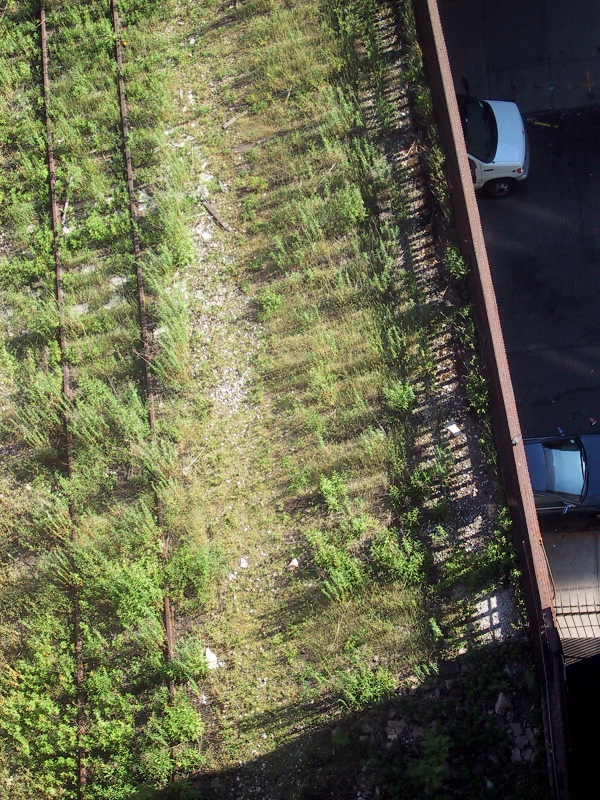
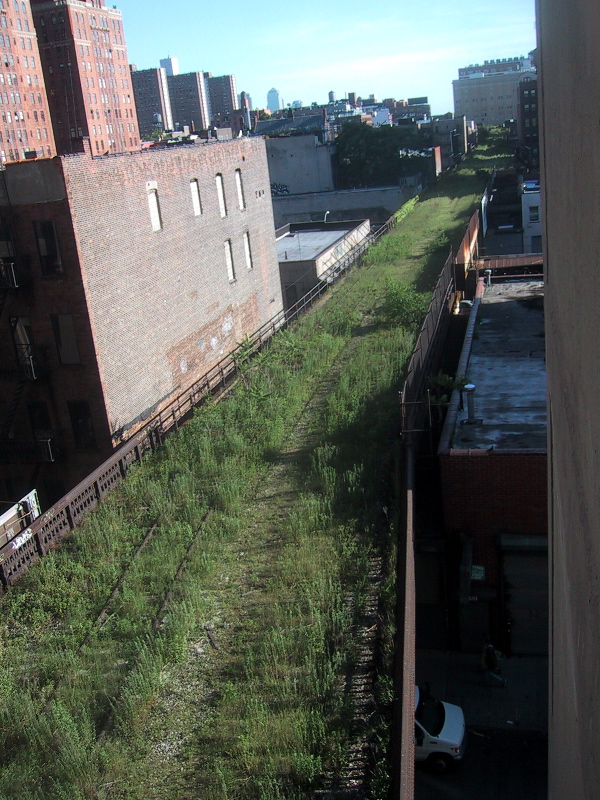
I was in the garden most of the afternoon. No, not the wonderful wild tundra of the High Line represented above, in a picture taken Saturday afternoon, but the 12′ x 16′ roof which lies outside our apartment.
New Yorkers have many gardens, and almost all of them are communal property. Chelsea however has no real public park, so Barry and I consider ourselves fortunate indeed. We have both the luxuriant garden court of our building, and the far smaller, and far less light-gifted, accidental Eden immediately outside our own walls.
I would describe the exposure outside our second-floor, north and east-facing windows as very deep shade. That’s the environment many of us remember from our childhood as the one which accounted for the cement-hard, packed ground lying under the largest shade tree in the neighborhood. Even the ferns and the Lilies-of-the-Valley couldn’t make it there.
I’ve been defeated repeatedly in my attempts at bringing a woodland environment to the perimeters of our urban shelter, but, partly thanks to a little past experience with limited resources, the undaunted Linda Yang and the Chelsea Garden Center, I haven’t given up yet.
Pictures will follow, as soon as the latest plantings establish themselves. I’m convinced that’s going to happen, or I wouldn’t already feel exhilarated by this afternoon’s work in “the garden.”

Highline2.JPG

The High Line? Looking at these pictures, it’s hard not to ask that it be kept exactly as it is. New Yorkers should all be able to run through a meadow, even if much of the horizon is composed of second-story windows.

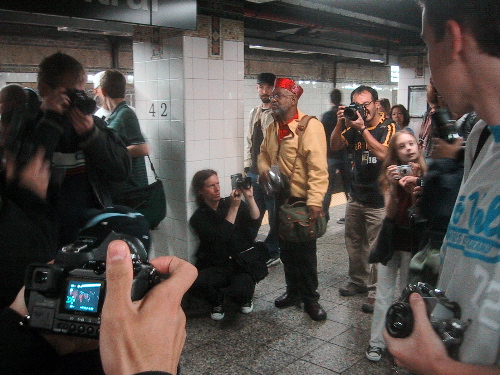
way cool photo-in captures New York MTA

MTAcameras1.JPG
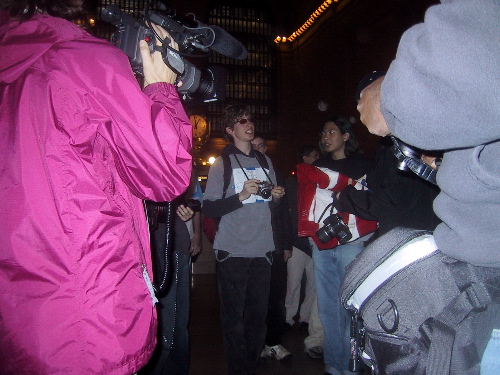
Grand Central Station
MTAcameras2.JPG
waiting for the Lex express
MTAcameras3.JPG
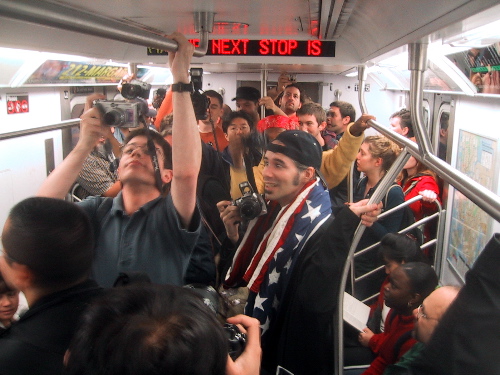
on board, somewhere above Union Square, er . . . actually, below
MTAcameras4.JPG
transferring to the L

I saw the message captioned, “Photographer’s Rights Protest,” and I told myself, “I’m in!”
The issue is the New York MTA’s recently-announced proposal that photography be banned throughout the system. Of course it would be for our protection, from camera-hefting researcher/terrorists. I was attracted to the issue (how could its lack of merit even be arguable?), but the fact that a demonstration was announced through the internet, the modest panache of its text appeal, and finally my own recent experience with MTA security incompetence, and its photographic documentation, made it a must.
An excerpt from the organizers’ webpage:

This will be a peaceful demonstration against the MTA’s proposed Photography Ban, conducted in the spirit of Rosa Parks. We will simply ride through Manhattan with our cameras, taking as many photographs as we please, of whatever we please. This is a completely legal protest, as photography within the subway system has not yet been banned (even though the police seem to have been told otherwise).

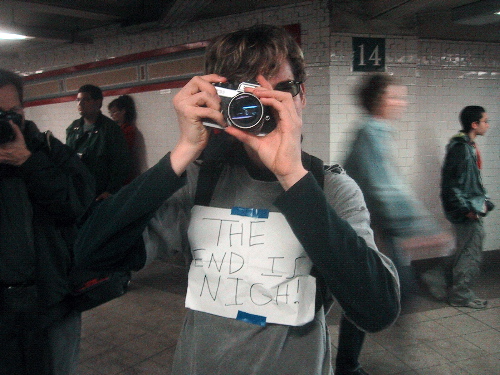
Participants were asked to bring cameras and, if they wished, “a witty sign.” I have to admit that while I had good intentions, I didn’t manage to fabricate the cool sandwich-board I had created in my head; I went shamefully textless. So did all but one of the hundred or so people who gathered in the central hall of Grand Central Station early this afternoon. That singular body sign, “the end is nigh,” was suitably wry but undoubtedly arcane for all passers- and sitters-by.
But maybe in this action it really was appropriate to just take pictures, especially if the press was already interested, as it seemed this afternoon it was.
The weirdest thing for someone who’s been in perhaps hundreds of other zaps and demonstrations was to be in the midst of all these people taking pictures of each other. Right now there must be thousands of shots out there somewhere showing people snapping people snapping people snapping people, and perhaps beyond.
Not incidently, our progress through the system today must represented the safest time and place in the history of the MTA – at least as far as any threat originating with camera-wielding terrorists is concerned. Don’t leave those cameras home, good folks; it’s for your own security.

For some early-posted, great images go to the dart board]

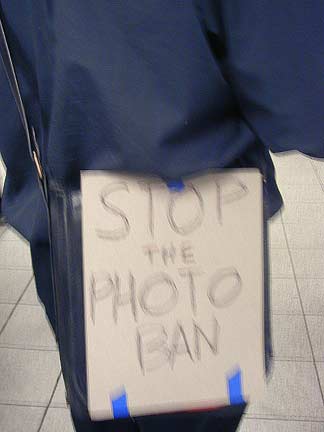
stopthephotoban.jpg
In the end, I broke down and made this crummy impromptu sign on the site, hoping it might raise us above the “flashmob”-type thing.

[bottom image from Forgotten NY]

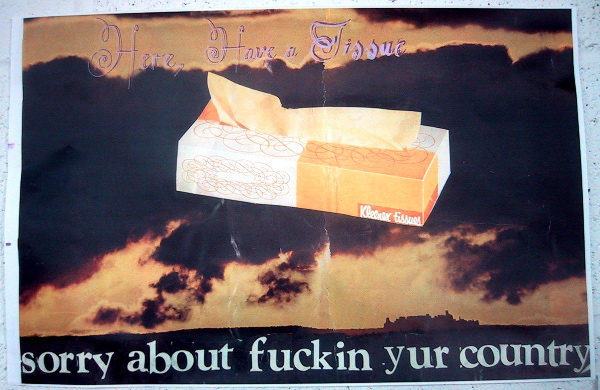
will a tissue make it better?

fuckinyurcountry.JPG

This is one of a group of works by Brian Belott [who shows at Canada] lining the gallery’s entrance ramp of the White Box show, “Majority Whip,” which closed yesterday. Closed, but not to be forgotten, since we can expect to see its children throughout this New York summer, and far beyond.

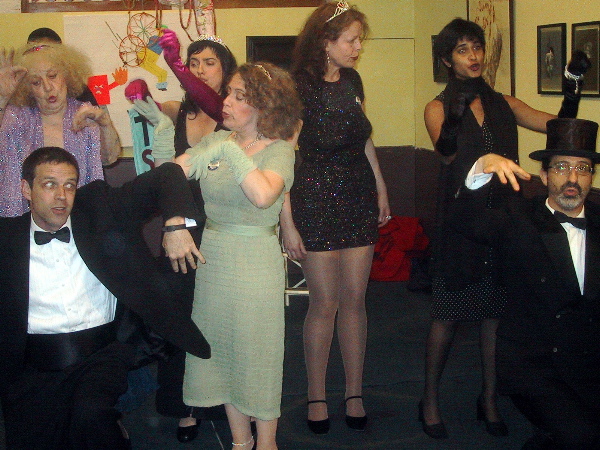
On Wednesday night, a clutch of Billionaires for Bush managed to crash an enthusiastic gathering of somewhat less-monied and decidedly un-Bush artists and activists in the gallery:
billionairesWhiteBox.JPG

Washington Square Marbles

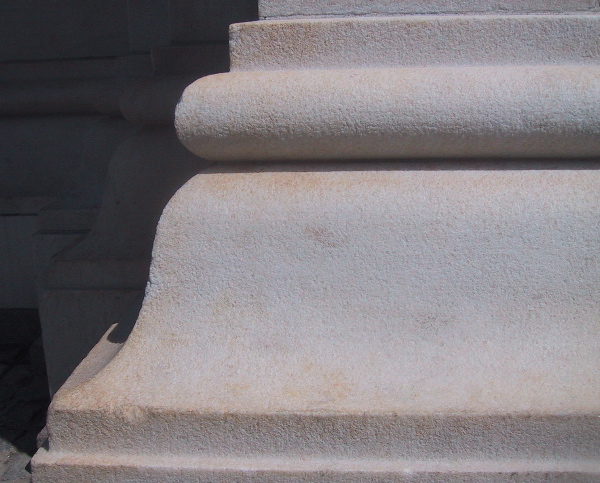
washington arch.JPG
not a pigeon in sight this past Thursday

Stanford White’s elegant Washington Square Arch has been restored, but virtually every square inch of its carved surfaces is now covered in an almost invisible high-tech screening material designed to keep out the New York pigeon. Only the flat and molded surfaces (including the base, a section of which is shown above) and the two pier sculptures of George Washinton manage to avoid the veiling.
I suppose Ancient Athens didn’t have much of a pigeon problem. This is just a thought, but if it had, without sophisticated modern plastic netting the Parthenon frieze would have been hidden under guano for over 2000 years and Lord Elgin would never have known his “Marbles” were even there.

“Where Do We Live”

my exciting nyc apartment.jpg
Lower East Side relativity

Half the theatre had emptied out when we returned after intermission last night. I did recall hearing, as the lights went up, one matron in the row in front of us repeating to her partner over and over again, “no content; the play has no content.”
She was wrong. In fact I think she may have been covering for her embarassment in being shocked by what was happening on stage. I cannot account for the reasons why so many others, like those two, failed to come back for the last 50 minutes of Christopher Shinn’s “Where Do We Live.” but the play making its U.S. premier at New York Theatre Workshop this month is definitely a serious container – of the relationships we all have with family, friends, lovers neighbors, strangers and, finally, the entire world.
He’s good. He’s very good.
Disclaimer: We stayed after the play for an audience discussion with the young playwright, so I may be a little ahead of the game. Here [the remaining] New Yorkers really redeemed themselves. I was blown away both by their theatre sophistication and by their obvious comfort in talking about some of the scenes and issues which had apparently caused our more prudish seatmates to flee the house, some only minutes after the play had begun. While there we were reminded that Shinn has been very fortunate in his teachers, who have included Maria Irena Fornes, Tony Kushner and Michael Cunningham. Whew.
September 11 plays a subtle, almost mute role in Shinn’s drama, written in the months after the destruction of the towers which had stood in sight of his apartment on the Lower East Side. Don’t concentrate too much on the dates projected on the back wall. The story which unfolds inside two neighboring apartments in a tenement abandoned by Giuliani’s Republican idea of New York is that of nine barely-related people struggling with all human connections, even those they would prefer to ignore.
The energetic young cast, some doubling, tripling or even quadrupling roles, was magnificent. Shinn is directing a play for the first time here, and he seems to know what he’s doing. The set and the costumes were a perfect match with the lighting, which peformed small miracles reinventing rooms and scenes. The great sound design was an integral part of the characters’ story, but it was just one of the many stimulants in which they indulged, just like real.
“Where Do We Live” opened in London at the Royal Court in 2002 and opens here officially this Sunday, May 9. Performances run only through May 30. If you’re not bored with youth, New York, sex, drugs or rock and roll, or indeed with relationships, you’re more than welcome to do something about changing the audience demographic responsible for the empty seats we saw later last night.

[image is not from the play, but rather from Mark Allen’s site, where it is described as “the confines of my super-exciting NYC Lower East Side apartment”]

suburban police SUVs occupy Manhattan sidewalk

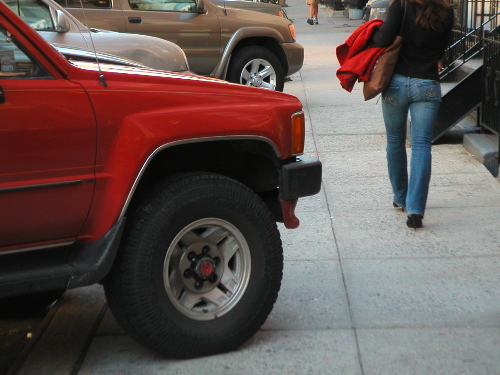
policeparking2.JPG
19th Street, east of 8th Avenue this afternoon: the signs read: “NO PARKING 8am to 6pm”

In 1962, at the peak of urban flight, New York City law was changed to permit police officers to live outside the city for the first time in its history. New York hasn’t been the same since. Although there have been many more frightening consequences, here we see one of the most visible.
Each of the vehicles shown above, almost all privately-owned and almost all SUVs, had large police permits lying on their dashboards. The 10th Precinct headquarters is located mid-block. So while they’re already getting free parking, apparently the street itself isn’t big enough for these commuters’ monsters. The narrow sidewalk of this quiet, tree-shaded residential block has to be commandeered for their convenience.
This is a scene reproduced all over the city, wherever there are police (or fire) stations. It’s no wonder that police routinely ignore threats to the safety and convenience of millions of New York pedestrians; the officers we pay for are essentially part of an occupying army, and they don’t know how to use their feet. I won’t even bring up large squad cars regularly double parked outside Krispy Kreme, or routinely blocking busy pedestrian crosswalks.

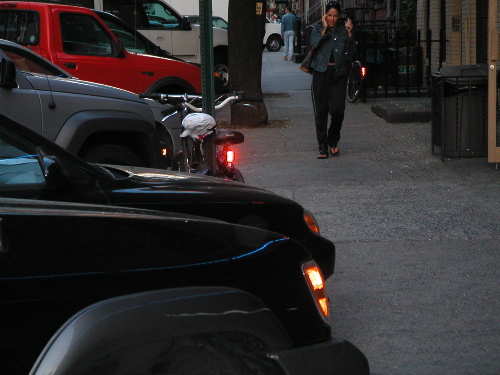
Incidently, the continued presence of these angle-parked precinct officers’ private tanks even at night makes the street signs somewhat disingenuous:
policeparking 1.JPG
the same block at 7:30pm last Friday

street storage: street parking

signNoParking.jpg

Let us suppose you have a chest of drawers that you sorely need for storage space but cannot fit into your small apartment. What to do?
Here is one thought: Why not put it on wheels and leave it curbside in front of your building? Naturally, you accept a theft risk and an obligation to move the chest across the street every few days to comply with alternate-side parking rules.
Absurd, right? You can’t just leave personal property on the street.
But what if we call that thing on wheels, oh, a car? Suddenly, it becomes O.K. to gobble up precious public space for your own benefit. Not only that, but on most streets you also need not pay a dime for this storage area.

So begins Clyde Haberman’s “NYC” column in today’s NYTimes.
While eventually we will be forced to ban on-street parking in New York, presumably starting only with Manhattan at first, it’s not going to be easy, not least because of the sense of entitlement fostered for car owners by every city administration for over half a century.
Before 1950 it was illegal to park overnight in Manhattan. Transportation Alternatives activist John Tierney has cited how old photographs demonstrate “gracefully uncluttered streets. Many of the sidewalks were much wider than today’s and adorned with greenery.”

The city’s pedestrian majority, as Police Commissioner Arthur Wallander approvingly observed in 1947, was firmly opposed to ”the public streets being used as garages.” But the city’s politicians had their own cars to park and favors to hand out. So some of the world’s most expensive real estate has ended up being used to store hulks of metal, at unbeatable prices.

But of course he’s not been alone in encouraging New Yorkers to take back the streets. Two and a half years ago Frank Pelligrini proposed in Time that incoming mayor Bloomberg be so bold as to make his mark by doing the right thing by all New Yorkers.

Banning parking would rev all the economic engines that the city runs on, and eliminate the real source of economic dead weight, namely private-vehicle owners who are just waiting for an excuse to get out of town for the weekend anyway

[image from unrev.com]