of shirtwaists and straitjackets: labor and Republicans

shirtwaist_names.jpg
Don’t let the Republican barons bring back their “good old days.”

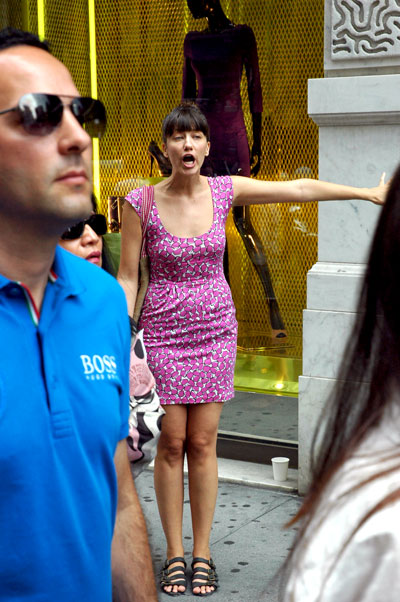
I was downtown on Friday afternoon at the corner of Greene Street and Washington Place, at 4:45, the exact moment one hundred years earlier when a fire began inside one of the three floors occupied by the Triangle Waist Company. In 1911, less than an hour after the fire began, 146 garment workers were dead, most of them young women and girls (the youngest were 14), either from the fire itself or because they had jumped a hundred feet and more to their deaths. The factory owners had locked the exits on each of three floors, to ensure that their hundreds of pawns (600 female workers, and about 100 male) could not leave their work stations, in violation of even the rudimentary safety statutes in effect before the horrific disaster which changed everything. Well, not everything, and not quite overnight.
Also, appallingly, today we see increasingly bold attacks on unions and governmental regulatory authority of any kind, which, if successful, would straitjacket all working people, even Republicans not yet become rich: The party is maneuvering to roll back everything which was won by organized labor in the years after 1911, including both safety and living wage rules.
The Republicans want to be able to lock the exit doors, just like they used to.
The Triangle Waist Company factory fire should be remembered as a tragedy dividing an age of capitalist barbarism from an age of enlightened, direct government interest in the welfare of the governed. Instead today there are ominous signs that it may be remembered as only one more horror inspiring only a temporary improvement in the condition of the powerless.
shirtwaist_funerary_bunting_skirts.jpg
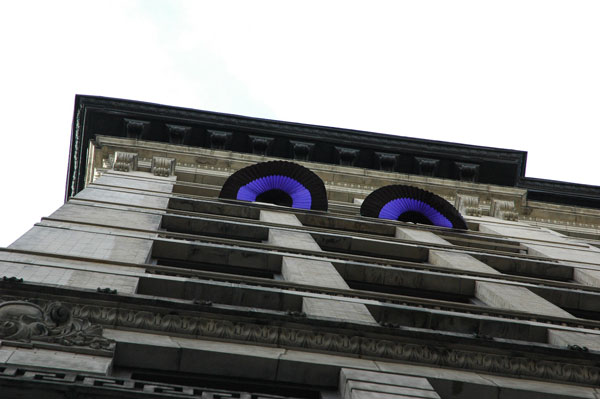
On the 100th anniversary of the tragic – and criminal – fire which engulfed the top three floors of the building which once housed the Triangle Waist Company factory, an installation on the eighth floor, visible from the street below, suggested both funerary bunting and the parachuting skirts of young women jumping to their deaths.
shirtwaist_red_socialist_party_flag.jpg
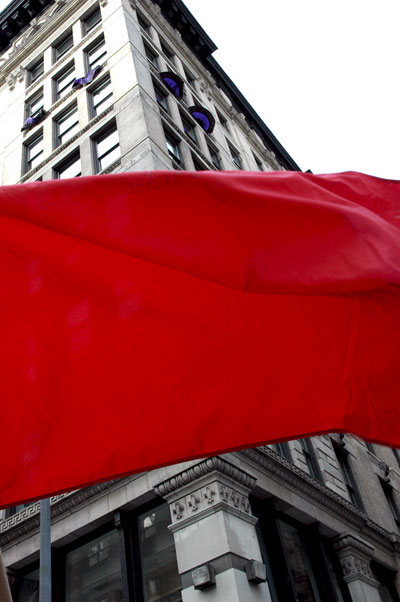
One man, a member of the Socialist Party USA, waved a brave red flag, telling everyone in hearing, “We were there!” He’s right.
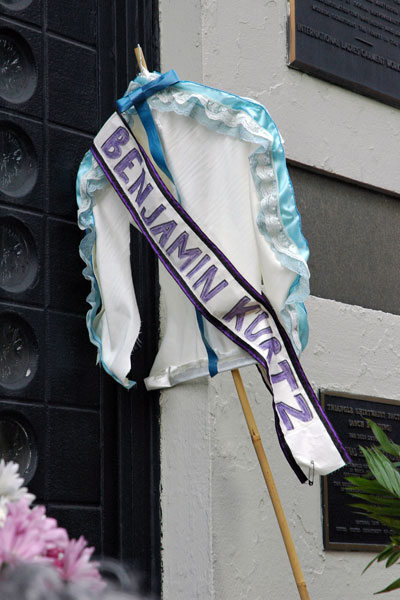
shirtwaist_Benjamin_Kurtz.jpg
Benjamin Kurtz, 19, was one of the few male victims of the fire, represented here by one of the shirtwaist replicas which was carried to the site in a procession earlier.
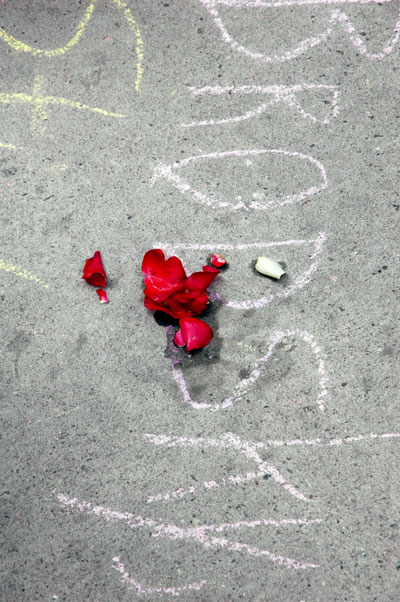
Shirtwaist_rosewater.jpg
On Friday, one woman in the crowd explained that the most common name among the dead was “Rosie.” She carried a large bowl of rose water and rose petals into which people were invited to dip their hands and caress the side of the building or the pavement.
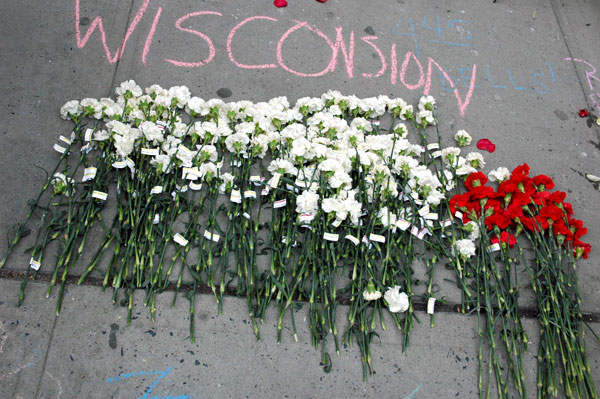
Wisconsion.jpg
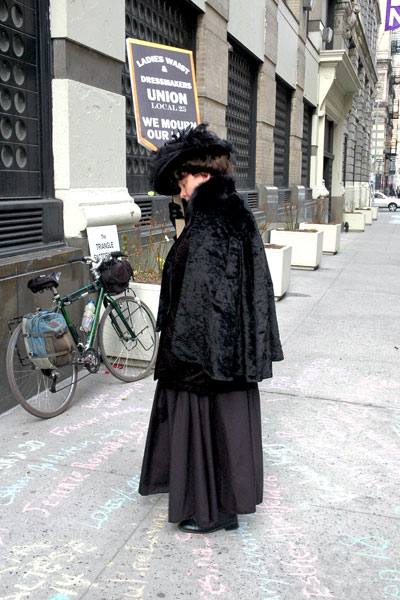
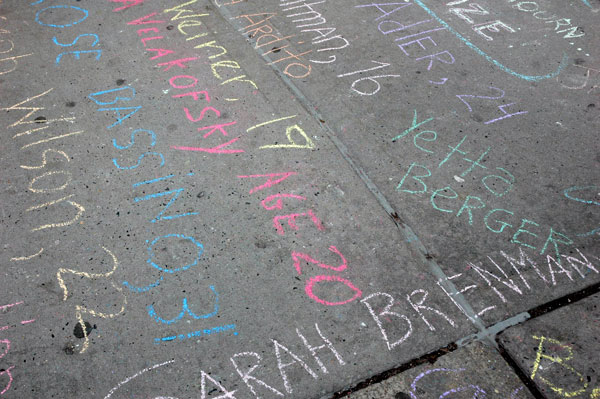
The names of those who had perished had been written in oddly-festive, parti-colored chalk onto the sidewalk, and here the name “Wisconcion” alluded to the unravelling of both hard-fought workers’ rights and industry regulations currently underway in Wisconsin and elsewhere in the U.S. Even in New York today, the sweatshop itself survives.

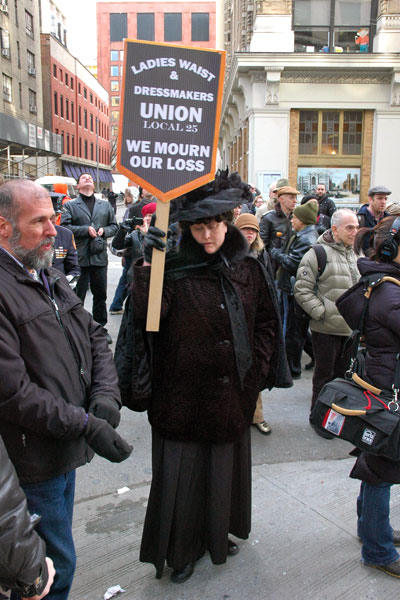
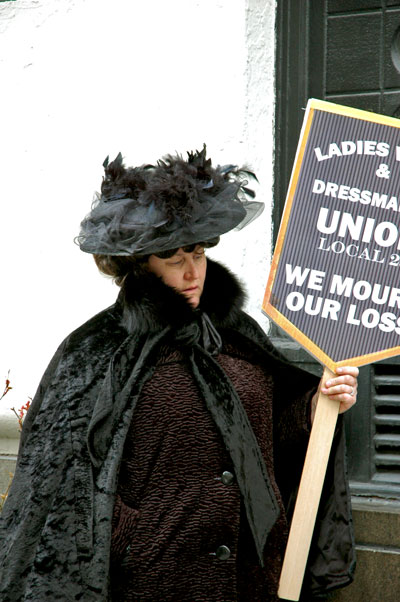
While I was standing about and photographing the group and the visual props gathered on this historic corner, I noticed in the near distance a woman dressed all in black, of brave proportion and stately manner, perfectly-costumed in the manner of a hundred years back. She carried an old-fashioned sign, and moved slowly on the edge of and eventually right through the crowd. At first it seemed that no one else had noticed her, but eventually it was clear she just couldn’t be ignored.
I felt a cold shiver and my knees weakened when I first spied her, and I thought about her heroic models and at least a century of noble antecedents. Did she represent one of the founders of the International Ladies Garment Workers Union (ILGWU) or local 25* specifically, to which the Triangle workers belonged? Since she seemed very well dressed, perhaps she was a patron, like Mary Dreier, Alva Vanderbilt Belmont, Anne Morgan (J. P. Morgan’s daughter), or any of a number of wealthy and influential women who worked to share their privilege with their sisters.
As I was leaving, I heard the sad phantom speak to the crowd for the first time: She began by asking, “Are any of you members of a union?”
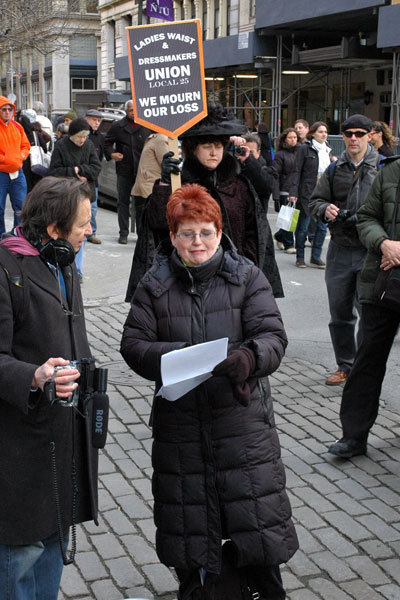
shirtwaist_spectre_appears.jpg
Union_patron_appears.jpg
union_patron_looks_at_names.jpg
union_patron_near_wall.jpg

The figure I’ll call our conscience seemed to appear out of nowhere, perhaps with a warning: The robber barons are back.

*
The New York State Archives has this to say about Local 25:

Local 25 [of the ILGWU] was known for its militant members. These members led the famous 1909 Uprising of 20,000 in which workers walked out of the Triangle Shirtwaist Factory. The uprising eventually sparked a widespread walkout among shirtwaist workers throughout the city. Many shops met the union’s demands while others including the Triangle Shirtwaist Factory did not. Strengthened by a post-strike spike in membership, the workers remained active. The tragic Triangle Shirtwaist Factory fire of 1911 further spurred the union’s growth, finally establishing the local’s position in the New York garment industry.

In its account the archive addresses the particularly-energetic radicalism of Local 25. There were communist sympathizers in all ILGWU locals, but the more conservative union leaders, regarding 25 as the hotbed, decided to divide its workers into two new locals. It didn’t quite work, but eventually, reflecting the history of the American labor movement generally, the union was able to keep genuine leftists out of it leadership entirely.
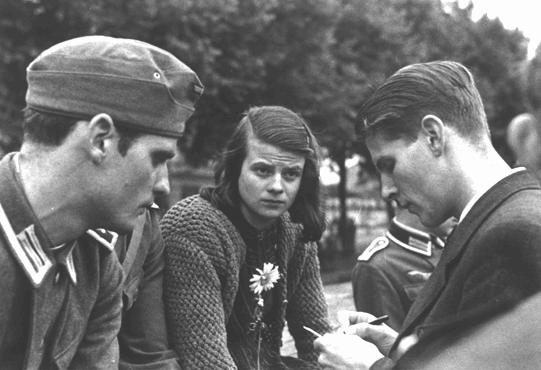
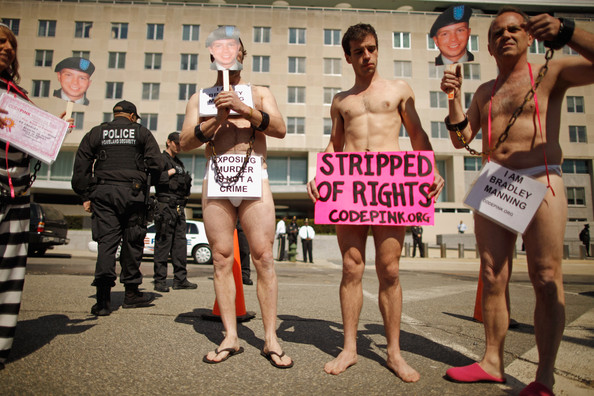
we’re “good Germans,” Bradley Manning’s the real thing

WhiteRose.jpg
surely we can hold ourselves to a higher justice than that which condemned them

The Six core members of Die Weisse Rose (The White Rose), a non-violent resistance group in Nazi Germany, were arrested by the Gestapo, tried and executed in 1943. Some of the male members had been activated for military service and been witness to atrocities, both on the battlefield itself and against civilian populations. The group had become known over the eight months prior to the arrests for an anonymous leaflet campaign describing what the government was doing and calling for resistance. The text of their sixth and final leaflet was smuggled out of the country and copies of it were dropped over Germany by Allied planes.
Today the members of the White Rose and others who opposed the Nazi regime, including those inside the government and the military who revealed the plans of the Nazis to other governments both before and after the war began, are honored as some of Germany’s greatest heroes. They acted from conscience and spoke truth to power; almost all of them paid for it with their lives.
Pfc Bradley Manning is their heir. Having learned about government and military lies, official war crimes, and having even been asked to contribute to them, he could not claim ignorance, or deny his moral responsibility to expose and to put an end to the hypocrisy and the atrocities.
Manning is the real thing.
Manning is a hero, not merely for what he did, which is only what morality and codes both command, but because doing it is still today an exceptional act for anyone within government or the military. He is also a hero because he is being punished horribly for doing it – by the real criminals themselves. Finally, and perhaps most discouragingly, he is a hero because, although he has not been tried or convicted of any crime, most Americans seem to believe he is a traitor, or much worse.
The shy young army private did precisely what all members of the armed forces are supposed to do, and have been instructed to do, at least since the 1946-1947 Nuremberg Trials. Those processes established that the traditional military defense of just following orders, the “Superior Orders” plea, isn’t enough to escape punishment.
These trials established the “Nuremberg principles,” which provided the basis for all subsequent prosecutions, anywhere in the world, for crimes against the peace, war crimes, crimes against humanity, and genocide. They continue to stand even if most Americans do not believe this sort of thing could apply to them. They are encouraged in maintaining this perverted self-deception by their most exalted leaders: When he was asked about the possible prosecutions for American torture practices, our current President says he’s “a strong believer that it’s important to look forward and not backwards.”
In fact, most of us share directly in the guilt for American crimes at home and abroad. We’ve been waging wars on the other side of the planet – shamefully – for almost ten years. My partner Barry ended a 2007 post on American electoral politics: “Americans didn’t exactly reject the Bush administration in 2004, when we had all seen the images of Abu Ghraib, and knew that they had no legitimate evidence of Iraqi WMDs. When Americans . . . say the people of countries like Germany under the Nazis were guilty, what does that say about us?”
Any individual or group choosing to describe and oppose criminal U.S. policy on ethical or moral grounds is without honor in this country today, this in the nation which was so instrumental in destroying Nazism and creating the document which set guidelines for determining what constitutes a war crime. Manning’s experience confirms this.
The most salient muckraker in the country today is now the least visible to his fellow citizens.
Manning remains locked in solitary confinement, ten months after being arrested for allegedly passing a mountain of digital “U.S. secrets” to WikiLeaks. He awaits his kangaroo court. Meanwhile, inside the Marine brig he is subject to no-touch-torture regimens which include being stripped naked each night and forced in the morning to stand outside his cell naked for “inspection.” After the revelations about American prisoner treatment over the last ten years, I think we know what that’s all about.
Meanwhile the real criminals, inside government, corporations, or the military, are free to continue the practices which were the subject of Manning’s whistle-blowing (no 5 am naked inspections for them). Those at the top have flourished and become rich, but those who would point out their crimes are ignored, punished, or imprisoned (and in at least one extraordinary case, fired for speaking out).
Ours may be the least responsible government in the West. Its elected (a generous adjective) officials do not pursue even in the most general terms the policies which the voters enjoin on them, and the mainstream media doesn’t cry foul. It’s the height of idiocy for citizens of a modern republic to believe in the first place that they could trust the paid officers of an unrepresentative and irresponsive oligarchy to know what is best for them, but to permit them to properly administer the affairs of the citizenry in secrecy is more dangerous still. The secrets, in any event, belong to the people. Bradley Manning is the agent of their retrieval. He is our tribune.
We know that as a nation we’ve been bad, very bad; an impenetrable cocoon of silence at the top means that no one with any political power will admit it; but worst of all, too many “good Americans” also refuse to admit that we might be guilty of anything.
Surely we’ve never engaged in optional wars, tortured the state’s “enemies,” or killed incalculable numbers of innocents in the nations we’ve invaded. Nor have we enslaved many of our own people, or placed others in concentration camps solely on the basis of race, and we’ve never corrupted our own constitution or judicial systems in the name of “national security.”
Or if we have done those things (we have, and we’re still doing some of them today), maybe we stay silent because we didn’t do them on a Nazi scale. Or maybe it’s because we think our shit don’t stink.

David House
David House is Manning’s support team. He is a friend, and a computer scientist now a researcher at MIT, who visits him in jail twice a month, one of the very few people permitted to do so. On December 23, 2010, House appeared on MSNBC’s Dylan Ratigan Show, guest-hosted by Jonathan Capehart, to describe his latest visit. I transcribed a section of his statement in a video shown on Firedoglake (FDL), specifically, Firedoglake TV:

After commenting that there are laws protecting whistel blowers in the United states, Capehart asked House, “Do you think Bradley Manning did anything wrong?” He replied: “If the allegations against Bradley Manning are true, I think he is an ethical giant of our generation. I think perhaps in this case America has judged him in the press much too quickly, and we should really reconsider why we keep alleged whistle blowers locked up in solitary confinement.”
When he was asked if he holds Assange resposnsible for the situation in which Manning finds himself, House responded that he would have to have information about whether they had a relationship, adding that all information to that effect is coming out from one very unreliable source [Adrian Lamo]. “So I don’t think that’s something I could speculate on now.” Capehart then suggested they talk about House’s thoughts on what Assange has done with the information that he has released via WikiLeaks. House: “So I think that the underlying principles of the WikiLeaks organization are actually principles which are very much in line with most American ideals, the principles of open government, the principles of government transparency; so at least from an abstract, 30,000 foot perspective, I think the actions of WikiLeaks are very much in line with the principles of the American people.

I can’t imagine a better spokesperson. House is awesome.

EXPOSING WAR CRIMES IS NOT A CRIME!, reads the banner on the home page of the Bradley Manning support site. There are demonstrations of support planned for Manning all over the world tomorrow, March 20. The site has information for all of them. The gathering in New York will be at 2 pm in Union Square. Clothing optional.

Jay+Marx+Supporters+Army+Pfc+Bradley+Manning+7Jd5U-Tuvs6l.jpg
supporters of Army Pfc Bradley Manning at a rally at the State Department March 14th
(SF activist Logan Price, in the pink sign, writes on FDL about why he got naked)

APPENDIX I: Manning was, and still is, a very young man (only 21 when he first started transferring classified data into his personal computer). He was not a sophisticated undercover agent. It seems to me that he was in the place where he found himself, where he had incredible access to government documents, because he was smart and because he was a techie, in fact a computer geek. I also can’t help noticing that, since Manning is gay (openly for I don’t know how long), the army may have chosen neither to ask nor to tell; there just may not be enough straight men who answer that description and are also willing to serve their country, as Manning was when he enlisted (and is now more than ever, as we see). But all of that, including the impact upon Manning’s story of DADT is the subject for another discussion altogether.

APPENDIX II: [This account of how Manning met House is taken from the Wikipedia entry for Manning] While he was at Fort Drum in New York, Manning regularly traveled to the Boston area to visit his then boyfriend, Tyler Watkins, who was studying neuroscience and psychology at Brandeis University. At Brandeis he “was introduced to Watkins’s network of friends, and the university’s hacker community, as well as its ideas about the importance of information being free. He visited the university’s “hackerspace” workshop, and met David House, the computer scientist and MIT researcher who has been allowed to visit him in jail twice a month, the only person apart from his lawyer with permission to do so.”

[first image from Wikipedia, the second from Jay Marx’s Zimbio photostream]

anticipating spring, with small golden cups

yellow_crocus_2011.jpg

It may not be New York’s first crocus of spring, but it’s something of an event here. On the very first day of March I looked at the plant pots outside our north-facing breakfast room window and was surprised to see several yellow buds had already appeared from within the tight bunches of grass-like leaves I’d been watching for weeks as they pushed above the surface of the soil.
We never have even a sliver of direct sunlight show up on our roof terrace, even around the summer solstice, but last year I had read that flowering bulbs have stored the sun within their corms, and so can be expected to flower the spring after they are planted even if they fail to see it, or feel it, as the days become longer and the soil begins to warm.
Right now however it looks to me that they actually do miss our great golden star: I’m sure I planted white and purple examples as well as gold last fall, and not one of those has shown up yet; also, the dozen or so flowers that have appeared are certainly scrawnier than those seen in better environments, but after this (or surely any) winter, they are certainly welcome, however imperfect.

Armory Arts Week 2011, a few personal impressions

Dependent_New_York_Fine_Arts.jpg
The Dependent, where boundaries blurred (here the New York Fine Arts room)

I’ve found my art fair. “Armory Arts Week” worked this year: Institutions often don’t age any better than people, and maybe the secret of life for old art shows is in the spawning of the new.
The Armory Show itself was, well, armorial, although there were pockets of real humanity.
Independent, which was such a hit last year on its first outing, was definitely more cerebral than both the Armory itself and even its own first manifestation. But there was little eye candy or energy, and it felt surprisingly stiff and corporate. I’m certain many individual conceptual projects would open up if only I could hang around some more, but on a frustratingly-short weekend of compelling attractions there’s almost never enough time.
Speaking of candy, Daniel Reich hosted a modest, slightly roguish party inside his gallery on Friday afternoon. A salute to the 60s and the current gallery installation, Jack Early’s Ear Candy Machine, it included continuous live music performances. it will probably remain one of my personal highlights of the week, and only partly for its odd folksy character (and Daniel’s inimitable conversation).
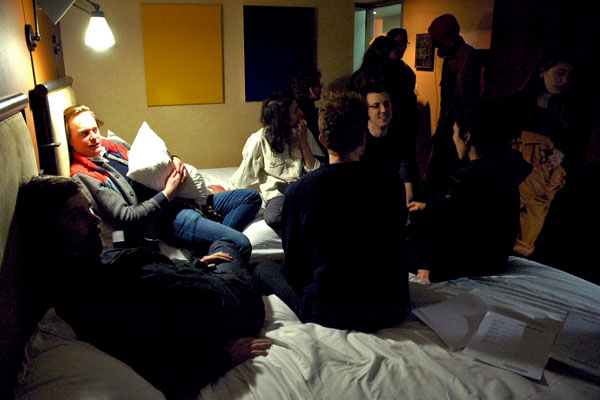
The Dependent was the event I had most anticipated since I first heard about it, and I wasn’t disappointed. Last night the Gramercy Fair (The Gramercy International Contemporary Art Fair), the 1994 progenitor of the modern Armory Show, was resurrected for a few hours. This was no sterile reproduction however, but a brilliant, exciting original. On the basis of the magic created last night, may have already created its own legend. It was “let’s put on a show,” and the results were pretty compelling, beginning with the contagious enthusiasm of the crowds on both sides of the “proscenium,” and continuing through the marvelous blur of boundaries between art, environment, artists, viewers and listeners. The dozen or so exhibitors were given one hour to arrange their installations inside an equivalent number of smallish rooms (inside the Sheraton Hotel on West 25th Street) before the doors were opened at 4 pm. The show was supposed to end five hours later, but the crowds were still lined up outside when we left at nine o’clock.

“Battle of the Brush,” encamped in Bryant Park

Battle_of_the_Brush_opening.jpg
this is not a reenactment

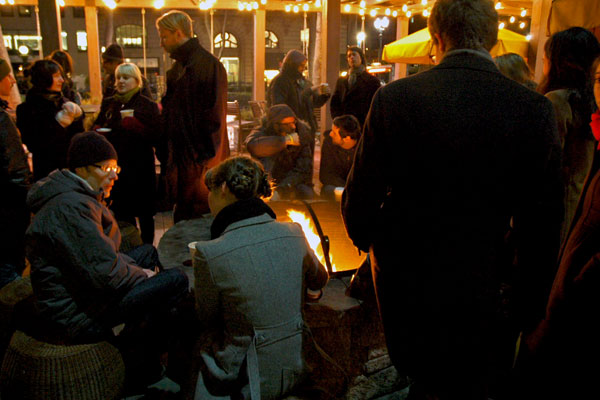
It looks a bit like a hobo encampment, but the group huddled around the fire in the picture above is actually a part of the very jolly crowd attracted to the opening of “Battle of the Brush” in Bryant Park Thursday night. The occasion was one of the oddest openings of the year, to one of the most creative art shows of the year.
Great idea: Bring the art to the street (or at least the park); adapt an existing venue; and still end up with a clean, white space.
The work is on view in closed, retrofitted and climate-controlled vitrines (actually, two of the booths which had recently housed The Holiday Shops at Bryant Park). Visitors will be able to see the art, en plein-air, until February 2.
I suppose it could have been even colder on the “opening night,” but normally I don’t find myself standing still outside on a wintery night in January. I thought it was pretty frigid, especially after I had to remove my gloves to operate the camera.
The burning wood was a boon (boonfire?) however, as were the bottomless cups of hot chocolate proffered by the freezing ‘wichcraft folks. Incredibly, overhead heating lamps actually made it possible for some of the crowd to lounge about in the Adirondack chairs we normally associate with summer – or ski resorts.
The crowd was great. I had a ball.
I think the full title of this small painting show, organized by Alex Glauber‘s Corporate Art Solutions, is “Battle of the Brush: A Civil Reenactment of Two Painterly States.” The reference to “battle” is perhaps less than half-serious, but it pretends to describe a clash between current abstract and realist styles of painting. Located where it is, the exhibition draws upon Bryant Park’s history as an encampment for soldiers during the Civil War. Ironically, the eight paintings in the show, by eight painters, are installed in two enclosed kiosks , or “camps”, and are arranged across from each other on a terrace dominated by a fountain dedicated to the Progressive reform leader and adopted New Yorker, Josephine Shaw Lowell, who spent much of the Civil War nursing the wounded.
The participating artists include:

REALISM REGIMENT: Alison Blickle, Tom Sanford, Nicola Verlato, Eric White
ABSTRACT REGIMENT: Justin Adian, Anoka Faruqee, Patricia Treib, Roger White

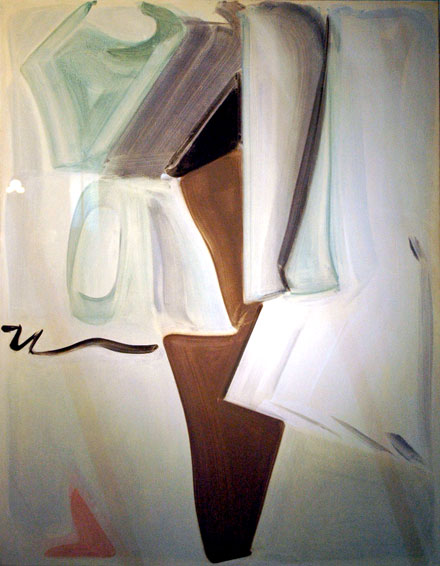
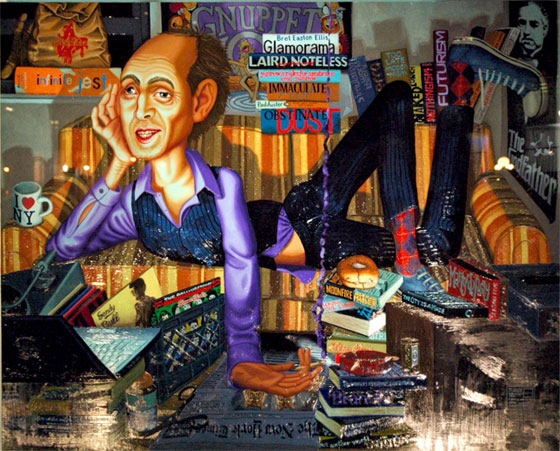
Because of the unusual ambient light, the plexiglas reflections, and the cold, the two images below are less than ideal, even by my own modest standards. I argued with myself about whether I should include any picture at all, other than the one showing the huddled fanatics, but I decided to go for some art as well, since that’s what it’s all about.

Patricia_Treib_Battle.jpg
Patricia Treib Armless Sleeve 2010 oil on canvas 56″ x 50″

Tom_Sanford_Battle.jpg
Tom Sanford Perkus Tooth 2010-2011 oil on wood panel

thrown out of Gagosian for addressing Kiefer’s art

Anselm_Kiefer.jpg
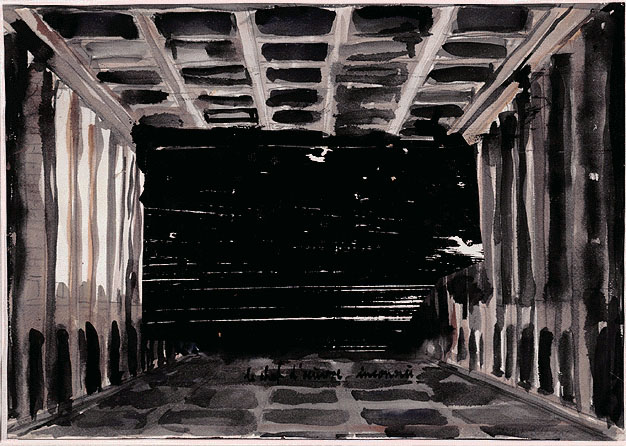
Anselm Kiefer le chef d’oeuvre inconnu (“unknown masterpiece”) 1982

“This is private property,” a gallerista in towering heels shot back. “We’re here to sell art.”
A small group of activists were thrown out of the Gagosian Gallery on West 24th Street this past Saturday on the final day of Anselm Kiefer‘s solo show, “Next Year in Jerusalem”. Claudia Roth Pierpont reports from the New Yorker’s online News Desk that a woman in her late fifties was swept up in the fracas which resulted when New York police officers called by the gallery arrived to evict the last four of the group (they had originally numbered eight). They had explained to gallery representatives that they had wished to participate in the conversation initiated by Kiefer’s work, and identified themselves as part of U.S. Boat to Gaza. Ingrid Homberg, who was visiting the exhibition independently, and who had tried to discuss it with the activists, was injured and fell when one of the officers dragged her out of the gallery.
It’s worth reading the Gagosian press release for the show, for the ironies provoked by Kiefer’s steely, overprotective New York gallery alone. The text includes these words, describing the central piece of the exhibition, “Next Year in Jerusalem”:

This imposing structure contains Kiefer’s provocative act, literally and imaginatively, to remind [us] of what has happened and what can still happen in the world. Occupations [the name of the piece, begun in 1969] is a visceral confrontation between history and the present that is lodged in the stuff of memory

.
ADDENDUM: The artist and writer Mira Schor has more information, and a wise, ruminative essay, “Anselm Kiefer@Larry Gagosian: Last Century in Berlin“, on her own blog.

[image (of a work not included in the Gagosian show) from Deutsche Bank]

Smithsonian/Wojnarowicz censorship protest, NYC

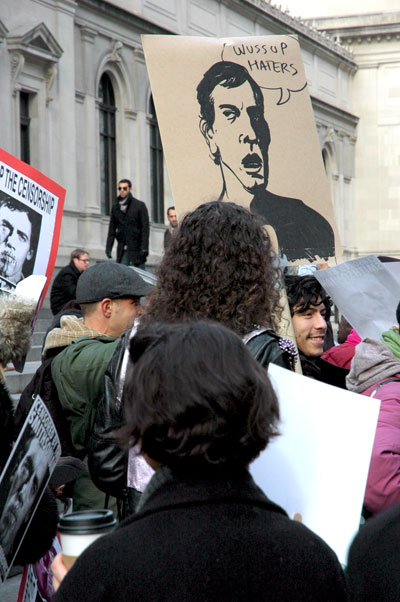
artpositive_wassup.jpg
what would David think?

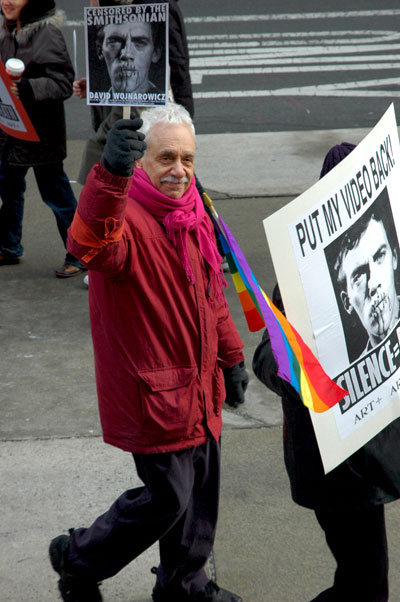
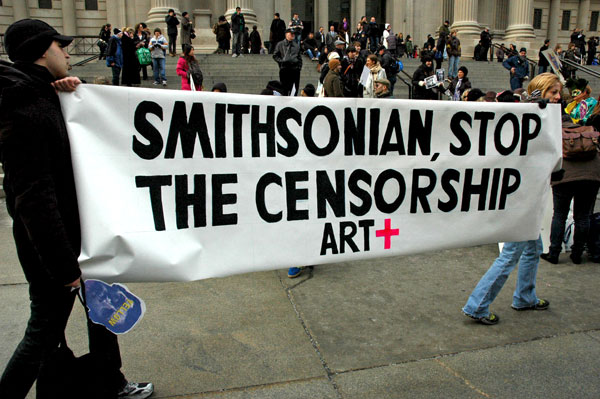
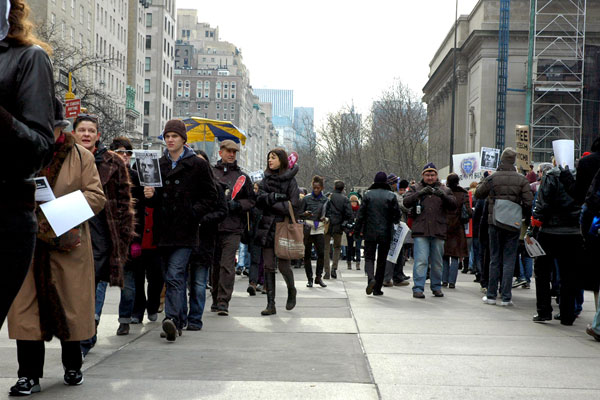
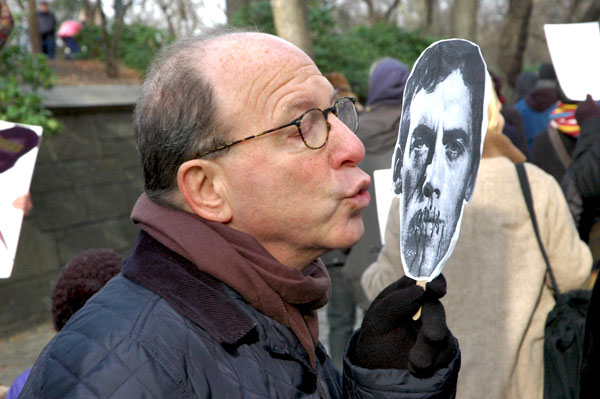
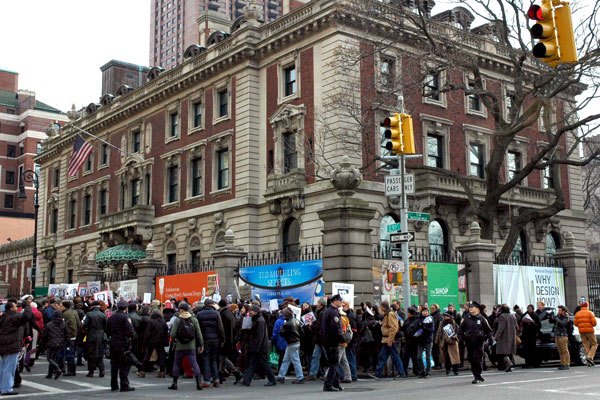
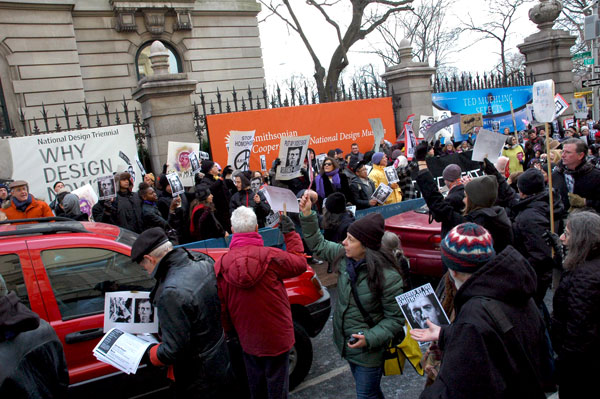
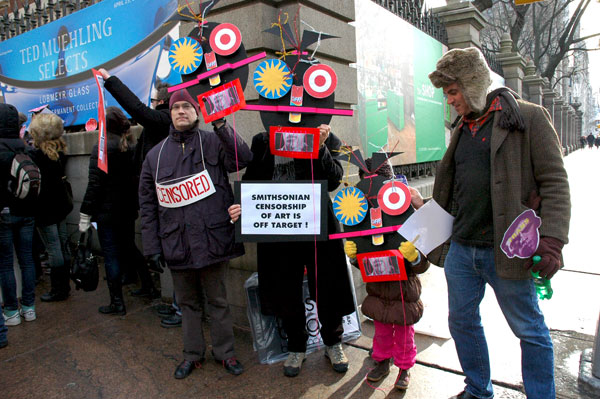
Sunday’s march up Museum Mile attracted around 400 to 500 people to the Smithsonian’s Cooper-Hewitt Museum to demand the return of David Wojnaroowicz’s video, “A Fire in My Belly,” to the National Portrait Gallery (NPG) exhibition, “Hide/Seek.”
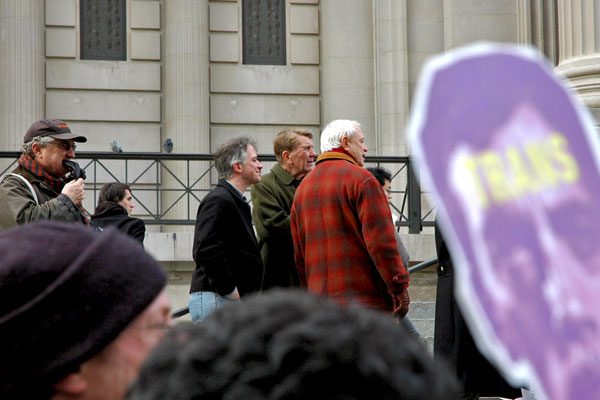
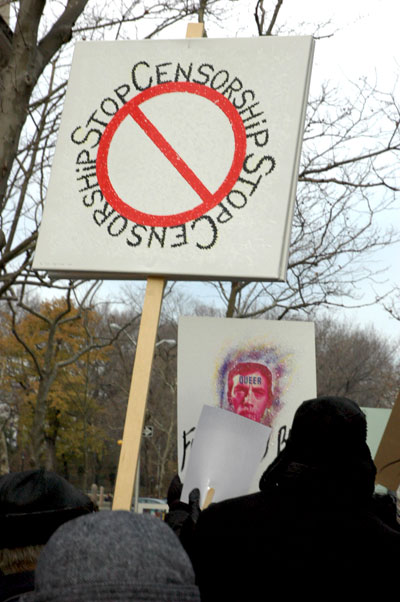
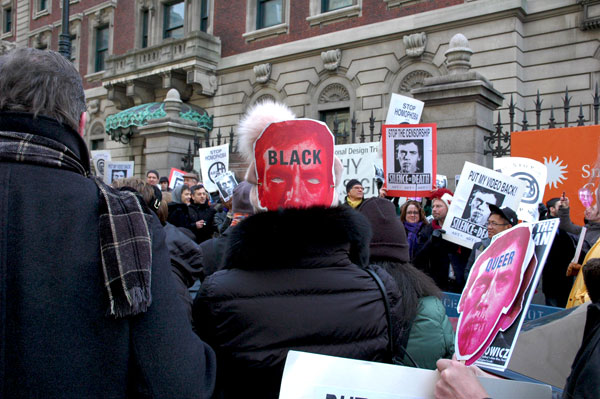
I’ve uploaded here a few images from my experience of the rally; they are arranged in chronological sequence.
Committed artists, writers, thinkers and other citizens demand that the Smithsonian, which controls the NPG, restore the work so the public can see the exhibition as the curators intended. G. Wayne Clough, the Secretary of the Smithsonian and the man who cowardly pulled the art from the show one month after it opened, must apologize to the entire country, and to the people of all the first, second and third world countries which should be able to expect of the United States something other than institutional and governmental censorship and the pandering to demagogues and the benighted.
The arbitrary suppression of words and images inconvenient to those who wield power cannot go unchallenged.

We attracted a lot of press coverage both before and after the protest. The issue and our demands have been broadcast to a lot of people, but even as I headed uptown on Sunday I was wondering if, in defending light and reason, we might also be helping the devil. Those thoughts disturbed me then and they still do.
It’s like this: Bill Donohue is dumb, and although John Boehner and Eric Cantor may be little smarter, none of these hollow men is too dim to know that when they and other self-appointed censors and moralists pull these publicity stunts they only ensure that more people get to see what they think they shouldn’t.
So while Donovan and the others make lots of money off of their bullying and intimidation, they and others drawn into encouraging and supporting this transparently-cynical chicanery continue to do so because of both the illusion and reality of power produced by the wide media attention it draws. What discourages me most is the thought that the more public the blowup today, the more successful the censorious attacks of the wacky Right may be tomorrow, intimidating future victims from doing anything which might offend the morality police. These rows may actually inhibit free speech and expression going forward, and we have already seen that the leaders of our institutions are spectacularly lacking in courage.
While I’d rather not dwell on these gloomy thoughts, unfortunately the National Portrait Gallery show remains expurgated as I write this, with no sign of any change. Of course the whole thing is ridiculous, but are the censors winning? We have to know what we are up against if we hope to defeat them.

Since the demonstration on Sunday I’ve come across two links which may help explain to those who first came across this old war story only this month: They describe the issues, relatively unchanged in over two decades, and their historical context.
James Romberger, David’s collaborator, writes about his friend. And this 1990 video, showing the artist talking about the right-wing backlash against the NEA and arts funding, helps us to realize how much we lost when David’s voice was silenced, in the end not by the bigots, but by AIDS.
A printed excerpt from the video, David speaking:

And the thing that makes me laugh is that in the last twenty years images and words that artists or writers make have had absolutely no power, given that we’re essentially competing against media, you know, in order to create something that reverberates in those image or words. And the fact that, if at this point the images and words that can be made by an individual have such power to create this storm of controversy, isn’t that great?
It means the control of information has a crack in its wall.

Recent national and international stories, involving an explosive challenge to the dominance of corporate and government news sources, suggest that the crack can be protected, and enlarged, only if we’re willing to work at it.

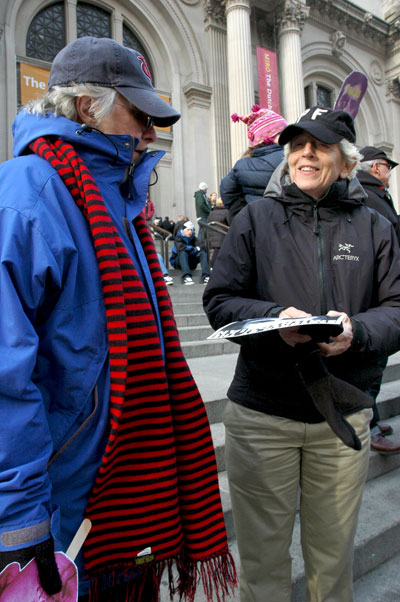
artpositive_Betsy_Louise.jpg
Betsy Crowell and Louise Fishman on the steps of the Metropolitan
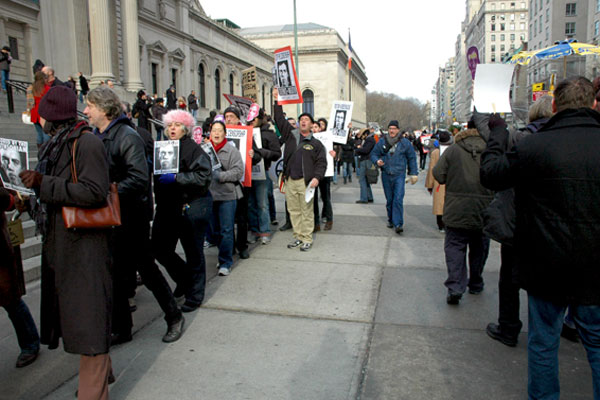
artpositive_picket.jpg
the picket forming on Fifth Avenue
artpositive_Jonathan.jpg
Jonathan “Ned” Katz below the steps
artpositive_banner.jpg
our spanking-new ART+ banner
artpositive_Alist.jpg
A-list establishment queers, plus one random journalist, checking out the scene
artpositive_low_picket.jpg
the picket about to head north
artpositive_STOP.jpg
international sign
artpositive_Jerry.jpg
Jerry Saltz loving David
artpositive_target.jpg
target Smithsonian, here its Cooper-Hewitt satellite
artpositive_blackqueertransfemaleredyellow.jpg
masks as epithets designating “the other” (black, red, yellow, queer, female. etc.)
artpositive_word_on_the_street.jpg
on 91st Street, haranguing the Smithsonian
artpositive_ant_family.jpg
family of art ants outside the museum (Target is a major funder of the Smithsonian)

ADDENDUM: Philip Kennicott has a smart, even electrifying piece in the Washington post, “After removing video from ‘Hide/Seek,’ Smithsonian chief should remove himself“.

censorship and homophobia, AIDS, sex, art, religion

CENSORED_August_1_1989.jpg

I never thought we’d still be doing this 20 years on. The image above is of a thin stenciled sign I held up on the steps of the Metropolitan Museum of Art August 1, 1989.
I thought of it as a work of art; I was thinking of both the sign and the afternoon.
I didn’t make the sign. Along with a lot of others just like it, and any number of other images and texts, it was a small, elegant part of a powerful New York demonstration protesting the Corcoran Gallery of Art’s cancellation of the D.C. exhibition of the show, “Robert Mapplethorpe: The Perfect Moment” and the Helms Amendment. The amendment was designed to prohibit the National Endowment for the Arts (NEA) funds from ever being used for so-called “obscene” or “indecent” materials, descriptions that at the time had repeatedly been applied to much of Mapplethorpe’s art, and to that of Andres Serrano, who had also become a target in what was being called the American “culture wars.”
While the artists attacked became more famous than ever, neither the NEA nor our other cultural institutions ever recovered from the assault on their artistic integrity and independence. I’m reluctant to employ the war metaphor (we’re going off in every direction with real wars already), but I think most people would say that, whatever it is called, a fundamental culture struggle continues today: There are too many frightened people in this country, and too many anxious to profit from that fear.
Bill Donohue is a vile and disgusting little opportunist with a computer and a fan base which he regularly whips up to get them to send checks his way. A retrogressive darling of the crazy Right, he invents issues and targets which can attract enough visibility to provoke the fears and hatreds of ignorant older Catholics, allowing him to draw a very generous salary of some $400,000 a year. His primary targets are gays, jews, women, progressives of any kind, and all news media (excepting the just-pretend one, Fox).
While Donohue does not represent the Catholic Church, officially or otherwise, he operates within its comfort zone. He may be the crazy ranting uncle everyone would like to ignore, but the Church hierarchy has never disavowed anything he has said; and they all go to the same banquets.
I thought that the kind of primitive depravity he represents had been pretty much squished twenty years ago, but on the 1st of December, which was, whether incidentally or not, World AIDS Day, the head of the Smithsonian, institutional parent of the National Portrait Gallery, pulled the David Wojnarowicz video, “A Fire in My Belly.” from the excellent NPG exhibition, “Hide/Seek,” and apologized for its contents. The show had already been open for an entire month when complaints from Donohue’s Catholic League, several Right-wing House Republicans, and Fox News [sic] resulted in its peremptory censorship, or debasement.
So we have a professional gay-bashing Catholic fanatic leaning on two fellow political and social fundamentalists, House Republicans John Boehner and Eric Cantor, to blackmail a great museum by threatening to cut its funding if it did not remove a work of art to which the Catholic nut objected. Viz. ants on a crucifix. We know it’s not about ants: Donohue and his own coterie are unhappy about everything that has happened in the West since the suppression of the Spanish Inquisition. His Republican fellow-travelers may be in it for power, but their sympathies may actually be sincere, however warped.
I hate to do anything to give more visibility to Bill Donohue, or his Congressional altar boys, but this madness has now been covered by the media everywhere, and roundly condemned in as many places, and the Smithsonian has so far failed to reinstall the art it was so anxious to agree with the nasty little man was offensive.
PUT IT BACK – NOW!
A lot of people are going to be on Fifth Avenue this Sunday demanding that the Wojnarowicz video be returned to the National Portrait Gallery. We will be demonstrating as colorfully and dramatically as we can that we care about censorship and homophobia.
We have to be there, at one o’clock on the steps of the Met, Fifth Avenue and 82nd Street. And why the Met? Because it’s the front porch of the art world, because there’s plenty of space and a grandstand of sorts. From there the group will march up to the Cooper-Hewitt Museum, which actually is a part of the Smithsonian.
The 1989 demo included the ACT UP group “Art Positive” (broadcasting a double meaning for the second word); the primary target then was homophobia and censorship. The 2010 demo will include members of the 1989 collaborative, and the entire demonstration has been designated “ART+” (only a slightly altered written form of the 1989 name); the primary target is essentially, and shockingly, the same, homophobia and censorship.
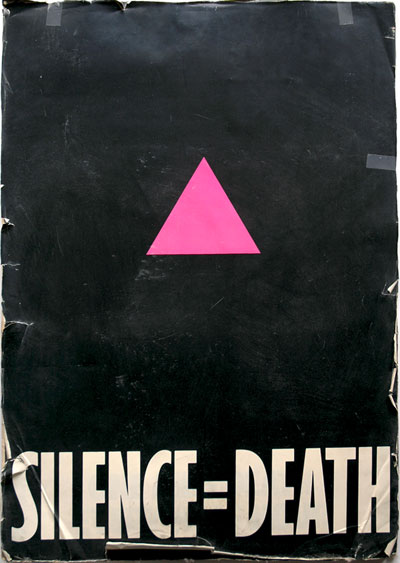
But since we’re talking about the public treatment of work by an artist closely identified with a disease which as a nation we still haven’t fully confronted, the subject of AIDS must not be left out of the discussion. Silence does equal death.
Finally, because we are dealing with people identifying themselves as representing the interests of the Catholic Church, we also have to understand that the targets of their assault necessarily include all women everywhere.

SILENCE_EQUALS_DEATH_b.jpg

And there’s more: America’s continuing failure as a society to deal with what it thinks of as the very scary subjects of sex and art (and not only when they are combined, or ignited by the inclusion of AIDS) is inseparable from the ignorance and fear which prevents it from addressing our newest, and rapidly-mushrooming real problems.
In this country the public conversation always gets back to religion (if it ever leaves it in the first place). Organized and intensifying public religion gums up the works of virtualy every institution and increasingly ties our hands when we have to deal with impending national and planetary disasters. We may never grow up enough to understand the damage it has done and continues to do, but there’s a slim hope that a larger percentage of the next generation will be able to think for itself.

AIDS_and_its_Metaphors_Wojnarowicz.jpg

For more information on the censorship outrage:
ART+ [the demonstration site]
Modern Art Notes [Tyler Green – one of many posts]
NEWSgrist [Joy Garnett – see many posts]
Diamanda Gal�s [Washington City Paper, Arts Desk]

[the second image is of a slightly-battered veteran ACT UP foamcore-mounted sign which spends its retirement leaning on a wall in our apartment, a constant reminder; the third photograph includes, in addition to the Sontag volume and an old ACT UP “Stop the Church” button, the cover of “Seven Miles a Second“, a posthumously-completed graphic novel written by Wojnarowicz in collaboration with James Romberger and Marguerite Van Cook, and a small globe turned toward Africa]

finally, almost the entire “Big Bambú” experience

BB_two_rings.jpg

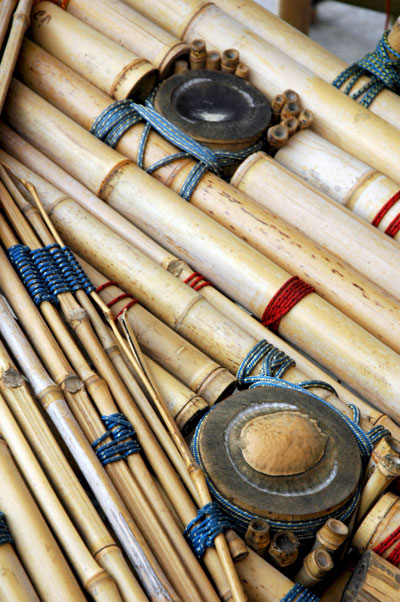
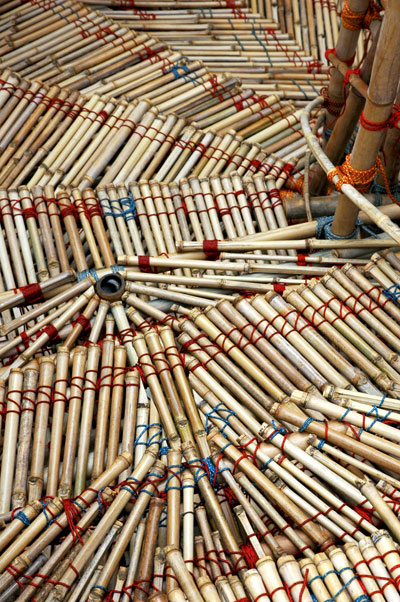
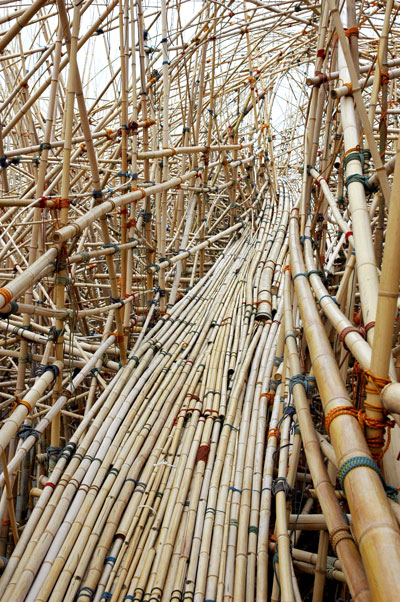
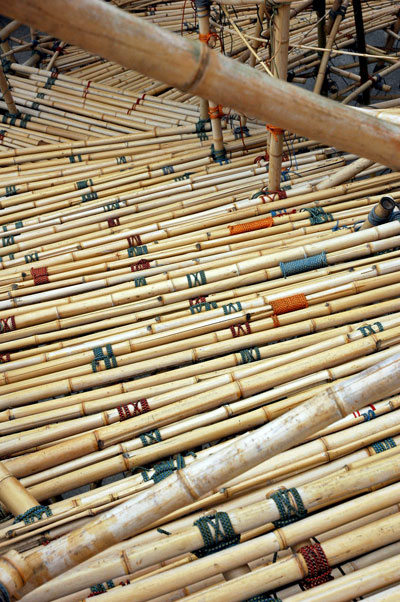
The last time we were on the roof of the Metropolitan Museum we were partially rained out, even if it was not quite raining. It was the press preview of the completed first stage of Brothers Mike and Doug Starn‘s extraordinary installation, “Big Bambú” (the Museum closes the beautiful bamboo gates if the surfaces are too wet). We were only able to admire the “forest” from below and, staring up, we could only imagine the experience of actually walking along its ascending, curving, elevated trails.
We were back for another try last Monday, four months later, also to see how much more had been completed by the artists and their team of rock climbers in the interim. Since it had been raining earlier in the morning our chances for getting any higher than we had in April didn’t look good, but we were eager to chance it (it was another press preview and we would be able to record the work with our cameras).
We did check roof conditions with the Communications Department before we left, and it sounded promising. By the time we arrived at two the rain had long stopped and a favorable zephyr had done much to dry the reeds. The rewards of our gentle climb were those of being able to see the beauties of the work’s more functional forms close up, and the thrill of knowing we were walking where no one would have been able to before this spring, and would not be able to again after this fall.
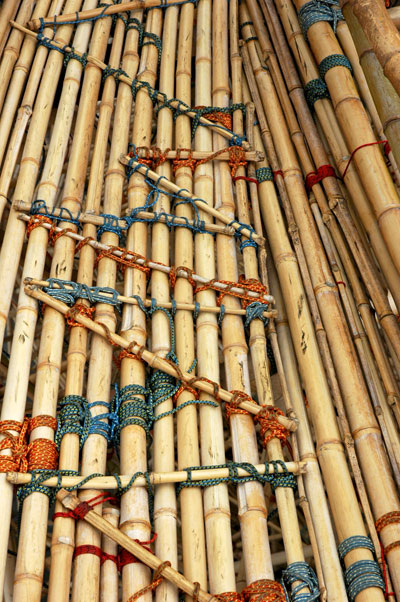
Once up in the air, born by the squeaky bamboo and its nylon bindings, seduced by the rhythms and the patterns of the paths, and listening to the sound of birds on a misty afternoon, I found it very difficult to come back down. Only the sight of two hawks circling high above, visible through a clearing of the tapering verticals, could remind me of my customary attachment to the earth.
We slowly retraced our steps to the roof surface, and still we lingered.
Oh, by the way, “Big Bambú” is big, and getting still bigger: It’s probably about the size of the Temple of Dendur downstairs. Maybe bigger.

BB_stairs.jpg

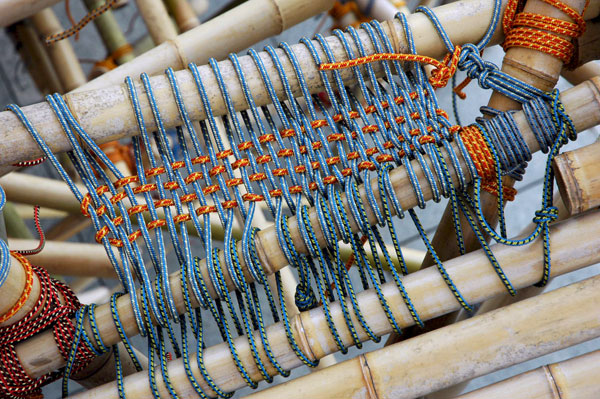
BB_weave.jpg

BB_zigzag.jpg

BB_path.jpg

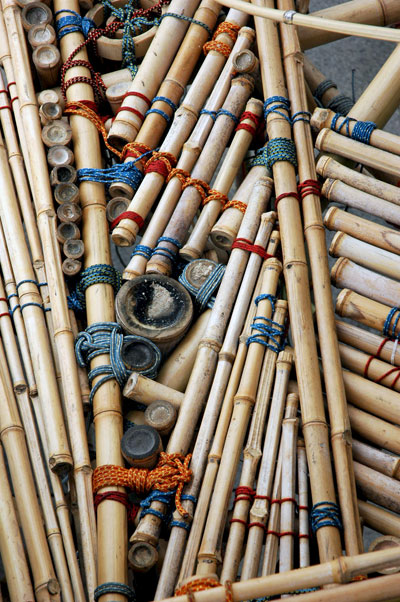
BB_sockets.jpg

BB_gate.jpg

BB_downhill.jpg

BB_skyline.jpg

Code Pink visits NYC oil addicts (shops) on Fifth Avenue

Dana_outside_Zara.jpg

at_Zara_with-press.jpg

Zara_banner.jpg

Dana_pointing.jpg

Sally_cop_Dana.jpg

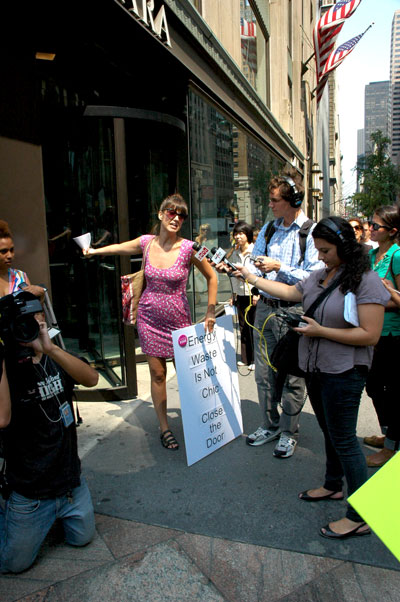
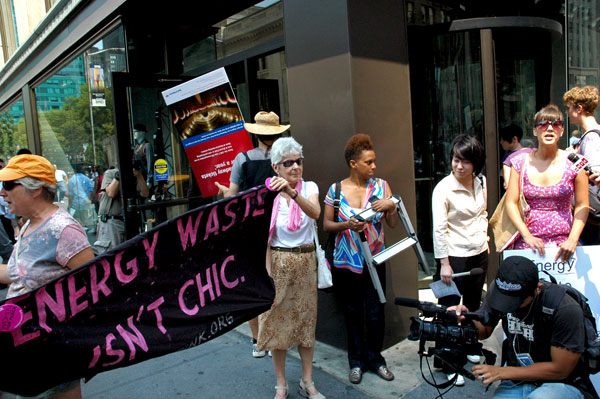
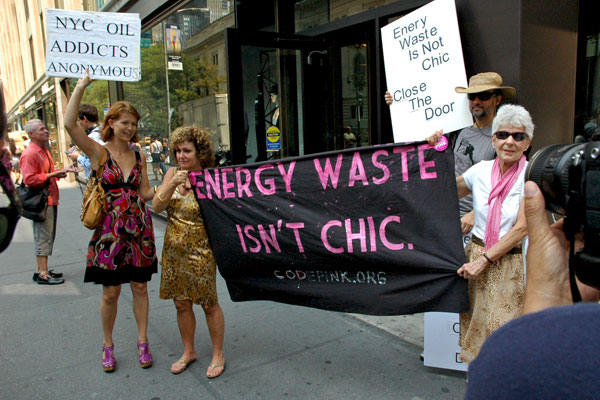
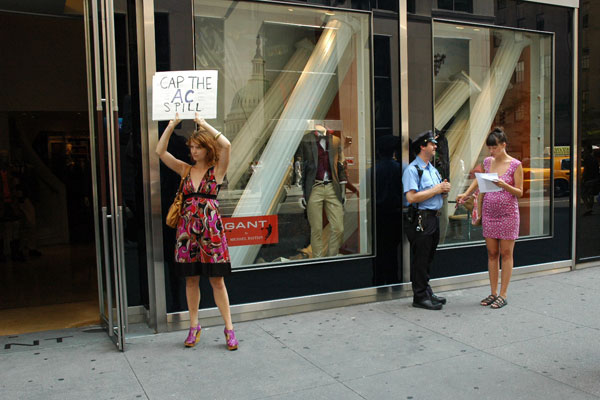
Continuing their “Action Against Illegal Energy Waste”, members of Code Pink returned today to some of the Fifth Avenue stores they had visited July 23rd, once again acting as a part of the international mutual aid movement, “NYC Oil Addicts Anonymous“.
This is an excerpt from the text of an email sent out this week by Code Pink:

Two years ago, the New York City Council passed a very reasonable law prohibiting large stores from cranking their air conditioning and leaving their doors open. But they still do it – one retailer was quoted in the New York Times as saying, “It’s business; sometimes you got to do what you got to do.” As consumers, we have to show these businesses that we’re disgusted, not enticed.
Leaving the doors open cranks their electricity use by 25% during peak hours, overloading the power grid, making blackouts more likely, and increasing the oil and nuclear demand in New York. It makes as much sense as leaving gas pumps flowing onto the sidewalk when you’re not using them. And as conscious women working for peace and justice we see the direct links between resource wasting, addiction to oil, wars for oil and on and on!

I joined the group on the door-shopping trip up Fifth Avenue which began at noon today, gamely juggling two protest signs, my not-so-lightweight camera, and several sturdy bags I was going to need later at the Union Square Greenmarket.
There was no shortage of targets from the very start, but most of the stores closed their doors very soon after our banner and signs appeared outside, and the chants began. When we got to the Gant Store however we encountered more than a little resistance: Not only did the manager refuse to close the two large doors (through which, incidentally, I could feel the store’s cold air as I stood behind the banner about 20 feet across from the opening, its fabric coming down only to my knees), but she called the police, who arrived with remarkable alacrity.
I wasn’t a part of the conversation which our excellent guides, Sally Newman and Dana Balicki, had with the two or three officers, but it was clear they wanted us to leave, and they definitely refused to do anything about the open doors. In all fairness to them, the cops may have been aware that our City Council had passed a statute (two years ago) whose enforcement responsibilities were placed in the hands of the understaffed Department of Consumer Affairs.
Eventually they decided we cold remain, as long as we did not obstruct the door or the passage of any pedestrians (in fact, we had not been a threat to either, from the beginning).
Before I decided to go today I thought about the scale of the action. There are so many huge problems, more dramatic and immediate crises than that which provoked the response of which I was to be a part, but I said to myself that this is clearly a no-brainer. We only have to bring the issue to the attention of the merchants. There can’t be any rational excuse for leaving doors wide open while you’re pumping cooled air produced by polluting and non-renewable fossil fuels through your store, sending even more hot air out the other end of the system.
I was right: It is a no-brainer. Apparently there are just fewer brains out there these days.

ADDITIONAL COVERAGE:

  • Lewis Dodley, with video, on NY1
  • Daniel Tucker, writing on WNYC News Blog
  • Jennifer Glickel reporting for DNA info
  • Natural Resources Defense Counsel staff blog post by Eric Goldstein
  • Rebecca Myles, interviewing Sally Newman Friday evening, on WBAI Evening News (starting 3 minutes into the broadcast)
  • Catalina Jaramillo writing in El Diario
  • Fuji News Network, covering the issue and the action on Saturday