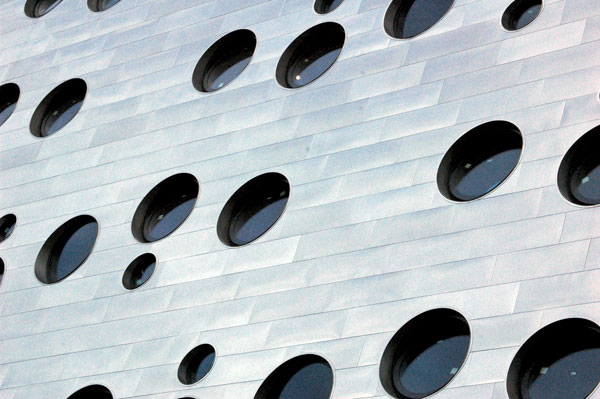
Because I believe so strongly in preserving an interesting building’s integrity, and an artist’s vision, I find it hard to say this, but what’s happening to the building that once housed Fr. Bruce Ritter‘s Covenant House shelter for homeless and runaway youth may just possibly be an improvement over the original concept – and execution.
I’ve now seen what looks to be the almost-finished “Dream Hotel Downtown” of hotelier Vikram Chatwal, located at 346 West 17th Street. It is a refitting of a building designed and constructed for the Maritime Union half a century ago to accommodate medical and recreational facilities for its members. The 11-story building is located behind the re-conceived Maritime Hotel, and both eccentric structures were designed by a young architect named Albert Ledner.
I remember the buildings when they were new, and the excitement they created, and I’m delighted that at least two of this architect’s trio of Village commissions has survived at all.
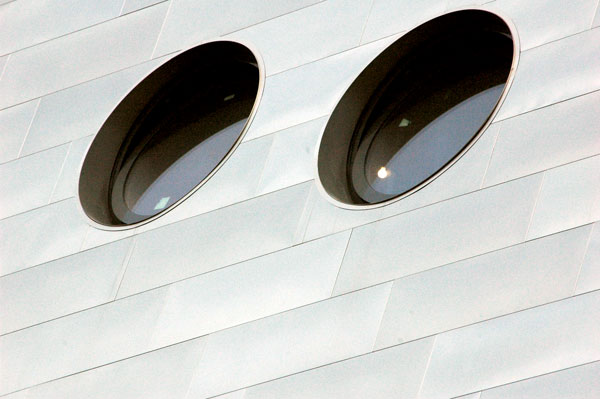
I say that the new building may be an improvement because, while I’ve always loved its perfect round windows, along with their beautifully-crafted frames and hopper-like opening mechanisms, the new dancing pattern punched out by the current design team, Handel Architects LLP, in two different sizes of openings, really makes me smile. Also, the building’s original tiny ceramic tiles were replaced by stucco years ago, probably because of problems inherent in the materials, and the way the horizontal lines of the (tile-like) rectangles composing the new shiny (hull-like) metal skin wrap around the tilted corners of the main facade, and dip down along the sides, showcases a very different effect, one at least equal to the 1960’s original.
The overall building shape remains unchanged.
Now if only somebody would change that name: “Dream Hotel” scares me silly.
NOTE: Except for its romance-novel appellation, I think I could love this building, but now I’m wondering if it’s already a doomed affair: While looking for additional information on the building’s design and construction, and searching, sometimes fruitlessly, for links to incorporate in this blog, I got the impression that the project may be on hold. There are some indications that the “dream” may be trouble, because of problems related to money, the health of the principal, or (perhaps the least daunting challenge) engineering problems, and I notice that the hotel web site itself is still “under construction”.
Category: NYC
showy vine on Jefferson Market Garden fence

Ipomoea alba
I was walking about the West Village this afternoon when I spotted this gorgeous plant garlanding the high metal fence surrounding the lush Jefferson Market Garden. I immediately thought of one of my childhood favorites (and always a guaranteed gardening success), the Morning Glory, although this was clearly not my Michigan friend.
Just now I Googled “vine with large white flowers” and discovered I had seen and photographed a “Moon Vine”, or “Moonflower” (Ipomoea alba). It’s “a species of night-blooming morning-glory”, according to Wikipedia, where I also learned that it may grow to 100 feet, given the appropriate host.
But the plant isn’t just a pretty face and a tall drink of water: Ipomoea alba played an historic role in the history of rubber:
The ancient Mesoamerican civilizations used the Ipomoea alba morning glory to convert the latex from the Castilla elastica tree and the guayule plant to produce bouncing rubber balls. The sulfur in this morning glory served to vulcanize the rubber, a process pre-dating Charles Goodyear’s discovery by at least 3,000 years.
*
But why is a tall person a “tall drink of water”? I’ve noticed a lot of silly ideas about this very-old-fashioned expression on line, but the phrase (one of my favorites) was always pretty clear to me, even as a child: Obviously if a very tall person took a drink of water, it would have a lot longer to go to reach the stomach.
Saint-Gaudens’ “Hiawatha”, and Manifest Destiny
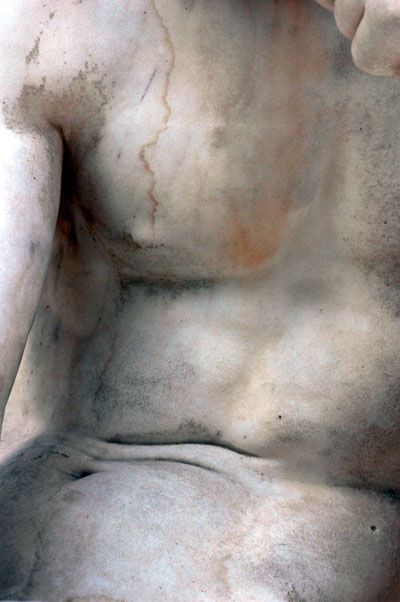
Augustus Saint-Gaudens Hiawatha in clay, 1871-1872; this marble carving, 1874, 7 feet 9 inches high, including pedestal [detail]
Barry and I were leaving the Metropolitan Museum cafe in the American Wing yesterday when we passed the Saint-Gaudens marble “Hiawatha”. I must have passed it any number of times before, but now I found myself zeroing in on the beautifully-modeled torso of this noble young man, created by an artist who was only about 23 himself when he began the work in clay. Then, thinking about the date, 1870, I thought about the time and geography of the work’s origins.
In the very midst of the beginnings of the last segment of our protracted Indian wars, a very young Augustus Saint-Gaudens, fled Paris, where he had studied for three years, on the outbreak of the Franco-Prussian War. He settled in Rome in late 1870 where he began work on “Hiawatha”, his first full-length statue. His inspiration was the legendary Chippewa chief and founder of the Iroquois confederacy who was the main protagonist in Henry Wadsworth Longfellow’s enormously popular 1955 poem, “The Song of Hiawatha“*.
In 1870 Saint-Gaudens’ native country was still nursing the wounds of the Civil War; France and Germany were engaged in a duel which quickly realized the end of one empire and the birth of another, both with enormous consequences which continue today; the Italian army had crossed the papal frontier (finally completing the wars for unification), in the same month the artist arrived in Rome. Saint-Gaudens however was otherwise engaged.
The War Between the States may have ended (he had been too young to participate), but there was hardly going to be any peace on the other side of the Atlantic, where twenty more years of wars directly impacted – in fact completely devastated – the people represented in his early masterpiece.
Americans were eager to settle the lands which had been opened up in the west, and Civil War veterans, adventurers and misfits were volunteering to secure their right to be there, defending it from the legitimate claims of the peoples we were already making into legends and heroes. The United States was determined to fulfill its own peoples’ “manifest destiny” and would not allow what remained of native American civilizations to stand in the way of its claim to the “Land of Many Uses“. In spite of occasional sensational – and hugely popularized – news events like “Custer’s Last Stand”**, the full horror of these last Indian Wars was largely removed from the consciousness of Americans back east, much as in the case of our own wars today.
It was all over by 1890: Providence had made the entire country safe for the American Empire, but the devil had taken the hindmost; the Indian was now almost gone, and almost forgotten, except where and how it served the victors to remember him.
But it is a beautiful statue.
*
The fame and legend attached to both the poem and its subject continued well into the 20th century: I remember my class being told in grade school to memorize the trochaic tetrameter of this Longfellow poem, and we barely questioned the assignment (I never got beyond a few stanzas).
**
When my own family drove west in the big Buick on a long vacation 55 years ago, the Little Big Horn ranked extremely high on our own list of “must sees”, and in fact, I’ve never forgotten my impressions of that sad, and then still very desolate, little-visited place.
“The Voyage of Garbhglas” at the Irish Hunger Memorial
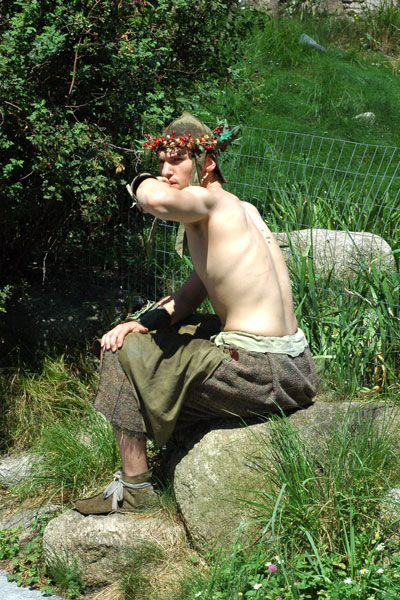
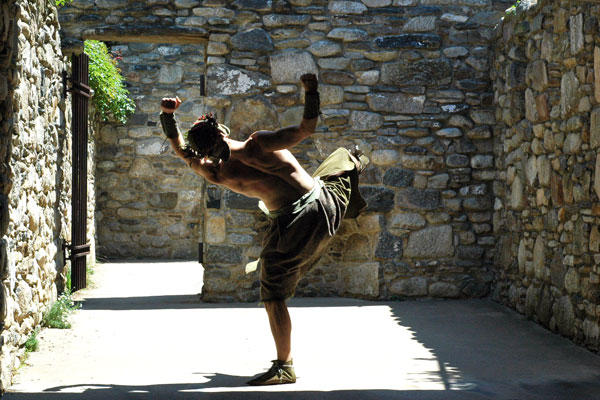
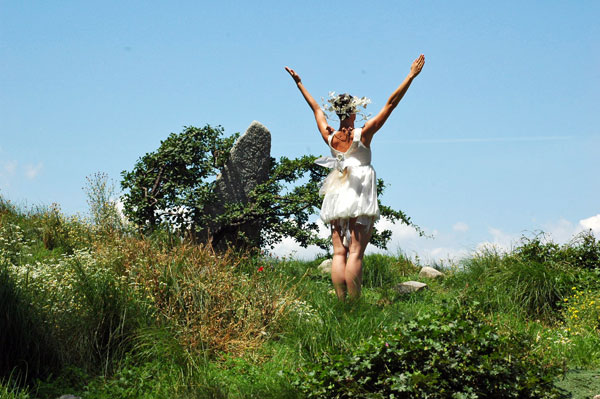
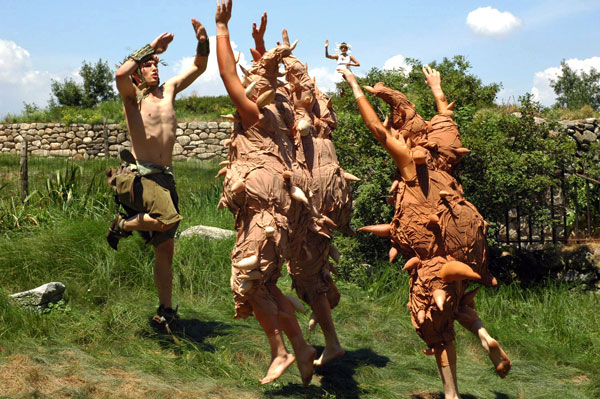
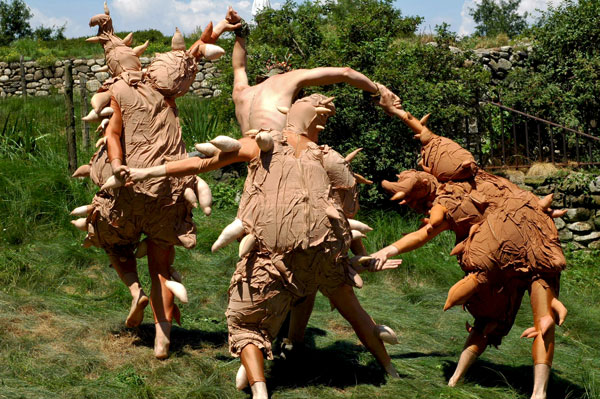
Barry and I headed for the Irish Hunger Memorial shortly after noon on Monday (after my visit to City Hall Park) to see an excerpt of “The Voyage of Garbhglas“, choreographed by Christopher Williams and presented, courtesy of the Lower Manhattan Cultural Council, as a part of the River To River Festival.
It was a total delight, a magical allusion to ancient Irish faerie lore performed in a magical Irish place on a beautiful afternoon, and I recommend it to anyone who can make downtown for the two performances remaining, Wednesday and Thursday, at 12:30 each day. The Memorial is located inside Battery Park City, 290 Vesey Street at North End Avenue, an easy, almost straight walk west from the World Trade Center stop of the E train.
The performers were Ursula Eagly, Kira Blazek, Caitlin Scranton, Michael Ingle, Sydney Skybetter, Moses Kaplan, and Andrew Smith. I believe Michael Ingle was the celtic youth, and the three other male dancers were what I’ll call “the tubers”. Christopher Williams himself and Matthew Tutsky played troubadour harps of different sizes, and the music was by Gregory Spears, who can be seen in some of the images directing the singers.
Barry has posted a video, on Bloggy, of a short segment of the 30-minute performance and has a link to his Flickr set.
As someone who tries to take advantage of what New York has to offer culturally, I think a lot about how everyone who would like to see art in performance (in any medium) can find a way to do so without having to deal with discouraging lines, fifth-balcony-in-the-rear seats, or even sold-out notices. In my own case it helps that I’m usually interested in work that most people are unlikely to even be aware of, and I’m lucky to have the leisure to seek it out. But what happens when something really good becomes well known, and suddenly everyone wants to see or hear it?
I was considering this subject with Barry when we left the performance of “Garbhglas”. His answer was that the ideal would be that there would be so much art out there, and really good art, that there would never have to be a line or a crowd. We’d all have so many options that we wouldn’t have to keep bumping into each other, or fight for tickets. Of course that ideal assumes we all think and feel for ourselves and aren’t seduced by the inevitable hype – including, I suppose, in this case, my own modest efforts at making a ballyhoo.
This time the subject had come up because in Monday’s surprisingly intimate, georgic performance by Williams’ dancers and musicians, while everything took place outdoors, it seemed that there was really room on the Memorial’s platform for only about a hundred people to fully experience it, not including whatever the numbers were for those standing on the street below.
While I imagine there must be other things to do at lunch time Wendsday and Thursday, if you go, maybe it wouldn’t be a bad idea to plan on getting to “Garbhglas” early for its final two performances.
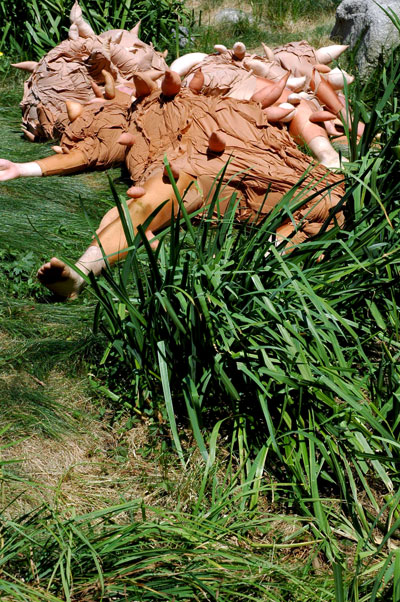
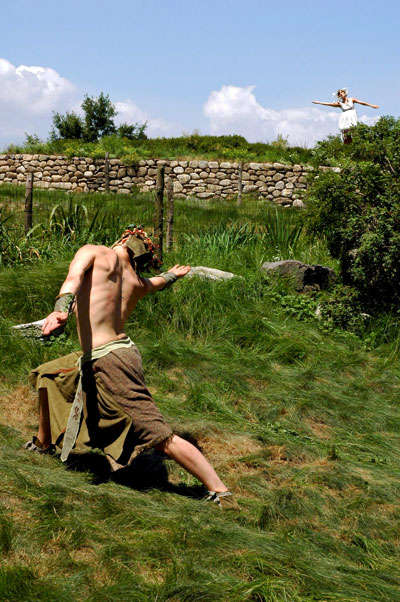
Time’s Up! makes City Hall Park a community garden
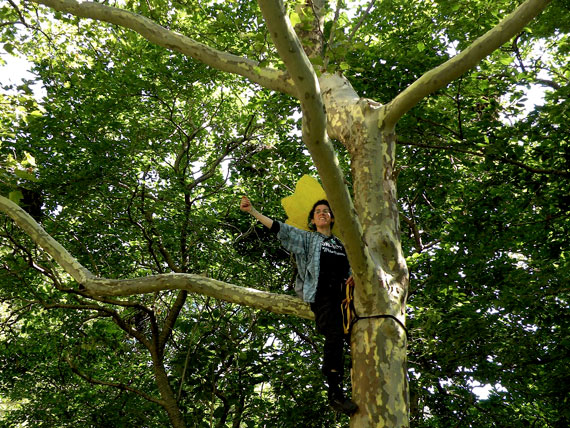
Jessica Sunflower planted in CIty Hall Park
UPDATE: A public hearing concerning the City’s proposed new rules will be held next Tuesday, August 10 at Chelsea Recreation Center, 430 West 25th Street, at 11:00am. It should be very colorful. The New York City Community Garden Coalition (NYCCGC) is urging its supporters to testify about the importance of making community gardens permanent. Information can be found on the Coalition�s web site, including the proposed rules themselves, the expiring 2002 agreement, and a history of the evolution of New York City community gardens.
New York City appears to have officially abandoned its efforts to preserve the 500 community gardens which have been protected from development since 2002 by the Spitzer Agreement (“Preservation Agreement“). That compact, which ended a hard-fought battle begun more than 20 years earlier, saved hundreds of community gardens, but it expires on September 17 this year.
Proposed Department of Housing and Preservation (HPD) rules will permit these precious urban green spaces to be legally transferred for commercial development. These popular and flourishing bootstrap gardeners’ oases had replaced neighborhood vacant lots where buildings had been abandoned by landlords following the flight of residents to the outer boroughs and the suburbs during the sixties and seventies.
These older structures, neglected and often torched, but ultimately leveled in any case, all eventually became city property. The City hoped to profit from their sale and the tax revenues which would follow their development, but there was no commercial interest in the properties until residents, both old and new, had worked hard to successfully rebuild and improve their neighborhoods.
The communities which have fought for these spaces and nurtured them for years are understandably very angry. Yesterday Jessica Sunflower and some friends decided to bring the Time’s Up! campaign to preserve these gardens down to City Hall itself. The precise venue chosen was City Hall Park, on the doorstep of both the Mayor’s office and the City Council Chamber. Sunflower managed to climb into a tree planted in the Mayor and Council’s own official “garden”, and she was joined on the ground by some serious community advocates.
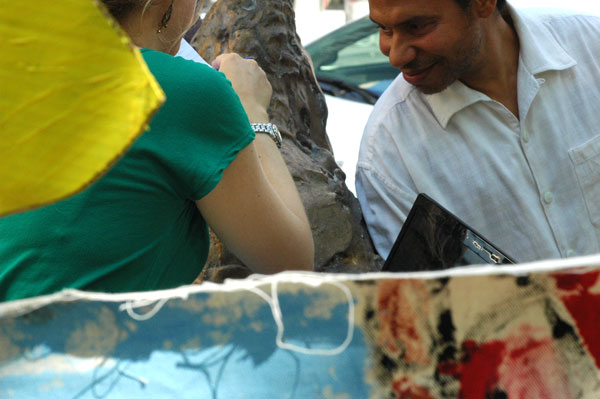
modern activism: back on the ground, even as Sunflower was being ushered into a police vehicle, supporters were busy broadcasting the action from a laptop resting on the plinth of a bronze sculpture at the edge of the park
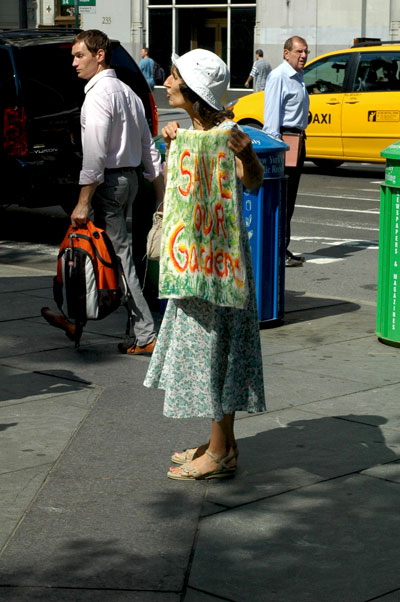
the voice of one crying in the City Hall wilderness – will it be heard?
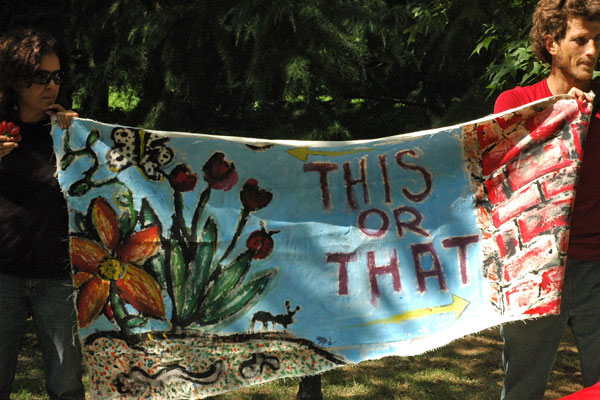
for thirty years, the communities have chosen gardens over brick
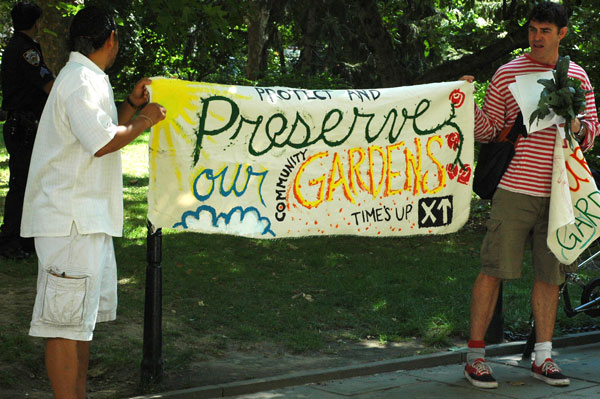
kale bouquet: the Times once described New York’s more successful community gardens as “spectacular stretches of kale-toned respite”
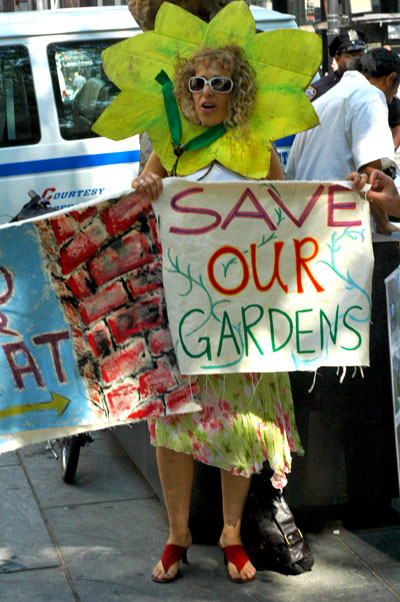
the sunflower petals abandoned by the prisoner while she was being removed from the tree were quickly salvaged and recycled back on the ground
[image at the top by Rebekah McCabe, from a Flickr set uploaded by Barbara Ross]
gay or black in the garden state: is it still 1953 in NJ?
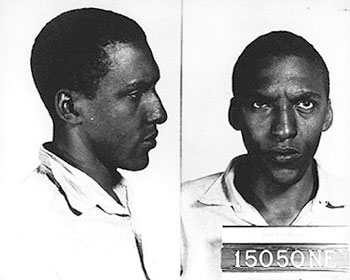
Bayard Rustin’s 1953 mug shot*
The CEO of an Atlanta credit union, on a visit to New Jersey for his 30th high school reunion, has been shot and killed in a Newark park by an undercover policeman. The alleged sex-related incident ended in the senseless death of an unarmed man, DeFarra Gaymon, a successful businessman and a married father of four.
The official explanation, delivered by the acting Essex County prosecutor (that the officer, trying to arrest Gaymon for lewd behavior, had fired in self-defense), makes no sense, and even if the pieces could be fitted together they suggest a world I thought had disappeared decades ago: I remember what many urban parks looked like after dark half a century back, I know that the police played them for sport, and I know the combination could destroy lives, but it’s now 2010. This Essex County park is located in a state which by most accounts ranks at the very top in the nation in laws extending equality and civil rights to both the gay and black communities (yes, the victim was black), and I thought we now had better uses for our constabulary – and that we could still afford real uniforms.
Actually, 57 years ago Bayard Rustin got off much easier than DeFarra Gaymon, whatever the unfortunate Atlanta businessman was doing in the park last Friday night.
According to the New York Times story, “The officer, whose name was not released because of his undercover work, had been on what is not usually a particularly dangerous assignment, scouring the park, in northern Newark, for men seeking sex.” The Times also tells us: “The officer and his partner were patrolling the park in plain clothes, part of an operation that has been going on for years, said Mr. [Robert D.] Laurino, the prosecutor.”
And that would be, . . . an assignment to arrest men who have no interest in frightening the horses. In the email he sent out before dawn this morning my friend, the activist Bill Dobbs, reminds us that “Those who seek hookups in such locales traditionally shield their activities from uninterested parties.”
The Essex County sheriffs have been very interested for years. May we ask why?
The whole incident stinks, and the only hope for justice, and reform of current police tactics, is the power of the presumed outrage of both Gaymon’s family and the community or communities targeted by a law enforcement agency.
In his letter, Dobbs asks:
What exactly was this undercover officer doing in a park known for cruising? Uniformed cops are safer and more effective for such situations � less danger when an arrest is made since cops identities are clear. Who approved this undercover operation? Was it a �sting� operation, enticing men and then arresting them? Was the cop given this assignment considered attractive to other men? Were there backup officers involved? What does the NJ gay lobby think about this? The only person who seems to be quoted on NJ matters gay, Steven Goldstein, is so rabidly and single-mindedly pro-gay marriage – will he and the state-wide gay political group Garden State Equality speak about an alleged sex-related incident that ended in the death of an unarmed African American man? According to the Star Ledger newspaper several hundred arrests have been made in that park over a year and a half, where has Garden State Equality been? How much money has been wasted on this operation?
Additional links:
*
The image at the top is of Bayard Rustin’s mug shot. His Wikipedia entry reads, in part:
In 1953, Rustin was arrested in Pasadena, California for homosexual activity. Originally charged with vagrancy and lewd conduct, he pleaded guilty to a single, lesser charge of “sex perversion” (as consensual sodomy was officially referred to in California then) and served 60 days in jail.
[image from GBMNews]
Book bargains to benefit homeless LGBT Youth
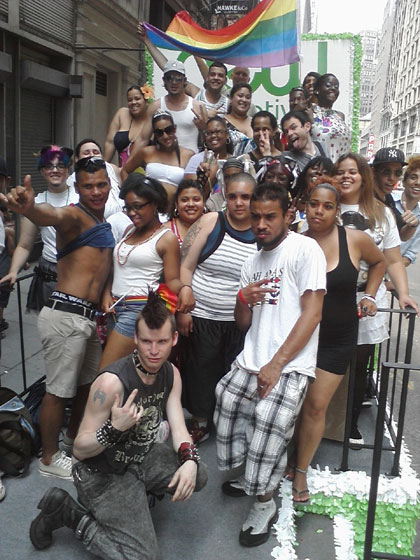
New Alternatives marched in the 2010 NYC Pride Parade last month
A July 10 benefit for New Alternatives for LGBT Homeless Youth will offer both some incredible book bargains and the opportunity to do something for some of the most vulnerable (yet spunkiest) folks in New York. The organization was founded by activist Kate Barnhart, whom I first met some 20 years ago, when she was just about the youngest and most fearless member of ACT UP (and there was serious competition for both roles). She hasn’t slowed down since.
These are the details of the benefit:
Huge Book Sale on July 10
At LGBT Community Center on West 13th Street
Will Benefit Homeless LGBT Youth
�Buy a book, save a young life� fundraiser
Offers ten thousand new volumes on sale
For $10 per shopping bag
NEW YORK, NY, June 28, 2010 � A huge sale of more than ten thousand new and used books will take place in the West Village on July 10, with the proceeds going to charity. The event, called �Buy a Book, Save a Young Life,� will take place on Saturday, July 10 from Noon-6pm at the LGBT Community Center on 13th Street.
The books on sale encompass every subject and genre, including children�s, art, classic and modern literature, as well as collectables and rarities. These books were donated by veteran bookseller Robert Warren, who recently closed his landmark New York bookstore, Skyline Books. Admission is free to this event, and people can fill a shopping bag full of books and pay $10 per bag.
All proceeds of the �Buy a Book, Save a Young Life� sale will benefit New Alternatives, the East Village program based at Middle Collegiate Church. New Alternatives provides desperately needed services to LGBT homeless youth, including hot meals, emergency housing referrals, case management, and life skills training.
There will be a special pre-sale on July 10 for dealers and collectors. For an admission fee of $25 (also going to New Alternatives), shoppers can get a jump on the crowd from 11am-Noon. Admission includes one free bag of books. Additional bags of books will be $25 each.
For hardcore bargain hunters, from 5pm to the 6pm closing, the price plummets to $1 per bag of books.
To match New Alternatives goals of promoting HIV awareness and safer-sex education, each bag of books comes with free condoms, and New Alternatives promises a fun festive atmosphere. In addition to great book bargains the event will include performances from queer and queer-friendly acts such as Circus Amok, Rude Mechanical Orchestra, and The Church Ladies for Choice. Expect music, stilt walking, juggling and a good vibe to abound.
ADDENDUM: See Karen Ramspacher’s brief description of the group in her comment on Bloggy
[image from New Alternatives]
friends to celebrate Harry Wieder in Cooper’s Great Hall
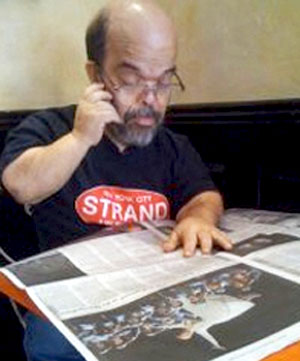
There will be a great congregation of friends and activists inside the Great Hall at the Cooper Union tomorrow evening at six o’clock. There they will be celebrating the rich life of Harry Wieder, cut short, shockingly, in an accident in April.
Harry was a familiar friend and powerful advocate of many progressive causes, so I expect the room will resemble a portrait of the face of New York grassroots activism (of almost every sort) as it operated over the last few decades.
I also expect that this memorial will not be a lugubrious affair. Harry meant a lot to the people who shared his life and his dedication. But we also knew how to share in laughter, and there should be plenty of that tomorrow.
Harry was also completely familiar with the historic Great Hall, not least for his regular attendance at ACT UP meetings, which continued while they were being held there in the early 90’s. It was a time, difficult to imagine today, when the press of hundreds of AIDS activists (I’m sure I remember hearing the number 700 one week), attracted by the urgency of the issues and the energy of the coalition, had forced a move from the pre-restoration Center to a larger venue. It was Cooper which welcomed us.
I’ve been back many times since those years, and Barry and I will be there tomorrow.
Speaking of ACT UP, and the kind of energy which seems in scarce supply these days, the incredibly-important ACT UP Oral History Project has just added 14 new interviews with ACT UP activists and add 9 important video clips and transcripts to its web site. Visit, rummage around, then go out and change the world.
While working on this post I once again found myself Googling for an image of “Harry Wieder”; there aren’t a great number, and most of them are mixed in with a much, much larger number of images of “Prince Harry”. Our Harry would love that.
[image via pinknews]
tomorrow is the last chance to “Escape from New York”
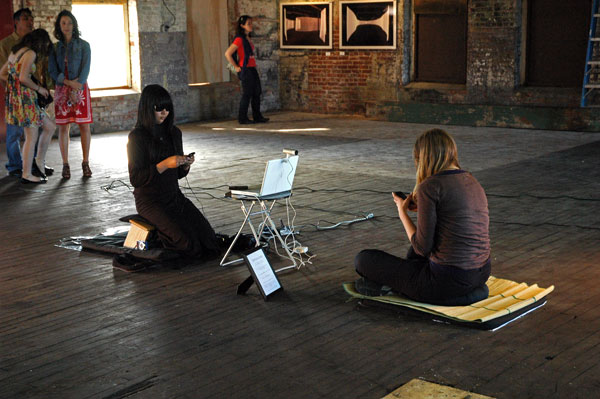
An Xiao The Artist is Kinda Present [still from five-hour performance]
Tomorrow is the last day for the tonic and pleasures of the huge-scale Paterson, New Jersey installation, “Escape from New York“, and I just realized that I hadn’t uploaded any images yet. The show, curated by Olympia Lambert, is a treat on its own, but added to that, for those willing to leave familiar streets, are the curiosities (nineteenth-century usage) represented in the numerous and varied reminders of the town’s industrial and social history.
The old core of Paterson still displays countess monuments to its former wealth, most of the public, banking and commercial buildings plainly marked to show they were erected at the turn of the twentieth century.
There are also an amazing number of nineteenth-century mill buildings just beyond the center, many of them handsomely restored (and presumably looking for artists), One of them (unrestored) shelters the work of the 43 “Escape” artists Lambert has collected. It and its dozens of sturdy brick neighbors share an old mill race and are perched below tree-covered hills just below a surprisingly idyllic Passaic Falls.
The cataract is the the second-highest large-volume falls on the U.S. East Coast, which accounts for Paterson’s importance 200 years ago. Okay, the day we were there we saw a wedding party being photographed before it on a wide grassy ledge while we watched from above. Together with the architectural treasures the falls offer an additional incentive for a rail trip, a brief, comfortable ride on NJ Transit from Penn Station.
If you miss your own escape to New Jersey and these combined pleasures, there will be at least a chance to see some of the work in Manhattan in July (minus Paterson, of course). Lambert is putting the finishing touches on arrangements for “Return to New York”, to be installed at HP Garcia Gallery July 7-31.
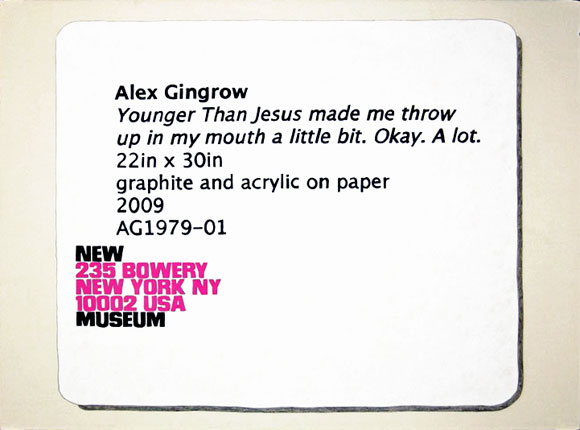
Alex Gingrow Younger Than Jesus made me throw . . .
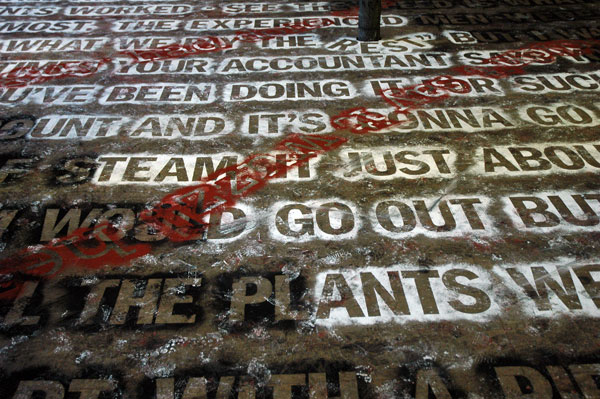
Nicholas Fraser The Paterson Project [detail]
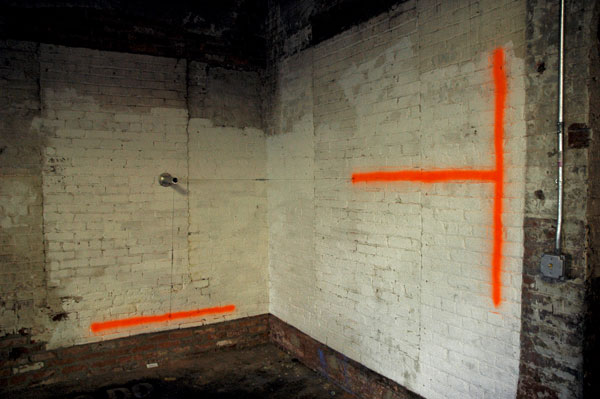
Peter Soriano Other Side # 82 (MEC)

Man Bartlett circle drawing XII – rendition above pointpiece II – constant
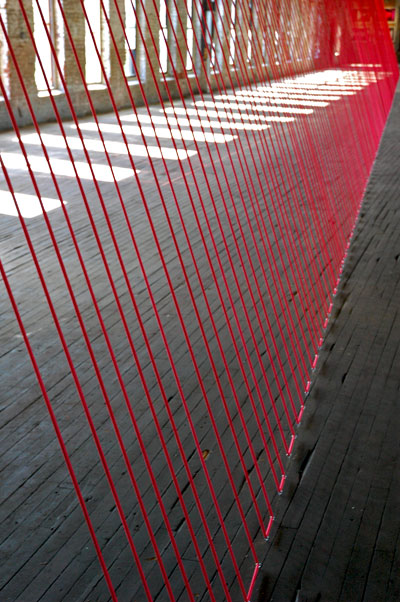
Thomas Lendvai Untitled ([large detail]
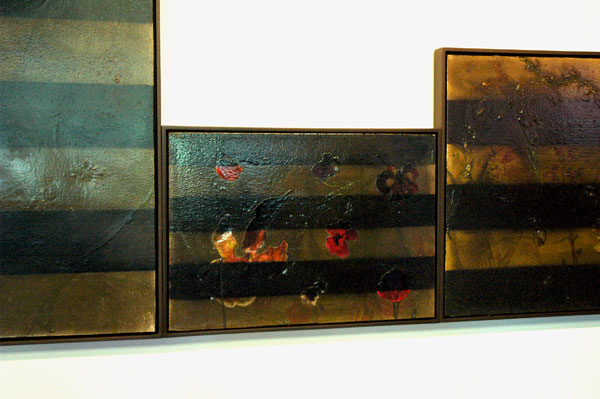
Tamas Veszi Dark Matter [detail]
Lagniappe: An abbreviated look at a few of the mills, and the falls:
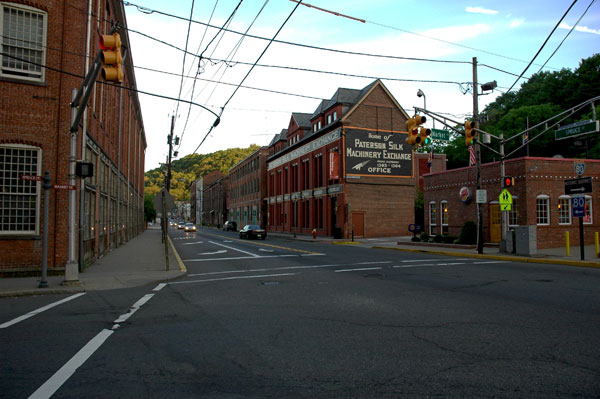
the corner of Spruce and Market, at dusk on a Saturday
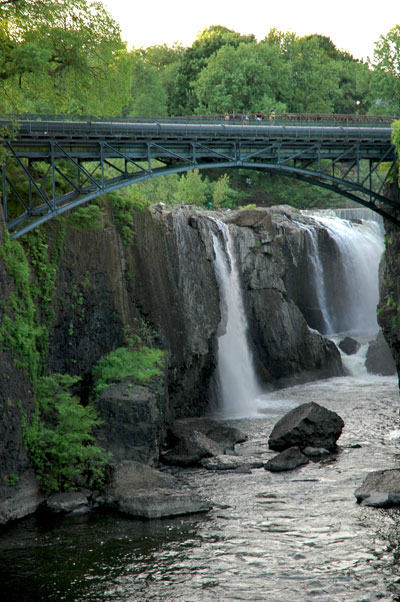
the footbridge is historically the eighth on the site
[image of “Younger Than Jesus made me throw . . . ” from the artist’s site]
World Naked Bike Ride: raw for cause, in New York City
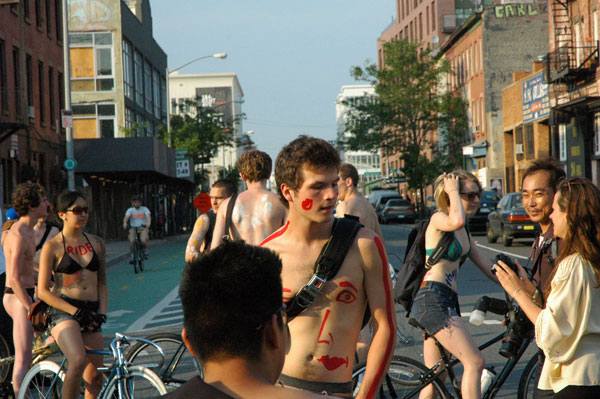
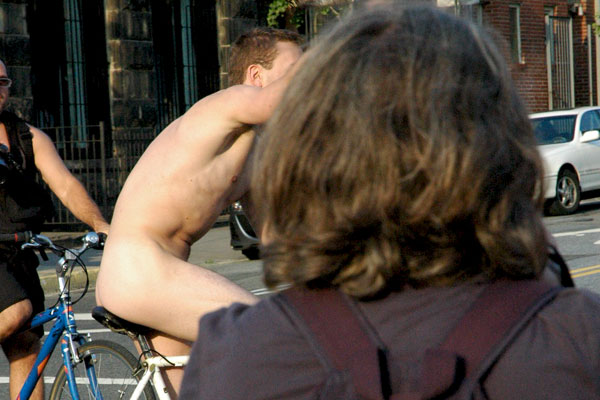
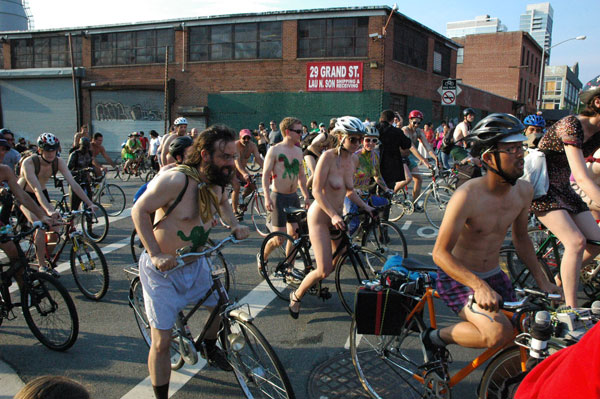
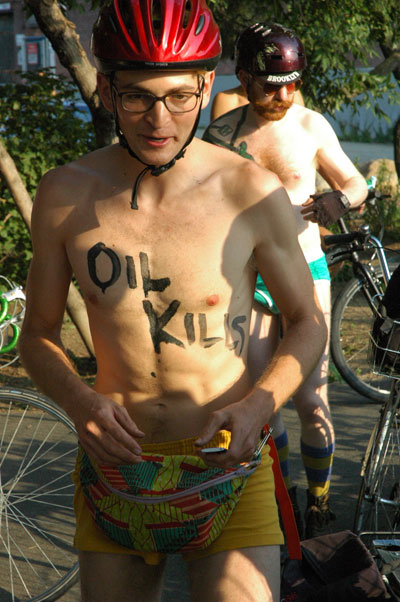
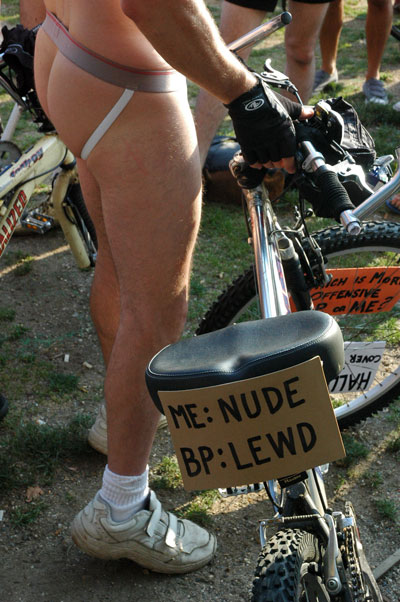
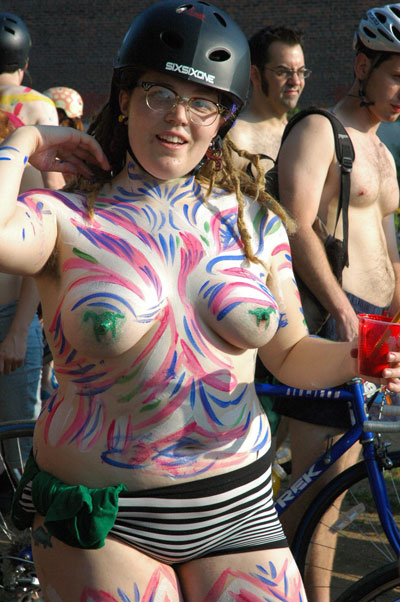
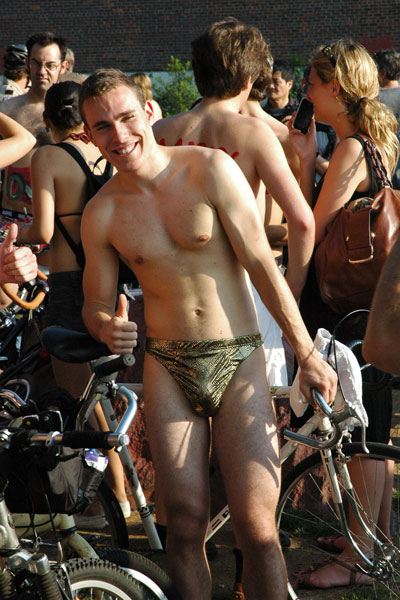
Barry and I were at Grand Ferry Park Saturday afternoon, but, bicycle-less and resolved to remain fully-clothed, we were were able to offer nothing more than admiration and documentation for New York’s contribution to the World Naked Bike Ride. We watched an upbeat crowd of enthusiasts assemble and ride off in a deliciously and infectiously brash rally which took them over the Williamsburg Bridge and into Manhattan as far north as the UN before returning across the river later to party.
Enthusiasts in cities all over the planet have been taking this annual event very seriously for years. They seem to get it, even if New York doesn’t. With an ebullience and a commitment which should be heartening to anyone who questions our culture of oil and cars, and who supports a sustainable transport alternative, people elsewhere have taken to the streets in impressive numbers – and in unashamed expression. Until yesterday however, in spite of (or because of?) the Naked Bike Ride’s Dionysian attractions and its celebration of freedom, New York’s participation had for years been chimerical, and finally pretty underwhelming.
I doubt anyone’s been counting cheeks, but it looks to me like the city “showed” better this year (even if we’re not yet up to the standard set by a certain awesome English seaside resort town).
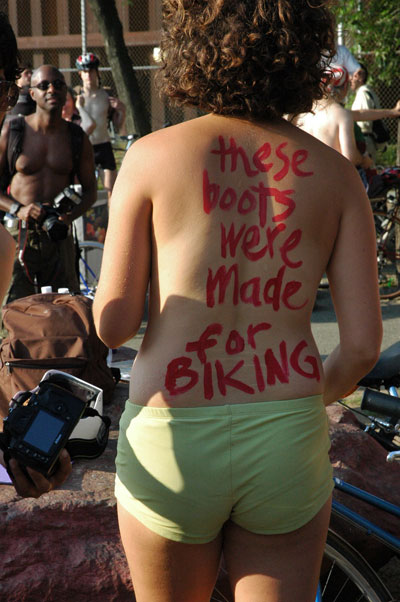
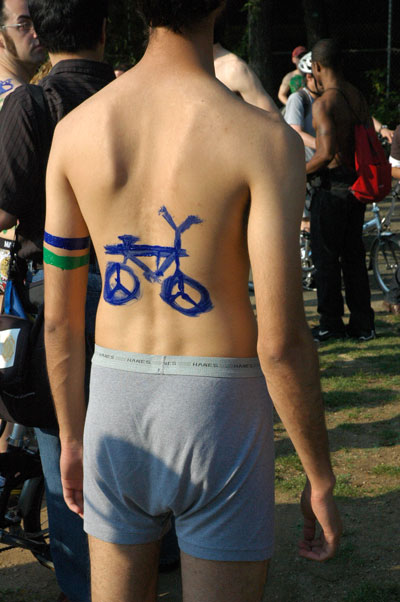
Note: To be fair, the images I’m publishing at the top and bottom of this post are a somewhat misleading representation of what the bicyclists looked like once they hit the road. Many of the costumes seen here were later removed, beginning even as the group was assembling at the top of Grand Ferry Park. To wit:
In the still and video images I’ve seen on line, most spectators around the city seem to have enjoyed their exposure to the group’s rolling march, but some may be asking what’s the connection between environmentalism, bicycles, and nakedness. Why is this action naked? I may be prejudiced, but I’d say that not only do bikes have a huge potential for raising the quality of the environmental, one which we could start realizing almost immediately, but bikes also (when used civilly) seem to be able to charm almost anyone.
So bikes may be excellent poster children for saving the planet, but why naked bicyclists?
Two years ago Mark Barwell, a very fit-looking English environmental activist, took part in the Brighton & Hove Naked Bike Ride, and the BBC interviewed him prior to the run, photographing him in road costume (“completely starkers”, as the reporter offered in the accompanying audio link). Barwell discussed the serious objectives of the demonstration and went on to address what everyone always zeros in on: “The idea is to be as loud as possible, really”, he said, and then he offered the best explanation ever for its anomalous motif: [my transcript below]
Cyclists on the road are really the most vulnerable road users. Cycle lanes tend to appear and disappear all over the place, and drivers as a rule are quite sensitive to cyclists on the road, but there are quite a lot of issues where we’re very much vulnerable, and that’s where the naked thing comes in. It’s to highlight the vulnerability, and also, as a follow through, to celebrate body freedom, and the fact that a naked body really isn’t that bad a deal.
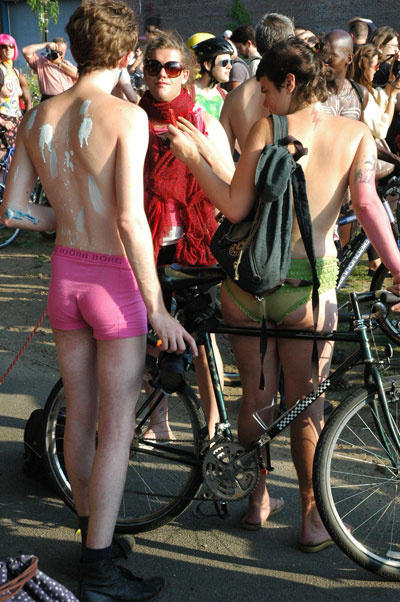
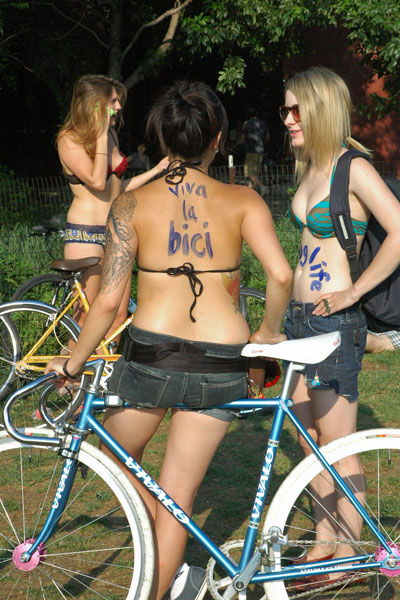
It must have had something to do with the rendezvous’ Williamsburg location: I don’t think I’ve ever before seen so much pale nerd skin, its beauties enhanced here by a lot of body paint broadcasting genuine conviction.
The image at the top is of the group about to leave the park; those which appear below were all collected in the hour before.
For much more, go to the New York Post video site for Jeff Lieberman’s excellent video coverage of the ride’s swath through Manhattan.
[I tried my best to get this post up sooner, but I was having serious server problems all day Sunday]
ADDENDA: I’ve uploaded additional images on Flickr, and Gothamist has more photos and video (look for Oliver “waving” to the cars on the bridge); go for the slide show on John Zwinck’s feed and that of dogseat