Barry and I don’t observe anything religious, but we can’t help it if our historical memories kick in once in a while. Usually it involves a good meal, and there’s definitely one of those in the works for tomorrow, which happens to be the day celebrated as Easter by some.
Easter has come to be associated with colored eggs, but I think it was only a coincidence that I came across these giants earlier this week.
The picture is of some of the ostrich and emu eggs being sold by Roaming Acres (Sussex County, New Jersey) at the Union Square greenmarket on every Friday. The off-white and the dark blue/green colors are achieved without benefit of coloring. The big birds responsible, while hardly native to these climes, are actually local stock (as they must be, by greenmarket regulations, and in their case also “all natural”). The farmer himself sells the big eggs (one ostrich egg equals 18-24 chicken eggs) both fresh and hollowed out. He also offers ostrich meat and handsome ostrich leather goods, but the emu are cherished for their eggs alone (both with and without original content).
This picture, or one similar, will probably soon find its way onto our food blog, since I picked up a frozen ostrich fillet while I was there. We already have an ostrich egg sitting on a table in the parlor, one I brought with me when I moved back from South Africa 35 years ago, but I have my eye on one of those dark emu beauties.
Category: NYC
potted spring excitement, with no bulb in sight
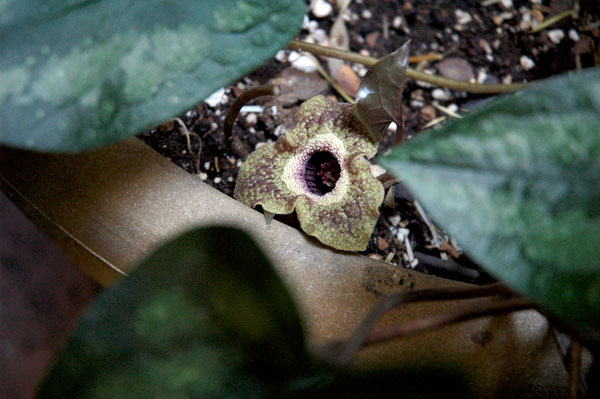
Chinese Wild Ginger Asarum Splendens
Spring comes to the sunless recesses of our roof garden.
I must leave to others, meaning anyone who can plant or is able to overlook gardens touched directly by the rays of our life-sustaining star, the delights of brightly-colored bulb flowers. Our own garden pleasures are more subtle, and sometimes more exotic.
The odd growth shown above is apparently a flower, but there is always only one (it’s in a pot after all). It appears each year at this time within the very healthy clump of evergreen wild Chinese ginger which has naturalized itself in one of our terrace pots. It’s surprisingly hard, or woody, to the touch. It is, as might be easily imagined, even more bizarre before it actually opens to (barely) announce itself: The first time I spotted it, at least five years ago, I thought it was a piece of debris fallen from an upstairs window. I was about to pull it out when I noticed that it was somehow connected to the tangle of shiny green leaves all around it which had miraculously survived the winter unaltered.
With all respect to the excellent mushroom and the magical truffle, this node? appears to be somewhere on the evolutionary ladder between fungi and what we think of when we say “flower”, regardless of its actual botanical status. While it certainly suggests a sexual appurtenance, it also looks like it would have no interest in, and no chance of, attracting the reproductive ministrations of a bee.
Powhida: “No artist should have to watch this”
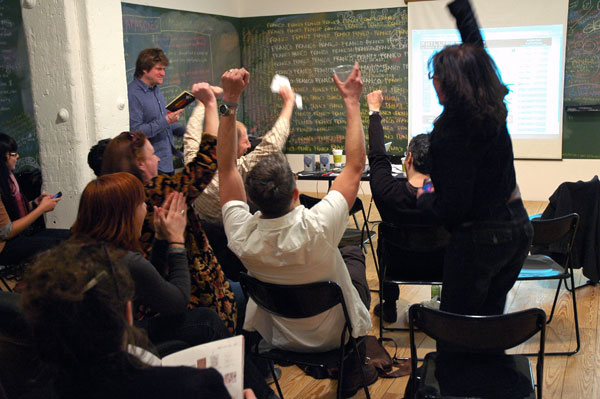
all heck breaks loose as Powhida exceeds the estimate
A number of art enthusiasts found their way to Winkleman gallery, and a Saturday in “#class“, this past weekend to take part in the (unbilled) “T-Bill Gaming” event. Tom Sanford and William Powhida had set up a projector and screen linked to a laptop, allowing gallery visitors follow the Phillips de Pury auction, “NOW: Art of the 21st Century“, in a live simulcast which began at noon.
Fans were invited, Sanford’s own blog had announced, to participate in a “relational aesthetics art project” involving “the sometimes-overlooked art of book making”. We had been invited to “watch the excitement unfold as shadowy and anonymous international art patrons determine the actual market value, not only of the works, but also of the hundreds of artists themselves!”
Fully in the spirit of the month-long project created by Powhida and Jen Dalton, the installation was described as an attempt “to make the world of contemporary art auctions more accessible to the Average Joe on the streets of Chelsea.”
The excitement in the gallery was building for hours as the auctioneer moved closer and closer to lot #257, a drawing by Powhida, “Untitled (Dana Schutz), which the artist had donated to a Momenta Art benefit five years ago. All heck broke loose when it went for $1,900 ($2,375 including 20% premium, and before taxes). The piece exceeded the high end of the auction house estimate. Since only a few years earlier someone had taken it home for $150, it certainly represented a good “investment” for its original owner, even if neither its author nor the non-profit space to which he had gifted it shared one penny of the bounty.
At some time in the midst of the excitement buildup the artist himself was heard to say:
No artist should have to watch this
For the artists and their friends and confederates in class that afternoon it was good fun, but mixed with the fun were melancholy thoughts framed by the sudden and direct confrontation with the reality of the art market. Inside the auction gallery however it all appeared to be only about money.
I’m sure we all had far more fun in class than did the crowd a few blocks south. I have a decent amount of experience with New England antique and estate auctions, and some familiarity with New York art auctions produced by a slightly less prestigious house than this one. I had always associated auctions with great fun and drama, even for the parsimonious participant, so I was shocked at how hurried and perfunctory the proceedings were on Saturday. Not a whit of drama – and no wit – came from the podium. The only excitement generated by the house (as opposed to that created by our own party on 27th Street) happened when the man in the $5000 suit, who normally finds himself selling off Picassos and Rauschenbergs, started the bidding on one item at $9 (it finally sold for $100).
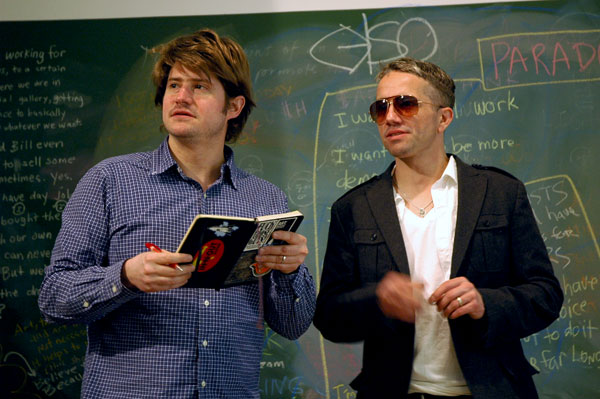
the gamers
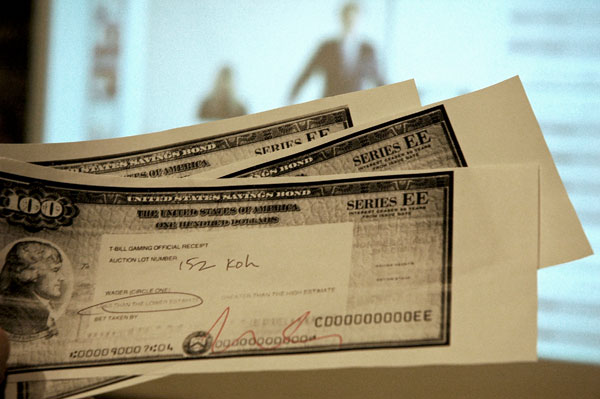
bets placed
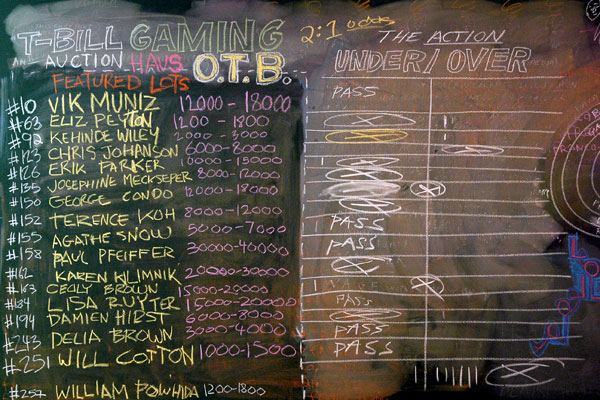
the board
Yevgeniy Fiks names names in Communist Tour of MoMA
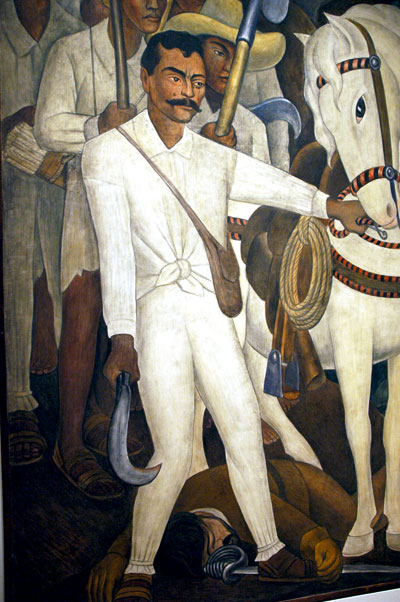
Diego Rivera Agrarian Leader Zapata 1931 fresco 7′ 9.75″ x 6′ 2″ [large detail taken from a slightly oblique angle, of the painting in MoMA’s collection]
Of course there was Rivera, and Kahlo, but most of the other committed pinko commies hanging around inside the Museum of Modern Art have been largely hidden from our history, from the institutional history of MoMA, and from the history of the art and the artists themselves.
Leading a tour of the Museum on 53rd Street this past Monday, artist and teacher Yevgeniy Fiks started to sort things out for the record. Barry and I were extremely fortunate to be a part of the discreet group of enthusiasts which he directed in a “Communist Tour of MoMA”.
One of my favorite parts? Enjoying the fact that any number of other museum visitors who happened near us were learning more than they had bargained for when they walked into the galleries of the permanent collection that afternoon.
If you missed the road trip clear your calendar for Fiks’ presentation, “Communist Modern Artists and the Art Market” at Winkleman gallery March 12, another event in William Powhida and Jen Bartlett’s month-long project, “#class“.
I’ve uploaded below images taken at a few of our stops (devotions, secular “stations”), and Barry has a more narrative report, assembled from his notes, on his own site.
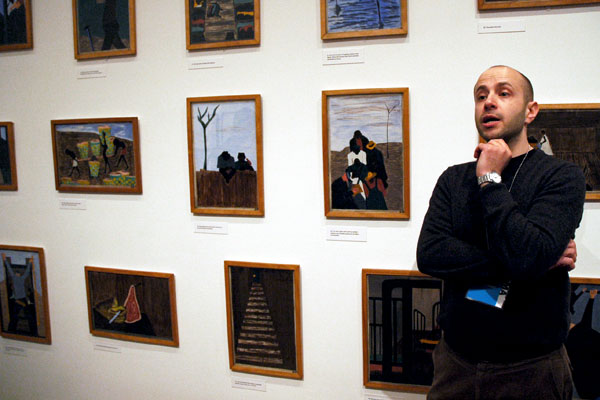
Jacob Lawrence
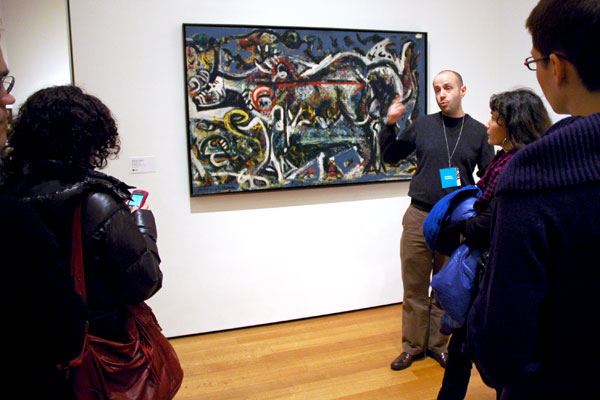
Jackson Pollock
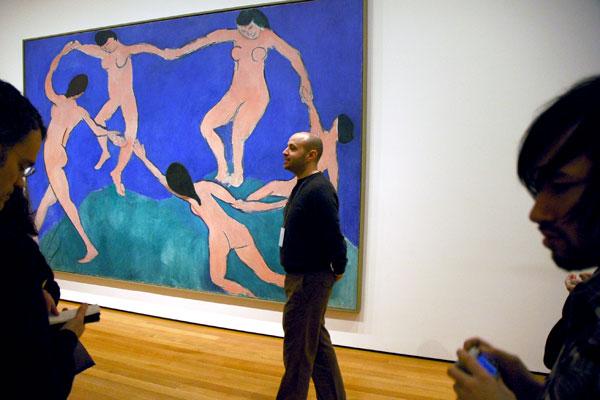
Henri Matisse
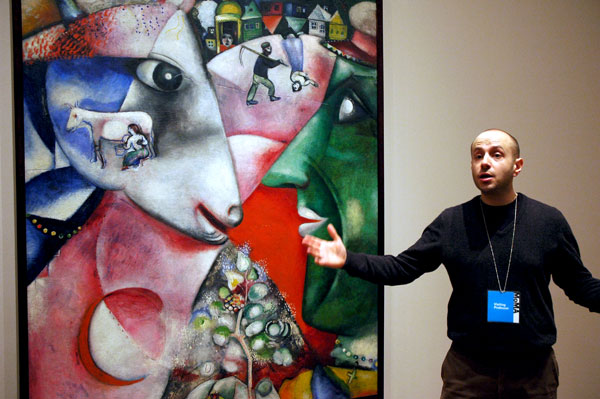
Marc Chagall
NYPD: racial profiling, false collaring, permanent records

up against the wall, spread over the hood, or face down on the ground; then into the computer
From 2004 through 2009, in a policy that has gotten completely out of control, New York City police officers stopped people on the street and checked them out nearly three million times, frisking and otherwise humiliating many of them.
Upward of 90 percent of the people stopped are completely innocent of any wrongdoing. And yet the New York Police Department is compounding this intolerable indignity by compiling an enormous and permanent computerized database of these encounters between innocent New Yorkers and the police.
Not only are most of the people innocent, but a vast majority are either black or Hispanic. There is no defense for this policy. It�s a gruesome, racist practice that should offend all New Yorkers, and it should cease.
These are the first angry paragraphs of Bob Herbert‘s righteous and powerful Op-Ed piece in today’s Times, “Watching Certain People“.
And none of this is even news! Why do most New Yorkers continue to be indifferent to what’s being perpetrated within what is generally considered to be one of the world’s most diverse and most liberal societies?
Herbert’s outrage is rightly directed at the racism so dramatically demonstrated by the statistics, but we would be ashamed of and alarmed by the police tactics themselves even if they were exercised within a completely homogeneous society.
While no one is contending that the practices of the New York City Police Department [NYPD] are equivalent to those of the Geheime Staatspolizei [Gestapo], the Ministerium f�r Staatssicherheit [Stasi], or the Komitet Gosudarstvennoy Bezopasnosti [KGB], how much emulation of the tactics used by systems we call totalitarian will we tolerate in our guardians? Do we care at all as long as we think “decent people” aren’t being harassed, intimidated, and permanently documented?
New York City has taken its cue from the nation’s irrational and hysterical response to the events of 9/11, the so-called “Patriot Act“, and produced a number of its own unconstitutional police toys in the name of “security”, some of them (as in the case of the federal operations) with absolutely no relationship to terrorism, or indeed patriots, and none of them able to promise safety to their white middle-class or wealthy authors in any event.
At what point will we know it’s gone too far? If we’re indifferent to what’s happening or simply not paying attention, how will we know when the land of the free and the home of the brave has actually become a military/police state, its population cowed into submission by fear of the other, to be hunted down in its midst or somewhere on the other side of the planet?
[image, illustrating NYPD stop-frisk statistics for the first half of 2009, from revcom.us]
BHQF’s “We Like America” at Whitney 2010 Biennial
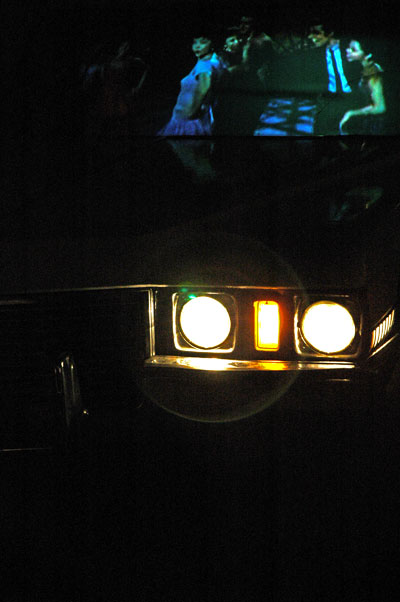
Bruce High Quality Foundation We Like America and America Likes Us 2010 vehicle and educational implements, dimensions variable [detail of installation]
ADDENDUM: [April 30, 2010] The entire sound video projected onto the inside of the windshield can be viewed here on vimeo, although as the April 20 comment at the bottom of this post (which alerted me to the link) says, it’s not quite the same isolated from the ambulance/hearse; the experience of the darkness of the installation itself, the imperfect acoustic of the space, and the murky projection, can’t really be reproduced on a computer screen.
I feel good about the Whitney 2010. While I like excitement, I resist hype like the plague. This Biennial has been accompanied by neither, which at the very least gives visitors a better chance to experience the individual works for themselves, and unencumbered with a theme. There is some very good, even awesome work on the three floors of the exhibition I saw at the preview (the floors not devoted to favorites from earlier years), but for me none of them had so fundamental an impact as the Bruce High Quality Foundation installation, “We Like America and America Likes Us”.
In “Art Class“, a 2007 piece published on Artnet, Ben Davis had described Picasso’s “Guernica” as “the most successful political image of the 20th century”. His argument was that isolated artistic gestures cannot resolve social contradictions “without any social movement backing them up to give them force”, continuing:
This does not mean that art or artists cannot play any political role; it is just that some model besides the middle-class one of “my art is my activism” is necessary, one based on concrete solidarity and practical action. Picasso�s Guernica is the most successful political image of the 20th century. Guernica, in fact, embodies the fact that art�s political value is determined in its relation with mass struggle, not in its individual content — the imagery of the painting, moving as it is, is completely drawn from a vocabulary of forms Picasso had already developed in previous work. Yet, during the Spanish Civil War, after its appearance at the Spanish Republic�s booth at the 1937 World�s Fair, Guernica was literally removed from its stretchers, rolled up and toured internationally to win support for the Republican cause. In England, visitors brought boots to send to the front.
The Bruce High Quality Foundation seems to be taking a different route with its own institutional, social and political critique, probably one more suited to our own politically-lethargic times. Bruce’s confrontations with our own tropes have been found just about everywhere: on our streets, our waters, our public plazas, even inside the galleries and expositions of the system they speak to.
I have to confess to a penchant for political art, and to a number of years spent in sort of a groupie relationship to this arts collective, and yet “We Like America and America Likes Us” is one of the most affecting works, in any genre, I’ve ever encountered. Where do we bring our allegorical boots?
We are all wounded, wrapped in felt. Are we inside an ambulance or a hearse? What is to be done?
Like much of what Bruce does, it’s not conventionally “beautiful” – except as truth is beauty, and yet the incredibly elegiac recorded remembrance of “America” which accompanies the fast video montage of heterogeneous clips projected onto the tall Cadillac windshield is riveting, and profoundly moving.
I don’t know the length of the loop (and there was no indication on the museum’s wall text); but for all I know it could be as long as the melancholy story it tells.
Especially for those who will not be able to visit the Whitney, I have some excerpts. The text, recited by a luscious, soothing female voice, begins:
We like America. And America likes us. But somehow, something keeps us from getting it together. We come to America. We leave America. We sing songs and celebrate the happenstance of our first meeting � a memory reprised often enough that now we celebrate the occasions of our remembrance more often than their first cause.
And a little later I listened as the gender pronouns slithered over each other in ecstasy, and in sorrow:
We wished we could have fallen in love with America. She was beautiful, angelic even, but it never made sense. Even rolling around on the wall-to-wall of her parents� living room with her hair in our teeth, even when our nails trenched the sweat down his back, and meeting his parents, America stayed simple somehow. He stayed an acquaintance, despite everything we shared. Just a friend. We could share anything and it would never go further than that.
No one really knows how love begins. A look on his face one time after we�d made love � a text message too soon after the last one. When did we become a thing to hold on to rather than just something to hold? We didn�t know America was in love with us until it was too late. Maybe we couldn�t have done anything about it anyway. America fell in love with the idea of us, with some fantasy of us, some fantasy of what America and us together would be, before we had a chance to tell him it could never work, we weren�t ready for a relationship, we weren�t comfortable being needed, we didn�t have the resources to be America�s dream.
It wasn�t easy letting America down. As we stuttered through our rehearsed speech we watched the change on her face. We could see the zoom lens of her attention clock away. We could feel ourselves receding back into the blur of the general population.
The last lines are:
There was a time we thought we were nothing without America. When she left, we realized all the excuses we�d been making. All the problems we�d been trying not to address. We drunk dialed our memory of America just to hear what we were thinking. We worked late and we told ourselves we had to, that the work came first, that this was an important time in our lives and that love could wait. Just wait a little longer and we�d fix everything, we�d say. Solving the America problem, our lack of attention, our disinterest in sex, our never being home, our thinking of her as a problem � it would have to wait.
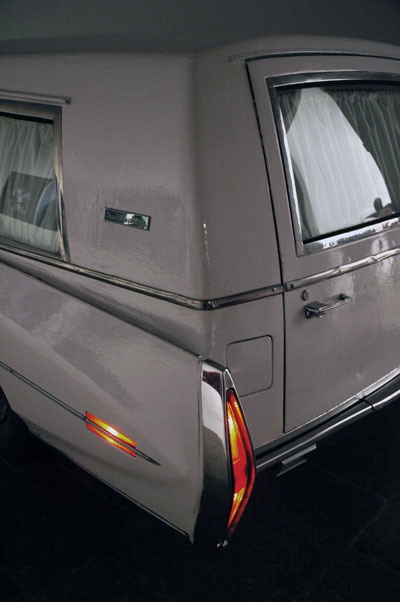
[installation view of the rear of the curtained 1972 Miller-Meteor ambulance/hearse]
[text from the audio of the installation courtesy of the artists]
“Bring Your Own Art” [BYOA], the X Initiative farewell

By the time I realized that I should look into buying the small Man Bartlett drawing I had seen at “BYOA” the first night, it was gone, and I hadn’t even gotten a usable image. This piece, “pointpiece II (constant)” dated 2009, is ink on paper, and roughly 6 by 8 inches, approximately the size of the piece I saw enclosed in plastic and attached to a pillar that Wednesday afternoon. All of Bartlett’s art is pure in concept, form and beauty; whether it’s been a work on paper or a performance, I’ve been drawn into each of them even before knowing anything about their context or the artist’s purpose.
I could not not go. As soon as I heard that X Initiative was marking the end of its one-year tenancy in the former DIA space on 24th Street with a 24-hour Walter Hopps-inspired event, I was on it. Everyone was invited to bring their own art and install it in the several large Chelsea galleries. They would be open for viewers and participants for 24 consecutive hours.
Of course it was more of a gathering, than a fair, and in spite of the potential for banality, or worse, it differed from events like the hoary, ineluctable, twice-a-year Washington Square art exhibit in the general quality of the art which had been brought through the door (and there were definitely some hot spots), but also in its overall fundamental earnestness and sincerity, its moments of profundity and nuttiness, its odd sweetness, and not least in the fact that, ultimately, it couldn’t escape its sad ephemeral reality.
I visited the scene twice, once on Wednesday afternoon, and again just as the event officially ended at eleven the next morning. I would also have been there for the party Wednesday night had I not already committed to attending a Meetup event, “Social Media Art” downtown.
What I did see of the X Initiative’s farewell blowout was a rich feast. As soon as I walked in I realized I’d be looking at almost every square inch of the galleries (except for the ceilings, which I think was a safe assumption) to avoid missing something, meaning either the art or the interventions, because while the scale of some of the work installed was fearlessly ambitious, there was much that might have taxed Richard Tuttle’s powers of observation.
One cavil: The lighting was tough, even before the sun had entirely set, but that was understandable given the circumstances of this fragile moment
The works described in this entry are just a few of the pieces which pleased the eye, and the camera as well, in the case of those shown below.
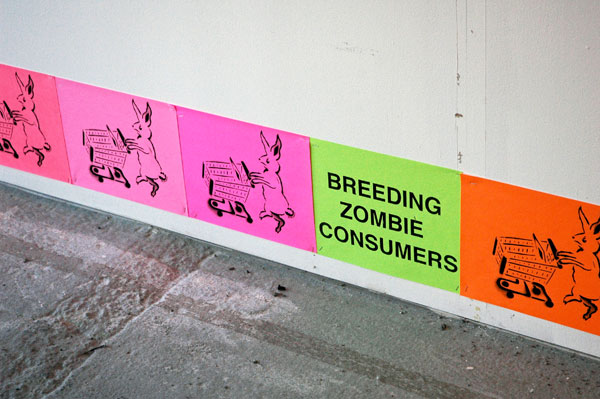
Sam Sebren (bunny) used his multiples to line the base of some of the walls. For what you’ll probably want to know about the artist, see this discussion.
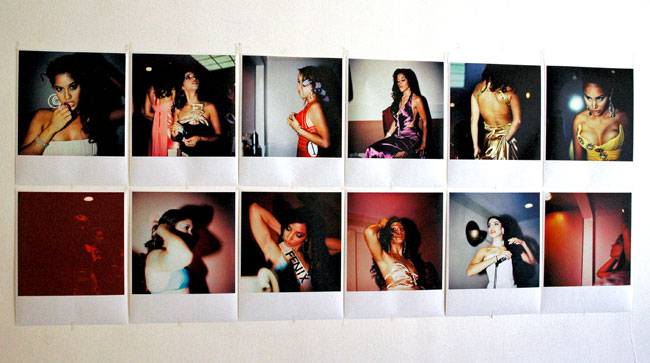
Cecilia Jurado’s �Miss Taxi�, a three-channel video and photography installation, was in the Queens International 4 a year ago; the images and the footage are taken from a beauty pageant held each year in Queens for relatives of taxi workers
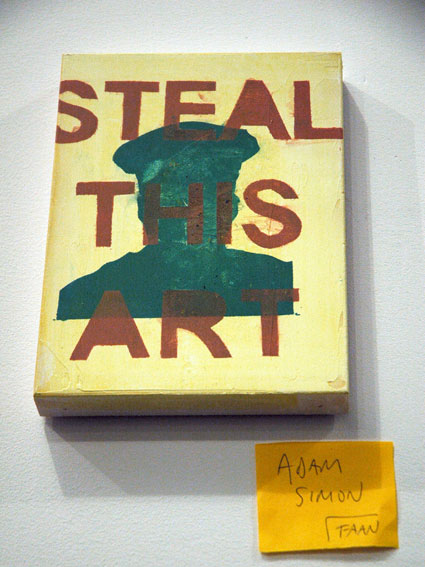
Well, maybe “steal” was misleading, but Adam Simon‘s “Steal This Art” was just one of a number of excellent pieces in the exhibition which were a part of the remarkable Fine Art Adoption Network [FAAN] founded by the artist and commissioned by Art In General.
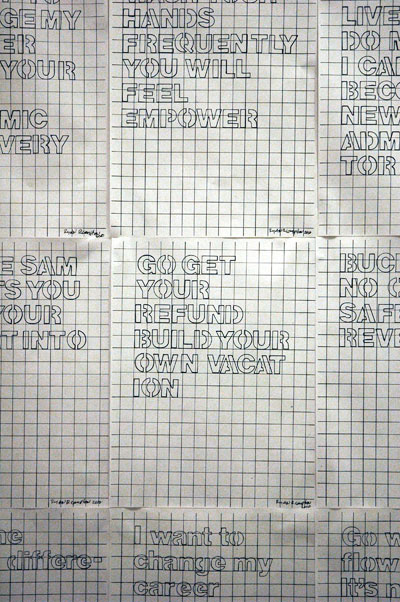
Ryan Compton’s hand-drawn text pieces grabbed me with their non-sequiturs and cut-up syntax; my favorite read:
Go with the
flow
it’s not rocket
science
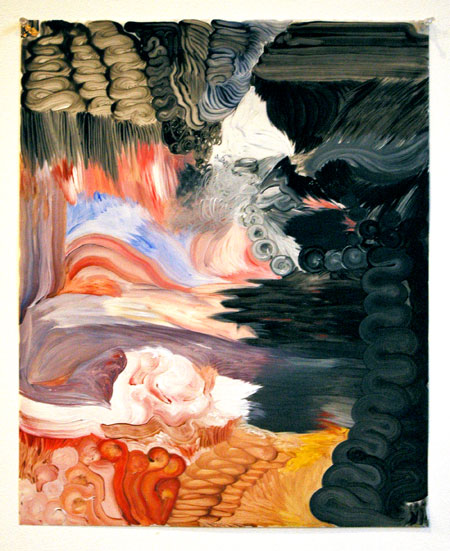
Peggy Cyphers showed several exquisite acrylic pieces (on Mylar?), and I still can’t get their richly-colored voluptuous shapes out of my head.
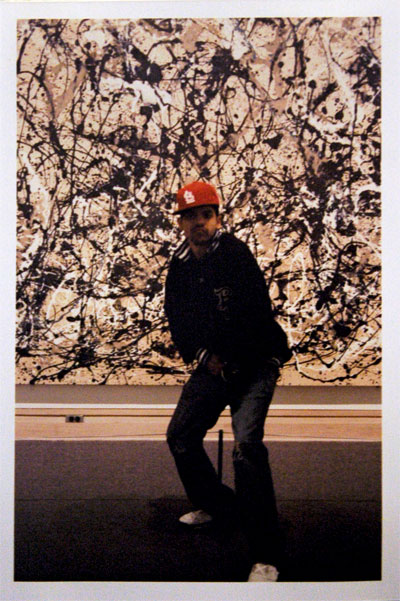
Felix and Dexter‘s small “snapshots” of the artists’ interactions with art and community were taped to all four sides of a column and seemed to charm everyone who managed to see them
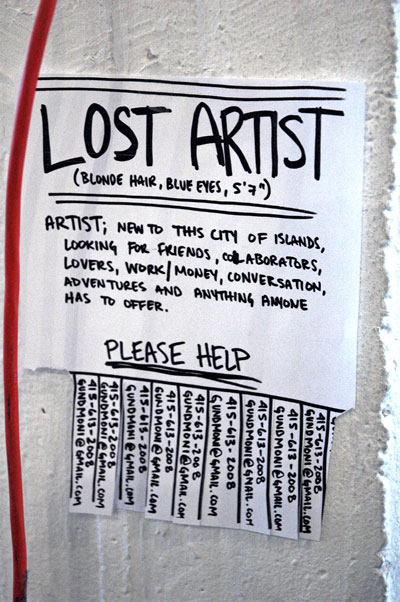
I have no idea
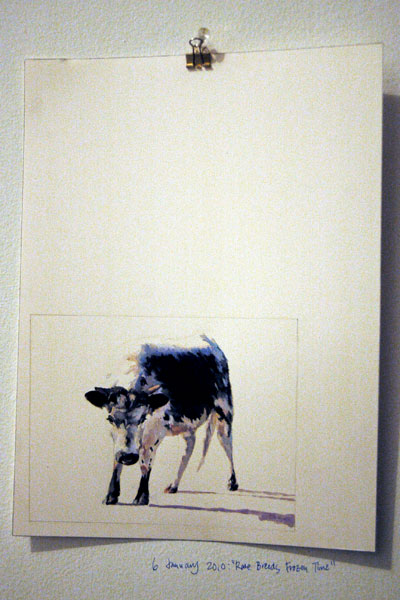
Judith Hoffman‘s year-long project requires her to paint one image each day from her local paper (it appears to be the Times), “paying homage to On Kawara and the decline of printed news”; the image of this handsome young calf, dated January 6, is titled “Rare Breeds Frozen Time”
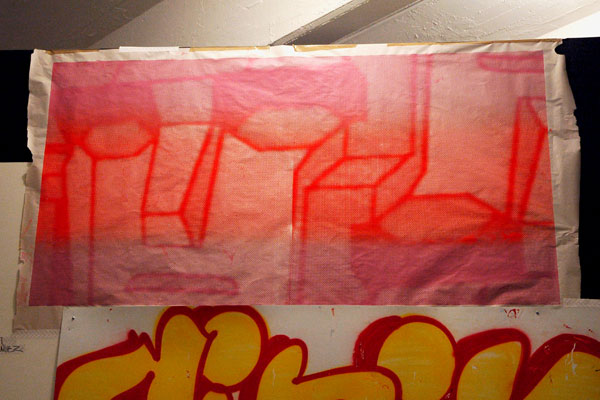
Starscream was only one of several artists there whose work could be described as street art, although in the anarchic configuration of this show their placement in the galleries ended up looking at least as conventional, or “inside”, as that of any of the other artists.
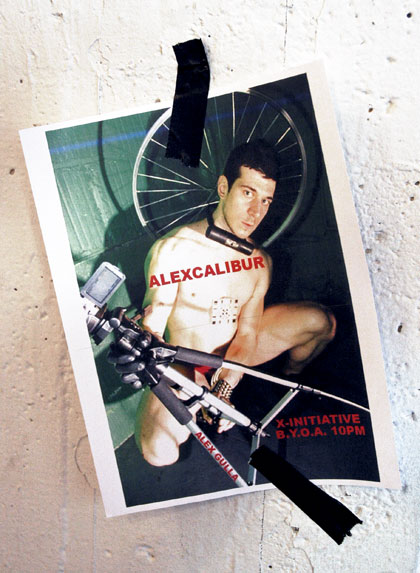
I saw several of these posters taped about the place when I went by on Thursday. I assumed it was some kind of guerrilla (or pseudo-guerrilla) poster project. Great styling. I went home and Googled “Alex Gulla” and “Alexcalibur” and I learned that the “project” was only about the electronic rock performance inside the space the previous night. I may have been disappointed on two counts (one of them of course that I had missed the party and the chanteur), but I still have my souvenir flier. The black duct tape was a nice touch.
[image of Man Bartlett’s drawing from the artist]
an IDIOM: a conversation with Salinger’s ghosts

just how much could it have hurt?
I know I’m one of the publishers, and so it may not be quite proper for me to sing the praises of the online arts magazine Barry and I introduced late last summer, but I’m going to risk it anyway.
Although so much else of IDIOM is just as good or even better, because of its particular timeliness and its unexpected format I wanted the conversation between some of the publication’s writers, “On the passing of J.D. Salinger“, which we published yesterday, to get more attention than it might otherwise attract.
So consider this a flag.
The spirited short piece is nothing like the fulsome academic discourse available almost everywhere this week, and you’ll feel like you’re sitting in the room with the three young participants – even contributing to the conversation. The voices you’ll hear are those of Alice Gregory, Editor Stephen Squibb and Jessica Loudis.
While you’re at the site, take a look at the latest posting, which is equally timely, “Art and Culture in Haiti after the Quake“, by Hong-An Truong, and browse through the still-modest-size archives.
My own two cents about Salinger’s “The Catcher in the Rye” is the thought which came to me almost immediately after hearing about Salinger’s death: I don’t mean to minimize the importance of what he accomplished back in 1951, but, as a gay boy the year it was written, and a gay young man when I finally read it, “Catcher” never quite resonated with me in the same way it did with others. It seems to have attached itself to the psyche of many of my approximate contemporaries, or at least the straight, male, white, middle to upper class types.
Today I’m no longer gay; I think of myself as totally queer instead, but I can remember what it was like when being gay meant dissemblance, invisibility, powerlessness, desperation and, for “practicing” Catholics, eternal damnation. I’m now more than cool with my orientation, in fact I consider it a strength in almost every way, and I’m definitely no longer totally alone with it. So maybe I should try once again to make Holden Caulfield’s acquaintance: His own much-analyzed disconnect looked pretty trifling to me at a time when the the whole world despised my, literally, unspeakable differentness and when I would have been crushed in an instant had I revealed myself.
This last thought can only serve as a footnote, and I don’t want to make too much of a purely personal irony, but I can’t help noting that, at roughly the same time I began emerging from a closet to which I had been condemned by others, J.D. Salinger shut himself up in one of his own construction. It’s his odyssey that still baffles everyone.
[image from the Telegraph via IDIOM]
chartreuse holiday lights, good as gold

A few days ago, unable to entirely escape the sometimes forced jollity of the season while walking about the City, I found myself casually thinking about the number of color schemes that could be drawn on to celebrate these December holidays (or decorate things which already had perfectly respectable aesthetics) – and also the hues that couldn’t.
The decor I had in mind at the time was mostly that which attaches to the traditional, Christmas-inspired parts of these celebrations, and the colors which even in the mixed societies of today still seem to dominate the December palette, even in warmer climates, where balloons are sometimes pretty Christmas-y.
I decided in my head that, at least when it comes to monochromatic lighting arrangements, orange was certainly out, if only because orange was so important to some major October and November holidays. I think I had also eliminated bright yellow, and hadn’t even thought of chartreuse, so I was pretty surprised, coming out of Chelsea Market two days ago, to come across thousands of these tiny chartreuse lights fixed to every surface of the trees planted just west of the raised terrace of the Maritime Hotel on 9th Avenue.
I decided they were probably actually yellow, or gold, that it was the bright blue light remaining in the sky that was tinting them a bit chartreuse. By the time I got closer and captured this image the sky had darkened a bit and they no longer looked anything but gold. I now determined that one way or another, gold goes with almost everything, including (let’s hope for all of our sakes) this brand new year.
Chelsea hats, crazy wigs, and Serigne, New Year’s 2009
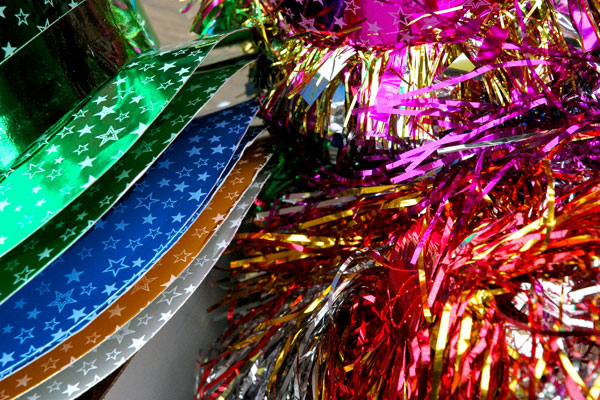
I passed the stand set up on the corner of 7th Avenue and 23rd Street. It was late last evening, windy and bitterly cold. The two vendors were selling New Year’s Eve party hats, light wands, and noise makers. I had already passed them by when I stopped to think about checking out the merchandise. My arms however were already juggling several heavy bags of food, so I decided I’d go back today to pick up something for a occasion to whose observance I’ve never been indifferent.
I’ve saved stuff from past years when I thought something was a little more special than most of the ephemera manufactured for this ancient holiday; I could recycle the old tin horns and such, but I probably needed some fresh party streamers. Then I asked myself, should I also get two pairs of 2010 spectacles? I’d never worn the silly things before, but this just might be the very last year for that classic template.
Aside from satisfying my needs, or encouraging last-minute buying impulses, I was looking forward to seeing what I expected would be a colorful array of merchandise (bring the camera!). It hadn’t occurred to me that the market experience, the bargaining between customer and seller would itself have been a powerful draw.
I didn’t see any streamers, and I didn’t spring for the glasses, but Serigne gave me a good price on two outrageous tinsel “wigs” (I might have some work in persuading Barry to wear his). I had already asked Serigne if I might take a few pictures of his table display, and he was kind enough to ascent – even without the condition that I make a purchase, although he encouraged me to do so. I heard him talking to the woman he was with, who later told me he was her son, and I was mesmerized by the cadences of their speech. I asked what language they were speaking, and they told me it was Wolof, that they were Wolof, from Senegal.
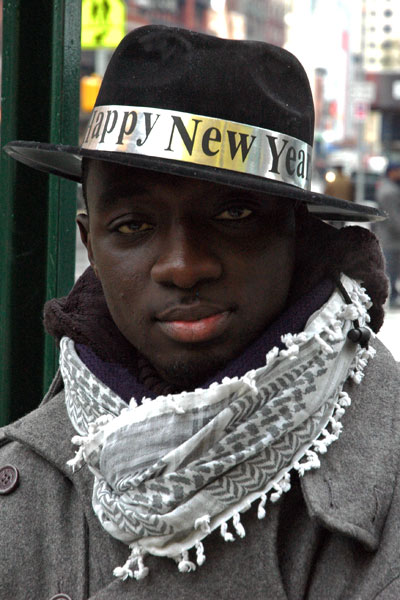
Serigne suggested I take a picture of his hat. It was one of the many models arrayed accross the table, but I doubt it could ever look as good as it does on his own handsome head.