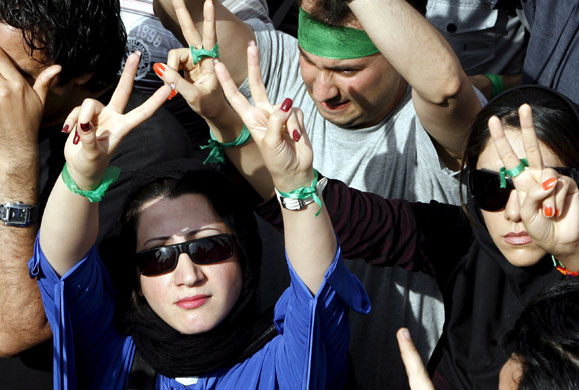
some of the hundreds of thousands of Mousavi supporters marching in silence today in central Tehran (green was the signature color of the opposition’s campaign)
I think they’re going to make it. There will be more demonstrations tomorrow, and the protests are likely to be more broadly-based and increasingly countrywide. A general strike has been called for the same day.
Iran’s twentieth-century political history is a complex story, and the second half especially includes a far-from-innocent involvement on the part of the U.S. [fed first by our lust for oil and Cold War hysteria – okay, it was actually pretty disgusting], but today it suddenly appears that the people who created and maintained one of the greatest civilizations in human history just may be about to emerge from the tyranny of a crude religious fanaticism which had briefly hijacked both their own best hopes and the world’s admiration for their magnificent culture.
I’d like to add that I wish that ordinary U.S. citizens had the kind of political courage being displayed on the streets of Iran today; We could certainly use it. Beginning last November I’ve been expressing my doubts about whether we were going to get what we had voted for. I should be writing more about my increasing fear and disgust, but I’ll wait for another occasion.
ADDENDUM: I just saw this Ted Rall cartoon. Although I said I wouldn’t go into Obama’s failures now, I couldn’t resist the adding this note. I do this even though Rall doesn’t address our hope-and-change President’s equally disturbing failure to address the economic meltdown (instead handing over the government to Wall Street), and his cynical reversals on gay rights issues.
[image, from the Guardian, by Abedin Taherkenareh/European Press Photo]
Category: Politics

“Then and Now” at the LGBT Center
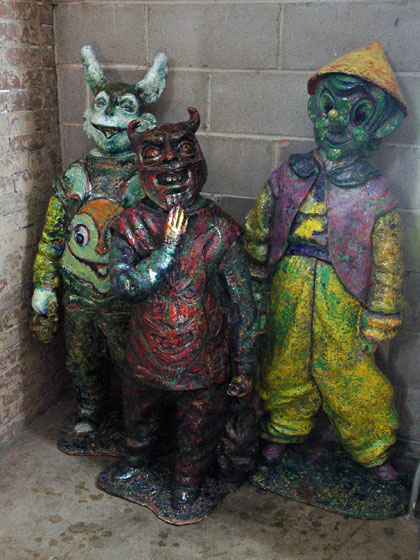
Bill Mutter Bunny Boy, Devil Boy, Pinnochio Girl (dates unknown) ceramic sculptures, dimensions variable [installation view]
I think what you see above was the most intense image I carried home in my head from the opening of “Then and Now” at the LGBT Center last night. For the longest moment, when I spotted them just as I reached the busy stair landing where these smallish (2 1/2 to 3 1/2 feet tall) figures were installed in a corner to the left, I was still almost totally distracted by a conversation with Barry about an installation we’d just seen. I absolutely didn’t know what I was looking at for a few seconds, but I remember I was almost giddy with delight and at the same time a little unbalanced by their suggestion of some kind of horror.
They seem to be children in halloween costumes, but the members of this little band clearly represent some kind of outsiders, especially when seen in the context of the building where they’ve been assembled, although in fact, like all the undisguised queers they seem to represent, they would be outsiders virtually anywhere.
I know little more about the artist than what I learned from this link, and in the last paragraph of this 1987 New York Times review of a group show.
What follows are images of a few of the other works installed on 13th Street, some of it from the 1989 “The Center Show” show and some of it chosen by the artists in that show for inclusion in this one. All works dated “1989” are works installed twenty years ago.
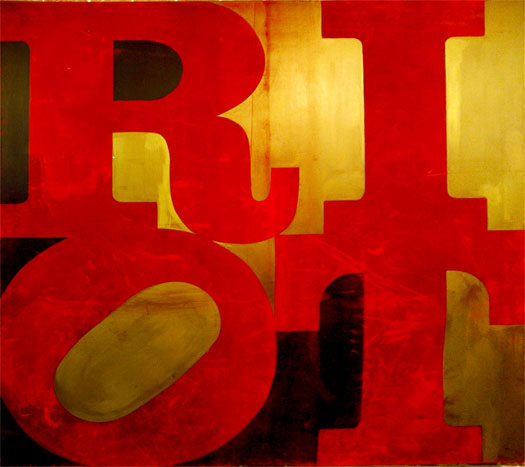
Gran Fury RIOT 1989 acrylic on canvas
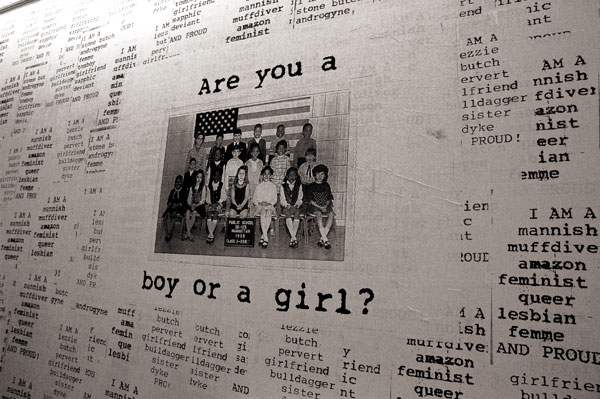
fierce pussy [title not supplied] 2009 black and white xeroxed posters on wall, dimensions variable [large detail of installation inside a multiple-toilet room marked “ALL GENDERS” on the door]
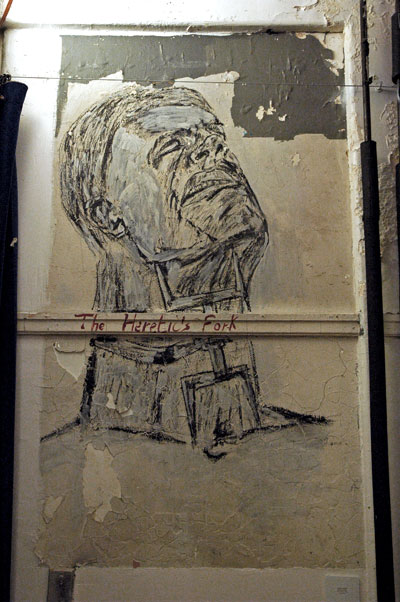
Leon Golub Heretic’s Fork 1989 oil on wall [installation view]
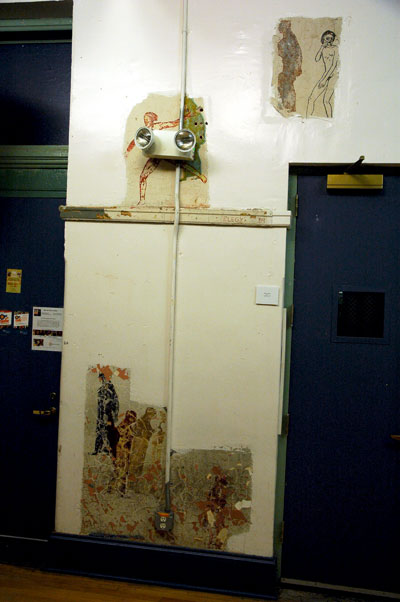
Nancy Spero Elegy 1989 acrylic on wall [installation view]
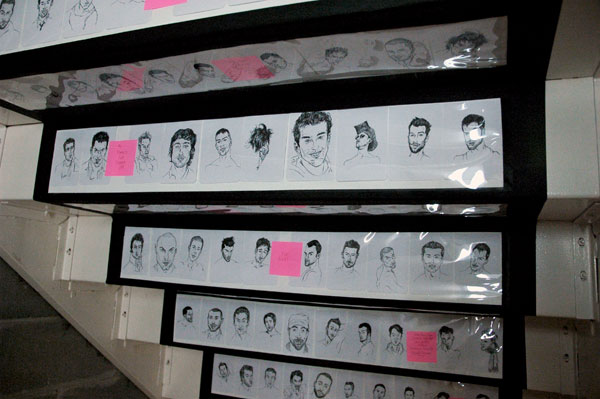
Tre Chandler A narrative of ga(y)zes 2009, 90 ink on paper drawings; 10 ink on paper post-its, dimensions variable [large detail of installation]
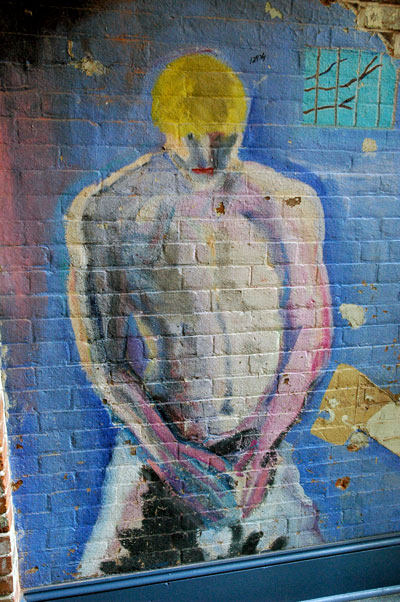
Stephen Lack Boy on Wall 1989 oil on wall [large detail of installation]
queer marriage: California goes both ways
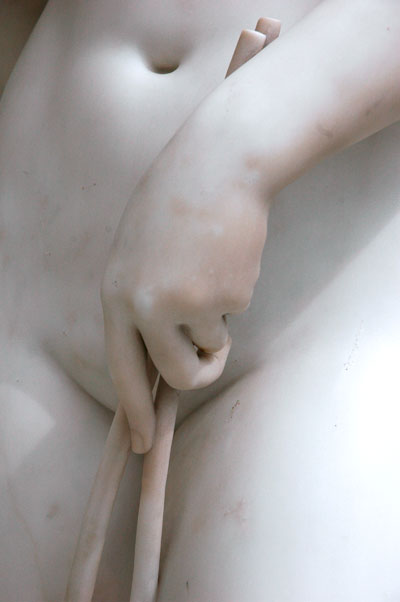
with good in one hand
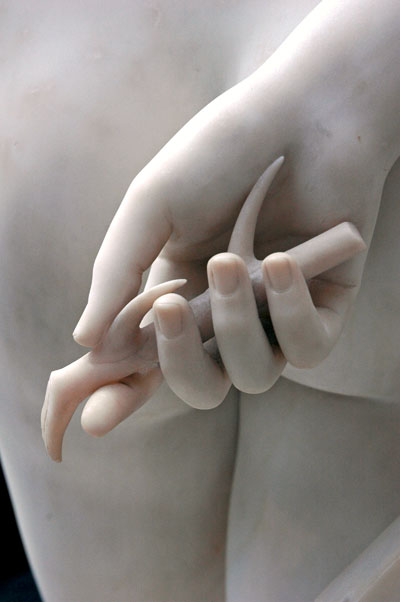
and evil in the other
Barry and I happened to be visiting the Metropolitan’s newly-reworked American Wing on the same day the California Supremes announced their decision on queer marriage. There didn’t seem to be one jot of a connection between the two events when we started out, but I eventually manged to find one.
I spent much more time with the nineteenth-century sculptures in the glass court than I might normally have expected to because we were with the artist Sarah Peters, whose work has been inspired by the milieu in which these earlier American masters flourished, and by their skills, although she finds her own space in interpreting that world anew and commenting on what the artist and his/her contemporaries thought of it through her own drawings and sculpture.
I was also eager to investigate what had inspired Holland Cotter’s terrific piece on the galleries which appeared in the Times last Thursday.
The female nude by Hiram Powers, intended as a California allegory, attracted my attention primarily for the odd props the figure was holding, especially the divining rod which she grasped so demurely before her smoothed pudendum. My mind jumped back to the news of the day when I read the note on the museum card, which reads in part:
Inspired by the California Gold Rush of 1849, Powers devised the following program for this allegorical figure: “. . . an Indian woman . . . stands in a reserved and guarded posture and with a watchful expression, holding the divining rod in her left, and pointing with it down to the earth, under a large quartz crystal, which supports the figure on the right. Quartz is the matrix of gold and the divining rod is the miner’s wand, or the sceptre of ‘California’ . . . In the right hand, which is held behind, there is a branch of thorns, to finish the allegory for she is the miner’s goddess, or ‘Fortune,’ and as it is usual to represent the Goddess ‘Fortune’ with good in one hand and evil in the other [my italics], by suitable emblems I have done so with ‘California,’ and the moral is that all is not gold that glitters. . . .”
What California gives, she also taketh away – sorta, sometimes, possibly only for a while. Maybe the queers will eventually make out, er, . . . that is, within a structure certified by the state.
BTW, it would certainly help if we could remember to call it “civil marriage” rather than “marriage”, which in this benighted land always means religion is involved. That way we might be able to get the folks over 30 to go along with the concept.
For those still interested in the allegory with which I started this post, here’s “California” in full figure:
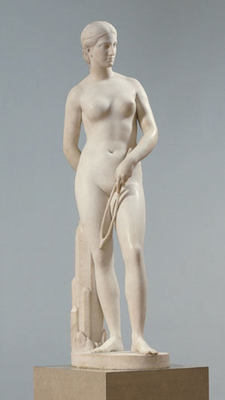
Hiram Powers California 1850�55 (this carving, 1858) marble 71″ x 18.25″ x 24.75″
[third image from Metropolitan Museum of Art]
Keith Haring’s “Once Upon A Time”, 20 years old today
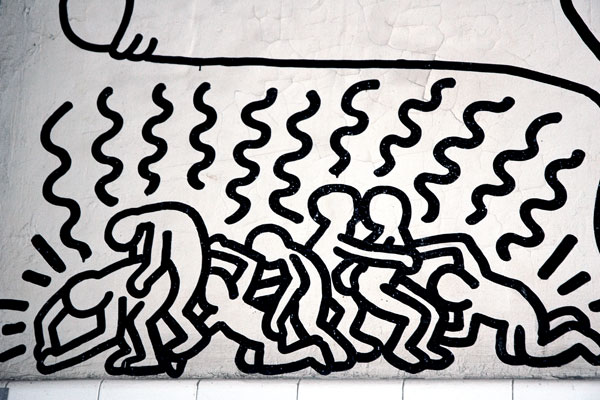
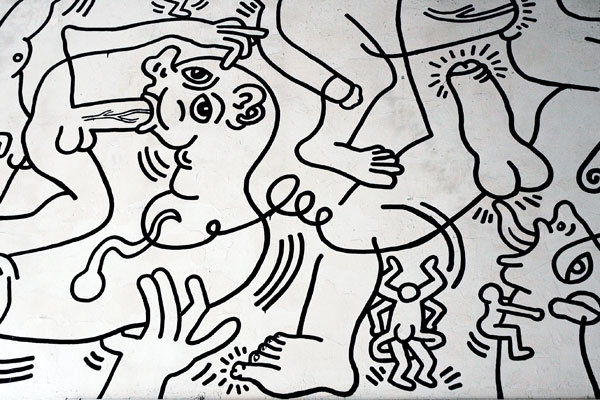
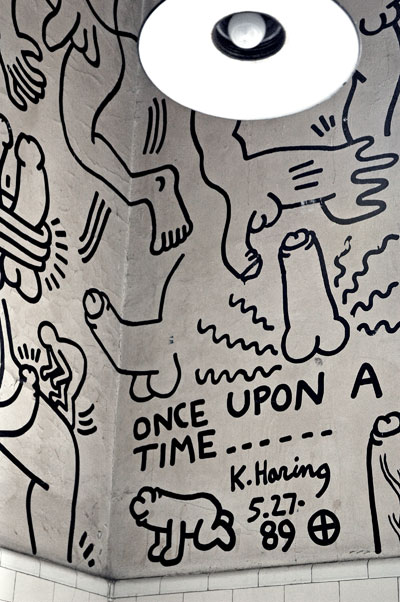
I’ve seen it described as his masterpiece; it’s almost certainly his most personal, exuberant and uninhibited expression of pure sexual jouissance.
Twenty years ago today Keith Haring finished his men’s room mural, “Once Upon A Time”, on the second floor of the LGBT Community Center on West 13th Street. Then he signed and dated it. The detail shots above show that it remains there today, pretty much as he left it, with one important exception: The ancient toilet fixtures and partitions which brought both great relief and great joy to the building’s habitues over the years have long since been ripped out. Sadly, the room appears to have fallen into desuetude.
But, wait, is that actually a conference table I see in the picture below?
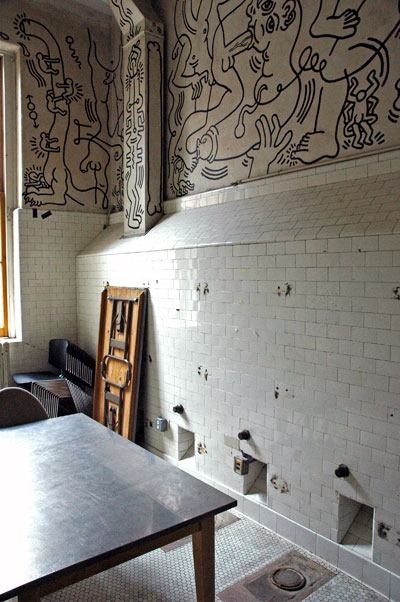
While Haring’s room-size installation may have been the most extravagant, it was just one of many works included in The Center Show [see video], organized in 1989 to celebrate the 20th anniversary of Stonewall. These additional artists included, among others, Leon Golub, David LaChapelle, Barbara Sandler, Kenny Scharf, Nancy Spero, and George Whitman, and much of their work remains inside this amazing, reinvented 165-year-old school building today, continuing to enrich the dynamic energy it both encourages and shelters.
The Center is putting on a show again this year. It’s entitled “Then and Now“, and it’s intended to commemorate the 1989 events with a new installation by a new catalog of artists, although without the permanent, applied-directly-to-the-walls part of the original. It opens tomorrow, May 28, with a free reception from 6:30 to 8:30, and it will remain installed throughout the summer.
The artists invited this time around are:
Trisha Baga, The Brainstormers, Ian Campbell, Tre Chandler, Chi Peng, Abby Denson, fierce pussy, Daphne Fitzpatrick, Lola Flash, Alex Golden, Rory Golden, James Kaston, Jillian McDonald, Bill Mutter, Deirdre O’Dwyer, James Rohmberger, Jamel Shabazz, Nathaniel A. Siegel, Lori Taschler, Wu Ingrid Tsang, Forrest Williams, and Sarah Nelson Wright
Scouts turned into child soldiers (think Hitlerjugend)
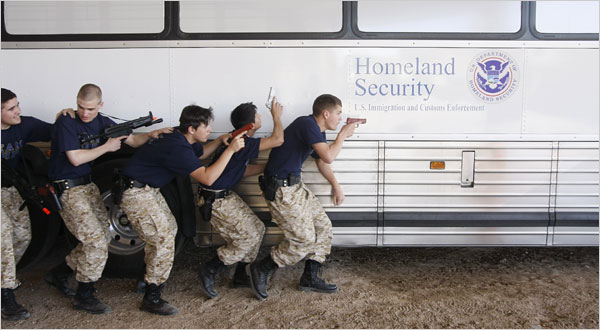
�This is about being a true-blooded American guy and girl” – Imperial County sheriff’s deputy
The Explorers program, a coeducational affiliate of the Boy Scouts of America [BSA] that began 60 years ago, is training thousands of young people in skills used to confront terrorism, illegal immigration and escalating border violence . . . .
While reading this incredible lead article on the front page of today’s NYTimes, my jaw dropping ever lower as I digested its horrors, I suddenly had the odd, faintly-heartening thought: Should we be grateful for one small favor? I mean, as homos we are fundamentally excluded from BSA membership, which normally means no participation in any of their fun and games or lovely overnights, so at least the Boy Scouts of America and their affiliate, the coeducational Explorers program, aren’t teaching violence, militarism, xenophobia, racism and fascism to our own young people (or at least not to those boys and girls who dare to be out while teenagers).
But seriously, this is appalling, so appalling that I had to think about whether this was April Fool’s Day.
These are children, and they’re being given “soft” guns, sometimes shooting real guns (�I like shooting them,� [one 16 year-old girl] said. �I like the sound they make. It gets me excited.�). They are taught how to fight ill-defined or subjective categories of enemies like “illegals”, “terrorists”, “active shooters” and marijuana farmers. No, I didn’t see anything in the article about taking down homos; maybe we’ve made some progress.
The program is restricted to kids 14 or above, but the reporter, Jennifer Steinhauer, suggests there seems to be some wiggle room: One sheriff’s deputy supervising a local post as a volunteer avowed, �I will take them at 13 and a half”.
The story primarily covers towns in Imperial County, in Southern California. It’s the poorest county in the state, ” . . . and the local economy revolves largely around the criminal justice system. In addition to the sheriff and local police departments, there are two state prisons and a large Border Patrol and immigration enforcement presence.”
Our older monsters are creating new monsters.
[Todd Krainin image from the Times]
Le�n Ferrari and Mira Schendel at MoMA
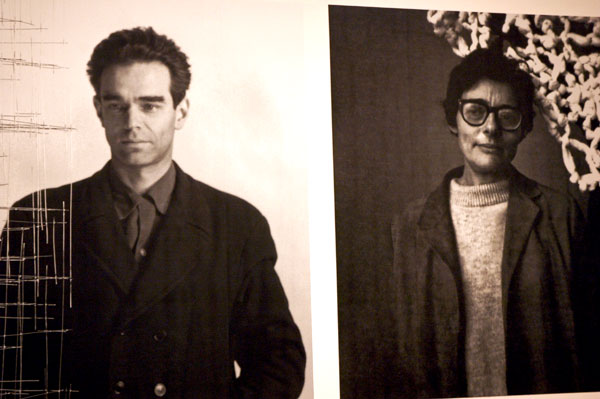
these portraits of Le�n Ferrari and Mira Schendel introduce “Tangled Alphabets”
Schedule complications kept Barry and me from MoMA’s Tuesday press preview of “Tangled Alphabets: Le�n Ferrari and Mira Schendel“, so I missed my only chance to photograph anything in this wonderful show. The only part of the exhibition free to cameras on our visit the next day, during one of the members’ previews, were these two handsome blown-up photographs mounted outside the entrance to the galleries, taken when these South American artists were young. Schendel died in her late sixties, in 1988; Ferrari, almost 90 now, is still working – and still making righteous mischief.
I am very, very sorry I didn’t have a chance to capture and share here some images of Ferrari’s metal sculptures and Schendel’s hanging filaments or transparent papers.
I really recommend the show, and the museum itself has to be commended for mounting a serious exhibition which is, as Barry said when we left the museum on Wednesday, hardly designed as a money-making tourist magnet; being virtually entirely monochromatic, it almost seems to be discouraging traffic.
I was ignorant of both of these artists until I found myself marveling over and over at the beauty, the audacity and the conscience of the works by Ferrari which I saw displayed by several galleries participating in PINTA last November, and before I spotted some stunning drawings by Schendel at Eleven Rivington two months earlier.
The brilliance of the art scene in New York can easily turn us all into provincials. Until visiting “The Geometry of Hope: Latin American Abstract Art from the Patricia Phelps de Cisneros Collection” at the Grey Art Gallery in the fall of 2007 I had probably operated under the assumption that if there were anything to know and value about South American abstraction, as New York sophisticates most likely we already knew it and knew its merits: Any exhibition devoted to the subject would probably be largely a kindness or an exercise in recondite art history.
The Cisneros collection was an eye opener for me, and a lesson for avoiding similar surprises, embarrassments really, in the future.
ADDENDA:
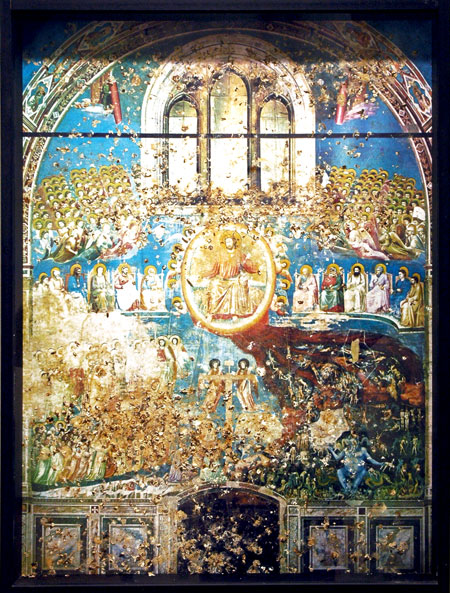
- Roberta Smith works her magic in a review of the show which appeared in today’s New York Times.
- This chronology from the Cecilia de Torres gallery includes some great images of Ferrari’s life and his work.
a rebel, and righteous: Maria von Maltzan
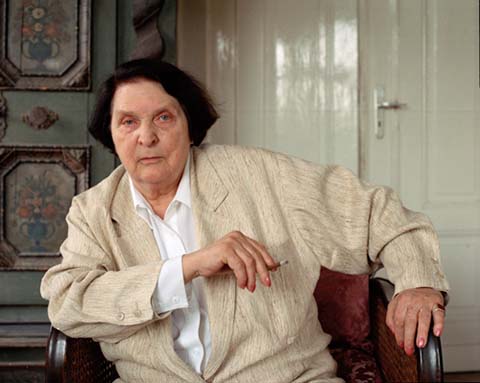
Maria von Maltzan
accepted no imitations
It’s her birthday.
Maria Helene Fran�oise Izabel Gr�fin von Maltzan, Freiin zu Wartenberg und Penzlin, was born on her wealthy family’s Silesian estate, Schloss Militsch, north of Breslau on March 25, 1909. She died in Berlin’s Kreuzberg district in 1997, after a very long and very rich life as a rebel, and one of the righteous – among all nations and for all people.
I first came across her heroic story in some incredible segments which peppered an excellent book I read last year, “The Fall of Berlin“, by Anthony Read and David Fisher. I must have been impressed, because I noted the date of her birth in my pocket calendar and later transferred the information when I bought one for 2009. It probably helped that I realized that this year would be her 100th anniversary.
Von Maltzan’s rebellion first became a public one with a decision, uncharacteristic for a girl in her society, to study biology, botany and anthropology. The righteousness was probably always there, but when she completed her doctorate in the natural sciences in the fateful year 1933 she almost immediately began her involvement in what was only the first of many underground anti-Nazi resistance movements to follow. She was very young, a part of a Bohemian circle in Munich, but she soon began illegally smuggling information out of the country.
Her lack of enthusiasm for the new regime alone would have been enough to trash a chance for any appointment with a scientific or academic institution, and none was to follow – ever. Von Maltzan began what would become a long career of what the world’s conventionally-successful would call underemployments. She survived on money earned as a translator, a free-lance journalist and a lecturer. She also cared for horses and worked as a stunt rider for Bavaria Film. When she moved to Berlin in 1935 she worked in publishing, later as a postal verifier and then with the German Red Cross assistance service.
During the war she completed studies in veterinary medicine, all the while carrying messages and leading refugees through the sewers of Berlin toward freedom, falsifying papers, sheltering Jews and other fugitives (both in her own apartment and elsewhere), and personally assisting many of them in fleeing the country, whether, as in “Action Swedish Furniture”, inside crates marked “Schwedenm�be” or personally conducting some across the Bodensee (Lake Constance) to safety in Switzerland. In the midst of her underground activities she managed to remain close to both the conservative Kreisau Circle and the Communists.
During the last months of the war, inside a Berlin now leveled by allied bombs, Maltzan continued to help both refugees and deserters, and she organized a private soup kitchen for abandoned forced foreign laborers in the back court of her apartment house in Wilmersdorf.
I’m leaving out the story of three marriages (two to the man she hid from the Gestapo inside her couch for years) and the death of a child. But there was much more. Most of the heavy personal cost of von Maltzan’s heroic exertions and incredible acts of courage were performed within a world whose restraints and terrors we can hardly imagine. We also won’t ever know the full nature and extent of what she suffered both before and after 1945.
After the war, her family members dead or scattered, and her home now inside Poland, she managed to found a veterinary practice, working first for the Soviet occupiers and after that for the British. But she later lost her license because of a drug dependency and her need for psychiatric care.
She slowly regained her personal and professional independence, first traveling with a circus, later working in the Berlin Zoo, always caring for animals. She also managed to get employment as a substitute for vacationing veterinarians.
She eventually settled near the Kurf�rstendamm in Berlin and opened a thriving veterinary practice which was patronized by both pet-owning celebrities and their equivalents in the red-light district. In 1981 she moved to Berlin-Kreuzberg, bringing her practice with her. She treated the animals brought to her by the punks in her neighborhood for free. While outwardly she might appear harsh and ill-tempered, inside she was a pushover for the victim, the vulnerable and the downtrodden. She readily chose to defend the relatively powerless individuals and multitudes who were crowded into her district, foreigners or outsiders of all kinds, from corporations, police and politicians. She told an interviewer:
I’m quite engaged in social things now because this part of Berlin is a perfect slum. They don’t like me to say it. I really stand up for this part of Berlin, Kreuzberg. They’ve shoved everybody into this area – Turks, colored people, Poles, everyone stuck into this corner! We have houses with eight flats on one floor with one w.c. on the staircase. The police, you can’t imagine how brutal they are down here, beating. If I see it – because you can see I have big corner windows with a clear view – I go down and get hold of the police and say, “Why are you beating these people?” And the silly police say to me, “Perhaps you like colored here!” “Well, ” I say, “I prefer them to helmets!”
In 1987 she was awarded the title “Righteous Among the Nations” by Yad Vashem. In this undated video interview conducted in her [killer] apartment von Maltzan says:
Because my mother was unjust I have a very high feeling of justice. That’s the real matter of the whole thing. That’s why I’m furious with Israel; they wanted to give me a eucalyptus tree, and I could get a medal pricked to my breast! Such things I don’t really care for.
And they said to me they wanted to make a big kickup for me in Bonn, but the letter inviting me for this arrived the day after the attack on Sidon [she mentioned rockets and red phosphorus]. I wrote back saying that all my life I’ve tried to be for the peaceful co-existence of all people, of all colors and all regligions, and I don’t see that Israel has anything to do with these my ideas, and so I don’t think I want a medal from you. I didn’t go.
Maria von Maltzan died November 12, 1997, in Berlin. She had published her memoirs, “Schlage die Trommel und f�rchte dich nicht“, a little over ten years earlier, but they have not yet been translated into English.
NOTE: There is a more extensive citation in the German Wikipedia, from which I’ve taken most of my account here.
[image from gayblock]
“Changing Times” will mean interesting times
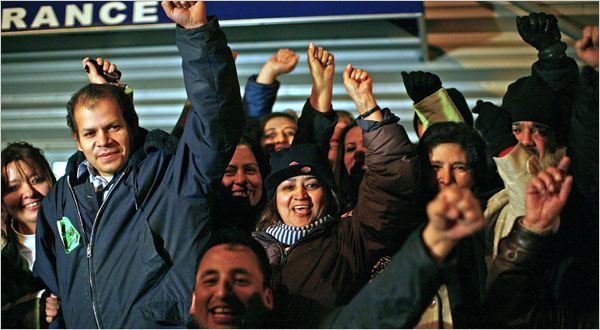
Republic Windows employees celebrate getting everything they asked for, after sit-in
taking over the factory
After writing up my report of what was said by others at last Thursday’s panel at the X Initiative I asked myself what I thought about the question implied in the program’s title: “After the Deluge?; Perspectives on Challenging Times in the Art World”. I’ve decided to continue the discussion I had with myself in this space.
As far as the economy is concerned, I think things are going to get pretty crazy out there, and they may perhaps stay pretty crazy for a long time. In spite of the optimism coming from Washington and in much of the press in the last few days, I still think we’re sliding into another great depression. I’d say they’ve really broken it this time. I’m especially concerned because I’m not hearing anyone who is supposedly in charge really admit it.
If the U.S. population is a little more than 300 million and the total amount of the so-called bailouts and capital infusions remains no more than the estimate of $9.9 trillion published in an article in the Times two months ago (which now may seem a very optimistic assumption), those numbers equate to more than $32,000. for every single American. And yet it may not do the trick. The country, and the whole world, might still collapse into chaos.
Under both best- and the worst-case scenarios, there will be changes in the way we all live.
But let’s put aside the doomsday bugbear; it seems there’s something else going on, and this phenomenon just might turn out to be a good thing. People are not just worse off than they were one year ago, or perhaps eight or even thirty years ago, as we’re now learning. People are mad; they’re *really* mad; and it’s not just about the AIG bonuses. It’s about the selfishness, the greed, the arrogance and the pure stupidity of those who have been given those bonuses, as well as all the other financial tycoons, and their fellow-traveling politicians too. They have together created the disaster which is taking from people their jobs, their savings and their hopes, while mortgaging their future and that of their children with the trillions of dollars stuffed into the pockets of those same tycoons and politicians, in transactions which remain opaque today.
For what it’s worth, we can be sure this debacle won’t look anything like the last one. When things like wars and depressions come back, when historical things are repeated, they actually never do “come back”, and they really never are “repeated”. World War II looked nothing like its almost-equally infamous namesake. We can also be sure that Great Depression II will end up looking nothing like the first one, which seemed to have defined the 20th century almost as much as totalitarianism, genocide and industrial progress.
One thing we do know is that nothing was ever quite the same both during and after the Great Depression. I think there’s a good chance that nothing will survive the current crisis in the same form in which it existed just one year ago, including the current arrangements within the art world. I have no predictions about galleries or other institutions, but the relationship between the artist, the gallery and the public may be altered. It’s probably safe to assume that while some will certainly survive and eventually flourish once again, any space which today we think of as on the leading edge will almost certainly be supplanted in that role by others not yet in business, and the old edge will become the middle ground.
But assuming we don’t end up tearing each other apart over scraps of food, maybe we can look forward to “interesting times” as for artists and the people who love them and what they do. I’ve assembled a far-from-exhaustive list of developments which I think we’re likely to see just ahead of us, if not already. It does not include trends which would seem to be unrelated to the economic depression, like digital experimentation. Also, most are not entirely new concepts or developments, and some of them are already here.
Every artist will finally get a website, including those who have held out because of some idea of principle, and those who have depended on their galleries.
There will be more virtual art, meaning both online work and projects.
We will see an growing trend toward the adoption of “open source, open content and open distribution” (pace Eyebeam).
There will be more interactive work.
Individual artists and groups of artists will be showing work in their studios, art both by themselves and by others.
Artists will organize shows themselves in vacant buildings and storefronts, even if private and public institutions fail to do so.
Some businesses, large and small, will find it useful and rewarding to cooperate with artists in a symbiotic relationship.
A distressed economy will encourage the recognition of the folly, and even counterproductive consequences, of camera prohibitions.
We can expect to see a greater popular documentation of the visual arts, where it doesn’t interfere with its appreciation by others.
We will see more street art and more street performance, both in more inspired forms than ever.
We are sure to see more work that reflects the growing populism abroad in the land today.
And consequently, we will see more socially and politically provocative work (actually, that may be mostly wishful thinking).
But this new art will be subversive (no, I mean really subversive), even if it’s not “Political”.
There will be work which would have been unrecognizable as art, by most people, until now.
And certainly there will be art created in totally new mediums.
But, because of reduced budgets, we can still expect more works on paper and more work using found materials.
Governments and citizens will finally grant artists a status withheld from them until now, recognition as a full and worthy part of society in every way.
It all sounds good to me, but the best thing I’ve heard or read describing the positive things which lie ahead for artists even in our reduced economic circumstances was a piece Holland Cotter wrote for the Times, published February 12, “The Boom Is Over. Long Live the Art!“:
At the same time, if the example of past crises holds true, artists can also take over the factory, make the art industry their own. Collectively and individually they can customize the machinery, alter the modes of distribution, adjust the rate of production to allow for organic growth, for shifts in purpose and direction. They can daydream and concentrate. They can make nothing for a while, or make something and make it wrong, and fail in peace, and start again.
Now if we can all just get through this no-money thing and crawl out the other side in one piece.
[image by E. Jason Wambsgans from the Times via Chicago Tribune and AP]
Solmi’s “il vilipendio di cose destinate al culto”
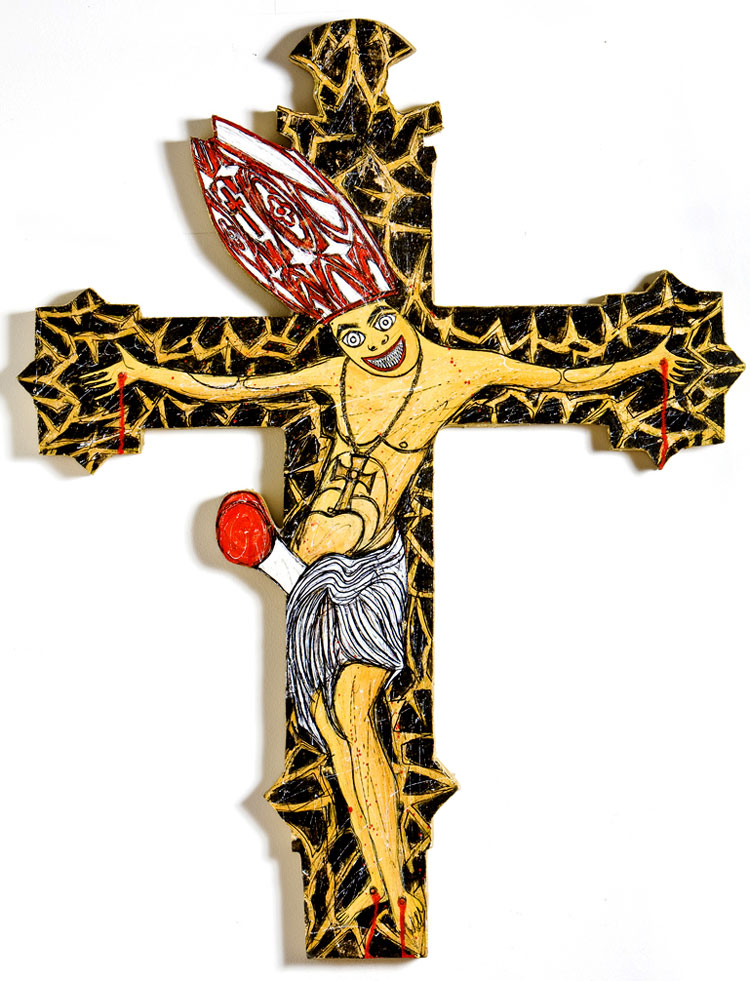
Federico Solmi’s “crucifix” [my punctuation], related to his 2008 hand-drawn animation video, “The Evil Empire“, a satirical look at the outrageous exploits of a fictive pope, and a part of his “ongoing desire to satirize tyrants” [as quoted in both ARTINFO and ArtNet].
I suppose this artist’s work may look to some like heady stuff, but only if you’re Catholic, unwholesomely deferential toward superstition, or just dysfunctionally prudish.
The object shown at the top is a little provocative, but it’s also very beautiful, and I think his red knob is cute. Still, Solmi’s crucifix, while being shown at Bologna’s Arte Fiera this past January, so aroused local judge Bruno Giangiacomo (Judge for the Preliminary Investigation (Giudice per le Indagini Preliminari or G.I.P) who appears to have only heard about it second hand, that he had the Carabinieri seize it from the booth occupied by Naples’ Not Gallery and the artist charged with, essentially, blasphemy (“il vilipendio di cose destinate al culto“/”contempt for an article of worship”) and obscenity (“l�esposizione di oggetti osceni“/”the display of obscene objects”). The crucifix had already been sold to a collector, and Solmi first heard about the charges after he had returned to his home in New York. The blasphemy count was later dropped, when someone realized that the statute had been rendered null by a constitutional court in 2000.
No, sadly, this wasn’t a publicity stunt, but when I was first told about the confiscation and the charges I did think that someone was pulling my leg. Actually I was almost stupefied, since the great city where this occurred has the reputation here of being Italy’s most politically and socially radical. The artist’s own home town and the capital of Emilia-Romagna, Bologna led the country�s socialist movement early in the twentieth century, was extremely active in the revolt against the fascists in 1944, and after the war, until the last decade, the city consistently voted for communist governments. I had assumed its fiery, secular, non-conformist political history would have supported an artist’s right to his creation, however provocative. Now it’s up to the lawyers to decide how much liberty is too much liberty.
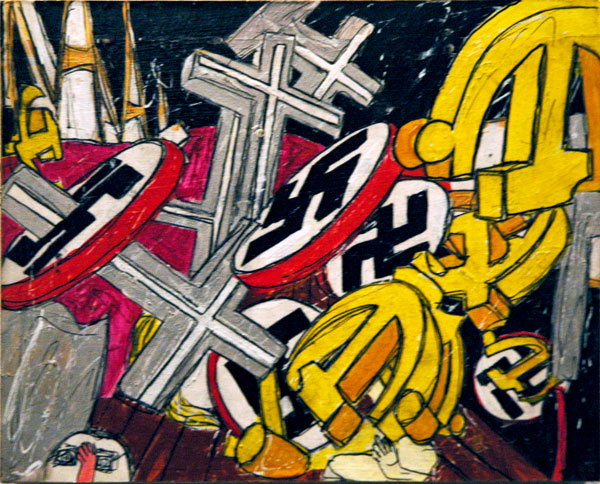
drawing used in Solmi’s “Evil Empire” video
Our own art fairs last week didn’t produce anything like this kind of excitement. It almost makes me nostalgic for Rudy Giuliani’s imbecilic tantrum over the Brooklyn Museum show, “Sensation“, ten years ago. Just kidding; maybe we should think of censoring little boys and she-goats as more than enough excitement.
For more information see these ArtNet and ARTINFO articles.
[image at the top from the artist’s New York gallery, LMAK Projects, via ArtNet]
sharia in Afghanistan: 20 years for downloading
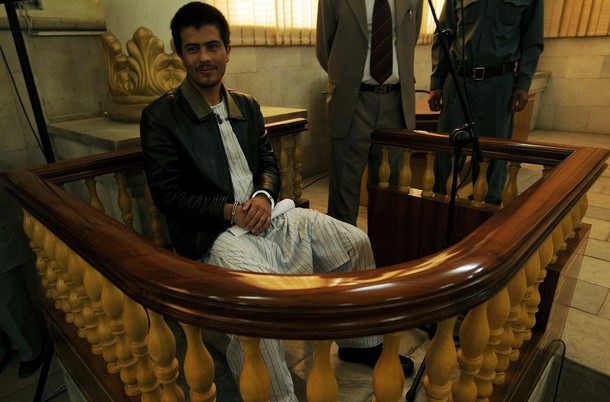 Sayed Parwiz Kambakhsh, sentenced not for downloading porn, but for printing an internet article about Islam and women�s rights, and adding comments on the Prophet�s shortcomings on the subject
KABUL, Afghanistan � The Supreme Court in Afghanistan has upheld [in a secret decision made last month, but revealed only yesterday] a 20-year prison sentence for an Afghan university student journalist accused of blasphemy.
. . . .
The student, Parwiz Kambakhsh, 24, from northern Afghanistan, was arrested in 2007 and sentenced to death for blasphemy [following a two-minute trial; the sentence was commuted to 20 years last October] after accusations that he had written and distributed an article about the role of women in Islam [my italics]. Mr. Kambakhsh has denied having written the article and said he had downloaded it from the Internet. His family and lawyers say he has been denied a fair trial.
This story in today’s Times headlines only one of an increasing number of incidents within “occupied” Afghanistan, including murder and imprisonment, which reflect appalling threats to personal freedoms, especially those affecting women, and the ordinary functions of the media, even within the capital itself. The threats come from the Taliban, Islamists, the traditional conservative patriarchy, and even from official government, political and less extreme religious circles.
Can someone tell me again why we’re in Afghanistan?
It’s been seven and a half years since we invaded that country and sharia* is still, literally, the law of the land. This place is on the other side of the world, but its where our new President wants to introduce a larger American armed presence than that which we have already installed there, and that mindless military solution looks like it’s about to become the model for our next overseas adventure, the occupation of one of our allies, Pakistan (whose government has already handed over a good part of its own territory to the Taliban and sharia law) in our continuing “war against terrorism”. In the beginning it was all about Bush, but in the end it’s just going to be Obama and the ghost of LBJ.
Occupying these countries will not make them do what we want them to do, and who doesn’t already know that?
Looking to the west, all the way across Iran to Iraq, we also learned today that the courageous reporter and patriot who insulted Bush fifteen months ago in Baghdad by throwing two shoes at the visiting American commander/comqueror has been sentenced to three years in prison. I would say he’s lucky he wasn’t shot on the spot, executed, “disappeared”, or given 20 years, but this is no way to treat political protest, even in an “Islamic, democratic, federal parliamentary republic” assembled by clueless occupiers. Bush himself, no enemy of secret trials or torture, responded, after ducking the shoes, “that’s what people do in a free society, draw attention to themselves”. Zaidi could be heard screaming outside the room.
One more thought to ponder: Take a look at a map of the Middle East and imagine what you would think about these developments, and the other political and military arrangements an aggressive U.S. empire has made with countries in the area if you were responsible for the security of the proud and ancient people of Iran.
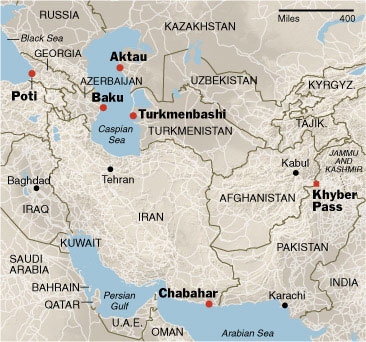
feeling surrounded
*
Unless you have a very strong stomach, don’t search Google images “sharia”. (I made the mistake of going there because I was hoping to find a generic picture of the subject to illustrate this entry.)
[first image from Getty Images; second from the New York Times]