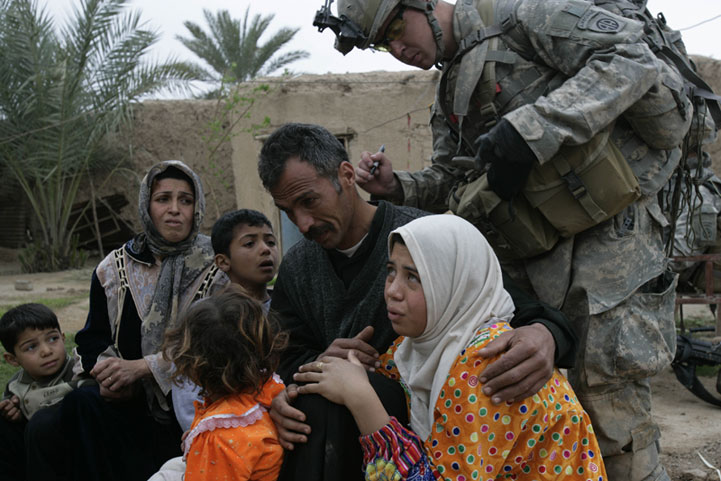
inside the gallery the caption reads: Yuri Kozyrev Iraq 2007 US forces mark Iraqis with serial numbers to track movements in and out of village
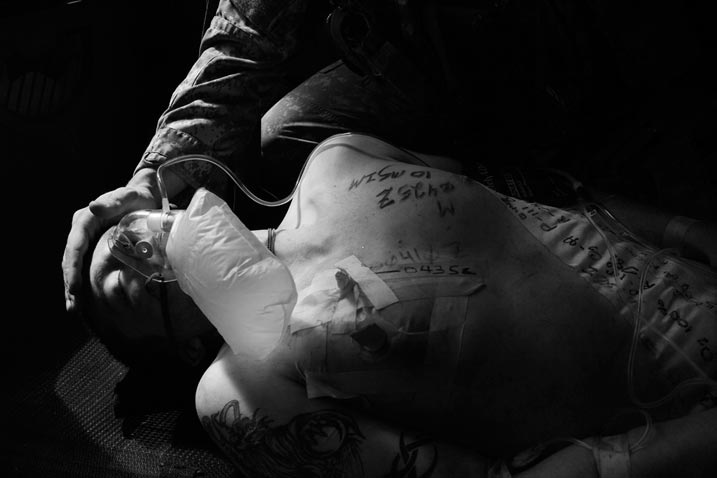
inside the gallery the caption reads: Jared Moossy Afghanistan 2007 An [sic] wounded American soldier is airlifted by helicopter in eastern Afghanistan
I really, really would like to get away from what my grammar school teachers called “current events” and what I call “matters of life and death”, and go back to posting about the fine arts, but my intentions are being confounded by both events and the art. Yesterday, after visiting the group installation “The Ballot Show“, about you-know-what, at the Front Room Gallery in Williamsburg, I headed a little further west to the Sideshow Gallery’s “Battlespace: Unrealities of War“, and there I almost lost it.
These are images by 23 photographers “embedded” with our troops in Iraq and Afghanistan. Under the terms of their being allowed there they are forbidden to publish, in their regular commercial news outlets, the more violent images of injury and death hanging on the walls in this gallery. And so the wars go on, with the citizens who sustain them easily able to ignore the worst of what is being done in their name to both American troops and the “enemy”.
People elsewhere in the world don’t have this luxury; they’ve been shown such photographs since the wars began.
While in the gallery I couldn’t quite bring myself to photograph the most obscene images of mutilations and carnage. I cannot explain why, even to myself, especially since broadcasting them is precisely the intent of the photographers and the purpose of this installation.
I found the Battlespace site itself only a few minutes ago, so I’m using its images rather than my own, and, hoping to redeem myself for my timidity yesterday, I’ve decided to upload below one of the most powerful images I saw, one which I did not capture with my camera. I should add that it is not the most grotesque: This body was still living, and being attended by medical personnel.
Inside the gallery on Bedford Street the wounded soldier on the table appears almost, literally, “life size”. The scale in which it appears online can barely suggest the horror of what you are actually looking at.
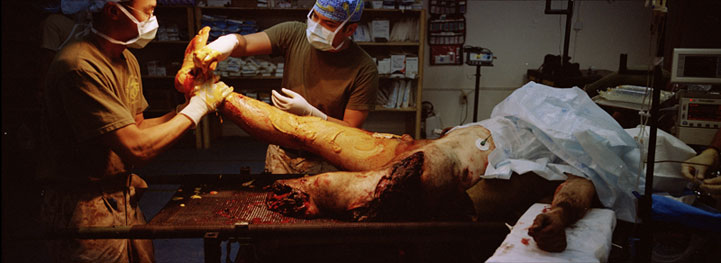
inside the gallery the caption reads: Lucian Read Iraq 2006 American soldier lies on an operating table in Ramadi after being wounded in an IED blast
Visit the exhibition itself before it closes next Sunday. You will never forget it.
[all images from Battlespace]
Category: Politics
Obama’s change will require something like revolution
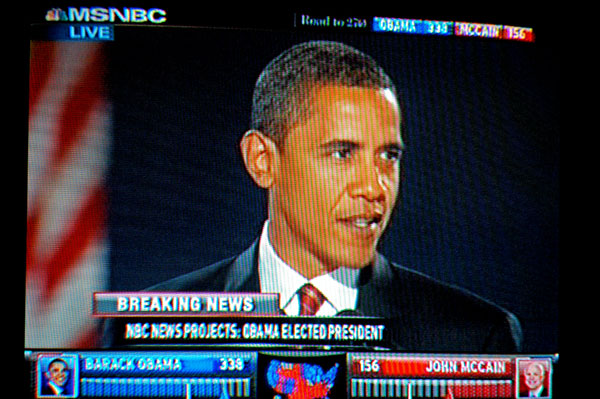
On election day at around 6:30 in the evening I drafted some thoughts that seemed to reflect my state of mind at the time. Barry and I were going to meet Paddy Johnson a little later at the election watch party at Huffington Post headquarters, where I had hoped to come up with an image to go with the draft post. But by the time Obama’s election was actually called, around 11 o’clock Eastern, I had tears in my eyes. I was home, and when I looked at my lines a little later I knew they just wouldn’t fly right then (unless you were asleep that night or brain dead, you know what I mean).
Like most of the world, I am overwhelmed and overjoyed by what has happened, even more so since I will admit that ever since 2000 I thought I’d never see another real Presidential election (even blogging about my scepticism, repeatedly, beginning almost seven years ago). I had seriously underestimated the Republicans incompetence in both their ability to govern and to maintain power.
But it’s now less than three days later and the questions have already begun.
Will Obama be be able to oversee our national restoration? My brother reminded me on the phone yesterday afternoon, from suburban D.C., of the price we had to pay to bring about this victory. We endured eight disastrous years of a Bush presidency, years which saw both the haughty ascendancy and the ignoble collapse of the unmourned Late Capitalist, Neoconservative and Republican regime. Nothing of importance or worth in our own Republic or in much of the rest of the world has escaped the depredations of its arrogance, its sententiousness, its dominion and its greed. I had believed for years that no fundamental political change would occur until we had sunk into a genuine economic depression, and I had gloomily predicted the change would be toward some form of Fascism.
I hadn’t anticipated the confluence of the dramatic events of the last year and the exceptional capabilities of Barack Hussein Obama. I’d say we were far luckier than we deserved to be. There was certainly no inevitability in the timing of either’s appearance.
But in order to rebuild institutions, restore well-being and a belief in the future, the new President will have to pull off something like a major revolution. And he’s going to have to move fast. Roosevelt’s entire “First New Deal” was proposed and passed by Congress within the first 100 days of his administration. I can’t imagine how he and his administration managed it, but in 1933 the people were demanding immediate relief.
Today there may not yet be universal recognition of the full impact of the current economic collapse. Only a few are beginning to describe it as equivalent to the Great Depression, whose ravages were well underway as FDR assumed office (although to be sure, our 32nd President didn’t also have to deal with two messy wars and Global Warming when he moved into the White House). Without that full recognition of the seriousness of our crisis, and with the continuing strength of contemporary skeptics, dinosaurs and reactionaries, including the fact that almost as many people didn’t vote for him as did, Obama will almost certainly have to push through what must be, and almost certain will be, an extremely progressive agenda while not making it look too radical, and he will have to do it in a way that will disarm and even enlist on its behalf as many of its potential adversaries as possible.
It was very interesting to me when I finally looked into it, that during his campaign Roosevelt had apparently spoken to the voters of nothing remotely related to what became his extraordinarily-ambitious New Deal programs; in fact, much of what he did say suggested an agenda quite the opposite of what was later framed and passed. Not knowing this then, but because I knew something about my countrymen, it did not surprise me when I heard nothing specific about any kind of new New Deal from Obama at any time during his own extended campaign.
Obama knows he will have to be diplomatically politic. The nation is fortunate that such an approach corresponds with his own temperament, and that he brings to the task an extremely sharp mind, including the ability to think and speak on his feet, and what appears to be enormous strength of character. I have no doubt that if anyone could pull this thing off in this shaken country at this time, Barack Obama could, but he won’t be able to do it alone.
I know there will be mistakes, as FDR made mistakes, but, and call me Pollyanna again, I believe he will pull it off, partly because of what I have just written, but also because he will have so much help (both enthusiastic and skilled), and because we have come to such a pass that we all really want to see him to succeed: Regardless of our diversity, and despite the vast range in our individual conditions and current fortunes, none of us can afford the cost of failure. We’ll have to be in there with him.
Did I mention the awesome and “monumental” importance that our success would signify, an importance even beyond that of our decision to make a man who happens to be [described as] Black the President of the United States? More than a material recovery, success would mean the restoration of the all-but-buried idea of a free and welcoming America first invented by a wise, older world sometime in the seventeenth century.
These are the tone-deaf, and surprisingly angry lines I wrote early Tuesday evening, exactly as I had left them*:
The corporate devisers and the engine of our national disaster and disgrace have finally been repudiated. Bush and his enablers will squirm in their Pennsylvania Avenue lair for almost three more months, where they can still do a lot of damage, but the lease is up.
While it is clearly a victory for reason and common sense and what used to be called “the American way”, today’s vote marks only the beginning of the real recovery.
We must all immediately get to work picking up the shattered pieces of a proud republic, and it won’t be easy. While we are doing so it will be equally as important to resolve and ensure that as the privileged and proud citizens of this fortunate land we will never again sell our heritage to slick con men who thrive by preying on our selfish appetites and ignorant fears.
We are a free people only if we remain actively and continuously responsible for our own governance.
Freedom ain’t a tower.
*
I’m struck by the fact that I totally ignored mentioning the significance of race when I wrote about what I already expected would be an Obama victory. I’d like to think that what looks like my indifference to its role may turn out to be a bellwether for this country finally arriving at maturity, but I can’t help mentioning that later that evening I noticed and remarked to my friends that sadly even the Huffington party presented little more than a handful of dark faces in a sea of white. I was regretting that we hadn’t decided to watch the unfolding wonders from somewhere in the streets.
[image is a still of the MSNBC broadcast as seen on our home screen]
The Walrus: Lennon, on peace . . . and change
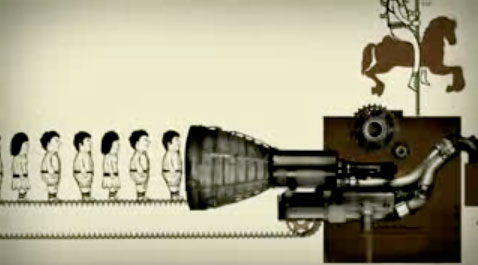
war machine [still from the video]
In 1969 14-year-old Jerry Levitan managed to get into John Lennon’s hotel room in Toronto’s King Edward Hotel with his reel-to-reel recorder where he interviewed his idol for the school paper. Nearly 40 years later Levitan produced an animated film documenting and illustrating what he heard and what he captured on tape in conversation with the Walrus that day.
A short excerpt of Lennon thrashing out war and change, from “I Met The Walrus“:
It’s up to the people . . . you can’t blame it on the gov’ment and say they’re doing it. Oh, they’re going to put us into war. We put them there. We allow it, you know, and we can change it; if we really want to change it we can change it.
“Walrus” was written and directed by Josh Raskin, with illustrations by James Braithwaite and Alex Kurina, and animation by Josh Raskin.
[image is a screen grab from YouTube, but I first heard about it today from scatteredsisters, a site maintained by a good friend in Antwerp together with her siblings dispersed about the globe]
still Guantanamo
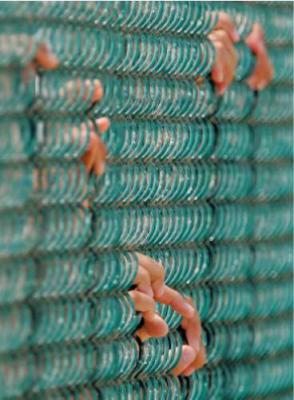
arrest the real criminals!
Guantanamo.
Nobody has to spell it out again. We all know what it is, and what it represents. We know it should never have been built and we know that it should have been plowed under long ago.
We also know that no one is talking about it any more*.
Its victims remain inside, but it has been arranged that we can never know anything of their innocence or guilt. The only thing we can be sure of is the guilt of so many who are outside, those who built it, those who maintain it still, and all of us who tolerate it.
*
Well, almost no one. In a letter to the editor of the NYTimes published yesterday, Larry Cox, Executive Director of Amnesty International, acknowledges that while Bush has decided to do nothing about Guantanamo, in spite of saying more than two years ago that he wanted to close what I call our Cuban concentration camp, both major candidates are actually on record as saying that they would close it. However, Cox and many others smell the rat:
But they must not transfer the the violations to other locations [my italics]. Detainees should be charged with a recognizable criminal offense, brought to full and fair trial or released.
The next president must also commit to abandon the military commission trials, repudiate secret detention, never again authorize or tolerate torture, and uphold the rule of law at home and abroad.
But my question (and our guilt) remains: Why not now?
[image from Getty Images via Nasir Khan]
a vote for Obama just won’t be enough
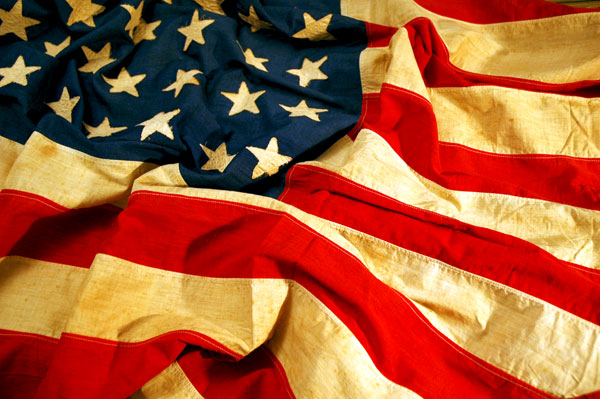
in storage since the wingnuts bought all the rights: my old, yellowing 48-star flag
I have had a very hard time getting as excited as most of my friends and acquaintances are about Obama’s candidacy, perhaps especially during the time he was coming closer to being the Democratic candidate and then to being chosen to occupy the office of President itself. I admit I’m spoiled: I’ve always had difficulty settling for less than what I want or, in this case, for less than what is needed by my country.
Yes, part of it’s because I’m politically far to the left at least of the image the candidate presents of himself, but I also believe that we have nothing but our fragile hopes to support any belief that Obama will have both the imagination and courage to do as President what absolutely must be done. The extremity of our current crisis requires an even more ambitious agenda, in both domestic and foreign policy, than what was required of FDR in 1933, and I see no evidence that anyone is fully aware of this, including the candidate – perhaps especially the candidate.
We’re in big trouble, and I don’t think we understand yet what’s wrong.
But I also worry that we are too anxious to lay the blame for our shame and misery, and the responsibility for our redemption and relief, solely on someone our system puts in charge of things. Neither Bush and Cheney nor the people and corporations who created them are fully to blame; after all, almost 50% of voters approved their candidacy – twice! At the same time, we won’t find our way out of this mess if we think our own responsibility ends after next Tuesday.
The October 27 issue of The New Yorker includes this letter from a reader which beautifully lays out the sense of what I’ve just touched on:
While I agree with your editorial support for Barack Obama, the challenges of national leadership are greater than simply choosing the right candidate (Comment, October 13th). Our preoccupations – consumer profligacy, national myths, and denial of the rest of the world – may not result in the best choice of leadership, as the second Bush term so clearly demonstrates. The question is whether we can make the personal sacrifices necessary to change ourselves, or whether we believe that change is only about what leadership we select. The original patriots risked their lives for what they believed. No one is asking that of us; just that we vote with care and with attention to our enduring values, and realize that there is more to being good citizens than going to the polls.
Jon Gilmore
South Orleans, Mass.
Bowery turf
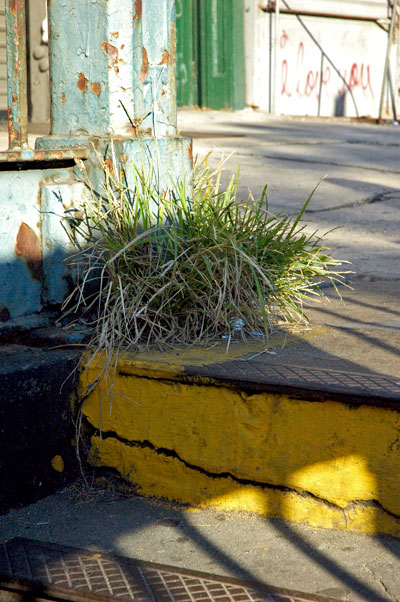
untitled (yellow riser) 2008
This grassy clump is growing at the top of the stairs of a subway entrance on Bowery.
Who says Manhattan’s lost its edge? Ask any European or Japanese visitor what s/he thinks about the appearance of our infrastructure – after twenty years of killer prosperity for the city. I’m afraid of what may lie ahead, even if it could mean the return of affordable apartments for artists and those who love them.
In any case, it looks like we haven’t lost our heart. I like the grafitto, “I love you”, in the background.
it’s not about term limits; it’s about fake democracy
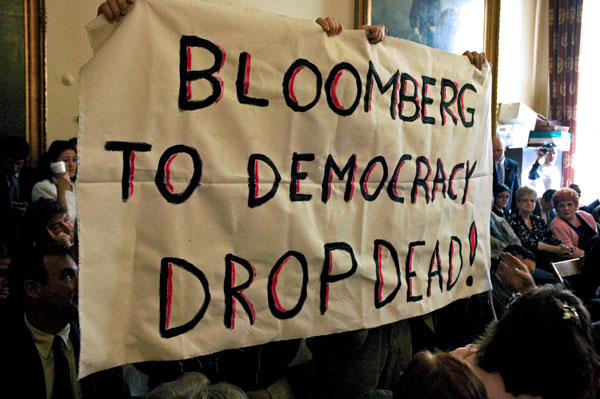
the Radical Homosexual Agenda seen in Council this morning
The real argument is about competitive elections, not term limits. Of course we’d like to think that every vote counts, but the fact is that we’ve designed a system in which money really counts; the votes are essentially just for decoration.
If we had a real system of public financing of elections there would be no argument for term limits. New Yorkers have voted twice to establish a system of term limits, a clumsy and ineffective mechanism intended to help level the playing field for candidates seeking office. It doesn’t really get us where we should be, but it’s not preferential, and it’s what we got.
While it’s not entirely about money, it’s about money. Wealth always attracts power and power attracts wealth. It’s not just ironic that the billionaire who initiated and bankrolled, to the tune of $4 million, successful term limits referendums in 1993 and 1996 now wants to overturn the results without a referendum, in order to support another billionaire: In fact it’s disgusting but it should surprise no one.
Supporters of Mayor Bloomberg’s call for the Council to negate the twice-expressed will of the voters of the city for his benefit are acting as if victory would automatically mean a third term for their candidate. Unfortunately they’re probably right. Bloomberg spent $100 million of his own money to buy and keep his first two elections; he is expected to spend another $80 million if we let him have his way with us a third time.
Supporters also argue that voters should have complete freedom to cast their ballots for whomever they wish. I agree, but it’s not going to happen if this kind of money (whether coming from individuals or very interested corporations) is always going to be there to tell us who and what is best for us. Any other other “whomever” or “whatever” will always be kept out of both sight and sound by people with more money behind them.
I’d like to think that my city is not for sale, and yet of course we know it is.
But there’s still hope, and some of it showed up at City Hall this morning. On the second day of hearings over the question of whether the Council should vote for another term for Bloomberg, the first statements were delivered by Queens Borough President Helen M. Marshall, Time Warner Chairman Richard D. Parsons, and Peter Vallone, Sr., who was Speaker of the City Council from 1986 until 2001. All three support Bloomberg, and all three spoke in his support today, but then something happened to throw a figurative wrench in their political works. I hope it might set the theme for the remainder of the day: Members of the Radical Homosexual Agenda [RHA website] got up from their seats and dropped the cloth banner shown above.
W.A.G.E. rage inside “Democracy in America”
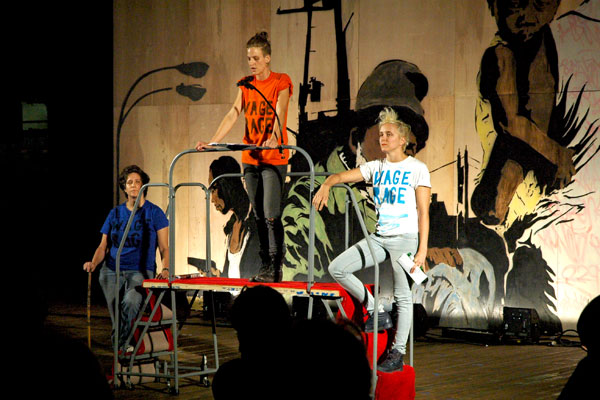
W.A.G.E. RAGE from the speakers’ platform in the Armory Drill Hall
Creative Time’s 2008 project, “Democracy in America: The National Campaign“, was a remarkable achievement on a national scale, and it all came together in our town this past September. I wouldn’t know where to start if I tried to address everything I saw on visits over two days, but I can say a few things about its general success, at least as I see it.
For starters, this is the kind of investment in public art that, unlike so many that are imposed upon us, could really make a difference to both a huge number of artists and a very large public. Also, it probably cost New York something less than the $15 million the Public Art Fund spent on Olafur Eliasson’s surprisingly-lame “New York City Waterfalls”. Thirdly, it involved the active and creative participation of thousands of people all over the country, from all sorts of backgrounds and they were exercising all kinds of talents. And finally, on a personal note, entirely aside from its undeniable intellectual and aesthetic appeal, I would say that any art project which can teach this art fan and political activist new things and radicalize him beyond his previous position must have gotten something very right.
Some of the liveliest elements of the entire Park Avenue Armory “Convergence Center” were to be found inside the Drill Hall. Throughout the week of the installation anyone could speak from a soapbox, but individuals and groups were also scheduled to perform or speak more formally at the east end of that magnificent vaulted shed. I heard parts of only a few segments in either format, but on the night of Saturday, September 27, I was there for addresses, in intense and reasoned argument, by some of the people of W.A.G.E. [Working Artists and the Greater Economy]. The words we heard then will some day be described as marking the moment when the gloves came off and artists in America began to be free.
Their website says that the group “works to draw attention to economic inequalities that exist in the arts and to resolve them”, and their fundamental argument was expressed in some of the statements we heard that Saturday, beginning with these notes which I’ve made with the help of the video available by Creative Time on vimeo:
“It seems apt that W.A.G.E. is here [as the world’s financial systems fall – Ed.] tonight to bring to light ongoing unjust fiscal practices in the art world”
[the speaker goes on to explain that institutions, should they choose to exhibit their work, don’t pay artists the costs for the exhibition, don’t pay their lecture fees, don’t pay fees for the reproduction of their images in their advertising materials, just for starters]
“Does this list sound absurd? It’s long. What is absurd is to exclude artists from payment for their labor and for the reproduction and exhibition of their work, within an economic climate where it is socially acknowledged that payment is granted for services rendered.”
[she added that it’s also not absurd because there are many examples of artist fees being covered in other countries, and then she continued, guessing some listeners might respond that those countries may be socialist, or that they must have more funding than our private institutions]
“If capitalism is you bag or priority, I can’t think of anything more capitalist than getting paid for your labor [italics mine].”
I’m sure you’ll be hearing more about this movement, even if you don’t become a part of it, and even if you don’t go to the site, where there’s much more about W.A.G.E. and CARFAC, the Canadian artist-run organization which has been so successful.
We love creative time, and we love Creative Time.
Palin as the “maverick” court fool’s scary marotte*
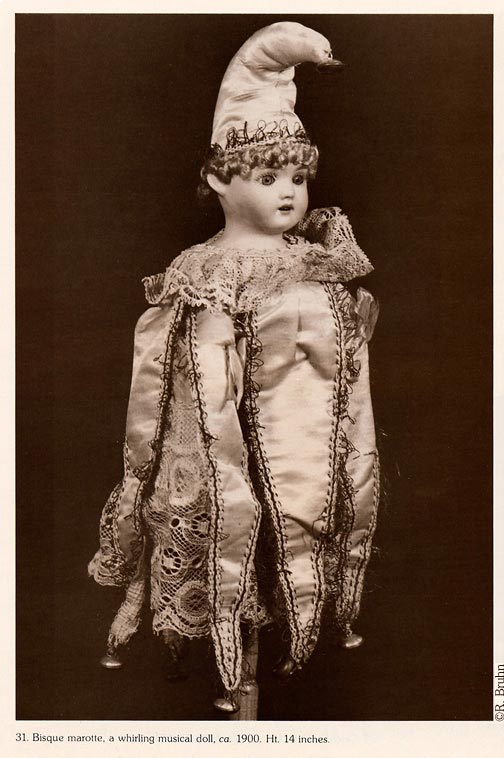
pretty empty
I’ve just sat through my first – and last, ever – Presidential or Vice-Presidential debate. As Barry twittered, immediately after we had together watched a real TV show in real time probably for the first time since 9/11:
I feel I lost IQ points watching that. I hope I get them back. What we call a “debate” is a travesty of that concept.
Two of my own thoughts: I think the Republican “principal” should be watching his back: My headline refers to his “dummy”, but in this country dummies have a history of taking over everything, even supplanting fools.
And after listening to Ms. Palin’s painful memorized deliveries, I never want to hear anyone visit the word “maverick” again. John McCain has only done two “maverick-ish” things in his lifetime: The first was the moment he asserted that he was capable of performing as President of the United States; the second was the moment he decided to tell us that, in a pinch (or something of that sort), Sarah Palin would be able to do the same.
I may be significant of nothing, but does anyone remember the original Ford Maverick, a slightly-gussied-up version of the Falcon, a tired earlier model? I do, for reasons not related to any virtues which might later have been associated with it, sentimentally or otherwise. Let it suffice to say, the Maverick was not a “memorable” car in any sense which could be related to worthiness.
Like the current Republican slate, just lipstick and paint on cheap plastic and rusting tin.
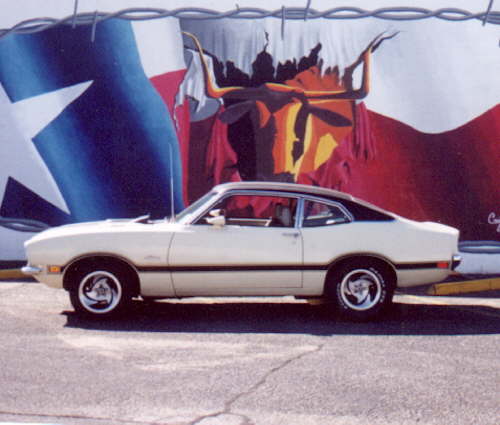
forty years ago a Maverick was merely sort of pathetic
*
the medieval court jester or fool’s own prop-stick fool
[first image, of a century-old bisque marotte, from antiquedolls; the second, of an early-seventies Ford Maverick, from barkbarkwoofwoof]
a guide to “Democracy in America”*
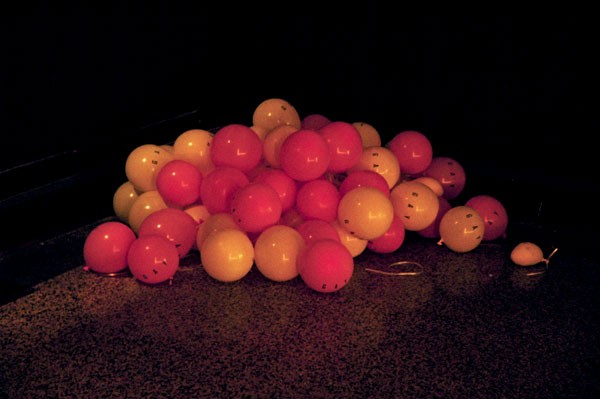
a clutch of some of the pink and yellow [g a y] balloons which accompany Sharon Hayes’s “Revolutionary Love 1 & 2: I Am Your Worst Fear, I Am Your Best Fantasy”, spotted hanging out at the bottom of a dark corner of the hall just outside the room where the sound and video piece is installed
I didn’t have time to do a full post on the show tonight, so I decided that I’d put up just one image and make a very strong recommendation that everyone who can do so make her or his way to the Park Avenue Armory tomorrow (actually that’s today, Saturday) for the last day of Creative Time’s essential contribution to the moment we’re all sharing right now, questioning the idea of “Democracy in America“.
It’s an awesome show, it’s not going to be forgotten, and you know you’re going to want to have been a part of it – especially after the news that an important and not unrelated show at the Chelsea Museum has been [summarily ?] pulled.
*
This headline is the title of the exhibition catalog, edited by its curator, Nato Thompson.