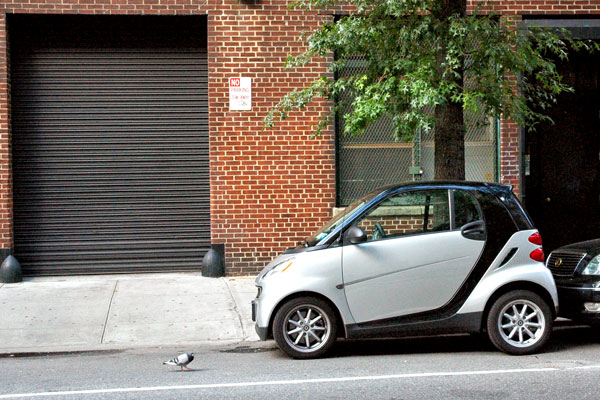
curb cut Smart
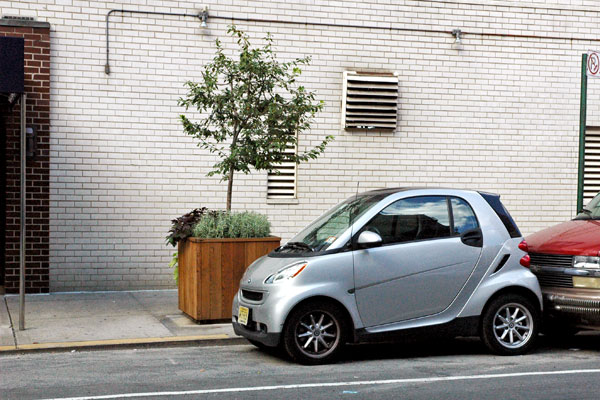
yellow line Smart
I spotted these two Smarts on the same block of West 21st Street this past Tuesday. They were both parked on the north side of the street, the front end of each safely (although barely) behind lines across which they legally cannot venture, back bumpers only a hair away from much larger vehicles parked to the rear.
These shots show that here in New York, and in Europe for ten years now, size really does matter.
Category: Politics
Volksgerichtshof in Guantanamo

Roland Freisler presided over the show trials of another regime
I’ve been buried among memoirs and histories of Nazi Germany lately so the news of today’s verdict by an illegitimate, burlesque* court operating inside a room of an abandoned airport control tower within our remote, bargain-rental military base at Guantanamo Bay brings to my mind the Volksgerichtshof (People’s Court) established by the Nazi regime after the Reichstag fire. That court continued operating (eventually without Freisler, who was killed in an Allied bombing raid February 3, 1945) until the end of its creators’ own gruesome unjustifiable war, initiated several years later.
No, in spite of our government’s attempt to maintain the contrary, including commissioning a special film, this is no Nuremberg trial. Interesting fact: Roland Freisler may have been a screamer and a monster, but at least the Nazis had the courage of their convictions: their show trials were open to the public – and filmed exhaustively.
One more thought: Does it mean anything that after all this time we still don’t even know the name of this dangerous terrorist, the little man from the other side of the world whom the full power of our state condemned today? It’s not in any headline I’ve seen, and you’ll find you have to go well into the first or second paragraph of a news story to find it.
I’m ashamed of my country’s government, and don’t talk to me about our mute Democrats, the frightening-loyal “opposition”. At this moment I see no reason to hope for an end to our fundamentally stupid or simply abominable policies at home or abroad. The patriots of the German Resistance eventually came to understand that only a German defeat could save their country, Europe and the world. It would be good to be able to believe we haven’t gone that far ourselves, but I’m not willing to bet on it right now.
*
The prosecution has announced that even if a defendant ends up acquitted, he (so far they are all men – or boys, at the time they were rounded up) can be thrown right back into a Guantanamo cell or imprisoned in some other rathole which would be equally or even more isolated.
Can we pinpoint the moment when a nation sold its soul?
[image from a currently-inactive site, germanika]


the NYPD’s unlawful war on New York cyclists
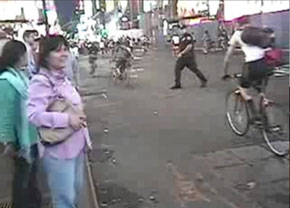
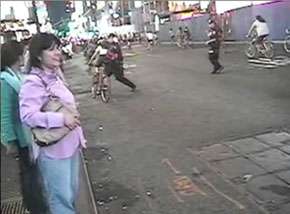
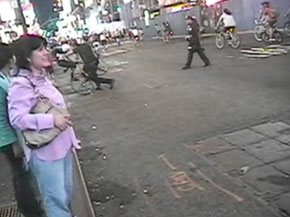
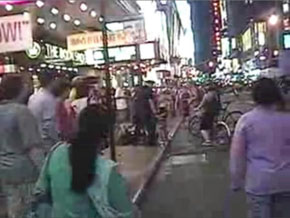
another uniformed thug, saving our streets for cars
Around 9:30 on Friday night, a bicyclist pedaling down Seventh Avenue veered to the left, trying to avoid hitting a police officer who was in the middle of the street.
But the officer, Patrick Pogan, took a few quick steps toward the biker, Christopher Long, braced himself and drove his upper body into Mr. Long.
Officer Pogan, an all-star football player in high school, hit Mr. Long as if he were a halfback running along the sidelines, and sent him flying.
As of Tuesday evening, a videotape of the encounter had been viewed about 400,000 times on YouTube. “I can’t explain why it happened,” Police Commissioner Raymond W. Kelly said on Tuesday. “I have no understanding as to why that would happen.”
These are the first short paragraphs of a longer Jim Dwyer piece, “When Official Truth Collides With Cheap Digital Technology”, published on line by the NYTimes a few hours ago. The site conveniently supplies a side box, a history capsule of some recent arrests in New York City. It focuses on the dramatic discrepancies between police accounts and what was captured by cameras, and there are also links to texts and videos.
New York’s bicyclists have seen the future of the city, and they are already a part of it. Unfortunately the NYPD is operating somewhere in the early twentieth century: They may be our “[girls and] boys in blue”, but when there’s a bicycle in sight they act like Brownshirts.
See video evidence from this past Friday of the latest violent assault in the NYPD’s continuing illegal campaign against bikes here, and for more history, see this video report.
[bystander’s video stills from the New York Post]
loan from Mass Transit account urged for Highway Fund

Are we going to be taken for another ride?
This NYTimes headline and story is of a kind once available only inside The Onion, “America’s finest news source”, but my benighted countrymen have been honing their skills as jokesters lately:
Drop in Miles Driven Is Depleting Highway Fund; Loan From Mass Transit Is Urged
WASHINGTON – Gasoline tax revenue is falling so fast that the federal government may not be able to meet its commitments to states for road projects already under way, the secretary of transportation said Monday.The secretary, Mary E. Peters, said the short-term solution would be for the Highway Trust Fund’s highway account to borrow money from the fund’s mass transit account, a step that would balance the accounts as highway travel declines and use of mass transit increases. Both trends are being driven by the high price of gasoline and diesel fuel.
Money collected by the federal gas tax goes to the Highway Trust Fund. Most of it goes to highway construction and repair, but a very small percentage goes to help fund what we continue to flatter ourselves in calling our “system of public transportation”.
Silly me, that I should have ever thought the Republicans really believed in the beauties of the free market.
[image from ronin691]
Dalai Lama and John McCain
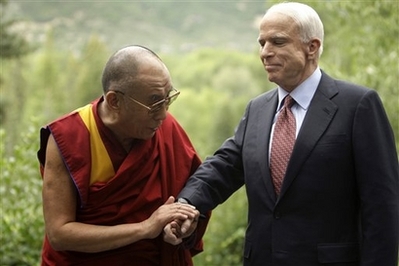
two cult leaders, getting along famously
Why does this photo of McCain’s meeting yesterday with Tenzin Gyatso not surprise me? But then, maybe it really should have surprised me:
“I hate the gooks,” McCain said in 2000. “I will hate them as long as I live.”
This trip down memory lane was brought to us by Eyeteeth.
[image by Carolyn Kaster from AP; and thanks to Barry for the Eyeteeth citation]
“Home Delivery” at MoMA seems to miss the point
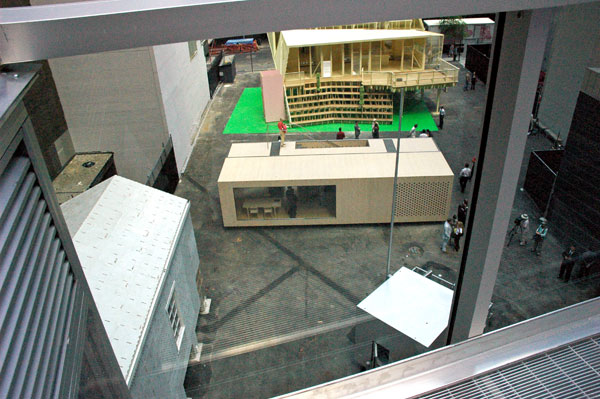
there goes the neighborhood (single-family houses visit midtown)
How many more suburban mini-estates do we really need? How many more can we bear?
It was a long time ago, and the details are a bit hazy, but I’m sure that my first love was the art of architecture and all its wonderful works. I remember the shapes and structural details of every room and every back yard in which I found myself as a very young child, even those I knew when I was barely able to walk, and Frank Lloyd Wright was my first artistic hero (well, I did grow up in the plains of the Midwest).
To this day architecture is second to none among my passions, and it’s a long list.
And so it was that on Tuesday I found myself getting up at the crack of dawn in order not to miss the press preview for the Museum of Modern Art’s new architecture show, “Home Delivery: Fabricating the Modern Dwelling”. In truth, Barry and I got there just after 11:30, but that’s an exceptionally early hour for either of us to be abroad, and we were just in time to hear the group addressed by Barry Bergdoll, the museum’s new Chief Curator of Architecture and Design. I had already noted his intriguing bio, and that was another incentive to make it up to 53rd Street that morning.
The show is fascinating, at least as much for a historical survey as for a review of the latest innovations. On Tuesday we were whisked out by one o’clock. There was hardly enough time to learn more than that I have to go back for more; this post isn’t a review, by any means. I was also excited enough about the show to buy the catalog on my way out, and I already know that it’s going to make me want to know more.
But I confess to one serious misgiving about the show.
In a world whose population is exploding, whose natural environment is threatened and whose resources are diminishing (including especially the resources which have supported cheap transportation of all forms), it would seem to me that if a modern museum’s show about architecture is focused almost entirely on free-standing private dwelling units, regardless of all the sexy bits about computer design, pre- or modularly-fabricated structures, and revolutionary ecological breakthroughs, it is at least half-dead in the water already and unlikely to be remembered as a landmark achievement by any future generation.
The American model of single-family homes, occupying plots of land preferably as large and as isolated as possible, is an exception elsewhere in the world, and it is about to become obsolete here as well. This ideal could only have been realized on a rich underpopulated continent. This bountiful wilderness was “tamed” by people who had learned everything they would need to know to satisfy their remarkable misanthropic compulsions from the genius generated by the far more amalgamated civilizations, mostly of Europe and Asia, from which they had fled.
To this day the average American disdains apartment living and in fact virtually any kind of shared space. We don’t really like each other very much. We don’t like living near other people and we don’t like traveling with them either. We must have our own houses and our own cars; except for those of us who already live with and thrive with them, we almost universally loathe the idea of apartment buildings and all forms of public transportation. Most of us don’t even want to share a free-standing house (regardless of how large it is and how big the home spread) with relatives not part of our own nuclear family, and even within these families we insist on having our own separate rooms; we also want our own cars, beginning at age 16, and until now these vehicles had to be big (trucks, really) even if we didn’t intend to take anyone else along for the ride. We basically want to be alone, and in both our hankering and the reality we’ve achieved, we really are alone.
We deserve to be by ourselves and we can afford it, or so most of us have been thinking until at least recently.
With its new architectural design show, “Home Delivery”, MoMA seems to have received the wrong delivery, since in spite of the fascination of both its subject and the attractions of its installations, its fundamental focus on the single-family dwelling is the same as that identified with the mid-century modern age which produced many of the historical projects to which it gives homage. For New York it was an age dominated in popular projects by the problematic vision of Robert Moses, and we know now that the salad days of the profligate suburban American “ranch” (in whatever style or pastiche) are finally over, everywhere.
Five temporary, very different “model homes” have been erected on a vacant lot just west of the museum; while each of them is a delight to read about and explore, only a single structure (with the possibility of one other) has been designed so it could be a part of a multiple-dwelling structure.
Frank Lloyd Wright didn’t have any use for apartment living either, but in fairness I would say that when he was born in 1867 there was still a real American frontier and both Europeans and Americans were marveling, even then sometimes in very different ways, at what seemed to be the unlimited possibilities of an industrial age. Also, in the mid-nineteenth century the world’s population was only about one sixth that of today’s figure of 6.7 billion, and the projection for 2050 is for close to ten billion. If we haven’t learned to live in sophisticated multiple dwellings by then, those who have somehow managed to survive are likely to be sheltering inside mud huts.
ADDENDUM: I may be reading too much into its significance, but the architects involved in the design of the full-scale, free-standing houses are almost all Americans.
Except for the special case of the very cool “micro compact home” of Horden Cherry Lee Architects/ Haack + H�pfner Architects (U.K. and Germany), and the elegant and very flexible solution called System3 by Oskar Leo Kaufmann and Albert R�f (Austria), all of the projects in MoMA’s vacant lot were by architects who appear to be based in the U.S.
The office of Kaufman and R�f is located in the pretty Voralberg town of Dornbirn, in the center of an Alpine province not known for population density.
Construction geeks of all kinds will want to watch the stop-time video I just came across on Treehugger showing the assembly of System3 inside MoMA’s back yard. The “module” arrived on 54th Street in a single Hapag-LLoyd shipping container and was assembled in one long morning.
Obama really gets ‘religious’ – but we’ll pay for it
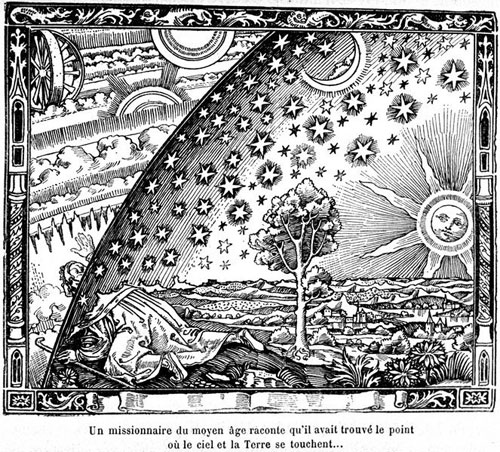
Barack Obama plans to expand Bush’s “faith-based” initiative.
That just about does it for me. The flag pin he decided to add to his lapel should have been a warning, but I really found myself distanced from the man after enduring his “adjustments” on fundamental issues like gun control, government surveillance, trade policy, and getting us out of Iraq. Now I’m also supposed to go along with his call for escalating the government’s financial support (my taxes included) for the most powerful institutions of superstition, obscurantism, prejudice and hate in the nation.
Haven’t we and the world already paid far too much for the mistake of giving religion the free pass it enjoys now (and I’m not referring only to its tax-free status)? If organized religion were capable of benignly and impartially ministering to the welfare of everyone we wouldn’t have had to invent government. And if religion could possibly be described as fundamentally caring and nonpartisan, there’d be only one of them out there.
Obama still has four months to continue turning off many of his most enthusiastic supporters. Does he think the big money he will attract by doing so will smell better than the mites coming from those with little to spare? Does he actually believe in the junk positions he’s assuming, or does he do it because he has to do in order to get elected? Either way, I wouldn’t hold my breath waiting for any president to move to the left once she or he slithers into the Oval Office. The creditors wouldn’t stand for it.
I should pay more attention to what I’ve already written: We really do have only one political party.
George Carlin was right.
ADDENDUM: This excerpt is from a post by Huffington Post blogger Barry W. Lynn, an ordained minister and Executive Director of Americans United for Separation of Church and State:
The problem with the faith-based initiative is that it’s a euphemism. We used to call such things “taxpayer-supported religion.” Of course, no one would support it if it were called that. After all, the idea of taxing people to pay for religion is scary. It’s what got folks so riled up back in the colonial period. No one wanted to pay taxes to support some other person’s religion.
No one wants to pay them today, either. Yet increasingly we are being asked to do so. Eager to appear faith friendly, candidates in both parties are increasingly upping the ante for how much they plan to dole out to religion if elected.
[image from Steve Kemple]
for her grace on this day: hip, hip, hooray!
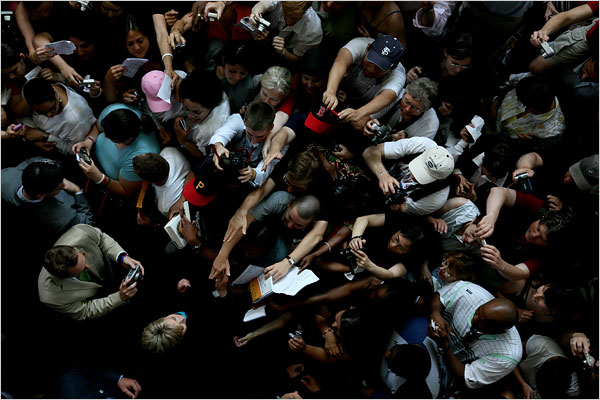
Clinton being greeted by supporters invited from across the country to attend her speech today
From the NYTimes on-line report on Hillary Rodham Clinton speaking this afternoon in Washington, only blocks from the White House:
“You can be so proud that, from now on, it will be unremarkable for a woman to win primary state victories, unremarkable to have a woman in a close race to be our nominee, unremarkable to think that a woman can be the president of the United States,” she said. “To those who are disappointed that we couldn’t go all of the way, especially the young people who put so much into this campaign, it would break my heart if, in falling short of my goal, I in any way discouraged any of you from pursuing yours.”
At that point the cheers, mostly from women, swelled so loud that Mrs. Clinton’s remaining words could not be heard.
[image by Todd Heisler for the NYTimes]
real terrorists don’t photograph anything
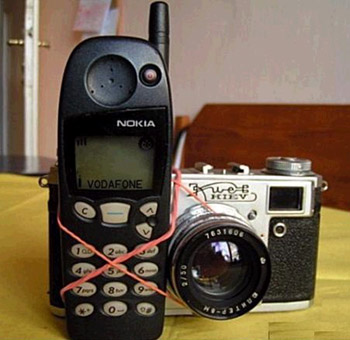
really scary
Why is everybody so afraid of my camera and your camera, even though they all own at least one themselves, and sometimes these same people are the ones spending fortunes installing security cameras to watch us?
I saw this Guardian piece in a Bloggy “linkage” post which appeared yesterday. The paper had published it the day before that. It’s too good, and far too important not to share. And don’t miss some of the links in the second paragraph.
It’s written by Bruce Schneier, an internationally-known security expert and currently British Telecom’s chief security technology officer.
Here’s a tiny excerpt:
Given that real terrorists, and even wannabe terrorists, don’t seem to photograph anything, why is it such pervasive conventional wisdom that terrorists photograph their targets? Why are our fears so great that we have no choice but to be suspicious of any photographer?
Because it’s a movie-plot threat.
[delightful image created by bloganything]
Hillary’s still thinking it over
Will someone please explain to me why it’s going to take the better part of a week for someone to respond to their own colleague’s selection as the candidate to oppose so monstrous an alternative as the man who represents the people who control the party which has virtually destroyed our polity?