selling off the High Line to developers – no, really!

Denari_hl23.jpg
fourteen floors, most of them condos, to be built on top of our park

I admit that I’ve known about this building for some time. I’ve been quietly fuming about it (something I don’t do often – the quietly part, that is) for perhaps a year; it’s just that getting an email from the developers boasting essentially about how clever they are to have arranged this public scam put me over the top.
This isn’t the first instance in which the city has sold a part of the High Line to developers, and it may not be the worst, but it’s just about the most egregious.
Has New York been able to reverse nature’s own law, that plants need sun, even in parks? And, more importantly, are we going to have parks in this city or are we just going to have developers’ opportunities?
This text is copied directly from the press release I received today:

Denari’s HL23 will rise fourteen stories from a singularly challenging site: a 40-foot wide footprint located at 515-517 West 33rd Street, just steps from Tenth Avenue and half covered by the High Line, the historic elevated railway bed slated for transformation into one of the nation’s most lyrical urban parks. Overcoming this through-block site’s inherited restrictions while exploiting them with boldness [and the power of money and influence], Denari has conceived a building that will dramatically increase in size as it rises from its slender footing to cantilever gracefully over the rails. Made possible by a Special Authorization, comprising of seven waivers granted by the New York City Department of City Planning [my emphasis] in support of the building’s unique contribution to the cityscape, HL23’s reverse-tapering form [absolutely the reverse of New York’s historical and progressive setback zoning] will make it a local landmark while creating cinematic views and unrivaled intimacy with the High Line for residents inside.

Why not call it the Highline Tunnel? Construction is supposed to begin in a few days.

CORRECTION: I originally described it as a thirteen-story building in this post, but apparently a penthouse will comprise a fourteenth floor.

[image from triplemint]

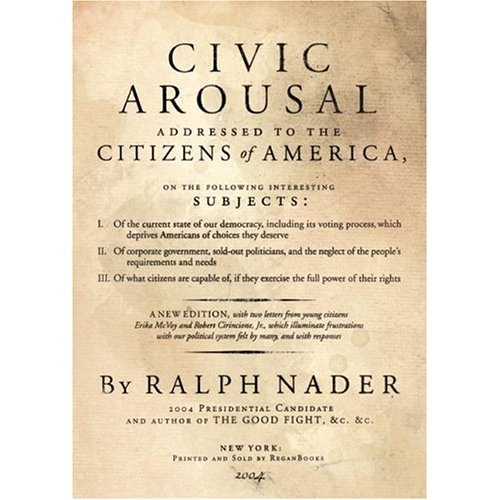
Nader’s candidacy: we should expect nothing less of him

Ralph_Nader_Civic_Arousal.jpg
Common Sense, so uncommon today

The candidate is a brilliant man of the highest integrity. He is generous, dedicated public servant responsible for world-altering reforms which have saved, literally, countless lives. In the words of one of his published critics:

More than any other single person, Ralph Nader is responsible for the existence of automobiles that have seat belts, padded dashboards, air bags, non-impaling steering columns, and gas tanks that don’t readily explode when the car gets rear-ended. He is therefore responsible for the existence of some millions of drivers and passengers who would otherwise be dead. Because of Nader, baby foods are no longer spiked with MSG, kids’ pajamas no longer catch fire, tap water is safer to drink than it used to be, diseased meat can no longer be sold with impunity, and dental patients getting their teeth x-rayed wear lead aprons to protect their bodies from dangerous zaps. It is Nader’s doing, more than anyone else’s, that the federal bureaucracy includes an Environmental Protection Agency, an Occupational Safety and Health Administration, and a Consumer Product Safety Commission, all of which have done valuable work in the past and, with luck, may be allowed to do such work again someday. He is the man to thank for the fact that the Freedom of Information Act is a powerful instrument of democratic transparency and accountability. He is the founder of an amazing array of agile, sharp-elbowed research and lobbying organizations that have prodded governments at all levels toward constructive action in areas ranging from insurance rates to nuclear safety. He had help, of course, from his young “raiders,” from congressional staffers and their bosses, from citizens, and even from the odd President. But he was the prime mover. – Hendrik Hertzberg, in The New Yorker, March, 2004

He is a highly-educated man. His first languages are Arabic and English, and he later acquired Chinese, Russian, Spanish, and Portuguese. He is a crusading attorney, a prolific writer, and he tirelessly delivers speeches with an energy, eloquence and control equal to that of the best nineteenth-century orators. His entire life has been dedicated to public service. An enormously important social critic, but a very private man, he hasn’t been content with the role of intellectual gadfly. Instead he has moved into the more dangerous stage of a personal political activism, most dramatically (but gently) regularly entering himself as a candidate for the Presidency since 1992.
He has been absolutely correct on every issue with which his candidacy has been associated, but the fundamental issue which underlay everything he stood for in each of these elections and which underlies it today is the most important of all: The stranglehold of corporate power over the nation’s political institutions and the economy. Nader is properly disgusted with the Republicans and Democrats equally on this issue.
No other candidate, compromised as they are, can or will ever address this problem, but until it is addressed and resolved there will be no real change, This is the strength of the argument and the campaign identified with a man who, remarkable as it may be, seems to have no personal ambitions for political office.
But so many reject him at the polls, even though they must know he is absolutely right.
My countrymen vote over and over again for far lesser candidates, but for many blind partisans it isn’t enough to simply refuse to support the man and his principles. Nader has to be wiped off the ballot so that no one else can vote for him. The man has to be eliminated from the scene altogether, and this must be done with a venom and an implied violence that often surpasses that directed at Bush and the Republicans who created him.
Yesterday a friend of mine sent an email around to a number of people he knew bearing the subject line, “stop him before he kills again”. It was basically a short note with a hysterical warning about the old bugbear of a Ralph Nader candidacy. There was a link to a story speculating about the former candidate’s plans.
I have no idea where this rabid nonsense comes from about Nader being responsible for all of our travails since the coup which brought us a Bush presidency, but it reminds me of the continuing popularity of the myth which would have Saddam Hussein responsible for 9/11.
I had first replied to my friend that Nader never was the problem, is not now and will not be the problem should he decide to run again. I had been most upset about the email’s call, “stop him before he kills again”. I asked what that was supposed to mean, and suggested that everyone has the right to run for office. I couldn’t help adding that this should be especially important if she or he is right, unlike the competition anointed by the corporations, party bosses and the media.
His response was that “flighty principles” have to be thrown aside and that pragmatism is now the order of the day. He also referred to a comment from a friend of his who suggested that a vote for Nader was a “self-satisfying” act at a time when the Bush menace threatened and that “pragmatism” was now the order of the day.
I couldn’t simply go back to him with another reply; I was spending too much time on the subject to keep it just between the two of us. Like any good blogger, I decided to do a post instead.
Let me say first that I don’t vote in a way to show or feel that I’m right. My votes are never “self-satisfying”. In fact, if I wanted to satisfy myself I’d vote Republican or not at all (the former in the interest of my pocket, the latter in order to accept the basic lie of our system and for my peace of mind).
Politics really are an almost full-time occupation for me, and they’ve been so at least since I sort of campaigned for Dewey in 1948 [yeah, but I’ve gotten smarter, and my parents can’t influence me now], yet I leave the strategizing and maneuvering up to the politicos. It’s the strategizing and maneuvering that produces the abominations which occupy (and always occupy) the highest offices in the nation. It’s the strategizing and maneuvering that gives do-nothing Congresses and play-it-safe presidents. It’s the strategizing and maneuvering that arranges things so that the professional politician’s own special, vetted confederate gets in.
Am I the only one bothered by the fact that American political life has almost nothing to do with “policy” [def. “a course or principle of action adopted or proposed by a government, party, business, or individual”]?
Electoral politics are not a “game” for me, although most Americans seem to see it that way, and the American media definitely plays it that way. Sadly however, the game approach may in fact make a lot of sense, since what we continue to refer to as “politics”, in this country, are not the politics of a free and democratic society. The system has always been in the hands of the powerful. Originally that meant powerful, wealthy individuals, but in the nineteenth century it came to mean powerful corporations, and the Supreme Court certified that development. Our Congress, our Executive Branch and our Supreme Court are all the product of collaborating or competing corporate interests; everything is arranged for profit. The policies you or I vote for are the policies of the candidates and office holders only if they are the policies of the corporations which created them.
Nader has been the only modern candidate for the office of President who has ever told the truth about corporate ownership of Congress and the White House and he has founded his candidacy on a fundamental change in the system. Kucinich has been almost equal to Nader in his dedication to a cause which should be the priority of every citizen. I have voted for both men, whenever I have had the opportunity and with the best conscience. It doesn’t “satisfy” me to do so, because I’ve known each time I did so that the corporations and the media were ensuring that what my candidate stood for would remain invisible to the voters who most need them and who would gain the most from their election.
In a 2004 post I quoted a letter to the NYTimes by Alexi Arango which I thought perfectly explains what drives Nader’s repeated candidacies:

Ralph Nader’s central thesis is that corporate influence on lawmakers is a greater danger to democracy than even a Bush presidency. In this context, Mr. Nader’s run for president is easier to understand.

Nader has never killed anyone, and he’s not going to start now. He runs for office because the Democrats have totally abandoned what they represent they stand for, but he runs for office above all because the party (including both Clinton and Obama) is in the pay of the corporations. In fact in a very real sense today we all live in “the company town”. You may think these are desperate times which demand that I and every other voter, even the smart ones, dance with the big donkey, but I think the times are more desperate than most people realize and I know that nothing will change if we continue to accept the lie about our electoral freedom. It’s the Democrats who threw away the 2000 election, and every election since, including the Congressional elections. By now we have no excuse for not knowing how or why.
It’s up to the Democrats to defeat or overcome a Nader candidacy by making it unnecessary or redundant. To decide to change nothing, but to demand that his candidacy and that of any other true reformer be prevented so that we might get more of nothing (Democratic “winners” forever and ever stuffed into corporate pockets) is simply to assume an absurd position, not a pragmatic position.
Looking at what the Democrats have been saying and doing about domestic and foreign policy for almost two decades, even now with a Democratic Congress, can we blame Nader’s 2000 run for the way the Democrats have behaved since then?
It’s Nader who is the patriot.
When I was very young, like everyone else of my generation, I was told that any American could grow up and run for President. Nobody said, “. . . except for the best ones”.

ADDENDUM: For what I will call the definitive statement on the significance of Nader’s candidacy, read John Nichol’s piece on CommonDreams.

[image from Amazon.com]

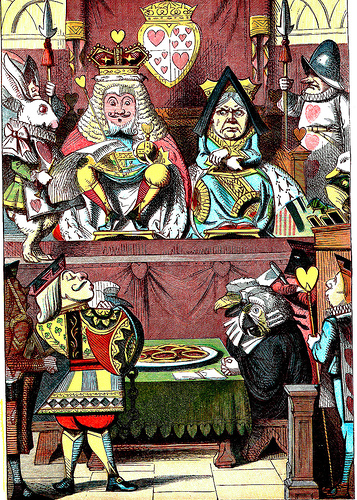
“No, no! Sentence first – verdict afterwards”

Alice_trial.jpg
Alice begins to doubt that justice really will be done.

And still they don’t get it.
I’m having trouble enough sleeping at night, thinking about the horrors routinely executed in our name around the world, but this headline to an AP story I saw on line last night looked particularly alarming:

Executions May Be Carried Out at Gitmo

Lewis Carroll is alive and well in America today; it’s just too bad for the knaves that not enough people are noticing.

[image from storynory]

“They hate our freedoms”

wiretapping.jpg
the enemy is us

“They hate our freedoms” [from Bush’s 2002 State of the Union address]

But just yesterday:

WASHINGTON (Reuters) – The U.S. Senate overwhelmingly passed a bill on Tuesday granting retroactive immunity from lawsuits to telecommunications companies that took part in President George W. Bush’s warrantless eavesdropping program.
[The bill would replace a 15-day extension of a surveillance law which expires this week, a law whose provisions for the protection of privacy and personal freedoms the Bush administration and the companies have repeatedly, and avowedly, violated.]
The 1978 Foreign Intelligence Surveillance Act (FISA) requires that the government receive the approval of a secret FISA court to conduct surveillance in the United States of suspected foreign enemy targets.
But after September 11, Bush authorized warrantless surveillance of communications between people in the United States and others overseas if one had suspected terrorist ties [although in fact we do not know the full extent of the warrantless wiretapping program, or the extent to which FISA has been violated].

[image from ABC news]

yes, of course we torture

Waterboarding-Definition-Wikipedia24dec05a.jpg

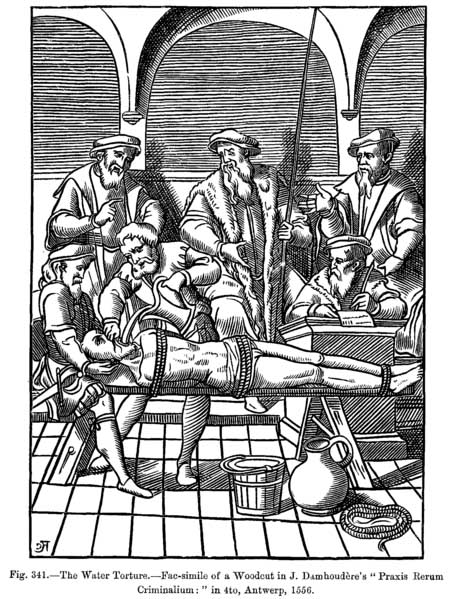
We do torture. The whole world knows it, and even in the land of the brave and the free and the righteous none of us needed to wait for the U.N. High Commissioner for Human Rights or anyone anyone else to tell us what we all know already.

Waterboarding should be prosecuted as torture: U.N.
MEXICO CITY (Reuters) – The controversial interrogation technique known as waterboarding and used by the United States qualifies as torture, the U.N. human rights chief said on Friday.

Why do we do torture? Because we want to, and because we can. And by the way, ordinary Americans have repeatedly shown they’re okay with it, or it wouldn’t continue today.

[image from Wikipedia via mindfully.org]

Guantanamo: is there no limit to the obscenities?

Guantanamo.jpg
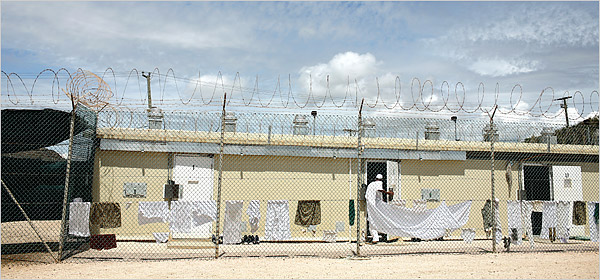
a view of the camp we’ve known about for six years, not the secret one

Really?!!!
We learn tonight that the regime in Washington has been maintaining a separate concentrated concentration camp totally hidden inside the Guantanamo camp we already knew about, a concentration camp which had already been created and maintained, with the explicit or tacit support and approval of members of both parties, outside of any legal system existing anywhere on the planet.
Even now, a year and a half after the last Congressional election, the Democratic majority hasn’t been able to bring itself to talk about even the original camp. Please tell me once gain about the genius of the vaunted two-party system which is supposed to promote liberty and justice for all.

[image by Carlotta Gall and Andy Worthington from the NYTimes]

a dream of Obama

maybe making a world of difference, and one of correspondence as well
Obama_supporters.jpg
If the candidates could not be everywhere on Sunday, their allies could try. Gloria Walsh, center, a retired schoolteacher, paused to campaign for Barack Obama in Harlem, with Cordell Cleare and Mrs. Walsh’s granddaughter, Haja Barfield, 3. [NYTimes caption]

A lot of us will be voting in primaries tomorrow. Maybe that calls for a whoopee, maybe not.
For many of us there’s nobody now running for president with whose political positions we have much genuine affinity. I admit this is nothing new in my case, but in a nation as materially-blessed as this one I have no problem laying the blame on an absurdly-frightened, ultra-conservative population rather than my own Leftist soul.
Still, I can’t quite bring myself to stay out of the discussion, at least not yet. There is not enought of a distinction between the expressed positions of Hillary Rodham Clinton and Barak Obama to make a rational choice, and even after all of our exposure to their separate personalities, while I know who I might “like” more, I don’t pretend to know what kind of a president either might be as an individual. But there’s something else going on here.
For me a vote for Obama is not really a rational choice; it’s a vote for a dream, a dream which can be shared by people who can make a difference, and they may just do so. That’s all I can expect of my mark this time, but it may turn out to be a lot. I think we have to go with the dream, since the disastrous wounds we have suffered over the last seven years make it clear that triangulation and incrementalism will not be enough to save the country. If it takes a dream to awaken a much-abused (and self-abused) citizenry, then I can try to be a dreamer one more time.
But in the end we are the ones who will have to do the work; the dream and the man can only inspire, perhaps to things not yet imagined by either.

Oh yes, there are also these four not-insignificant points, arguing against a Clinton candidacy, outlined yesterday by Bloggy. They fester somewhere between the categories of “positions” and “personalities” to which I referred above.

[image by Ozier Muhammad for the NYTimes]

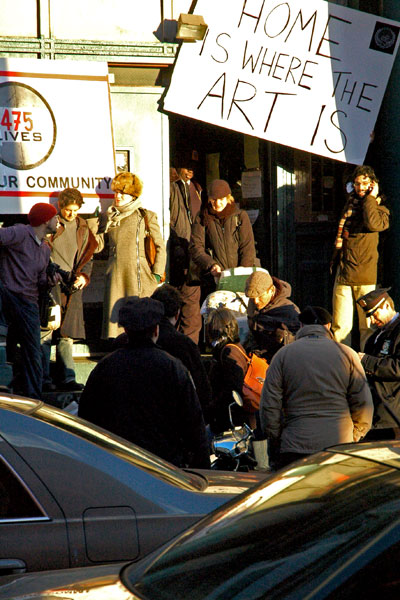
475 Kent: the insanity of New York housing policy

475Kent_INHUMAN.jpg
a silent cry from a witness across the street two days ago

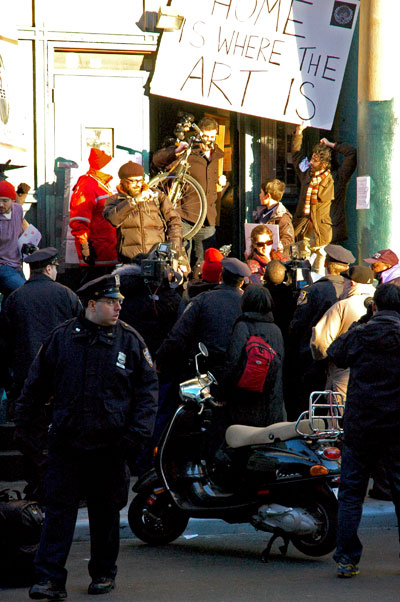
Whatever the bureaucratic, commercial or political story which lies behind the human tragedy of New York City’s dreadful and totally irresponsible eviction of over 200 men, women, children and their pets from their homes in the darkness nine days ago on one of the coldest nights of the year, if this doesn’t radicalize New Yorkers, we deserve whatever we get.
But there is no acceptable outcome to this particular tale other than the quick return of these people and a proper accounting of the official malfeasance which resulted in their removal in the first place.
Bloomberg, Markowitz, Quinn, anybody out there? We do note that that very decent local member of the City Council, David Yassky, has been with this story from the beginning, was at the scene on Sunday, and appears to be very supportive of the vibrant and creative community which has lived and worked inside this massive, 11-story Williamsburg building block for ten years.
For more on the story of 475 Kent, see Bloggy and any number of other on-line sites.
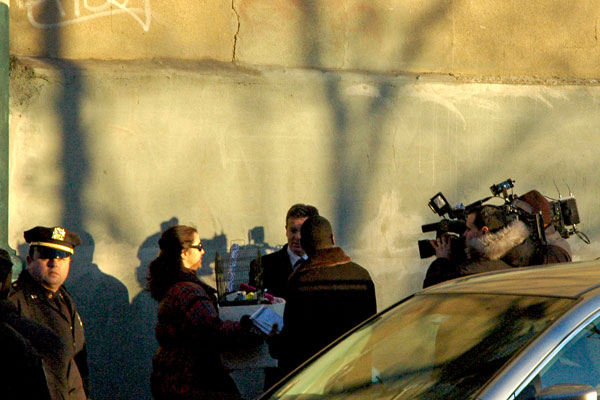
The images below were taken this past Sunday night. They show tenants retrieving their possessions (boxes, art, bicycles, baby carriages, parakeets, etc.) in the last moments before the building was finally padlocked, for a painfully-indefinite period. A large crowd gathered across the street in the bitter cold to observe the sad scene.
If you go to Barry’s flickr images, note the Police van parked on the sidewalk adjacent to the large crowd which was repeatedly pushed back from the parking lane onto that part of the sidewalk not occupied by an NYPD vehicle.

475Kent_bicycle.jpg
475Kent_birds.jpg
475Kent_baby_carriage.jpg

Israel’s civilian blockade war crime creates panic in Gaza

Gaza2.JPG
desperate people

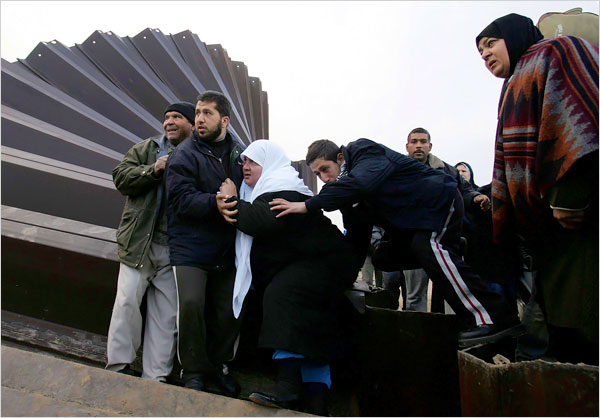
Israel’s blockade of Gaza is a war crime*, but the world will not say so.
Desperate Gazans themselves spoke out today when they blew up the wall separating them from Egypt. Tens of thousands have crossed the normally-sealed border to obtain both critical and ordinary supplies unavailable at home.
Much of the beleaguered territory’s 1.5 million residents have faced critical shortages of electricity, fuel, food, medicine and other supplies for months, but in the last week the closure has been tightened dramatically by Tel Aviv.
But we all knew this already, didn’t we? So . . . .

*
Article 54 of the additional protocol of the 1949 Geneva Conventions states that starvation of civilians as a method of warfare is prohibited, and that it is also prohibited to attack, destroy, remove or render useless objects indispensable to the survival of the civilian population, “whatever the motive”.

[image by Abid Katib from Getty Images via NYTimes]

Ingar Krauss at Marvelli

Krauss_Ingar_Beelitz.jpg
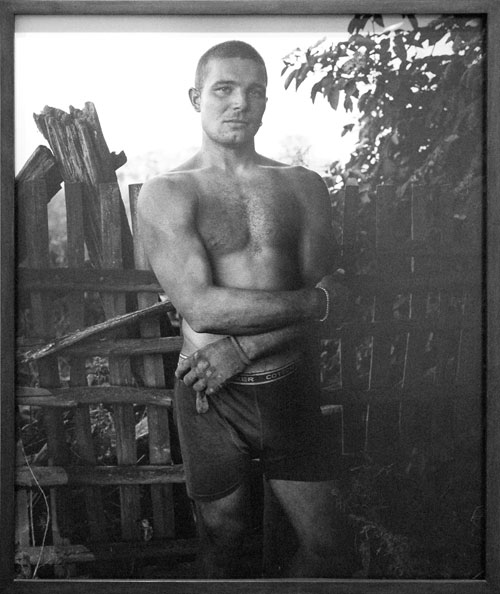
Ingar Krauss Untitled (Beelitz) 2006 gelatin silver print 40″x 33″ [installation view]


Every year thousands of harvest hands come and go like birds of passage.
*

Indulge me on this one, as I really wanted to upload this image. No, on second thought, I’d rather bring you with me, and try to explain why I’m so taken with it and all the the others in Ingar Krauss‘s current show at Marvelli Gallery, titled “Birds of Passage”.
Yes, the man is beautiful. In fact he’s very sexy. The very direct, black and white photograph looks like it has the special legitimacy this medium sometimes acquires with age, although the modern knit boxers reveal that the artist is not trying to deceive us on that account.
But there is much more to see here than the man’s own sad beauty and the beauty of the Brandenburg landscape which Krauss has gently draped around his shoulders and around those of most of the other eight men in these portraits. Every one of his workers, photographed here at the end of a long day, is distinctly beautiful. The range of their ages spans every one of the decades in which a fortunate man might expect to enjoy robust life, although several of them would not normally be described as particularly sturdy.
The gallery’s notes tell us that women, and sometimes entire families, are also a part of this seasonal worker migration, but here we see only men, and I suspect that males overwhelmingly dominate the numbers of these seasonal hands. Even the sad subjects of Dorothea Lange‘s documents weren’t usually fighting to survive alone in a foreign land.
Krauss makes me envious of the Germans, and happy for their guests. We need the artistry of a Krauss or a Lange here in the U.S. today, to show us the guest workers on whom we depend so much, visitors both documented and not. This show is a reminder of how much could be done, and what it might mean to us all.
Neither the aesthetic nor the storytelling in work like this can be isolated from the complex history and the simple beauty of the specific environment in which these pictures were captured, in Krauss’s case the underpopulated farms of the former Democratic Republic of Germany, or DDR. It’s also hard to ignore the combinations of personal tragedies and personal hopes contained in the situations in which these migrant Eastern European farm laborers have placed themselves.
There is also tragedy on a larger scale, but a larger hope as well. Even to someone like myself, with a long experience of Germans and Germany, these people look very German. I think about that because it’s likely that no one they are near thinks of them in that way. I’m pretty sure they wouldn’t think of themselves in that way either. And yet here they’re laboring in Germany for long hours on someone else’s land in an alien environment, struggling with an overseer’s foreign tongue in large richly-tilled fields which were once held in common by the socialist brothers and sisters of their own Polish, Russian, Ukrainian or other communities. Will they become Germans some day, or become the proud and prosperous brothers and sisters of Germans, as part of a larger, flourishing European community?
Well, I just wanted to say that I found it pretty tough to walk away from this show, both literally and figuratively. Thus this post.
The show has now been extended until February 2.
Oh, I almost forgot. I’ve seen and admired Krauss’s work at least once before, in a stunning, but heartbreaking show, “In a Russian Juvenile Prison“, mounted in the same gallery in October, 2004.
For more on the current show, see Vince Aletti writing in The New Yorker.

*
from the gallery press release