“superdelegates” betray Democrats’ claims of democracy

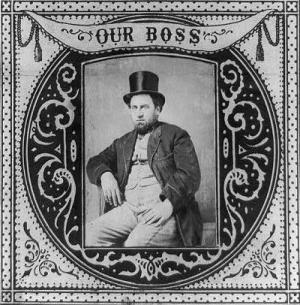
Boss_tweed.jpg
(he’s been split up, and works a little more subtly today)

I was originally just going to make this a comment on an earlier post of mine, but when I realized that if I did so I’d be directly following one of my own I decided to make it a post instead. Besides, this gives it much more visibility, and I suspect what I learned last night will be news to many.
When I saw this statement inside an on-line NYTimes story last night I couldn’t help thinking of a comment from one of my readers to the post in which I touched on the peculiarities of what we choose to call our democratic way:

In the overall race for the nomination, [after the New Hampshire primary] Clinton leads with 187 delegates, including separately chosen party and elected officials known as superdelegates. She is followed by Obama with 89 delegates and Edwards with 50.

“Superdelegates”? By my accounting, Obama should still be ahead of Clinton, having clearly exceeded her number of delegates in Iowa. I quickly checked my handy Wikipedia, and found that the system which established superdelegates was a response to a 1970’s change in the Democratic Party nomination process. Control had been taken out of the hands of party officials and entrusted to the more democratic (small “d”) primary and caucus formats, but the traditional smoke-filled rooms survived, albeit in diminished form. The bosses quicky arranged for the creation of a class of delegates to the presidential nominating convention, made up of elected officeholders and party officials, which was not to be bound by the democratic decisions made by primaries or public caucuses. Superdelegates comprise approximately one fifth of the delegates/votes in the national convention.
My commenter of last week argues for the democratic virtues of the American system, saying that in the “European system”, rather than go through what I might represent as an absurdly drawn-out presidential campaign and a motley series of public primaries,

The parties decide internally who will fill posts, and these decisions are made outside of the process of the election cycle, which is why the cycle runs only 6 weeks. They spend much longer posturing internally, outside of the public eye. Does that sound more democratic?

I would answer that the comparison isn’t so simple as that which he outlines, and considering the incredible mess we have made of the tools of democracy which we have inherited, he may even be asking the wrong question.
There are many more important reasons why the American electoral system fails the democratic test, so I won’t make too much of the impact of superdelegates, but being aware at least of their existence is one more small step toward dismantling the edifice of an unbearably selfish and destructive American exceptionalism.

[image of Boss Tweed, on an 1869 tobacco label, from Wikipedia]

“American Primary System Fails to Impress Europeans”

Duh.
Deutsche Welle, the English language on-line news site, reports that intelligent Europeans who study our political system essentially think the way we select candidates for office is, well, nuts.

National elections in Europe often last only six weeks and campaigns are publicly financed. That makes the details of the United States’ prolonged primary season, the winner-takes-all Electoral College and campaign financing groups particularly murky waters for Europeans.
“Quite frankly the American democratic system is atavistic,” said Frank Unger, an expert on US politics and a professor at the John F. Kennedy Institute, which is part of the Freie University in Berlin. “It’s outdated. It doesn’t really reflect democracy in a modern sense.”

I think he’s being kind.

big-money.jpg

[image from blog.kir]

GUANTANAMO DELENDA EST!

Guantanamo_saffron.jpg

Out of sight and out of mind. Our concentration camp in Guantanamo is still off the chart (literally); missing from the Democratic Congressional agenda; “not present” in presidential campaign rhetoric; and, most frighteningly and damningly of all, it still appears to have completely escaped our national conscience.

[fabric color swatch, otherwise unrelated to Guantanamo, from froggtoggs]

the obscenity of organized hate under cover of religion

girl_wounded_in_Iraq.jpg
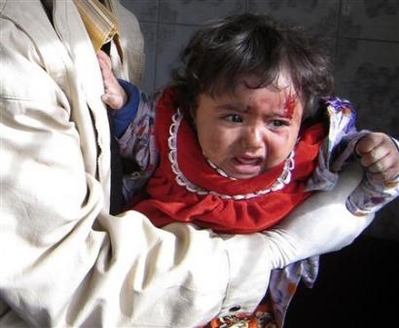
A girl, who was wounded in a bomb attack, receives treatment in a hospital in Baquba, 65 km (40 miles) northeast of Baghdad, December 25, 2007. U.S. forces killed two gunmen and detained four others in operation near Baquba, the U.S. military said. Hours later, a suicide bomber killed four people and wounded 21 at the funeral of the two men who were killed by the Americans, police said.

I’m not feeling good about religion today, any religion, but nothing new there.
I’m listening to a magnificent recording of Handel’s “Messiah” (the music, the music). I’d just read the CD liner notes which refer to Handel’s beneficences to the children’s home, London’s Foundling Hospital, which has been associated with his oratorio since 1750. Then I opened my computer to the news stories on my home page. The lead item from Reuters cried out with the image and caption at the top of this post.
There are no words for this obscenity.

[image and caption from an unidentified stringer working with Reuters]

Reverend Billy free this time, but the assaults never stop

free_speech.jpg
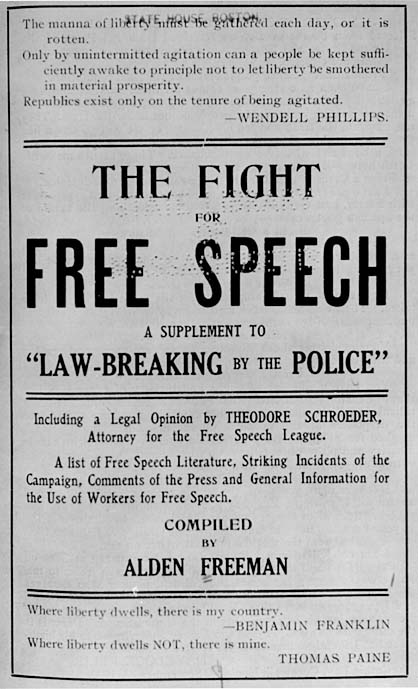
cover of a 1909 pamphlet created to protect the right of free speech at a time Emma Goldman was being prevented from speaking

How often does the NYPD have to be reminded about the First Amendment?
Two days ago all charges which the police had brought against the Reverend Billy for reciting the First Amendment to officers harassing Critical Mass cyclists in Union Square on June 29th were dropped.
New York’s guardians of [certain kinds of] law and order have once again failed to have their behavior upheld by the courts. Fortunately this time it was not the soft tissue of a citizen victim that bore the injury, but the tissue of the civil liberties each one of us shares. The escalating, accumulative record of police misconduct like this, regularly authorized and protected by Departmental and civilian municipal authorities, assaults our Constitutional protections and it may some day effect a mortal wound.
The NYTimes article by Anemona Hartocollis barely hints at what should have been a huge embarassment for the arresting officers and those who had handed them their assignment:

The Manhattan district attorney�s office quietly dropped its prosecution today of Reverend Billy, a street performer accused of harassing police officers by reciting the First Amendment at a rally in Union Square Park.
Prosecutors said today that they deliberately allowed the case to be dismissed by failing to meet a court-ordered deadline to file papers explaining why the arrest of Reverend Billy, whose real name is William Talen, was justified.
�Sometimes not making a decision is a good decision,� one prosecutor said.

Norman Siegel, Billy’s lawyer, let the Times know that the incident wouldn’t end there.

He said he would file a federal lawsuit against the city and the Police Department charging false arrest, malicious prosecution and violation of Mr. Talen�s free-speech rights.
�We call this trial by inconvenience,� Mr. Talen said, adding that between the two cases he had been required to appear in court six times and spend three nights in jail.
�There are a number of questions,� Mr. Siegel said. �Who ordered the arrest? Why put him through the system when he should get a desk appearance ticket? Who made the decision to take five months before getting the case dismissed?�
He called the case �a classic example of government abuse of power.�

The hundreds of plaintiffs suing the city and the Hudson River Park Trust over the dangerous condition of the holding pens in which they were dumped following their arrests during the 2004 Republican Convention are experiencing their own continuing abuse and hardship. A article written by Chris Lombardi, “Pier 57 cops also exposed to toxins during 2004 RNC“, which appeared in a recent issue of Chelsea Now, is interesting for many of its revelations. In it Lombard reports:

Right now, the suits are still at the deposition stage, with the 500-plus plaintiffs spending days at the federal courthouse downtown.
�They�re keeping them for eight hours at a time, sometimes,� said [Environmental Justice Law Project] co-founder Martin Stolar.

Eternal vigilance is the price of freedom, but do we have to pay for despotism too?

[image from the Emma Goldman papers, sunsite.berkeley.edu]

GUANTANAMO DELENDA EST!

Guantanamo_saffron.jpg

This post is part of a series begun on May 21, 2007, which will continue until the U.S. concentration camps at Guantanamo Bay and elsewhere around the world have been razed.

Two things this time around: First, we haven’t been screaming about Guantanamo for five years only to watch painfully as this miserable concentration camp is broken up and its internee victims removed and dispersed among any number of new facilities established inside the U.S. border, fresh black holes even less open to our own conscience and the world’s scrutiny than their notorious progenitor. Second, today is the eighty-ninth anniversary of the armistice which ended the Great War; it would be nice if we could believe our never-ending supply of old men in suits and brass had learned anything at all in the interim.

[fabric color swatch, otherwise unrelated to Guantanamo, from froggtoggs]

not so strange: Dalai Lama and Bush very good bedfellows

dalai-lama-hand-print.jpg
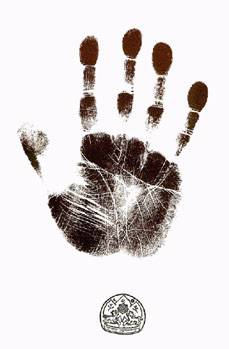
I’m thinking a blood-red ink would be more appropriate about now

Well of course he and Bush get along. Although he was presented the Nobel Peace Prize in 1989 “for his consistent resistance to the use of violence,” the Dalai Lama (aka Tenzin Gyatso) supports war, including the Iraq war. Of course by now we know that the Dali Lama supports everything. It’s what makes him so popular.
Today I accidentally came across a post I wrote four years ago at about the time of the last visit to the White House of the West’s vagabond Tibetan saint obsession [what I call the bandwagon/group-think syndrome]. I think it was already the smiling Gyatso’s second audience with Bush, and at that time I excerpted a report on the Guardian site:

The Dalai Lama said Wednesday that the U.S.-led war in Afghanistan may have been justified to win a larger peace, but that is it too soon to judge whether the Iraq war was warranted.
“I think history will tell,” he said in an interview with The Associated Press on Wednesday, just after he met with President Bush.

I’ve looked everywhere online, but I couldn’t find any sign that history has told His vacuous Holiness anything yet.
I’ll end by confessing that I’m no longer capable of being surprised by another form of hypocrisy, that of our peace-lovers in Congress pretending to be fired up about a Chinese-occupied Tibet while they continue to pursue the ruination and occupation of their own, equally-defenseless victim state in the Middle East.

[image of the Dalia Lama’s handprint from mmothra]

we Americans are ‘good Germans’

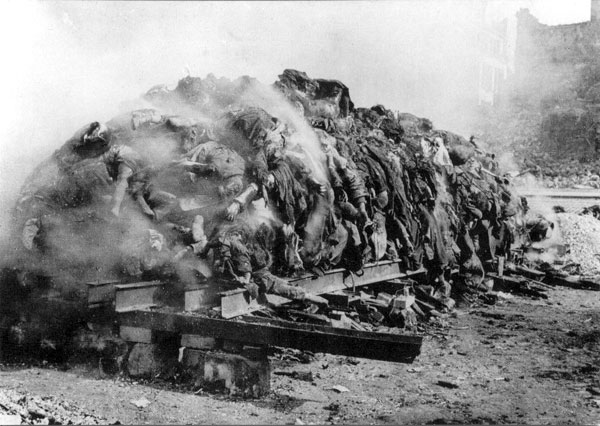
Dresden-pile-of-bodies.jpg
war is never what we expect it to be: Dresden, stacked bodies after 1945 Allied firebombing

We despair.
Four and a half years ago Barry and I each decided that we were retiring from both direct and indirect political action. We had just gone into the streets along with almost a million of our neighbors to protest the Bush regime’s plans for an unprovoked war against a small, almost defenseless state on the other side of the planet only to see the media virtually ignore the the demonstration and our two senators go on to support the the cynical, naked aggression in spite of polls which showed the majority of the people in New York State opposed it.
I don’t even sign petitions any more.
So why should I be surprised today to see that almost everyone else may have made the same decision? Americans now seem to be sitting this one out. They’re still answering the pollster’s questions, and in spite of the statistical bump favoring the war in its early stages, they still don’t like it, even if that’s as far as they’re willing to go.
Some four weeks ago, upon hearing the news of the latest failure of our so-called Democratic Congress to do absolutely anything to end a war which three quarters of Americans now oppose, Barry said to me, “That’s exactly why I’m now so estranged from political life”. I’m there too, but I’m sickened as he is by so much more than just the war itself: There are the cold Constitutional issues of course, which no one seems interested in dealing with, but the war and its hundreds of thousands of deaths and maimings, millions of refugees, and incalculable numbers of destroyed lives is only the most spectacular part of an even broader system of terror which has been corrupting us all. This is a campaign which threatens people everywhere in the world including of course our own communities, a vicious but also incredibly stupid and dangerous crusade unleashed in our name after September 11. We have prisons and countless “interrogations” consciously designed by our elected officials and governmental institutions to exist outside of any known system of justice. “I see no sense of outrage by the people running our government”, Barry continued. “They show absolutely no sense of outrage.”
In fact neither of us sees much evidence of outrage anywhere within our borders, including an absence among ordinary citizens. In spite of the fact that we don’t have the kind of motivation which a fully-developed police state might provide, we, that is all Americans, have become very good at being “good Germans“.*
I started writing this post in mid-September but only got as far as a short mock-up. Frank Rich’s passionate Op-Ed piece in Sunday’s NYTimes [conveniently, the online text has direct links to his references] made me go back to my notes. Rich uses the phrase “Good Germans” in his headline without fully defining it, but he does do an excellent job of shattering any illusions of innocence we might still retain.
We do torture people. We can no longer deny it. This may be the first time you’ve seen Andrew Sullivan’s name used on this blog (and I’d like it to be the last), but Rich links to our lazy mainstream media’s designated homosexual spokesperson to illustrate the connection between the administration’s “interrogation” practice and that of the Nazis.

As Andrew Sullivan, once a Bush cheerleader, observed last weekend in The Sunday Times of London, “America’’s “’enhanced interrogation”’ techniques have a grotesque provenance: “’Verschärfte Vernehmung’, enhanced or intensified interrogation, was the exact term innovated by the Gestapo to describe what became known as the ‘third degree.’ It left no marks. It included hypothermia, stress positions and long-time sleep deprivation.”
”

We apparently do commit war crimes, and we hire mercenaries. Rich believes the tale of our well-paid hired guns is “a leading indicator of every element of the war’s failure”, and sometimes the worst stories can’t be swept under the carpet. Three weeks after the Nisour Square massacre of 17 Iraqis, the Times columnist skillfully parses the more recent killing on Tuesday, by members of another private security firm, of the two women driving a car in Baghdad in these words:

The gunmen who mowed down the two Christian women worked for a Dubai-based company managed by Australians, registered in Singapore and enlisted as a subcontractor by an American contractor headquartered in North Carolina. This is a plot out of “”Syriana”” by way of “”Chinatown”.” There will be no trial. We will never find out what happened.

We’re now “laundering” our atrocities! Is anyone out there following this?
Actually, almost all of us are going about our business as if nothing is happening. We’re not lying down on the tracks in front of troop transports. We’re not wearing badges announcing our identification with the muslim “other”. We’re not beating down the doors of the NSA demanding that we be “interrogated” about our loyalty to the “Homeland”. We’re not running standing in front of a Marine Sergeant’s M-16 as he tries to search the home of a frightened Iraqi family.
Yes, these are heroic acts, and perhaps they’re completely preposterous in the twenty-first century, but I don’t even see or hear us talking about resistance in any form.
The rest of the world is following this very closely. We don’t look good. We’re already paying for our cowardice, and the bill is not going to get any smaller. Rich’s column concludes with a warning and an appeal:

Our humanity has been compromised by those who use Gestapo tactics in our war. The longer we stand idly by while they do so, the more we resemble those ““good Germans”” who professed ignorance of their own Gestapo. It’’s up to us to wake up our somnambulant Congress to challenge administration policy every day. Let the war’’s last supporters filibuster all night if they want to. There is nothing left to lose except whatever remains of our country’’s good name.

I have to end by saying I just don’t share his Frank Capra optimism. How can we as ordinary Americans expect to have any impact on government policy when we have neither democracy nor the stomach for serious revolt?

*
Borrowing the definition found in Wikipedia: The ‘good Germans were the citizens of Nazi Germany who, after 1945, claimed not to have supported the regime, even if they made no effort to oppose it. Today the term has been given a broader application, one which refers to people in any country who observe reprehensible things being done by their government but nevertheless remain silent and do not challenge or impede them.

[image from erichufschmid via airamericaradio]
Pro Publica arrives in town: expected to speak to power

Power_of_the_Press.jpg
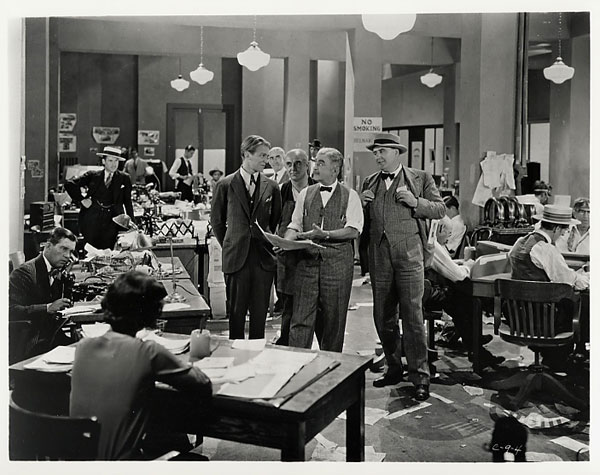
In the middle of the Times city room in The Power of the Press (Columbia Pictures, 1928), the city editor (Robert Edison) congratulates cub reporter Clem Rogers (Douglas Fairbanks Jr.) for getting his first page-one story as the more seasoned reporters gripe that it was all beginner’s luck.

Sometimes the news about the news is the best news.
In the NYTimes today we learn about the formation of a well-funded and independent, non-profit group of investigative reporters who will give away their work to individual news organizations, those in which its work will “make the strongest impression”. Beginning early next year Pro Publica will operate out of a newsroom in New York City with 24 journalists and a staff of about a dozen more on an annual budget of $10 million.

[Paul E. Steiger, previously top editor of The Wall Street Journal and soon to be Pro Publica’s president and editor-in-chief] said he envisions a mix of accomplished reporters and editors, including some hired from major publications, and talented people with only a few years’ experience, so that the group will become a training ground for investigative reporters. He would not say specifically where he is shopping for talent, but did not rule out The Journal.

I don’t see how the project could fail. Both commercial and non-profit news organizations are cutting costs and neglecting the kind of journalism which will be Pro Publica’s meat and potatoes. If one outlet declines to pick up the coverage they offer, another will. At the very least the one which turned down the story will be asked why it isn’t covering it. And there’s no reason why this thing would have to be confined to the print media.

Mr. Steiger said that relationships with publications could be tricky, requiring the flexibility to make each comfortable.
In most cases, he said, Pro Publica will appeal to a newspaper or magazine while a project is under way, to gauge interest and how much oversight the publication wants. In others, he said, his group might present more or less finished products to other outlets.
If Pro Publica and a publication cannot agree on how to approach a topic, or what can be written about it, he said, his group will look for another outlet, or publish its reporting on its own Web site.

Did I mention that the the plan is to do “long-term projects, uncovering misdeeds in government, business and organizations”. Quoting Steiger, describing how Pro Publica hopes to fill a vacuum in almost all current news coverage: “It is the deep-dive stuff and the aggressive follow-up that is most challenged in the budget process”.
The money comes from Herbert M. and Marion O. Sandler (California mortgage lending, savings and loans), described as major donors to the Democratic Party and critics of President Bush.

Mr. Sandler [who will serve as chairman of the group] said his interest in investigative journalism has been abetted by friendships with reporters in the field.
“Both my father and my older brother always focused on the underdog, justice, ethics, what’s right,” Mr. Sandler said. “All of my life I’ve been driven crazy whenever I encounter corruption, malfeasance, mendacity, but particularly where those in power take advantage of those who have few resources.”

Old-school progressive journalism breathes again, paradoxically funded by a pair of “financial honchos” and directed by a successful Wall Street Journal editor. This is not exactly “Mr. Smith Goes to Washington“, but then nothing ever was.

[image and caption from IJPC]

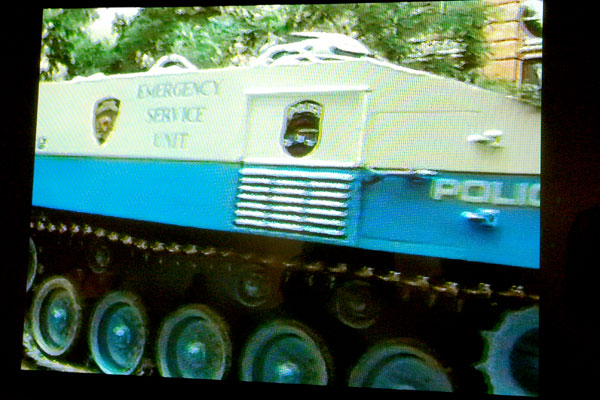
Clayton Patterson at Kinz, Tillou + Feigen

Patterson_Clayton_video_1.jpg
Patterson_Clayton_video_2.jpg
Patterson_Clayton_video_3.jpg
Patterson_Clayton_video_4.jpg
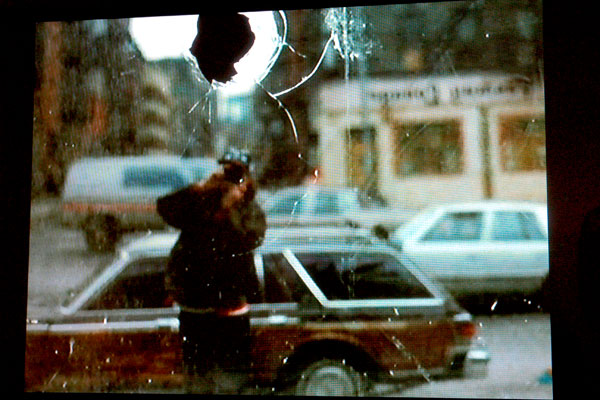
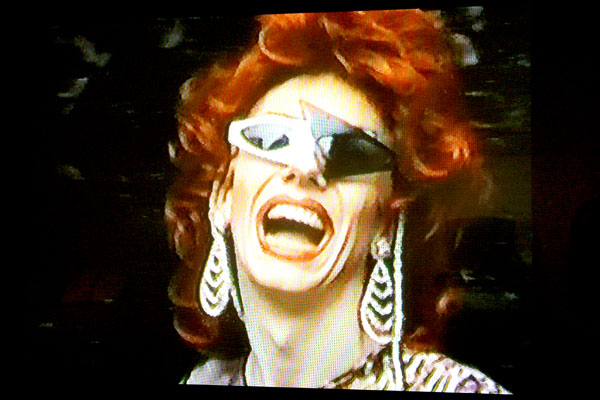
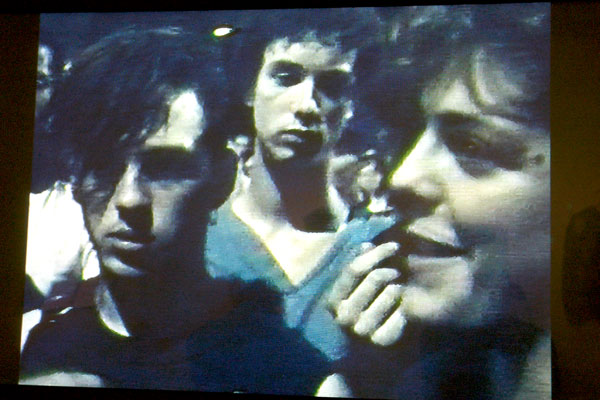
[four stills from the video installation of the film, “Captured”]

How do you write about a chronicler with a soul? How do you write about a bard with a camera? We can’t begin to understand the importance of people like this until they are gone. Maybe it has to wait until we are gone as well, but in the meantime we can give it a try.
I’d have to see this show, “The Lower East Side“, for its historical and political importance, even if the photographs didn’t have their own beauty. And they do.
Clayton Patterson (okay, it’s already the legendary Clayton Patterson) is currently represented by some of his sculpture, a tiny sampling of his enormous archive of photographs, and an excerpt from a documentary video in a show at Kinz, Tillou + Feigen, a gallery whose heritage, through Richard L. Feigen and Feigen Contemporary is itself pretty legendary.
The sculptures assembled from found materials are documents themselves, setting the entire installation in a specific time and space. The photographs are intense portraits, both candid and posed, of the Lower East Side community stretching from the early 80’s to the present. To anyone who did not know this city before the mid-90’s, or who might be unfamiliar with the neighborhood now, many will look like they must have been invented. In fact they are all perfectly true, and astonishingly intimate.
The same must be said of a film, “Captured”, shown on a television monitor in the smaller space. Its subject is Patterson and the neighborhood he calls home and which he has looked after for almost three decades. It was put together by Dan Levin, Ben Solomon and Jenner Furst, largely using Patterson’s own footage, and excerpts are being played in the gallery through the duration of the show. Patterson’s photographs can be seen on the gallery site. Here I’m only showing stills from the film, except for this one image:

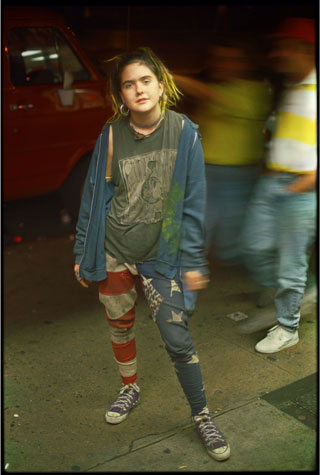
Patterson_Clayton_%28grunge%20girl%29.jpg
Clayton Patterson Untitled (grunge girl) 1992/2007 C-print

By the way, if you’re very young, on the street, and want to have a distinctive style, wouldn’t it make sense to find your own? That’s why I was struck by the resemblance between this 1992 “Grunge Girl” captured by Patterson, and this 2002 “Billy”, who was part of Bradley McCallum and Jacqueline Tarry’s show at Marvelli gallery three years ago (the couple is now represented by Caren Golden).

[image at the bottom from ktfgallery]