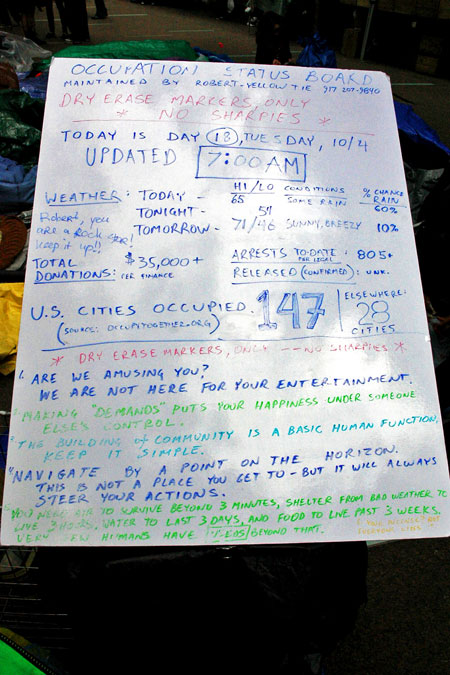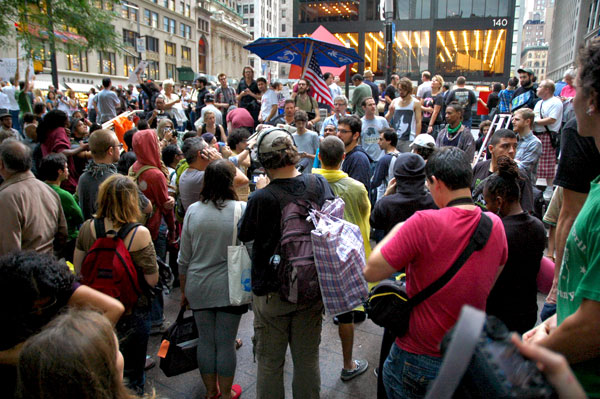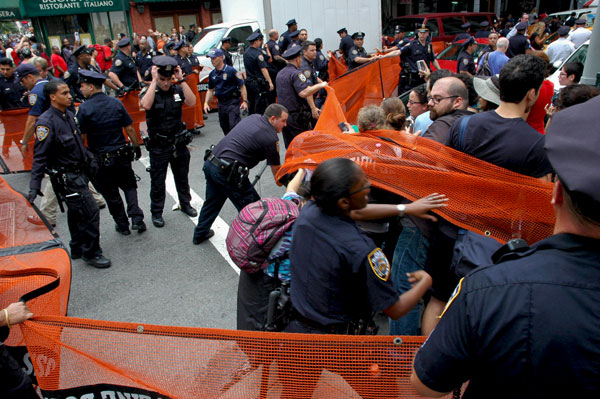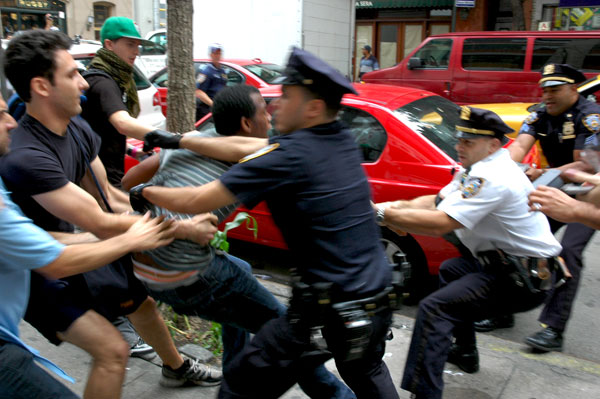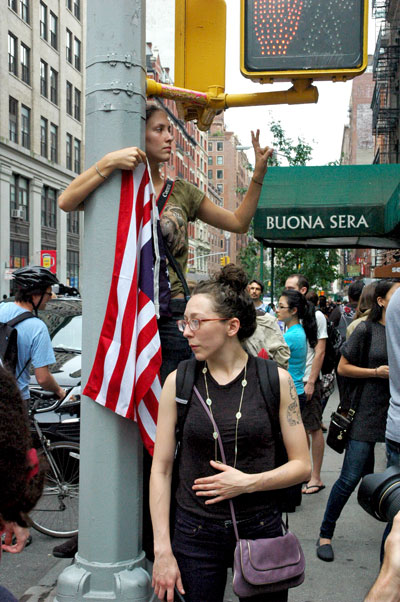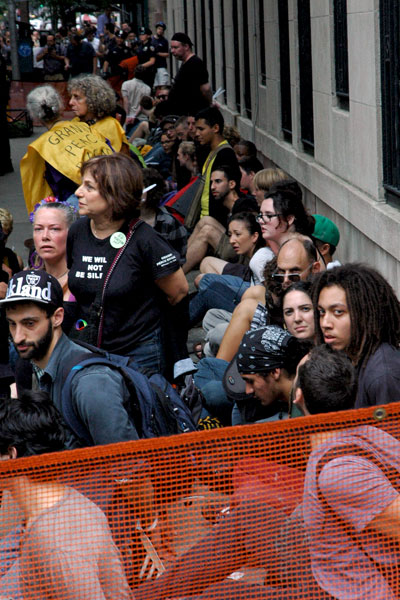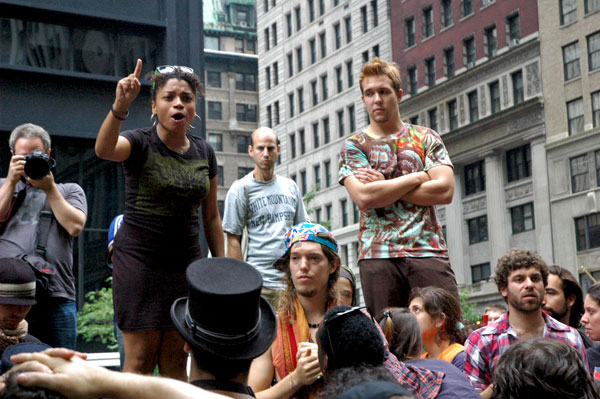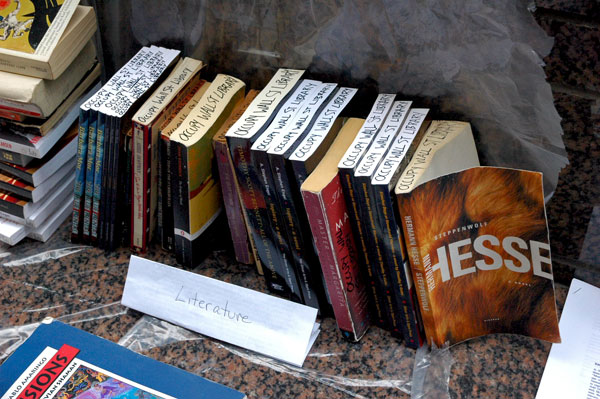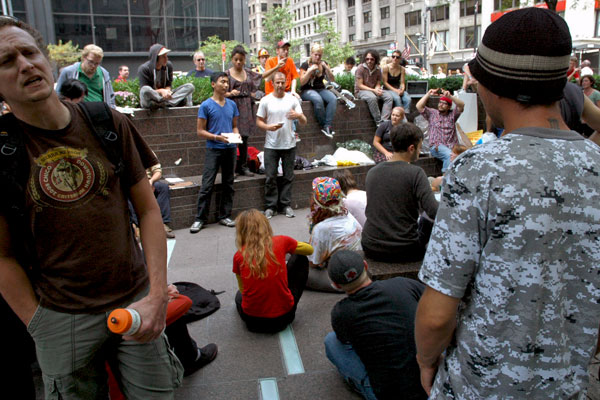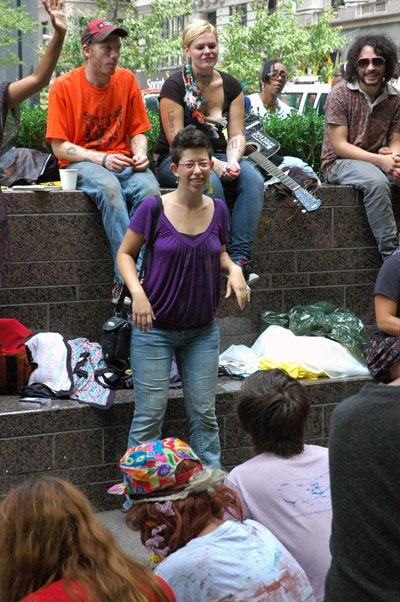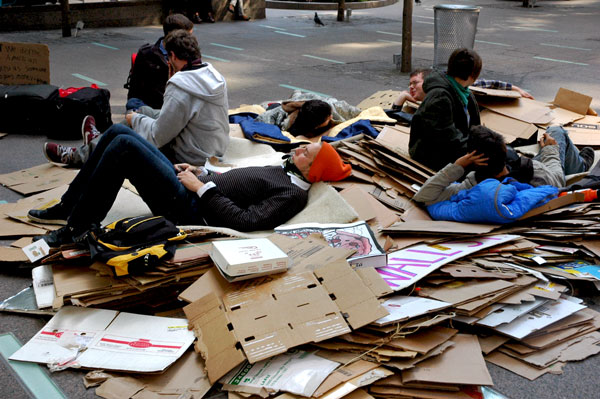
#OccupyWallStreet day 18: occupation status board

OWS_day_18_occupation_status_board.jpg
Tuesday, October 4, 2011, inside Liberty Plaza, New York City

ADDENDUM: The list of participants in the march has grown. This is what was being reported by #OccupyWallStreet as of 8:30 this evening:

AFL-CIO (AFSCME)
United NY
Strong Economy for All Coalition
Working Families Party,
TWU Local 100
SEIU 1199
CWA 1109
RWDSU
Communications Workers of America
CWA Local 1180
United Auto Workers
United Federation of Teachers
Professional Staff Congress – CUNY
National Nurses United
Writers Guild East
VOCAL-NY
Community Voices Heard
Alliance for Quality Education
New York Communities for Change
Coalition for the Homeless
Neighborhood Economic Development Advocacy Project (NEDAP)
The Job Party
NYC Coalition for Educational Justice
The Mirabal Sisters Cultural and Community Center
The New Deal for New York Campaign
National People’s Action
ALIGN
Human Services Council
Labor-Religion Coalition of New York State
Citizen Action of NY
MoveOn.org
Common Cause NY
New Bottom Line
350.org
Tenants & Neighbors
Democracy for NYC
Resource Generation
Tenants PAC
Teachers Unite

Tomorrow is big.
#OccupyWallStreet is likely to move into another dimension with the “Community/Labor March to Wall St against Corporate Greed and the Big Banks”. A number of unions and community groups will be a part of the march of the 99 percent Thursday afternoon. These include the United Federation of Teachers, 32BJ SEIU; 1199 SEIU Workers United; and Transport Workers Union Local 100; PSC-CUNY United NY; the Strong Economy for All Coalition; the Working Families Party; Vocal-NY; New York Communities for Change; Community Voices Heard; Alliance for Quality Education; [list in formation].
It has been announced that this march is “permitted”, meaning that the permits which the NYPD requires for any public assembly have actually been obtained, having been sought in deference to the preferences of some of the groups participating.
It was to start at City Hall (250 Broadway), but the assembly point has been changed, presumably in response to the anticipated numbers. Now it will assemble near or just east of Foley Square (map). The marchers will go down Park Row past police headquarters and City Hall to Broadway, where they will turn left and continue five blocks to Liberty Park (until recently called Zuccotti Park).
Any doubts about the importance being vested in this event are likely to be dismissed after even a quick look at the Google results for “Community/Labor March to Wall St against Corporate Greed and the Big Banks”.

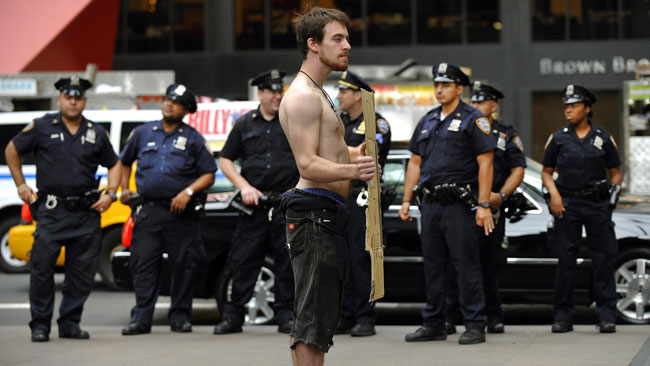
‘demonstrator’ at #OccupyWallStreet was Guy Fawkes

demonstrator_at_Liberty_Plaza.jpg
Carrying On
A demonstrator* at Zuccotti Park on Thursday, Day 13 of the Occupy Wall Street protests. [New York Times photo caption]

I saw him almost as soon as I arrived at the Plaza. He was standing at the eastern end of the park, facing Broadway, the pedestrians passing on the sidewalk and the line of cops posted close to the curb. I was somewhere to the rear and side. He was shirtless; he was silent and almost motionless; he was holding a large handprinted cardboard sign; and he had a distinctive face, with a look which spoke of control and resolution.
I noticed the shirtless part first (and the inescapable Line of Beauty), then, as I walked around to face him, I was surprised at the tender, clearly (and graphically) heartfelt message of the sign. It was only later that I thought of his resemblance to the signature Guy Fawkes images of anonymous.
I took some pictures of the guy with the raised fist, but I thought they lacked sufficient appositeness to be included in the scenes I later uploaded in my post about a visit to the #OccupyWallSteet encampment on Thursday.
Then I saw the image here at the top on an inside page of Friday’s hard copy edition of The New York times, page A23 to be precise. It was a three-column-wide picture with a short caption offering almost no enlightenment and with no mention of the words on the sign the “demonstrator” was holding. There was no article accompanying it.
I was disturbed by the casualness, even flippancy with which the Times had used it as filler, as entertainment for readers it had not informed about its context. It was also at that time that I first thought of Fawkes.
I thought both the messenger and the message deserved more, so I am posting my own image below.

*
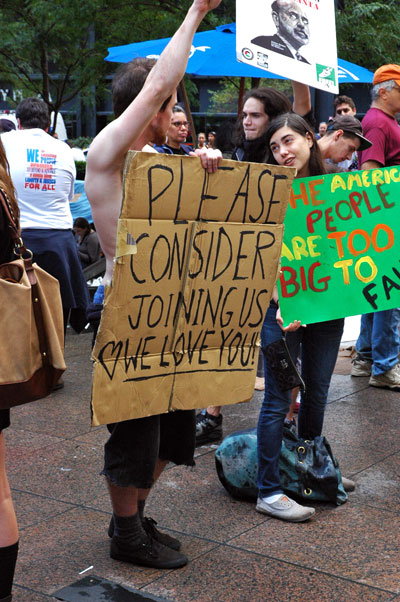
UPDATE: When I published this post the demonstrator’s name was not available to me. I asked at the time if anyone might know his identity, and I also wrote that I would like to know if the natural “mask” evoking one of the groups which initiated the 2011 Revolution was a conscious device (n.b. New York has outlawed the wearing of real masks for almost two centuries). Since then a reader has pointed me to this Times video in which the activist shown here appears, his name described in the credits as “Christopher Scully”. I still don’t know the story of the facial hair.

Day_!2_Please_Consider_Joining_Us.jpg

[I was unable to locate the image I saw in the paper on the New York Times own website, so this JPEG of the photo by Timothy A. Clary is from Agence France Presse – Getty Images, and it was published, cropped slightly at the bottom, by MSNBC]

Declaration of the Occupation of New York City

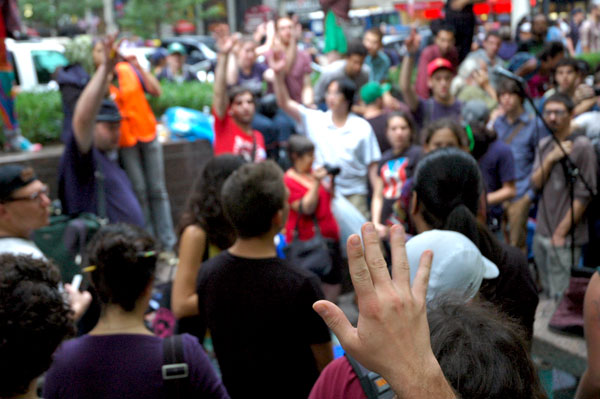
Day_8_General_Assembly_hand.jpg
General Assembly democracy, September 24, 2011

There was never anything mysterious about what the Wall Street protesters have been asking, but the obtuse may now find enlightenment with the appearance of a document published today by the General Assembly of #OccupyWallStreet, a “Declaration of the Occupation of New York City“.
It is in the nature of this unparalleled intensely-democratic movement that the text is not described as an official statement [“There is no official list of demands” @OccupyWallSt has tweeted] and what appears here will certainly change, but this is an historical moment; its significance should not be lost on any of us.

Declaration of the Occupation of New York City

Posted on September 30, 2011 by NYCGA

As we gather together in solidarity to express a feeling of mass injustice, we must not lose sight of what brought us together. We write so that all people who feel wronged by the corporate forces of the world can know that we are your allies.
As one people, united, we acknowledge the reality: that the future of the human race requires the cooperation of its members; that our system must protect our rights, and upon corruption of that system, it is up to the individuals to protect their own rights, and those of their neighbors; that a democratic government derives its just power from the people, but corporations do not seek consent to extract wealth from the people and the Earth; and that no true democracy is attainable when the process is determined by economic power. We come to you at a time when corporations, which place profit over people, self-interest over justice, and oppression over equality, run our governments. We have peaceably assembled here, as is our right, to let these facts be known.
They have taken our houses through an illegal foreclosure process, despite not having the original mortgage.
They have taken bailouts from taxpayers with impunity, and continue to give Executives exorbitant bonuses.
They have perpetuated inequality and discrimination in the workplace based on age, the color of one’s skin, sex, gender identity and sexual orientation.
They have poisoned the food supply through negligence, and undermined the farming system through monopolization.
They have profited off of the torture, confinement, and cruel treatment of countless nonhuman animals, and actively hide these practices.
They have continuously sought to strip employees of the right to negotiate for better pay and safer working conditions.
They have held students hostage with tens of thousands of dollars of debt on education, which is itself a human right.
They have consistently outsourced labor and used that outsourcing as leverage to cut workers’ healthcare and pay.
They have influenced the courts to achieve the same rights as people, with none of the culpability or responsibility.
They have spent millions of dollars on legal teams that look for ways to get them out of contracts in regards to health insurance.
They have sold our privacy as a commodity.
They have used the military and police force to prevent freedom of the press. They have deliberately declined to recall faulty products endangering lives in pursuit of profit.
They determine economic policy, despite the catastrophic failures their policies have produced and continue to produce.
They have donated large sums of money to politicians supposed to be regulating them. They continue to block alternate forms of energy to keep us dependent on oil.
They continue to block generic forms of medicine that could save people’s lives in order to protect investments that have already turned a substantive profit.
They have purposely covered up oil spills, accidents, faulty bookkeeping, and inactive ingredients in pursuit of profit.
They purposefully keep people misinformed and fearful through their control of the media.
They have accepted private contracts to murder prisoners even when presented with serious doubts about their guilt.
They have perpetuated colonialism at home and abroad. They have participated in the torture and murder of innocent civilians overseas.
They continue to create weapons of mass destruction in order to receive government contracts. *

To the people of the world,
We, the New York City General Assembly occupying Wall Street in Liberty Square, urge you to assert your power.
Exercise your right to peaceably assemble; occupy public space; create a process to address the problems we face, and generate solutions accessible to everyone.
To all communities that take action and form groups in the spirit of direct democracy, we offer support, documentation, and all of the resources at our disposal.
Join us and make your voices heard!

*These grievances are not all-inclusive.

#OccupyWallStreet day 12 – the park and the march

Day_12_Cornel_West_and_friends.jpg
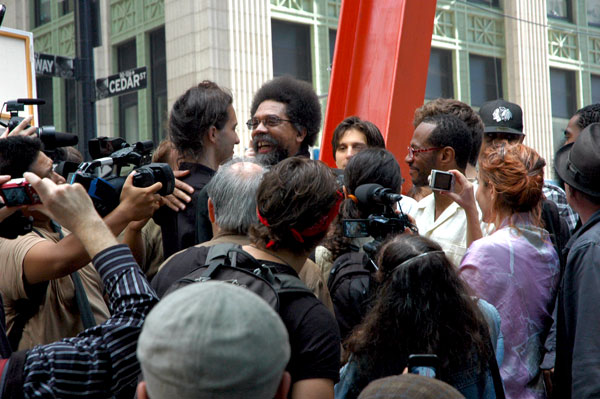
Cornel West returned to talk to the people in Liberty Plaza this afternoon before the 4 o’clock Stock Marker bell daily march; it was a clearly a mutual admiration society

I was downtown this afternoon visiting friends actually living with #OccupyWallStreet, and to meet others there who had come down for the first time to see what it was all about. I wanted to join the march which snaked through the Wall Street neighborhood twice every day, but I arrived early enough to breathe the air charged by the commitment and energy which sustains this remarkable phenomenon. This is the working map of the the encampment, but it’s actually looking more and more like Tahrir Square each day; @NickKristof, who showed up later in the day, wasn’t the first to notice this, and he’s not likely to be the last.
When I arrived Cornel West was at the top of the steps at the eastern end of the park. This time I didn’t see him address the entire group, as he did a few nights ago, telling the General Assembly, “Don’t be afraid to say ‘revolution’“. Instead, he seemed to be holding court, and he was loving it, as we all were.

Day_12_SEIU_Local_arrives.jpg
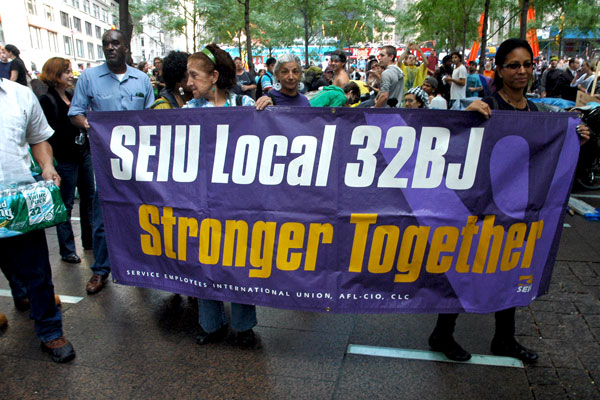
at about 3 o’clock representatives of the SEIU [Service Employees International Union] arrived, bringing cases of bottled water for thirsty campers

DaY_12_media_and_information.jpg
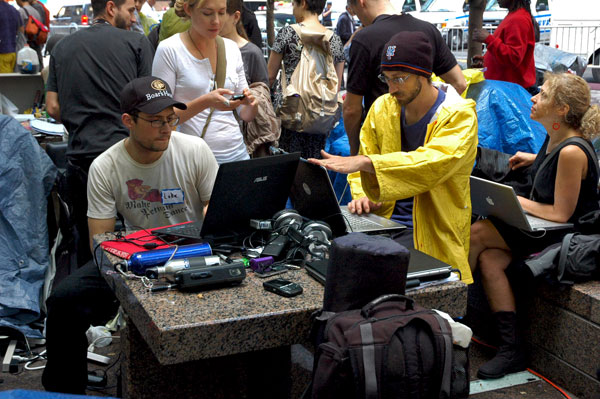
the media and information office is still one of my favorite photo subjects, although it’s probably in a tie with the General Assembly

Day_12_too_big_to_fail.jpg
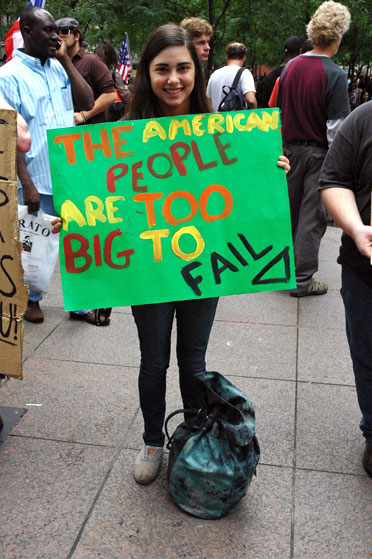
no explanation necessary

Day_12_pre-march_meeting_3_pm.jpg
the pre-march advisory assembly, just before the crowd pushed off

Day_12_thumbs_up.jpg
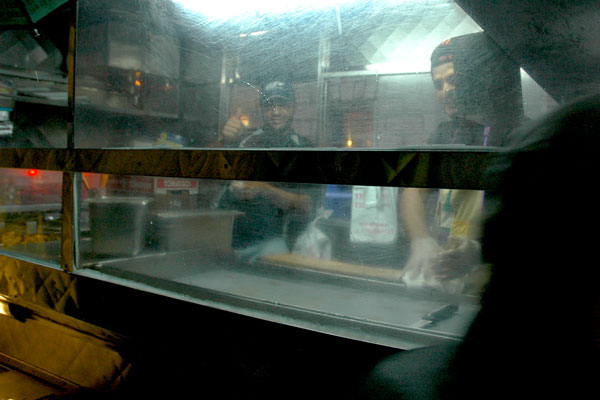
the moment we stepped off the skies turned black and within minutes we were all drenched by torrents of rain which continued (at least for me) until I finally escaped down a subway stairway an hour later; as we neared Broad Street on a narrow sidewalk these food cart workers, who were cleaning up their kitchen, both gave us thumbs up

Day_12_Broad_to_Wall.jpg
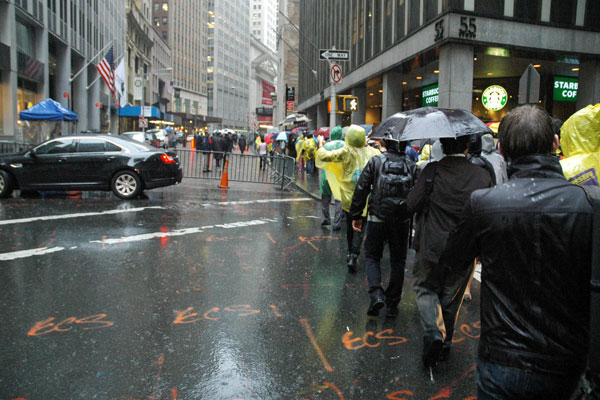
we marched straight up Broad Street, passed the Stock Exchange, and eventually headed east on Wall Street; meanwhile anyone who like me was not covered by a plastic poncho had been soaked to the skin within minutes; and these people go out twice a day, rain or shine – and many of them live outside, rain or shine; that’s pretty awesome

#OccupyWallStreet day 8 (cont’d)

Day_8_flowers_flag_tarps.jpg
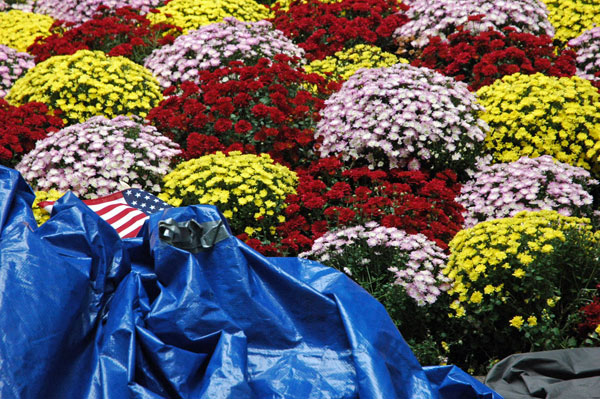
one of the colorful chrysanthemum planting beds inside Liberty Plaza [Park? Square?], a small American flag peeking out from behind rain tarps on the stone pavement below it

This post is the second of a series of captioned photographs taken last Saturday, beginning in Union Square mid-afternoon and ending that evening back at the #OccupyWallStreet campsite in Liberty Plaza. The first post is here.

[to open this second post completely, click onto the line of text at the bottom]

My experience of what I call the NYPD’s September 24th mini-riots began with my arrival at Union Square. Having rushed over from my apartment after seeing the live stream, I got there just as the demonstration had reached the southern end of the park. Hundreds of people who had walked two miles from the Wall Street area were smiling and in good spirits. They were marching west.

Day_8_WE_NEED_JOBS.jpg
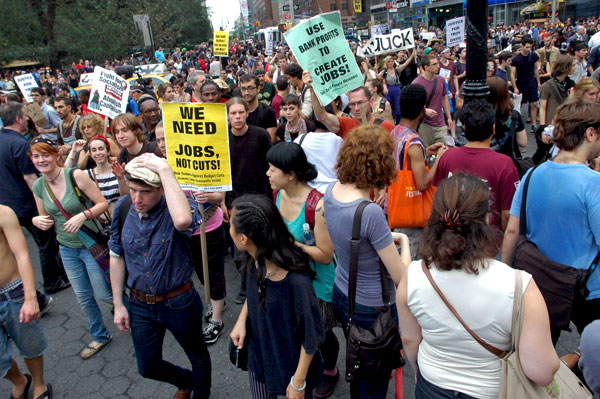
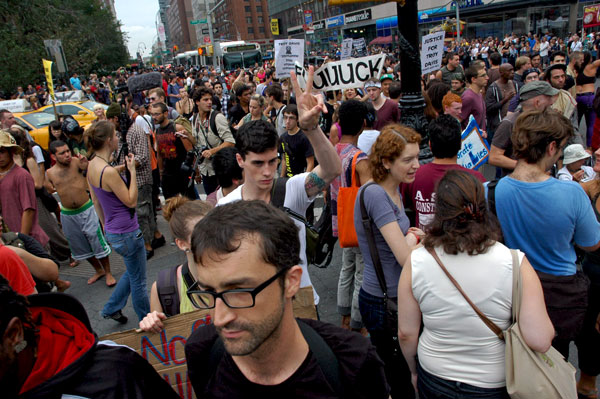
since Union Square had been the objective of the march, when it arrived there the enormous crowd had unavoidably begun to bunch up; some were still entering the park from the south, walking across 14th Street, and their numbers had forced others to walk in the street

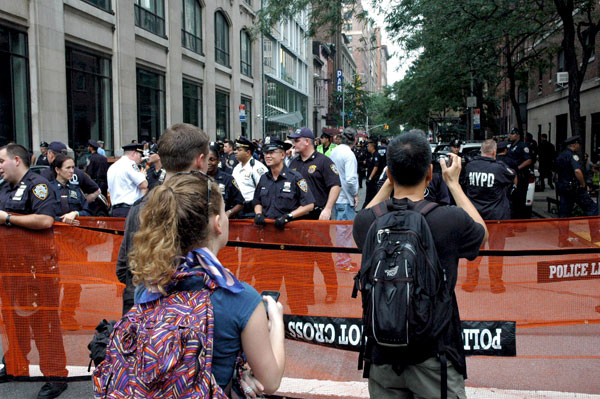
The police didn’t like that. They quickly became violent, ordering the marchers to do what in fact couldn’t be done and be where they couldn’t be. Without waiting they started assaulting the peaceful people and some bystanders, seemingly at random. Most of the rage and brutality came from the higher-ranking officers (the white shirts); it was clear at the time, and even more clear in the still and video images which record what happened, that many of the beat cops appeared to be shocked at what they were being told to do but perhaps more terrified of the anger of their superior officers.
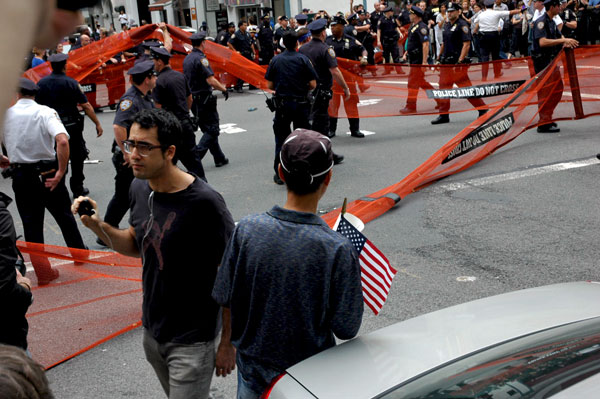
The NYPD had unrolled their hated contemptible plastic netting and were using it to separate the march into segments, and/or arrest any poor soul unlucky enough to be caught in the traps. People immediately panicked, screamed, and yelled (a totally natural response to such an assault and outrage), and that only further inflamed the cops, and the senior officers in particular.
I was trapped for a moment myself, but in an almost Keystone Cops melodramatic turn I spotted an open parking garage door and, with at least one other panicked refugee from the street roundup, ran into the building. Expecting to be pursued even inside, I started to run up a ramp to another level when I noticed another wide entrance opening to the side street to the west. My companion and I both slipped out of it just seconds before the attendant succeeded in closing the heavy overhead door. He may have been panicked himself by the violence going outside and was apparently notinterested in allowing the garage to become any kind of refuge.

Day_8_University_Place.jpg
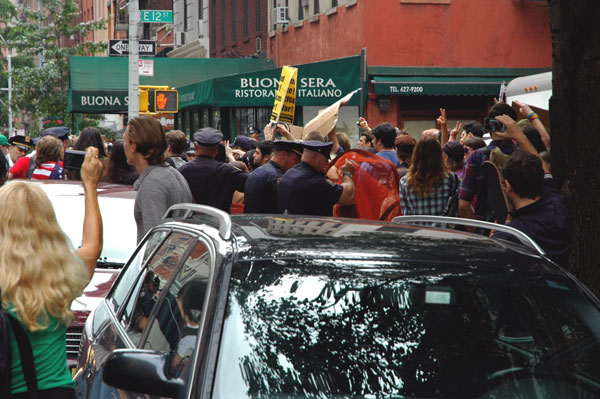
even after the disturbing events on 14th Street, a section of the march proceded peacefully down University Place, where most of its participants tried to remain on a sidewalk much too narrow even for their reduced number; the police however were more interested in unrolling their nets once more (here at 12th Street), and again shutting down the street entirely, than seeing the march continue on its way downtown without incident or major disruptions

Day_8_getting_names.jpg
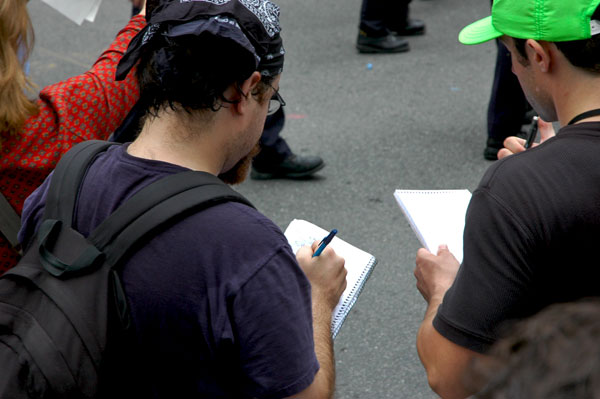
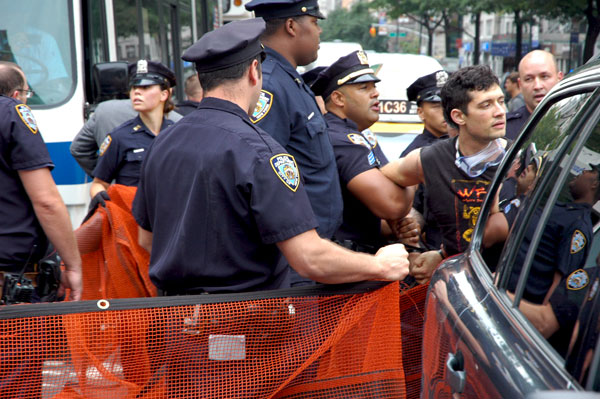
the police once again attacked the crowd violently at the intersection of 12th Street and University Place sometimes pulling their victims from the crowd, throwing or flipping them to the ground, binding their arms behind their backs with plastic cuffs, arresting them, and in several instances, macing them; support people, both trained and drafted on the spot, recorded the names of the arrestees when they were able to do so

Day_8_NYPD_weir.jpg
the NYPD’s monstrous system of weirs, birthed during the 2004 Republican National Convention, was as confusing to its potential victims as it was feared: No one knew where it would end up when it was first displayed, and of course no one wanted to end up like a trapped animal

Day_8_West_12_St_NYPD_blockade.jpg
if anyone was blocking pedestrian and motor traffic for other than a few moments, it was the NYPD, which locked down the streets below Union Square for what must have been a couple of hours; as usual, their self-directed assignment was, by their own admission, if not in these exact words, to keep a peaceful assembly of New Yorkers from interfering with the passage of vehicles to which their streets have been sacrificed

Continue reading “#OccupyWallStreet day 8 (cont’d)”

#OccupyWallStreet: a total must-visit, and then?

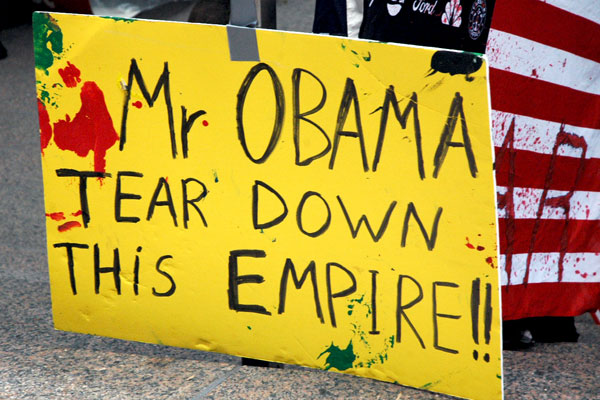
day_8_Mr_O_tear_down_this-empire.jpg
(at dusk, after the police-mini-riots on Saturday) a sign is propped up at the edge of Liberty Plaza; it faced a lineup of hundreds of uniformed police which for hours threatened the eviction of #OccupyWallStreet from the park

For anyone who can make the trip, I can’t recommend strongly enough a real, physical visit to the Liberty Plaza encampment of #OccupyWallStreet [OWS]. And if you get there you should definitely stay for a while.
For anyone interested in the issues and arguments identified with the movement, of course the site should be a draw anyway, but for anyone still hopeful of and interested in the possibility of an acceptable future for the U.S., anyone curious about or starved for the opportunity of experiencing a pure democratic process, and anyone who wants to watch the birth of a movement and a new politics, it’s a must. It’s also completely engaging and quite beautiful. The people are mostly young and some are very young (who else has the energy, the stamina, the relative invulnerability, or the idealism?), but in the park you will find little kids and folks of all ages (early this week I watched two octogenarians make their way from one long side to the other, and the man was using a walker).
For some reference, see below the three posts published since September 18.

And now a thought about what may be happening inside Liberty Plaza, in the outreach, in the marches and zaps that are likely to continue for some time, and in the minds and hearts of those who are listening to the message which this encampment embodies.
I can’t help musing on both the New Deal and real revolutions these days, including the French 1789 model. I didn’t come up with this either-or proposition, but it’s worth repeating: The 99 percent should make the 1 percent understand that from this moment we could go with either the French model or the American; that it’s really up to them.
On that note, I occasionally find myself puzzled by and a bit frustrated with the surprising mildness of the message often being expressed by people associated with #OccupyWallStreet; then I only have to remind myself that that approach is less likely to turn people off to what they (OWS) are saying and doing; that they operate totally by consensus; and that, whether its current political expression is genuinely mild or not, the movement will undoubtedly take on a life of its own, not unlike the French or every other revolution: After all, in 1789 the demand was only that the king rule better.

#OccupyWallStreet 8 (first draft)

day_8_Union_Square.jpg
what the march looked like at the foot of Union Square in mid-afternoon today, moments before the police attacked these obviously-hostile miscreants

This post will have to be something of a placeholder, as I’m far too tired to do more than put up a very few images from a day which I found both incredibly depressing and tremendously uplifting.
For the former, I offer the fact that, even by its own imagined standards, the NYPD dishonored itself today, a verdict with which many of its members would have to concur – were they allowed to do so. For the latter, I refer to my renewed, and extended, admiration for the democratic process, the determination, and the integrity of the participants in #occupywallstreet.

day_8_nine_against_one.jpg
an arrest near Union Square for, well, . . . something they’d decide on later

day_8_dragnet.jpg
silence your critics by ordering your lackeys to snatch them up in a dragnet and put them totally out of communication for a while (although the technique has some downsides, including that of the an occasional passerby being swept up – some of whom may not respect the current “anything for security” mantra and put up quite a stink – and there’s always the mischance of an attack on the press, like that which occurred on Saturday when a reporter for Public Television was arrested as he diligently pursued both his profession and what we would once have quaintly referred to as his rights)

day_8_tug-of-war.jpg
. . . and don’t be surprised if the intended victims don’t want to cooperate

day_8_flag_poles.jpg
. . . and if some really keep their cool

day_8_waiting_for_the_bus.jpg
a view of a large number of the arrestees, but I still don’t see any “hostiles”, even if tying their hands behind their backs and pushing them into the base of a building is intended to make them look guilty of just about anything

day_8_general_assembly.jpg
with the marchers back at Liberty Plaza, minus the total of 96 (according to an overheard police communication) who had just been arrested, the General Assembly convened to discuss a threatened charge by the NYPD, now lined up three and four deep at the east end while menacing them with prominent stacks of the Department’s now-notorious orange netting

day_8_media_central.jpg
the media center was busier than usual because of the mess made by the NYPD and the attention it had attracted

day_8_OWS_library.jpg
on this particular afternoon the on-site library was attracting fewer patrons than usual

The beginnings of an appendix:
Colin Moynihan in The New York Times
OccupyWallStreet
live streaming from the site
#occupywallstreet twitter
AnonOps Communications

#OccupyWallStreet: a brave new world, without the irony

occupywallstreet_repeating.jpg
general assembly, with facilitator in white tee, speaker in blue, one repeater left front

#occupywallstreet is onto something. We are witnessing, or at least those who are paying attention are witnessing, the birth of an extraordinarily important movement for fundamental change in political and economic arrangements which we have been told are not just normal, but unassailable. Unfortunately the current brutal and oligarchical order has also been protected by the sad reality that many who might otherwise support change are pretty comfortable with things as they are now, or at least think they are. People are afraid of losing what they have, and change is scary anyway. Many are not willing to cross an employer – or any other authority – and many just won’t chance reaching for an alternative to what already exists, even if they belong to what the movement for change describes as the 99 percent of the population crushed by the greed and corruption of the other 1 percent.
While this is only the beginning, this is not a children’s crusade and must not be dismissed as one. Regardless of one’s take on Michael Moore or Keith Olbermann, it’s worth thinking about what the oft-self-described ‘comic’ told the pundit today of the unholy and disastrous alliance of Wall Street, government and the media: “They think they’re going to get away with it [and] believe me, they’re not done yet . . . ” Also: “There will be riots in the streets . . . what you see on Wall Street [i.e., specifically #occupywallstreet] will be known as ‘that’s where it began'” [my emphasis].
Today some of the most noble and courageous members of the multitudes included in “the 99 percent” continue to occupy Liberty Plaza (called “Zuccotti Park” before the current protest began), to the surprise of most observers, including many of their sympathizers. They remain there even in the rain and in the darkness, forbidden by the NYPD the use of any cover or electricity. Yesterday Barry and I visited their “encampment” for the second time.
Once again we happened to have picked a pretty quiet moment, the police who surround them being content for a time with sequestering their superior numbers and sheathing their brute strength. Of course there was also the implied violence of that monstrous elevated surveillance tower overhead. But people inside the park were not all idle. While some rested or were in engaged in discussions, others were talking to pedestrians who had stopped to learn what was going on. Some were being interviewed by the press, and throughout the hour or so we were there a large group was seriously engaged in the process of an extraordinarily open and democratic “general assembly”.
The NYPD had forbidden the, from using an amplified bullhorn. On that subject, the statute forbidding the use of electric amplification for speech, like all New York laws, is applied selectively, and all activists know it. Social and political protests are not permitted to use even portable battery bullhorns without a permit (try getting one), and I’ve seen cops get pretty violent when they saw they were being employed, as they did inside this camp on Monday. I’ve also seen the police totally ignore stores and other commercial use of bullhorns on the sidewalk. Naturally the restriction either does not apply to religious institutions, or else it’s just not invoked.
The volume of ambient sound found in Liberty Plaza makes it impossible to hear anyone at any distance, and certainly impossible to carry on a conversation in a reasonable-sized group. In order to be able to conduct any kind of assembly the group had had to improvise a system which required more than just a facilitator. A number of hand and arm signals were established; they represented the simplest and most common moves or requests which might be expected from the “floor” (like ‘point of order’). Also, because they wanted to keep the noise down (yeah), people were asked, should they want to approve or applaud what they heard, to raise their arms and “jazz hands”. Most remarkably, there were also a number of “repeaters” positioned at some reasonable distance from the speakers who were asked to speak from a designated area in the front of the assembly. The repeaters’ assignment was to dutifully repeat in unison each phrase uttered by the speaker, who for that to work would have to regularly break up her or his address, thus facilitating its broadcast to the larger group.
Wow.
I was impressed. I was more than impressed, even if only an hour later I thought to myself, ‘what about an old-fashioned cheerleader megaphone?’. But while I was still witnessing this phenomenon at the base of the skyscrapers I thought only of its beauty. Standing near the front and hearing this beautiful call and repeat process continuing for so long, my mind sort of boggled, and my heart swooned. I thought of what it meant to have to pause and interrupt something important you wanted to say after every short word construction, but I also felt that it somehow resulted in a more profound delivery and a more thoughtful response than normal discourse, at least in these circumstances.
I could barely take in the awesomeness of what I was experiencing (ACT UP had only needed facilitators!). I slipped into reverie. I was witnessing the communal resonance of some ur-language; the long-distance conversation of some remote mountain people; a fully-engaged and over-the-top Greek chorus. It seemed like the most natural thing in the world, as if these people had been doing this all their lives – or had prepared all their (mostly) young lives for the moment when they would be called to do this.
One of the people who spoke lived in the area and had asked to speak in order to complain about the noise of the encampment (in particular, as it turned out, that of the night before, when there had apparently been an unplanned response to the murder of Troy Davis which violated their own noise curfew). The seriousness, respect and detachment with which the repeaters broadcast to the group (of which they were a part) the complaint being made against it, and effectively against the importance of everything the group was doing, dramatized for me the awesomeness of what it was accomplishing with this free and open, heroically-democratic process being exercised only blocks from the dark canyons of Wall Street.

occupywallstreet_arts_&_culture.jpg
the fun/arts & culture working group announced “formal Friday” for the next day

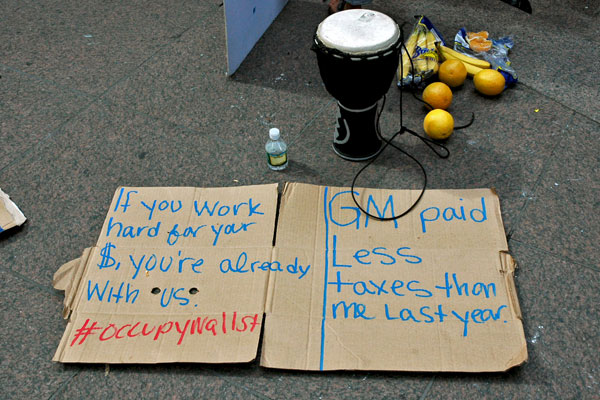
occupywallstreet_GM_paid_less_taxes.jpg
sign, at rest for now

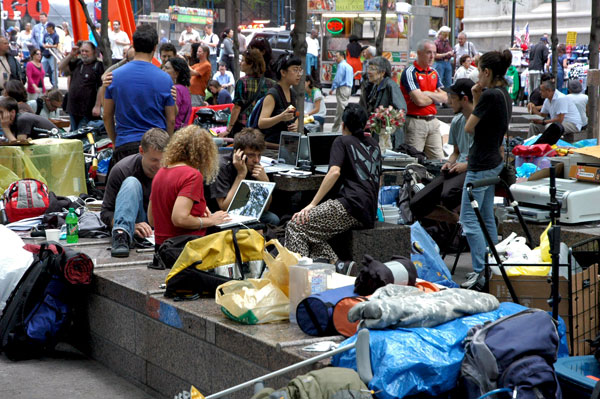
occupywallstreet_media_central.jpg
central media department

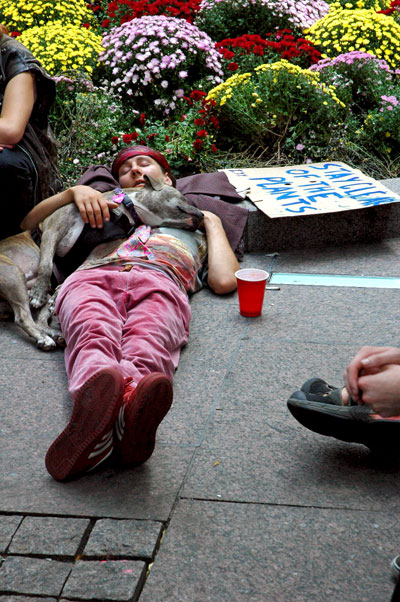
occupywallstreet_stay_clear_of_the_plants.jpg
staying clear of the planting beds

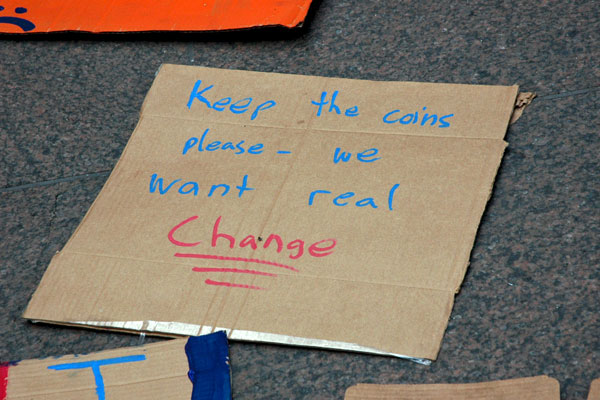
occupywallstreet_keep_the_coins.jpg
pretty focused

#OccupyWallStreet: will this be the U.S. Fall?

takewallstreet_resting.jpg
are we watching the beginning or the end? (relaxing in Zuccotti Park early this afternoon)

#OccupyWallStreet is now in its second day, and no one knows where or when it will end.
It seems to be in the nature of grass-roots political uprisings that there should be neither leaders nor defined objectives, and it is clearly true of this one. This should be not be a surprise, and it unlikely to be a liability, especially in the early stages of a popular street protest.
But this one just might become something more than just another protest which will once again frustrate its authors and participants and be ignored or endured by its targets wielding economic and political power.
The remarkable thing about uprisings of any kind – and in any place – may be the fact that they happen at all, and we who enjoy (or do not enjoy) a system which has always seemed impervious to revolution may now be in for a big shock: The Arab Spring may now have become the U.S. Fall. There is clearly general unrest throughout the country, and its physical expression has begun with political action outside the institutions which have frustrated and even defied the wants and needs of most of its citizenry. We do not know how far it will go, but unlike the case of the dissent provoked by the last, Great Depression, this time there appears to be no Roosevelt around to save either the institutions or the citizenry.

takewallstreet_tourists.jpg
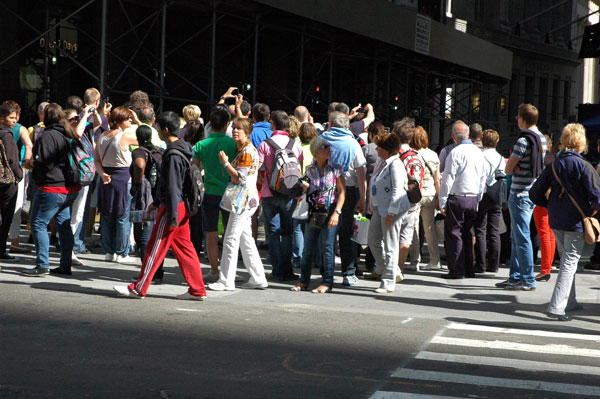
tourists staring down Wall Street, flummoxed by the security services’ decision to shut down all the streets which approached the shrine

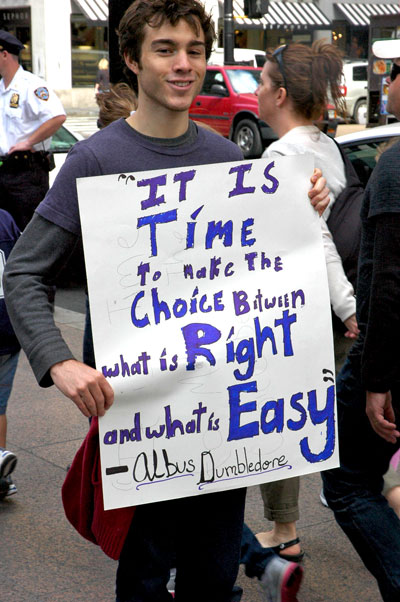
takewallstreet_Dumbledore.jpg
a particularly dangerous-looking revolutionary, and not atypical of the people gathered inside the park

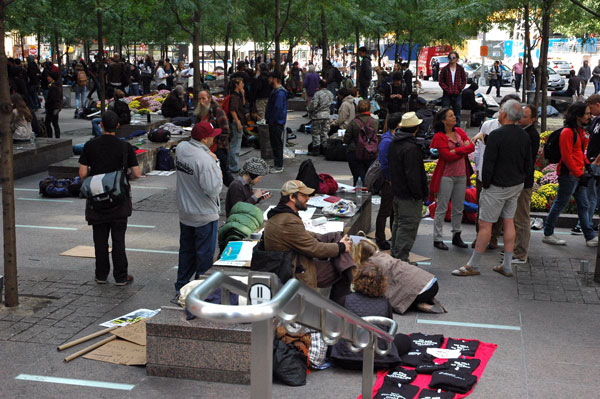
takewallstreet_Zuccotti-Park.jpg
all quiet in the park this afternoon: signs, t-shirts, food, meetings

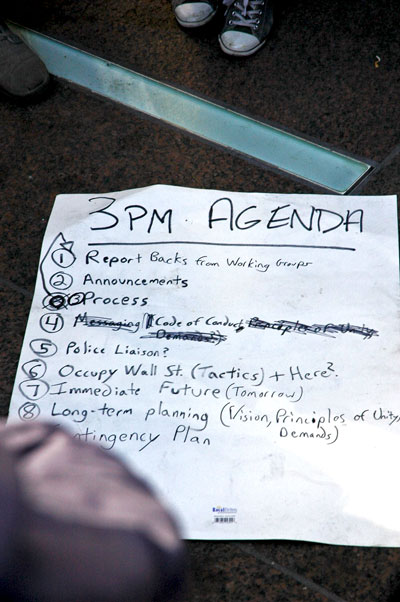
takewallstreet_agenda.jpg
the agenda for the general assembly just ended

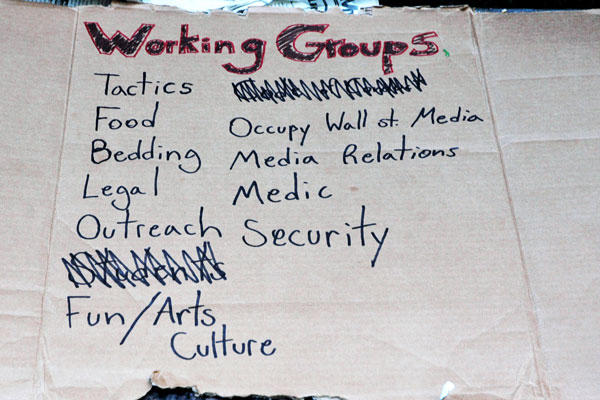
takewallstreet_working_groups.jpg
and working groups too

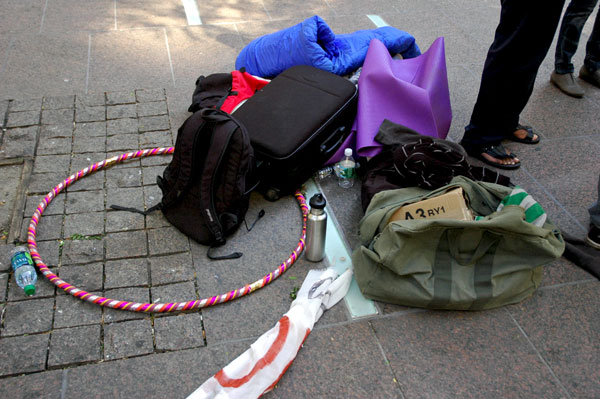
takewallstreet_hula_hoop.jpg
were there hula hoops in Tahrir Square?

the Wall: remnant of full fabric of 20th-c German history

Mauer_waving_across_wall.jpg
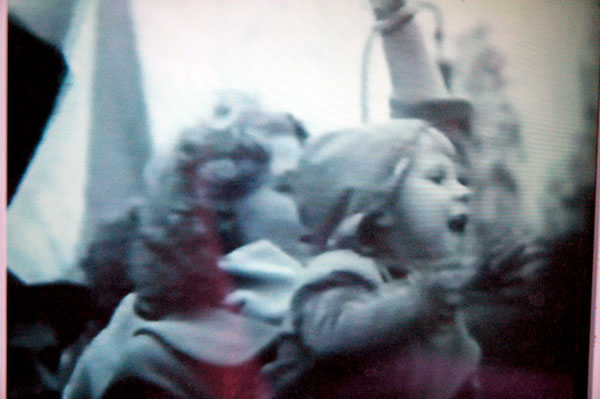
woman and child at the Wall, waving from West to East, 1961 (from a video on a stele at the Wall Memorial)

ADDENDUM: two images have been added within the original set below [on August 21, 2011]

I find myself nearly choking up as I write this. Yes, it’s been a very long time since I’ve blogged anything on this site, but my emotion has nothing to do with having been absent so long from a “post”. The reason I’m feeling a bit fragile right now is that I’ve been looking lately at a lot of images attached to the history of the Berlin Wall, memorialized yesterday exactly 50 years after it was installed. There are also my own memories of the Wall, and of Berlin, which begin in late spring of 1961, a few months before it even existed.
I returned to Berlin several times during the years the wall stood (but not often enough, as I still regret), and I’ve been back three times since it was torn down in 1989.
I suppose it’s natural that at this time there should be more and more attention being paid to this piece of German and Western history, more perhaps than that currently being focused on the Nazi regime and its so much greater horror. At least two generations have been born since 1945, and Germans today are well-educated about the country’s darker legacy, and fully-conscious of both the origins and the deeds of the twelve-year regime which ended in a Berlin bunker. Over 65 years later Germany is a very different country, the Germans a very different people, and almost no one survives today who could be said to have played an important role in the horrors which accompanied the first half of the last century.
The story of a divided Germany, a divided Berlin, however remains very much alive – and insufficiently known or documented. It’s also the story of a divided people, and much of that division remains today. Both victims and tormentors survive, certainly in numbers sufficient to attract the curious social observer or documentarian.
Peter Schneider wrote in the Times two days ago that when he first began investigating the Wall 30 years ago his progressive friends thought his interest was weird, that the subject should be of interest to the Right: “The left held that the split was the price Germans had to pay for the crimes of the Third Reich.” I can back him up: I was aware of something like that attitude among the Germans I knew decades ago.
Even today it seems there’s not even the beginnings of a consensus about what happened between 1961 and 1989, or how it happened.
The Wall was one of the last remnants of a social and political struggle which began before 1933 and continued after 1945; it was a part of a much broader panorama of German history, and not just a product of an East/West Cold War (which had been germinating for several generations, not merely years). Much of the suspicion and passion of the struggle which created the wall is still with us, even if disguised and diffused.
I have been obsessed with German history all my life, and especially with the 25 years fateful years of the Weimar and National Socialist eras, but in the last decade or so I have become increasingly interested in the story of divided Germany, and especially divided Berlin (subjects my teachers would have called “current events”). Part of the reason for my fascination and hunger for information could be the fact that Barry and I have stayed, on our last two visits, in what had been East Berlin. There is nothing like affection for an adopted neighborhood – even a temporary one – and proximity to the subject to inspire interest in its history. But I’m sure I would find the subject fascinating even at a greater distance, and it offers virtually unlimited opportunities for discovery.
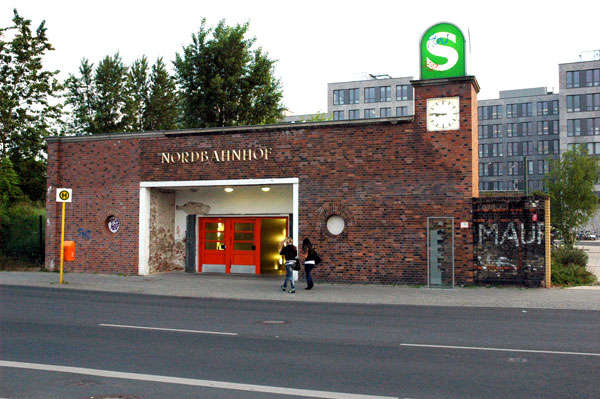
I took these pictures while we were in Berlin in May of this year. I’m using, welcoming, the anniversary of the Wall as the occasion and an inducement to publishing them here now. We stayed just one street away from the Berlin Wall Memorial, which begins roughly at the Nordbahnhof, on Gartenstrasse, and runs along Bernauerstrasse. The memorial service held yesterday was held one street in the other direction from our apartment. These photographs were captured in half-light, as we returned to our base on our first full day in the city.
Mauer_Nordbahnhof.jpg
The S-Bahn stop, Nordbahnhof, closed between August 13,1961, the day the Berlin Wall went up, and September 1, 1990, is at the southwestern edge of the Bernauerstrasse section of the Wall Memorial; it includes an extensive, and evocative, “ghost stations” exhibit; this same building, by Richard Brademann, was constructed in 1936 and survived war (bombs, flooding), the postwar division of the city, and finally the Wall which destroyed its function
Mauer_Bergstrasse_curb.jpg
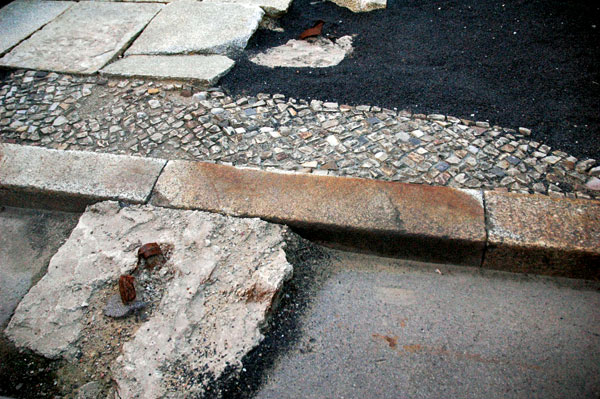
looking not unlike a street in Pompei, the archeological remains of Bergstrasse, showing the curb, paving stones and stumps of metal fence poles which were a part of the wall system
Mauer_wall_section_Denkmal_Schild.jpg
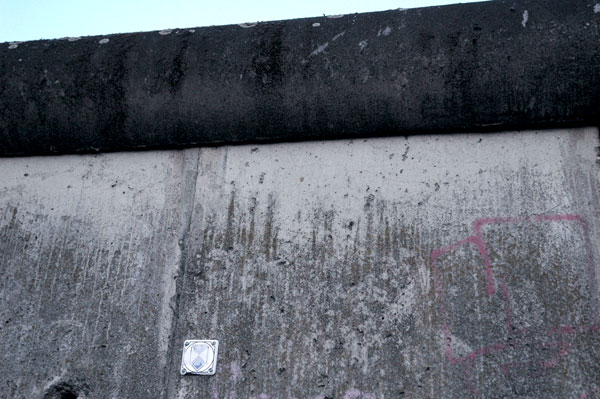
a section of one of the last surviving pieces of the Wall, on Bernauerstrasse, showing the small international Denkmalplakette, or monument emblem, established by the 1954 Hague Convention to identify “movable or immovable property of great importance to the cultural heritage of every people,” to be protected in the event of armed conflict.
mauer_wall_remnant_and_steel_memorial.jpg
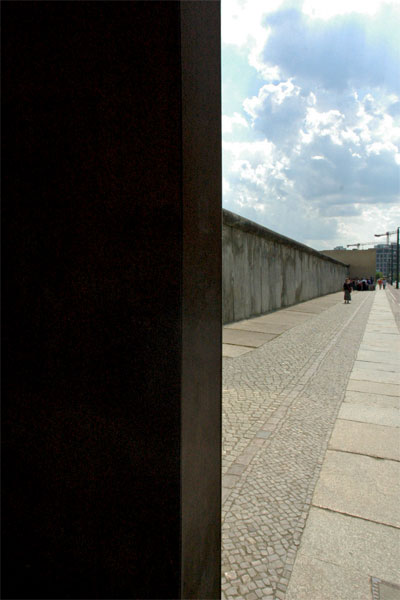
a view of one of a section of the concrete “Grenzmauer 75” (restored to its original condition), and in the left foreground the edge of the steel side wall designed by the memorial architects, the Stuttgart firm Kohlhoff & Kohlhoff, so that the polished surface of one of its sides would give an impression, artistically and optically, of the sheer length of the original barrier, most of which does not survive; the Gedenkst�tte has not yet been completed in its entirety
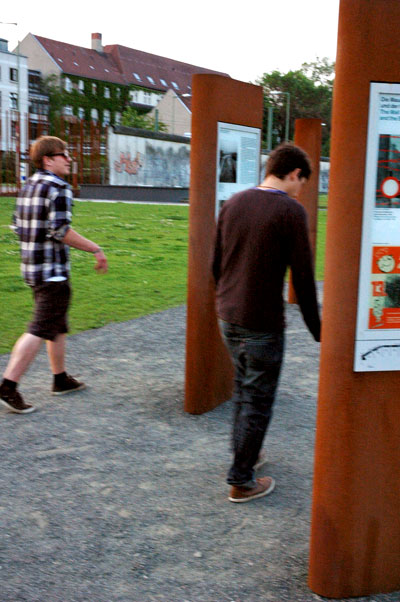
Mauer_youths_visiting_monument.jpg
two Berlin youths visiting the still-under-construction Memorial Grounds on Bernauerstrasse, at dusk; we were near them while they watched one of the video screens imbedded in a stele, and when then-B�rgermeister Willy Brandt was seen speaking to the crowd at the wall, only three days after the closure (criticizing what he described as President Kennedy’s empty rhetoric, asserting “Berlin expects more than words. It expects political action”), one of the two uttered respectfully – and affectionately, “Der Willy,” in the way Germans often modify a friend’s given name.
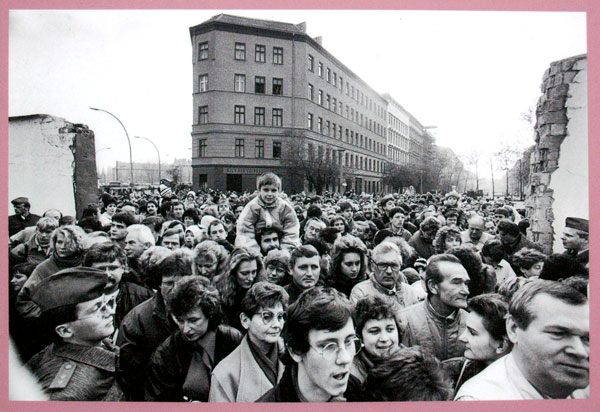
mauer_11_Nov_1989_first_crossing.jpg
an image included in the wall of memorial materials located along Ackerstrasse, about one kilometer east of where this crowd of happy, stunned(?) East Berliners crossed to the West from Eberswalderstrasse into Bernauerstrasse the morning of November 11, 1989, through the first new street opening

More on the Wall, pictures and texts, from German sites, in English:
Germany marks 50 years (Deutsche Welle)
Before and After Photos of Germany’s East-West Border (Der Spiegel)
‘West Berliners Felt Abandoned and Powerless’ (Der Spiegel)