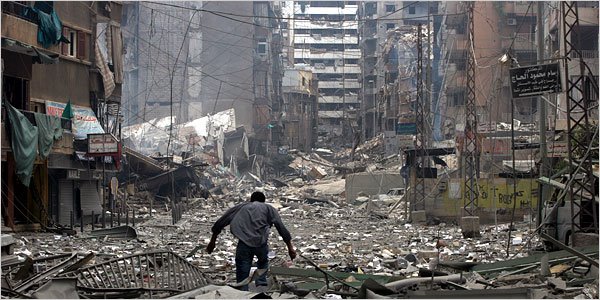
Isn’t it strange that our last remaining guardians of truth, the political cartoonists and the two biggie bloggers, have been virtually silent on the biggest news story in the world today?
See Juan Cole if you want enlightenment.
[image from theangryarab, where it is not credited]
Category: Politics
every one of us is in charge of the U.S. gulags
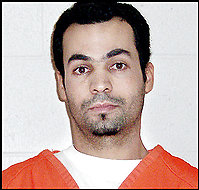
Benamar Benatta, in an undated Federal detention facility photograph
This sort of thing will disgrace us all forever.
NEW YORK – An Algerian man believed to be the last domestic* detainee still in custody from a national dragnet after Sept. 11 and who was cleared of links to terrorism in November 2001 [my italics] was set free this week, his lawyer said Friday.
If a nation describes itself as a democracy, just as every citizen shares in the credit for its government’s accomplishments each must be considered complicit in its crimes, both foreign and domestic. We are all prison warders and we are all military commanders.
The awesomeness of this shared responsibility would be terrifying even in time of peace, but today we are altogether incapable of dealing with it: We don’t want to face the fact that there are no civilians in America at this time, that we all look like legitimate targets to the enemies we have accumulated around the world, so let’s just go shopping.
*
a very important qualification, whose reality and significance Americans can no longer escape
[image from washingtonpost.com]
they’ve lost the potato chip!*
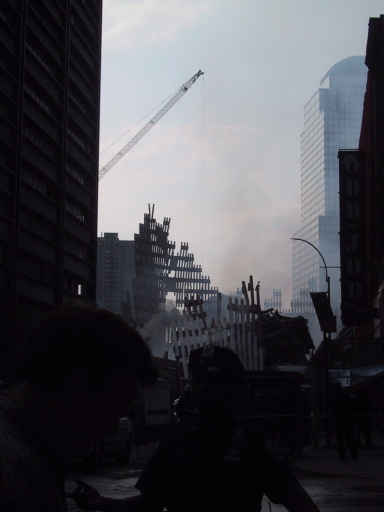
[an image either Barry or I captured only days after September 11]
Oops.
The only remaining recognizable relic of the sacred World Trade Center buildings is missing, but I guess we’re still more or less on target to spend nearly a billion dollars on two holes – incidently, totally not a part of anyone’s memory of the structures.
Newsday carries an AP story this morning under the headline, “Lasting legacy lost?”
Nine stories of the World Trade Center’s north tower facade stood in thousands of tons of rubble while workers recovered bodies and cleared the site of the towers’ ruins.
When workers brought the latticework facade down in December 2001, officials said some of it would be saved. Sept. 11 family members say they want to one day return the steel columns to Ground Zero to become part of a memorial.
But today, officials say they aren’t sure how much of that facade they have and what can be put back together.
See this link for more images from the weeks after September 11.
*
the name was Barry’s way of recognizing my reference when I told him that the facade segment was missing (we’ve both worked in the WTC and we’re New Yorkers; we can be as irreverent as we want about our countrymen’s excuse for their latest bloodlust)
thoughts of Israel somehow always cancel thought
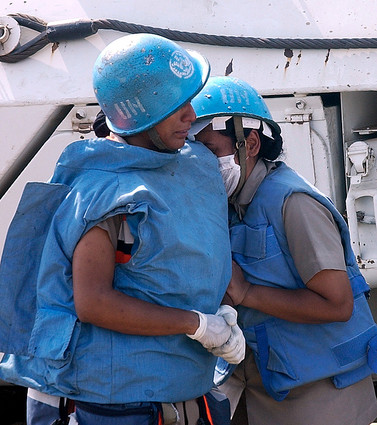
U.N. peacekeepers react at the sight of citizens who were killed when Israeli warplanes targeted their vehicles Saturday (July 15th) AP
I’ve just read two disturbing pieces in today’s NYTimes Metro section describing the reaction of New York’s “leaders” to the latest insanity in Israel, Gaza, Lebanon [and?]. I know it’s crazy, since the subject is Israel, but somehow those paragraphs still managed to provoke some thoughts. Maybe it has something to do with “current events”, a quaint expression contemporary with the very last era when people had any acquaintance with history.
Yesterday’s rally for Israel on East 42nd Street, called in response to the current violence within the permanent crisis in the Middle East, inspired Clyde Haberman’s latest column, titled “A Word Fails Them”, devoted to the one important word missing from each of the speakers’ rhetoric. We read that Israel’s ambassador to the UN told the crowd, referring to his nation’s raids in Lebanon, “Let us finish the job”. To the many (foreign) critics who claim that Israel is using “disproportionate” force in these bombings, he answered: “You’re damn right we are”.
In the same column our own Congressman Jerry Nadler (normally an excellent statesman, but exercising a selective blindness on this issue as usual) is quoted asking those assembled, “Since when should a response to aggression and murder be proportionate?” Wait a minute, is he even listening to what he’s saying? I thought we had answered his question pretty conclusively sometime during the twentieth century.
Sometimes it seems that not a single American politician might be found who would even begin to question conventional wisdom when the subject is Israel. And am I the only one in the country whose Jewish friends are able to talk rationally about Israel’s past – and future? For the sake of all Israelis, for our own sake, for that of the entire Middle East, and for the planet’s survival, I certainly hope not.
Inside today’s hard copy of the paper, in a news article on page 2, Hillary Rodham Clinton repeats the tired, disastrous mantra of the need for [unquestioning] “support” for Israel:
Addressing a crowd of several thousand in Midtown at an impassioned rally for Israel, she said America must show “solidarity and support” for Israel in the face of the “unwarranted, unprovoked” seizure of three Israeli soldiers by members of Hamas and Hezbollah, which she described as among “the new totalitarians of the 21st century.”
Wait a minute, “the new totalitarians”? Doesn’t anyone read history any more? If there’s anything essential to totalitarianism it’s the existence of a state, and it seems to me that it’s precisely the absence of one that started this mess and continues to fuel it today.
“We will stand with Israel because Israel is standing for American values as well as Israeli ones,” said Mrs. Clinton, who joined two dozen political and religious leaders on a stage a few blocks from the United Nations headquarters on the East Side.
But this, from the same article, may even top the “new totalitarians” thing:
Bringing the threat home, she compared Israels military response, which has included heavy bombardment of Lebanon, to a theoretical response by the United States if it faced attacks from neighboring countries. “I want us here in New York to imagine, if extremist terrorists were launching rocket attacks across the Mexican or Canadian border, would we stand by or would we defend America against these attacks from extremists?” she said to roars of approval.
That logic would have had us bombing and blockading all of Saudi Arabia immediately after 9/11.
But I suppose my critique is irrelevant, since 9/11 is “history”, and so for Americans now it can exist only as myth. Well then, moving along, let’s suppose there were a border skirmish, a kidnapping, shooting or small rocket attack by non-governmental Canadian or Mexican “extremists” in Minnesota or New Mexico [“Mexico”?]. I guess then it would be okay if we bombed Toronto or Mexico City, destroyed a country’s entire infrastructure, blockaded its borders and killed innocent civilians. She’s probably right. Americans would totally go with it, as they’ve been demonstrating to the world now for almost five years.
I have to admit that I did find some perspective in the the Times piece, even if it came from the reporter and not the bloodthirsty rally participants themselves. After relating Clinton’s remarks Patrick Healy writes:
Mrs. Clinton and the other speakers focused almost exclusively on Israels right to act militarily and unilaterally, and the speeches were fiery and resolute, with little mention of civilians in Lebanon and Gaza who have been injured in the fighting.
Even the normally contentious Congressman Anthony D. Weiner is quoted praising Bush on this one, although I can’t say I understand that W has actually done anything while the bombs have been falling, and Andrew Cuomo and Mark Green “each took the stage to declare allegiance to Israel” [whatever that means, although I suppose we already know all too well].
Isn’t anyone, anywhere, really thinking about this stuff?
The Times piece ends with the best picture yet of what has become of the erst-while progressive, and George McGovern presidential campaigner, whom William Jefferson Clinton took with him when he returned to Arkansas thirty some years ago:
At a separate event yesterday, Mrs. Clinton also won support from another onetime critic-turned-ally, Rupert Murdoch, the owner of The New York Post, who was the host of a political fund-raiser for her in New York City.
We really do get the leaders we deserve.
POSTSCRIPT:
In the continuing tradition of an increasingly controlled media apparatus, once again we have seen in the current hostilities almost no images of the casualties and even very few images of the people immediately affected by the violence. All of the visual news or entertainment outlets seem enthralled, as usual, by pictures of destructive hardware and colorful explosions, when they are not showing the respectable suits or robes clothing the monsters who are behind the madness.
I have been able to find a few on the Newsday site, where the written and photographic coverage of important and sensitive events is always better than most newspapers.
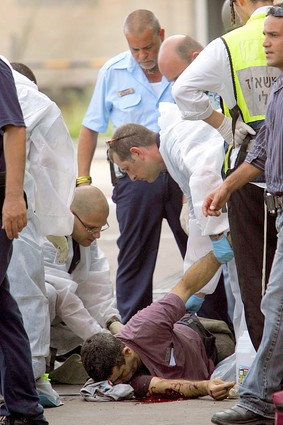
Israeli police and rescue workers tend to a victim’s body in Haifa, northern Israel, where a Hezbollah missile exploded in a railway depot, killing 8 (July 16th) Getty Images
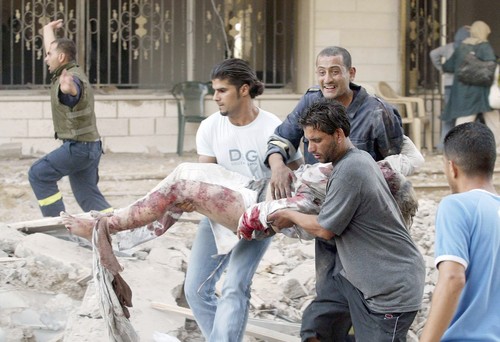
Lebanese civilians evacuate a corpse after the airstrikes in Tyre (July 16th) AFP/Getty Images
[images and captions from Newsday, where the first (photographer unidentified) is credited to AP Photo, the second is by David Silverman for Getty Images, and the third is by Hassan Ammar for AFP/Getty Images]
closer to Armageddon
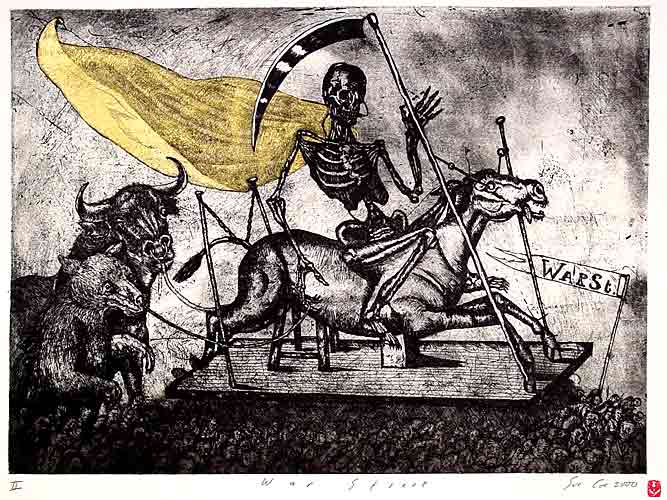
Sue Coe War Street 2000 etching 9.5″ x 12.5″
Okay, for better or for worse, the U.S. is the only “superpower” (for now) so I don’t think it’s presumptuous to talk about the size of our footprint: Right now unfortunately our impact doesn’t seem to be meliorative anywhere, and there may be no better gauge of the bankruptcy of American leadership and diplomacy than the headlines which appear on my YAHOO! page at this moment.
REUTERS:
Israeli reprisals hit Lebanon
North Korea storms out of meeting with South
Iran defiant after case goes back to UN
ASSOCIATED PRESS:
Israel attacks Beirut airport
India names suspects in train attacksJapan wants quick U.N. vote on N. Korea
AGENCE FRANCE-PRESSE:
Dozens killed as Israel bombs Lebanon over seized soldiers
North Korean missile diplomacy falters
Defiant Iran threatens to quit nuclear treaty
Now, what was it the Bush administration neocons were going to teach the world? It looks like we’re closer to the fundamentalist/crazies’ longed-for Armageddon than the Kristols’ new world of cadet-democracies, but that should not be either a surprise of a disappointment for most of Bush’s hard-core fans.
[image from Graphic Witness]
Chris Moukarbel at Wallspace
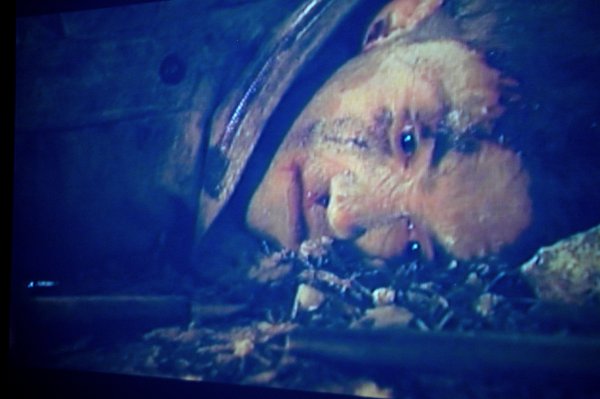
Chris Moukarbel Untitled 2006 DVD projection [still from installation]
Who owns 9/11? Even the question is scary, but most of us would answer in disgust, “George Bush”. Nevertheless we would have to admit that this quick response ignores the other part of the power/money equation which dominates our public and, increasingly, private lives. Chris Moukarbel’s audacious new work, together with the restraining order it has provoked, dramatizes the pervasiveness of corporate and governmental control over all information – and ultimately its disastrous impact on our ability to respond to any challenge, including but not limited to those posed by terroism.
The artist’s “Untitled” appears in a group show called “Data Mining” curated by Joe Scanlan and installed at Wallspace in Chelsea.
Moukarbel’s reference is Oliver Stone’s $60 milliion about-to-be-released film, “World Trade Center”. The artist [in this context I think the noun’s reference is clear] originally filmed a 12-minute video, “World TradeCenter 2006”, based on a bootleg copy of Stone’s script, but Paramount Pictures was able to persuade a court to issue a restraining order on the piece. What is being shown in the gallery this month is a work created from footage shot in the process of making the proscribed video. We see and hear two actors in position [trapped in debris beneath one of the towers] for their roles and conversing in character or addressing the director who remains off-camera.
Moukarbel speaks in an article which appears in today’s NYTimes:
“I’m interested in memorial and the way Hollywood represents historical events,” Mr. Moukarbel said in an interview yesterday, the day after his new video was shown as part of the group exhibition “Data Mining” at Wallspace, a Manhattan gallery. “Through their access and budget they’re able to affect a lot of people’s ideas about an event and also affect policy. I was deliberately using their script and pre-empting their release to make a statement about power.”
“My film was offered free on the Internet,” he said of “World Trade Center 2006.” “It cost $1,000 to produce. We’re at a place now where technology allows the democratization of storytelling.”
It’s a terrific piece with an awesome pedigree conveniently provided by the agents of power it addresses. At the opening two nights ago the gallery provided, in addition to the informational plaque attached to the wall outside the darkened viewing room, the complete text of the first video and a copy of the restraining order itself.
Eric Rofes, pleasure even in the manner of his departure
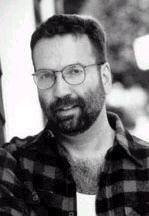
Eric Rofes
Eric Rofes died on Monday.
This remarkable and very gentle activist was one of the most important voices to ever represent the “sexual outsider” – meaning effectively just about everyone who’s ever done the thing, or even only thought of doing it, and still of course all women, as charter members of the tribe. Rofes was an individual thinker and mover, and as his own queer sub-community became more and more interested in pursuing an elusive and illusory respectability he often found himself a voice crying in the wilderness – when his arguments were not actually demonized, described as monstrously sexually-compulsive.
In the death announcement on the PlanetOut site, Richard Burns, executive director of New York’s Lesbian, Gay, Bisexual and Transgender Center, is quoted: “He was a critical thinker and someone who didn’t feel it was necessary to go with the flow in his analysis. He believed we needed to build a healthy community and respect adult sexual decisions and not pathologize or infantilize gay men’s sexual lives. In the face of HIV/AIDS that was not always a popular view.”
Ben Shepard, who also knew Rofes as a friend and a fellow activist, has written this memorial:
GOODBYE TO ERIC ROFES
I just got word that Eric Rofes died of a heart attack. I had known Rofes since our time in San Francisco with Shanti Project in the early 1990’s. We reconnected together in the late 1990’s doing SexPanic! stuff in 1998. He was a caring voice who hoped for pleasure to be part of our democracy. He argued for this, screamed about it, yearned for it. When he was attacked he fought back about it. And many attacked Rofes. They attacked him for wearing leather when he testified at the National AIDS Commission in San Francisco. He was criticized for embracing Walt Odets and the notion of survivor guilt among gay people who had lost whole cohorts of friends to HIV. And he was attacked when he ran Shanti Project. But he kept going. And he kept on asking people to think about the complexity of their lives and struggles and emotions. After leaving Shanti Project, he earned at PhD at Berkeley and wrote two enormously influential books, Reviving the Tribe: Regenerating Gay Men’s Sexuality and Culture in a Period of Ongoing Epidemic and Dry Bones Breathe: Gay Men Creating Post AIDS Identities and Subcultures. Both were enormously important, contextualizing the losses to community, pleasure, friendship, and social knowledge of the connection between public sexual space and community organizing with the AIDS years. Early in Reviving the Tribe, Rofes wrote about standing with tears in front of a sex club where he had once enjoyed so much pleasure. Rofes was intensely aware of the multiple losses to AIDS and the need to think through what was going on. “I believe that any hope for collective survival is rooted in the realities of our lives, however, harsh and seemingly unacceptable,” Rofes wrote. “Our inability to continue confronting the ever-intensifying manifestations of AIDS has brought us to the point of paralysis.”
Rofes railed against those who suggested gay men should just ‘grow up’ and reject public sexual culture. “Even a cursory look at the histories of our movement will show that sexual liberation has been inextricably bound together with gay liberation, the women’s movement, and the emancipation of youth,” he wrote. He suggested a vast cultural amnesia was taking place as the lessons of the gay liberation years were lost amidst panic over continued rates of HIV. Rofes was keenly aware of the complexity of questions of sexual self determination. “For many, the forbidden becomes desired; taboo produces cravings; the return of the repressed is made corporeal and is experienced as an enormous hunger,” he wrote in his newest book. He was always aware telling gay men or anyone to just say no served no one’s ends but the moralists. Thus, HIV prevention would have to be considered within a broad holistic, harm reduction approach. For Rofes, there was far more to the question of pleasure than just getting off or male privilege. Central principles of democracy in America lay at the core of the sex panic question. Rofes wondered, can you lose your job for deviating from conventional sexual norms? For many, the answer is affirmative. Like so much else within our democracy, what one person enjoys, another will inevitably find offensive, he counseled. Variation is a core component of social life. And some people built alternative kinship networks. This should not be condemned, at least not in a pluralistic democracy. “Among the most effective ways of oppressing a people is through the colonization of their bodies, the stigmatizing of their desires, and the repression of their erotic energies,” he claimed during the National Gay and Lesbian Task Force‘s Creating Change Conference San Diego, November 16, 1997. “We believe continuing work on sexual liberation is crucial to social justice efforts,” (see complete speech here).
In 1998, Rofes came to New York to speak on a panel for the one year anniversary of SexPanic! and contacted me. I had just finished a book about the San Francisco AIDS years (White Nights and Ascending Shadows: An Oral History of the San Francisco AIDS Epidemic) and he wanted to talk about the book. We talked about survival, the capacity for resiliency, and the hope for a lusty pleasure in a democracy. I told him about my work with the group as a kinky straight man and he encouraged me to push forward and help forge a different kind of politics based in caring connection and social justice rather than identity, despite what people said. I had always had an image of him being a radical, but in person he was a caring, thoughtful person willing to consider each of our unique contributions. He was ever aware of all of our capacities to contradict ourselves and be bountiful. And was painfully aware that some of his greatest critics were gay men who scorned him for integrating his own personal story into a larger story of gay liberation and the need to revive the tribe. ‘Where are your sexual politics?’ he wondered after such attacks.
In the years that followed Rofes tried to build a broad based movement for gay men’s health. He was keenly aware of the need for social movements to support broad based struggles for social justice. When I interviewed Rofes for my dissertation, he helped tease out the relationship between embodied experience and the history of struggles for pleasure. Rofes saw that the role of the gay liberation movement was to reject notions that pleasure should be considered a peripheral component of social movement activity. Rofes helped me think about pleasure and play as strategy for organizing. “Play is a term for drag, ACT UP zaps, the use of food in the Latino Community, the use of dance dramaturgy, culture jamming, the carnival, and other forms of creative community building activities,” he helped explain to me, as we talked. Thus, play is the exhilarating fun, the pleasure part, the joy of building a more emancipatory, caring world. Rofes would point out that humor, drag, eating food together, cultural rituals support activism. “Ultimately, does a sober form of organizing appeal to more than white people in a sustainable way?” he asked. We concluded that play was part of expanding networks, social capital, and friendships extended around activism.
As we walked away after the interview in the West Village, Rofes said to me that he felt like a strange kind of survivor from a storm, from a different kind of era. Many, many of his friends had passed. AIDS was still around and so was Rofes, who had recently gotten tenure at the school where he happily taught and wrote.
That Spring of 2005, Rofes wrote that his life was a success despite the losses. “Recently I attended a dance party, one of the many evenings of intense music and cavorting available to thousands of gay men in my city each weekend. I looked over the crowd of primarily twenty-something and thirty-something men, shirtless, gyrating, arms reaching to the heavens. I thought immediately at how the doomsayers criticize this population of young gay men, saying things such as, ‘I didn’t work my ass off during the past 30 years to create a culture of drug use and unprotected sex and self-centered me-me-me attitudes. This is not what the gay movement was all about….’ And then I realized something, something surprising and simple. As someone who has spent the last 30 years working on gay liberation and AIDS activism and sexual liberation, what I saw before me was precisely the world I was trying to create. When we fought during the 1980s and 1990s to prevent gay men’s sexual cultures from being destroyed, when we worked to preserve certain values about gender play, friendship, and erotic desire, when we quietly worked behind the scenes to ensure that certain spaces would survive gentrification and public health crackdowns, we were fighting to preserve the ability of new generations of gay men to create worlds of pleasure and desire. As I looked out over the sea of dancing men, I realized, despite all the battles we’ve lost in terms of politics and discourse and the media, gay men and gay sexual cultures had managed to survive and, indeed, thrive.”
The last time we saw each other was last Spring during the Pacific Sociological Association Meetings. In between a tour to Slammer‘s sex club in West Hollywood we talked about other heroes of the movement who were facing their mortality. Rofes was always concerned about AIDS, but none of us know how we are going to go out.
Eric Edward Rofes was 51 years old. He is survived by his long time partner Crispin and friends from around the world. He will be missed.
[image from Gay Today]
Rolfes had a lover and died in Provincetown, on a summer day, while working on a writing project, unexpectedly, of a heart attack. There aren’t many more attractive scenarios for a departure, especially for a pleasure-loving activist in the age of AIDS.
Oppenheimer would not be surprised
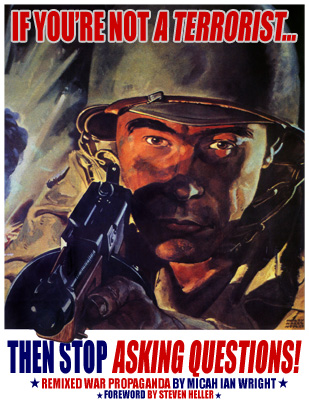
In the last hours these two stories have appeared in the NYTimes:
“Cheney Assails Press on Report on Bank Data” and:
“Court Bars Info Request on NSA Wiretapping”
So, the engineer behind the systematic destruction of our liberties is outraged that the media might inform us of the fact, and in a related case our courts have once again ruled on the side of the rogue executive. Even the third branch of our government is paralyzed to resist these authoritarian depredations, fearing the accusation of being soft on terrorism (the new McCarthyism) while ignoring the terrorism at the top.
Wednesday evening we were privileged to attend a magnificent performance of Heinar Kipphardt’s 1968 play, “In the Matter of J. Robert Oppenheimer” at the Connelly Theatre in the East Village. In the drama, which is based on actual transcripts from a 1954 hearing, Oppenhiemer has been summoned before a committee of the Atomic Energy Commission charged with determining whether his security clearance will be reinstated. In the first act he responds to one of the lawyers arguing against his case,
“There are people who are willing to protect freedom until there is nothing left of it”.
Can anyone say the phrase, “police state”? Or are we going to wait until we are totally forbidden to do so?
[image from Micah Wright]
Bush absolutely did not visit Iraq or Baghdad last Tuesday
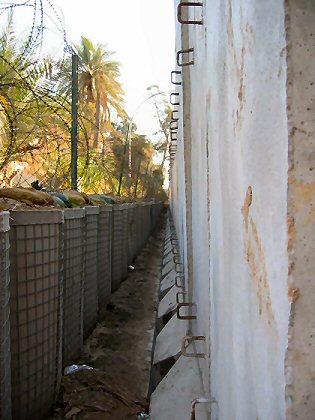
no hanging garden, this [a section of the Green Zone perimeter]
I’m tired of the media’s [continuing] misleading descriptions of last week’s flight by Bush to Baghdad International Airport and the Green Zone. If I thought it was just a question of semantics, I’d leave it alone, but words are important, especially when they are instruments of propaganda and they are going unexamined.
He didn’t “visit Iraq”.
He didn’t “visit Baghdad”.
He visited a god-damned super-bunker sheltering people who call him sir.
Even at that our heroic conqueror’s departure for his five-hour stop-off inside a fortified headquarters (“the Ultimate Gated Community”) shared by his victorious army of pacification and a more-or-less client local government had to be kept secret from his own staff. Also, what does it say about this stunt that Nouri al-Maliki, the Iraqi Prime Minister and Bush’s host, didn’t know the President of the United States was coming until virtually the moment he showed up at the door?
[image from Rich Galen’s Mullings]
Guantanamo suicides a ‘PR move’* [to draw attention]

no, unfortunately this image is very real, and not Trompe l’oeil [the Yahoo! News caption for the picture begins: Leg irons and hand cuffs hang on a board at Camp Delta at Guantanamo Naval Base in Guantanamo, Cuba, in 2004.]
*
So reads the headline on the lead story on the BBC at the moment. The attribution for the description of the deaths of three prisoners in our Cuban concentration camp is the United States Deputy Assistant Secretary of State for Public Diplomacy [my italics].
Colleen Graffy told the BBC the deaths were part of a strategy and “a tactic to further the jihadi cause”, but taking their own lives was unnecessary.
We’re expected to listen to our “public diplomat” explain their deaths as a bad career move, but we aren’t allowed to know who any of these folks are?
[news tip from Barry; image, credited “AFP/Pool/File/Mark Wilson”, from Yahoo! News]