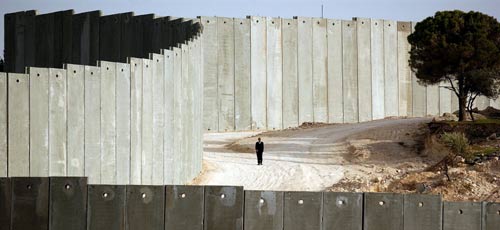
a Palestinian man walks next to a section of a wall eight-meters high built by the Israeli government, arbitrarily separating Jerusalem (and some additional annexed lands) from the Palestinian suburb of Abu Dis
We will not prevent terrorist acts by raising walls or bombing innocent strangers with sophisticated weaponry; by increasing the legal penalties for posession of a bomb; by spying on each other, high-tech or otherwise; by humiliating “the other;” by outlawing nail files or lighters; by putting an armed guard in every environment which has been a previous target; by incarcerating all the brown people on earth; by staying at home behind drawn curtains.
If we want to see it cease, we have to look to the cause of the terrorist response, not its manifestations. And it is a response; terrorism is always a response of the weak to the assaults of the powerful.
Terrorism feeds on imperialism. Neither of these is a state, merely a tactic; eliminate the imperialism and the threat from terrorism will disappear. We will never be made safe by building walls or by extending the power of our own state at home or abroad; the entire planet will survive and prosper if we recognize the appropriate limitations of that state and the proper proportion of our people, and placing both in the community of all nations and peoples.
[image from Newsday by Moises Saman]
Category: Politics
difficult music for difficult times: an appreciation
[of a kind of harmony]
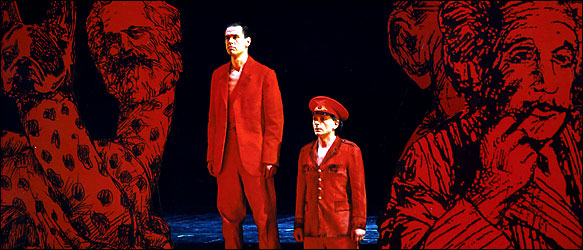
and I’m also very fond of red, when it’s used well [scene from “Shadowtime”]
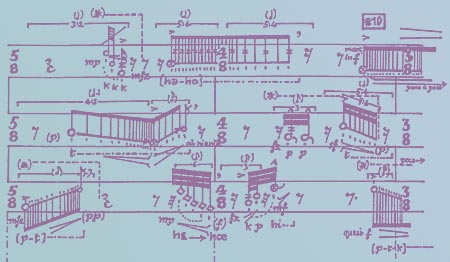
Brian Ferneyhough Time and Motion Study III 1974 16 mixed voices, percussion, live electronics [detail of the score]
I had intended to get tickets to Brian Ferneyhough‘s new opera, “Shadowtime,” which receives its American premier next week, from the moment I had heard about it. But the Lincoln Center Festival flier we had received weeks ago had very soon been buried underneath competing mailings and was almost immediately forgotten – until this afternoon, when I read Jeremy Eichler’s piece, “A secular Messiah gets His own Opera,” in the NYTimes Arts&Leisure section. I immediately looked for the Festival site on line and then grabbed the phone, fearing that there might no longer be anything available but my best chance would be with a human voice. Then even as I was doing this I had to remind myself that this was not “La Boheme.” The world wasn’t going to be beating a path to Columbus Circle in order to hear an opera about “an arcane cultural philosopher” featuring “fantastically intricate music, with nothing as old-fashioned as a tune in sight,” in Eichler’s words – even if I had been seduced immediately.
While the two paragraphs from near the conclusion of the Times piece I’m copying below may not entirely explain my own love of difficult music (which is as much about the vulgar appeal of its invention, its energy, its novelty and its provocation as it is about its intellectual virtues), they do say something about the social and political utility of difficult art – in any medium.
“Shadowtime” had its premiere last year at the Munich Biennale, and critical reaction ranged widely. The Süddeutsche Zeitung hailed it as “an apex of modern operatic artistry,” but The Sunday Times of London described it as overly cerebral, “an abstract idea of an opera rather than the thing itself.” The truth may well depend on one’s definition of modern opera.
Mr. Bernstein [Charles Bernstein, the librettist], for his part, readily concedes the many difficulties of “Shadowtime,” and argues that they arise not only by design but by necessity. “Clarity is valuable in many situations, but not necessarily in art,” he said in a recent interview at his Manhattan apartment. “Many will no doubt be befuddled, just as a work that seeks to be clear risks boring people. These are the risks you have to take.”
Yet more seems to be at stake than simply keeping an audience challenged. When pressed, Mr. Bernstein echoes Benjamin’s friend and colleague Theodor Adorno, who defended difficult music as having its own social value precisely because it teaches us how to withhold understanding and therefore helps us resist the allure of false clarity in the world beyond the concert hall. Complexity, in other words, is a worthy ideal in art because reality is even more complex and dissonant than the thorniest work of modernism, even if politicians and the commercial culture reassure us that everything is simple, clear and harmonious.
Oh yes, I had no trouble getting two good seats on the aisle in the orchestra, and for a fraction of the price of seats at that older and much more famous opera venue where they don’t seem to be able to get past “La Boheme.”
[first image from the NYTimes; second image from tagederneuenchormusik]
MTA: stadium treated as emergency, but security gets yawn

leaving it up to the riders
Barry has just about covered the issue, with the help of Newsday‘s estimable Ray Sanchez, but a letter to the editor published in the NYTimes helps to illustrate the scale of the criminal incompetence and negligence of those at the top by bringing up the most recent scandal involving the MTA:
To the Editor:
The terrorist blasts in London and a similar attack last year in Madrid dramatically point to the vulnerability of New York’s transit system to a similar attack.
Despite setting aside nearly $600 million [state and federal money] to secure the transit network against a terrorist strike, the Metropolitan Transportation Authority has accomplished little since 9/11. It was not until March 2003 that the agency announced a plan to address the transit system’s weaknesses.
In fact, the lion’s share of the money has not been allocated. The agency’s most public initiative is a failed proposal to ban photography by straphangers.
Its foot-dragging is especially unsettling when contrasted with the speed with which it rushed through a deal for the proposed West Side stadium. [the italics are mine]
Instead of issuing color-coded alerts, the federal government and the M.T.A. should urgently undertake measures with existing money to enhance security.
Manuel Cortazal
Bronx, July 7, 2005
Wish us all luck. It looks like we’re going to need it.
[image from the MTA]
first they came for the pornographers . . .
. . . but I wasn’t a pornographer*
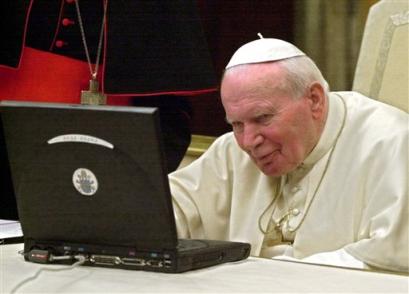
safe enough for him?
Patrick Moore has an OPINION piece in today’s Newsday, “Bush team uses ‘skin game’ to attack porn,” which sounds an alarm on behalf of principles much greater than the protection of our access to adult sexual entertainment. An excerpt follows:
Under the guise of regulatory powers, the department [of Justice] is planning a punitive and ideologically motivated assault on the adult entertainment industry. A legal challenge last month delayed the onset, but Justice is hoping later this year to begin enforcing a host of regulations so onerous that they may represent the end of pornography as a viable business in America.
Regardless of one’s feelings about adult entertainment, the situation is a disturbing illustration of a larger trend in the Bush administration: the use of regulatory powers to advance a conservative moral agenda.
. . . .
One can understand that the government wants to ensure that porn performers are of legal age. However, these regulations ensure no such thing. In fact, in several lawsuits involving underage performers, the minors had provided government-issued IDs to producers. As we are learning in terms of both national security and immigration, government IDs are easily obtained and easily falsified. And demanding proof of age for performers who are clearly 30 or 40 years old seems less about protecting children than about punishing an industry the government deems immoral.
By focusing on regulatory enforcement, the Department of Justice cannily avoids repressing adult entertainment on the basis of content, knowing that the First Amendment presents a challenge that probably cannot be overcome. But the effect – suppression of protected speech, whether or not it is deemed obscene – is achieved outside the normal checks and balances of American government.
The Bush administration has a track record of attempting to regulate morality behind a smoke screen of law enforcement, bureaucratic rules and scientific research. These efforts are often focused on unpopular issues, where the administration is fairly certain that public opinion will provide protection, regardless of the ethics involved. Few citizens in an increasingly conservative America will fight to protect the constitutional rights of pornographers.
AIDS is another example. For several years now, researchers applying for National Institutes of Health grants to study AIDS have been told to remove references to gay men, even though they continue to represent the majority of cases here in the United States. And, famously, the Bush administration has touted its compassion for those dying of AIDS in Africa, even while it denies funds to organizations that offer reproductive health services or stress condoms over abstinence.
Full disclosure: I knew Patrick Moore slightly but I admired his good sense hugely when we were both busy with ACT UP fifteen years ago.
*
My introduction is a conscious reference to Martin Niemöllers lines about moral failure in the face of the Holocaust:
First they came for the Communists, but I was not a Communist, so I said nothing. Then they came for the Social Democrats, but I was not a Social Democrat, so I did nothing. Then came the trade unionists, but I was not a trade unionist. And then they came for the Jews, but I was not a Jew, so I did little. Then when they came for me, there was no one left to stand up for me.
Yes, I know a morality crusade does not make a holocaust, but although we deal with new evils in new times, fascism’s tactics, and the kind of popular response needed, have changed very little.
[image via E. Heroux]
liberty and justice for all
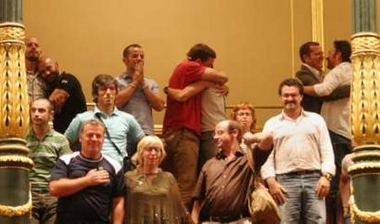
reaction in the public gallery of the Cortes on June 30, as the Spanish parliament extended full rights of marriage to all citizens
Some day a people crazy about waving its own flag at home and around the world may actually understand the liberty and justice it was intended to represent.
Meanwhile, much of the rest of the world has already overtaken us.
Excerpts from the speech by Spanish prime minister Jose Luis Rodriguez Zapatero delivered just prior to the vote last Thurday which legalized gay marriage and adoption of children by gay couples:
We are not legislating, honorable members, for people far away and not known by us. We are enlarging the opportunity for happiness to our neighbors, our co-workers, our friends and, our families: at the same time we are making a more decent society, because a decent society is one that does not humiliate its members.
In the poem ‘The Family,’ our [gay] poet Luis Cernuda was sorry because, ‘How does man live in denial in vain/by giving rules that prohibit and condemn?’ Today, the Spanish society answers to a group of people who, during many years have, been humiliated, whose rights have been ignored, whose dignity has been offended, their identity denied, and their liberty oppressed. Today the Spanish society grants them the respect they deserve, recognizes their rights, restores their dignity, affirms their identity, and restores their liberty.
It is true that they are only a minority, but their triumph is everyone’s triumph. It is also the triumph of those who oppose this law, even though they do not know this yet: because it is the triumph of Liberty. Their victory makes all of us (even those who oppose the law) better people, it makes our society better. Honorable members, There is no damage to marriage or to the concept of family in allowing two people of the same sex to get married. To the contrary, what happens is this class of Spanish citizens get the potential to organize their lives with the rights and privileges of marriage and family. There is no danger to the institution of marriage, but precisely the opposite: this law enhances and respects marriage.
Today, conscious that some people and institutions are in a profound disagreement with this change in our civil law, I wish to express that, like other reforms to the marriage code that preceded this one, this law will generate no evil, that its only consequence will be the avoiding of senseless suffering of decent human beings. A society that avoids senseless suffering of decent human beings is a better society.
With the approval of this Bill, our country takes another step in the path of liberty and tolerance that was begun by the democratic change of government. Our children will look at us incredulously if we tell them that many years ago, our mothers had less rights than our fathers, or if we tell them that people had to stay married against their will even though they were unable to share their lives. Today we can offer them a beautiful lesson: every right gained, each access to liberty has been the result of the struggle and sacrifice of many people that deserve our recognition and praise.
Today we demonstrate with this Bill that societies can better themselves and can cross barriers and create tolerance by putting a stop to the unhappiness and humiliation of some of our citizens. Today, for many of our countrymen, comes the day predicted by Kavafis [the great Greek gay poet] one century ago: ‘Later ’twas said of the most perfect society/someone else, made like me/certainly will come out and act freely.’
Can we try to remember these noble words the next time any U.S. politician opens his or her mouth?
[a dear friend of mine, Jamie Leo, forwarded the speech text this morning; it can be found on Doug Ireland‘s site, where the translation is credited to Rex Wockner; image by Susana Vera from Reuters]

Tom Hurndall? – but “old news” is no news, we’re told
[unless it helps the White House – or the NYTimes]
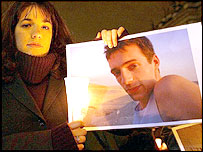
Sophie Hurndall, Tom Hurndall’s sister: “. . . but there are thousands of cases out there where people don’t have the weight behind them that we have.”
UPDATE:
In Britain the media is interested in the Battle of Trafalgar and Tom Hurndall, even though both are dead. We get runaway brides and the ten commandments on a lawn. If you live in the right place once in a while you get a peek at a real story, but only a peek and only on terms supported by a larger agenda.
Lest anyone think that the nationality of the victim is key to the quality of justice extended or press coverage provided, the story of the very American Rachel Corrie is more than a caution. Oh, and she and her family were just as photogenic, just as white, just as blond as the Hurndalls. The usual popularity of the type is familiar to everyone in America; viz. the description of the ubiquitous missing children and young women in never-ending reports on the pretend-news programs of CNN and Fox. Sometimes war and politics trumps everday racism, even in America.
In a tiny article [scroll down] on page 8 today, the NYTimes reports that the Israeli soldier who killed Tom Hurndall two years ago has been found guilty by a military court.
For more, see this BBC story for a description of the crime, and this one for a bit on the trial itself.
The defendant was led out of the court in handcuffs and tried to attack a number of photographers and cameramen filming him.
More than 50 people crowded into the small courtroom on a military base in southern Israel, to hear the verdict – which took more than an hour to read out.
In addition to the manslaughter verdict, [Taysir] Hayb was found guilty of obstruction of justice, incitement to false testimony, false testimony and improper conduct.
The court was told Hayb fired at Mr Hurndall from an Israeli army watchtower, using a sniper rifle with a telescopic sight.
Witnesses said Mr Hurndall, from north London, had been escorting children away from gunfire when he was hit in the head by a single shot.
The Israeli army initially disputed this account, but under pressure from Mr Hurndall’s family and the British government it ordered a full investigation. It later indicted Hayb, a member of Israel’s Bedouin Arab minority [my italics].
The identity of the defendent serves to further dramatize the story as both a personal tragedy and as representative of the much larger human disaster fed by the U.S.-supported Israeli government occupation policy, the incompetence of Palestinian leadership, and the silence of good people everywhere.
[image from BBC News]
disgusted, but not quite shutting up
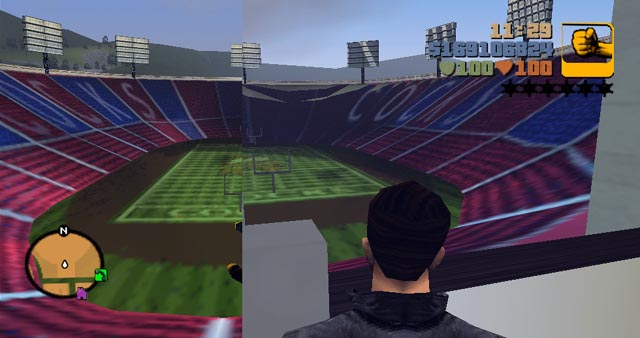
” . . . the inside of the stadium in Liberty City”
Yes!
Just when I think I’ve been doing pretty well with my own campaign of “inner emigration”* [because, basically, we are clearly not a democracy; I don’t think anything else we can do will make a difference; there are no institutions left in place to turn this country around; etc.], something gets me going again. This time it’s Barry, with whose frustrations [“I rarely post about politics anymore. I’m too disgusted.”] – and limits of patience – I am totally in agreement.
* For discussions of the subject, see a discussion centered on Thomas Mann and his contemporaries, and one devoted to the experience of Karl Amadeus Hartman.
[image from colinfahey.com]
life after birth

respect
A gentle letter to the editor in today’s New York City Newsday ends with this terse critique of the Republicans’ evil politics of stem-cell research: “After all, we may differ as to when human life begins, but it certainly does not end at birth.”
The full text follows.
President George W. Bush’s antipathy to stem-cell research is a paradox wrapped in a conundrum. How can he have any respect for human life when his rush to war has resulted in the deaths of thousands of innocent people?
To say nothing of his role as governor of Texas, where he executed numerous people. If Bush was truly concerned with the dignity of human life, his policies would be 180 degrees different in almost every category. After all, we may differ as to when human life begins, but it certainly does not end at birth.
Max Podrecca
Manhattan
bringing terror home, “Peace by Piece”

Damien Davis Bear and Cover 2004 paper bears, desk [installation view]
How do we address the horror of Hiroshima and Nagasaki today, sixty years after the fact? The artist Hiroshi Sunairi, a native of Hiroshima, asked his students at New York University this question when he taught a course one year ago entitled “Peace by Piece.” Some of their answers are currently assembled downtown in Tribeca’s Debrosses Gallery.
My own most profound memory of atomic war is not the initial report of my country’s annihilation of these two great cities but rather the routine, regulary-scheduled school rehearsals for an imagined defense against the oh-so-likely employment of these same bombs by a former ally suddenly turned satanic enemy. Unlike the people of Hiroshima and Nagasaki, we were always able to come out from under our desks. To this day the people of the United States remain the only ones who have ever used these insane weapons against another.
Although he is far too young to have ever experienced the terror of The Bomb, or even the fear of its terror, Damien Davis manages to describe it in this simple, powerful installation. The small folded pieces of paper which appear at the bottom left in the picture are stray origami cranes folded by the students as part of the political mobilization of the project.
The exhibition will be accompanied by the artists and their professor on a flight to Hiroshima this summer, where it will be installed from August 13 through August 20 at the old Bank of Japan building, Hiroshima Branch, one of the few buildings which survived the 1945 bombing.
the World Trade Center site as a grand public plaza
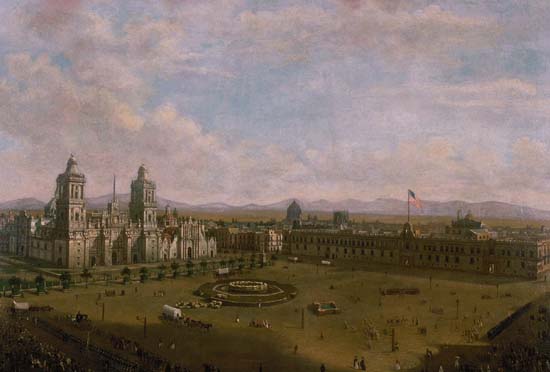
Pietro Gualdi Grand Plaza of Mexico City, Following the American Occupation of September 14, 1847 1847 oil on canvas [one of my all-time favorite public squares, for the richness of its life – once we left]
Over seventy years ago the Empire State Building was completed within thirteen months and yet we’re still staring at a hole downtown.
As we approach the fourth anniversary of the attacks on the World Trade Center we have no idea what’s going to be built on the still-empty site. Every intended purpose and every proposed design has ended up being compromised or rejected for one reason or another.
Except for the shopping mall.
The cultural spaces are out; people are apparently terrified of the idea of sitting at a desk high above “ground Zero,” so no one is talking about building the tall office buildings first included in the proposals; and no one knows where the little Greek church is going to be. The only projects now left on the table are something called the “Freedom Tower,” which has just been put on hold once again (because of the name, it’s a not-so-surprising augury for Bush’s America) and the even more tenebrous “Freedom Museum.” The current state of plans for a memorial to the events of September 11 is a mess, and it was ill-conceived from the start.
And as far as real freedom is concerned, forget about it; gotta stay off the grass and stay off the streets. Maybe watch it on TV.
So I have a modest proposal to resolve the problem. Actually it’s not modest in its implications or in the scale of its ambitions, only in the simplicity of its utility and its physical design.
New Yorkers have been told that they have no right to assemble in large numbers in Central Park to party or address political grievances, and they have seen how impossible it is to find any alternative in a city without great open public spaces. I suggest that the site of the old World Trade Center be made a true monument to freedom by reserving every acre of its surface as a public square devoted solely to the enjoyment of the people and to their right of expression, whether in joy or in anger.
It absolutely must not be a lawn however, even if there were any way to ensure that great assemblies of people would not damage it. We need a great plaza worthy of a great city. Plazas welcome free assembly. Downtown, in the new World Trade Center there will be trading in ideas and grass is not part of the kit.
We would be perfectly happy with cut stone or the happy-sounding, gravel-like surface used almost universally in the grand parks of European towns and cities. Trees, yes. Include trees perhaps, but only around the perimeter. London Plane trees would do just fine. Above all, let us have light and air. Freedom thrives on it.
ADDENDUM: A year and a half ago, Barry did a post describing a provocative, minimalist WTC proposal from Ellsworth Kelly, although his concept involved the grass thing.
[image from Louisiana State Museum]