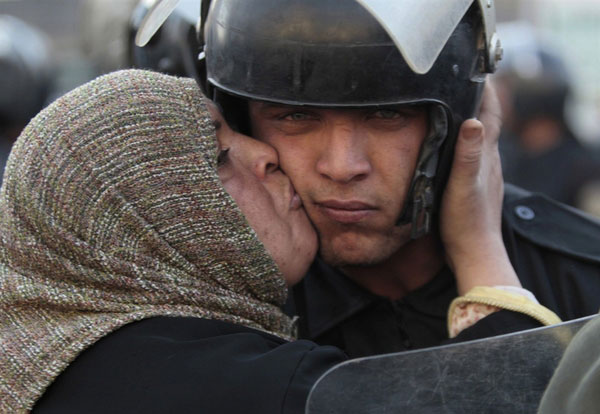
protester and riot policeman, Cairo, Friday, January 28, 2011*
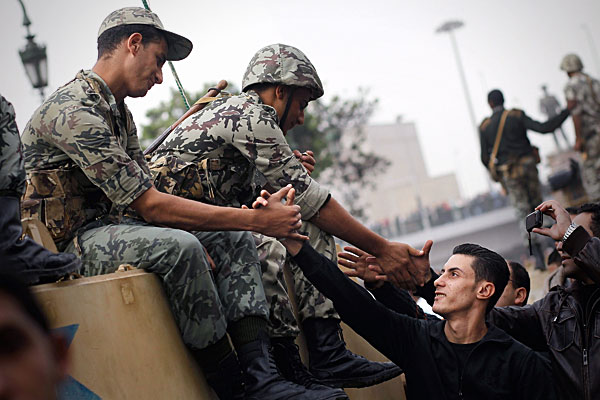
protesters and soldiers, Cairo, Saturday, January 29, 2011
NOTE: This post was composed just after 6 pm today, Wednesday; since then (it’s now 11 pm in New York) its thesis has become reality.
So what is the story? Will it be kisses and handshakes?
The police, uniformed or plainclothes, have largely been discounted as a significant factor in how the events in Egypt will unfold, although that story is still to be told, but the position of the army is definitely not yet resolved. To me it’s looking more and more like the army is working toward the same end, although not to identical purpose, as what passes for the Mubarak regime right now: Every president of Egypt since King Farouk was overthrown in 1952 (by generals) has been a high-ranking army officer. Whatever their relationship may have been before last week, the upper echelon of the military is presumably no longer fully vested in Mubarak. Yet it’s unlikely that it would want to see their general-in-a-striped-suit completely disgraced; an orderly departure of an old comrade would almost certainly be preferred.
Here’s my further argument:
The officers are more likely to prefer Suleiman to the unknown that’s represented by what surely looks to them as a still-leaderless mob, and in fact they may themselves have created his new vice-presidential office as a transition device, although not a transition to democracy.
The fact that the army is not fighting the protesters in Tahrir or elsewhere should not be taken as clear evidence of its indifference to the outcome; in fact it may be part of a cynical plan shared with the Mubarak administration (and possibly Obama’s as well): Extended, and even increasing, chaos in the streets just may look to them like an opportunity for the restoration of order, under the authority of more or less the same interests which made up the old regime (and those of Washington).
Even the army rank and file, conscripts said to be unlikely to want to fire at the protesters, might come around to an accommodation with some kind of crackdown. This would especially be likely if they and other Egyptians come to look upon the revolutionaries, their numbers reduced by fear and attrition, as the enemies of Egypt.
Win-win: Everyone saves face; everyone saves power. The people? They never had it, and look what they would do with it if they did.
Last week I watched spellbound as Egyptians did what no one thought possible. I thought removing Mubarak was a done deal, and that the world, or the best of the world, wished them well.
I think I was mistaken. It now seems that the revolution is alone.
Today I realize how very much more will still be demanded of the heroic defenders of Egypt’s ancient honor, and future greatness. I wish them well; I wish us all well.
*
For a discussion of this image, see Garance Franke-Ruta in The Atlantic, “Why the Kiss Picture Is So Radical.”
[first image from Greenerblog (Lefteris Pitarakis / AP); the second image from CNBC]
Category: Politics
the U.S. has more blood on its hands
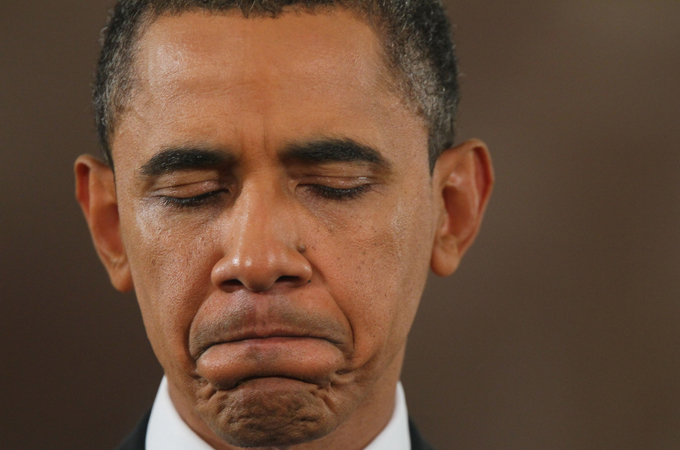
The shameful U.S. role in the 2011 Egyptian revolution will never be forgotten, above all in the Middle East.
The Mubarak regime (and the army?) has clearly planned and executed today’s violent confrontations in Tahrir Square and in Alexandria in order to retain power. It hopes to create a situation where it will be able to depend upon the loyalty of the lower military ranks when it orders the army to do its duty to protect the nation from those the regime portrays as its enemies, and it has to attract support from those, including some people who have supported the protests so far, who have become frightened by the violence initiated by its paid thugs and mustered civil servants.
Part of the plan is to silence the foreign journalists, who are the only source of information for people both within and outside Egypt (obviously the state monopolization of broadcast news and the continued shutdown of internet and cellphone service wasn’t enough).
The execution of this plan began today.
But Mubarak has help. The Obama administration, like governments around the world, remains complicit in the crimes of an Egyptian government which had already lost its legitimacy, but today joins the ranks of regimes which will be forever associated for their iniquity.
In addition, Obama’s neglect of the Mubarak regime’s assault on the press and communication systems has not gone unnoticed (note: many have suggested that our own government is working on a “kill switch” which would allow the White House to disconnect the Internet and all electronic communications at its will, “for security purposes”). “Many people make the very important point: Obama made NO mention of internet and mobile phones. The silence is deafening.,” tweeted Evan Hill (yesterday evening, New York time), responding to the President’s statement earlier. Even if Obama wanted to argue that what happens in Egypt is up to the Egyptians, silence is not a neutral act: The government’s monopoly of all means of communication is a huge advantage for reaction and repression.
None of this was necessary; none of this would have happened had our democratically-elected President done something more than ask “both sides” to avoid violence.
The MSM seems obsessed about the fact that the Egyptians in the streets have no leader; why isn’t it interested in the fact that neither do the Americans?
Mark LeVine has a very, very wise and beautifully-articulated piece on the Opinion page of the Al Jazeera site, “It’s time for Obama to say Kefaya!,” answering the question of why we persist in a disastrous foreign policy. I hadn’t read it yet when I borrowed the image at the top for my own post. Now I’m totally depressed: It seems only a revolution could alter our posture in the world. This is LeVine:
Such a position [supporting the status quo in the Middle East] is as tragic as it is stupid, as the president has been offered an unprecedented and until a few weeks ago unimaginable opportunity to back radical but peaceful change that is not stained by Western intervention in a region that everyone believes must undergo such change in order to prevent it becoming even more of a hotbed for terrorism and anti-Western sentiments.
. . . .
So the question really needs to be asked – whose interests is President Obama serving by remaining silently supportive of the status quo when he could, and by any measure, should, be lending vocal, public support for the peoples of the Arab world as they finally rise up against their leaders?
Is it companies like Lockheed Martin, the massive defence contractor whose tentacles reach deep into every part of the fabric of governance (as revealed by William Hartung’s powerful new book, Prophets of War: Lockheed Martin and the Making of the Military Industrial Complex)?
Is it the superbanks who continue to rake in profits from an economy that is barely sputtering along, and who have joined with the military industrial complex’s two principal axes-the arms and the oil industries-to form an impregnable triangle of corrupt economic and political power?
It’s hard to think of any other candidates at the present time.
[image of President Obama during the 2011 State of the Union speech from Al Jazeera (GALLO/GETTY)]
fears now for our own revolution, not the Egyptian
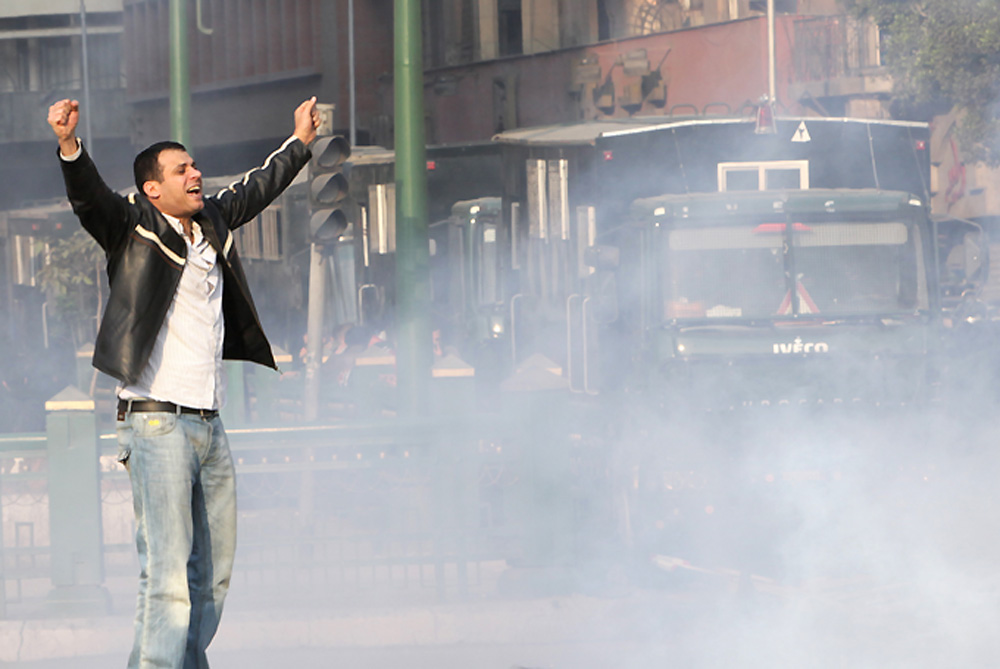
It’s now pretty clear that the Egyptian people are going to succeed in freeing themselves entirely without the help of the U.S. Today I’m not worrying as much about whether their courage and nobility will enable them to defend their magnificent, popular revolution as I am about the consequences of its brilliant success for the U.S. Their achievement is one which I fully expect to be repeated elsewhere in the Middle East – and beyond – one in which my government, it will be remembered, had no part, offered no help or encouragement, and in fact was only a hindrance.
Is Obama nuts? Who’s the terrorist now?
It’s as if the U. S. government was not satisfied with the degree of disgust with which much of the world holds its imperial presence, military adventures and reactionary foreign policy, and now President Obama has decided to further inflame the hatred by giving people in the Arab and Muslim world, and elsewhere, even more reason for their distrust, confirming the worst suspicions of some and making new enemies of others.
For us in the U.S., and for the world, the danger of this policy, whether authored by stupidity or narrow national calculation, should be obvious. Not only will we be hated and reviled, but the threats, both real and perceived, which since 9/11 have torn our political economic and social fabric apart, may now prove fatal to everything we ever thought we stood for. The nation which once appeared as a beacon of freedom for people around the world is now on the losing end of history, and those who have inherited so much from its founders can expect to find themselves in history’s dustbin.
Read Nicholas Kristof, writing now from the streets of Cairo:
Yet one thing nags at me. These pro-democracy protesters say overwhelmingly that America is on the side of President Mubarak and not with them. They feel that way partly because American policy statements seem so nervous, so carefully calculated — and partly because these protesters were attacked with tear gas shells marked “made in U.S.A.”
The upshot is that this pro-democracy movement, full of courage and idealism and speaking the language of 1776, wasn’t inspired by us. No, the Egyptians said they feel inspired by Tunisia — and a bit stymied by America.
Everywhere I go, Egyptians insist to me that Americans shouldn’t perceive their movement as a threat. And I find it sad that Egyptians are lecturing Americans on the virtues of democracy.
“We need your support,” pleaded Dr. Mahmood Hussein, a physiology professor. “We need freedom.”
Ahmed Muhammad, a medical student, told me: “Egyptian people will not forget what Obama does today. If he supports the Egyptian dictator, the Egyptian people will never forget that. Not for 30 years.”
I don’t think Americans can be reminded enough that the events in Egypt are not about them, but we’ve been so invested in the dictatorial regime now being leveled by a popular, nonpartisan national revolt that we cannot claim we had nothing to do with it in the past, cannot pretend we’re not involved in what’s happening now, and cannot expect to be isolated from its consequences.
More from Kristof, in a post done today:
I also fear that this choreography – sending former diplomat Frank Wisner (whom I admire) to get Mubarak to say he won’t run for reelection — will further harm America’s image. This will come across in Egypt as collusion between Obama and Mubarak to distract the public with a half step; it will be interpreted as dissing the democracy movement once again. This will feed the narrative that it’s the United States that calls the shots in the Mubarak regime, and that it’s the United States that is trying to outmaneuver the democracy movement. In effect, we have confirmed to a suspicious Egyptian public that we are in bed with Mubarak and trying to perpetuate his regime (even without him at the top) in defiance of a popular democratic movement.
[image from Al Jazeera (EPA)]
free Egypt
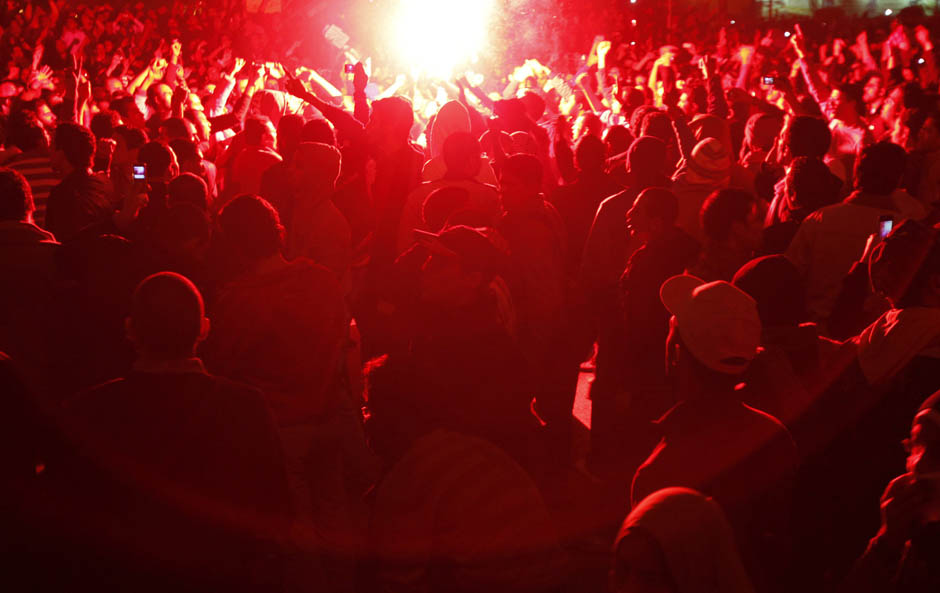
flares of anti-government protesters in Tahir (Liberation) Square January 25
ADDENDUM [the first five paragraphs below]:
The patronizing West, and the U.S. in particular, has always backed dictators in Arab countries because it sees such regimes as the only alternative to fundamentalism, and yet over and over again that policy has produced the fundamentalist regimes it fears most.
We’re now seeing that there is a third possibility, and we all better start supporting it before its too late everywhere.
By the way, I’ve just learned (from the Egyptian paper, Al-Masry Al-Youm) that The Pentagon is hosting senior Egyptian military leaders for annual bilateral defense talks this week, and that Pentagon Press Secretary Geoff Morrell, commenting on the talks, said: “That’s just one example of how engaged we are with the Egyptians, even as these developments have taken place on the streets of Cairo and elsewhere.”
No, I’m not making this up.
The same article describes the financial history of our relationship with the Mubarek regime:
Since its 1979 peace deal with Israel, Egypt has become the biggest recipient of US military aid after Tel Aviv, receiving nearly $36 billion in military assistance in annual installments of $1.3 billion.
I was up much of the night (January 26-27) scrambling about the internet, looking for more information (in English) on what is happening in Egypt. I was amazed at how much is out there, including video and audio recordings.
I want to share with others interested in the remarkable events of this week just some of the news sources I have found. These are just a few of the most accessible, most useful, and least hysterical sites for the unfolding events (note that some of the links may change location or even disappear):
SOME LINKS ADDED January 28
The English-language online site of a progressive Egyptian paper, Al-Masry Al-Youm
The English-language site of Al Jazeera
Mona Eltahawy (Egypt-born, New York-based columnist), anywhere you find her (heard on NPR)
The Guardian’s “Egypt” coverage
The Guardian live updates
Jack Shenker’s site (reporter for the Guardian)
the NYTimes’ blog, “The Lede” (edited by Robert Mackey)
Huffington/AP has live updates
The Times has a good perspective/analysis piece in this morning’s edition
And, finally, may the press gods bless the New York Review of Books for this
Juan Cole, oddly silent until the last few days
Democracy Now! has some good phone interviews
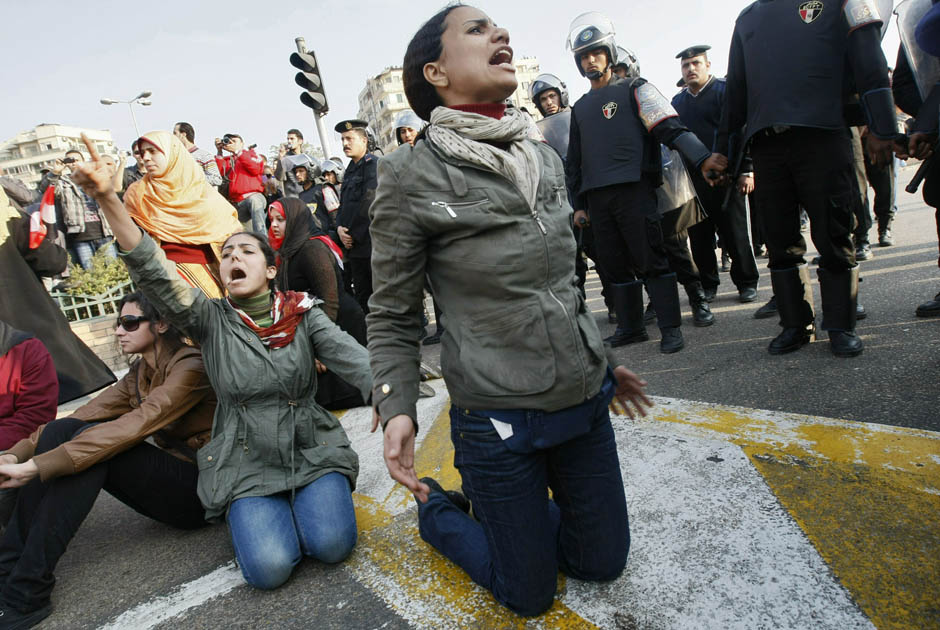
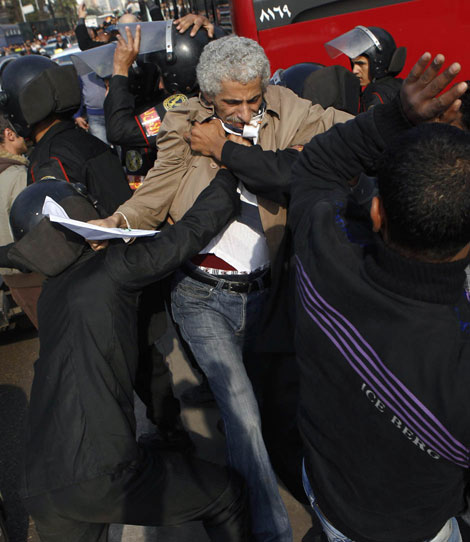
the demonstrations, while dominated by young men, are clearly diverse
[first image by REUTERS/Asmaa Waguih, the second by Mohammed Abed/AFP/Getty Images, the third REUTERS/Amr Abdallah Dalsh; all three from National Post]
Captain Honors pulled from carrier’s Afghan tour
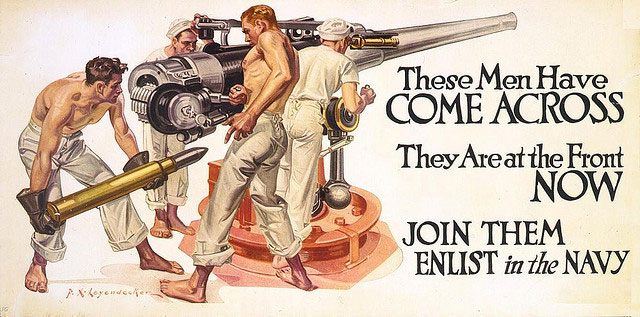
Join the Navy and see yourself made a laughingstock. How’s that unit cohesion thing work?
The captain of the USS Enterprise (not the starship), Owen Honors, has reportedly been temporarily relieved of his command because of the controversy over the stupid and raunchy videos he produced and broadcast to the ship in 2006 and 2007.
I don’t know why this is happening only now, three and four years later; the offending videos had been seen by thousands on board while the carrier was on two six-month Middle East deployments. It may have something to do with the beginning of our finally disabling DADT, although the videos were arguably equally offensive to women, who are allowed in the navy – even if they’re free to be asked and tell. In any event, Captain Honors will not be in command of the Enterprise and its compliment of nearly 6000 men and women (both het and homo) when it leaves for Afghanistan this month.
While looking online for images of queerdom in the Navy I came across this intriguing 1918 poster by queer artist Frank Xavier Leyendecker; he was doing his part for the war effort in the way he knew best, eroticizing the product with his illustrations.
I have a passion for history, and I just couldn’t drop this image. I decided to use it as an excuse to give a tiny bit more context to the continuing nonsense coming from supporters of those who are still scared witless there might be homos in the military.
F.X. Leyendecker’s brother, Joseph Christian, was an equally-skilled illustrator, and equally homo. I used one of his illustrations in a post I written two years back, also grumpy.
J.C. also admired the navy:
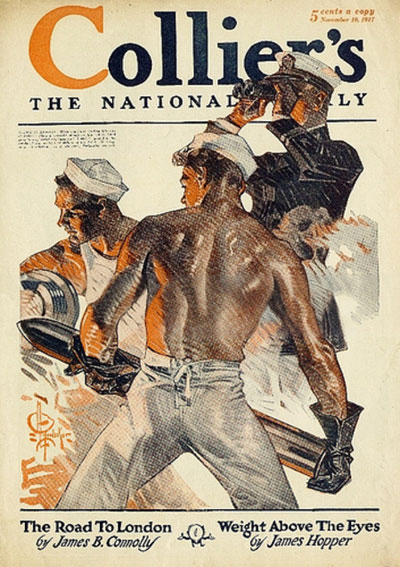
[top image from Joan Thewlis’ photostream; image at bottom form bilerico]
thrown out of Gagosian for addressing Kiefer’s art
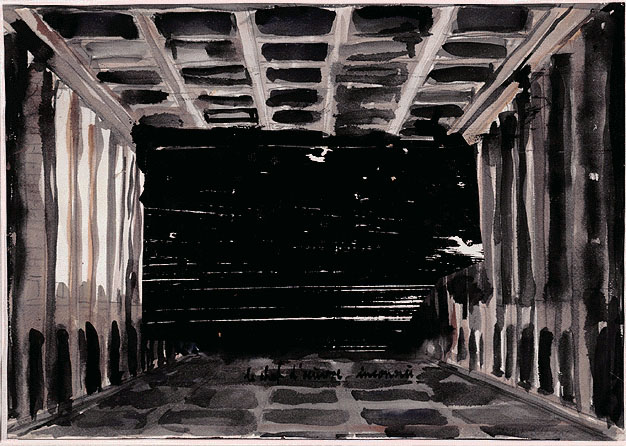
Anselm Kiefer le chef d’oeuvre inconnu (“unknown masterpiece”) 1982
“This is private property,” a gallerista in towering heels shot back. “We’re here to sell art.”
A small group of activists were thrown out of the Gagosian Gallery on West 24th Street this past Saturday on the final day of Anselm Kiefer‘s solo show, “Next Year in Jerusalem”. Claudia Roth Pierpont reports from the New Yorker’s online News Desk that a woman in her late fifties was swept up in the fracas which resulted when New York police officers called by the gallery arrived to evict the last four of the group (they had originally numbered eight). They had explained to gallery representatives that they had wished to participate in the conversation initiated by Kiefer’s work, and identified themselves as part of U.S. Boat to Gaza. Ingrid Homberg, who was visiting the exhibition independently, and who had tried to discuss it with the activists, was injured and fell when one of the officers dragged her out of the gallery.
It’s worth reading the Gagosian press release for the show, for the ironies provoked by Kiefer’s steely, overprotective New York gallery alone. The text includes these words, describing the central piece of the exhibition, “Next Year in Jerusalem”:
This imposing structure contains Kiefer’s provocative act, literally and imaginatively, to remind [us] of what has happened and what can still happen in the world. Occupations [the name of the piece, begun in 1969] is a visceral confrontation between history and the present that is lodged in the stuff of memory
.
ADDENDUM: The artist and writer Mira Schor has more information, and a wise, ruminative essay, “Anselm Kiefer@Larry Gagosian: Last Century in Berlin“, on her own blog.
[image (of a work not included in the Gagosian show) from Deutsche Bank]
Smithsonian/Wojnarowicz censorship protest, NYC
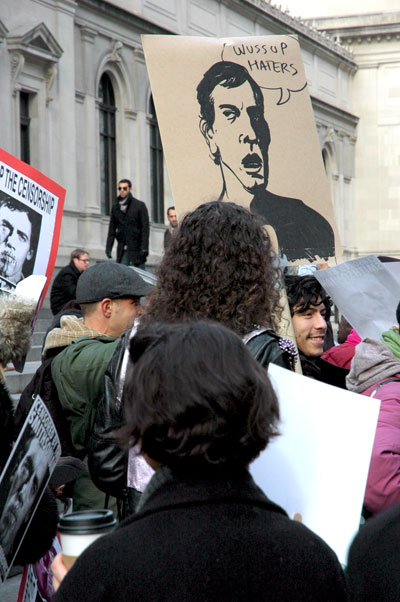
what would David think?
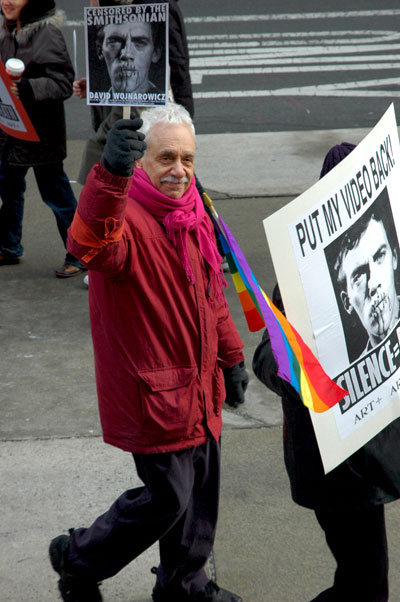
Sunday’s march up Museum Mile attracted around 400 to 500 people to the Smithsonian’s Cooper-Hewitt Museum to demand the return of David Wojnaroowicz’s video, “A Fire in My Belly,” to the National Portrait Gallery (NPG) exhibition, “Hide/Seek.”
I’ve uploaded here a few images from my experience of the rally; they are arranged in chronological sequence.
Committed artists, writers, thinkers and other citizens demand that the Smithsonian, which controls the NPG, restore the work so the public can see the exhibition as the curators intended. G. Wayne Clough, the Secretary of the Smithsonian and the man who cowardly pulled the art from the show one month after it opened, must apologize to the entire country, and to the people of all the first, second and third world countries which should be able to expect of the United States something other than institutional and governmental censorship and the pandering to demagogues and the benighted.
The arbitrary suppression of words and images inconvenient to those who wield power cannot go unchallenged.
We attracted a lot of press coverage both before and after the protest. The issue and our demands have been broadcast to a lot of people, but even as I headed uptown on Sunday I was wondering if, in defending light and reason, we might also be helping the devil. Those thoughts disturbed me then and they still do.
It’s like this: Bill Donohue is dumb, and although John Boehner and Eric Cantor may be little smarter, none of these hollow men is too dim to know that when they and other self-appointed censors and moralists pull these publicity stunts they only ensure that more people get to see what they think they shouldn’t.
So while Donovan and the others make lots of money off of their bullying and intimidation, they and others drawn into encouraging and supporting this transparently-cynical chicanery continue to do so because of both the illusion and reality of power produced by the wide media attention it draws. What discourages me most is the thought that the more public the blowup today, the more successful the censorious attacks of the wacky Right may be tomorrow, intimidating future victims from doing anything which might offend the morality police. These rows may actually inhibit free speech and expression going forward, and we have already seen that the leaders of our institutions are spectacularly lacking in courage.
While I’d rather not dwell on these gloomy thoughts, unfortunately the National Portrait Gallery show remains expurgated as I write this, with no sign of any change. Of course the whole thing is ridiculous, but are the censors winning? We have to know what we are up against if we hope to defeat them.
Since the demonstration on Sunday I’ve come across two links which may help explain to those who first came across this old war story only this month: They describe the issues, relatively unchanged in over two decades, and their historical context.
James Romberger, David’s collaborator, writes about his friend. And this 1990 video, showing the artist talking about the right-wing backlash against the NEA and arts funding, helps us to realize how much we lost when David’s voice was silenced, in the end not by the bigots, but by AIDS.
A printed excerpt from the video, David speaking:
And the thing that makes me laugh is that in the last twenty years images and words that artists or writers make have had absolutely no power, given that we’re essentially competing against media, you know, in order to create something that reverberates in those image or words. And the fact that, if at this point the images and words that can be made by an individual have such power to create this storm of controversy, isn’t that great?
It means the control of information has a crack in its wall.
Recent national and international stories, involving an explosive challenge to the dominance of corporate and government news sources, suggest that the crack can be protected, and enlarged, only if we’re willing to work at it.
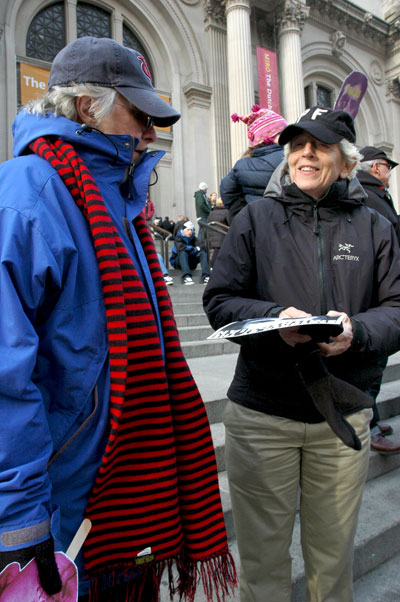
Betsy Crowell and Louise Fishman on the steps of the Metropolitan
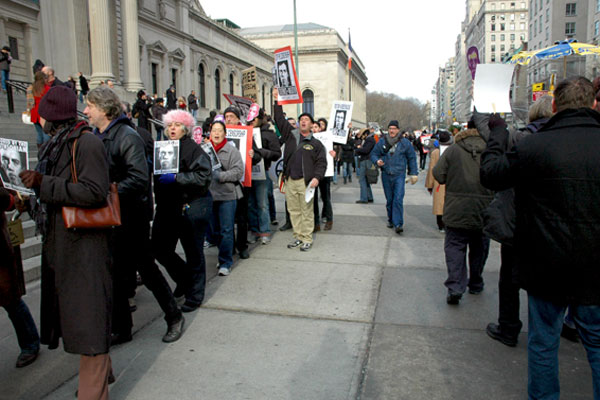
the picket forming on Fifth Avenue
Jonathan “Ned” Katz below the steps
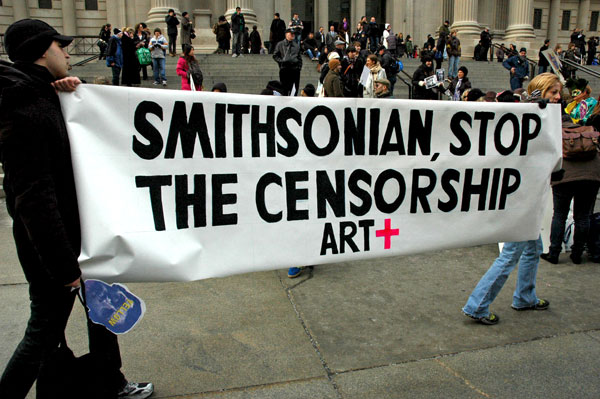
our spanking-new ART+ banner
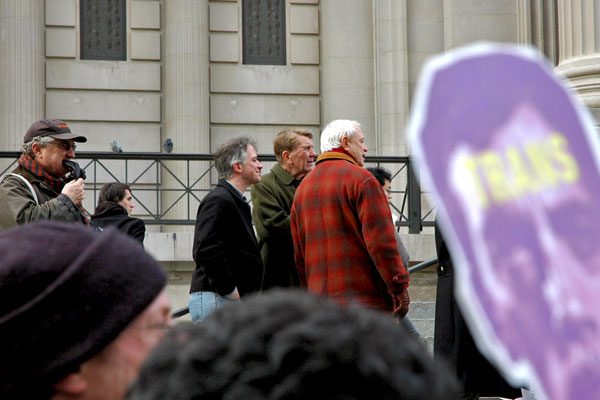
A-list establishment queers, plus one random journalist, checking out the scene
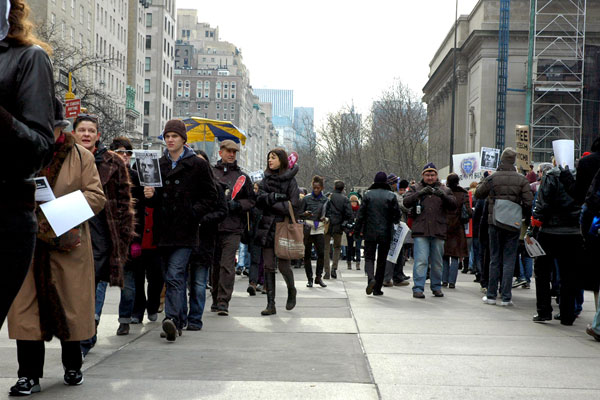
the picket about to head north
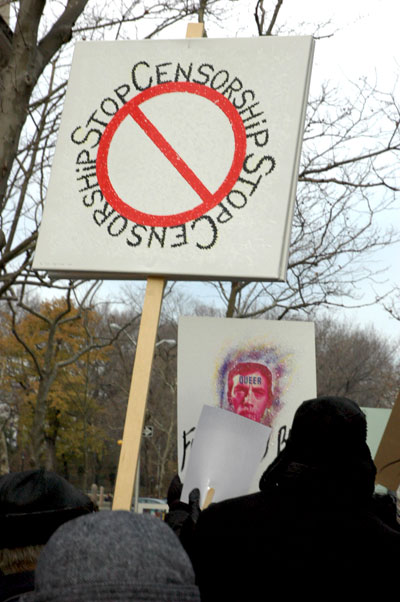
international sign
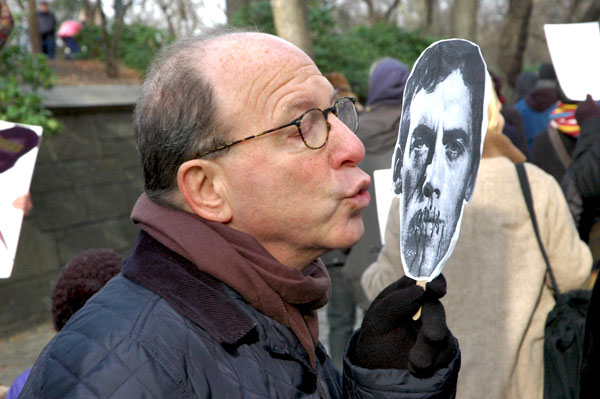
Jerry Saltz loving David
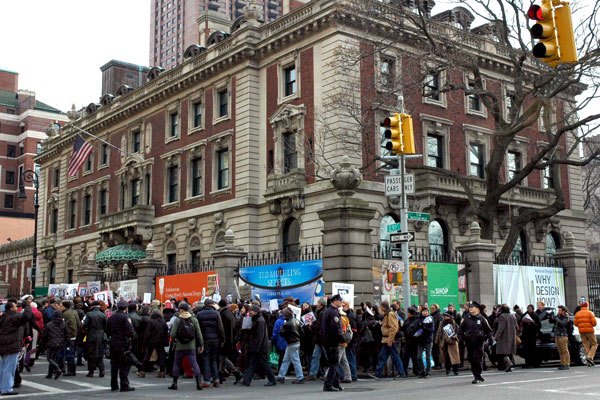
target Smithsonian, here its Cooper-Hewitt satellite
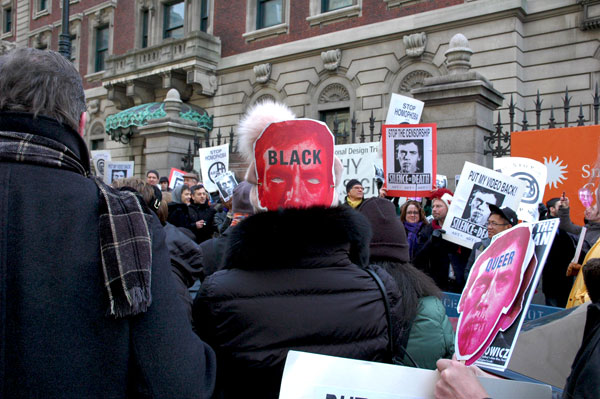
masks as epithets designating “the other” (black, red, yellow, queer, female. etc.)
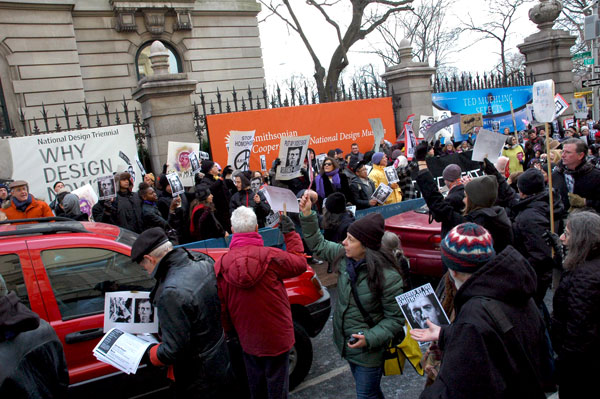
on 91st Street, haranguing the Smithsonian
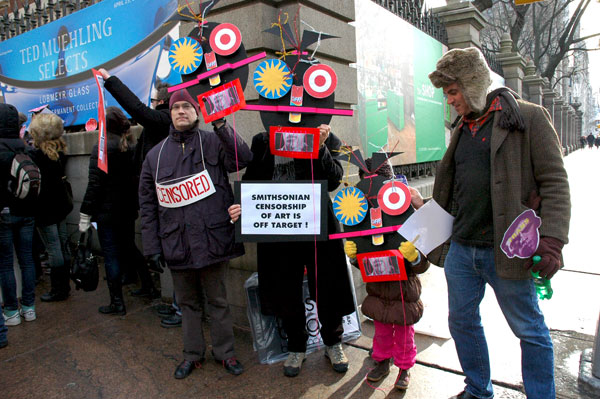
family of art ants outside the museum (Target is a major funder of the Smithsonian)
ADDENDUM: Philip Kennicott has a smart, even electrifying piece in the Washington post, “After removing video from ‘Hide/Seek,’ Smithsonian chief should remove himself“.
censorship and homophobia, AIDS, sex, art, religion

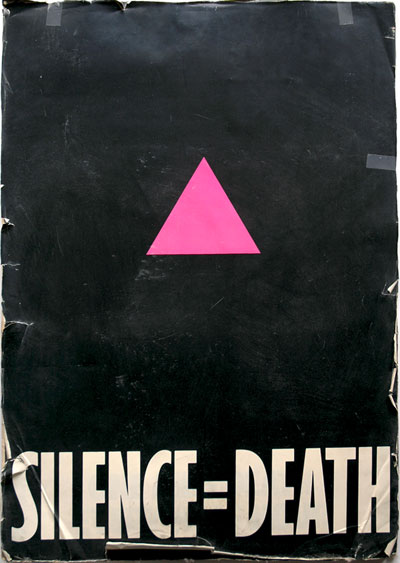
I never thought we’d still be doing this 20 years on. The image above is of a thin stenciled sign I held up on the steps of the Metropolitan Museum of Art August 1, 1989.
I thought of it as a work of art; I was thinking of both the sign and the afternoon.
I didn’t make the sign. Along with a lot of others just like it, and any number of other images and texts, it was a small, elegant part of a powerful New York demonstration protesting the Corcoran Gallery of Art’s cancellation of the D.C. exhibition of the show, “Robert Mapplethorpe: The Perfect Moment” and the Helms Amendment. The amendment was designed to prohibit the National Endowment for the Arts (NEA) funds from ever being used for so-called “obscene” or “indecent” materials, descriptions that at the time had repeatedly been applied to much of Mapplethorpe’s art, and to that of Andres Serrano, who had also become a target in what was being called the American “culture wars.”
While the artists attacked became more famous than ever, neither the NEA nor our other cultural institutions ever recovered from the assault on their artistic integrity and independence. I’m reluctant to employ the war metaphor (we’re going off in every direction with real wars already), but I think most people would say that, whatever it is called, a fundamental culture struggle continues today: There are too many frightened people in this country, and too many anxious to profit from that fear.
Bill Donohue is a vile and disgusting little opportunist with a computer and a fan base which he regularly whips up to get them to send checks his way. A retrogressive darling of the crazy Right, he invents issues and targets which can attract enough visibility to provoke the fears and hatreds of ignorant older Catholics, allowing him to draw a very generous salary of some $400,000 a year. His primary targets are gays, jews, women, progressives of any kind, and all news media (excepting the just-pretend one, Fox).
While Donohue does not represent the Catholic Church, officially or otherwise, he operates within its comfort zone. He may be the crazy ranting uncle everyone would like to ignore, but the Church hierarchy has never disavowed anything he has said; and they all go to the same banquets.
I thought that the kind of primitive depravity he represents had been pretty much squished twenty years ago, but on the 1st of December, which was, whether incidentally or not, World AIDS Day, the head of the Smithsonian, institutional parent of the National Portrait Gallery, pulled the David Wojnarowicz video, “A Fire in My Belly.” from the excellent NPG exhibition, “Hide/Seek,” and apologized for its contents. The show had already been open for an entire month when complaints from Donohue’s Catholic League, several Right-wing House Republicans, and Fox News [sic] resulted in its peremptory censorship, or debasement.
So we have a professional gay-bashing Catholic fanatic leaning on two fellow political and social fundamentalists, House Republicans John Boehner and Eric Cantor, to blackmail a great museum by threatening to cut its funding if it did not remove a work of art to which the Catholic nut objected. Viz. ants on a crucifix. We know it’s not about ants: Donohue and his own coterie are unhappy about everything that has happened in the West since the suppression of the Spanish Inquisition. His Republican fellow-travelers may be in it for power, but their sympathies may actually be sincere, however warped.
I hate to do anything to give more visibility to Bill Donohue, or his Congressional altar boys, but this madness has now been covered by the media everywhere, and roundly condemned in as many places, and the Smithsonian has so far failed to reinstall the art it was so anxious to agree with the nasty little man was offensive.
PUT IT BACK – NOW!
A lot of people are going to be on Fifth Avenue this Sunday demanding that the Wojnarowicz video be returned to the National Portrait Gallery. We will be demonstrating as colorfully and dramatically as we can that we care about censorship and homophobia.
We have to be there, at one o’clock on the steps of the Met, Fifth Avenue and 82nd Street. And why the Met? Because it’s the front porch of the art world, because there’s plenty of space and a grandstand of sorts. From there the group will march up to the Cooper-Hewitt Museum, which actually is a part of the Smithsonian.
The 1989 demo included the ACT UP group “Art Positive” (broadcasting a double meaning for the second word); the primary target then was homophobia and censorship. The 2010 demo will include members of the 1989 collaborative, and the entire demonstration has been designated “ART+” (only a slightly altered written form of the 1989 name); the primary target is essentially, and shockingly, the same, homophobia and censorship.
But since we’re talking about the public treatment of work by an artist closely identified with a disease which as a nation we still haven’t fully confronted, the subject of AIDS must not be left out of the discussion. Silence does equal death.
Finally, because we are dealing with people identifying themselves as representing the interests of the Catholic Church, we also have to understand that the targets of their assault necessarily include all women everywhere.
And there’s more: America’s continuing failure as a society to deal with what it thinks of as the very scary subjects of sex and art (and not only when they are combined, or ignited by the inclusion of AIDS) is inseparable from the ignorance and fear which prevents it from addressing our newest, and rapidly-mushrooming real problems.
In this country the public conversation always gets back to religion (if it ever leaves it in the first place). Organized and intensifying public religion gums up the works of virtualy every institution and increasingly ties our hands when we have to deal with impending national and planetary disasters. We may never grow up enough to understand the damage it has done and continues to do, but there’s a slim hope that a larger percentage of the next generation will be able to think for itself.
For more information on the censorship outrage:
ART+ [the demonstration site]
Modern Art Notes [Tyler Green – one of many posts]
NEWSgrist [Joy Garnett – see many posts]
Diamanda Gal�s [Washington City Paper, Arts Desk]
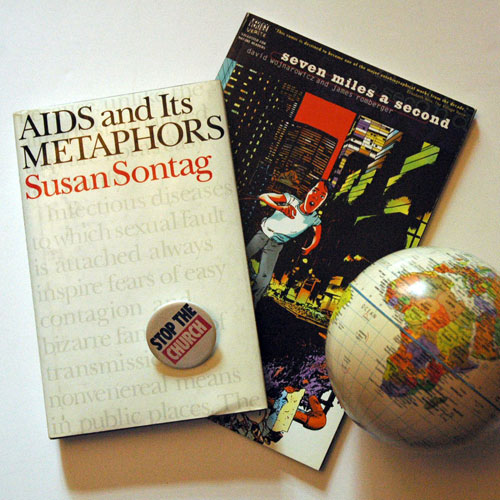
[the second image is of a slightly-battered veteran ACT UP foamcore-mounted sign which spends its retirement leaning on a wall in our apartment, a constant reminder; the third photograph includes, in addition to the Sontag volume and an old ACT UP “Stop the Church” button, the cover of “Seven Miles a Second“, a posthumously-completed graphic novel written by Wojnarowicz in collaboration with James Romberger and Marguerite Van Cook, and a small globe turned toward Africa]
Code Pink visits NYC oil addicts (shops) on Fifth Avenue
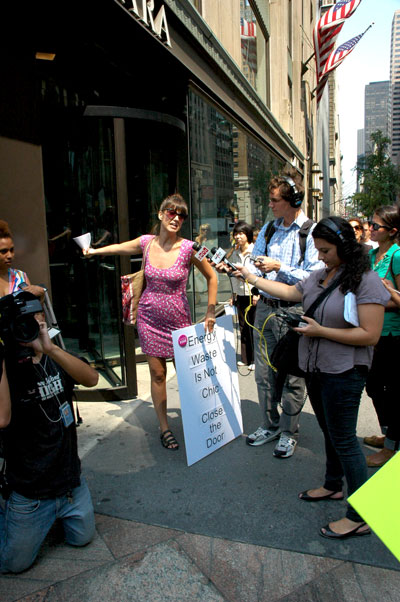
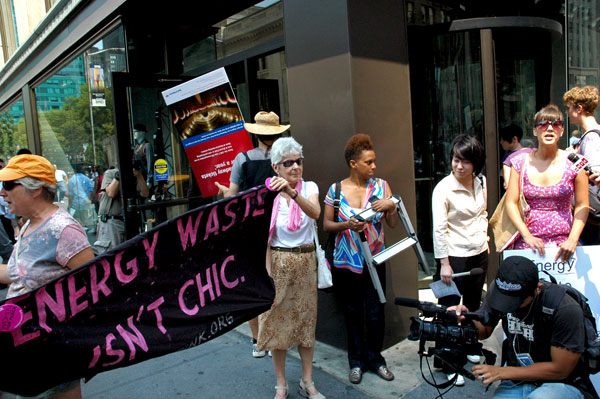
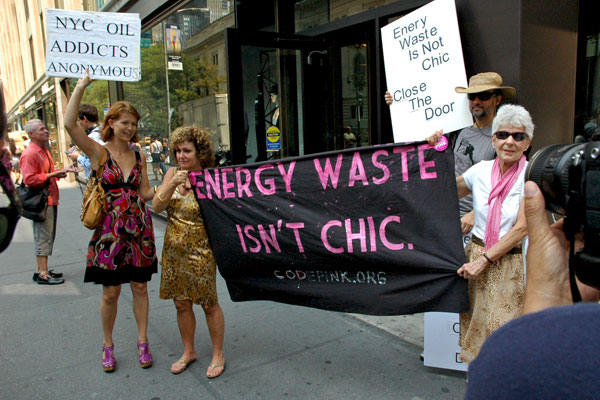
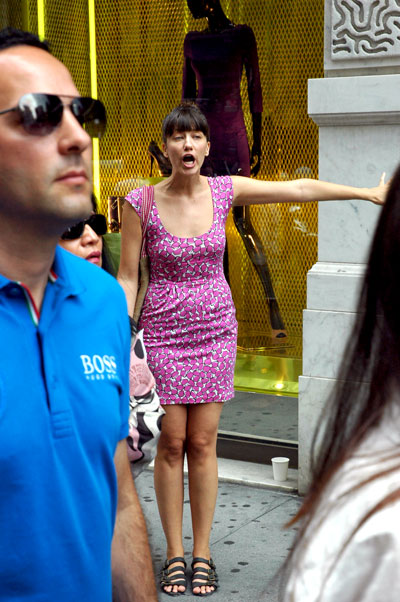
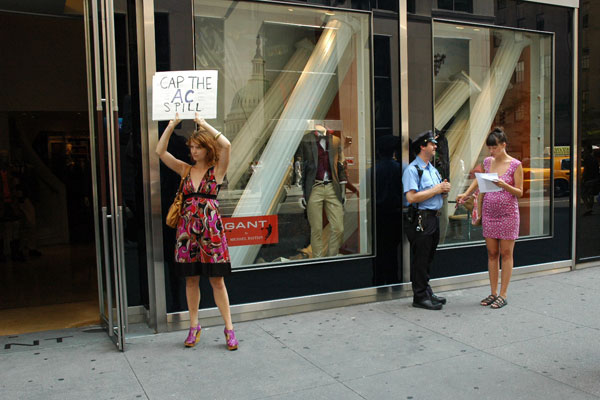
Continuing their “Action Against Illegal Energy Waste”, members of Code Pink returned today to some of the Fifth Avenue stores they had visited July 23rd, once again acting as a part of the international mutual aid movement, “NYC Oil Addicts Anonymous“.
This is an excerpt from the text of an email sent out this week by Code Pink:
Two years ago, the New York City Council passed a very reasonable law prohibiting large stores from cranking their air conditioning and leaving their doors open. But they still do it – one retailer was quoted in the New York Times as saying, “It’s business; sometimes you got to do what you got to do.” As consumers, we have to show these businesses that we’re disgusted, not enticed.
Leaving the doors open cranks their electricity use by 25% during peak hours, overloading the power grid, making blackouts more likely, and increasing the oil and nuclear demand in New York. It makes as much sense as leaving gas pumps flowing onto the sidewalk when you’re not using them. And as conscious women working for peace and justice we see the direct links between resource wasting, addiction to oil, wars for oil and on and on!
I joined the group on the door-shopping trip up Fifth Avenue which began at noon today, gamely juggling two protest signs, my not-so-lightweight camera, and several sturdy bags I was going to need later at the Union Square Greenmarket.
There was no shortage of targets from the very start, but most of the stores closed their doors very soon after our banner and signs appeared outside, and the chants began. When we got to the Gant Store however we encountered more than a little resistance: Not only did the manager refuse to close the two large doors (through which, incidentally, I could feel the store’s cold air as I stood behind the banner about 20 feet across from the opening, its fabric coming down only to my knees), but she called the police, who arrived with remarkable alacrity.
I wasn’t a part of the conversation which our excellent guides, Sally Newman and Dana Balicki, had with the two or three officers, but it was clear they wanted us to leave, and they definitely refused to do anything about the open doors. In all fairness to them, the cops may have been aware that our City Council had passed a statute (two years ago) whose enforcement responsibilities were placed in the hands of the understaffed Department of Consumer Affairs.
Eventually they decided we cold remain, as long as we did not obstruct the door or the passage of any pedestrians (in fact, we had not been a threat to either, from the beginning).
Before I decided to go today I thought about the scale of the action. There are so many huge problems, more dramatic and immediate crises than that which provoked the response of which I was to be a part, but I said to myself that this is clearly a no-brainer. We only have to bring the issue to the attention of the merchants. There can’t be any rational excuse for leaving doors wide open while you’re pumping cooled air produced by polluting and non-renewable fossil fuels through your store, sending even more hot air out the other end of the system.
I was right: It is a no-brainer. Apparently there are just fewer brains out there these days.
ADDITIONAL COVERAGE:
- Lewis Dodley, with video, on NY1
- Daniel Tucker, writing on WNYC News Blog
- Jennifer Glickel reporting for DNA info
- Natural Resources Defense Counsel staff blog post by Eric Goldstein
- Rebecca Myles, interviewing Sally Newman Friday evening, on WBAI Evening News (starting 3 minutes into the broadcast)
- Catalina Jaramillo writing in El Diario
- Fuji News Network, covering the issue and the action on Saturday
Time’s Up! makes City Hall Park a community garden

Jessica Sunflower planted in CIty Hall Park
UPDATE: A public hearing concerning the City’s proposed new rules will be held next Tuesday, August 10 at Chelsea Recreation Center, 430 West 25th Street, at 11:00am. It should be very colorful. The New York City Community Garden Coalition (NYCCGC) is urging its supporters to testify about the importance of making community gardens permanent. Information can be found on the Coalition�s web site, including the proposed rules themselves, the expiring 2002 agreement, and a history of the evolution of New York City community gardens.
New York City appears to have officially abandoned its efforts to preserve the 500 community gardens which have been protected from development since 2002 by the Spitzer Agreement (“Preservation Agreement“). That compact, which ended a hard-fought battle begun more than 20 years earlier, saved hundreds of community gardens, but it expires on September 17 this year.
Proposed Department of Housing and Preservation (HPD) rules will permit these precious urban green spaces to be legally transferred for commercial development. These popular and flourishing bootstrap gardeners’ oases had replaced neighborhood vacant lots where buildings had been abandoned by landlords following the flight of residents to the outer boroughs and the suburbs during the sixties and seventies.
These older structures, neglected and often torched, but ultimately leveled in any case, all eventually became city property. The City hoped to profit from their sale and the tax revenues which would follow their development, but there was no commercial interest in the properties until residents, both old and new, had worked hard to successfully rebuild and improve their neighborhoods.
The communities which have fought for these spaces and nurtured them for years are understandably very angry. Yesterday Jessica Sunflower and some friends decided to bring the Time’s Up! campaign to preserve these gardens down to City Hall itself. The precise venue chosen was City Hall Park, on the doorstep of both the Mayor’s office and the City Council Chamber. Sunflower managed to climb into a tree planted in the Mayor and Council’s own official “garden”, and she was joined on the ground by some serious community advocates.
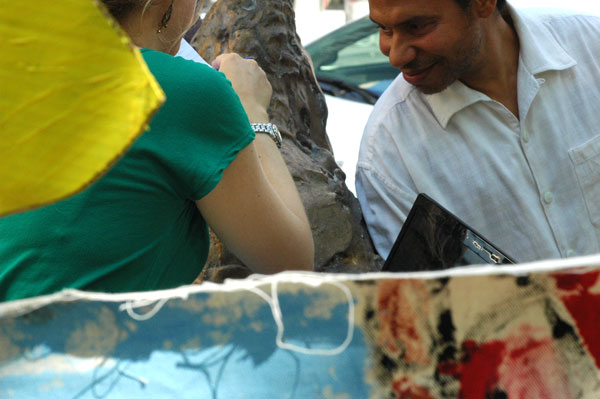
modern activism: back on the ground, even as Sunflower was being ushered into a police vehicle, supporters were busy broadcasting the action from a laptop resting on the plinth of a bronze sculpture at the edge of the park
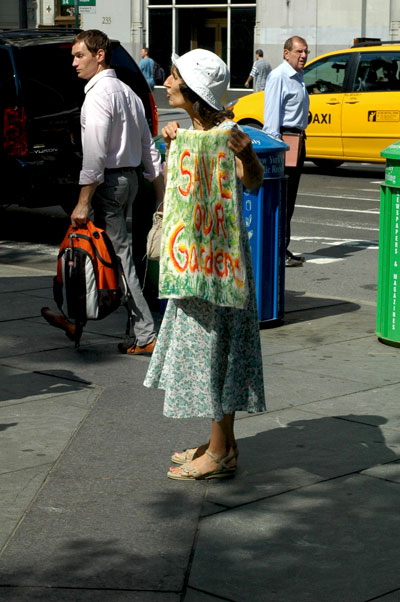
the voice of one crying in the City Hall wilderness – will it be heard?
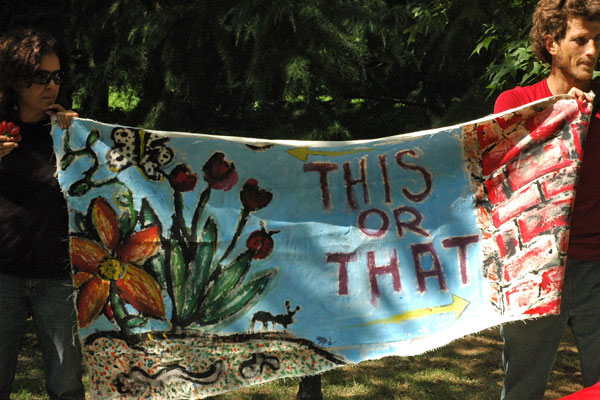
for thirty years, the communities have chosen gardens over brick
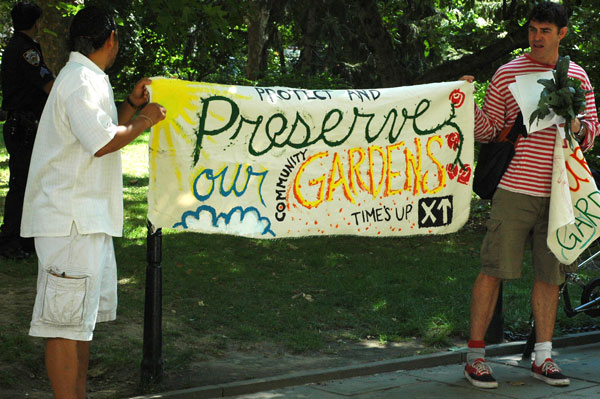
kale bouquet: the Times once described New York’s more successful community gardens as “spectacular stretches of kale-toned respite”
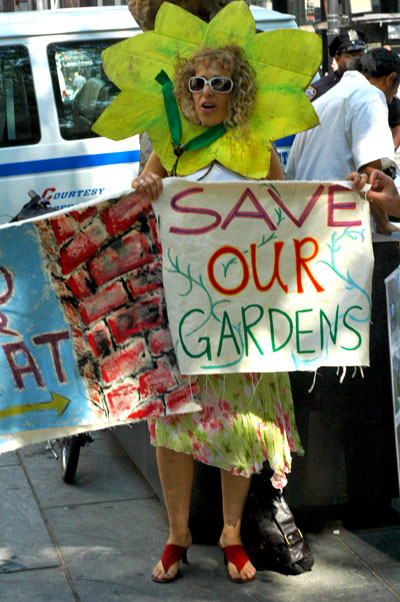
the sunflower petals abandoned by the prisoner while she was being removed from the tree were quickly salvaged and recycled back on the ground
[image at the top by Rebekah McCabe, from a Flickr set uploaded by Barbara Ross]