Sonoma County settles out of court with Clay Green

Tooker_Landscape_With_Figures.jpg
George Tooker Landscape with Figures 1965-1966 egg tempera on pressed wood 25.5″ x 29.5″

we are alone . . . but we are not alone

Their nightmare began only two years ago, and no one can undue the psychological damage done to Clay Green and Harold Scull or return to the surviving spouse the home and virtually all the property and personal possessions the two men had shared for 20 years, but their injuries have finally been acknowledged.
Last Friday, just two days before his suit would have been opened in court, California’s Sonoma County, agreed to a settle Greene’s complaint out of court, for the amount of $653,000. Greene will retain $275,000, his lawyers will take $300,000*, and Scull’s estate will be given the remainder. It was announced in the San Francisco Chronicle that the nursing home will pay $53,000, but it was not made clear where it will end up.
Greene’s suit against Sonoma had claimed that his sexual orientation was the reason social workers had separated him and his dying partner and why the county had summarily sold off their belongings, including shared personal mementos.
Under the terms of the agreement Sonoma County did not admit it had discriminated against the two elderly men, but the county’s lawyer, Gregory Spaulding admitted that there had been �procedural errors� in the disposal of the property.
The Sonoma County Press Democrat** reports that Spaulding said that the error had led to policy improvements at the Public Guardian’s office regarding property disposition and case management, but that he had also spoken on the subject of the Harold and Clay’s own status before the law:

He said the dispute might have been avoided if the men had been able to be legally married or if they had registered as domestic partners. Because they weren’t, their funds were viewed as separate, he said.
�Marital status played a role in what options were available to them,� Spaulding said.

In my April post I pointed out that, while Harold and Clay may not, and today could not, have been married, they had been a couple for 25 years and “. . . had taken the precaution of naming each other both beneficiaries of their respective estates and agents for medical decisions, and the authorities still proceeded as if they had no personal or legal relationship.”
Barry and I know any number of heterosexual couples as friends, and we occasionally ask them whether they have ever had to prove they were married. They inevitably answer no, that they are never asked to furnish copies of their marriage certificates. Some of them in fact had never actually married, and yet they have been able to take advantage of all of the perquisites which are attached to a state which is supposedly carefully circumscribed by law.
People like Harold and Clay – and Barry and James, our friends Jill and Gabriella and others, and millions of other couples around the world – don’t even get to be asked.

*
The National Center for Lesbian Rights in San Francisco had represented Greene, and Amy Todd-Gher was his lawyer, so I’m wondering about this compensation figure.
**
I and a number of other bloggers had complained months ago that like most of the commercial media, the Sonoma County, New York Times-owned paper, the Press Democrat, had long refused to cover this story altogether. The paper has finally acquitted itself with its coverage of the settlement, but this excerpt from the paper’s July 22 post however is a bit disingenuous:

The case grabbed national media attention with its shocking claims of abuse at the hands of those meant to protect the frail and vulnerable. Gay rights groups pummeled county officials with strident e-mail and some threatened a boycott on county tourism and wines.
Although the suit was filed in August 2009, it didn’t become widely known until a report about it ran in April on the website of the National Center for Lesbian Rights.

[image from eric reber]
Costa Rica followup: Monroe Doctrine means it’s all ours

centralamerica.jpg
America’s backyard

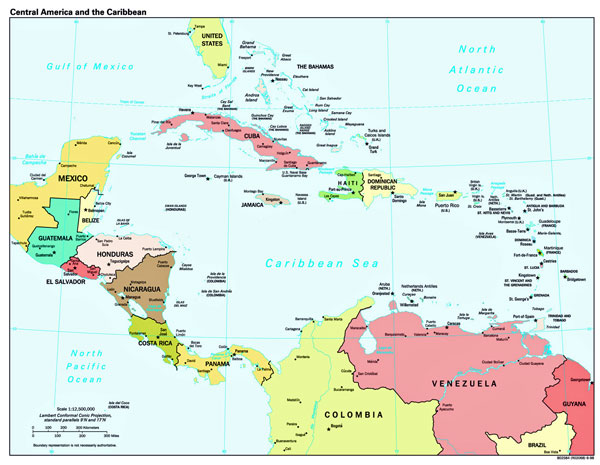
We still haven’t heard one peep from the commercial media/entertainment news corporations (even the simple fact that something’s happening), but Mark Vorpahl has written an articulate and persuasive description of what’s really behind the U.S. flotilla en route to the southern Caribbean (Mare Nostrum, or our “Fourth Shore”), “The U. S. Military Moves Into Costa Rica“.
I am entirely in agreement with his conclusions. Anyone who would prefer not to be completely surprised by another shooting war, or the next U.S.-backed coup attempt, should read what he has to say.
An excerpt:

Most of these measures [recent U.S. military operations in Central and northern South America] have been justified on the grounds of combating drug trafficking, including the military buildup in Costa Rica. However, they have not curtailed this problem at all. Such U.S. military buildups have generally been accompanied by an increase in drug trafficking, as has happened in both Columbia and Afghanistan. Based on this record it can only be concluded that the “War on Drugs” rationale is a red herring for public relations consumption, not the actual motivation.
This military build up in Costa Rica is the latest in a series of moves the U.S. has made in Latin America that seeks to use threats and arms to reverse the strength of popular anti-imperialist forces across the region. The U.S. is playing with the possibility of erupting a continental conflagration for the sake of corporate profits.
While it is doubtful that the U.S. wants to directly engage in a military conflict with, most likely, Venezuela right now, preparations for this possibility are being made. What is more likely in the short term is that the U.S. military will use its forces to engage in sabotage and intimidation in hopes of reversing support for the nations aligned with ALBA. It is also very possible that the U.S. military will help to support proxy armies, such as Colombia’s, in military conflicts that align with U.S. interests. However, this is a dangerous game. Even in the short term, the U.S. ruling class may drag the nation into another direct conflict, in spite of their intentions, that could spread to involve numerous other nations.

[image from Map of the United States (the irony was not likely intended)]

Costa Rica asks for U.S. invasion; U.S. media silent

coca.jpg
Coca (Erythroxylum coca)

ADDENDA:
This extended discussion on Upside Down World, published July 15, includes a statement that the idea of the U.S. military presence did not originate in a request from Costa Rica; rather it was initiated by the U.S. in a diplomatic request from the US Embassy made on July 1.
Also, in its own post on the Costa Rican story [in Spanish, but easily translated], the Comisi�n Intereclesial de Justicia y Paz describes the operation as “continuing the process of the militarization of Central America” and refers to it as a part of the continuing U.S. agenda for Latin America, which has recently seen the establishment of seven bases in Colombia, intensified militarization in Honduras and Haiti, the announcement of new bases in Panama.

On July 2nd the Congress of Costa Rica authorized the entry of 46 U.S. warships capable of carrying 200 helicopters and warplanes, plus 7,000 U.S. Marines “who may circulate the country in uniform without any restrictions”, plus submarine killer ships, to the Costa Rican coast for “anti-narcotics operations and humanitarian missions”.
Where’s the outrage? Actually, where in fact is the news?
I have not found a single line on this story anywhere in the MSM.
I think the media silence is probably the first thing which should be questioned (have we all, including the world at large, become inured to yet another attestation to the expanding American imperial lust?).
But I am just as shocked by the news itself. Why is this happening?
Is it because we’ve done so well with both our former and continuing foreign wars and interventions? Is it because we’ve done so well with our internal war on drugs, or because our impact on the drug traffic in other countries has been so benevolent?
Or does it actually have nothing to do with interventions, or drugs? I’d like to hear from people who are familiar with Costa Rica and have followed the events about which we currently hear nothing.
So far Costa Rica is only asking for “help”, but remember how “helpful” our innate imperialist impulse has been elsewhere for two centuries. I can’t imagine why any Latin American country would actually welcome the arrival of the U.S. military, unless of course there were banana kings running things at the top, or at least a right-wing regime, and they/it were worried about losing control. Oh, wait, bananas are still a major Costa Rican export, and the government, while enlightened, is still composed of members of an entrenched oligarchy, and by most accounts its biggest concern lately has been “security”.
The current president, Laura Chinchilla Miranda, who follows the modest centrist welfare policies of the National Liberation Party and promises to continue the free-trade policies of her predecessor, �scar Arias, is a social conservative who opposes abortion and gay marriage. But, more significant to the story of her nation’s call for U.S. Military help, she ran on a platform which promised to be tough on crime, and it included a larger and more professional law enforcement establishment. Sworn in two and a half months ago, one of her first acts was to create the nation’s first anti-drug “czar”, whose office is a part of the cabinet.
For half a century Costa Rica had enjoyed peace and political stability, and, overall an impressive growth in economic prosperity and social welfare systems, but beginning in the 90’s the country began to witness the rise of its own version of American neo-liberalism, which threatens the moderate socialism built up in the previous decades. It all sounds very American to me. The only thing missing was a security panic of their own and an indigenous drug war, and they’ve just ordered both.
But not everyone in Costa Rica is happy.

For a good discussion of the issues (with some reservation about a mostly-irrelevant postscriptive remark about the brave and unselfish volunteers in uniform), go to Costa Rica Blogger.

[all thanks to artist Pedro Velez for the Comisi�n Intereclesial de Justicia y Paz post alert]

[image from Wikipedia]

gay or black in the garden state: is it still 1953 in NJ?

Bayard_Rustin_12-2.jpg
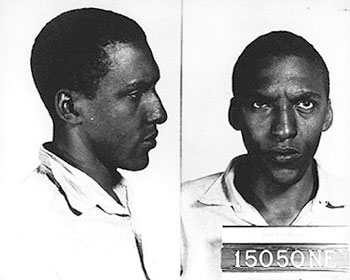
Bayard Rustin’s 1953 mug shot*

The CEO of an Atlanta credit union, on a visit to New Jersey for his 30th high school reunion, has been shot and killed in a Newark park by an undercover policeman. The alleged sex-related incident ended in the senseless death of an unarmed man, DeFarra Gaymon, a successful businessman and a married father of four.
The official explanation, delivered by the acting Essex County prosecutor (that the officer, trying to arrest Gaymon for lewd behavior, had fired in self-defense), makes no sense, and even if the pieces could be fitted together they suggest a world I thought had disappeared decades ago: I remember what many urban parks looked like after dark half a century back, I know that the police played them for sport, and I know the combination could destroy lives, but it’s now 2010. This Essex County park is located in a state which by most accounts ranks at the very top in the nation in laws extending equality and civil rights to both the gay and black communities (yes, the victim was black), and I thought we now had better uses for our constabulary – and that we could still afford real uniforms.
Actually, 57 years ago Bayard Rustin got off much easier than DeFarra Gaymon, whatever the unfortunate Atlanta businessman was doing in the park last Friday night.
According to the New York Times story, “The officer, whose name was not released because of his undercover work, had been on what is not usually a particularly dangerous assignment, scouring the park, in northern Newark, for men seeking sex.” The Times also tells us: “The officer and his partner were patrolling the park in plain clothes, part of an operation that has been going on for years, said Mr. [Robert D.] Laurino, the prosecutor.”
And that would be, . . . an assignment to arrest men who have no interest in frightening the horses. In the email he sent out before dawn this morning my friend, the activist Bill Dobbs, reminds us that “Those who seek hookups in such locales traditionally shield their activities from uninterested parties.”
The Essex County sheriffs have been very interested for years. May we ask why?
The whole incident stinks, and the only hope for justice, and reform of current police tactics, is the power of the presumed outrage of both Gaymon’s family and the community or communities targeted by a law enforcement agency.
In his letter, Dobbs asks:

What exactly was this undercover officer doing in a park known for cruising? Uniformed cops are safer and more effective for such situations � less danger when an arrest is made since cops identities are clear. Who approved this undercover operation? Was it a �sting� operation, enticing men and then arresting them? Was the cop given this assignment considered attractive to other men? Were there backup officers involved? What does the NJ gay lobby think about this? The only person who seems to be quoted on NJ matters gay, Steven Goldstein, is so rabidly and single-mindedly pro-gay marriage – will he and the state-wide gay political group Garden State Equality speak about an alleged sex-related incident that ended in the death of an unarmed African American man? According to the Star Ledger newspaper several hundred arrests have been made in that park over a year and a half, where has Garden State Equality been? How much money has been wasted on this operation?

Additional links:

The (Newark-based) Star-Ledger
Atlanta Journal Constitution

*
The image at the top is of Bayard Rustin’s mug shot. His Wikipedia entry reads, in part:

In 1953, Rustin was arrested in Pasadena, California for homosexual activity. Originally charged with vagrancy and lewd conduct, he pleaded guilty to a single, lesser charge of “sex perversion” (as consensual sodomy was officially referred to in California then) and served 60 days in jail.

[image from GBMNews]

June 28 again, and all not so quiet on the eastern front

All_Quiet_On_the_Western_Front.jpg
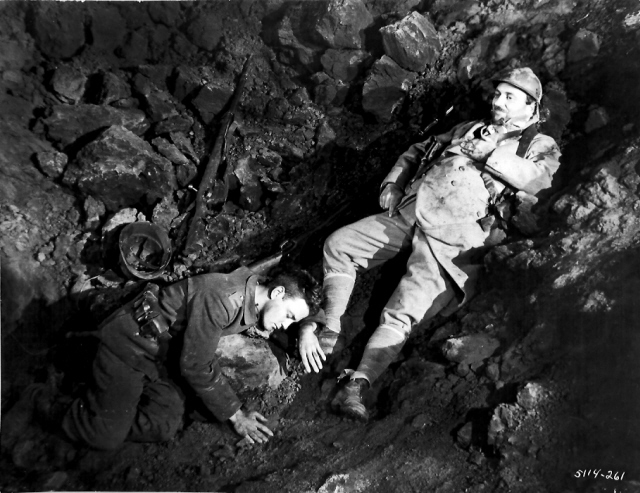
the enemies finally come face to face

We watched the restored version of “All Quiet on the Western Front” at home late last night. Before yesterday I had neither read the book nor seen the film. This early talkie, an eighty-year-old masterpiece, has survived, both as art and as a surprisingly strong piece of theater. It’s terrifying, when it’s not heart-braking, and there’s nothing maudlin or melodramatic about it.
It’s an extraordinary film; don’t wait for the remake.
As if it just watching “Front” were not already enough of a profound and moving experience, today we learned that the event that precipitated The Great War. The conflict that inspired Remarque’s seminal anti-war novel, and Russian-born Louis Milestone’s 1930 film of the same name which was based on the world-wide best-seller, occurred exactly ninety-six years ago (still within living memory – of at least a very few). While today is the anniversary of the assassination in Sarajevo of the heir to the Austro-Hungarian throne, It’s also the anniversary of the Versailles Treaty which officially ended the hostilities between the remaining major combatants. That accord was signed ninety-one years ago today.
The war was supposed to be “the war to end all wars”, the phrase a perverse, but catchy rationalization which was actually invented early on by its most enthusiastic champions.
It’s clear however that, as the direct heirs of its horrors, which include the Second World War, among others, we haven’t learned a thing in the intervening years. This is in spite of the hopes of the remarkable German author of “Front” and most of the people connected with the film, including its fictional chief protagonist, Paul B�umer, and the very real pacifist actor who played him, Lew Ayres.
In the image above Paul is lamenting the death, by his own hand, of a French Soldier who had lept into his trench in the chaos and heat of a particularly violent infantry battle.
In the Turner Classics commentary supplied with the DVD, film historian Robert Osborne sincerely and persuasively proposes that subtitles be created in every language, that the film be shown to people all over the world, and that they should see it again and again, once every year.
But today a country whose people mistakably believe themselves to be the most peace-loving on earth, have created two optional, trillion-dollar, asymmetric wars, killing fields inside dirt-poor nations which have no working governments, on the other side of the planet, and it seems we can give no justification for our continuing these wars other than the fact that we are at war(s). In retrospect, a century later, even the fools and jingoes who marched off in 1914 don’t look so singularly absurd as we once thought they did.
Besides, while the number of casualties in 1914-1918 certainly dwarf the total of all losses in the Middle East, that war was at least brought to a halt in four and a quarter years. Our own, current madness has already gone on twice that long.

[image from leftofcybercenter]

friends to celebrate Harry Wieder in Cooper’s Great Hall

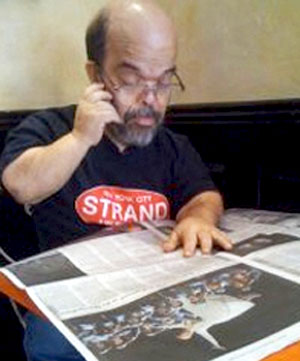
harry_wieder.jpg

There will be a great congregation of friends and activists inside the Great Hall at the Cooper Union tomorrow evening at six o’clock. There they will be celebrating the rich life of Harry Wieder, cut short, shockingly, in an accident in April.
Harry was a familiar friend and powerful advocate of many progressive causes, so I expect the room will resemble a portrait of the face of New York grassroots activism (of almost every sort) as it operated over the last few decades.
I also expect that this memorial will not be a lugubrious affair. Harry meant a lot to the people who shared his life and his dedication. But we also knew how to share in laughter, and there should be plenty of that tomorrow.
Harry was also completely familiar with the historic Great Hall, not least for his regular attendance at ACT UP meetings, which continued while they were being held there in the early 90’s. It was a time, difficult to imagine today, when the press of hundreds of AIDS activists (I’m sure I remember hearing the number 700 one week), attracted by the urgency of the issues and the energy of the coalition, had forced a move from the pre-restoration Center to a larger venue. It was Cooper which welcomed us.
I’ve been back many times since those years, and Barry and I will be there tomorrow.
Speaking of ACT UP, and the kind of energy which seems in scarce supply these days, the incredibly-important ACT UP Oral History Project has just added 14 new interviews with ACT UP activists and add 9 important video clips and transcripts to its web site. Visit, rummage around, then go out and change the world.

While working on this post I once again found myself Googling for an image of “Harry Wieder”; there aren’t a great number, and most of them are mixed in with a much, much larger number of images of “Prince Harry”. Our Harry would love that.

[image via pinknews]

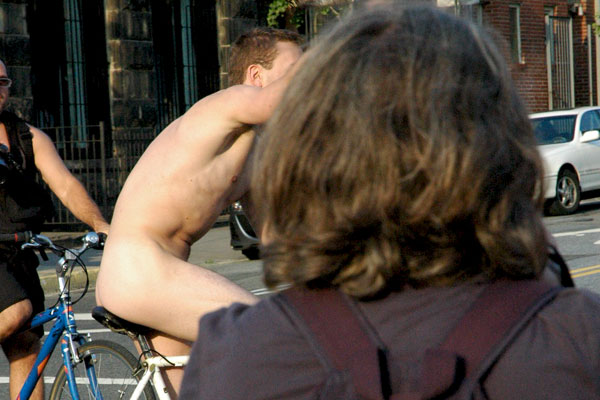
World Naked Bike Ride: raw for cause, in New York City

Naked_Bike_Ride_top_of_the_park.jpg

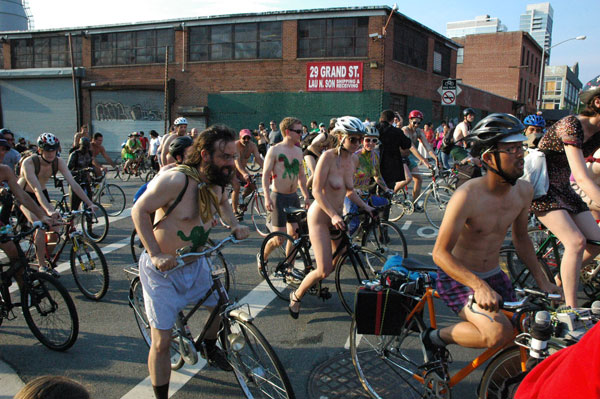
Barry and I were at Grand Ferry Park Saturday afternoon, but, bicycle-less and resolved to remain fully-clothed, we were were able to offer nothing more than admiration and documentation for New York’s contribution to the World Naked Bike Ride. We watched an upbeat crowd of enthusiasts assemble and ride off in a deliciously and infectiously brash rally which took them over the Williamsburg Bridge and into Manhattan as far north as the UN before returning across the river later to party.
Enthusiasts in cities all over the planet have been taking this annual event very seriously for years. They seem to get it, even if New York doesn’t. With an ebullience and a commitment which should be heartening to anyone who questions our culture of oil and cars, and who supports a sustainable transport alternative, people elsewhere have taken to the streets in impressive numbers – and in unashamed expression. Until yesterday however, in spite of (or because of?) the Naked Bike Ride’s Dionysian attractions and its celebration of freedom, New York’s participation had for years been chimerical, and finally pretty underwhelming.
I doubt anyone’s been counting cheeks, but it looks to me like the city “showed” better this year (even if we’re not yet up to the standard set by a certain awesome English seaside resort town).

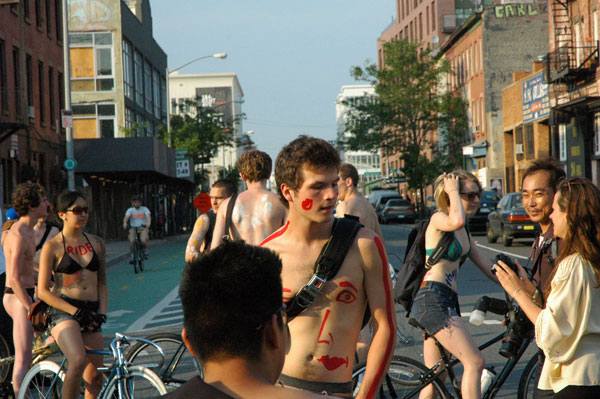
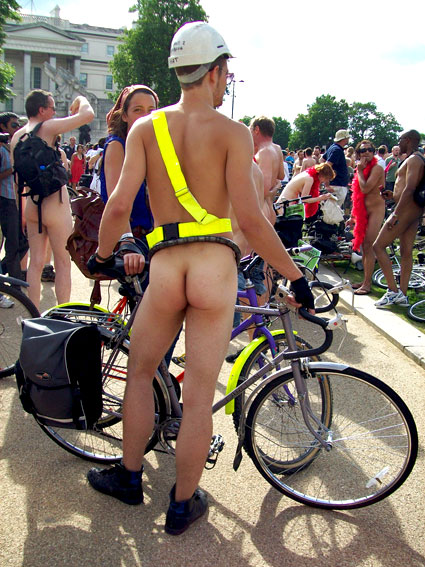
Note: To be fair, the images I’m publishing at the top and bottom of this post are a somewhat misleading representation of what the bicyclists looked like once they hit the road. Many of the costumes seen here were later removed, beginning even as the group was assembling at the top of Grand Ferry Park. To wit:

Naked_Bike_Ride_youth_mounted.jpg
Naked_Bike_Ride_and_off.jpg

In the still and video images I’ve seen on line, most spectators around the city seem to have enjoyed their exposure to the group’s rolling march, but some may be asking what’s the connection between environmentalism, bicycles, and nakedness. Why is this action naked? I may be prejudiced, but I’d say that not only do bikes have a huge potential for raising the quality of the environmental, one which we could start realizing almost immediately, but bikes also (when used civilly) seem to be able to charm almost anyone.
So bikes may be excellent poster children for saving the planet, but why naked bicyclists?
Two years ago Mark Barwell, a very fit-looking English environmental activist, took part in the Brighton & Hove Naked Bike Ride, and the BBC interviewed him prior to the run, photographing him in road costume (“completely starkers”, as the reporter offered in the accompanying audio link). Barwell discussed the serious objectives of the demonstration and went on to address what everyone always zeros in on: “The idea is to be as loud as possible, really”, he said, and then he offered the best explanation ever for its anomalous motif: [my transcript below]

Cyclists on the road are really the most vulnerable road users. Cycle lanes tend to appear and disappear all over the place, and drivers as a rule are quite sensitive to cyclists on the road, but there are quite a lot of issues where we’re very much vulnerable, and that’s where the naked thing comes in. It’s to highlight the vulnerability, and also, as a follow through, to celebrate body freedom, and the fact that a naked body really isn’t that bad a deal.

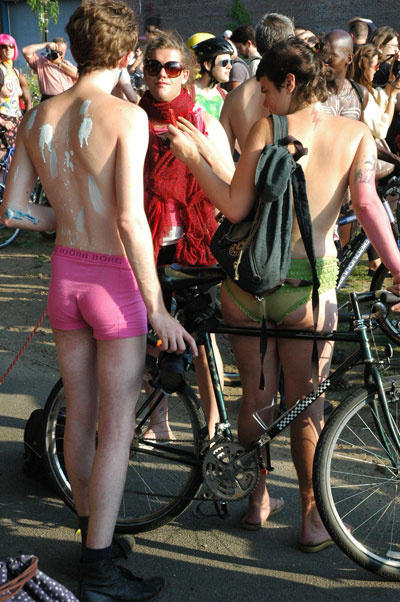
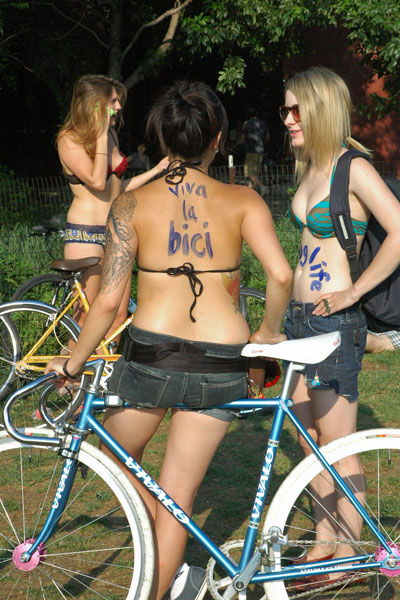
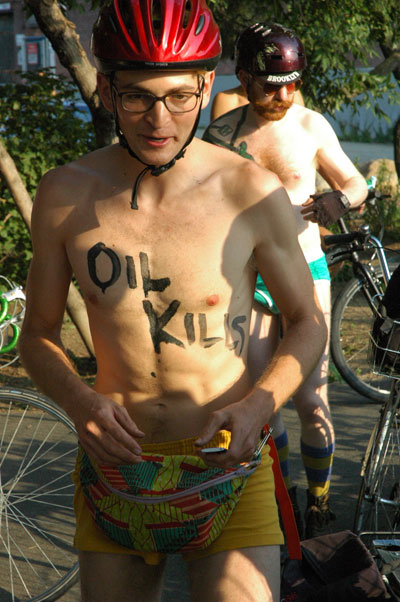
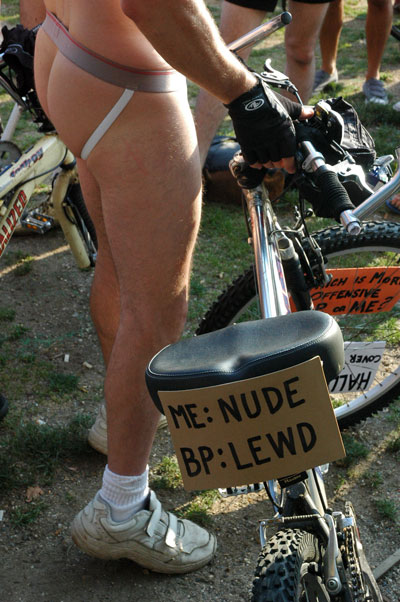
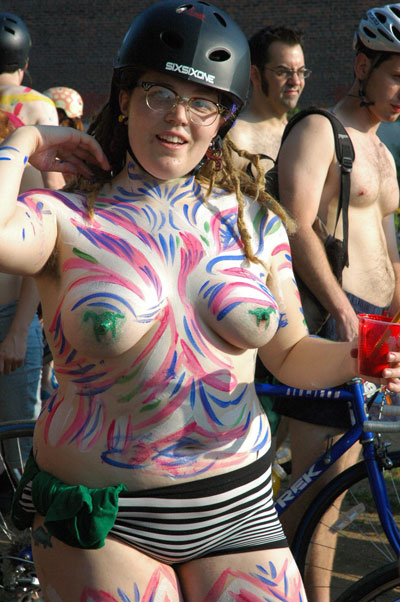
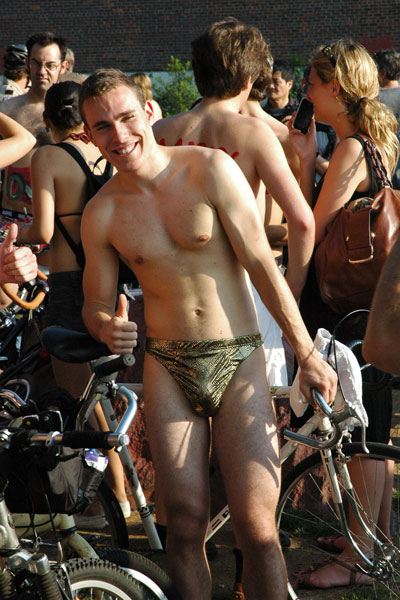
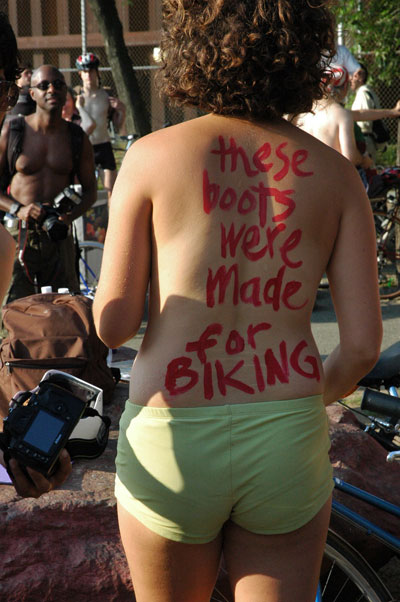
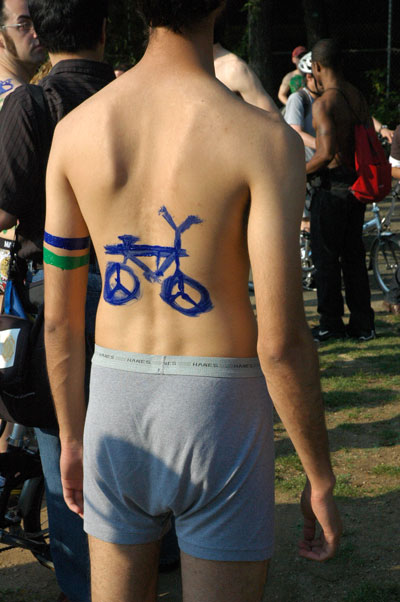
It must have had something to do with the rendezvous’ Williamsburg location: I don’t think I’ve ever before seen so much pale nerd skin, its beauties enhanced here by a lot of body paint broadcasting genuine conviction.

The image at the top is of the group about to leave the park; those which appear below were all collected in the hour before.

Naked_Bike_Ride_three-graces.jpg
Naked_Bike_Ride_three_women.jpg
Naked_Bike_Ride_oil_kills.jpg
Naked_Bike_Ride_me_nude_BP_lewd.jpg
Naked_Bike_Ride_green_nipples.jpg
Naked_Bike_Ride_golden_thong.jpg
Naked_Bike_Ride_boots_made_for_walking.jpg
Naked_Bike_Ride_blue_bicycle_drawing.jpg

For much more, go to the New York Post video site for Jeff Lieberman’s excellent video coverage of the ride’s swath through Manhattan.

[I tried my best to get this post up sooner, but I was having serious server problems all day Sunday]

ADDENDA: I’ve uploaded additional images on Flickr, and Gothamist has more photos and video (look for Oliver “waving” to the cars on the bridge); go for the slide show on John Zwinck’s feed and that of dogseat

Williamsburg hosts NYC unit of World Naked Bike Ride

naked_biker_yellow_strap.jpg
but it won’t be just about the uniform

I love bikes; I love bicyclists; I love naked. Tomorrow afternoon, Saturday, in a rare, very special concurrence of the stars, like-minded enthusiasts will be privileged to witness or be part of an awesome event promising all three distractions – if they make their way over to Williamsburg some time around 5 o’clock.
World Naked Bike Ride will be celebrated by New York-area enthusiasts starting with a rally beginning at that hour in Grand Ferry Park. Time’s Up! has the details here.
The annual world-wide event is described by our local activists as “A fun and liberating protest towards reducing the dangers posed to our world and our bodies by auto and oil dependence!”, and they advise:

Clothing is optional, please come as bare as you dare. Creative costuming is also highly encouraged. Body painting and bike decoration will start at 5pm, with the ride departing no sooner than 6:30pm, no later than 7:00pm. Be sure to bring lights, bells, a sense of humor and a positive attitude!

There will be plenty of laughs to accompany a message born in disgust and anger, and one which is growing increasingly louder, but the continuing, and still unfolding, news about the horrors of the Gulf oil spill ensures that both the humor and the protest will be more visible and powerful this year.
The media can no longer afford to ignore the issues which will bring masses of colorful and determined bicyclists into streets all around the world tomorrow.

The picture at the top is from last year’s (world-wide) event, specifically, “Naked Bike Ride London 2009“. The Brits seem totally into it.

[image from itslefty via Flickr]

the real meaning of Memorial Day (or Decoration Day)

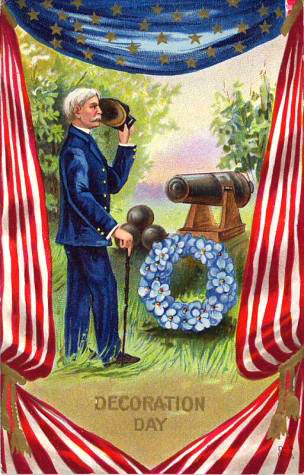
decoration-day-civil-war-holiday-patriotic.jpg
but where’s the gray, and, for that matter, the colors of our countless other fallen foes?

And it’s not for generals.
It seems Memorial Day is not supposed to be just about hot dogs, the Indianapolis 500, or summer whites. In fact the holiday formerly known as Decoration Day (the official name by Federal law until 1967) wasn’t even originally owned by war veterans. While today it commemorates Americans who died in any war throughout our extraordinarily-aggressive, warlike history, it was first enacted in response to the horrors of a civil war. The date itself, now established as the last Monday of May, was originally determined by the month of the final surrenders which marked the conclusion of the American Civil War.
But its disjointed history is actually far from the tidy story which an official declaration might seem to suggest.
What became Decoration Day, and eventually Memorial Day, had many separate origins. Towns in both the North and the South were already memorializing their recent war dead, and “decorating” their newly-dug graves, in spontaneous observances in the years before the 1868 official proclamation by General John Logan, the last national commander of the Grand Army of the Republic, in his “General Orders No.11”.
The holiday the general created was first observed on May 30, 1868. Flowers were placed on the graves of both Union and Confederate soldiers at Arlington National Cemetery. That cemetery, incidentally, was located on land the U.S. government had appropriated from Robert E. Lee at the beginning of the war, a development likely to have made an significant impression on the defeated South as much as on the Lee family itself.
Within two decades or so all of the northern states were observing the new holiday, but the South refused to acknowledge it. This should not have surprised anyone, either then or since. Even though the date May 30 had been picked precisely because it was not associated with any battle or anniversary, the observance itself was tainted by its association with the victorious and hated Union.
The various states of the old Confederacy continued to honor their own dead, on separate days, until after World War I, when the holiday was broadened to include not just those who died fighting in the Civil War but Americans who died in any war. Even then, most of the states of the old South still maintained separate days for their own dead, and do so to this day, although with varying degrees of enthusiasm.
I checked into this history yesterday when I was trying to decide whether I could honorably display the antique 48-star flag I’ve had for almost 40 years (antique in fact when I acquired it). I had kept it in a Chinese camphor-wood trunk for decades because our flag had come to be associated almost entirely with American jingoism; it had been hijacked by the crazies on the Right. Although I still had my doubts about the direction of this country even after Obama’s 2008 victory, I pulled the old banner out and hung it in the apartment last year, on the day of his inauguration, and again a few months later on July 4th.
Bush’s wars have now become Obama’s wars, and my very tentative interest in flag-waving, even flag-hanging, has (please excuse the choice of word) sort of flagged, although I still find things to love about this increasingly dysfunctional country.
When do we get a holiday celebrating the peacemakers? Of course that’s entirely a rhetorical question, coming from a citizen of a country which has almost never not been at war somewhere.
I went to Wikipedia in my search for a quick answer to my question about the original significance of the day we celebrate today mostly as just another excuse for a long weekend. There I learned that one time the holiday many originally associated with uncomplicated patriotic sacrifice did not mean the same thing for everyone, even in the 1860’s. In the Wikipedia entry for “Memorial Day: History”, I found this very moving and evocative window onto an America which was cursed to know war far better, and was far more weary of and horrified by it than our own:

At the end of the Civil War, communities set aside a day to mark the end of the war or as a memorial to those who had died. Some of the places creating an early memorial day include Sharpsburg, Maryland, located near Antietam Battlefield; Charleston, South Carolina; Boalsburg, Pennsylvania; Carbondale, Illinois; Columbus, Mississippi; many communities in Vermont; and some two dozen other cities and towns. These observances coalesced around Decoration Day, honoring the Confederate dead, and the several Confederate Memorial Days.
According to Professor David Blight of the Yale University History Department, the first memorial day was observed by formerly enslaved black people at the Washington Race Course (today the location of Hampton Park) in Charleston, South Carolina. The race course had been used as a temporary Confederate prison camp for captured Union soldiers in 1865, as well as a mass grave for Union soldiers who died there. Immediately after the cessation of hostilities, formerly enslaved people exhumed the bodies from the mass grave and reinterred them properly with individual graves. They built a fence around the graveyard with an entry arch and declared it a Union graveyard. The work was completed in only ten days. On May 1, 1865, the Charleston newspaper reported that a crowd of up to ten thousand, mainly black residents, including 2800 children, proceeded to the location for included sermons, singing, and a picnic on the grounds, thereby creating the first Decoration Day

So, the real meaning? I don’t think we have agreement even now, and for myself I haven’t yet decided whether to pull that faded old cloth from the trunk tonight.

[image of pre-WWI Decoration Day postcard from vintagepostacards]

Dominus totally gets Harry Weider, in today’s Times

Harry_Wieder_at_the_NYPL_2.jpg
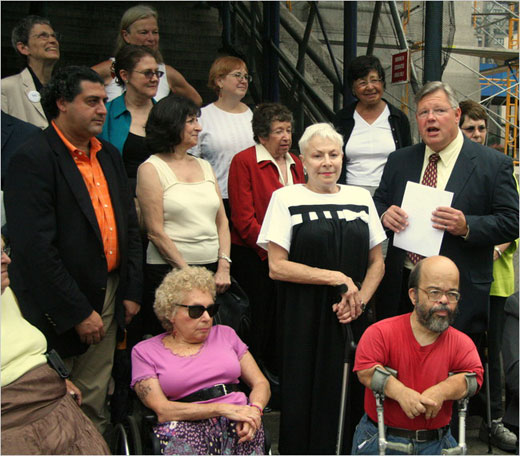
Harry Wieder, above at lower right, at a press conference calling for wheelchair access seven days a week to the James A. Farley Post Office. [Times caption]

Today’s New York Times will include this lovely, absolutely lovely piece about Harry Wieder (which the paper unfortunately burdened with a totally lame headline*) by Susan Dominus: “Remembering the Little Man Who Was a Big Voice for Causes“.

He sometimes attended seven or eight meetings in a day, even if he snored his way through one or two of them. His friends joked that he must have a clone � �but why would anyone clone someone that strange?� Mr. Wasserman [Marvin Wasserman, a longtime ally and occasional victim] said.

*
I dunno, but I think I actually prefer, “Gay dwarf activist killed by New York taxi“, the headline I saw two days ago on an Australian site.

[Michael A. Harris image from the Times site]