Harry Wieder (1953-2010)

Keith_and_Harry.jpg
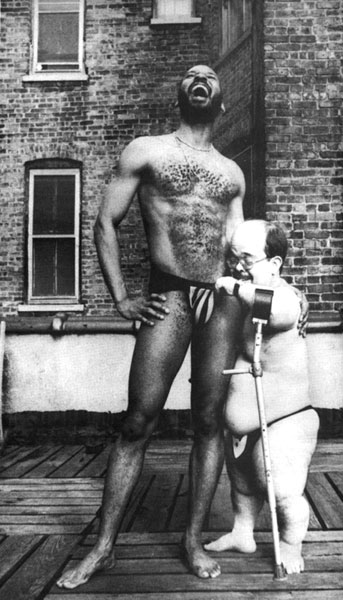
Harry was always an activist (here he is saying hello to the late Keith Cylar)

ADDENDA: I’ve now located* the original full image of the photograph I included above when I first did this entry, as well as the text which accompanied it, from a pre-summer issue of OutWeek published almost twenty years ago; this is Keith Cylar and Harry Wieder’s reply to the photographer and activist Michael Wakefields’s question about their ideal getaway:

“We would live in a world where we would then have the freedom to do more than just fantasize, where our fight to end AIDS has brought a reality, and there are countless sexual possibilities, especially for a militant sexual dwarf”

I’ve also added an image further into the entry, of Harry inside the maw of the beast, an ACT UP Monday night meeting

He described himself as a “Disabled, gay, Jewish, leftist, middle aged dwarf who ambulates with crutches”, but Harry was much more. He was the essential activist, and he was much loved.
I first met him through ACT UP, where I sat next to him at a Monday night meeting, and after that he seemed to be everywhere, especially wherever there was something to be said to power. I was deeply proud to call him a friend.
I hadn’t yet heard his own multifarious description of himself, but as I came to know better both the man and his work I watched his identity as an activist and as a man gradually enlarge in my own consciousness. Eventually I seemed to have assembled an image of all of his various hats and identities on my own, even adding “person of color” in my enthusiasm. I can’t account for that add-on. Harry might have been a bit “swarthy”, but I think it was his compassion and his natural affinity for the issues which affected blacks, or maybe there was even an ambiguous word from Harry himself. Then, only years later, when he told me where he then lived on the Lower East Side, in a home for the deaf, did I realize that his physical challenges included a hearing disability.
The news magazine OutWeek called Harry a “militant sexual dwarf” in a 1991 article which included the photo above. He’s seen peeking into the swimsuit of Keith Cylar, one of the co-founders of Housing Works. Barry remembers, “he was [certainly] aggressively flirtatious”.
We all loved him.
During all of his active life he worked to improve transportation for all so there was more than a little irony in the fact that he was struck down the night before last by a taxi on Essex Street, on the Lower East Side where he lived. It’s one of the most dangerous of the stretches which had attracted his latest traffic-control activism, virtually up to the moment of his death. He was leaving a regular meeting of Community Board 3, one of several groups which has been concerned with the neighborhood’s safety.
Board 3 will be joined by Community Board 2 at a public hearing scheduled by the NYC Department of Transportation for next Thursday on the issues of traffic and safety in the Village and the Lower East Side. Harry will certainly be a part of it.
Harry_Weider_1990_ACT_UP_meeting.jpg
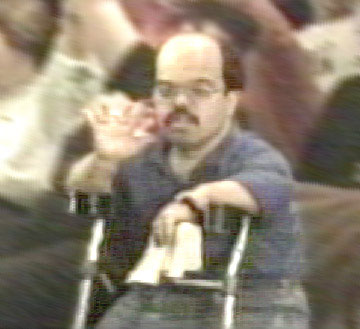
Harry, waving from the front row during a 1990 ACT UP meeting [detail in a still from a video]

For more details: DNAinfo; The New York Post; Wall Street Journal (blog); the Lo-Down; Gothamist; The Edge (for starters)

*
EDIT:
When I first published this post I was unable to locate Michael Wakefield’s original, uncropped image, but Bill Dobbs located it in the OutWeek archive and pointed me to it (it’s on page 36); it now appears here at the top

[first image by Michaeld Wakefield from the OutWeek archive; the second from James Wentzy]
8th anniversary of jameswagner.com

eighth_anniversary.jpg

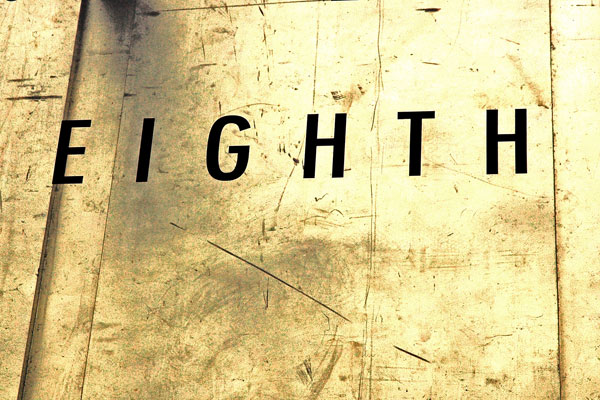
Today is the eighth anniversary of this blog.
I said it last year, and I’m delighted and incredibly privileged to say it again: This is also the anniversary of what turned out to be the most important event in my life, the night Barry and I met (now nineteen years ago).
Last year I also wrote, looking at the world outside our circle of close friends, that I was “more upbeat about the world” than I had been the year before, the eighth year of our second Bush, adding, “but only a bit”. That hasn’t changed, a bit.
And happy birthday, Paddy Johnson!

[the image is of a portion of the street number on the glass above one of the Art Deco entrances of the former Port Authority Commerce Building (1932), 111 Eighth Avenue the wall seen several feet behind the glass is covered with gold leaf]

NYPD says “Happy Earth Day!” by stealing NYers’ bikes

NYPD_junks_bikes.jpg
gone, but surely not forgotten

It’s Earth Day. It’s also the day the White House and the City of New York decided to junk hundreds of bikes, the vehicles used by New Yorkers to reduce their carbon footprint.
From Gothamist, two hours ago:

Obama has no idea what he just got himself into. Someone sent this photo to the blog This Is FYF, which reports that “citing security concerns that bikes might be secret pipe bombs, NYPD officers clipped the locks of hundreds of bikes along Houston Street this morning in preparation for President Obama’s speech at Cooper Union. The bikes were unceremoniously put in the back of the truck. Onlookers were not given information as to what would become of the bikes. Happy Earth Day!”

Those bikes are at least as important to their riders as cars are to their drivers, and, in some cases, represent as major an investment for their owners as a car does for those who like piloting their own multi-ton metal vehicles around the city. Would the NYPD be so cavalier in junking hundreds of those precious planet-scarring cars?
The history of the NYPD’s war on bikes tell us that for the men and women in blue today’s crackdown on innocent parked bikes is a win-win situation: The cops get to pretend they’re guarding us from terrorists, and at the same time they’re reducing the actual number of bikes (and, perhaps more crucially, discouraging potential riders from thinking of bikes as a reasonable alternative to cars).
Has anyone noticed the stories in the media and the glossy posters telling us that in just about one week we can begin celebrating the fact that “May is Bike Month in New York City!“? Someone should share the information with the City authorities.
And perhaps in one final note here, prollyisnotprobably reminds us that Bicycling Magazine put NYC within the top ten on its list of the most cycling friendly cities in the country. The prollies had already suggested our city doesn’t belong there.

RELATED: “NY activists drop rainforest banner at City Hall

[image by Anthony Rebholz/Thisisfy via Gothamist]

NY activists drop rainforest banner at City Hall

rainforest_bannner_38.jpg

UPDATE: [2 PM, APRIL 22, 2010] Both Tims were released a short while ago, after an arraignment in which each was charged with two misdemeanors: “Obstruction of Government Administration” and (a Parks violation) “Unlawful Posting of Sign”; each was also charged with one violation: “Disorderly Conduct”

ADDENDUM: [April 22, 2010] Tim Keating discusses the issues in this excellent Rainforest Relief video, recorded on a New York subway platform in April, 2008

Added six hours after this post was published: It’s just like the late 80s and 90s: We’re still having to learn to do stunts and run through hoops just to get the attention of elected officials, bureaucrats, journalists and the people who take and handle our money, in the hope of persuading them, or their handlers, to do what they should have been doing all along. It seems to be the new American way.

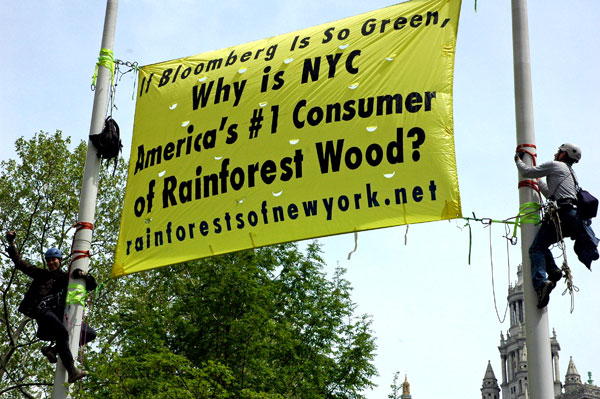
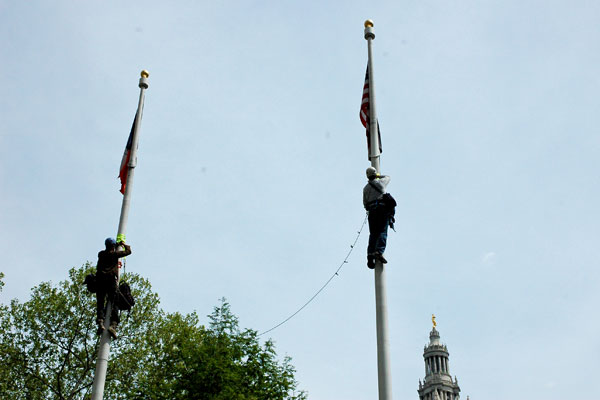
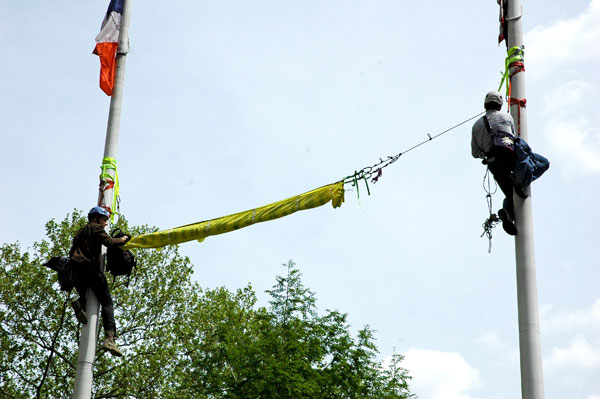
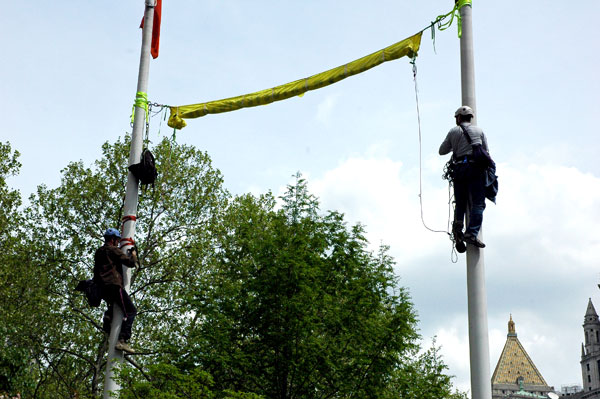
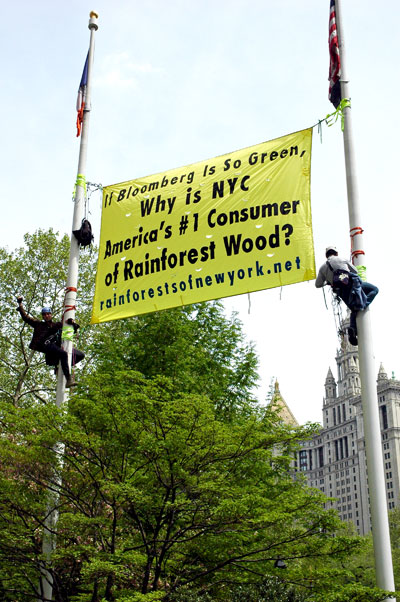
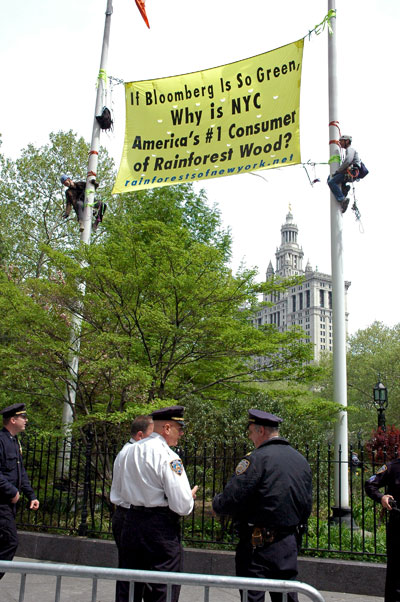
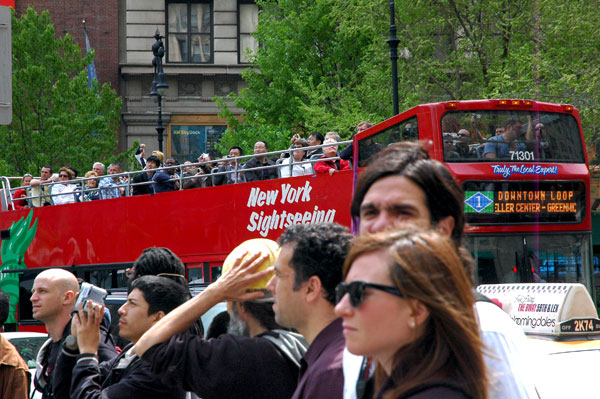
Two intrepid activists from the group, “Rainforests of New York” (yeah, New York rain forests: we’re actually the country’s #1 ongoing consumer of the irreplaceable wood from the planet’s vanishing tropical rain forests) at midday today shimmied up two of the 40-foot flagpoles planted at the foot of City Hall Park. There the team, Tim Doody and Tim Keating, masterfully strung a handsome 150-square-foot banner broadcasting, to Mayor Bloomberg, the people of New York, tourists on foot and sitting in open-top buses, and by now the whole world, the gross hypocrisy of a city which talks green while refusing to acknowledge its dependence on “exotic wood” products purchased (with public money) from those whom our building appetites reward for continuing to destroy rain forests and altering the entire world climate.
The action was organized by Rainforest Relief and the New York Climate Action Group [NYCAG]
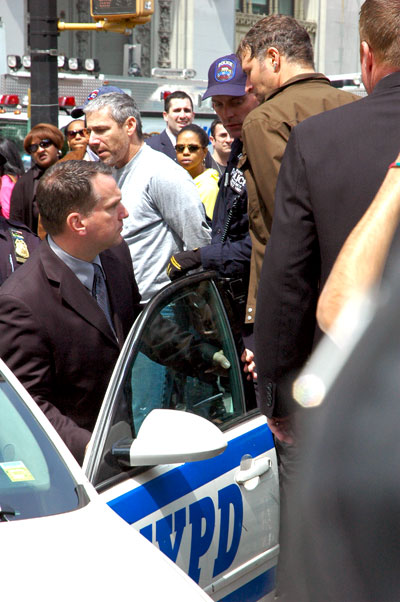
The banner was unfurled some time after noon, and it was still in place at 1:45 pm, well after the triumphant climbers had lowered themselves to the ground. They were arrested by gloved members of the “Police Emergency Service” while being hailed by the supportive lunchtime crowd, which then saw them driven off to the First Precinct.

rainforest_bannner_17.jpg

rainforest_bannner_23.jpg

rainforest_bannner_22.jpg

rainforest_bannner_31.jpg

rainforest_banner_63.jpg

rainforest_banner_67_b.jpg

rainforest_bannner_95.jpg

Harold and Clay: bond annulled, separated, effects seized

Before_Stonewall_2.jpg
[still from the documentary, “Before Stonewall“; it is not a picture of Harold and Clay]

UPDATE: County settles with Clay out of court

ADDENDUM: This is a link to a page on the NCLR site which includes a picture of the couple and more of a background on what they had together, and what was taken from them. Note also that Harold and Clay had taken the precaution of naming each other both beneficiaries of their respective estates and agents for medical decisions, and the authorities still proceeded as if they had no personal or legal relationship.

This is the basic story: Harold Scull, 88, and Clay Greene, 77, a couple for 25 years, and living together for 20 years, were physically and permanently separated, forcibly, when Harold was injured two years ago in a home accident. Clay was not permitted to see his partner or have any say in his care. Their property was summarily seized and auctioned off to pay for Harold’s medical care and for the cost of the separate nursing homes to which the county had assigned them. Harold died a few months later and Clay was only informed of the fact days after. Neither had seen the other in the interim, and the home, possessions and virtually all property and personal mementos they shared had been disposed of by the county.

When I heard about these horrors via an email from a friend I first thought was that the account must be an invention, perhaps a cruel scam, but then, registering the integrity of my source, and seeing the story verified elsewhere, I was horrified and revolted. My stomach turned.
This is the kind of thing many might have thought could only exist as an invention, a hypothetical worse-case scenario constructed to help advance an understanding of the importance of securing the human rights of a large portion of humankind in this country, and beyond. It certainly wasn’t something that happened in a civilized society today, to people like, well, us.
So, are we really living in post-Stonewall world?
The nightmare for Harold and Clay began only two years ago, and it didn’t happen in, say, . . . Arkansas. I’m picking on that state because, for me, there the political is personal: Arkansas is where my partner Barry was born and grew up, but we refuse to visit friends and family there, for a number of reasons, many of them related to the primitive laws and customs it uses to condemn and endanger relationships like our own.
No, this story unfolded in California, and in fact in the San Francisco Bay area. Moreover, the local media, in the form of the Sonoma County, New York Times-owned paper, the Press Democrat, has refused to cover the story or the legal case being advanced by the surviving partner, Clay Greene.
It’s pretty clear that queers still aren’t safe anywhere in this country.
I’m copying here the account which appears on the site of the NCLR [National Center for Lesbian Rights]:

Greene v. County of Sonoma et al.
Clay and his partner of 20 years, Harold, lived in California. Clay and Harold made diligent efforts to protect their legal rights, and had their legal paperwork in place�wills, powers of attorney, and medical directives, all naming each other. Harold was 88 years old and in frail medical condition, but still living at home with Clay, 77, who was in good health.
One evening, Harold fell down the front steps of their home and was taken to the hospital. Based on their medical directives alone, Clay should have been consulted in Harold�s care from the first moment. Tragically, county and health care workers instead refused to allow Clay to see Harold in the hospital. The county then ultimately went one step further by isolating the couple from each other, placing the men in separate nursing homes.
Ignoring Clay�s significant role in Harold�s life, the county continued to treat Harold like he had no family and went to court seeking the power to make financial decisions on his behalf. Outrageously, the county represented to the judge that Clay was merely Harold�s �roommate.� The court denied their efforts, but did grant the county limited access to one of Harold�s bank accounts to pay for his care.
What happened next is even more chilling: without authority, without determining the value of Clay and Harold�s possessions accumulated over the course of their 20 years together or making any effort to determine which items belonged to whom, the county took everything Harold and Clay owned and auctioned off all of their belongings. Adding further insult to grave injury, the county removed Clay from his home and confined him to a nursing home against his will. The county workers then terminated Clay and Harold’s lease and surrendered the home they had shared for many years to the landlord.
Three months after he was hospitalized, Harold died in the nursing home. Because of the county�s actions, Clay missed the final months he should have had with his partner of 20 years. Compounding this tragedy, Clay has literally nothing left of the home he had shared with Harold or the life he was living up until the day that Harold fell, because he has been unable to recover any of his property. The only memento Clay has is a photo album that Harold painstakingly put together for Clay during the last three months of his life.
With the help of a dedicated and persistent court-appointed attorney, Anne Dennis of Santa Rosa, Clay was finally released from the nursing home. Ms. Dennis, along with Stephen O’Neill and Margaret Flynn of Tarkington, O’Neill, Barrack & Chong, now represent Clay in a lawsuit against the county, the auction company, and the nursing home, with technical assistance from NCLR. A trial date has been set for July 16, 2010 in the Superior Court for the County of Sonoma.
[there is a pdf link to the complaint filed in Clay Greene’s name at the bottom of the NCLR page itself]

Suggested media contacts:
Catherine Barnett, Executive Editor, The Press Democrat
Arthur Sulzberger Jr., Chairman & Publisher of the New York Times
Richard Berke, Assistant Managing Editor of the New York Times
Adam Nagourney , the chief national political correspondent for the New York Times

[image from flickr]

Yevgeniy Fiks names names in Communist Tour of MoMA

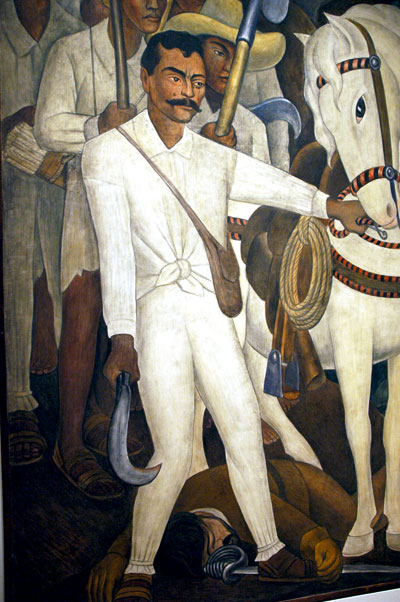
Diego_Rivera_Zapata.jpg
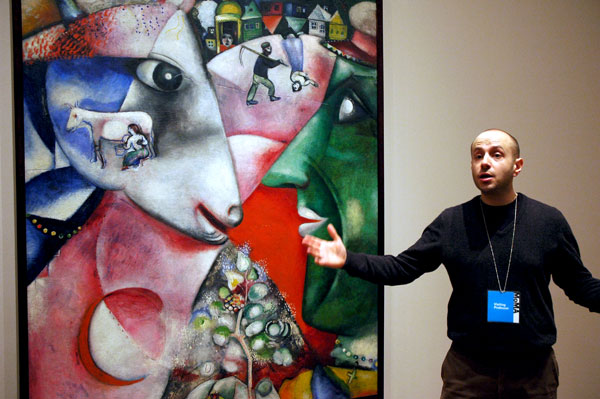
Diego Rivera Agrarian Leader Zapata 1931 fresco 7′ 9.75″ x 6′ 2″ [large detail taken from a slightly oblique angle, of the painting in MoMA’s collection]

Of course there was Rivera, and Kahlo, but most of the other committed pinko commies hanging around inside the Museum of Modern Art have been largely hidden from our history, from the institutional history of MoMA, and from the history of the art and the artists themselves.
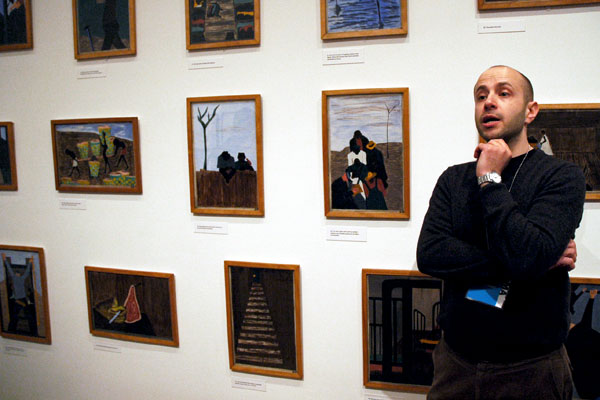
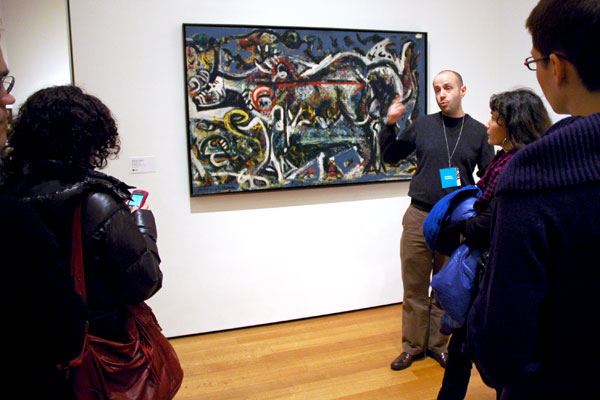
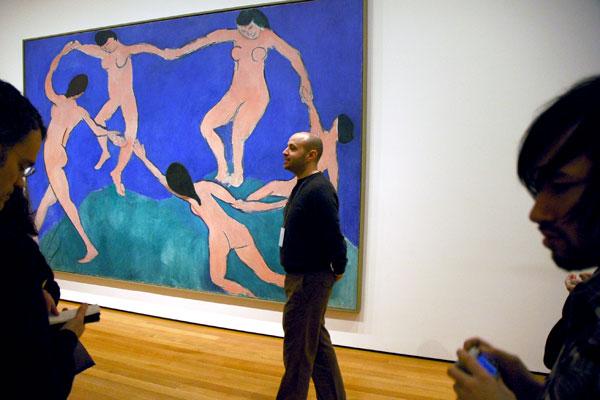
Leading a tour of the Museum on 53rd Street this past Monday, artist and teacher Yevgeniy Fiks started to sort things out for the record. Barry and I were extremely fortunate to be a part of the discreet group of enthusiasts which he directed in a “Communist Tour of MoMA”.
One of my favorite parts? Enjoying the fact that any number of other museum visitors who happened near us were learning more than they had bargained for when they walked into the galleries of the permanent collection that afternoon.
If you missed the road trip clear your calendar for Fiks’ presentation, “Communist Modern Artists and the Art Market” at Winkleman gallery March 12, another event in William Powhida and Jen Bartlett’s month-long project, “#class“.

I’ve uploaded below images taken at a few of our stops (devotions, secular “stations”), and Barry has a more narrative report, assembled from his notes, on his own site.

Yevgeniy_Fiks_Jacob_Lawrence.jpg
Jacob Lawrence

Yevgeniy_Fiks_Jackson_Pollock.jpg
Jackson Pollock

Yevgeniy_Fiks_Matisse.jpg
Henri Matisse

Yevgeniy_Fiks_Paul_Chagall.jpg
Marc Chagall

NYPD: racial profiling, false collaring, permanent records

Stop&Frisk.jpg
up against the wall, spread over the hood, or face down on the ground; then into the computer

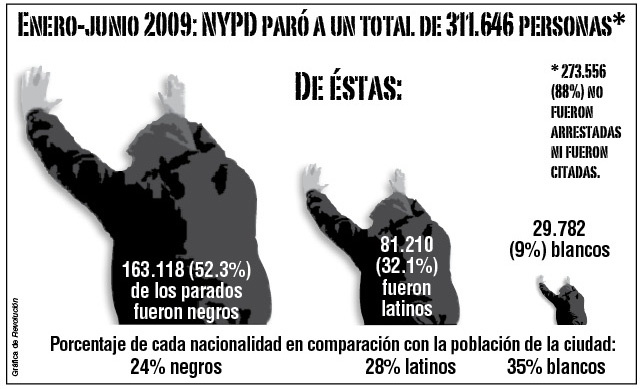
From 2004 through 2009, in a policy that has gotten completely out of control, New York City police officers stopped people on the street and checked them out nearly three million times, frisking and otherwise humiliating many of them.
Upward of 90 percent of the people stopped are completely innocent of any wrongdoing. And yet the New York Police Department is compounding this intolerable indignity by compiling an enormous and permanent computerized database of these encounters between innocent New Yorkers and the police.
Not only are most of the people innocent, but a vast majority are either black or Hispanic. There is no defense for this policy. It�s a gruesome, racist practice that should offend all New Yorkers, and it should cease.

These are the first angry paragraphs of Bob Herbert‘s righteous and powerful Op-Ed piece in today’s Times, “Watching Certain People“.
And none of this is even news! Why do most New Yorkers continue to be indifferent to what’s being perpetrated within what is generally considered to be one of the world’s most diverse and most liberal societies?
Herbert’s outrage is rightly directed at the racism so dramatically demonstrated by the statistics, but we would be ashamed of and alarmed by the police tactics themselves even if they were exercised within a completely homogeneous society.
While no one is contending that the practices of the New York City Police Department [NYPD] are equivalent to those of the Geheime Staatspolizei [Gestapo], the Ministerium f�r Staatssicherheit [Stasi], or the Komitet Gosudarstvennoy Bezopasnosti [KGB], how much emulation of the tactics used by systems we call totalitarian will we tolerate in our guardians? Do we care at all as long as we think “decent people” aren’t being harassed, intimidated, and permanently documented?
New York City has taken its cue from the nation’s irrational and hysterical response to the events of 9/11, the so-called “Patriot Act“, and produced a number of its own unconstitutional police toys in the name of “security”, some of them (as in the case of the federal operations) with absolutely no relationship to terrorism, or indeed patriots, and none of them able to promise safety to their white middle-class or wealthy authors in any event.
At what point will we know it’s gone too far? If we’re indifferent to what’s happening or simply not paying attention, how will we know when the land of the free and the home of the brave has actually become a military/police state, its population cowed into submission by fear of the other, to be hunted down in its midst or somewhere on the other side of the planet?

[image, illustrating NYPD stop-frisk statistics for the first half of 2009, from revcom.us]

BHQF’s “We Like America” at Whitney 2010 Biennial

Bruce_High_Quality_We_Like_America.jpg
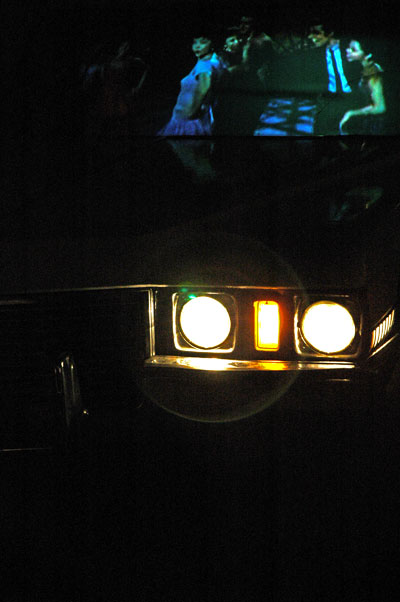
Bruce High Quality Foundation We Like America and America Likes Us 2010 vehicle and educational implements, dimensions variable [detail of installation]

ADDENDUM: [April 30, 2010] The entire sound video projected onto the inside of the windshield can be viewed here on vimeo, although as the April 20 comment at the bottom of this post (which alerted me to the link) says, it’s not quite the same isolated from the ambulance/hearse; the experience of the darkness of the installation itself, the imperfect acoustic of the space, and the murky projection, can’t really be reproduced on a computer screen.

I feel good about the Whitney 2010. While I like excitement, I resist hype like the plague. This Biennial has been accompanied by neither, which at the very least gives visitors a better chance to experience the individual works for themselves, and unencumbered with a theme. There is some very good, even awesome work on the three floors of the exhibition I saw at the preview (the floors not devoted to favorites from earlier years), but for me none of them had so fundamental an impact as the Bruce High Quality Foundation installation, “We Like America and America Likes Us”.
In “Art Class“, a 2007 piece published on Artnet, Ben Davis had described Picasso’s “Guernica” as “the most successful political image of the 20th century”. His argument was that isolated artistic gestures cannot resolve social contradictions “without any social movement backing them up to give them force”, continuing:

This does not mean that art or artists cannot play any political role; it is just that some model besides the middle-class one of “my art is my activism” is necessary, one based on concrete solidarity and practical action. Picasso�s Guernica is the most successful political image of the 20th century. Guernica, in fact, embodies the fact that art�s political value is determined in its relation with mass struggle, not in its individual content — the imagery of the painting, moving as it is, is completely drawn from a vocabulary of forms Picasso had already developed in previous work. Yet, during the Spanish Civil War, after its appearance at the Spanish Republic�s booth at the 1937 World�s Fair, Guernica was literally removed from its stretchers, rolled up and toured internationally to win support for the Republican cause. In England, visitors brought boots to send to the front.

The Bruce High Quality Foundation seems to be taking a different route with its own institutional, social and political critique, probably one more suited to our own politically-lethargic times. Bruce’s confrontations with our own tropes have been found just about everywhere: on our streets, our waters, our public plazas, even inside the galleries and expositions of the system they speak to.
I have to confess to a penchant for political art, and to a number of years spent in sort of a groupie relationship to this arts collective, and yet “We Like America and America Likes Us” is one of the most affecting works, in any genre, I’ve ever encountered. Where do we bring our allegorical boots?
We are all wounded, wrapped in felt. Are we inside an ambulance or a hearse? What is to be done?
Like much of what Bruce does, it’s not conventionally “beautiful” – except as truth is beauty, and yet the incredibly elegiac recorded remembrance of “America” which accompanies the fast video montage of heterogeneous clips projected onto the tall Cadillac windshield is riveting, and profoundly moving.
I don’t know the length of the loop (and there was no indication on the museum’s wall text); but for all I know it could be as long as the melancholy story it tells.
Especially for those who will not be able to visit the Whitney, I have some excerpts. The text, recited by a luscious, soothing female voice, begins:

We like America. And America likes us. But somehow, something keeps us from getting it together. We come to America. We leave America. We sing songs and celebrate the happenstance of our first meeting � a memory reprised often enough that now we celebrate the occasions of our remembrance more often than their first cause.

And a little later I listened as the gender pronouns slithered over each other in ecstasy, and in sorrow:

We wished we could have fallen in love with America. She was beautiful, angelic even, but it never made sense. Even rolling around on the wall-to-wall of her parents� living room with her hair in our teeth, even when our nails trenched the sweat down his back, and meeting his parents, America stayed simple somehow. He stayed an acquaintance, despite everything we shared. Just a friend. We could share anything and it would never go further than that.
No one really knows how love begins. A look on his face one time after we�d made love � a text message too soon after the last one. When did we become a thing to hold on to rather than just something to hold? We didn�t know America was in love with us until it was too late. Maybe we couldn�t have done anything about it anyway. America fell in love with the idea of us, with some fantasy of us, some fantasy of what America and us together would be, before we had a chance to tell him it could never work, we weren�t ready for a relationship, we weren�t comfortable being needed, we didn�t have the resources to be America�s dream.
It wasn�t easy letting America down. As we stuttered through our rehearsed speech we watched the change on her face. We could see the zoom lens of her attention clock away. We could feel ourselves receding back into the blur of the general population.

The last lines are:

There was a time we thought we were nothing without America. When she left, we realized all the excuses we�d been making. All the problems we�d been trying not to address. We drunk dialed our memory of America just to hear what we were thinking. We worked late and we told ourselves we had to, that the work came first, that this was an important time in our lives and that love could wait. Just wait a little longer and we�d fix everything, we�d say. Solving the America problem, our lack of attention, our disinterest in sex, our never being home, our thinking of her as a problem � it would have to wait.

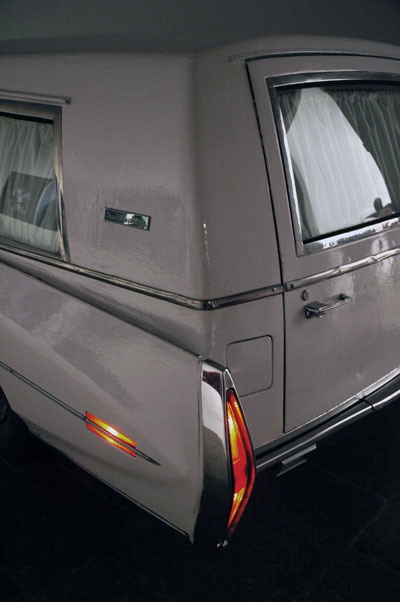
Bruce_High_Quality_We_Like_America_rear.jpg
[installation view of the rear of the curtained 1972 Miller-Meteor ambulance/hearse]

[text from the audio of the installation courtesy of the artists]

Obama has decided press conferences are for chumps

white-house-press-room.jpg
if he’s not going to come by anymore, why not bring back FDR’s pool, or put up a parking lot?

Sure, I know it’s not a race, but I did beat (scooped?) the Times again, although by only slightly less than a week this time: Obama hasn’t held a press conference since July, as I wrote here. However if you read this story by Peter Baker in the Times today you’ll get the impression that it only means that our current President is being hip, that he’s found a better way.
What he’s found, the article tells us, is a media strategy that works for the White House. Baker doesn’t bother to address whether it works for his own profession, or for the public, whose only window onto the doings of our so-called representative government is a vigilant, independent press.
I’m certainly anything but a part of MSM, but it doesn’t make me feel any better about this president’s relationship to the press to be told that he has a more generous understanding of what constitutes “the press” than did his predecessors. Obama may be, as the Times headline puts it, “taking questions”, from other than the wire service, print and broadcast reporters who work inside the White House, but he’s doing it on his terms, and those terms have been dictated to us.
Addressing “alternative” media alone does not satisfy the public’s need (and a free republic’s requisite) to see that reporters of all kinds are able to freely ask their own questions, not those induced by an officeholder, and in a forum and at a time not engineered by that same public servant.

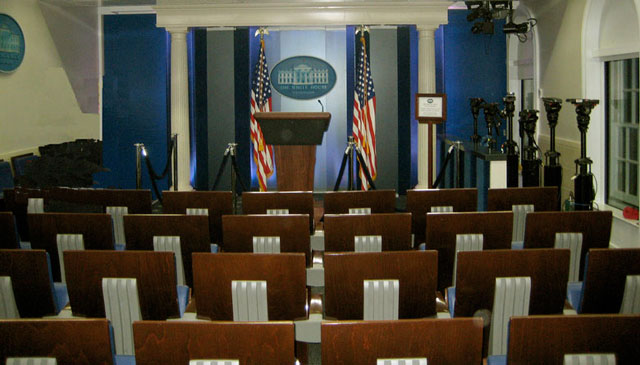
[image of the renovated James S. Brady Press Briefing Room at the White House from visitingdc]

so how about a frakking presidential news conference?

FDR_press_conference.jpg
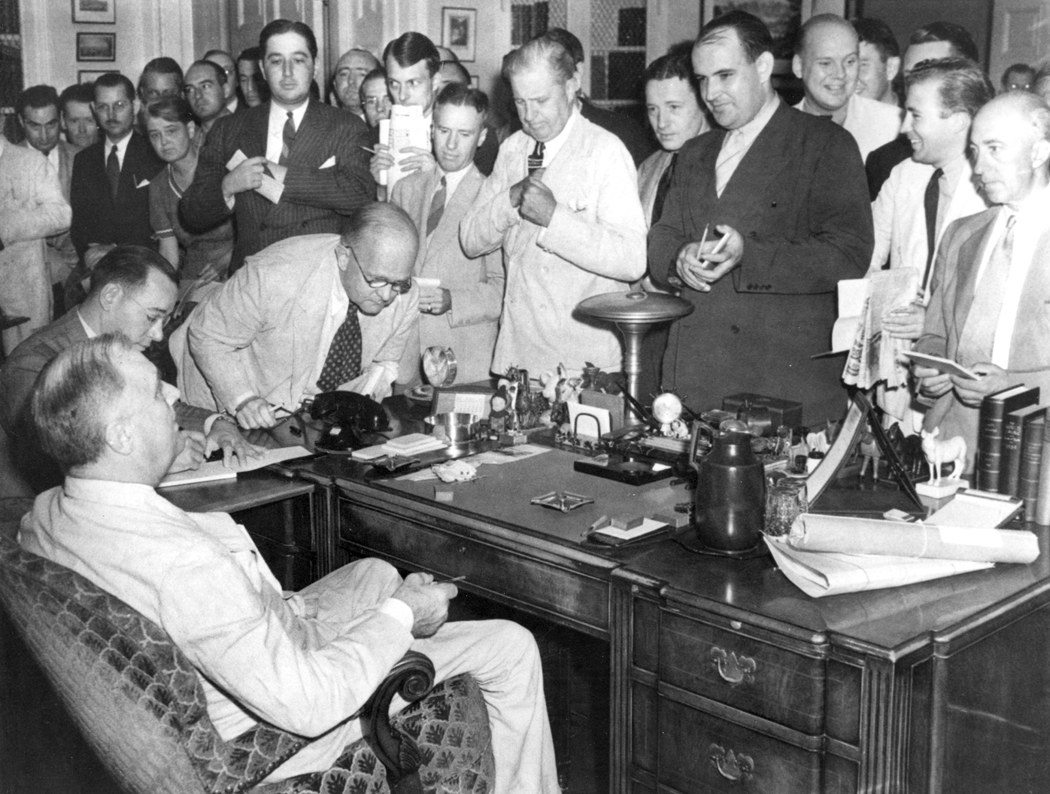
FDR talks to the press; the press talks to FDR

I was only slightly confounded to realize I had no interest in watching the speech last night; didn’t even think about recording it in case it turned out POTUS actually said something. When it comes to a corporate one-party state, I guess I make a bad subject.
And I’m old-fashioned: As unsatisfying as they may almost always have been, I still have some good memories of actual Presidential news conferences. Not recalling the last time I had heard of one, this morning I went on line looking and found that Obama hasn’t had a press conference in six months.
Transparently nontransparent.

[image from swamppolitics]