cyclist wins asylum but remains in jail

In fact he has always been truly free, but the great and tender soul of Reza K. Baluchi was officially granted political asylum yesterday by U.S. immigration judge LaMonte Freerks. Today his body remains in jail, because the INS itself hasn’t yet decided whether they will appeal. They have 30 days to decide whether they will try again to throw him to the tender mercies of the Iranian government which had tortured him and from which he fled 6 years ago. Iran, of course, is part of the administration’s own invention, the “axis of evil,” regardless of the merits of that designation.

During his asylum hearing, which began Monday, Mr. Baluchi was nervous, said his lawyer, Suzannah Maclay of the Florence Immigrant and Refugee Rights Project.
“He was clearly very anxious,” Ms. Maclay said. “He had expected to get a final decision, and instead he’s taken back to detention.”

But Baluchi is definitely not down yet.

“Today I’m happy,” Mr. Baluchi said with his customary optimism after the hearing. Once he gets out, he said, he plans to ride to Los Angeles. From there, he will run across the country, eight hours a day, to New York City — and ground zero. Shortly after the Sept. 11 attacks, Mr. Baluchi wrote that he would conclude his voyage at the site of the World Trade Center, “so that my message of peace and love can reach the whole American people.”

Valentine’s Day art massacre

Nicolás Dumit Estévez and his performance piece, his art, was assaulted by New York City Police on Valentine’s Day. They succeeded in shutting down his activities for the day, but the artist and the work somehow survives. Here he describes the project which he began and which the police concluded. The art survived the experience, and was made more powerful for having been so outrageously challenged, but the honor of our Police Department was again compromised, and in the same degree.

NOTES ON “LOVE IS BLIND”
An intervention developed by Nicolás Dumit Estévez and modified by the New York City Police
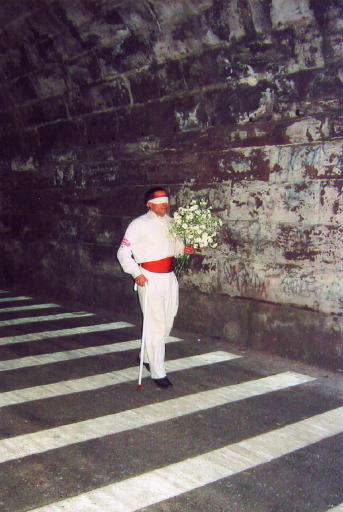
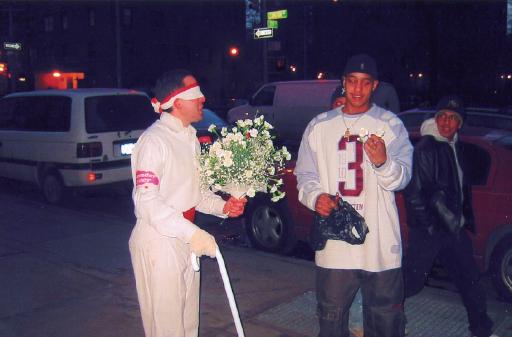
On February 14 I left El Museo del Barrio blindfolded, unaware of what I would see at the end of a performance piece that I called “Love is Blind,” which was part of “The Love a Commuter Project.” This project consists of a series of site-specific performances and interventions that take place every year on Valentine’s day in the New York City subway system. In 2003 the project was presented in conjunction with “The S Files” at El Museo del Barrio. Besides watching out for some icy spots on the sidewalk, my job during the performance was to locate pedestrians who would help me find the way to the subway station at 110th and Lexington Avenue in exchange for a white carnation. The plan was to save the remaining part of the bouquet to share with subway commuters. Along the way to the subway station a policewoman helped me cross under the tunnel below the train tracks on Park Avenue, and an older woman who spoke Spanish proffered a blessing “Dios te bendiga mi hijo,” after making sure I was going to be ok. Someone who I perceived as a strong man grabbed me by the arm to help me walk from 108th to 109th Street, while a disgruntled pedestrian tried to confuse me when I asked him for directions. “You’re at 125th St.,” he said, while my Samaritan told me that we were crossing 108th. Another man helped me make it all the way down the stairs of the subway station. I remember feeling his hand as he took mine and guided it to the cold metal railing. I then proceeded to use the white cane I was carrying to search for an empty spot near the token booth. I found one on the north side of the station. Two children initiated the first underground interaction as they detached several carnations from the bouquet. “Take another one for your mother,” yelled a commuter, perhaps from the other side of the turnstile. “Don’t touch them,” said an adult to a child who insisted on having one of the carnations. What felt to me like a rushing commuter snapped up a flower without giving me time readjust the bouquet in my hand. Then there were the predictable quiet moments between the departure and arrival of the Number 6 train. All of the sudden, the hissing sound of police walkie-talkies invaded the space. That day the city was under Code Orange, raised from Yellow by the Department of Homeland Security. Sensing what might be happening, I took the blindfold off and walked above ground to find that three uniformed officers were questioning my colleague Manuel Acevedo, who was videotaping the project, as well as a friend who came to watch the piece. After several attempts to explain what we were doing, we were ushered into the back of a car and driven to the precinct, where I managed to make a quick phone call from my cell phone before one of the agents confiscated my phone and Manuel’s video camera. We were not permitted to contact anyone else. At the precinct I glanced at a booklet on fighting terrorism and the snapshots of several individuals who were wanted by the Law. We had plenty of time to kill as the agents busied themselves swiping our ID cards and figuring out what was recorded on the video camera they could not manage to operate. About 40 minutes later, an officer came to us and asked us to show him the video. He later return with our IDs, shook our hands and apologized. We could go. I remember shaking his hand while holding the bouquet in my other hand, when suddenly the friend who came to watch the piece took the flowers and tossed them into the trash, perhaps trying to rid himself of the memories of the incident. I rushed to retrieve them. The carnations still looked fresh, ready for other commuters to pluck them from the foam that held them in place. Instead, they ended up in a glass vase at home, as a reminder of how current law enforcement in the name of “safety” has reconfigured the use of the spaces we share in the city, not to mention the interactions we forge with one another in these so-called public places.
Nicolás Dumit Estévez
February 21, 2003, New York City


seeing more Blue

The Blue Button Project is beginning to take on a life of its own.
I’ve watched it as it evolved out of frustration and horror into a resolve and finally a tool with which to do something about the terror U.S. policy is responsible for around the world. I’m exhilarated to be now regularly running into people on the streets and elsewhere who are wearing the Blue Button and willing to express resistance to the injuries being done to all of us around the world, supposedly at our own bidding and for our own good.
Check out the site now, and see how or where you can find the Button, and please let us know if you have any ideas for increasing its visibility.

profundity from the sports pages

I do look at the sports pages! It’s just that I don’t look for what most everyone else looks for. Sometimes it’s an item about culture, the large-mouth bass, a really hot photograph, a heart-warming human vignet, and sometimes it’s about freedom.
Yesterday I first read in the NYTimes Sports pages about what many had already heard, that a young woman at Manhattanville College, Toni Smith, was bravely exercising her freedom of speech on the floor of a basketball court.

It was the smallest of gestures inside the tiniest of college basketball gymnasiums, a half-revolution of the body that had gone unnoticed for months.
But a few weeks ago, people at Manhattanville College’s women’s basketball games began to recognize that the senior guard Toni Smith would quietly turn her back to the American flag during the pregame playing of “The Star-Spangled Banner,” a silent protest, they learned, of America’s potential involvement in an Iraqi war.

Two nights ago her stand, and the enormous outrage it provokes among Americans who wrap themselves in the flag rather than defend the liberties it represents, came to the attention of the world.Smith’s noiseless protest led to a clamorous, sellout crowd for a game inside Manhattanville’s 50-year-old, 300-seat, cinder block gym tonight in the middle of the college’s leafy campus 25 miles north of New York City. It brought 15 protesters outside the college’s main gate waving flags and placards, and a retinue of police officers and security guards to watch them. It attracted 20 photographers and a handful of national television cameramen who encircled the Manhattanville bench to get a glimpse of Smith as she turned her back and stared at the floor.

A very impressive letter in today’s Times represents a sharp understanding of the significance of Smith’s gesture and why we should be very concerned about those who are so outraged by it.

THE ATHLETE AND THE FLAG
To the Editor:
Re “Player’s Protest Over the Flag Divides Fans” (Sports pages, Feb. 26):
On the one hand, patriotic Americans appear obsessed with the flag as a symbol of cherished freedoms. On the other hand, many of the same Americans are angry and intolerant when Toni Smith exercises her right to practice the most fundamental of those freedoms.
Toni Smith, a senior guard on Manhattanville College’s women’s basketball team, turns her back to the flag during the pregame playing of “The Star-Spangled Banner” to silently protest America’s potential involvement in a war on Iraq.
The rancor exceeds mere disagreement. The patriots are offended by Toni Smith’s observance of a First Amendment right.
Because free speech is so fundamental to American notions of freedom, the act of protest is inherently patriotic, regardless of the point of view or substance. If that is not the case, it is immaterial whether the military has fought and sacrificed for the First Amendment freedom to protest.
MICHAEL HEILBRONNER
Portland, Ore., Feb. 26, 2003

fingering the terrorist promotes terrorism

Some mornings really manage to do what mornings are supposed to do: restore your faith in the world, its beauty and its possibilities.
Today I read a NYTimes follow-up on the story of the Michigan high school student who is paying attention to his world and who knows his (theoretical) rights.

Bretton Barber, a high school junior in Dearborn Heights, Mich., who is deeply interested in civil liberties, knew what to do when he was sent home from school on Feb. 17 for wearing a T-shirt with a picture of President Bush and the words “International Terrorist.”
First, he called the American Civil Liberties Union. But it being Washington’s Birthday, no one answered.
Next he went on the Internet to re-read a Supreme Court case from 1969, Tinker v. Des Moines, that supported students’ freedom of expression. Then he called the Dearborn High School principal to talk about his constitutional rights. And then he called the news media.

Barber had been told by the vice-principal that he couldn’t wear the shirt because it promotes terrorism. Go figure.

fascism, not democracy, is the natural state

Norman Mailer argues in the International Herald Tribune that “the Bushites” really believe that the only way to save America (from the decadence whose mention makes their “conservative” partners slaver and drool) is to build a military empire. That our own democracy will be destroyed in the process is of no concern to these interests.
He recognizes that in the end we may not go to war against Iraq, and he believes that if that happens, “Bush is in terrible trouble.” He’s not optimistic however.

My guess though, is that, like it or not, want it or not, America is going to go to war because that is the only solution Bush and his people can see.
The dire prospect that opens, therefore, is that America is going to become a mega-banana republic where the army will have more and more importance in Americans’ lives. It will be an ever greater and greater overlay on the American system. And before it is all over, democracy, noble and delicate as it is, may give way. My long experience with human nature – I’m 80 years old now – suggests that it is possible that fascism, not democracy, is the natural state.
Indeed, democracy is the special condition – a condition we will be called upon to defend in the coming years. That will be enormously difficult because the combination of the corporation, the military and the complete investiture of the flag with mass spectator sports has set up a pre-fascistic atmosphere in America already.

“I have something for people. Love.”

A charming and winning young Iranian who knows about war was arrested in Arizona last November as an “illegal” after pedaling around the world for six years in the name of peace. He may be deported.

Originally, he planned to end his trip in Canada, but while standing on the Champs-Élysées on Sept. 11, 2001, his mission became clear: ride to Ground Zero on the first anniversary of the attacks and present to the American people the good wishes that he had collected on his travels.
Then he got caught on Nov. 10. Immigration officials confirm that Mr. Baluchi had applied for a visa in Monterrey, Mexico. He was found with little beyond a tent, the binder of clippings, some personal effects and a mass-produced bicycle. The little man with the big heart can be persuasive when he starts to cry. “I sorry. I make mistake. I love America.”

He doesn’t seem to understand his situation, as he runs circles around the exercise yard in the detention facility where he currently resides.

“I go Ground Zero,” he said. “I have something for people. Love.”

This week Reza K. Baluchi had his opportunity to explain himself in fededral immigration court. The judge is expected to rule on thursday whether he will be sent back to Iran where he has already served 18 months in prison for association with “counterrevolutionaries.”
For for more about this “idyllic wanderer who thinks one man can change the world,” but at the risk of breaking down while reading it, see The Arizona Republic story I found on the interesting, “The Iranian,” website.

Instead of bicycling from Los Angeles to New York, Reza Baluchi intends to run the final 2,500 miles.
“I cannot stop me,” he says. “I run for peace.”

For great pictures and stuff see this website and this one, apparently the work of admirers.

Bush’s binary world

A really snappy OP-ED piece from a, er, Frenchie, was jumping off the page in Sunday’s NYTimes. Régis Debray asks when will Washington learn to count to three.

[“Old Europe”] now knows that the planet is too complex, too definitively plural to suffer insertion into a monotheistic binary logic: white or black, good or evil, friend or enemy.

Debray warns that a U.S. which misunderstands its real interests will, like all empires, coast, from military victory to military victory, to its final decline.

“Old Europe,” the Europe of Crusades and expeditionary forces, which long sought by sword and gun to subjugate Jerusalem, Algiers, Timbuktu and Beijing, has learned to distinguish between politics and religion. In 1965, one of its old champions, de Gaulle, loyally warned his American friends that their B-52’s would not be able to do anything against Vietnamese nationalism — and that to devastate a country is not the same as winning hearts and minds. Europe no longer takes its civilization for civilization itself, no doubt because it is better acquainted with foreign cultures, notably Islam. Our suburbs, after all, pray to Allah.
Europe has learned modesty. A civilization that believes itself capable of making do without other civilizations tends to be headed toward its doom. To be sure, in defending its interests a great nation may end up promoting freedom. Such was the situation with the concentration camps. It will not be the case for the $15 barrel of crude.
The stakes are spiritual. Europe defends a secular vision of the world. It does not separate matters of urgency from long-term considerations. The United States compensates for its shortsightedness, its tendency to improvise, with an altogether biblical self-assurance in its transcendent destiny. Puritan America is hostage to a sacred morality; it regards itself as the predestined repository of Good, with a mission to strike down Evil. Trusting in Providence, it pursues a politics that is at bottom theological and as old as Pope Gregory VII [11th century].
Europe no longer possesses that euphoric arrogance. It is done mourning the Absolute and conducts its politics . . . politically. It is past the age of ultimatums, protectorates at the other end of the planet, and the white man’s burden. Is that the age America is intent on entering? One can only wish it good luck.

liberties enjoyed for two centuries now cancelled

Harvey Wasserman, activist and longtime leader of the anti-nuclear movement, says that, “in terms of basic legal rights and sanctuary from government spying, Americans may be less free under George W. Bush than as British subjects under George III in 1776.”

Though the trappings of free speech remain on the surface of American society, the Homeland Security Act, Patriot I, Patriot II and other massively repressive legislation, plus Republican control of the Executive, Legislative and Judicial branches, plus GOP dominance of the mass media, have laid the legal and political framework for a totalitarian infrastructure which, when combined with the capabilities of modern computer technology, may be unsurpassed.

Wasserman’s list of the administration’s assaults and treasons is awesome, and it’s not even exhaustive.

President Bush has asserted the right to execute “suspected terrorists” without trial or public notice;
The Administration claims the right to torture “suspected terrorists,” and by many accounts has already done so;
Attorney-General John Ashcroft has asserted the right to brand “a terrorist” anyone he wishes without evidence or public hearing or legal recourse;
The Administration has arrested and held without trial hundreds of “suspected terrorists” while denying them access to legal counsel or even public notification that they have been arrested;
The Administration has asserted the right to inspect the records of bookstores and public libraries to determine what American citizens are reading;
The Administration has asserted the right to break into private homes and tap the phones of US citizens without warrants;
The Administration has attempted to install a neighbors-spying-on-neighbors network that would have been the envy of Joe Stalin;
The Administration has effectively negated the Freedom of Information Act and runs by all accounts the most secretive regime in US history;
When the General Accounting Office, one of the few reliably independent federal agencies, planned to sue Vice President Dick Cheney to reveal who he met to formulate the Bush Energy Bill, Bush threatened to slash GAO funding, and the lawsuit was dropped;
After losing the 2000 election by more than 500,000 popular votes (but winning a 5-4 majority of the US Supreme Court), the Administration plans to control all voting through computers operated by just three companies, with code that can be easily manipulated, as may have been done in Georgia in 2002, winning seats for a Republican governor and US senator, and in Nebraska to elect and re-elect US Senator Chuck Hagel, an owner of the voting machine company there;
FCC Chair Michael Powell (son of Colin) is enforcing the Administration’s demand that regulation be ended so nearly all mass media can be monopolized by a tiny handful of huge corporations;
Attorney-General Ashcroft has assaulted states rights, a traditional Republican mainstay, using federal troops to trash public referenda legalizing medical marijuana in nine states;
Ashcroft has overridden his own federal prosecutors and assaulted local de facto prohibitions against the death penalty, which has been renounced by every other industrial nation and is now used only by a handful of dictatorships, including Iraq.

After describing the overseas record of previous administrations and the cynical devices and shameful depredations of this one, Wasserman concludes,

In other words: the media hype about bringing democracy to Iraq is just that. There is absolutely no reason to believe a US military conquest would bring to Iraq the beloved freedoms George W. Bush is so aggressively destroying here in America.
A regime that so clearly hates democracy at home is not about to wage war for one abroad.