American airline threatens to divert flight over queer kiss

americanairlines.jpg

SEE AN UPDATE IN THIS SEPTEMBER 26 POST: “the American Airlines homo scare: even worse than reported

Shortly after takeoff, Varnier nodded off, leaning his head on Tsikhiseli. A stewardess came over to their row. “The purser wants you to stop that,” she said.
“I opened my eyes and was, like, ‘Stop what?’ ” Varnier recalled the other day.
“The touching and the kissing,” the stewardess said, before walking away.

This isn’t fiction; It’s right there in print, in “The Talk of the Town” section of The New Yorker. The two people told to cut the show of affection while on a transatlantic flight one month ago were two gay men.
They asked to speak to the purser, who denied instructing the stewardess to tell the men anything. She admitted there was nothing inappropriate about the behavior they described and while she initially seemed to be supportive she ended the discussion by announcing that kissing was improper behavior on an airplane. She then said she was busy with meal service and left, promising to come back afterward.

Half an hour later, the purser returned, this time saying that some passengers had complained about Tsikhiseli and Varnier’s behavior earlier. The men asked more questions. Who had complained? (She couldn’t say.) Could they have the stewardess’s name, or employee number? (No.) Would the purser arrange for an American Airlines representative to meet them upon landing at J.F.K.? (Not possible.) Finally, the purser said that if they didn’t drop the matter the flight would be diverted.
After that, [a passenger whom we know who was seated behind the couple] said, “everyone shut up for a while. ”Maybe an hour later, the purser approached Tsikhiseli and said that the captain wanted to talk to him. Tsikhiseli went up to the galley and gave the captain his business card. The captain told Tsikhiseli that if they didn’t stop arguing with the crew he would indeed divert the plane. “I want you to go back to your seat and behave the rest of the flight, and we’ll see you in New York,” he said. Tsikhiseli returned to coach.

This is just one of the reasons why Barry and I are thinking about leaving the country. Such an assault may be worthy of a few paragraphs in a sophisticated New York magazine, on the basis of its outrageousness, but this sort of thing – and much worse – is still taking place all over the country, even on and above international waters. I just don’t think there’s a future in this country for people who think, even if they’re careful to kiss the people they’re supposed to kiss.
It’s not only about queer terrorists.

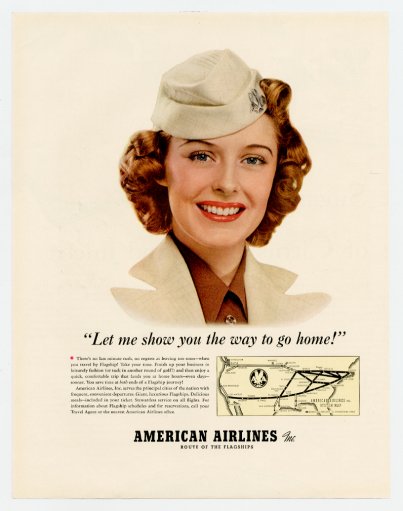
[image from Women in Uniform]

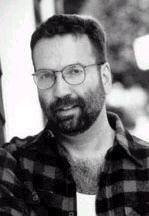
Eric Rofes, pleasure even in the manner of his departure

rofeseric2.jpg
Eric Rofes

Eric Rofes died on Monday.
This remarkable and very gentle activist was one of the most important voices to ever represent the “sexual outsider” – meaning effectively just about everyone who’s ever done the thing, or even only thought of doing it, and still of course all women, as charter members of the tribe. Rofes was an individual thinker and mover, and as his own queer sub-community became more and more interested in pursuing an elusive and illusory respectability he often found himself a voice crying in the wilderness – when his arguments were not actually demonized, described as monstrously sexually-compulsive.
In the death announcement on the PlanetOut site, Richard Burns, executive director of New York’s Lesbian, Gay, Bisexual and Transgender Center, is quoted: “He was a critical thinker and someone who didn’t feel it was necessary to go with the flow in his analysis. He believed we needed to build a healthy community and respect adult sexual decisions and not pathologize or infantilize gay men’s sexual lives. In the face of HIV/AIDS that was not always a popular view.”
Ben Shepard, who also knew Rofes as a friend and a fellow activist, has written this memorial:

GOODBYE TO ERIC ROFES

I just got word that Eric Rofes died of a heart attack. I had known Rofes since our time in San Francisco with Shanti Project in the early 1990’s. We reconnected together in the late 1990’s doing SexPanic! stuff in 1998. He was a caring voice who hoped for pleasure to be part of our democracy. He argued for this, screamed about it, yearned for it. When he was attacked he fought back about it. And many attacked Rofes. They attacked him for wearing leather when he testified at the National AIDS Commission in San Francisco. He was criticized for embracing Walt Odets and the notion of survivor guilt among gay people who had lost whole cohorts of friends to HIV. And he was attacked when he ran Shanti Project. But he kept going. And he kept on asking people to think about the complexity of their lives and struggles and emotions. After leaving Shanti Project, he earned at PhD at Berkeley and wrote two enormously influential books, Reviving the Tribe: Regenerating Gay Men’s Sexuality and Culture in a Period of Ongoing Epidemic and Dry Bones Breathe: Gay Men Creating Post AIDS Identities and Subcultures. Both were enormously important, contextualizing the losses to community, pleasure, friendship, and social knowledge of the connection between public sexual space and community organizing with the AIDS years. Early in Reviving the Tribe, Rofes wrote about standing with tears in front of a sex club where he had once enjoyed so much pleasure. Rofes was intensely aware of the multiple losses to AIDS and the need to think through what was going on. “I believe that any hope for collective survival is rooted in the realities of our lives, however, harsh and seemingly unacceptable,” Rofes wrote. “Our inability to continue confronting the ever-intensifying manifestations of AIDS has brought us to the point of paralysis.”
Rofes railed against those who suggested gay men should just ‘grow up’ and reject public sexual culture. “Even a cursory look at the histories of our movement will show that sexual liberation has been inextricably bound together with gay liberation, the women’s movement, and the emancipation of youth,” he wrote. He suggested a vast cultural amnesia was taking place as the lessons of the gay liberation years were lost amidst panic over continued rates of HIV. Rofes was keenly aware of the complexity of questions of sexual self determination. “For many, the forbidden becomes desired; taboo produces cravings; the return of the repressed is made corporeal and is experienced as an enormous hunger,” he wrote in his newest book. He was always aware telling gay men or anyone to just say no served no one’s ends but the moralists. Thus, HIV prevention would have to be considered within a broad holistic, harm reduction approach. For Rofes, there was far more to the question of pleasure than just getting off or male privilege. Central principles of democracy in America lay at the core of the sex panic question. Rofes wondered, can you lose your job for deviating from conventional sexual norms? For many, the answer is affirmative. Like so much else within our democracy, what one person enjoys, another will inevitably find offensive, he counseled. Variation is a core component of social life. And some people built alternative kinship networks. This should not be condemned, at least not in a pluralistic democracy. “Among the most effective ways of oppressing a people is through the colonization of their bodies, the stigmatizing of their desires, and the repression of their erotic energies,” he claimed during the National Gay and Lesbian Task Force‘s Creating Change Conference San Diego, November 16, 1997. “We believe continuing work on sexual liberation is crucial to social justice efforts,” (see complete speech here).
In 1998, Rofes came to New York to speak on a panel for the one year anniversary of SexPanic! and contacted me. I had just finished a book about the San Francisco AIDS years (White Nights and Ascending Shadows: An Oral History of the San Francisco AIDS Epidemic) and he wanted to talk about the book. We talked about survival, the capacity for resiliency, and the hope for a lusty pleasure in a democracy. I told him about my work with the group as a kinky straight man and he encouraged me to push forward and help forge a different kind of politics based in caring connection and social justice rather than identity, despite what people said. I had always had an image of him being a radical, but in person he was a caring, thoughtful person willing to consider each of our unique contributions. He was ever aware of all of our capacities to contradict ourselves and be bountiful. And was painfully aware that some of his greatest critics were gay men who scorned him for integrating his own personal story into a larger story of gay liberation and the need to revive the tribe. ‘Where are your sexual politics?’ he wondered after such attacks.
In the years that followed Rofes tried to build a broad based movement for gay men’s health. He was keenly aware of the need for social movements to support broad based struggles for social justice. When I interviewed Rofes for my dissertation, he helped tease out the relationship between embodied experience and the history of struggles for pleasure. Rofes saw that the role of the gay liberation movement was to reject notions that pleasure should be considered a peripheral component of social movement activity. Rofes helped me think about pleasure and play as strategy for organizing. “Play is a term for drag, ACT UP zaps, the use of food in the Latino Community, the use of dance dramaturgy, culture jamming, the carnival, and other forms of creative community building activities,” he helped explain to me, as we talked. Thus, play is the exhilarating fun, the pleasure part, the joy of building a more emancipatory, caring world. Rofes would point out that humor, drag, eating food together, cultural rituals support activism. “Ultimately, does a sober form of organizing appeal to more than white people in a sustainable way?” he asked. We concluded that play was part of expanding networks, social capital, and friendships extended around activism.
As we walked away after the interview in the West Village, Rofes said to me that he felt like a strange kind of survivor from a storm, from a different kind of era. Many, many of his friends had passed. AIDS was still around and so was Rofes, who had recently gotten tenure at the school where he happily taught and wrote.
That Spring of 2005, Rofes wrote that his life was a success despite the losses. “Recently I attended a dance party, one of the many evenings of intense music and cavorting available to thousands of gay men in my city each weekend. I looked over the crowd of primarily twenty-something and thirty-something men, shirtless, gyrating, arms reaching to the heavens. I thought immediately at how the doomsayers criticize this population of young gay men, saying things such as, ‘I didn’t work my ass off during the past 30 years to create a culture of drug use and unprotected sex and self-centered me-me-me attitudes. This is not what the gay movement was all about….’ And then I realized something, something surprising and simple. As someone who has spent the last 30 years working on gay liberation and AIDS activism and sexual liberation, what I saw before me was precisely the world I was trying to create. When we fought during the 1980s and 1990s to prevent gay men’s sexual cultures from being destroyed, when we worked to preserve certain values about gender play, friendship, and erotic desire, when we quietly worked behind the scenes to ensure that certain spaces would survive gentrification and public health crackdowns, we were fighting to preserve the ability of new generations of gay men to create worlds of pleasure and desire. As I looked out over the sea of dancing men, I realized, despite all the battles we’ve lost in terms of politics and discourse and the media, gay men and gay sexual cultures had managed to survive and, indeed, thrive.”
The last time we saw each other was last Spring during the Pacific Sociological Association Meetings. In between a tour to Slammer‘s sex club in West Hollywood we talked about other heroes of the movement who were facing their mortality. Rofes was always concerned about AIDS, but none of us know how we are going to go out.
Eric Edward Rofes was 51 years old. He is survived by his long time partner Crispin and friends from around the world. He will be missed.

[image from Gay Today]
Rolfes had a lover and died in Provincetown, on a summer day, while working on a writing project, unexpectedly, of a heart attack. There aren’t many more attractive scenarios for a departure, especially for a pleasure-loving activist in the age of AIDS.
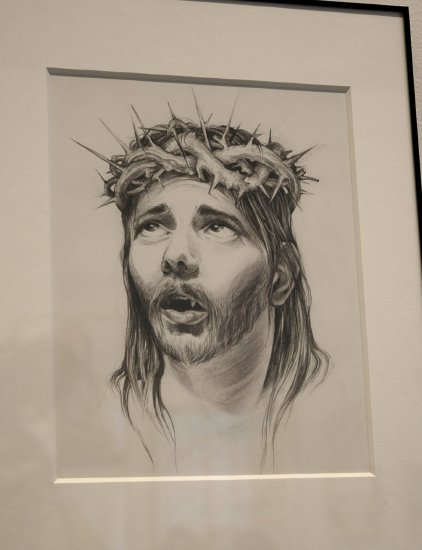
“Gay Art Now” at Paul Kasmin

McDonaldDanielJesus.jpg
Daniel McDonald Jesus Christ, Vampire 2006 pencil drawing 14.25″ x 11.25″ framed [installation view]

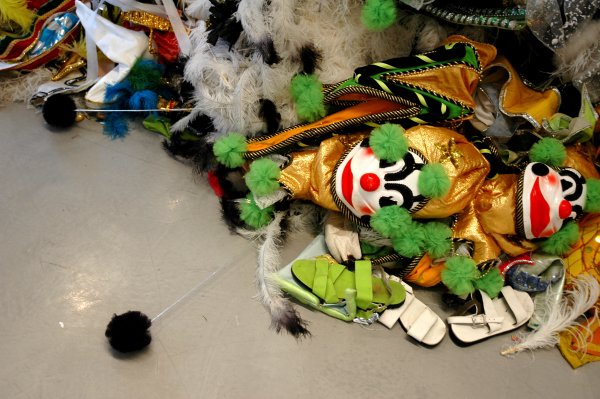
FraserAndreaUmMonumonto.jpg
Andrea Fraser Um Monumonto As Fantasias Descartadas 2003 mixed media (Brazilian carnival costumes) dimensions variable [detail of installation]

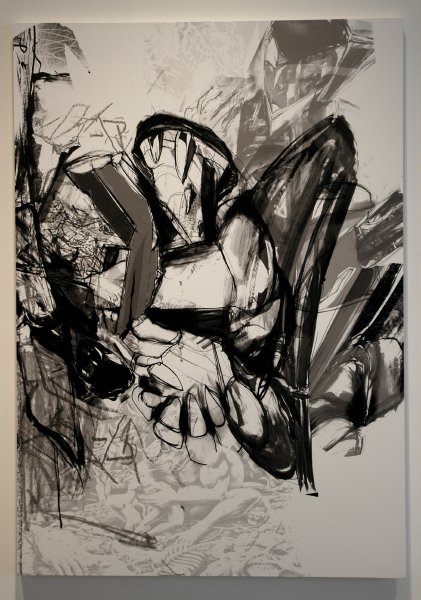
BalkDennis.jpg
Dennis Balk Untitled digital print on canvas 68.25″ x 48″ [installation view]

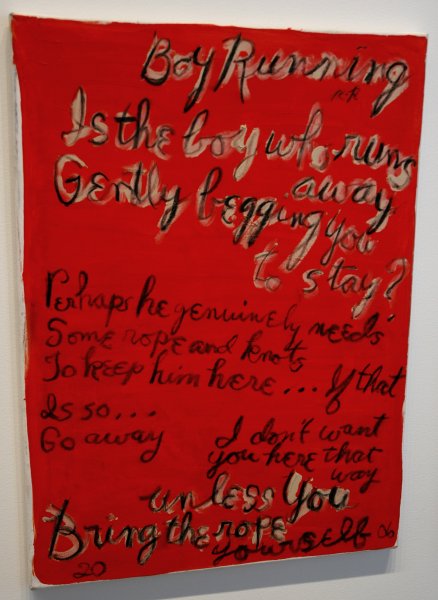
RicardReneboyrunning.jpg
Rene Ricard Untitled (Boy Running) 2006 30″ x 22″ [installation view]

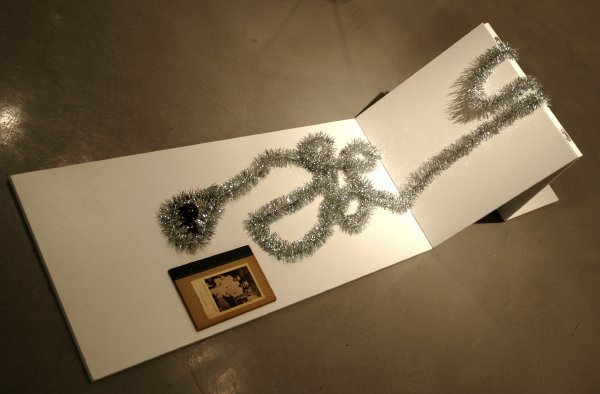
BurrTomChristmasCollapse.jpg
Tom Burr Christmas Collapse 2005 wood, latex paint, metal hardware. galss, paper [installation view]

WitensteinIvan.jpg
Ivan Witenstein Help 2006 watercolor and graphite on paper 68.75″ x 51.75″ [installation view]

It’s a terrific title for a show, and an even better excuse for a great press release, but best of all is the work itself. The artist Jack Pierson has curated one of the most arresting group shows of the year for Paul Kasmin’s main space on 10th Avenue.
Pierson introduces his choices under the headline, “THE NAME OF THIS SHOW IS NOT GAY ART NOW“:

It seems to me the notion of Gay Art is somewhat passé and this show is an ode to its passing. It includes work by over fifty artists, not all of whom are gay, identify as gay, and not all of whom are living. The name of this show is not Gay Art Now. Maybe the link being made is about sensibility, maybe it’s about society. –Jack Pierson

Brooklyn College MFA works resurrected, with scars

I wrote a little while back that I would show some of the damage the school had done to work created by Brooklyn College Masters degree students. While this small post can’t show the full extent of the physical and psychological assault, it may help to show what New York really thinks about art where it’s not attached to big money or some kind of celebrity.

Desselbefore.jpg
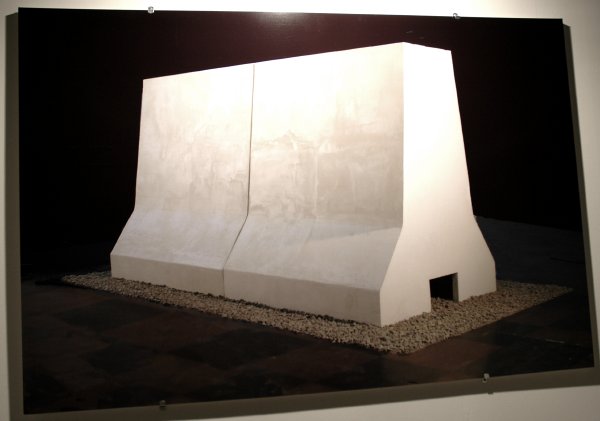
Susan C. Dessel Texas Barrier 2006 cement, styrofoam, cheesecloth, rocks (barrier structure: 5’6″ H x 10′ W x 4’D, rocks 8’ D around structure) [installation view of photograph in re-assembled show documenting the original site-specific installation; the photograph itself is by Robert Puglisi]

Desselafter.jpg
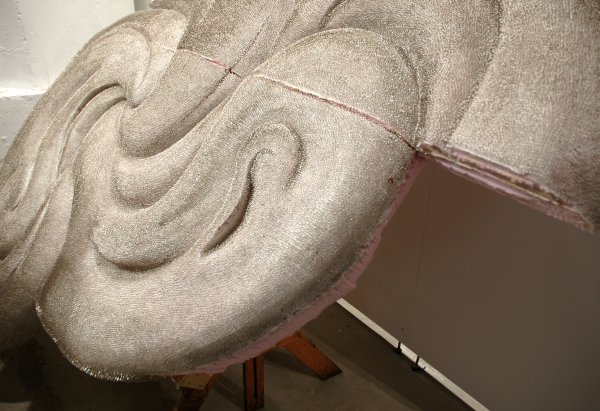
Susan C. Dessel Texas Barrier Post Mortem 2006 (elements of Texas Barrier) [large detail of installation in re-assembled show]

Even in photo reproduction, for me Dessel’s original installation stood as a brutal monument to exclusion or “security”; in its damaged form, its shattered pieces reconfigured and squeezed into an alcove in something less than ideal lighting, the work sadly suggested something more like a wounded, defeated animal. I don’t know how to sort out an irony through which an evil process can transfom a scary, inanimate object into a creature less the object of scorn than of pity, but I want to watch where Dessel goes from here.

Junyejin1.jpg
jun Yejin’s damaged sculpture (large sections broken off and removed, and large remaining areas of straight pins completely flattened)

FucileCarrieflattened.jpg
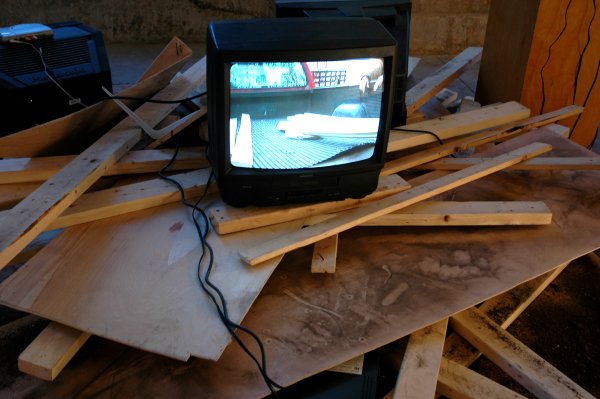
Carrie Fucile’s large wooden house sculpture, as totally flattened by workers sent by Brooklyn College, including her video documentation of men loading pickup trucks

Piontkowskiparrots.jpg
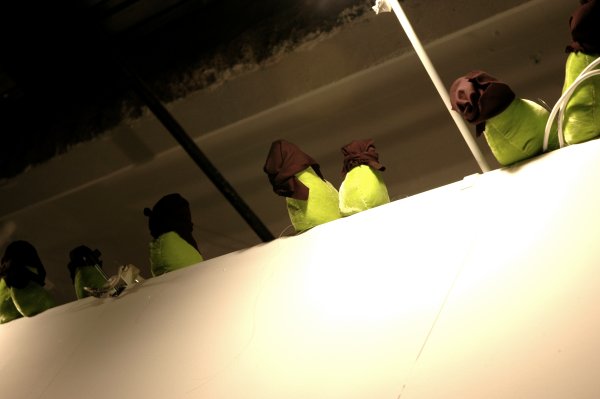
Megan Piontkowski’s Brooklyn College parrots were re-configured after their initial outing in the show’s original venue: While these little guys suffered damage when they were taken from the War Memorial, the artist herself has altered their appearance further herself. Tiny dark hoods now cover their heads, in a reference to the violence of New York City’s summary act of art censorship and the College’s ready cooperation in it.

There are more photographs on the “PlanB Prevails” website, along with an open letter from Vito Acconci, one of the few artists to be heard from on this assault on the arts and on civil rights which exploded five weeks ago.

Bush needs federal help to protect his marriage

Somebody must currently be leaning very hard on George, perhaps some homo brute has a gun at his back and is forcing him to walk out on Laura and pad down the aisle once again. Why else would our Commander-in-Chief be thumping for a constitutional amendment in order to stay with his wife?
It seems to me a real man could just say no, or at least yell to the Secret Service for help. Anyway, from where I sit when you see a Republican panic and run off to try to rig up a clumsy, big-government device in order to defend a marriage it sadly looks like just plain cowardliness. If Bush or even some lower-ranking heterosexual is unable to protect her or his marriage without calling in the feds, the contract’s no longer likely to be worth a damn anyway.
Then again, how could I know any thing about the horrors of bourgeois marriage? Barry and I have had too much fun being together for fifteen years to even begin thinking about “protection” or “defense”, other than safe sex, that is.
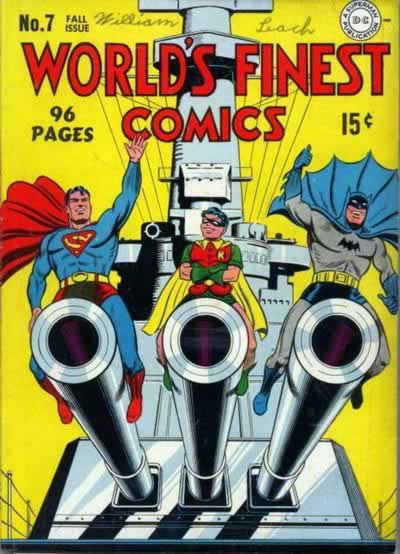
Oh, Bush’s problem? Maybe someone just has to start supervising our boy’s reading material:

supersonbarrels.jpg
[to protect the ancient innocent, this vintage DC Comics image has not been altered one bit]

[image from superdickery]

the penis art which threatens New York families

MarinAugusto.jpg
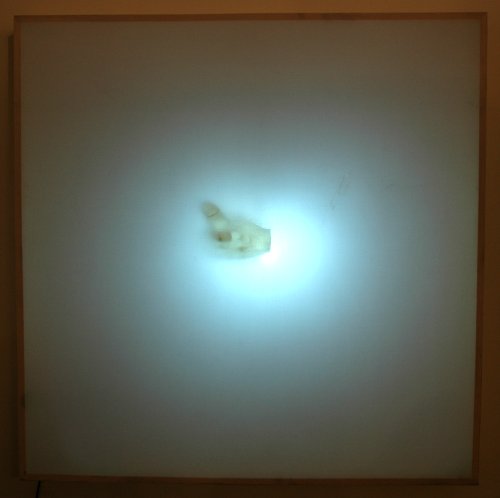
Augusto Marin’s notorious provocation

This is just one of five sculptures by Augusto Marin which is included in the Brooklyn College MFA thesis show shut down three weeks ago by the Brooklyn Parks Commissioner. This self-appointed guardian of New York’s public morals was outraged by the small image of a hand holding a penis and declared it not appropriate for families.
The show has finally been re-assembled elsewhere by the artists, and last night visitors at the opening reception, including members of families representing all ages and genders, were clearly at a loss at locating any provocation in a beautiful piece of molded resin lighted behind a beautiful stretched blue scrim. The work is one of four mixed media pieces in which the artist gently references traditional devotional objects both sacred and profane.
The damage done to much of the work when it was carted out of the War Memorial gallery was clearly evident however even in Marin’s own piece, which had suffered a tear when it was pulled from the wall. More here later about other, more serious damage and about some works in the current show which specifically address New York City government censorship and its destructive handmaiden Brooklyn College. We’re hosting Barry’s Mother this week so posting will have to be minimal for the next few days.
Oh, and as for all those editorials and letters referring to these graduate students as spoiled “kids”, maybe some people should do some fact checking. I know that several artists within this MFA group are old enough to have college-age kids themselves, and last night I spoke to one of them who had been absolutely shocked to hear the school’s own lawyer describe her class as “young kids”. Susan C. Dessel let the attorney know she herself was 60.

Brooklyn College MFA “Plan B Prevails”

WHEN DOES A PHALLUS DESERVE RESPECT?*

LouiseBourgois-with-phallus.JPG
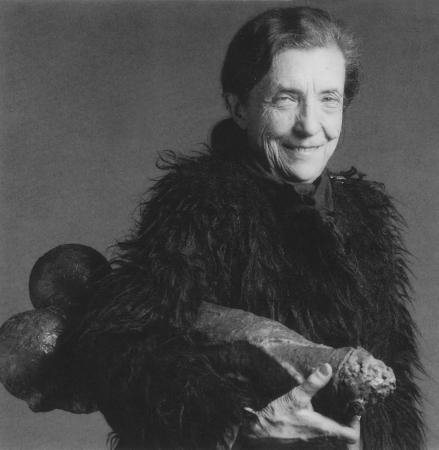
Robert Mapplethorpe Louise Bourgeois 1982 [image of Bourgeois holding her “Fillette”]

Now it’s official. Er, maybe I should write “anti-official”: The Brooklyn College 2006 MFA thesis show is re-opening, mostly. It was shut down by the City of New York for not being “appropriate for families” on May 6, the day after it opened. Shortly after that everything was hauled away by the school which sponsored it, and in the process some of the work was damaged or lost. Tomorrow night the exhibition is finally going to re-open in DUMBO – this time on private property. The opening reception is from 6 to 9 pm and it will include a live performance.
The reassembled and necessarily reworked show will include new pieces made in response to the censorship and thuggish trashing of the original installation. The students, who re-gained posession of their work only four days ago, are calling the new exhibition, “Plan B Prevails“.

*
One of the works included in the original MFA show was a sculpture by Augusto Marin which included a representation of a phallus.

THE SHOW DETAILS:
The artists are: Carla Aspenberg, Jill Auckenthaler, John Avelluto, Zoe Cohen, David Davron, Susan C. Dessel, Carl James Ferrero, Carrie Fucile, Pamela Gordon, Yejin Jun, Diane Kosup, Marni Kotak, Augusto Marin, Akiko Mori, Christopher Moss, Sarah Phillips, Megan Piontkowski and Tamas Veszi. The show will occupy 6,000 square feet of space donated by Two Trees Development.
Plan B Prevails is located at 70 Washington Street, Brooklyn, in 6,000 square feet of space donated by Two Trees Development. The entrance is located on Front Street. The exhibit is free to the public and is open Wednesday through Sunday from May 24 to June 16, 2006 from 12 to 6 pm or by appointment at Brooklynmfa@gmail.com. Take the F to York Street or the A/C to High Street.

[image from Georgetown]

UPDATE: In a comment which appears below Chris Moss points out that Louise Bourgeois used to teach at Brooklyn College herself! No, I can’t pretend I knew just how appropriate the image was!

postponed: Brooklyn College MFA students press conference

I’ve just gotten word that the Brooklyn College MFA Press Conference originally scheduled for 1 pm today has been POSTPONED. Details to follow.
I’m not going to speculate here, but I find this last-minute change very interesting.
On a related note, I’ve attended at least dozens of press conferences involving civil rights issues in New York, many of them enjoying the participation of Norman Siegel. They are very often if not usually held on the steps of City Hall, and not [never?] inside a law office. Even though access to the people’s house in New York is not free, and even if groups sometimes have to take a number to reserve a spot, those columns make a good visual if you can get in and the media knows exactly where you’ll be.
My understanding is that this particular conference relates to a civil rights suit against the City of New York as one of the defendents. Any reason why City Hall might be off-limits this time? Perhaps someone should ask the Mayor’s office.

Brooklyn College MFA students announce press conference

UPDATE: [noon, Friday, May 19] The Brooklyn College MFA Press Conference originally scheduled for 1 pm today has been POSTPONED. Details to follow.

FIGHTING THE CENSOR’S (ST)INK

Brooklyn College MFA students, members of the faculty and attorneys Norman Siegel and Steven Hyman will hold a press conference tomorrow afternoon announcing the filing of a lawsuit against the City of New York, the New York City Parks Department and Brooklyn College.
The location is the Law Offices of McLaughlin & Stern at 260 Madison Avenue (Betw. 38th and 39th) on the 20th Floor. The time is 1 pm.
I’ll be there.
For the background, see this blog and my six subsequent posts linked there at the bottom of the text.

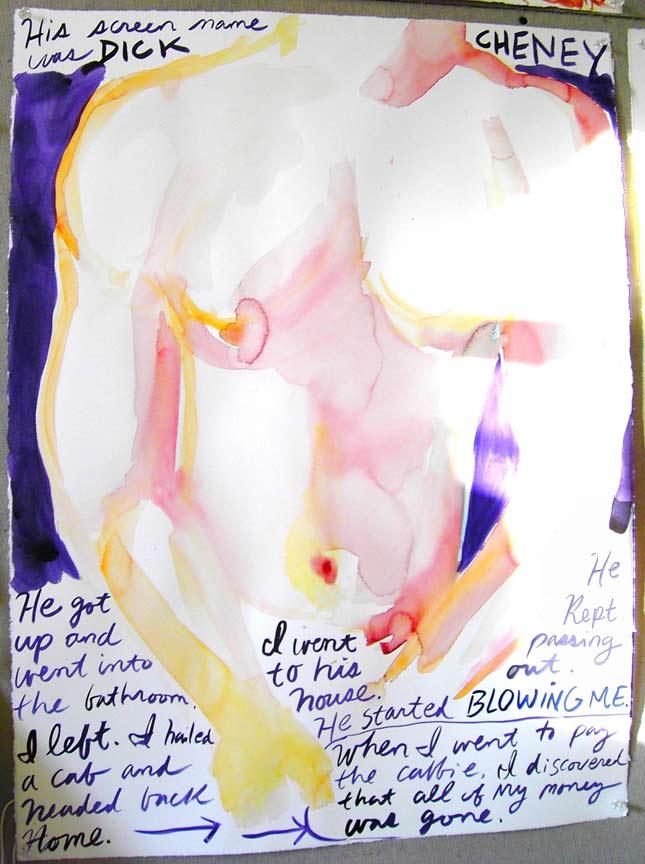
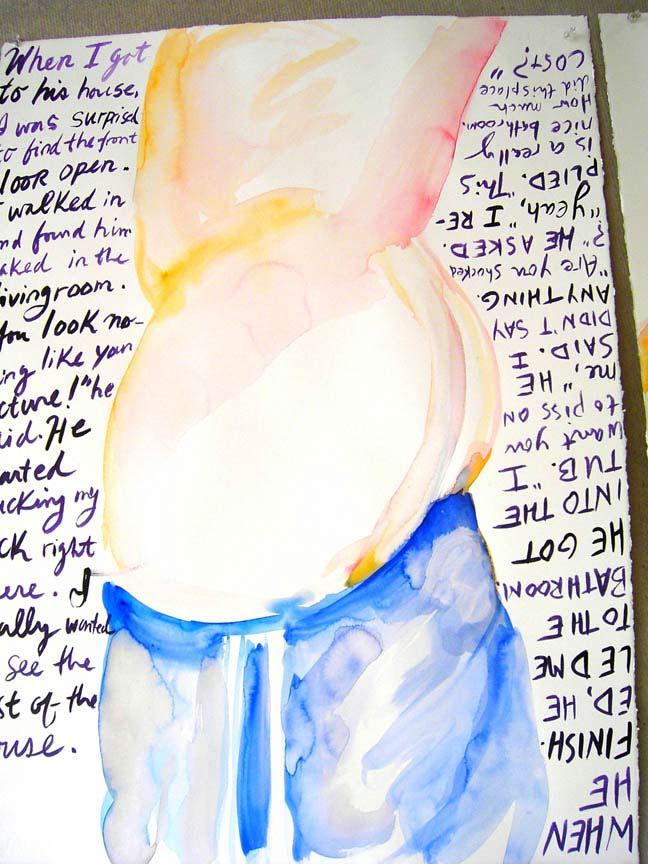
MFA show shut down for reference to Cheney sex?

FerreroCheney.jpg

Ferreroloins.jpg


Lèse majesté? Was sex the beard for political censorship?
From a story in the Fine Arts section of the NYTimes on Friday:

In addition to the hand-and-penis sculpture, works in the show included a video with sexual overtones in which women are dressed as nuns, and a watercolor of a man’s torso, with an accompanying narrative about a sexual encounter between two men, one of whom used the computer screen name Dick Cheney.

I don’t know about you, but I suspect what really might have done it for our self-appointed middle-aged, white male Parks Department guardian of public morals and social orthodoxy wasn’t the penis or the nuns (I can doubt whether Julius Spiegel cares much about either); it was more likely the combination of homosex and the Vice President of the United States.
We love Carl Ferrero’s art. Everything I’ve seen him do is mighty fine, when it’s not actually breathtaking.
I still don’t know exactly which offending image or images of Ferrero’s is/are in the show summarily shut down on May 4, but the entire world will be able to see his work and that of all the Brooklyn College MFA candidates when it re-opens in DUMBO; there will certainly be a media presence. The [second] reception will be on Wednesday May 24th from 6 to 9 at 70 Washington St. (down under the manhattan bridge overpass) in Brooklyn.

ADDENDUM: See this related story which appeared on the last page of today’s print edition of the NYTimes:

China Orders Art Galleries to Remove Paintings With Political Themes

Several galleries in this city’s thriving arts district were recently ordered by government officials to remove more than 20 paintings, apparently because they dealt with political themes, artists and gallery directors here said.

[images from Carl Ferrero]