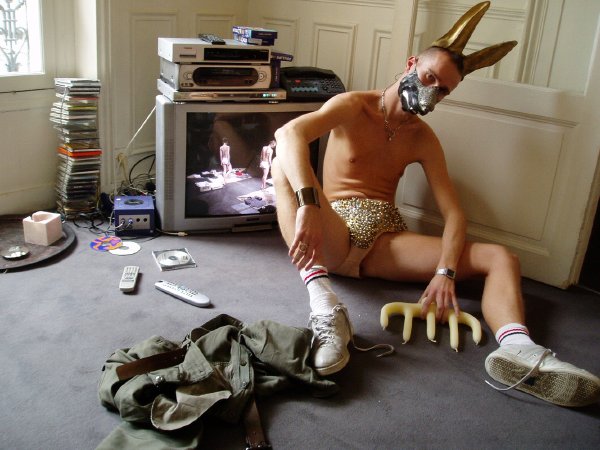
a boy and his fancy dog
Ever so often something reminds us that we really don’t know much about fetishes.
I found this fascinating but uncredited image on a site I was directed to by an email from Slava Mogutin (alright, I’ll admit it, I’m actually not totally unacquainted with the wonderful world of Le fétichisme dans lamour).
Agh, kids!
*
who may be the artist here, but go to his own site to see his credited stuff, including direction to his published writings
[image from fritzhaeg/sundown salon]
Category: Queer
Antonello da Messina at the Metropolitan
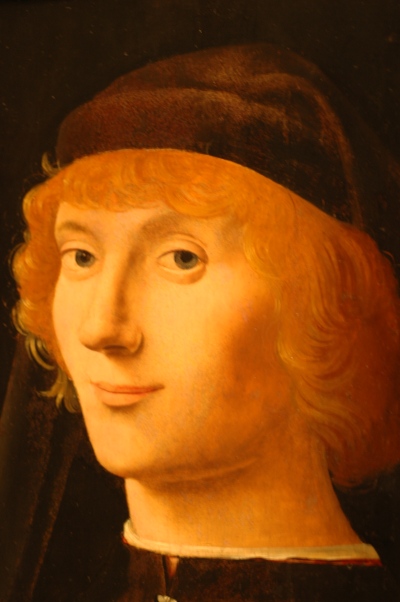
Antonello da Messina Portrait of a Young Man ca. 1470 oil on panel 10.5″ x 8.25″
Yes I saw the Fra Angelico show at the Met, but I try to keep this blog focused on what Barry and I like to call “underknown” artists [the still increasingly popular adjective “emerging” is too narrow a word to describe my attraction to the new as well as the obscure in all the arts].
For me the real excitement of my day on the edge of Central Park was a tiny temporary exhibition of work by the Sicilian Quatrocento painter Antonello da Messina (ca. 14301479). It’s a very small, jewel-box of a show which fits into a single dark cube of a room on the second floor of the European Paintings Galleries.
Although I’ve included his beautiful image of the Virgin at the bottom, a piece which the Met notes would have as the highlight of the installation, it was really da Messina’s almost-embarassingly profane portraits of young Italian noblemen that impressed me most.
The image at the top is by da Messina, but the one just below, like several other works included in the show as somehow relevant to his story, is actually by a different artist. It seems that Jacometto Veneziano also knew how to render a handsome face.
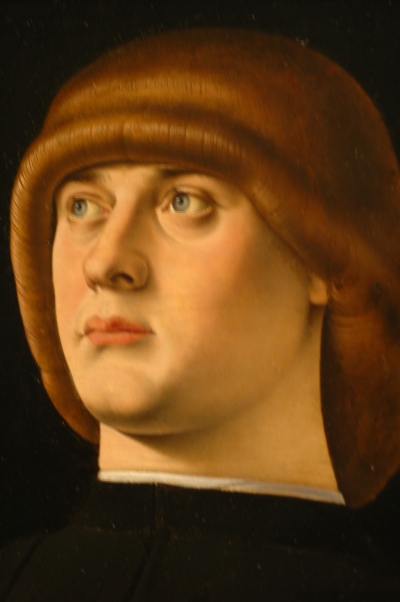
Jacometto (Jacometto Veneziano) Portrait of a Young Man ca. 1470 oil on panel 10.5″ x 8.25″
I wish the curators had managed to include either or both of these two handsome da Messina portraits in the show, even if it would have meant sacrificing some of its didacticism.

Antonello da Messina Portrait of a Man ca. 1475 oil on panel 14.25″ x 9.75″
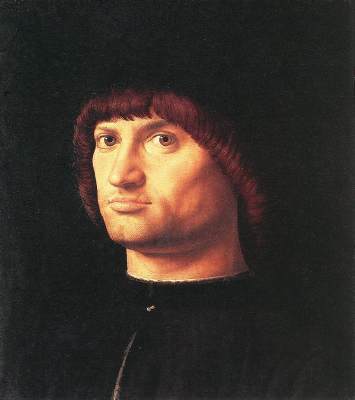
Antonello da Messina Portrait of a Man (Il Condottiere) 1475 oil on wood 13.75″ x 15″
Oh yes, the show does include a very, very sad Ecce Homo portraying an extremely vulnerable (and approachable) Christ which is unlike anything else produced by the Renaissance.
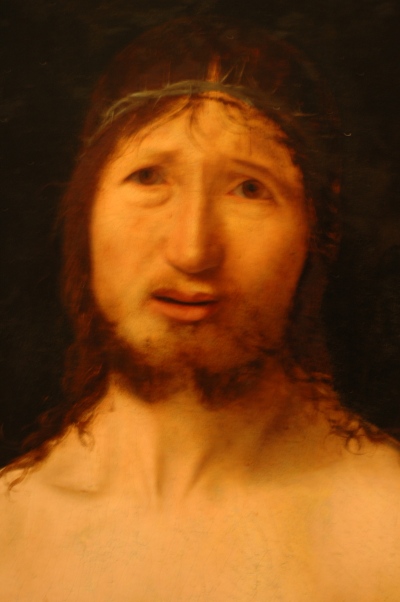
Antonello da Messina Christ Crowned with Thorns possibly 1470 oil, perhaps over tempera, on wood 16.75″ x 12″ [large detail]
At first I thought da Messina’s homoeroticism was all in my own head. But when I was home and able to look at the images again, and when more beautiful youths turned up in a quick Google search, I became convinced that the artist really loved men. The revelation was nearly as exciting as the moment several years ago when I came across, on an obscure pedestal behind the Met grand staircase, a 1st century Roman silver cup with reliefs of two men enjoying themselves in scenes of exceeding profanity. There was no curator’s note on the homo thing at that time either.
But of course there was plenty here on the Virgin.
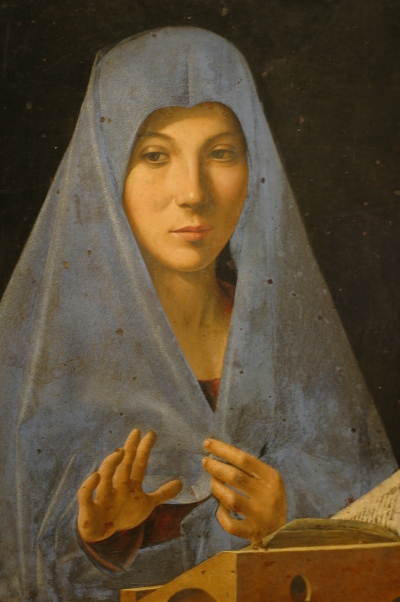
Antonello da Messina Virgin Annunciate ca. 1476 oil on panel 13.5″ x 17.75″ [large detail]
[the two thumbnail images are from Web Gallery of Art]
Kubrick does cute
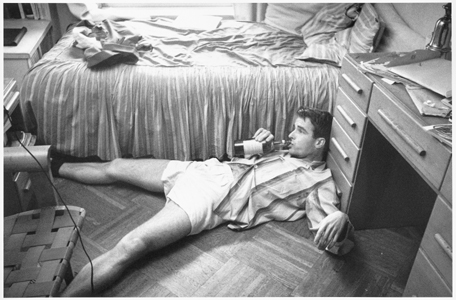
I just came across this picture of a very come-hither-ish Montgomery Clift while looking through an email from Phaidon Press. It’s from a new photography book, “Stanley Kubrick: Drama and Shadows,” a collection of images captured by the film director betwen 1945 and 1950, when he was still very young.
I know I may be one of the last people to discover Kubrick as photographer, but I still thought it worth broadcasting these images for those who might otherwise miss them.
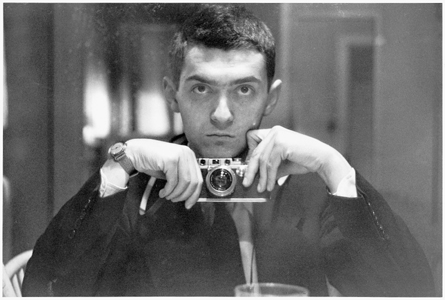
I think we can safely assume that the equally adorable subject of the picture below is the photographer himself.
keeping New Orleans alive, and honoring the dead their way
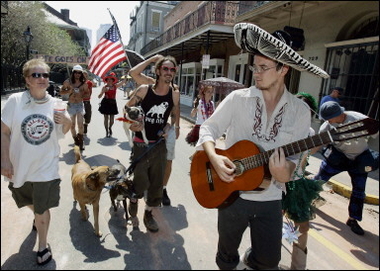
A ‘Gay Parade’ gets under way in the French Quarter of New Orleans. as a determined handful of hurricane survivors vowed to keep the spirit of New Orleans alive. The official parade was postponed because of the arrival of Hurricane Katrina six days ago.
New Orleans has a better chance of surviving if New Orleaneans are there to keep it going. Nobody should even think of leaving it all up to FEMA. Agence France Presse shows us today a little bit of how it’s going to happen.
NEW ORLEANS, United States (AFP) – Music, Mardi Gras beads, costumes and confetti returned to the French Quarter as a determined handful of hurricane survivors vowed to keep the spirit of New Orleans alive.
Decked out in a red polka-dot tutu and purple parasol, Candice Jamieson, marched through the city’s eerie abandoned streets, rattling a tambourine.
“We’re having a decadence parade,” said the 21-year-old student, referring to the annual gay pride march, usually a massive and raucous affair that rivals the city’s famed Mardi Gras festivities.
“We’re trying to bring up everyone’s morale,” Jamieson said moments before reaching out to catch beads tossed by the only populated balcony in Royal street.
“It’s usually a lot bigger,” Georgia Walker, 53, called down as she tossed more beads.
. . . .
Asked whether he thought some people might consider the parade in poor taste given that hundreds of survivors remained stranded and that rescue workers were harvesting the bodies of storm victims from streets and flooded homes, [Michael Skidmore] said the city was in desperate need of a little joy amid the carnage.
“We’re going to make life better, even if they laugh at us, we want them to laugh,” he said as his grass skirt flapped in the breeze.
Dancing in the streets is a traditional way of honoring the dead in the region, explained Diana Stray Dog as she held a pole flying a huge American flag against her shoulder.
“In New Orleans we celebrate death. When people die we go in the streets and sing,” she said, adding that she was marching to return some life to the battered city.
“Amid all the tears and all the sorrow we have a big heart and it’s not going to die.”
One of a number of places sheltering the life which continues in the city, in defiance of the authorities’ orders to leave, is Molly’s at the Market, described in better times by one fan as “Our favorite watering hole in the quarter, full of dropouts, queers, freaks, and phds. Oh yeah, and a fabulous juke box.”
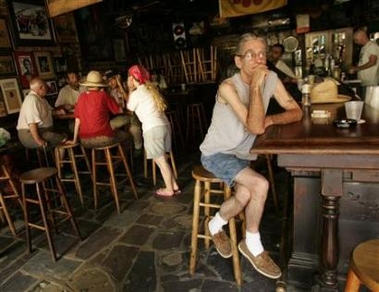
A patron spends the afternoon at Molly’s at the Market, one of at least two bars in New Orleans’ French Quarter that has remained open after Hurricane Katrina despite a lack of electricity and running water on September 4, 2005. Many residents of New Orleans who live in the few areas on high ground that escaped flood waters say they will defy official requests for them to abandon their homes.
UPDATE: For more on the “tribes” of the French Quarter, see this AP story, the stuff of tomorrow’s legends.
[top image by Robert Sullivan from AFP, second image by Shannon Stapleton from Reuters, both via Yahoo!]
Marcos is gay
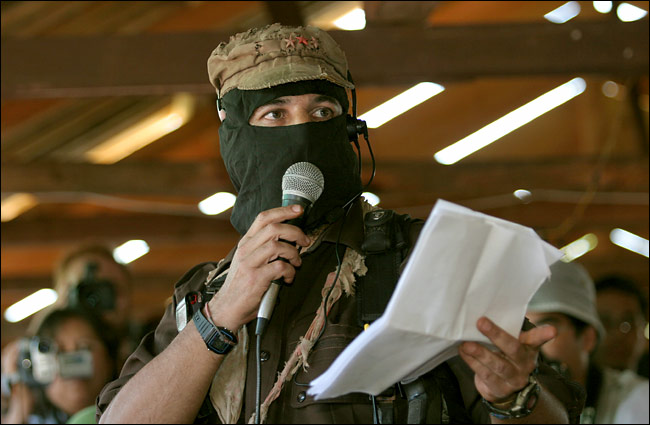
Subcommander Marcos
Well, maybe not, but he sounds really good, and he still looks wonderful.
His words, especially since they’re from the mid-90’s, won’t be news to many out there, but I tripped over this powerful quote from Subcommander Marcos while trying to get more information about the Mexican rebel this morning. I had just read this piece in the NYTimes about his current campaign to move his great nation to the Left. It was accompanied by this attractive photograph. After more than ten years of news accounts and imagery, I was immediately smitten all over again. The reporter himself was not immune to his attractions, for he wrote that Marcos “may be the only man in history to make a ski mask and pipe look sexy.”
Marcos is gay in San Francisco, black in South Africa, an Asian in Europe, a Chicano in San Ysidro, an anarchist in Spain, a Palestinian in Israel, a Mayan Indian in the streets of San Cristobal, a gang member in Neza, a rocker in the National University, a Jew in Germany, an ombudsman in the Defense Ministry, a communist in the post-Cold War era, an artist without gallery or portfolio…. A pacifist in Bosnia, a housewife alone on Saturday night in any neighborhood in any city in Mexico, a striker in the CTM, a reporter writing filler stories for the back pages, a single woman on the subway at 10 pm, a peasant without land, an unemployed worker… an unhappy student, a dissident amid free market economics, a writer without books or readers, and, of course, a Zapatista in the mountains of southeast Mexico. So Marcos is a human being, any human being, in this world. Marcos is all the exploited, marginalized and oppressed minorities, resisting and saying, ‘Enough’!
[image by Adriana Zehbrauskas from the NYTimes]
papal Carnival in Cologne
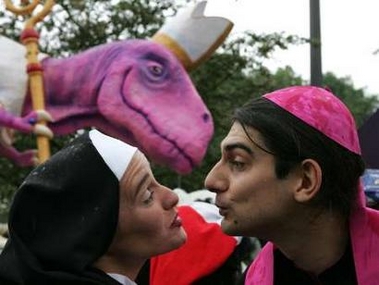
demonstrators dressed as a priest and a nun kiss in front of a large model dinosaur during an anti-religion demonstration in Cologne August 19, 2005 [as der Ratzinger arrived in Cologne]
Sometimes it’s best to let the thing speak for itself.
I’m very proud of my family’s ancient Rhenish Catholic [and before that, Roman without the Catholic] Heimat, and amazed at the effrontery of [Yahoo!]. See Bloggy for a related post.
[image by Pawel Kopczynski from Reuters which, together with my excerpt from its accompanying caption, is furnished by Yahoo!]

finally, a VJ Day which liberates the queers too?
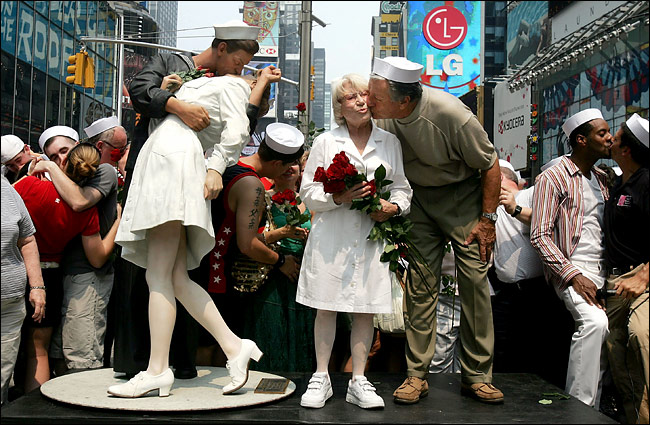
exactly 60 years later: the kiss watched ’round the world, its original models, and some contemporary enthusiasts
Although there is at least one same-sex couple in the group* kissing in the image above, they didn’t make it into the NYTimes photo caption today, and there’s nothing queer in the story which accompanies it. Does that suggest that we’re no longer remarkable, or still just unmentionable?
Well, at least we have our fabulous advertising ghetto.
*
click on the photo when you open the link
[image by Mario Tama from Getty Images via the NYTimes]
our own temporary Homomuseum – extended to August 19
UPDATE: post now includes lots of links
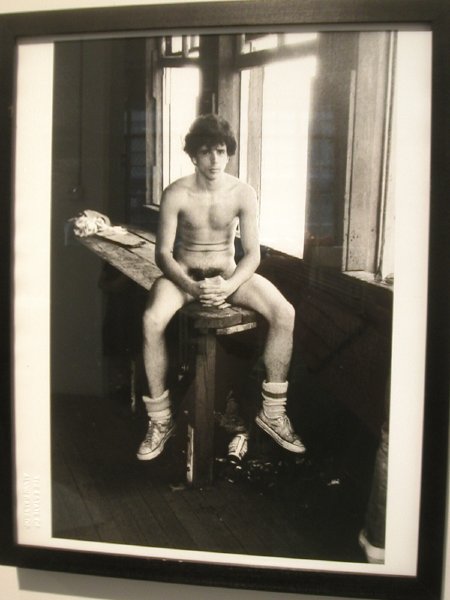
Alvin Baltrop Moment: NYC West Side Piers one of several images 1975-1986, printed 2005, gelatin silver prints 11″ x 14″ [detail of installation]
“Homomuseum? I didn’t know there was one!” answered a friend when I suggested he join us on a visit to the current show at Exit Art. The exhibition bears the title, “Homomuseum: Heroes and Moments,” and I was using the more catchy name, hoping it would attract a young homo’s immediate attention. It didn’t work. Only a movie would do it for him that day.
Maybe there’s a story there, but I don’t want to read too much into his indifference last Saturday. He and his partner had been to two great cultural museums the day before. And besides, Barry and I were ourselves only then heading up 10th Avenue, at least ten weeks after the show opened. And we know some of the artists, and we had been hearing about it for months.
Characteristicaly, we arrived on what was originally supposed to be its last day, but now this very moving and beautiful show has been extended until Friday, August 19. This temporary reprieve also has its sad side, since it serves as a reminder that in New York, and indeed in this entire country, there is no permanent Homomuseum on the order of Berlin’s twenty-year old Schwules Museum.
Like the Berlin museum, this show is about history, but it’s considerably less parochial than the institution which inherited the legend of the pioneering German researcher and cultural guardian Magnus Hirschfeld. This is what we should expect from the city which effectively functions as the world’s capital these days. The New York show is an account which stretches from the immediate past back until, well, ancient history. It actually starts in the mists of pre-history with an image of two female Bonobo apes pleasuring each other under the inquisitive gaze of a young son, moves through the fourth century before the Christian era to a sculpture installation depicting Alexander lying beneath his lover Hephaestion [the medium: suspended empty U.S. military shell cases], and continues to our own moment with projected images of AA Bronson and a description of the opening night performances by black male diva songstresses.
Exit Art’s assignment for this installation is distinctive from any other homo museum in one major repect: The exhibits are created by artists. Twenty-seven lesbian, gay, bisexual and transgender artists have created very personal conceptual portraits of queer heroes who have influenced culture, or of works which they feel strongly represent important moments in queer history. These are the “heroes and moments” of the show’s title.
Just to give an idea of the range of the work displayed, some of the exhibits not represented in the images below are James Bidgood and his hero Tony Duquette, ak burns and his hero Jack Smith, Geoffrey Hendricks and Sur Rodney (Sur) and their heroes and moment, “Homosexuals burned in the Middle Ages,” Derek Jackson‘s and his heroes “Diva Songstresses,” Marget Long and her hero Mercedes McCambridge, James Morrison and his hero Felix Gonzalez-Torres, and Phillip Ward and his hero Quentin Crisp.
Okay, how do we get a real, dedicated museum? We could argue forever about what should be its function or its mission, but surely by now we should be able to find the people to run it and the bucks to fund it. After all, we weren’t born yesterday.
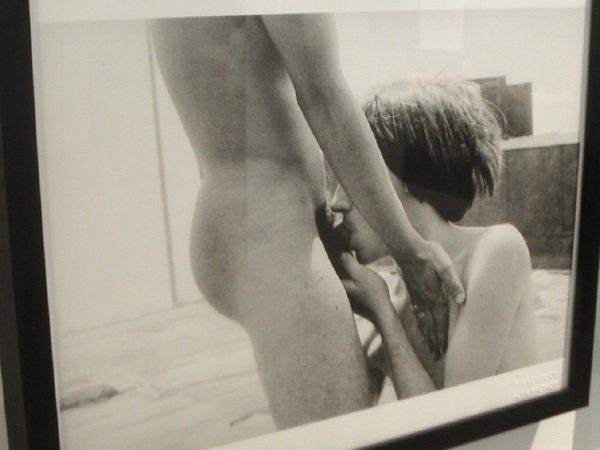
Alvin Baltrop Moment: NYC West Side Piers one of several images 1975-1986, printed 2005, gelatin silver prints 11″ x 14″ [detail of installation]
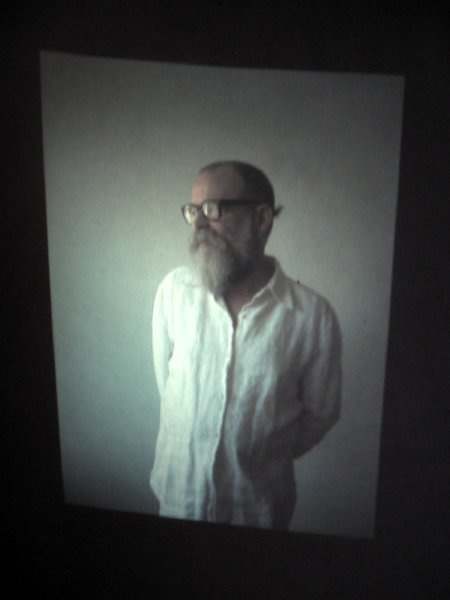
Christopher Clary Hero: AA Bronson
“AA Bronson (My Healer)” 2005 slide show installation [view of installation still]
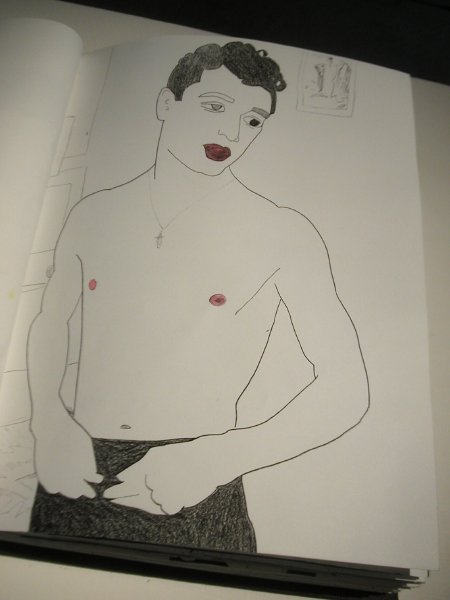
JP Forest Hero: Sal Mineo
“Sal Mineo” 2005 mixed media 18″ x 24″ x 78″ [large detail of installation]

Aaron Krach Hero: The dance floor
“DANCEFLOOR” 2005 Plexiglas 12′ x 12′ [detail of installation]
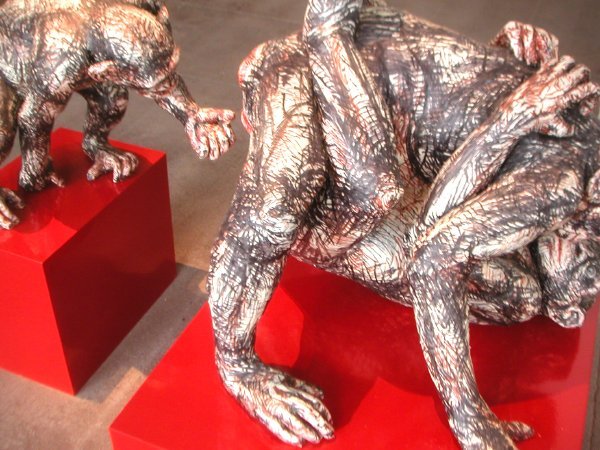
Rune Olsen Hero: The Bonobo Ape
“Hear Me Roar” 2004 Sharpie markers on tape, blue mannequin eyes, newpaper and wire 29″ x 52″ x 46″ [large detail of installation]

Milton Rosa-Ortiz Hero: Alexander the Great
“The Sacred Band in Elysium” 2005 casings, monofilament, glass seed beads 204″ x 96″ x 108″ [detail of installation]
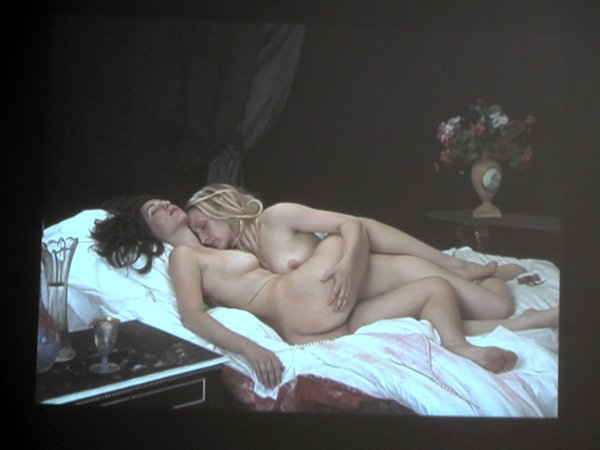
Mary Ellen Strom Hero: Gustave Courbet‘s “The Sleepers”
“Nude No. 5, Eleanor Dubinsky and Melanie Maar” 2004 video installation [still from installation]
See Barry for more.
first they came for the pornographers . . .
. . . but I wasn’t a pornographer*

safe enough for him?
Patrick Moore has an OPINION piece in today’s Newsday, “Bush team uses ‘skin game’ to attack porn,” which sounds an alarm on behalf of principles much greater than the protection of our access to adult sexual entertainment. An excerpt follows:
Under the guise of regulatory powers, the department [of Justice] is planning a punitive and ideologically motivated assault on the adult entertainment industry. A legal challenge last month delayed the onset, but Justice is hoping later this year to begin enforcing a host of regulations so onerous that they may represent the end of pornography as a viable business in America.
Regardless of one’s feelings about adult entertainment, the situation is a disturbing illustration of a larger trend in the Bush administration: the use of regulatory powers to advance a conservative moral agenda.
. . . .
One can understand that the government wants to ensure that porn performers are of legal age. However, these regulations ensure no such thing. In fact, in several lawsuits involving underage performers, the minors had provided government-issued IDs to producers. As we are learning in terms of both national security and immigration, government IDs are easily obtained and easily falsified. And demanding proof of age for performers who are clearly 30 or 40 years old seems less about protecting children than about punishing an industry the government deems immoral.
By focusing on regulatory enforcement, the Department of Justice cannily avoids repressing adult entertainment on the basis of content, knowing that the First Amendment presents a challenge that probably cannot be overcome. But the effect – suppression of protected speech, whether or not it is deemed obscene – is achieved outside the normal checks and balances of American government.
The Bush administration has a track record of attempting to regulate morality behind a smoke screen of law enforcement, bureaucratic rules and scientific research. These efforts are often focused on unpopular issues, where the administration is fairly certain that public opinion will provide protection, regardless of the ethics involved. Few citizens in an increasingly conservative America will fight to protect the constitutional rights of pornographers.
AIDS is another example. For several years now, researchers applying for National Institutes of Health grants to study AIDS have been told to remove references to gay men, even though they continue to represent the majority of cases here in the United States. And, famously, the Bush administration has touted its compassion for those dying of AIDS in Africa, even while it denies funds to organizations that offer reproductive health services or stress condoms over abstinence.
Full disclosure: I knew Patrick Moore slightly but I admired his good sense hugely when we were both busy with ACT UP fifteen years ago.
*
My introduction is a conscious reference to Martin Niemöllers lines about moral failure in the face of the Holocaust:
First they came for the Communists, but I was not a Communist, so I said nothing. Then they came for the Social Democrats, but I was not a Social Democrat, so I did nothing. Then came the trade unionists, but I was not a trade unionist. And then they came for the Jews, but I was not a Jew, so I did little. Then when they came for me, there was no one left to stand up for me.
Yes, I know a morality crusade does not make a holocaust, but although we deal with new evils in new times, fascism’s tactics, and the kind of popular response needed, have changed very little.
[image via E. Heroux]
liberty and justice for all
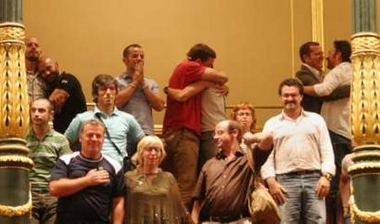
reaction in the public gallery of the Cortes on June 30, as the Spanish parliament extended full rights of marriage to all citizens
Some day a people crazy about waving its own flag at home and around the world may actually understand the liberty and justice it was intended to represent.
Meanwhile, much of the rest of the world has already overtaken us.
Excerpts from the speech by Spanish prime minister Jose Luis Rodriguez Zapatero delivered just prior to the vote last Thurday which legalized gay marriage and adoption of children by gay couples:
We are not legislating, honorable members, for people far away and not known by us. We are enlarging the opportunity for happiness to our neighbors, our co-workers, our friends and, our families: at the same time we are making a more decent society, because a decent society is one that does not humiliate its members.
In the poem ‘The Family,’ our [gay] poet Luis Cernuda was sorry because, ‘How does man live in denial in vain/by giving rules that prohibit and condemn?’ Today, the Spanish society answers to a group of people who, during many years have, been humiliated, whose rights have been ignored, whose dignity has been offended, their identity denied, and their liberty oppressed. Today the Spanish society grants them the respect they deserve, recognizes their rights, restores their dignity, affirms their identity, and restores their liberty.
It is true that they are only a minority, but their triumph is everyone’s triumph. It is also the triumph of those who oppose this law, even though they do not know this yet: because it is the triumph of Liberty. Their victory makes all of us (even those who oppose the law) better people, it makes our society better. Honorable members, There is no damage to marriage or to the concept of family in allowing two people of the same sex to get married. To the contrary, what happens is this class of Spanish citizens get the potential to organize their lives with the rights and privileges of marriage and family. There is no danger to the institution of marriage, but precisely the opposite: this law enhances and respects marriage.
Today, conscious that some people and institutions are in a profound disagreement with this change in our civil law, I wish to express that, like other reforms to the marriage code that preceded this one, this law will generate no evil, that its only consequence will be the avoiding of senseless suffering of decent human beings. A society that avoids senseless suffering of decent human beings is a better society.
With the approval of this Bill, our country takes another step in the path of liberty and tolerance that was begun by the democratic change of government. Our children will look at us incredulously if we tell them that many years ago, our mothers had less rights than our fathers, or if we tell them that people had to stay married against their will even though they were unable to share their lives. Today we can offer them a beautiful lesson: every right gained, each access to liberty has been the result of the struggle and sacrifice of many people that deserve our recognition and praise.
Today we demonstrate with this Bill that societies can better themselves and can cross barriers and create tolerance by putting a stop to the unhappiness and humiliation of some of our citizens. Today, for many of our countrymen, comes the day predicted by Kavafis [the great Greek gay poet] one century ago: ‘Later ’twas said of the most perfect society/someone else, made like me/certainly will come out and act freely.’
Can we try to remember these noble words the next time any U.S. politician opens his or her mouth?
[a dear friend of mine, Jamie Leo, forwarded the speech text this morning; it can be found on Doug Ireland‘s site, where the translation is credited to Rex Wockner; image by Susana Vera from Reuters]
