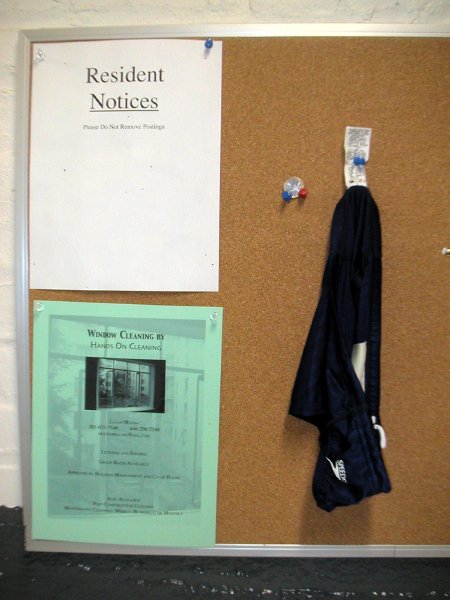
special bulletin spotted this afternoon
For me at least this was definitely the most provocative found item of clothing I’ve seen in our basement laundry room in the eighteen years I’ve been visiting its splendors. This midnight-blue Speedo even beats the 2(x)ist thong, size 32, I spotted a couple of years ago, since my first serious fetish matured at club pools during long summer afternoons decades before underwear even thought of becoming fashion.
For the curious, the tiny suit on the bulletin board is a size 34. From my own experience this means that in the real world it’s more like a 28 or 30. Sigh.
The small silver item immediately to its left is a one-Euro coin supported on the cork by two pushpins.
Ah yes, we are in Chelsea.
Category: Queer
“Pink Houses”

heroes at large
We met these two extraordinary men for the first time this afternoon. Until then our knowledge and experience of the nobility and the courage of John Schenk and Robert Loyd had been limited to the incredible reports which regularly came to us from Barry’s wonderful mother Earline, their good friend and neighbor.
John and Robert are visiting New York this week from Conway, Arkansas, because their story and that of their now thoroughly-notorious pink Victorian house is being told in a documentary which is part of the New York Independent Film and Video Festival.
Barry has already written more about the couple and the film, “Pink Houses.” We will be seeing it tomorrow night, Tuesday, at 6 o’clock. He’s included an article from the Arkansas Democrat-Gazette, a statewide paper.
While the film is presented from the viewpoint of these two men, it also includes comment from a representative of the Family Council a Little Rock-based organization that promotes traditional family values and television footage of Greenbrier farmer Wesley Bono talking about his decision to spread a dump-truck load of manure along streets around the Pink House on the day of last summers gay-pride parade.
“It didnt stop us,” Schenck says in the film, while standing outdoors with Loyd. “It smelled horrible for a couple of days, but were used to dealing with manure.”
. . .
In their 19 years in the Pink House, the two say, people have driven by and shouted derogatory names, shot at their house, broken their car windows and destroyed holiday decorations.
“One year we had a 9-foot Energizer bunny,” Loyd says. “It was decapitated Easter morning. I thought that was a little extreme.”
And some of us once assumed that the big city queer owned the breed’s style and courage.
Details: The 51-minute film will be screened at 6 o’clock on Tuesday, May 3rd, on screen 6 of the Village East Cinema, 181 2nd Avenue at 12th Street.
[image original source not available at this time]
Ratzinger’s history in New York

how do you say “booga booga!” in ten languages?
In an email with the subject line, “My encounter with Pope Benedict XVI,” a friend and awesome activist colleague of mine reminds us today that our outrage over what Josef Ratzinger represents has a history, including one very much in our midst. The following paragraphs are an excerpt from Michaelangelo Signorile’s first book, “Queer in America: Sex, the Media and the Closets of Power,” published in 1993.
[The event described here occurred on January 27, 1988. I will forever be grateful to the new pope for being so integral to my development.]
One protest that was announced was an upcoming zap of Josef Cardinal Ratzinger, the German prelate who was head of the Congregation for the Doctrine of Faith. He had written a paper for the Vatican in which he said that homosexuality was “intrinsically evil” and a “moral evil.” Cardinal Ratzinger had said the church had to fight the homosexual and fight against legislation that “condoned” homosexuality.
The Ratzinger appearance was at St. Peter�s, a church known for its modern architecture, at Citicorp Center…When I arrived, the place was packed. It was in a big amphitheater that looked more like the United Nations General Assembly chamber than a church. This wasn�t going to be a Catholic mass; St. Peter�s wasn�t even a Catholic Church. Ratzinger may have been a religious figure but he was also a political leader, especially since he was the church’s antigay crusader, here to fight against gay civil rights legislation. The church wanted him to speak in a slick, modern, secular-looking space, free of ornate and intimidating religious d�cor and adornment. It made the gathering accessible and open to people of all faiths and political persuasions.
Ratzinger sat at the altar, along with Cardinal O’Connor and several other prelates. Judge Robert Bork, the conservative Supreme Court nominee who’d just been rejected by the Senate, sat in the front row. Mrs. William F. Buckley, Jr., was there too, as was an incredible array of Upper East Side women, the upper crust of New York’s Catholic Society. There were prominent Wall Street businessmen and local government officials. And rows and rows of nuns, brothers, and priests, perhaps the heads of orders and parishes. I began to feel very small � I hadn’t seen so many priests since Catholic school.
I looked for protesters, but I couldn’t see anyone with a sign or a T-shirt. I wondered for a few moments if anything was really going to happen. I had decided to go there strictly to watch, to check out how these people operated when they conducted these demonstrations. As for myself, I didn’t know the first thing about protesting and I still wasn’t sure about it. I certainly didn’t like the idea of getting arrested.
…Ratzinger took the podium and began to speak. As soon as he finished his first sentence, a group of about eight people to the left of the crowd leaped to their feet and began chanting “Stop the Inquisition!” They chanted feverishly and loudly, their voices echoing throughout the building. The entire room was fixated on them. Activists suddenly appeared in the back of the church and began giving out fliers explaining the action. Two men on the other side of the room jumped up and, pointing at Ratzinger, began to scream, “Antichrist!” Another man jumped up, in one of the first few rows near the prelate, and yelled, “Nazi!” All over the church, angry people began to shout down the protestors who were near them; chaotic yelling matches broke out.
It was electrifying. Chills ran up and down my spine as I watched the protestors and then looked back at Ratzinger. Soon, anger swelled up inside me: This man was the embodiment of all that had oppressed me, all the horrors I had suffered as a child. It was because of his bigotry that my family, my church — everyone around me — had alienated me, and it was because of his bigotry that I was called “faggot” in school. Because of his bigotry I was treated like garbage. He was responsible for the hell I’d endured. He and his kind were the people who forced me to live in shame, in the closet. I became livid.
I looked at Cardinal O’Connor, who had buried his head in his hands, and I recognized the man sitting next to him. It was O’Connor’s spokesman and right-hand man, Father Finn, who had been the dean of students back at my high school, Monsignor Farrell. A vivid scene flashed in front of my eyes: The horrible day when I was in the principal’s office talking to the principal, the guidance counselor, and the dean, the day they threw me out because I was queer. I looked back at Ratzinger, my eyes burning; a powerful surge went through my body. The shouting had subsided a bit because some of the brothers had gotten in front of the room to calm the crowd. The police had arrived and were carting away protestors.
Suddenly, I jumped up on one of the marble platforms and, looking down, I addressed the entire congregation in the loudest voice I could. My voice rang out as if it were amplified. I pointed at Ratzinger and shouted: “He is no man of God!” The shocked faces of the assembled Catholics turned to the back of the room to look at me as I continued: “He is no man of God — he is the Devil!”
I had no idea where that came from. A horrible moan rippled across the room, and suddenly a pair of handcuffs was clamped on my wrists and I was pulled down….
…I was excited the see something in the New York Post the next day besides the gossip columns: a headline � “Gays Rattle Pope’s Envoy” � next to a photo of an anguished Cardinal Ratzinger.
I joined the ACT UP media committee.
One year later Signorile and I both participated, along with thousands of others, in the 1989 “Stop the Church” action. One of the most important catalysts for its success was our community’s anger over Ratzinger’s 1986 letter to the bishops of the Catholic church, “On the Pastoral Care of Homosexual Persons.”
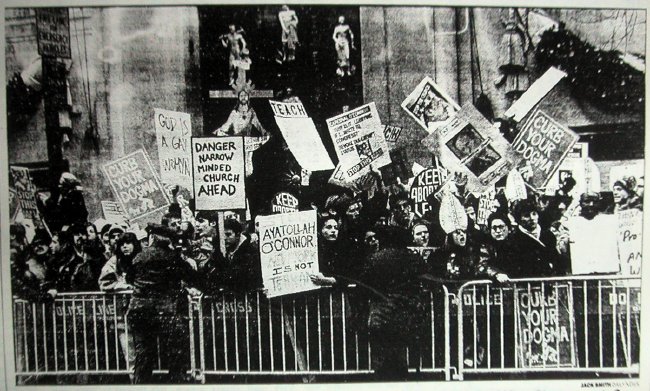
outside St. Patrick’s Cathedral, December 10, 1989
[image at top by Domenico Stinellis from the Associated Press via Robert Boyd; lower image is that of a Jack Smith photo on the front page of the Daily News copied from my archives]
don’t forgive them; they know what they’re doing
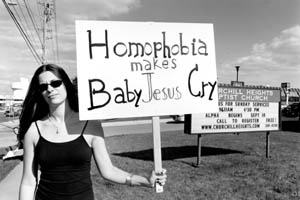
(just for starters)
Relativism be now damned! Absolutism has now triumphed! “Dictator” would be nice, but “pope” will do just fine. Besides, it amounts to the same thing, and the costumes are great. The man who would be baby Jesus’s vicar on earth knows the certainty of objective truth and he’s not going to be shy about reminding us.
Benedict XVI has a lot to answer for, but for starters I’ll point to a trespass which has weighed heavily on queers for almost two decades, whether or not they are aware of it. Seven years ago Peter Tatchell warned the world about the sour man who was appointed pope today, Joseph Ratzinger, “arguably the most homophobic of all Vatican leaders”:
In 1986, Cardinal Ratzinger wrote the infamous Letter to the Bishops of the Catholic Church on the Pastoral Care of Homosexual Persons. Ratzinger wrote that a homosexual orientation, even if the person is totally celibate, is a “tendency” toward an “intrinsic moral evil”. Moreover, a homosexual inclination is both an “objective disorder” and a “moral disorder”, which is “contrary to the creative wisdom of God”.
. . .
Most shocking of all, [a 1992 Vatican proclamation written by Ratzinger and authorized by John Paul II states] that when lesbians and gay men demand civil rights, “neither the Church nor society should be surprised when … irrational and violent reactions increase”.
This implies that by asking for human rights, lesbians and gay men encourage homophobic prejudice and violence: we bring hatred upon ourselves, and are responsible for our own suffering. The Catholic Church, it seems, blames the victims of homophobia, not the perpetrators.
This ugly stuff is in the public record, and every cardinal had to read it, but today 115 old men* decided to appoint the man responsible for it as their cult’s latest absolute monarch.
I can’t imagine good people wanting to have anything to do with this crew, but millions around the world continue to enable the evil they do.
* This is a board whose members almost to a man were selected with the counsel of, and in the mold of, the cardinal whom they chose as pope today. Borrowing some of Ratzinger’s own, notorious phrasing: When entrenched reaction demands conformity, “neither the Church nor society should be surprised when … [it gets it].” I expected a conservative successor to a conservative pope, but I didn’t expect the choice would be so obvious; the current college of crimson-robed cyphers has no imagination whatsoever.
[image by Kathryn Gaitens from nowtoronto]
meanwhile, with merry wives and husbands in Windsor today
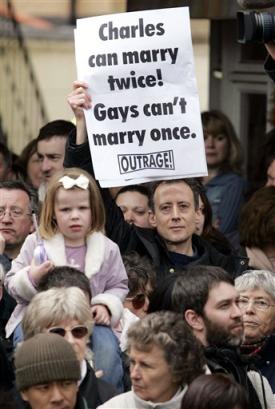
a voice crying in the wilderness
Peter Tatchell is fabulous, and absolutely irrepressible. We love him!
The AP photo caption reads:
Gay rights activist Peter Tatchell makes a protest as he stands in the crowd that were spectating the royal wedding between Britain’s Prince Charles and the Camilla Duchess of Cornwall in Windsor England Saturday April 9, 2005.
[image by Peter Tarry from the Associated Press pool; caption also from the AP]
but how would a vegetarian say it?
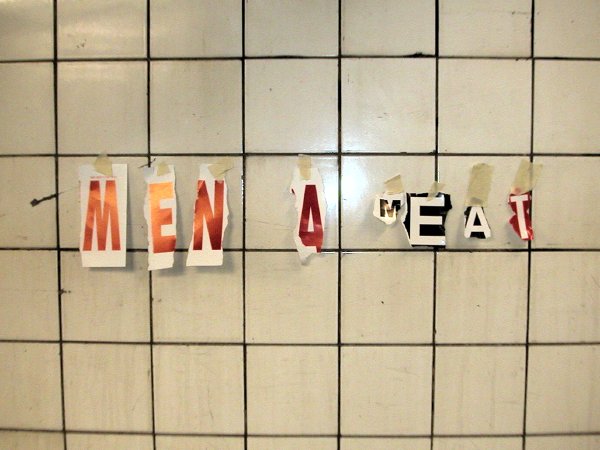
spotted tonight in the 23rd Street 1/9 subway station
My first thought was, this is Chelsea, and some of our neighbors have interesting ways of showing affection, but then it occurred to me that the message could have been meant literally, a la Valerie Solanas. Gulp.
And oh yeah, for those who collect such details, or just for the record, the sign seems to have been re-constructed from one of the MTA’s advisories about service disruptions.
getting one’s priorities straight
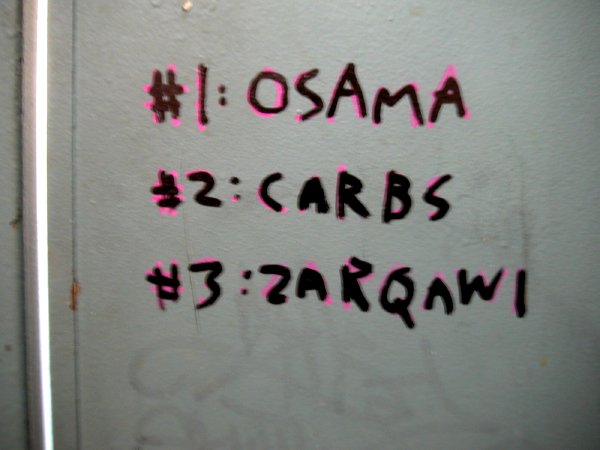
This graffito was found inside the boy’s room in one of the large Chelsea gallery/studio buildings today.
just crazy about dancing and such things
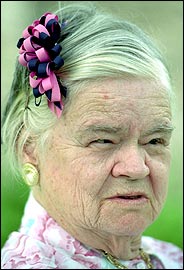
Opal Petty 1918-2005
She was 16 when her family had her committed to a mental hospital.
“Being fundamentalist Baptists her family didn’t approve of her wanting to go out dancing and such things. A church exorcism didn’t work, so the family made the decision to commit her.”
The quote is from the director of the Texas Civil Rights Project, Jim Harrington, the man who fought successfully for Opal Petty‘s right to return to society after 51 years.
She died one week ago at the age of 86, damaged by an “institutional syndrome,” but having lived nearly twenty years with people who loved and cared for her, and who were responsible for her resurrection.
Petty’s story should strike a painful chord in the hearts of most girls and women, and certainly queers of any age, who as little children were chastised by their families, to any degree, for behaving inapproriately. Some of us make it through.
[1994 image by Larry Kolvoord/The Austin American-Statesman via the NYTimes]
AIDS hysteria II: incitement to violence?
The witch hunt has begun in earnest, and we won’t be the only ones hunting. The most insidious aspect of what is already taking on the appearance of a coordinated media campaign is the fact that it will be so difficult to fight back. The victims of ignorance and fear are put into a position where almost any response looks like it’s merely a defense of the right to use recreational drugs, fuck like rabbits and murder the innocent.
Obviously responding to the media’s recent hysterics over the first, sketchy report of a more virulent form of the AIDS virus, linked invariably with stories about promiscuous gays, Richard Cohen writes today in the Washington Post [I shouldn’t be too surprised, since this is a paper which also thought the Iraq war would be a good thing] that the buggerers must be condemned.
For too long now heterosexuals have kept out of this debate. Many of us have been protective of gays, seeing them primarily as victims of discrimination.
. . .
But while gays clearly have their enemies, that should not mean they are immune from criticism. The fact remains that a portion of the gay population — maybe 20 percent, [Charles] Kaiser estimates — conducts itself in ways that are not only reckless but just plain disgusting. Unprotected, promiscuous sex in bathhouses and at parties and using drugs such as crystal meth to prolong both desire and performance are practices that should be no more acceptable for gays than for heterosexuals. Gays don’t get some sort of pass just because they’re gay.
. . .
They are entitled to their own sexuality, but not to behavior that endangers others, costs us all plenty and, too often, entails a determined self-destruction that too many heterosexuals overlook.
. . .
Back in the 1970s William Ryan of Boston College popularized the term “blaming the victim.” It gave voice to a needed concept, but it also silenced critics who saw that sometimes the victim needed to be blamed. This is the case now with gays when their behavior is both stupid and reckless. When they’re victims of discrimination, they need to be defended. When they’re victims of their own behavior, they need to be condemned.
Why was this piece written? What’s his purpose, since he gives no helpful advice, offers no proposals? While I have no reason to think it’s not his intention, Cohen’s venomous piece sounds to me like an incitement to violence.
Finally, and this isn’t a rhetorical question at all: If the “carriers” are just gay men, why are he and his straight colleagues so worried about our health? I don’t have a good answer.
AIDS hysteria
AIDS and (recreational) drugs. It’s a dangerous mix, but the danger is not just that described by the media lately; the danger lies also in our media’s obsession with drugs and the impact that obsesssion has on all of our society.
The latest wave of hysteria over what is still presented as “the gays’ AIDS” was inspired by the tentative discovery in one person of what may be a drug-resistant strain of HIV. Regardless of whether fears of a new mutation turn out to be justified, we should be asking some questions about the report itself and the public’s reaction to it.
Today’s NYTimes features a very frightening (although for reasons other than the paper intended) story in the center of the front page with the headline: “Gays Debate Radical Steps to Curb Unsafe Sex; Fear of a Severe AIDS Strain stirs talk of Intervention”
[Gay activists and AIDS prevention workers say] They want to track down those who knowingly engage in risky behavior and try to stop them before they can infect others.
It is a radical idea, born of desperation, that has been gaining ground in recent months as a growing number of gay men become infected despite warnings about unsafe sex.
Although gay advocates and health care workers are just beginning to talk about how this might be done, it could involve showing up at places where impromptu sex parties happen and confronting the participants. Or it might mean infiltrating Web sites that promote gay hookups and thwarting liaisons involving crystal meth.
Other ideas include collaborating with health officials in tracking down the partners of those newly infected with H.I.V. At the very least, these advocates say, gay men must start taking responsibility for their own, before a resurgent epidemic draws government officials who could use even more aggressive tactics.
Scared yet? That’s the agenda. But actually, in addition to the weakness of its basic premises, there’s a problem with most of the documentation used by the Times writer, Andrew Jacobs.
The piece discusses AIDS as if it were identified solely with the (American, male) gay “community,” and every measure discussed for fighting its spread is directed to those “others” who supposedly comprise that community. Moreover, as usual this paper enlists the support of some of gaydom’s more conservative “spokespersons.” The result is some pretty scary stuff for the eyes of an activist who has survived the first 25 years of the epidemic (every one of them as a person with HIV disease) without succumbing to the hysteria of our “drug” laws.
Historian Charles Kaiser: “A person who is H.I.V.-positive has no more right to unprotected intercourse than he has the right to put a bullet through another person’s head.”
GMHC‘s executive director, Ana Oliveira: “It makes a community stronger when we take care of ourselves, and if that means that we have to be much more present and intervene [my italics] with people who are doing this to themselves and others, then so be it.”
Treatment advocate David Evans: [who thinks gays are safe today] “You have to remember that was the era when Jesse Helms and others were saying that gay people got what they deserved, and that the government shouldn’t spend any money to help them. There was a time when people thought, ‘Oh my god, they’re going to put us in camps.’ ”
POZ editor Walter Armstrong: [playing much less loose with our rights and with common sense, would leave the policing to gay organizations, but he thinks they should use widespread screening and a partner-notification effort to track users of crystal meth who have been infected] “I think there are ways to do interventions [again, my italics] ethically, sensitively and compassionately. There’s a huge window of opportunity between criminalization and empty prevention messages.” recently
BUT IT’S STILL A WITCH HUNT IF WE ARE THE HUNTERS
The most reasonable voice included is that of author and clinical psychologist Walt Odets:
He and others said it would be more effective to try to identify the underlying causes of drug abuse and self-destructive behavior, including the difficulty of living in a society that rejects committed gay relationships while condemning homosexuals for having sex outside those relationships. Gay men, he said, are using methamphetamines as an anti-depressant.
Finally, at the bottom of the article we hear a reassuringly calm announcement from New York City’s Department of Health and Mental Hygiene about plans for
a more vigorous return to conventional H.I.V. prevention. Deputy commissioner Isaac Weisfuse says that his agency is planning to place information banners on gay Web sites and devote more money to hard-hitting ads about methamphetamine use.
And, he noted, the free condom has largely disappeared from public places. “Unfortunately, condom use has fallen off the radar screen,” he said. “We need to do something we did well 20 years ago, which is to get condoms in every place people socialize or have sex.”
In the end it’s still about knowledge and condoms – for everyone, not the totally discriminate use of “screening” procedures, prohibitions against sex, drugs (always the drugs the establishment doesn’t admit to), on line hookups, medical records or whatever they may come up with tomorrow.