Evan Schwartz and Michael Waugh

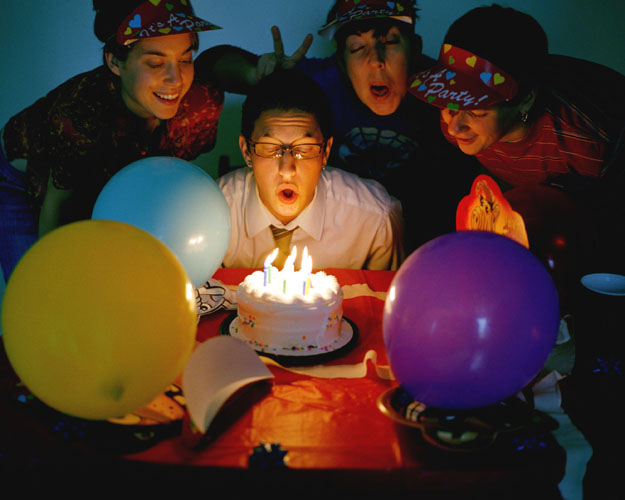
Schwartzbirthday.jpg
Evan Schwartz Birthday Party 2004 digital C-Print 30″ x 24″
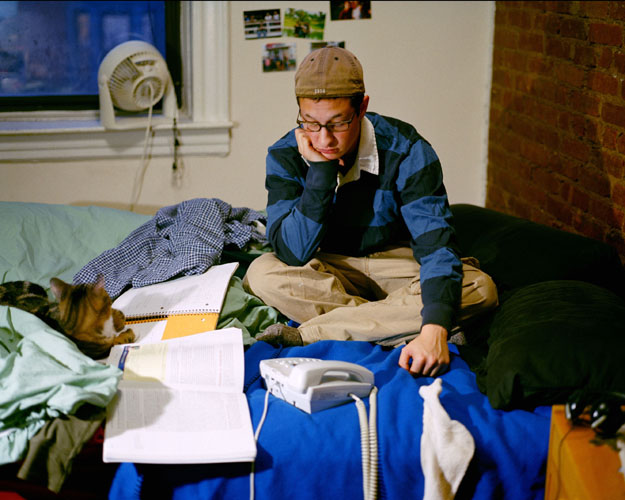
Schwartzbedphone.jpg
Evan Schwartz Waiting by the Phone 2004 digital C-Print 30″ x 24″

Evan Schwartz has his first solo gallery show and it dazzles, with both the bold inventions of his art and the infectious joy (and sad frustrations) of a second puberty – this time the one he really wanted.
The Schroeder Romero press release explains:

Evan Schwartz was born in Chicago, Illinois, in 1982 under a different name and gender. His new photography series Reclaiming Puberty, is a maturing timeline about growing up as a girl into a man. Through this self-exploration of gender and sexuality, Schwartz painfully discovers that in order to become the man he’s always wanted to be, he must go through the perils of adolescent boyhood first – after already experiencing adolescence as a girl.

The gallery installation follows chronologically her childhood and youth, documented in family photos, through a self-documentation of the courageous transformation process which permitted him the ordinary joys and frustrations recorded in the last images in the show, two of which are shown above.
Schwartz is currently a student of photography at Pratt Institute. I’m sure we will be seeing a lot more of his work, whatever form it may take.
Waughhandsdetail.jpg
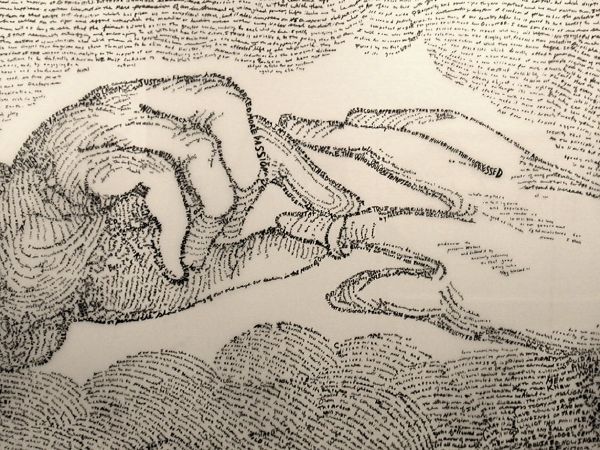
Michael Waugh Inaugural 2004 ink on mylar 36″ x 78.5″ detail

In the Project Gallery space Michael Waugh has installed a number of his text-drawn and text-painted works in [dis]honor of the frightening annointing process the nation will witness tomorrow on the capital steps. Waugh’s images allude to homosexual desire and identity. They are immediately and profoundly beautiful, as they always are in his work, but their relationship to the historical phrases of which they are mostly composed is profoundly disturbing, especially in the reality of the perverted politics of today.

[images at the very top from Evan Schwartz]
Susan Sontag

Sontag.jpg
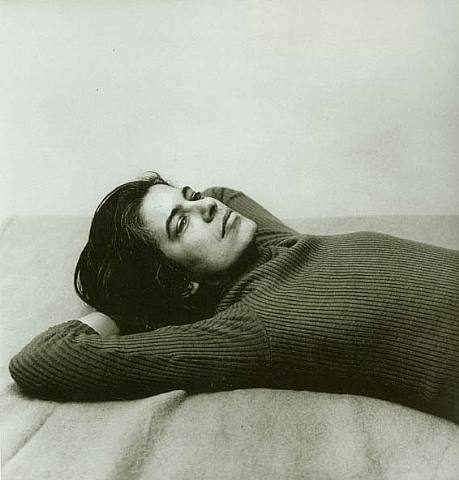
Peter Hujar Susan Sontag [1974-1975]

Susan Sontag died on Tuesday.
Beginning almost twenty years ago I had included her as a part of the homeland I had just adopted and which she had acquired at birth. Because of my profound general “otherness” and two nearly-profound early family dislocations, while it may not strictly fit the meaning of the German das Heimat, my New York City home had come to mean everything for me.
In this Manhattan Heimat Susan Sontag was my neighbor. Physically she really was my neighbor, since she owned an apartment just two blocks away from mine. For years I saw her everywhere in the city, although we never met. Her mind and what she was doing with it had already ensured that she would mean much more to me than an ordinary neighbor normally could. And then one evening I walked through the aura with which I had surrounded her.
I had already seen Edgar Reitz’s monumental first “Heimat,” (most sections twice) when I eagerly subscribed to the first American screening of the thirteen episodes of “Zweite Heimat” at the Public Theater almost twelve years ago.
After arranging myself in the first row for a double feature of two episodes, I noticed that she was only a few seats to my left. Only by coincidence, I had brought her new book, “The Volcano Lover,” with me to keep me occupied while waiting for the lights to go down. I think it was during the break that I gathered the courage to speak to her and ask if she might sign my copy.
I must have mumbled a few words, I hope not too gushing, about how much I admired both her writing and her bold social and political activism, and then we exchanged a few thoughts about the film, all of which escape me now, except that we discovered that we were both enormous fans of both epics. She signed the book, “for Barry and Jim – Susan Sontag ‘Heimat 6&7’ 7 July 1993.”
On every other day I spotted her in the audience she was totally absorbed in conversations with various companions. I was saved from embarassing myself, but I seriously regret the lost opportunities. Gosh, I wish I could have gone with her to Sarajevo, but Barry has written from the heart about how much she became a part of our New York experience, of our own shared Heimat.
She will certainly be greatly missed by many.
It’s late Tuesday night as I’m writing this. The death toll for all the shores around the Indian Ocean, the work of one wave over only a few hours, has now exceeded that of the U.S. military alone in Vietnam over a period of ten years. I’m already recalling Sontag’s unassailable morality, her creative curiosity and her courageous voice as I think about the individual and community tragedies millions of people in southern Asia are enduring at this moment. What would Sontag say about our government’s lame response? Colin Powell is absolutely wrong. We are stingy, very stingy, and we have been for decades.*

*The United States initially offered $15 million in relief to cover all of the nations affected (what we spend on the Iraq war every hour, and a fraction of the estimated cost of Bush’s January 20 Nuremberg rally). Oh sure, after being ridiculed by people in a number of other countries, we’ve now apparently upped our commitment by another $20 million, although that figure is marked as a loan.
Radically contrary to popular U.S. opinion, the amount of our foreign aid, in terms of percentage of gross national product (approximately one tenth of one percent), is the lowest of any industrialized nation in the world. Incidently, Norway’s contribution is proportionately almost ten times that of ours.

[image from Matthew Marks via artnet]

Colin Powell, may he not enjoy this retirement

He’s gone. Colin Powell’s finally gone, and under the most cowardly of circumstances, just slipping out the back door quietly to no good purpose, and not three years ago, not two years ago and ultimately not at any time before November 2, but instead only days after the apparently successful election campaign of the man for whose stupidity and insane belligerance he destroyed whatever reputation he may* have assembled years ago.
That same cowardice, in the line of his duty as Secretary of State, is responsible for the deaths of perhaps over a hundred thousand Americans and Iraqis.
Powell’s legacy will, and not incidently, include his argument that the U.S. armed services couldn’t (shouldn’t?) be integrated – for homosexuals, that is. I’m sure however that he would have made the usual exception for times of war like the present, when they are needed for cannon fodder.
A very small man indeed.

*I’ll leave it to others, who know much more than I do, to comment on Powell’s early, very problematic career in the Viet Nam war (a Mai Lai cover-up is apparently only part of it) and in the Iran-Contra affair (coordinating the sale of missiles to Iran), and I’m sure they will.
[thanks to Elise Engler for the reminder about Powell’s early days]

David Wojnarowicz eventually got to China

Woj:stonesweep2.JPG
David Wojnarowicz untitled (1988-89) collage on masonite 39″ x 32″ detail

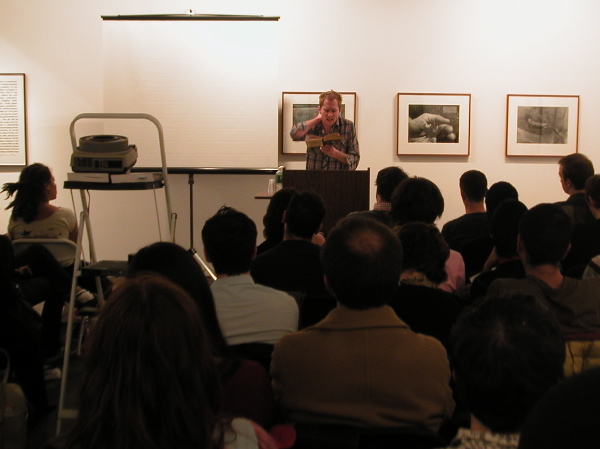
David could make the stones weep, but he could also make them scream. Last night we were welcomed by PPOW and Poets House to a tribute to the artist and writer David Wojnarowicz, who died of AIDS complications in 1992. The evening was scheduled for one of the last days of the gallery’s current show, “Out of Silence: Artworks with Original Text by David Wojnarowicz.” Five writers, artists and activists read from his texts or delivered original work inspired by his art and his rage.
For someone who had met David and who had been familiar with and in awe of his power for twenty years, the most surprising thing about the evening was the description and engagement of the overflow crowd; most of the people in the room were too young to have known the man whose memory brought them together last night.
The young novelist and poet Douglas A. Martin read an excerpt from Wojnarowicz’s powerful memoir, “Close to the Knives,” the scene where the artist/poet describes an erotic encounter with a stranger inside his “salesman station wagon” parked off a deserted road somewhere in Arizona. This was more of a performance than a reading. David was in the room.

Woj:DouglasAMartin.JPG
Douglas A. Martin inside David Wojnarowicz

His former lover, Tom Rauffenbart, reminded many in the room that David was not just an angry man. A child who loved life of all kinds, he never shut down an extraordinary curiosity which began very early. One of the works on display in the room was a black and white photographic print showing an obviously homemade biological specimen (certainly not dead from David’s hand) in a jar on a windowsill. There was a text within the image, small white print in the lower right corner:

When I was a kid I went into the backyard and tried to
dig a hole to China with a shovel and a bucket. After an
entire afternoon I hadn’t even left New Jersey

For more on David and the evening, see Bloggy.

Reno knows

Reno.JPG

We spotted this wonderful, much-used Toyota last night while walking to the E train Spring Street stop. I had already taken this shot before I walked around the side of the car and saw the door emblazoned with a large “Citizen Reno” sign. Of course!
Inside on the dashboard was a small stack of her DVD, “Rebel Without a Pause.” Is our hero tempting the culturally and politically savvy thief, or just advertising?

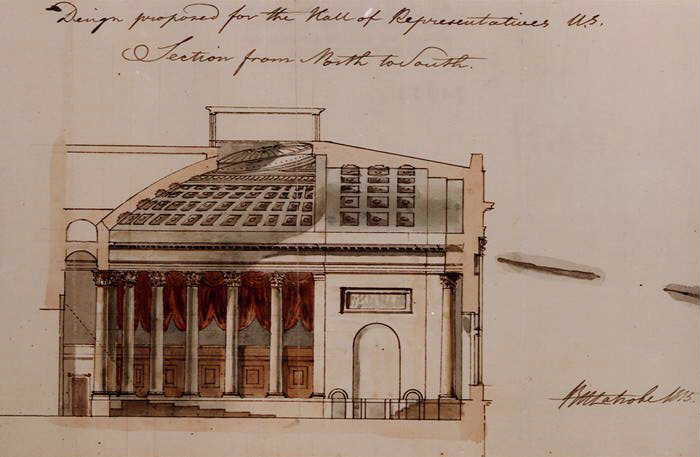
the House and Peter Hort

HouseLatrobe.jpg
Benjamin Henry Latrobe Design Proposed for the Hall of Representatives, U.S., Section from North to South (1815) ink and watercolor on paper

For weeks now Barry and I have both been dismayed by the strange candidacy which Peter Hort has mounted for Representative of our local Congressional district.
I believe what is happening only shows that even supposedly sophisticated New Yorkers are naive when it comes to politics, or that money can persuade otherwise good people to act quite badly. Both explanations are pretty disturbing, but each is still better than some of the other possibilities.
For his reading of the subject, including both background and foreground, see Barry’s post of last night which links to his previous entries, to Hort’s own site and a number of other relevant sources.

[image of the old House chamber from Library of Congress]

Bill Dobbs

dobbs.jpg
“life could be beautiful”

I really like him. Those who know William K. Dobbs know that’s not so easy to say, but now that he’s become the subject a modest but delightful profile in the NYTimes, written by Michael Brick, it may be easier for me to explain why.
Sure, from the very first time I heard him speak in front of an ACT UP meeting in the late 80’s I’ve always respected him, as virtually without equal among some really tough competition, even if early on that also meant hoping I could stay out of the line of his fire, the kind of fire usually associated with biblical prophets. In the years since however I’ve managed to overcome some of my timidity and the rewards of knowing him just a bit better include (and he’d laugh at me for this) real affection.
He was admired for his mind and his integrity throughout the activist community from the very beginning, but he could be intimidating. His devotion to principle was uncompromising. We may have been wrong, but most of us had the strong impression that he would not be easy to know personally. Saints can be extremely tough to live with.
Dobbs stayed around. Within the AIDS and Queer movements the authority of his stentorian voice and his facile pen represented a strong focus and a highly-intelligent conscience within groups with many rivals for those roles, but few equal to or even faintly resembling Bill. I think we were all fascinated with our mysterious intellectual Clark Kent. There were certainly many crushes.
Today Brick describes Dobbs as “a main organizer and the official spokesman of United for Peace and Justice.” How did he get to opposition to the Iraq war, the Bush administration and eventually both major political parties from the more narrow focus of his earlier activism? It’s not a big step for for many of us, but here’s Dobbs’s account:

“Gay is the lens that I look at life through,” he said, sitting recently in a diner near Madison Square Garden, the convention site. “Is there a connection between that and antiwar work? I feel a connection, but it’s not easy to articulate. It’s about power. It’s a visceral need to stop war based on the lessons I’ve learned as a gay man.”
. . . .
Mr. Dobbs says he is motivated to protest by the cruelty of fate, the nature of power and the virtue of free expression. “Life could be beautiful, but it won’t,” he says, paraphrasing Lily Tomlin. “What’s wrong with the world?”

OK, but like Bill himself, we’re still going to keep trying to make a difference. Let’s get out there this weekend (and stay out there for as long as it takes), let’s make it very colorful and let’s keep it very safe.

[image from the NYTimes]