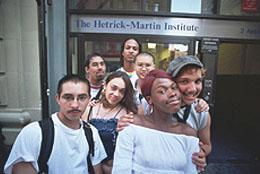
Harvey M would love Harvey F!

Follow-up on my August 2 Harvey Milk High School post
The big guns are still turned on the modest little New York high school which operates as a shelter for kids who really, really need it, and some on the assault team are homosexual.
The media’s special tizzy includes this week’s New York “Intelligencer” page, where 5 out homos are asked what they think about New York City’s plan to expand its queer high school. Four of the interviewees just don’t seem to quite get it, and they include Frank DeCaro, Andrew Solomon, Mistress Formica and Emil Wilbekin. Harvey Milk High may not have been necessary for them, and for the same reason Harvey Milk High probably wouldn’t have enrolled them anyway.
Harvey Fierstein understands the stakes. First he replies to the question, “Were you out in high school?”

“At 13. I went to Art and Design. There was a boy named Pablo who used to breast-feed his baby doll in English class. I was hardly the most outrageous kid in school.”

When asked if he wishes he had gone to a gay high school, he explains of course that his school was a special school, but he understands that even art can’t protect all kids. “Is [a gay high school] a good idea now, in New York of all places?” Harvey:

“The school’s almost twenty years old! They wouldn’t be expanding it if they couldn’t say, ‘Shit, this works.’ This is not for all gay kids. It’s for 14-year-old drag queens who get beaten up daily. Gay teenagers have the highest rate of suicide attempts, and because they’re smart, they very often do it successfully.”

For a pretty comprehensive outline of the issues at stake, see Michael Bronski’s essay in the Boston Phoenix. I like his suggestion for an alternative solution to violence against queer kids in school:

Sending in the National Guard? Well, it was the last resort for integrating public schools in the South in 1950s.

He articulates every argument against the policy of a separate school, but he still can’t conclude that in the real world at this moment the kids could be safe without it.
The school is not the mistake; the mistake is that after almost 20 years we have done nothing to make it unnecessary.

John Weir, sloppy style pundit – and “dad”


Storied John Weir ( “The Irreversible Decline of Eddie Socket” author, CBS terrorist, elusive man about town, beloved professor) has been watching Television. Well, maybe it’s less like pay-per-view than view-per-pay, since his account of what he has been seeing ran under his own byline in the NYTimes on Sunday.
Professor John has been watching “Queer Eye for the Straight Guy,” but he has his own reading of both the amazing current popular flowering of queer sensibility, and the popular sense of queer powers which accompanies it. He thinks it’s something of a misreading of reality, and something less than the straight guy’s envy of a putative higher aesthetic way out of his reach.
I think John has adopted a French deductive approach in his analysis of the queer aestetic, something like, “It doesn’t fit with my experience therefore it must not be true.” John tells us that it’s his experience that queers do not have an “eye” – or at least that they don’t let it fashion their own appearance or manner, and especially not that of their personal environment.

If this is reality TV, why aren’t the straight guys hostile and punctilious and the gay men sloppy and depressed? “All the gay men I know are terrible slobs, including you,” my mother told me, when she called to discuss the show. “Do you think you could get them to clean up your apartment?” Indeed, the show insists on reinforcing the stereotype that gay guys are groomed and charming and slender and witty, and no more than 35 years old. Yet here I sit in my Megadeth T-shirt, dirt broke, middle-aged, downing a carton of vanilla ice cream and spilling it on my computer keyboard.
Some gay men dress down to look “street,” but I’m not a chic slob, I’m a real one. My apartment is designed like a bowling alley, with the furniture pushed against the walls, except where it can be used to cover carpet stains.

Well, his proposition is at least worth an entertaining argument, and John is more than equal to that, but his take on why straight guys are willing to listen to queer style coaches is even more intriguing. He says the new “reality” TV show flatters heterosexual men by putting them where they already are, at the center of the action.

In the meantime, is “Queer Eye for the Straight Guy” creating a new “common ground” where gay men and straight men can bond? No doubt it is, for some people — in particular, for television executives and advertisers impressed with the show’s ratings. To me, however, the most touching aspect of the show is its plain proof that all men, straight or gay, yearn to be praised by a guy.
. . . .
Anybody with a father has learned how difficult it can sometimes be to get a man to pay attention to you. The subversive charge of “Queer Eye for the Straight Guy” may not be its homo/hetero get-together, but its demonstration that all men want contact with other men. Of course, you can learn the same thing from a hockey game.
Still, I think of the show’s grooming guru, Kyan, asking his [straight guy] buddy Adam if anyone had ever taught him how to shave, and Adam’s mumbled reply, “No, unh-unh, no.”
In that moment, it seemed like five gay dads had been beamed down to planet Earth to give men what they really want: a father who’s not afraid to pat your head and say, “Atta boy.”

Oh John, we miss you. Now where’s the new book, dad?
[image by Chris Gash, NYTimes]

undoing Justinian’s cruel Code


Is that a basball bat in his right hand?
I admire a minds that can think in terms of millennia! Well, those who run the Catholic Church may be an exception, but perhaps it’s because they only think in terms of millennia – other millennia.
This is the complete text of a July 31 press release from ILGA-Europe, the European region of the International Lebian and Gay Association:

Europe free of laws banning same-sex relationships for the first time in 1,500 years
On 1st August 2003, with the entry into force of a new penal code in Armenia, the last law in any country of Europe outlawing relationships between people of the same sex will be eliminated.
For the first time in many centuries, and probably since the enactment of [Catholic] Byzantine Emperor Justinian’s legal code in the 6th Century AD, there will be no part of Europe where lesbians, gays and bisexuals face a threat of criminal prosecution simply because of their love for a person of the same sex.
While the process of repealing laws banning same-sex relationships goes back two hundred years to the Napoleonic Code, the major changes have come about in the last half-century: in 1950 two-thirds of today’s 48 European countries still criminalised relations between women and between men, or between men only.
There were two key factors in accelerating the process of change: first, a ruling by the European Court of Human Rights in 1981 that these laws
violated the European Convention on Human Rights; and secondly, the fall of the Iron Curtain, and the subsequent accession of the countries of Central and East Europe to the Council of Europe and to the European Convention.
The legal change in Armenia was made a condition of that country’s membership of the Council of Europe in 2001, following lobbying by ILGA-Europe of the Council’s parliamentary assembly.
A new criminal code was approved by the National Assembly on 18th April 2003, with ratification by the President on 30th April, and entry into force on 1st August.
Ailsa Spindler, ILGA-Europe Executive Director, commented “this is an important milestone in the achievement of LGBT rights in Europe. But it is just the beginning. A number of countries – Albania, Bulgaria, Greece, Ireland, Portugal, Serbia/Montenegro, and the United Kingdom – still have discriminatory provisions in the criminal law. 33 European countries provide no legal recognition whatsoever for same-sex partners. And, of course, legal equality is itself only one element in the fight against discrimination”.
Note for editors
While Armenia falls outside the usual geographical definition of Europe, it is generally accepted as falling within the political concept of Europe, as exemplified by its membership of the Council of Europe.

still, you have to demonstrate a “history” to be saved


Hetrick-Martin youth
An email arrived Thursday at 8:30 in the morning, asking me to attend a press conference at City Hall to show “support for the Hetrick-Martin Institute.”
Sure, I had heard the recent news that the city had finally agreed to extend serious support for the 19-year-old Harvey Milk High School, so I felt honored that I was being asked to be a part of the celebration, and I thought nothing more. It never occurred to me that some people would seriously attack the concept of educating and protecting from assault or even death kids who were, or who were perceived by others to be, lesbian, gay, bisexual or transgendered, or in some cases just questioning.
When I arrived, I found out that the press conference had been quickly assembled and scheduled in response to the news that some powerful people had decided to file a lawsuit to block the city from funding the school.
Let’s get a few things straight, before we try to address the issues being raised. One, the school is not new. It was first opened in 1984, and it was a public school “program” even then. Two, as a high school which operates to serve kids who would otherwise be lost in the system, it is not unique in New York. Third, it’s not a school where kids learn how to be homos; they are taught the same subjects available in any other school, but here they have a chance to learn, without having to worry about their safety.
These kids are truly at risk. They are tormented by their peers, and sometimes even by teachers, principals and others charged with their care; they are assaulted; they are terrorized. They are unable to learn in what is intended to be a learning environment. For the most vulnerable youths it is a torture environment which may somehow be endured – or not. Sometimes they are killed.
They are not like the character Will on television’s “Will and Grace.” They are not middle class. They are overwhelmingly not white [75% are black and hispanic]. They have no support system. Many are homeless or in foster care. Many have attempted suicide. Many are not open to their parents or any other adults. Many have been thrown out by their parents. They are not codifying their sexuality; others are doing it for them. Their numbers include many who are still questioning their sexuality, and statistically 13% of Harvey Milk students are straight. Regardless of whether they are lesbian, gay, bisexual, transgendered, questioning or even straight but perceived by peers as otherwise, these kids just can’t hide it. And they shouldn’t. They’re kids.
There are 1.1 million children in the New York school system, which means that perhaps 100,000 are homosexual, and that doesn’t even include the other queer categories. Harvey Milk, even after being expanded this year, will be able to protect only about 170. Obviously not every queer gets to be saved.
LGBT and Q youth have been in danger in our schools for hundreds of years, and they shouldn’t have to wait for adults to realize this and to decide what they will do about it – even whether they will do something about it. We should not inflict society’s bias on the young and simply say they have to live with it.
This totally unnecessary battle is being waged today in an electric environment. We are in the midst of a period of great change. The larger American public’s acceptance of sexual difference is clearly growing, but it is still appallingly retarded. Only this summer did our highest court decide that private homosexual acts could escape criminal charges. Largely due to attitude changes now everywhere so apparent, what I call the forces of darkness are feeling more threatened than ever, and they will not roll over. Bush and the Pope are freaking out. They hope variously to bring others along with them or to personally profit from the ignorance and fear of millions.
Notorious homophobe Ruben Diaz and his friends and allies want to erase us. Are they threatened by GLBTQ people finally being recognized as human beings?
Well, they sure ain’t interested in the kids. Diaz says his opposition is not based on prejudice but rather on the fact that the Harvey Milk school promotes “segregation,” yet Diaz and other social conservatives and religious fundamentalists have never supported the “integration” of queers, and they aren’t starting now.
The “Children of the Rainbow Curriculum” proposed ten years ago to foster greater tolerance and diversity in New York public schools was excoriated and thrown out the window by Mr. Diaz and other homophobic individuals and institutions. The result is the moral chaos we have now. My partner Barry looked at this photograph and said that Diaz and the New York Hispanic Clergy Association might as well be screaming, “We want our gay kids dead!” For Diaz-sorts however, there are no gay kids. There are only what he calls “normal” kids, and any others are just deliberately being perverse.
Diaz and his cronies shout that HMI means segregation. “It’s misleading to say this is an issue of segregation,” Newsday quotes the Hetrick-Martin Institute’s director, David Mensah. “Kids have fled their home schools to get to us. They need a safe haven.”
Mensah cited the example of a student referred to Harvey Milk after his third suicide attempt. “For him, suicide was not a mental health issue,” Mensa said. “He was being harassed at his school.”
In the latest Hetrick-Martin Institute newsletter, Debra Smock, the Director of its brilliant child, the Harvey Milk School, describes the need for its expansion as bittersweet. “In a perfect world, there wouldn’t be a need for HMS, but in this day and age there is a need for the school and a need for the expansion.”
The saddest part of this very sad story of what we do to our youth was made clear to me during the press conference, when several speakers described the means by which a student is enrolled in the school. Harvey Milk High School is over-subscribed. A kid can be referred by his or her parents, his teacher, principle or his guidance counselor. The kid can also apply directly. There’s just one catch. To be admitted, you have to be able to demonstrate what one person called “a history.” Think what that means, especially when so many still have to be turned away.
We have to get to work on the schools that are not Harvey Milk. We have to get to work on New York. We have to work on America.
For more, see Bloggy, “REGARDING ‘THE GAY HIGH SCHOOL,'” and dkos, “Gay hysteria.”

a gay Askew


Othniel “Niel” Boaz Askew
[Photo by Victor Carnuccio]
The story about Askew most people won’t hear is in the Gay City News.

Emanuel Xavier is a gay poet and author who frequented many of the same nightclubs as Askew did back in the 1990s. This past December, Davis honored Xavier and other LGBT activists at the Councilmember’s Holiday Pride event at Long Island University. According to Xavier, around 1995, he and [Clifford Nass, Askew’s roommate at the time] dated for several months, well before Askew’s 1996 arrest.
During his relationship with Nass, Xavier spent a considerable amount of time in the West 43rd Street apartment.
He recalled Askew as “an incredibly sweet person,” saying that “the media is portraying him as a monster and he wasn’t one despite committing such an inhumane act.”
. . . .
Despite Xavier positive recollections about Askew, he also recalled signs of a troubled side to the man.
“He had issues with being comfortable within his own skin,” Xavier said. “He was concerned about his image. We often joked about how he was so white. In connecting with me as a person of color, I think he was trying to be comfortable with himself and always complimented me on being an out artist who was proud of who I was.”
The two men maintained a casual acquaintance, running into each other occasionally at gay events.
“I ran into him on and off for the last several years,” Xavier said. “The last time I saw him was last year at the Roxy. He looked really good.”
Like [Victor Carnuccio, a friend of Askew’s who had photographed him in 1992], Xavier noted that Askew had bulked up, with a noticeably muscular physique.
“It was a very brief conversation. He told me about going into politics,” said Xavier. “When I read about Councilmember Davis threatening to out him it was so surprising because he was already so out and on the scene.”

What’s it all mean? I suspect there are more tales to be heard before this story dies.
We’re free now, and some of us just won’t shut up.

how will it be read?

Is the story going to be “Wacko AIDS homo slays saintly populist in hallowed hall?” Or will it be, Homophobia helped to destroy two lives – again?”
Interesting developments available from the media today:
Askew’s police record, supposedly sealed, was somehow made know to Davis.
Since his record was (supposedly) sealed, Askew purchased a gun legally .
The gun Askew used to kill Davis was bought in North Carolina.
Askew and Davis were allowed to skip the metal detectors.
The little girls with tiaras, there for a presentation, got screened.
“Court records” (still officially sealed) indicate Askew was HIV-positive.
Askew had once planned a modelling career – apparently with good reason.
Askew was beautiful.
His former lawyer describes Askew as “a charmer.”
Askew may have thought the charming Davis had been flirting with him.
But see these commercial sites for the complete (sometimes hysterical) news stories:
NYTimes
Newsday
Daily News
Post
NY1

“cherchez la femme”

[updated information added to the bottom of this post]
Only this time “cherchez l’homme” might be a more useful suggestion.
Neither James E. Davis (41) nor Othiel Boaz Askew (31) had ever married. Both were described as bright, attractive, smart dressers, ambitious, real talkers – and at least a little kooky.
Today the NYTimes capsule story on Askew reveals something missing so far from other accounts of yesterday’s tragedy.

“The councilman [Davis] began to think of himself as something of a mentor to him,” said Amyre Loomis, who was Mr. Davis’s spokeswoman. Ms. Loomis said Mr. Askew had asked Mr. Davis to write a letter for him saying that Mr. Askew had a promising future in public service.
But according to a law enforcement official, Mr. Askew gave a very different version of events when he called in a complaint to the F.B.I. against Mr. Davis yesterday, claiming that Mr. Davis had threatened him.
James Margolin, a spokesman for the F.B.I.’s New York office, said yesterday: “Late this morning, a caller who identified himself as Askew alleged that he was the victim of harassment by Councilman Davis in connection with the upcoming primary election. He expressed no intention to cause harm to Councilman Davis.”
According to the complaint, Mr. Askew and Mr. Davis took a walk together earlier this month through Fort Greene Park, and the councilman said he had done a background check on Mr. Askew that he claimed revealed that he was gay and that the information might be exposed in the race. Mr. Askew considered this a threat, the law enforcement official said.

Ooops! This just in.
Now NY1 tells us a little more.

Police said [Askew had] been arrested in the past, convicted of harassment in 1996 after hitting his live-in boyfriend with a hammer in a domestic dispute and leaving him bruised and bleeding. Askew was also charged in 1999 with stealing a leather bag from another male friend. Both incidents were in Manhattan.

QUEERS READ THIS!


[undocumented photo from the 2002 exhibition at the London club Queer Nation]
“QUEERS READ THIS!” was anonymously distributed during New York’s “Pride” weekend in 1990 as a tabloid piece with wonderful bold graphics. It became a manifesto. It reads as well today.
This is just one section of many:

AN ARMY OF LOVERS CANNOT LOSE
Being queer is not about a right to privacy; it is about the freedom to be public, to just be who we are. It means everyday fighting oppression; homophobia, racism, misogyny, the bigotry of religious hypocrites and our own self-hatred. (We have been carefully taught to hate ourselves.) And now of course it means fighting a virus as well, and all those homo-haters who are using AIDS to wipe us off the face of the earth. Being queer means leading a different sort of life. It’s not about the mainstream, profit-margins, patriotism, patriarchy or being assimilated. It’s not about executive directors, privilege and elitism. It’s about being on the margins, defining ourselves; it’s about gender- fuck and secrets, what’s beneath the belt and deep inside the heart; it’s about the night. Being queer is “grass roots” because we know that everyone of us, every body, every cunt, every heart and ass and dick is a world of pleasure waiting to be explored. Everyone of us is a world of infinite possibility. We are an army because we have to be. We are an army because we are so powerful. (We have so much to fight for; we are the most precious of endangered species.) And we are an army of lovers because it is we who know what love is. Desire and lust, too. We invented them. We come out of the closet, face the rejection of society, face firing squads, just to love each other! Every time we fuck, we win. We must fight for ourselves (no one else is going to do it) and if in that process we bring greater freedom to the world at large then great. (We’ve given so much to that world: democracy, all the arts, the concepts of love, philosophy and the soul, to name just a few gifts from our ancient Greek Dykes, Fags.) Let’s make every space a Lesbian and Gay space. Every street a part of our sexual geography. A city of yearning and then total satisfaction. A city and a country where we can be safe and free and more. We must look at our lives and see what’s best in them, see what is queer and what is straight and let that straight chaff fall away! Remember there is so, so little time. And I want to be a lover of each and every one of you. Next year, we march naked.


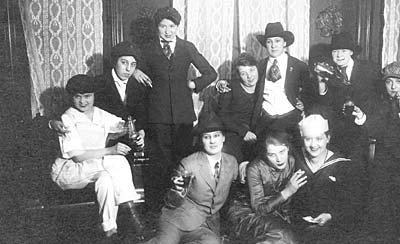
[Butch Femme Couples, circa 1920, donated to the New York Lesbian & Gay Community Services Center by Barbara Warren and Stephanie Grant]

home repairs

John Rechy suggests in a Commentary piece in Sunday’s LATimes that gratitude may not be the appropriate response to the decision in Lawrence and Garner vs. the State of Texas.

Without in any way belittling the decency of the justices in their brave opinion, some might view the decision as a vastly imperfect apology for the many lives devastated by cruel laws that made possible the myriad humiliations of gay people, the verbal assaults and screams of “faggot!” — the muggings, the suicides, the murders — all occurring even during this time of victory. The flagrant dissent by Justice Antonin Scalia and two of his colleagues — in an effort to uphold the Texas law — will help to keep fertile the atmosphere of hatred that allowed three men to mangle Trevor Broudy in West Hollywood and allowed Matthew Shepherd to be butchered in Wyoming.

No, we cannot be grateful.
Rechy writes only about the modern American experience,* but the horror is on a much larger scale than that. Violence against perceived sexual and behavioral deviation, never bounded by geography or time, continues today and beyond today, here and everywhere.
Instead of showing gratitude, we should be demanding reparations, and, since millions, even billions, of queers who have been crippled physically and psychologically for millenia by the assaults of a dumb, blind, malicious and implacable sexual establishment are now dead, lost or beyond recovery, the blood money and the attention should go to endow lively support centers for lesbian, gay, bisexual, transgendered and transexual youth at risk everywhere, like New York’s Y.E.S. No groups need more help and no groups can do more to repair us right here and around the world, now and maybe forever.
____________________
* One story excerpted from the LATimes piece:

In 1973, California finally repealed its anti-sodomy laws. But still, in 1977, driving home from UCLA in the early evening, I saw muggers fleeing from the man they had assaulted on the street. I drove the bleeding man to the police station so that a squad car would be sent to the area. The bruised man — clearly gay — was returning home with groceries when attacked. At the station, the sergeant studied him after I had recounted what I had seen, and asked him, “What did you try to do with those guys?”

[thanks to Barry]