gay or black in the garden state: is it still 1953 in NJ?

Bayard_Rustin_12-2.jpg
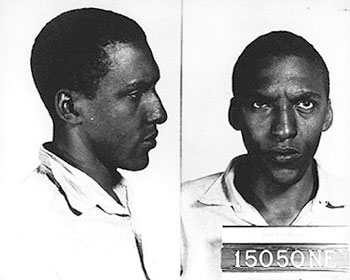
Bayard Rustin’s 1953 mug shot*

The CEO of an Atlanta credit union, on a visit to New Jersey for his 30th high school reunion, has been shot and killed in a Newark park by an undercover policeman. The alleged sex-related incident ended in the senseless death of an unarmed man, DeFarra Gaymon, a successful businessman and a married father of four.
The official explanation, delivered by the acting Essex County prosecutor (that the officer, trying to arrest Gaymon for lewd behavior, had fired in self-defense), makes no sense, and even if the pieces could be fitted together they suggest a world I thought had disappeared decades ago: I remember what many urban parks looked like after dark half a century back, I know that the police played them for sport, and I know the combination could destroy lives, but it’s now 2010. This Essex County park is located in a state which by most accounts ranks at the very top in the nation in laws extending equality and civil rights to both the gay and black communities (yes, the victim was black), and I thought we now had better uses for our constabulary – and that we could still afford real uniforms.
Actually, 57 years ago Bayard Rustin got off much easier than DeFarra Gaymon, whatever the unfortunate Atlanta businessman was doing in the park last Friday night.
According to the New York Times story, “The officer, whose name was not released because of his undercover work, had been on what is not usually a particularly dangerous assignment, scouring the park, in northern Newark, for men seeking sex.” The Times also tells us: “The officer and his partner were patrolling the park in plain clothes, part of an operation that has been going on for years, said Mr. [Robert D.] Laurino, the prosecutor.”
And that would be, . . . an assignment to arrest men who have no interest in frightening the horses. In the email he sent out before dawn this morning my friend, the activist Bill Dobbs, reminds us that “Those who seek hookups in such locales traditionally shield their activities from uninterested parties.”
The Essex County sheriffs have been very interested for years. May we ask why?
The whole incident stinks, and the only hope for justice, and reform of current police tactics, is the power of the presumed outrage of both Gaymon’s family and the community or communities targeted by a law enforcement agency.
In his letter, Dobbs asks:

What exactly was this undercover officer doing in a park known for cruising? Uniformed cops are safer and more effective for such situations � less danger when an arrest is made since cops identities are clear. Who approved this undercover operation? Was it a �sting� operation, enticing men and then arresting them? Was the cop given this assignment considered attractive to other men? Were there backup officers involved? What does the NJ gay lobby think about this? The only person who seems to be quoted on NJ matters gay, Steven Goldstein, is so rabidly and single-mindedly pro-gay marriage – will he and the state-wide gay political group Garden State Equality speak about an alleged sex-related incident that ended in the death of an unarmed African American man? According to the Star Ledger newspaper several hundred arrests have been made in that park over a year and a half, where has Garden State Equality been? How much money has been wasted on this operation?

Additional links:

The (Newark-based) Star-Ledger
Atlanta Journal Constitution

*
The image at the top is of Bayard Rustin’s mug shot. His Wikipedia entry reads, in part:

In 1953, Rustin was arrested in Pasadena, California for homosexual activity. Originally charged with vagrancy and lewd conduct, he pleaded guilty to a single, lesser charge of “sex perversion” (as consensual sodomy was officially referred to in California then) and served 60 days in jail.

[image from GBMNews]
Book bargains to benefit homeless LGBT Youth

New_Alternatives_HOP.jpg
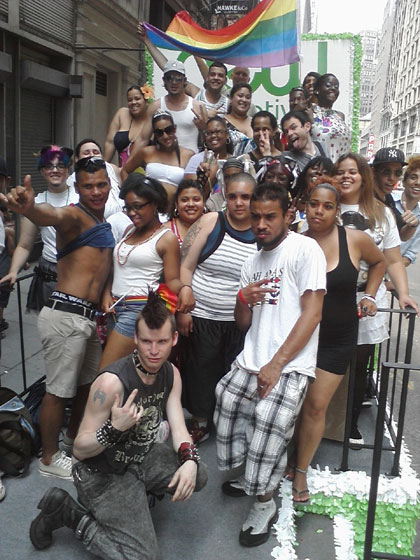
New Alternatives marched in the 2010 NYC Pride Parade last month

A July 10 benefit for New Alternatives for LGBT Homeless Youth will offer both some incredible book bargains and the opportunity to do something for some of the most vulnerable (yet spunkiest) folks in New York. The organization was founded by activist Kate Barnhart, whom I first met some 20 years ago, when she was just about the youngest and most fearless member of ACT UP (and there was serious competition for both roles). She hasn’t slowed down since.
These are the details of the benefit:

Huge Book Sale on July 10
At LGBT Community Center on West 13th Street
Will Benefit Homeless LGBT Youth
�Buy a book, save a young life� fundraiser
Offers ten thousand new volumes on sale
For $10 per shopping bag
NEW YORK, NY, June 28, 2010 � A huge sale of more than ten thousand new and used books will take place in the West Village on July 10, with the proceeds going to charity. The event, called �Buy a Book, Save a Young Life,� will take place on Saturday, July 10 from Noon-6pm at the LGBT Community Center on 13th Street.
The books on sale encompass every subject and genre, including children�s, art, classic and modern literature, as well as collectables and rarities. These books were donated by veteran bookseller Robert Warren, who recently closed his landmark New York bookstore, Skyline Books. Admission is free to this event, and people can fill a shopping bag full of books and pay $10 per bag.
All proceeds of the �Buy a Book, Save a Young Life� sale will benefit New Alternatives, the East Village program based at Middle Collegiate Church. New Alternatives provides desperately needed services to LGBT homeless youth, including hot meals, emergency housing referrals, case management, and life skills training.
There will be a special pre-sale on July 10 for dealers and collectors. For an admission fee of $25 (also going to New Alternatives), shoppers can get a jump on the crowd from 11am-Noon. Admission includes one free bag of books. Additional bags of books will be $25 each.
For hardcore bargain hunters, from 5pm to the 6pm closing, the price plummets to $1 per bag of books.
To match New Alternatives goals of promoting HIV awareness and safer-sex education, each bag of books comes with free condoms, and New Alternatives promises a fun festive atmosphere. In addition to great book bargains the event will include performances from queer and queer-friendly acts such as Circus Amok, Rude Mechanical Orchestra, and The Church Ladies for Choice. Expect music, stilt walking, juggling and a good vibe to abound.

ADDENDUM: See Karen Ramspacher’s brief description of the group in her comment on Bloggy

[image from New Alternatives]

friends to celebrate Harry Wieder in Cooper’s Great Hall

harry_wieder.jpg

There will be a great congregation of friends and activists inside the Great Hall at the Cooper Union tomorrow evening at six o’clock. There they will be celebrating the rich life of Harry Wieder, cut short, shockingly, in an accident in April.
Harry was a familiar friend and powerful advocate of many progressive causes, so I expect the room will resemble a portrait of the face of New York grassroots activism (of almost every sort) as it operated over the last few decades.
I also expect that this memorial will not be a lugubrious affair. Harry meant a lot to the people who shared his life and his dedication. But we also knew how to share in laughter, and there should be plenty of that tomorrow.
Harry was also completely familiar with the historic Great Hall, not least for his regular attendance at ACT UP meetings, which continued while they were being held there in the early 90’s. It was a time, difficult to imagine today, when the press of hundreds of AIDS activists (I’m sure I remember hearing the number 700 one week), attracted by the urgency of the issues and the energy of the coalition, had forced a move from the pre-restoration Center to a larger venue. It was Cooper which welcomed us.
I’ve been back many times since those years, and Barry and I will be there tomorrow.
Speaking of ACT UP, and the kind of energy which seems in scarce supply these days, the incredibly-important ACT UP Oral History Project has just added 14 new interviews with ACT UP activists and add 9 important video clips and transcripts to its web site. Visit, rummage around, then go out and change the world.

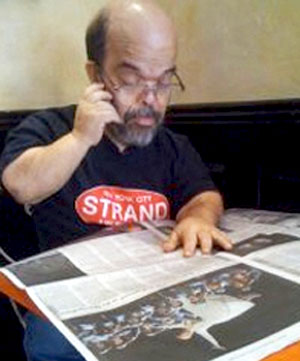
While working on this post I once again found myself Googling for an image of “Harry Wieder”; there aren’t a great number, and most of them are mixed in with a much, much larger number of images of “Prince Harry”. Our Harry would love that.

[image via pinknews]

Louise Bourgeois (1911-2010)

Bourgeois_I_do.jpg
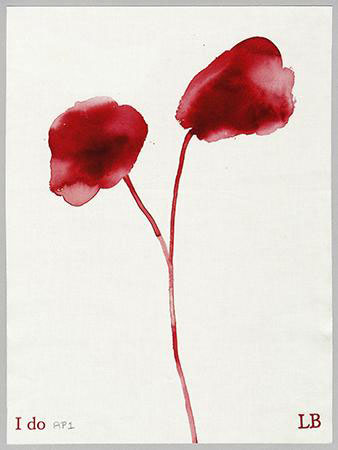
Louise Bourgeois I do 2010 archival dyes on cloth with embroidery

Louise Bourgeois died this morning. I had hoped, and fully expected to see this magnificent, (can I say ballsy?) artist, and extraordinary human being continue well into her second century, but although she almost made it, it was not to be.
Her art is likely to go on forever however; her legend had already begun years ago.
I do“, an edition of an image of two flowers joined on a single stem designed for the Freedom to Marry campaign, was to be one of her last activist contributions to the world blessed by her presence.
I think I first became aware of her generosity and her personal activism in the early 90’s when she agreed to contribute to the ACT UP Art Box (those balls again).

This site includes some wonderful images of both the artist and the artist’s work.

[image from eyeteeth]

Dominus totally gets Harry Weider, in today’s Times

Harry_Wieder_at_the_NYPL_2.jpg
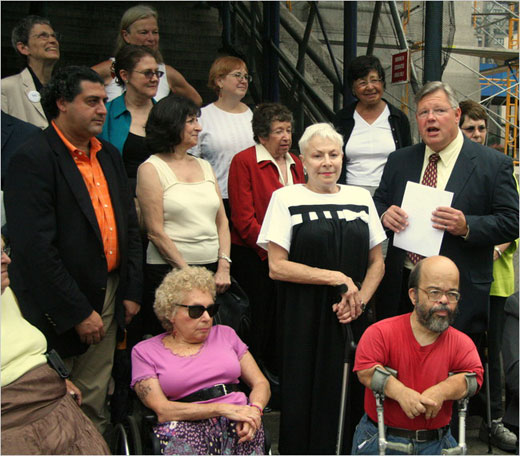
Harry Wieder, above at lower right, at a press conference calling for wheelchair access seven days a week to the James A. Farley Post Office. [Times caption]

Today’s New York Times will include this lovely, absolutely lovely piece about Harry Wieder (which the paper unfortunately burdened with a totally lame headline*) by Susan Dominus: “Remembering the Little Man Who Was a Big Voice for Causes“.

He sometimes attended seven or eight meetings in a day, even if he snored his way through one or two of them. His friends joked that he must have a clone � �but why would anyone clone someone that strange?� Mr. Wasserman [Marvin Wasserman, a longtime ally and occasional victim] said.

*
I dunno, but I think I actually prefer, “Gay dwarf activist killed by New York taxi“, the headline I saw two days ago on an Australian site.

[Michael A. Harris image from the Times site]

Harry Wieder (1953-2010)

Keith_and_Harry.jpg
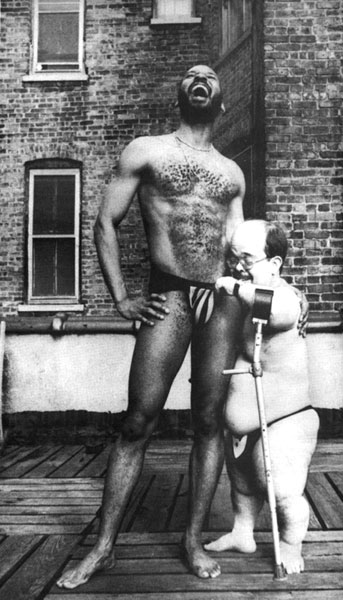
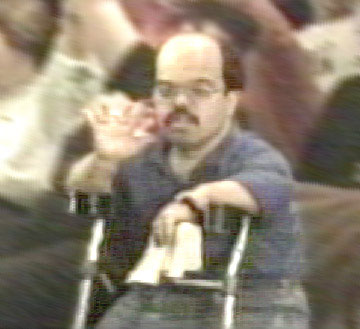
Harry was always an activist (here he is saying hello to the late Keith Cylar)

ADDENDA: I’ve now located* the original full image of the photograph I included above when I first did this entry, as well as the text which accompanied it, from a pre-summer issue of OutWeek published almost twenty years ago; this is Keith Cylar and Harry Wieder’s reply to the photographer and activist Michael Wakefields’s question about their ideal getaway:

“We would live in a world where we would then have the freedom to do more than just fantasize, where our fight to end AIDS has brought a reality, and there are countless sexual possibilities, especially for a militant sexual dwarf”

I’ve also added an image further into the entry, of Harry inside the maw of the beast, an ACT UP Monday night meeting

He described himself as a “Disabled, gay, Jewish, leftist, middle aged dwarf who ambulates with crutches”, but Harry was much more. He was the essential activist, and he was much loved.
I first met him through ACT UP, where I sat next to him at a Monday night meeting, and after that he seemed to be everywhere, especially wherever there was something to be said to power. I was deeply proud to call him a friend.
I hadn’t yet heard his own multifarious description of himself, but as I came to know better both the man and his work I watched his identity as an activist and as a man gradually enlarge in my own consciousness. Eventually I seemed to have assembled an image of all of his various hats and identities on my own, even adding “person of color” in my enthusiasm. I can’t account for that add-on. Harry might have been a bit “swarthy”, but I think it was his compassion and his natural affinity for the issues which affected blacks, or maybe there was even an ambiguous word from Harry himself. Then, only years later, when he told me where he then lived on the Lower East Side, in a home for the deaf, did I realize that his physical challenges included a hearing disability.
The news magazine OutWeek called Harry a “militant sexual dwarf” in a 1991 article which included the photo above. He’s seen peeking into the swimsuit of Keith Cylar, one of the co-founders of Housing Works. Barry remembers, “he was [certainly] aggressively flirtatious”.
We all loved him.
During all of his active life he worked to improve transportation for all so there was more than a little irony in the fact that he was struck down the night before last by a taxi on Essex Street, on the Lower East Side where he lived. It’s one of the most dangerous of the stretches which had attracted his latest traffic-control activism, virtually up to the moment of his death. He was leaving a regular meeting of Community Board 3, one of several groups which has been concerned with the neighborhood’s safety.
Board 3 will be joined by Community Board 2 at a public hearing scheduled by the NYC Department of Transportation for next Thursday on the issues of traffic and safety in the Village and the Lower East Side. Harry will certainly be a part of it.

Harry_Weider_1990_ACT_UP_meeting.jpg
Harry, waving from the front row during a 1990 ACT UP meeting [detail in a still from a video]

For more details: DNAinfo; The New York Post; Wall Street Journal (blog); the Lo-Down; Gothamist; The Edge (for starters)

*
EDIT:
When I first published this post I was unable to locate Michael Wakefield’s original, uncropped image, but Bill Dobbs located it in the OutWeek archive and pointed me to it (it’s on page 36); it now appears here at the top

[first image by Michaeld Wakefield from the OutWeek archive; the second from James Wentzy]

8th anniversary of jameswagner.com

eighth_anniversary.jpg

Today is the eighth anniversary of this blog.
I said it last year, and I’m delighted and incredibly privileged to say it again: This is also the anniversary of what turned out to be the most important event in my life, the night Barry and I met (now nineteen years ago).
Last year I also wrote, looking at the world outside our circle of close friends, that I was “more upbeat about the world” than I had been the year before, the eighth year of our second Bush, adding, “but only a bit”. That hasn’t changed, a bit.
And happy birthday, Paddy Johnson!

[the image is of a portion of the street number on the glass above one of the Art Deco entrances of the former Port Authority Commerce Building (1932), 111 Eighth Avenue the wall seen several feet behind the glass is covered with gold leaf]

Harold and Clay: bond annulled, separated, effects seized

Before_Stonewall_2.jpg
[still from the documentary, “Before Stonewall“; it is not a picture of Harold and Clay]

UPDATE: County settles with Clay out of court

ADDENDUM: This is a link to a page on the NCLR site which includes a picture of the couple and more of a background on what they had together, and what was taken from them. Note also that Harold and Clay had taken the precaution of naming each other both beneficiaries of their respective estates and agents for medical decisions, and the authorities still proceeded as if they had no personal or legal relationship.

This is the basic story: Harold Scull, 88, and Clay Greene, 77, a couple for 25 years, and living together for 20 years, were physically and permanently separated, forcibly, when Harold was injured two years ago in a home accident. Clay was not permitted to see his partner or have any say in his care. Their property was summarily seized and auctioned off to pay for Harold’s medical care and for the cost of the separate nursing homes to which the county had assigned them. Harold died a few months later and Clay was only informed of the fact days after. Neither had seen the other in the interim, and the home, possessions and virtually all property and personal mementos they shared had been disposed of by the county.

When I heard about these horrors via an email from a friend I first thought was that the account must be an invention, perhaps a cruel scam, but then, registering the integrity of my source, and seeing the story verified elsewhere, I was horrified and revolted. My stomach turned.
This is the kind of thing many might have thought could only exist as an invention, a hypothetical worse-case scenario constructed to help advance an understanding of the importance of securing the human rights of a large portion of humankind in this country, and beyond. It certainly wasn’t something that happened in a civilized society today, to people like, well, us.
So, are we really living in post-Stonewall world?
The nightmare for Harold and Clay began only two years ago, and it didn’t happen in, say, . . . Arkansas. I’m picking on that state because, for me, there the political is personal: Arkansas is where my partner Barry was born and grew up, but we refuse to visit friends and family there, for a number of reasons, many of them related to the primitive laws and customs it uses to condemn and endanger relationships like our own.
No, this story unfolded in California, and in fact in the San Francisco Bay area. Moreover, the local media, in the form of the Sonoma County, New York Times-owned paper, the Press Democrat, has refused to cover the story or the legal case being advanced by the surviving partner, Clay Greene.
It’s pretty clear that queers still aren’t safe anywhere in this country.
I’m copying here the account which appears on the site of the NCLR [National Center for Lesbian Rights]:

Greene v. County of Sonoma et al.
Clay and his partner of 20 years, Harold, lived in California. Clay and Harold made diligent efforts to protect their legal rights, and had their legal paperwork in place�wills, powers of attorney, and medical directives, all naming each other. Harold was 88 years old and in frail medical condition, but still living at home with Clay, 77, who was in good health.
One evening, Harold fell down the front steps of their home and was taken to the hospital. Based on their medical directives alone, Clay should have been consulted in Harold�s care from the first moment. Tragically, county and health care workers instead refused to allow Clay to see Harold in the hospital. The county then ultimately went one step further by isolating the couple from each other, placing the men in separate nursing homes.
Ignoring Clay�s significant role in Harold�s life, the county continued to treat Harold like he had no family and went to court seeking the power to make financial decisions on his behalf. Outrageously, the county represented to the judge that Clay was merely Harold�s �roommate.� The court denied their efforts, but did grant the county limited access to one of Harold�s bank accounts to pay for his care.
What happened next is even more chilling: without authority, without determining the value of Clay and Harold�s possessions accumulated over the course of their 20 years together or making any effort to determine which items belonged to whom, the county took everything Harold and Clay owned and auctioned off all of their belongings. Adding further insult to grave injury, the county removed Clay from his home and confined him to a nursing home against his will. The county workers then terminated Clay and Harold’s lease and surrendered the home they had shared for many years to the landlord.
Three months after he was hospitalized, Harold died in the nursing home. Because of the county�s actions, Clay missed the final months he should have had with his partner of 20 years. Compounding this tragedy, Clay has literally nothing left of the home he had shared with Harold or the life he was living up until the day that Harold fell, because he has been unable to recover any of his property. The only memento Clay has is a photo album that Harold painstakingly put together for Clay during the last three months of his life.
With the help of a dedicated and persistent court-appointed attorney, Anne Dennis of Santa Rosa, Clay was finally released from the nursing home. Ms. Dennis, along with Stephen O’Neill and Margaret Flynn of Tarkington, O’Neill, Barrack & Chong, now represent Clay in a lawsuit against the county, the auction company, and the nursing home, with technical assistance from NCLR. A trial date has been set for July 16, 2010 in the Superior Court for the County of Sonoma.
[there is a pdf link to the complaint filed in Clay Greene’s name at the bottom of the NCLR page itself]

Suggested media contacts:
Catherine Barnett, Executive Editor, The Press Democrat
Arthur Sulzberger Jr., Chairman & Publisher of the New York Times
Richard Berke, Assistant Managing Editor of the New York Times
Adam Nagourney , the chief national political correspondent for the New York Times

[image from flickr]

BHQF’s “We Like America” at Whitney 2010 Biennial

Bruce_High_Quality_We_Like_America.jpg
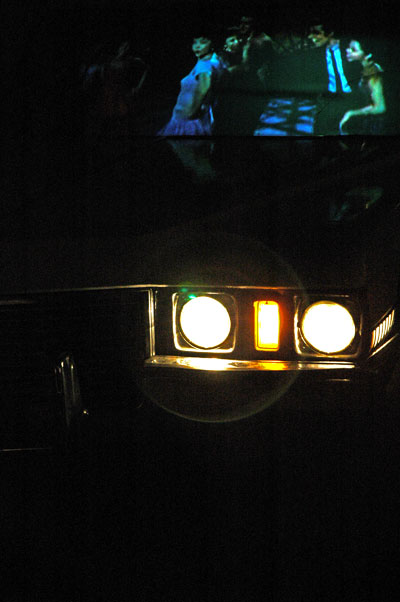
Bruce High Quality Foundation We Like America and America Likes Us 2010 vehicle and educational implements, dimensions variable [detail of installation]

ADDENDUM: [April 30, 2010] The entire sound video projected onto the inside of the windshield can be viewed here on vimeo, although as the April 20 comment at the bottom of this post (which alerted me to the link) says, it’s not quite the same isolated from the ambulance/hearse; the experience of the darkness of the installation itself, the imperfect acoustic of the space, and the murky projection, can’t really be reproduced on a computer screen.

I feel good about the Whitney 2010. While I like excitement, I resist hype like the plague. This Biennial has been accompanied by neither, which at the very least gives visitors a better chance to experience the individual works for themselves, and unencumbered with a theme. There is some very good, even awesome work on the three floors of the exhibition I saw at the preview (the floors not devoted to favorites from earlier years), but for me none of them had so fundamental an impact as the Bruce High Quality Foundation installation, “We Like America and America Likes Us”.
In “Art Class“, a 2007 piece published on Artnet, Ben Davis had described Picasso’s “Guernica” as “the most successful political image of the 20th century”. His argument was that isolated artistic gestures cannot resolve social contradictions “without any social movement backing them up to give them force”, continuing:

This does not mean that art or artists cannot play any political role; it is just that some model besides the middle-class one of “my art is my activism” is necessary, one based on concrete solidarity and practical action. Picasso�s Guernica is the most successful political image of the 20th century. Guernica, in fact, embodies the fact that art�s political value is determined in its relation with mass struggle, not in its individual content — the imagery of the painting, moving as it is, is completely drawn from a vocabulary of forms Picasso had already developed in previous work. Yet, during the Spanish Civil War, after its appearance at the Spanish Republic�s booth at the 1937 World�s Fair, Guernica was literally removed from its stretchers, rolled up and toured internationally to win support for the Republican cause. In England, visitors brought boots to send to the front.

The Bruce High Quality Foundation seems to be taking a different route with its own institutional, social and political critique, probably one more suited to our own politically-lethargic times. Bruce’s confrontations with our own tropes have been found just about everywhere: on our streets, our waters, our public plazas, even inside the galleries and expositions of the system they speak to.
I have to confess to a penchant for political art, and to a number of years spent in sort of a groupie relationship to this arts collective, and yet “We Like America and America Likes Us” is one of the most affecting works, in any genre, I’ve ever encountered. Where do we bring our allegorical boots?
We are all wounded, wrapped in felt. Are we inside an ambulance or a hearse? What is to be done?
Like much of what Bruce does, it’s not conventionally “beautiful” – except as truth is beauty, and yet the incredibly elegiac recorded remembrance of “America” which accompanies the fast video montage of heterogeneous clips projected onto the tall Cadillac windshield is riveting, and profoundly moving.
I don’t know the length of the loop (and there was no indication on the museum’s wall text); but for all I know it could be as long as the melancholy story it tells.
Especially for those who will not be able to visit the Whitney, I have some excerpts. The text, recited by a luscious, soothing female voice, begins:

We like America. And America likes us. But somehow, something keeps us from getting it together. We come to America. We leave America. We sing songs and celebrate the happenstance of our first meeting � a memory reprised often enough that now we celebrate the occasions of our remembrance more often than their first cause.

And a little later I listened as the gender pronouns slithered over each other in ecstasy, and in sorrow:

We wished we could have fallen in love with America. She was beautiful, angelic even, but it never made sense. Even rolling around on the wall-to-wall of her parents� living room with her hair in our teeth, even when our nails trenched the sweat down his back, and meeting his parents, America stayed simple somehow. He stayed an acquaintance, despite everything we shared. Just a friend. We could share anything and it would never go further than that.
No one really knows how love begins. A look on his face one time after we�d made love � a text message too soon after the last one. When did we become a thing to hold on to rather than just something to hold? We didn�t know America was in love with us until it was too late. Maybe we couldn�t have done anything about it anyway. America fell in love with the idea of us, with some fantasy of us, some fantasy of what America and us together would be, before we had a chance to tell him it could never work, we weren�t ready for a relationship, we weren�t comfortable being needed, we didn�t have the resources to be America�s dream.
It wasn�t easy letting America down. As we stuttered through our rehearsed speech we watched the change on her face. We could see the zoom lens of her attention clock away. We could feel ourselves receding back into the blur of the general population.

The last lines are:

There was a time we thought we were nothing without America. When she left, we realized all the excuses we�d been making. All the problems we�d been trying not to address. We drunk dialed our memory of America just to hear what we were thinking. We worked late and we told ourselves we had to, that the work came first, that this was an important time in our lives and that love could wait. Just wait a little longer and we�d fix everything, we�d say. Solving the America problem, our lack of attention, our disinterest in sex, our never being home, our thinking of her as a problem � it would have to wait.

Bruce_High_Quality_We_Like_America_rear.jpg
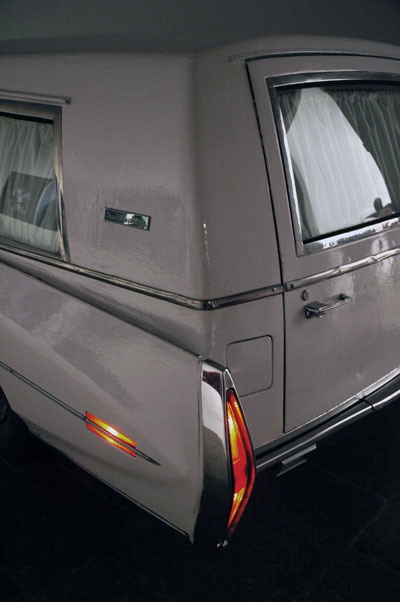
[installation view of the rear of the curtained 1972 Miller-Meteor ambulance/hearse]

[text from the audio of the installation courtesy of the artists]

an IDIOM: a conversation with Salinger’s ghosts

Salinger_Idiom_Telegraph_3.gif
just how much could it have hurt?

I know I’m one of the publishers, and so it may not be quite proper for me to sing the praises of the online arts magazine Barry and I introduced late last summer, but I’m going to risk it anyway.
Although so much else of IDIOM is just as good or even better, because of its particular timeliness and its unexpected format I wanted the conversation between some of the publication’s writers, “On the passing of J.D. Salinger“, which we published yesterday, to get more attention than it might otherwise attract.
So consider this a flag.
The spirited short piece is nothing like the fulsome academic discourse available almost everywhere this week, and you’ll feel like you’re sitting in the room with the three young participants – even contributing to the conversation. The voices you’ll hear are those of Alice Gregory, Editor Stephen Squibb and Jessica Loudis.
While you’re at the site, take a look at the latest posting, which is equally timely, “Art and Culture in Haiti after the Quake“, by Hong-An Truong, and browse through the still-modest-size archives.
My own two cents about Salinger’s “The Catcher in the Rye” is the thought which came to me almost immediately after hearing about Salinger’s death: I don’t mean to minimize the importance of what he accomplished back in 1951, but, as a gay boy the year it was written, and a gay young man when I finally read it, “Catcher” never quite resonated with me in the same way it did with others. It seems to have attached itself to the psyche of many of my approximate contemporaries, or at least the straight, male, white, middle to upper class types.
Today I’m no longer gay; I think of myself as totally queer instead, but I can remember what it was like when being gay meant dissemblance, invisibility, powerlessness, desperation and, for “practicing” Catholics, eternal damnation. I’m now more than cool with my orientation, in fact I consider it a strength in almost every way, and I’m definitely no longer totally alone with it. So maybe I should try once again to make Holden Caulfield’s acquaintance: His own much-analyzed disconnect looked pretty trifling to me at a time when the the whole world despised my, literally, unspeakable differentness and when I would have been crushed in an instant had I revealed myself.

This last thought can only serve as a footnote, and I don’t want to make too much of a purely personal irony, but I can’t help noting that, at roughly the same time I began emerging from a closet to which I had been condemned by others, J.D. Salinger shut himself up in one of his own construction. It’s his odyssey that still baffles everyone.

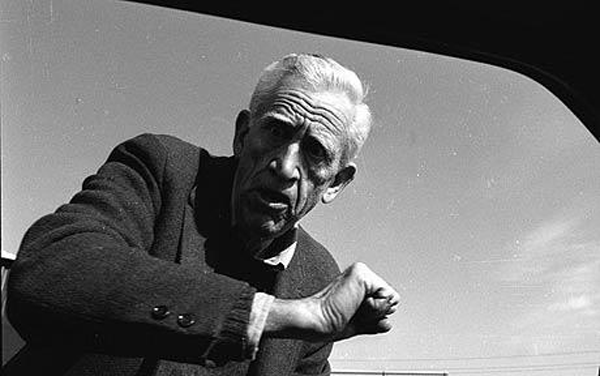
[image from the Telegraph via IDIOM]