civil rights, yes, but gay marriage be damned

Tab_Hunter_Roddy_McDowall.jpeg
no plastic grooms

This is the definition of “marriage” from the Merriam-Webster Online Dictionary:

mar�riage
Function: noun
Etymology: Middle English mariage, from Anglo-French, from marier to marry
Date: 14th century
1 a (1): the state of being united to a person of the opposite sex as husband or wife in a consensual and contractual relationship recognized by law (2): the state of being united to a person of the same sex in a relationship like that of a traditional marriage
2: an act of marrying or the rite by which the married status is effected ; especially : the wedding ceremony and attendant festivities or formalities
3: an intimate or close union

I see no religious or sacramental reference in this definition, and I am sufficiently familiar with recorded history and primordial custom to know that “marriage” has traditionally been regarded as a state independent of any and all religions.
I’m not going to jump onto anyone’s bandwagon in a quest to join my contemporary religionists and their reactionary concept of personal relationships, and if I should end up outside City Hall tomorrow (Saturday) it will be only to stand somewhere with a simple sign suggested by my friend Bill Dobbs:

CIVIL UNIONS FOR ALL

Although I’d try to add in something about civil rights for all, since not everyone is cut out for unions.
Two nights ago Dobbs sent an email around: “39 years after Stonewall the gays in New York City say GOD LOVES GAY MARRIAGE”, and he attached an image showing that on the central banner of Wednesday’s demonstration outside the Mormon Church’s New York headquarters across from Lincoln Center.
I’m just as disgusted as Bill, but I’m old enough to actually remember Stonewall and have to ask, what’s the hell’s going on here?

It seems we’re not alone on this. See “sorry, sweethearts, still fiercely disinterested in this one” from johnny i hardly knew you.

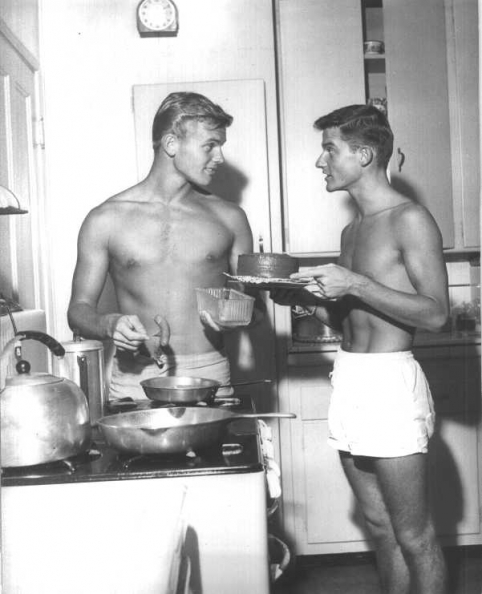
[image of Tab Hunter and Roddy McDowall from michaelprocopio]
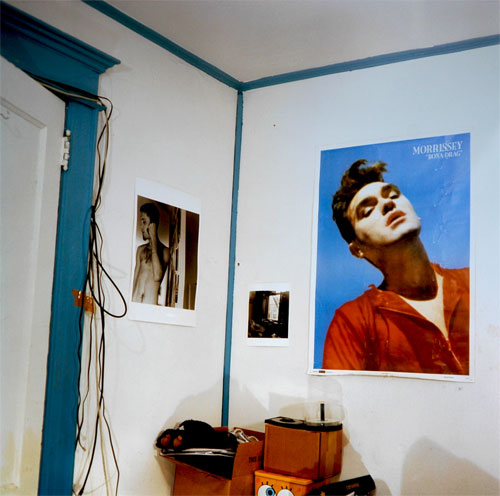
Gregg Evans and more, at the NURTUREart benefit

Gregg_Evans_Luis.jpg
Gregg Evans Luis 10/06 2007 digital C-print 16″ x 16″

Barry and I had a terrific time at the NURTUREart benefit Monday night, and we came home with the piece by Gregg Evans shown above.
Executive Director Karen Marston tells me that the staff is pleased and relieved that there was no major drop in either sales or enthusiasm this year, in spite of our current serious economic scare! She added that even if it hadn’t been a financial success she herself would have thought all the work worthwhile for its incalculable value in energizing the volunteers, the artists (including the school kids in the Outreach Program), patrons both continuing and newly-arrived, and friends who can’t live without art.
I can only say myself that the art displayed and available was very impressive, and that the room was filled with more happy and excited people – of all kinds – than I have ever seen at an arts benefit, and I’ve been to a lot.
I think the organizers are trying to arrange a way to make the works which did not walk out of the room that night visible on line and available for purchase. I know that if we had some fat in our own wallets right now the two of us would have reduced their number quite a bit further on our own. The exhibition had been selected from offerings by NURTUREart artists through the input of a curating team which included Koan Jeff-Baysa, Lowell Pettit, Amy Rosenblum Martin, and Lily Wei. Their excellent judgment was reflected in the quality of what we saw that night. If a system for the sale of the remaining works is set up, I will be reporting it here.
The picture at the top of this post?
We had purchased a ticket which entitled us to one artwork, but, since we were also on the benefit committee and had to get back to work, we had only a few seconds to make a pick from among 150 worthy pieces hanging on the walls of the James Cohan Gallery.
Quickly comparing notes when we could both take a break, Barry and I found we had each separately and immediately zoomed in on “Luis” without knowing anything about the artist or the series of work of which it is a part. It was enough that this beautiful big print suggested a mind and an aesthetic which seemed to be worth exploring further. It turns out that the image is part of body of work in which Evans investigates the home environments of a number of his friends.
I’ve searched on line for more information and I came across these two statements, on separate pages of an Arts in Bushwick preview/profile, about his work from the artist himself:

I have a friend who often talks about photographing the people he is close with as a way of maintaining relationships. I often wonder if I agree with his logic, if the power between photographer and subject creates connection or destroys it. Can one maintain a friendship with someone they are constantly observing? If, for example, I photograph the things which gather on bookshelves in a friend�s apartment is this photograph a testament to our friendship and existence, or is it really a marker of the beginning of the end? What happens to a relationship, or for that matter, a place, when it is suddenly acknowledged as important?
My work stems from day to day life; the seemingly banal objects and spaces we overlook in a given day or week, i.e. the books on one�s bookshelves or the newspapers we leave behind on the subway. I am interested in the remnants of consumer culture, archaeology, and what our products say about us.

There’s more here, on the White Columns Registry site, and there are also two books documenting his work, one carrying the weight of the painfully-disconsolate title, “I Could Walk Away Now And You Wouldn�t Care”, the other (a zine?) tagged with the more dispassionate, “The State of Upstate”.

it’s not about term limits; it’s about fake democracy

Bloomberg_RHA_term_limits.jpg
the Radical Homosexual Agenda seen in Council this morning

The real argument is about competitive elections, not term limits. Of course we’d like to think that every vote counts, but the fact is that we’ve designed a system in which money really counts; the votes are essentially just for decoration.
If we had a real system of public financing of elections there would be no argument for term limits. New Yorkers have voted twice to establish a system of term limits, a clumsy and ineffective mechanism intended to help level the playing field for candidates seeking office. It doesn’t really get us where we should be, but it’s not preferential, and it’s what we got.
While it’s not entirely about money, it’s about money. Wealth always attracts power and power attracts wealth. It’s not just ironic that the billionaire who initiated and bankrolled, to the tune of $4 million, successful term limits referendums in 1993 and 1996 now wants to overturn the results without a referendum, in order to support another billionaire: In fact it’s disgusting but it should surprise no one.
Supporters of Mayor Bloomberg’s call for the Council to negate the twice-expressed will of the voters of the city for his benefit are acting as if victory would automatically mean a third term for their candidate. Unfortunately they’re probably right. Bloomberg spent $100 million of his own money to buy and keep his first two elections; he is expected to spend another $80 million if we let him have his way with us a third time.
Supporters also argue that voters should have complete freedom to cast their ballots for whomever they wish. I agree, but it’s not going to happen if this kind of money (whether coming from individuals or very interested corporations) is always going to be there to tell us who and what is best for us. Any other other “whomever” or “whatever” will always be kept out of both sight and sound by people with more money behind them.
I’d like to think that my city is not for sale, and yet of course we know it is.
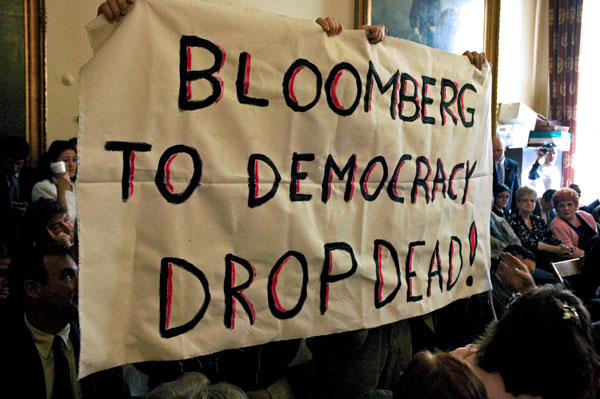
But there’s still hope, and some of it showed up at City Hall this morning. On the second day of hearings over the question of whether the Council should vote for another term for Bloomberg, the first statements were delivered by Queens Borough President Helen M. Marshall, Time Warner Chairman Richard D. Parsons, and Peter Vallone, Sr., who was Speaker of the City Council from 1986 until 2001. All three support Bloomberg, and all three spoke in his support today, but then something happened to throw a figurative wrench in their political works. I hope it might set the theme for the remainder of the day: Members of the Radical Homosexual Agenda [RHA website] got up from their seats and dropped the cloth banner shown above.

Matt Wolf’s Russell bio, “Wild Combination”, now at IFC

Arthur_Russell_photo_booth.jpg
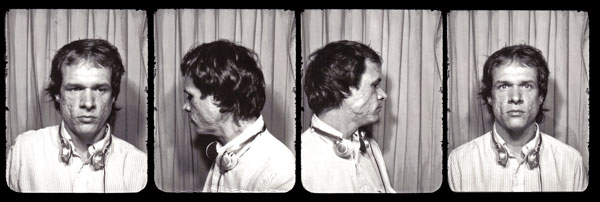
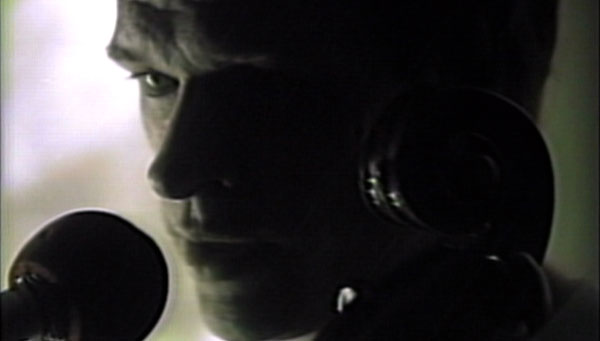
Arthur Russell (and ‘phones) in photo booth

Matt Wolf’s beautiful homage to Arthur Russell, “Wild Combination”, has been showing at the IFC Center in the West Village, the former Waverly, since September 26. It also opened at the ICA Cinema in London that day. In New York it’s currently scheduled to be shown through next Tuesday, October 7, but it might be extended, depending upon attendance. So go now.
It’s a work of art, and a great joy.
I wrote about it after seeing the preview at The Kitchen last May. There are a number on links, including a short sound widget, on my earlier post, but you probably won’t want to miss the film.

[image, credited to Audika Records, from Matt Wolf]

a guide to “Democracy in America”*

Sharon_Hayes_Revolutionary_Love_balloons.jpg
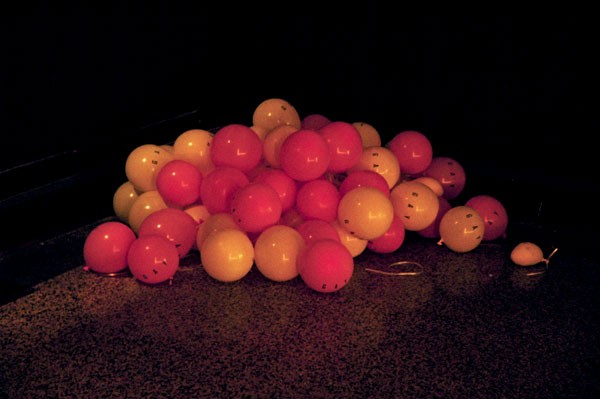
a clutch of some of the pink and yellow [g a y] balloons which accompany Sharon Hayes’s “Revolutionary Love 1 & 2: I Am Your Worst Fear, I Am Your Best Fantasy”, spotted hanging out at the bottom of a dark corner of the hall just outside the room where the sound and video piece is installed

I didn’t have time to do a full post on the show tonight, so I decided that I’d put up just one image and make a very strong recommendation that everyone who can do so make her or his way to the Park Avenue Armory tomorrow (actually that’s today, Saturday) for the last day of Creative Time’s essential contribution to the moment we’re all sharing right now, questioning the idea of “Democracy in America“.
It’s an awesome show, it’s not going to be forgotten, and you know you’re going to want to have been a part of it – especially after the news that an important and not unrelated show at the Chelsea Museum has been [summarily ?] pulled.

*
This headline is the title of the exhibition catalog, edited by its curator, Nato Thompson.

ACT UP oral history marathon

ACT_UP_NIH.jpg
we were never alone*

CORRECTION: I’ve corrected the text for screening location

ACT UP veteran Deb Levine is viewing the entire ACT UP Oral History Project videos from start to finish in a performance project she calls “ENDURING ACT UP”. She is inviting us to join her.
Levine has been working on her PhD. in Performance Studies at NYU and is writing about ACT UP for her dissertation. She says she’s focusing on one aspect in particular:

. . . how collectively people took care of each other during meetings, demonstrations, in committees and affinity groups, and especially as members became ill. I am most interested in the ways in which those relationships became an ethical and political practice – a topic that is not often foregrounded in other histories of the organization.

While she has been watching the interviews recorded by the Oral History Project, which was undertaken by Sarah Schulman and Jim Hubbard, and I assume she’s been through them all, she says that what she is missing is the opportunity to turn around and discuss what appears on the screen with others who witnessed and were a part of the phenomenon of this remarkable band of AIDS activists in the 80’s and 90’s.
The screenings began this morning at 10 at 721 Broadway on the 6th floor, room 613. They will continue through June 15. For a complete schedule and more information, go to the project’s web site.

*
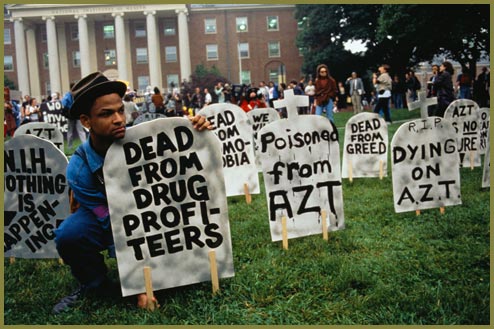
the image is from the ACT UP protest at the National Institutes of Health [NIH] in May, 1990, when we “stormed the NIH” to protest the slow pace of research; things picked up a bit later (the troublemaker seen in the foreground is Brian Keith Jackson)

[Donna Binder image from NIH library – yes, the NIH!, and the site has much more about medical activism]

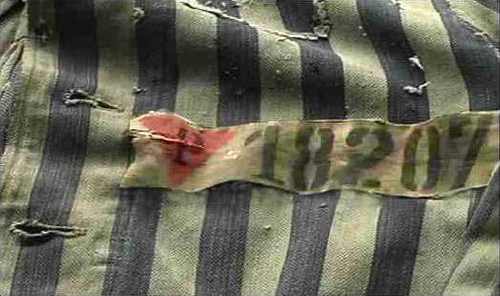
memorial to Nazi homo victims: “but no survivors”

pinktriangle.jpg
only part of the story

Berlin’s memorial to the thousands of homosexuals who were variously persecuted, tortured or murdered by the Nazi regime was dedicated yesterday. The official name of this German parliament commission, Denkmal für die im Nationalsozialismus verfolgten Homosexuellen [National Memorial for the Homosexual Victims of the Nazi Regime], may be formidable, but the structure itself is incredibly simple and ineffably moving in its sylvan setting within the Tiergarten, Berlin’s central park.
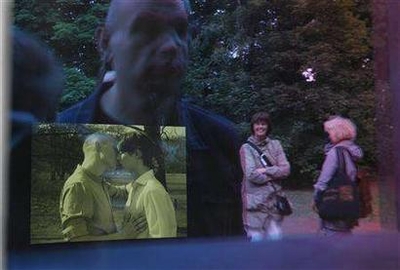
Positioned close to the iconic Reichstag Building, not far from the buried ruins of Adolf Hitler’s concrete bunker and across the street from the German capital’s very different but equally-astonishing Holocaust Memorial, the new memorial was designed by Elmgreen & Dragset, Danish-born Michael Elmgreen and Norwegian-born Ingar Dragset. The artists, who are based in Berlin, used the block shape, gray color and slight tilt of the individual steles of Peter Eisenman’s masterpiece for part of its inspiration, but a small video screen embedded in a recess on one side of this somewhat larger slab will portray a one and a half minute film loop by director Thomas Vinterberg of either two men or two women kissing. In the background of the figures in the videos, which were created before construction began, can be seen the same trees which surround the memorial as built.
Near the end of a very short article in the NYTimes today: “On hand for the unveiling was Berlin’s openly gay mayor, Klaus Wowereit, but no survivors.” The short article goes on to explain that Pierre Seel, who was the last known survivor of the camps, died in 2005.
As a queer man who first heard about this project in the mid-nineties when it was being proposed, and having now seen images of the powerful monument that these two wonderful artists have created, I’m unable to think of this work as a memorial only to the German and European victims of 1933-1945. Many homos who were not murdered but were imprisoned by the Nazis remained incarcerated in the new Germany long after the war. Homosexuality remained illegal in the Bonn Republic until 1969 and was only formally decriminalized in 1994.
Of course queers have been persecuted everywhere on the planet for thousands of years, but especially during the last few decades some societies have managed to grow up. They now recognize and protect the rights of all their members, while nowhere in the Western world do queer men, women and children remain more abused today, both by law and society, than they do in the U.S.
Berlin’s newest monument can be a memorial to all homos hunted in the past. Let it also be a foil for those who would hunt us still.

Berlin_homo_victims_monument.jpg
the protective glass in front of the video screen reflects viewers and surroundings

Note, and more: As the ambient landscaping is still immature, I haven’t included an image here of the structure or “pavilion” in its environment. This link to the memorial’s own site [currently in German only, but with a pretty exhaustive list of links in many languages]; and there’s an AP video below, recorded on the grounds of the memorial during grounds cleanup, with a short statement from the artists:


[image at the top from andrejkoymasky; image of memorial’s screen by Johannes Eisele from Reuters via Yahoo!]

Rauschenberg was gay? How was anyone to know?

rauschenberg_bed.jpg
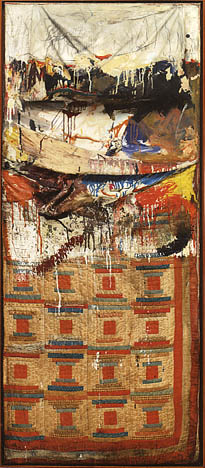
Robert Rauschenberg Bed 1955 mixed mediums 75″ x 32″ x 8″

Yes, the great man was queer. I had thought I made it pretty clear in my own post on March 14, but today I note that Tyler Green’s Modern Art Notes has gone and shoved it down the prissy throats of both members of the “regular” media and the art world’s own sophisticated pundits. Almost all of them seem not to have ever noticed, or, much more likely, were convinced it was too shameful a condition with which they could risk frightening the horses – or asses.
Green’s post, “Hetero-normalizing Robert Rauschenberg”, is totally on target, and bursting with links to his references and sources (there’s even a link to his links on the subject).
Bravo, Tyler!

[image from MoMA]

Matt Wolf’s Arthur Russell bio: “Wild Combination”

Arthur_Russell_Matt_Wolf_08.jpg
Matt_Wolf_turntable_07.jpg
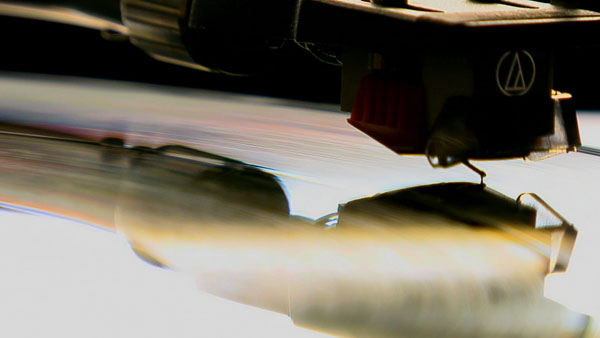
two stills from “Wild Combination”

I saw the New York premier of Matt Wolf‘s first feature-length film, “Wild Combination“, at the Kitchen last night. It’s an amazing documentary on the life and music of Arthur Russell, the innovative downtown musical composer/performer who just couldn’t stand still and wouldn’t be pinned down, even for his own visions of his art.
Unable to be really understood by most of his contemporaries, perhaps partly because of his own inadequacy with conventional communication, Russel’s cross-cultural and cross-disciplinary music never had a large audience, before his early death from AIDS complications in 1992. But twenty years later his music sounds as modern as today – or tomorrow. It now appears to be moving from an honored place in the memory of his fans and collaborators (and on thousands of reels on dusty storage locker shelves) into something like cult status among a new generation of listeners and artists which, like Russell, routinely ignores the false separation of genres and thrives on the offspring of musical cross-fertilization.
Wolf, an artist and filmmaker barely in his mid-twenties now, began his career in 2002 with “Golden Gums”. It was the first in a series of three relatively short experimental films, the others being “Smalltown Boys” in 2003 and “I Feel Love” in 2004. Their subjects were, in order, the young auteur’s own plaster dental cast offered to boyfriend as love token, a young teenage girl who seems to be the daughter of David Wojnarowicz, and the strange story of Andrew Cunanan’s hotel maid’s sudden celebrity. Only after “Wild Combination” could I imagine that each of these might be its own unique and perverse twist of the traditional documentary form. I’m not sure however if I might be able to read this into the filmmaker’s history only because his latest creation is clearly a documentary. But it’s certainly much more; it’s an imposing accomplishment and an exceptionally beautiful film in which one artist’s demonstrated imagination and fancy is directed toward showing the compelling musical beauty created by another.
But it doesn’t really matter, since all of these works do very well standing on their own. I only know for sure that I’ll be looking forward to wherever Wolf decides to go next.
“Wild Combination” will be screened elsewhere in New York later this year.
The Kitchen has organized a tribute to the music of Arthur Russell this weekend with performances tonight and tomorrow. The blurb on Time Out New York‘s site includes this on the performances:

On records such as 1986’s World of Echo and the posthumous Another Thought, Russell married joyous pop to muted, inward reflection. But this “Buddhist bubblegum” (much of which has been reissued this decade by Audika) will make up just a fraction of this three-day program, which also offers a rare chance to hear his large ensemble instrumental pieces played live. On Friday, Russell colleague Bill Ruyle conducts “Tower of Meaning,” a minimalist work for brass and strings. Saturday will find Ruyle, trombonist Peter Zummo and bassist Ernie Brooks participating in “The Singing Tractors,” an ensemble trance work that incorporates improvisation.

Here’s an Amazon widget which will let you sample some of his music:


More:

John Schaefer’s WNYC Soundcheck program interview with Matt Wolf
Sascha Frere-Jones writing about Russell in The New Yorker in 2004
Andy Beta’s piece on Wolf’s film in the current The Village Voice
Audika Records Arthur Russell catalog
Amazon’s Arthur Russell listings
Schedule of festival screenings

[images, the first from “Terrace of Unintelligibility” by Phil Niblock, courtesy of Audika Records, are both stills from the film and courtesy of Matt Wolf]

Bob Rauschenberg

bobjap2_2.jpg
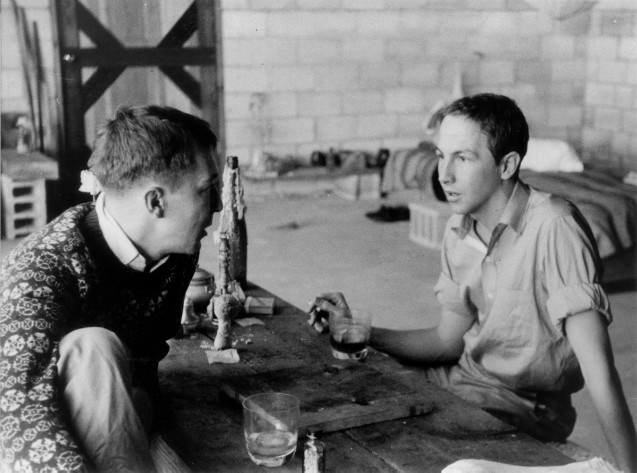
Jasper Johns and Robert Rauschenberg (1954)

Hot.
I couldn’t think of anything I might be able to add to the encomiums which have followed Monday’s announcement of the death of Robert Rauschenberg. Then this morning I saw and read the NYTimes obituary in the print edition. While growing up, and even for many years later, I remember seeing pictures of a beautiful young man whose work was more than capable of shaking up a post-war art world already conditioned to, maybe even bored by change. the Times, like too many other media sources in the last few days, showed us only pictures of an older artist, and many photographs I’ve been seeing portrayed a Rauschenberg weakened and partially paralyzed by a stroke.
Although he remained handsome and productive all his life, it was in the early years of his career that he produced most of the innovations for which he is now known and revered. I thought that we should all be able to see now what the strong, vital artist who changed so much of the world we inhabit today looked like while the revolution was underway. He was once very young and almost painfully beautiful, but he was never old.
The photograph here is of the artist relaxing in a studio with Jasper Johns. It was taken probably in the late 50s, the period in which they lived together downtown in various lofts around Coenties Slip and Pearl Street (the neighborhood of my own first New York home 25 years later). It’s interesting, although not surprising, that in his long obituary for Rauschenberg published in today’s Times print edition Michael Kimmelman describes their personal ties in “genteel” terms more familiar to readers of fifty years ago than to us today:

The intimacy of their relationship over the next years, a consuming subject for later biographers and historians, coincided with the production by the two of them of some of the most groundbreaking works of postwar art.

For a little more candor, see Jonathan Katz.

Related:

Rauschenberg
“bobrauschenbergamerica” in tears
Paul Lee at Audiello
Lawrence Weiner at Pocket Utopia

UPDATE: Shortly after I did this post I found this wonderful early image on Newsday‘s site:
Rauschenberg_Newsday.jpg
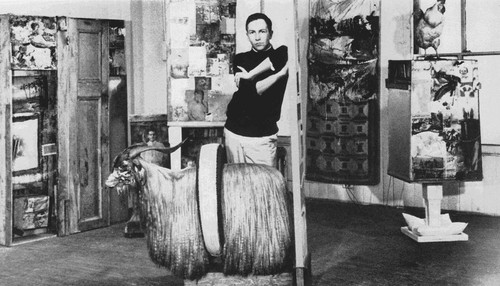
Robert Rauschenberg in his New York studio in 1958

[top image, a photograph by Rachel Rosenthal, from mettaartlove; added image from Newsday]