Vincent Gagliostro with Margaret Thatcher at Pulse

Gagliostro_Reagan.jpg
Gagliostro_youth_window_2.jpg
Gagliostro_torso_BW.jpg
Gagliostro_youth.jpg
Gagliostro_chat_room.jpg
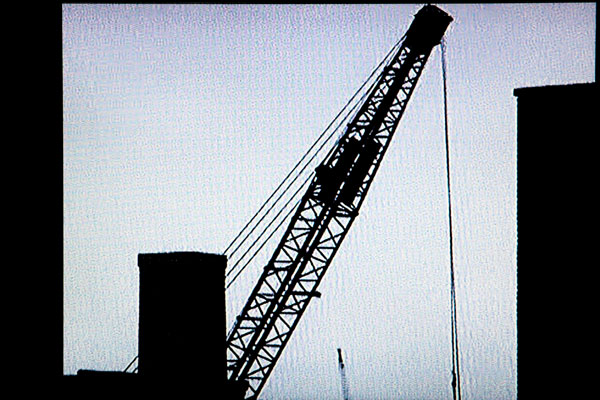
Gagliostro_crane.jpg
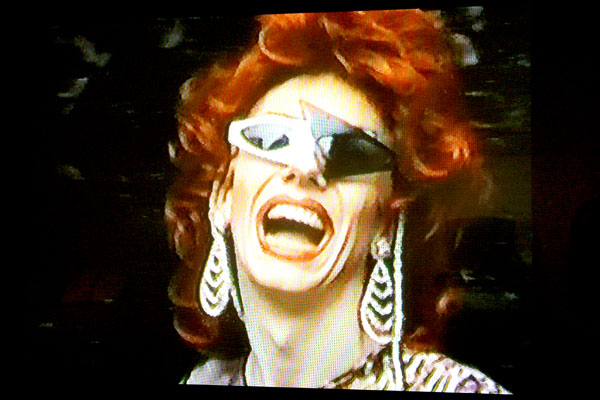
Vincent Gagliostro After Louie, an excerpt video [stills, and large details of stills, from installation]

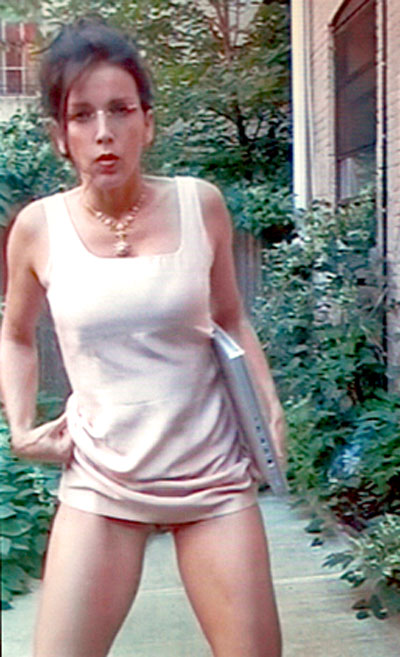
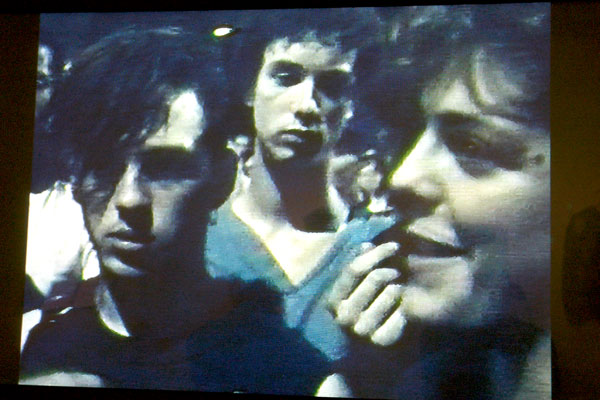
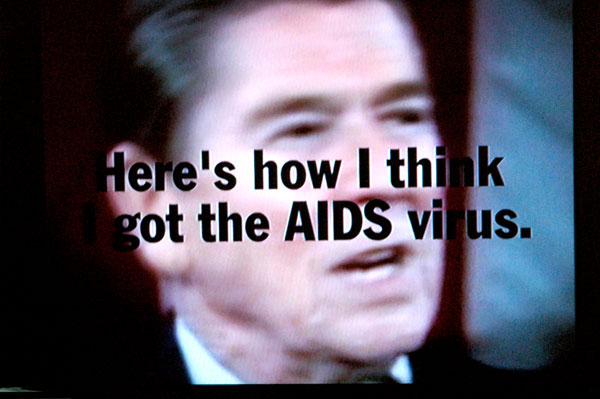
Margaret Thatcher showed a video by Vincent Gagliostro at Pulse. I’d like to describe it as an art trailer for a full-length film not yet produced, but even in its current form it’s certainly a complete work of art. There’s not a single ugly or unnecessary frame in this piece. I snapped only five images while standing in front of the video screen last month; five images appear here.
Gagliostro describes the work as:

. . . a political love story set against the backdrop of a time when the gay movement mattered, when lovers were not looking for their rights within mainstream structures and when activism existed in its rightful home: the streets.

The artist is a friend and an activist colleague of mine.
Although I’m also no stranger to the world which inspired Gagliostro in creating this film, I prefer to let the gallery press release set the scene with the help of the director’s own input:

“After Louie” hits you like a time bomb . . . was there really ever a New York like that where adventure and discovery and sexual tension were still palpable and possible on the skinny island of Manhattan? Was there a meatpacking district before Pastis? When you watch Gagliostro’s video, you actually remember, for a moment, the streets and the clubs and the boys with nice abs.
In the visual and audio collage of Gagliostro’s piece you recall that New York City from the not-so-distant end of the last century like it was yesterday. You remember it all not with nostalgia, but, quoting Gagliostro, “with relief that this New York actually existed and actually happened before it was too late; that despite the tragedy and loss and pain of that era there was still the nourishment of real off-line experience and the comforts of heart and sex and art and strangers and bodies and life, and soul growth before everything was already discovered, developed, trained, tracked, exploited, done, over.”

There’s a clip of the video here, on the artist’s very beautiful site.

to hell and back with Ratzinger

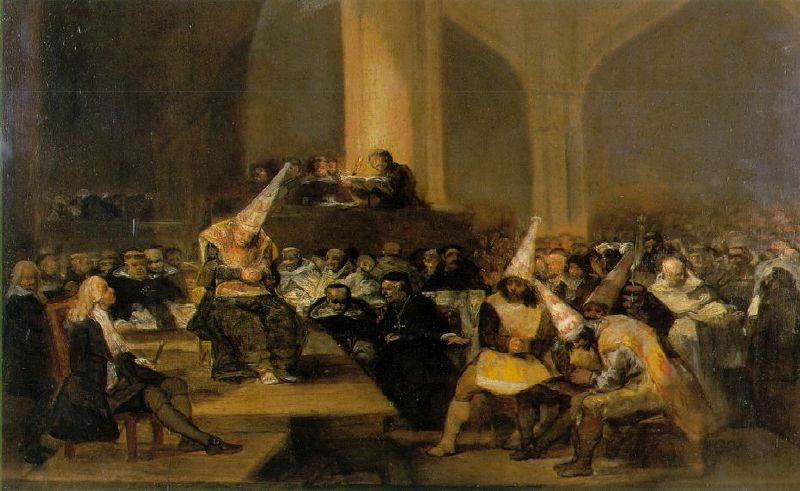
goya_inquisition.jpg
Goya Inquisition Scene (1816) oil on panel 18″ x 28.75″ [three notes: beginning in the Middle Ages the Church had prescribed the conical hat, generally yellow, as a distinguishing mark for Jews; Jewish conversos were the principal concern of the Spanish Inquisition; from 1981 until 2005 Josef Ratzinger was head of the Vatican department formerly known as the Inquisition]

I just did a search from this site, and I see that there are already two pages listing my various posts on Josef Ratzinger. I was hoping he’d be dead before I’d have to do another or, even better, irretrievably compromised by some spectacular scandal. I really didn’t want to have to think about this man again, and I certainly wasn’t going to display another picture of that freaky face*. Virtually everything he stands for disgusts me.
Okay, except maybe the part about “peace”, but I know he doesn’t actually mean it and, like the Dalai Lama, he’s certainly not going to embarrass our own “infernal” warrior king while he’s over here. By the way, I also don’t anyone believe a word he says about freedom or democracy. I was raised a Catholic, educated by Augustinians and Jesuits and studied history as an undergraduate and graduate student for ten years. I can assure you that the Church establishment has never cared what form governments assume so long as church interests aren’t compromised. [cf. Eugenio Pacelli and Reichskonkordat]
Also this week, don’t expect any homilies on capital punishment from Ratzinger, who we are repeatedly reminded has a boundless respect for life. Might hurt the sensibilities of the former “Texecutionor”.
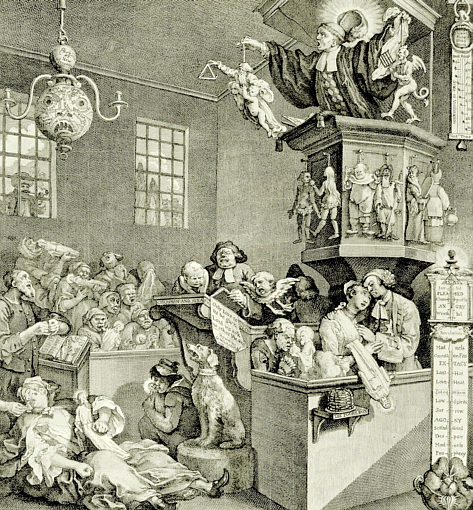
But the holy fiend is coming to New York again, and although both he and his office are increasingly irrelevant, apparently even to most Catholics, I just can’t maintain my blackout on the latest Ratzinger developments. I was struck by something I saw in the joint statement he and his D.C. host just issued. George Bush. Now there’s another pathetic excuse for an appointed ruler (so who’s using whom on this visit?). It seems they both wanted us to know how much they respect human rights and diversity. I’m used to these lies from the White House but I just couldn’t ignore it coming from our sanctimonious short-term visitor, since he’s never ignored me or many of my friends, or anyone else whose integrity and rights he regularly impugns. I’m talking about all queers and all women, just for starters, but you can certainly add anyone not of the strictest, doctrinally-acceptable religious persuasion (that is, his own).
There is one incident in particular in Ratzinger’s past, one which I cannot forget, one which was never disavowed. It’s a statment which continues to reflect this narrow, clueless disciplinarian’s real approach to the diversity of mankind rather than the “respect for his vast pluralistic society”, he affected yesterday in Washington. In 1992, during a period of particularly virulent antigay violence in the U.S., he authorized a Vatican proclamation which said that that when lesbians and gay men demand civil rights, “neither the Church nor society should be surprised when … irrational and violent reactions increase”.
Perfectly consistent with the Church’s traditional mode of addressing its own evils: Blame the victim.
Still we bleed, queers of every gender and our straight sisters as well, not least because of his vile ministry.
Josef Ratzinger arrives in New York on Friday. I’m sincerely hoping that at least some New Yorkers will know how to receive him properly.

*
although I’m not the first to notice that, on the other hand, his devoted personal secretary is pretty damn hot, even if this is way off subject (maybe)

[image from marxist.com]

ADDENDUM: [in the form of an appendix] For the complete text of a document describing queers as a “troubling moral and social phenomenon” and denying them a status from which they might argue for their rights, see the letter, “Considerations Regarding Proposals to Give Legal Recognition to Unions Between Homosexual Persons” on this Vatican site. This is a document which Ratzinger had authored, as head of Roman curia office once known as the Holy Inquisition. It was published by his old boss Karol Wojtyła in 2003.

play in your own yards, and leave Spitzer alone

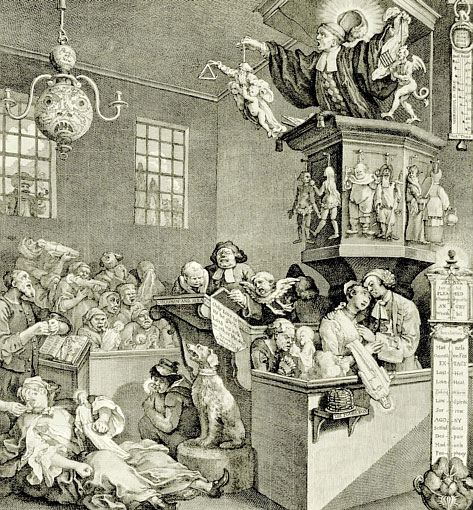
Hogarth_enthusiasm_delineated.jpg
William Hogarth Enthusiasm Delineated 1761

This is stupid, if not just evil. No, I’m not talking about Eliot Spitzer. Let him deal with his family; it’s not our concern. People are screaming at the Governor about his marital infidelity and announcing or calling for the end of his career. Meanwhile, George Bush’s murder count in Iraq, already in the hundreds of thousands, continues to mount and no one will pull the plug or talk about impeachment.
I simply don’t care what kind of sex the people I vote for engage in, just as I insist that they not care about my own – or yours either. Murder and other high crimes I care about.

[image from payer.de via fortunecity]

“Out of the Box” at Elga Wimmer

Hatry_Heide_Adaptations_start.jpg
Heide Hatry Expectations 2007 [still from video]

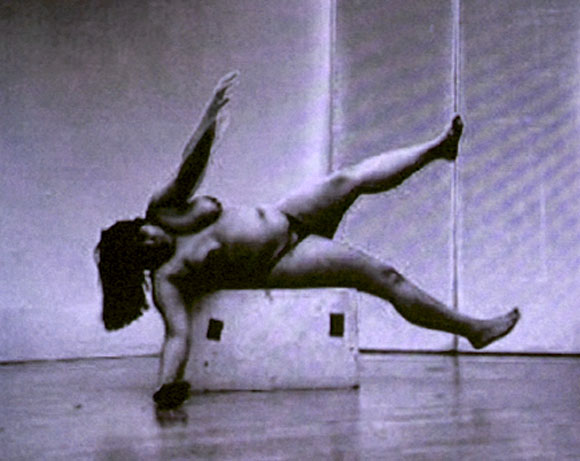
sonia_khurana_Bird_on_side.jpg
Sonia Khurana Bird 2000 [still from silent, b&w video]

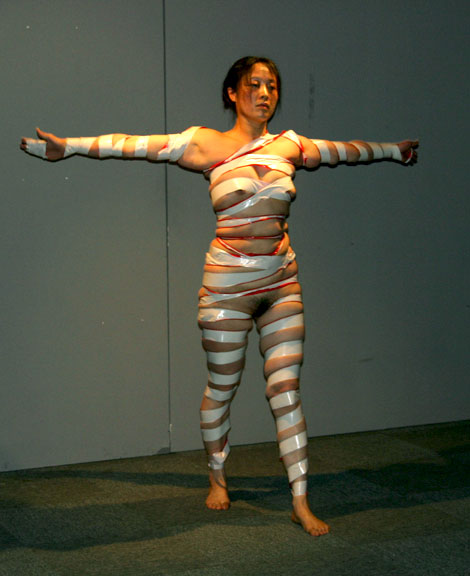
He_Chengyao_Broadcast_Exercise_arms_stretch.jpg
He Chengyao Broadcast Exercise 2004 [still from video]

I’d always felt very much an outsider when it came to art by women which might involve an assertive sexuality,. I confess this failing or inadequacy in spite of my natural inclination to welcome and embrace the unconventional or the anomalous – in art or almost anything else. Yes, I’m a guy, but while my neuroses may be those of a male, they are those of a queer male. Should that make it easier or more difficult to reach across the barrier? Could the circumstances of my pre-1960’s dating experiences (dissembling in order to survive, but fearing any intimacy with women since it might call for performance) have allowed a healthy relationship to women’s bodies even with the best will? Intimacy with a body matters, and heterosexuals and bisexuals may always get a head start in understanding gender – if not sex.
Whatever the answers, I humbly admit that the show currently installed at Elga Wimmer, of performance art influenced by Carolee Schneemann and other trailblazers, was a major breakthrough for me. “Out of the Box” was curated by Wimmer and Heide Hatry. I had wanted to visit the show because of my long experience with Wimmer’s excellent program, because of my interest in anything related to Schnnemann, and because I was interested in Sonia Khurana, one of the artists. The exhibition, of both video and still images, is a small miracle, “small” only because of the physical limitations of the gallery’s size. The artists are Regina José Galindo, Heide Hatry, Sonia Khurana, Carolee Schneemann, He Chengyao and Minette Vari. This small group includes women who began working in Latin America, Europe, Asia, North America, China and Africa, and it represents living artists of all ages.
They work with in very different materials and they communicate very different things, but all of the is courageous and tight; the art is breathtaking and ravishing; the statements are both incredibly intimate and extraordinarily public.

ADDENDUM:
See a subsequent post for more on the works themselves.

[images from Heide Hatry]

Clayton Patterson at Kinz, Tillou + Feigen

Patterson_Clayton_video_1.jpg
Patterson_Clayton_video_2.jpg
Patterson_Clayton_video_3.jpg
Patterson_Clayton_video_4.jpg
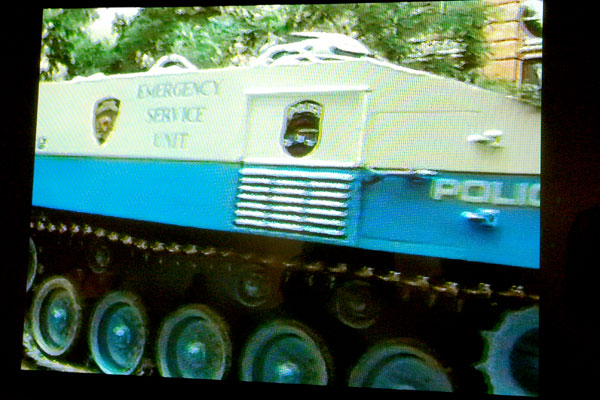
[four stills from the video installation of the film, “Captured”]

How do you write about a chronicler with a soul? How do you write about a bard with a camera? We can’t begin to understand the importance of people like this until they are gone. Maybe it has to wait until we are gone as well, but in the meantime we can give it a try.
I’d have to see this show, “The Lower East Side“, for its historical and political importance, even if the photographs didn’t have their own beauty. And they do.
Clayton Patterson (okay, it’s already the legendary Clayton Patterson) is currently represented by some of his sculpture, a tiny sampling of his enormous archive of photographs, and an excerpt from a documentary video in a show at Kinz, Tillou + Feigen, a gallery whose heritage, through Richard L. Feigen and Feigen Contemporary is itself pretty legendary.
The sculptures assembled from found materials are documents themselves, setting the entire installation in a specific time and space. The photographs are intense portraits, both candid and posed, of the Lower East Side community stretching from the early 80’s to the present. To anyone who did not know this city before the mid-90’s, or who might be unfamiliar with the neighborhood now, many will look like they must have been invented. In fact they are all perfectly true, and astonishingly intimate.
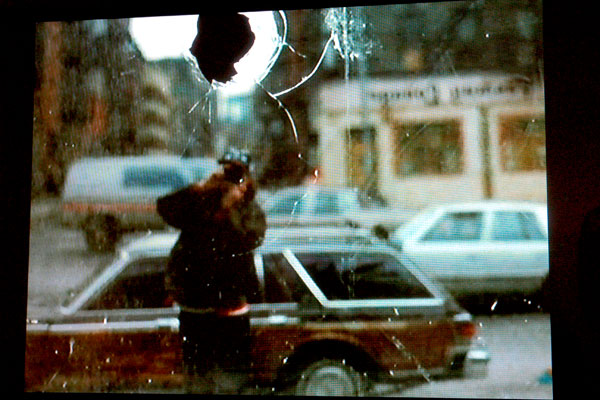
The same must be said of a film, “Captured”, shown on a television monitor in the smaller space. Its subject is Patterson and the neighborhood he calls home and which he has looked after for almost three decades. It was put together by Dan Levin, Ben Solomon and Jenner Furst, largely using Patterson’s own footage, and excerpts are being played in the gallery through the duration of the show. Patterson’s photographs can be seen on the gallery site. Here I’m only showing stills from the film, except for this one image:

Patterson_Clayton_%28grunge%20girl%29.jpg
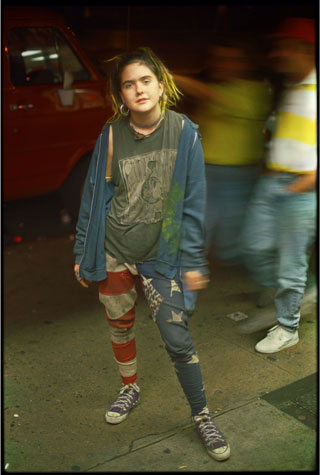
Clayton Patterson Untitled (grunge girl) 1992/2007 C-print

By the way, if you’re very young, on the street, and want to have a distinctive style, wouldn’t it make sense to find your own? That’s why I was struck by the resemblance between this 1992 “Grunge Girl” captured by Patterson, and this 2002 “Billy”, who was part of Bradley McCallum and Jacqueline Tarry’s show at Marvelli gallery three years ago (the couple is now represented by Caren Golden).

[image at the bottom from ktfgallery]

Dame Ethel Smyth’s “The Wreckers”

Smyth_Dame_Ethel_Sargent.jpg
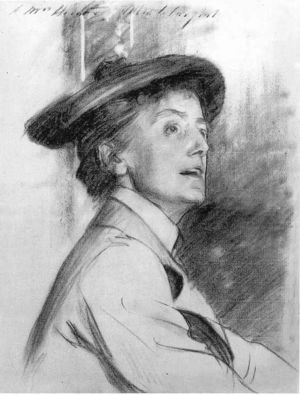
John Singer Sargent Ethel Smyth 1901 pastel

If this hundred-year-old opera had always enjoyed the success it deserves today I’d probably be whining about the endless parade of productions of La Boheme, Aida, La Traviata, Carmen and The Wreckers. As it turned out, for reasons I now find inexplicable, the last of the works I just named never made it. Dame Ethel Smyth‘s wonderful opera had in fact never been performed anywhere in the Western Hemisphere until last Sunday afternoon.
Barry and I are huge fans of Leon Botstein’s programs with the American Symphony Orchestra. For us it’s about “new music”, but surprise! Here the pleasures of unfamiliar musical genius arrive via a well-prepared trip backward in time. The Orchestra’s mission under Botstein’s direction is more usually described as the resurrection of large-scale symphonic or operatic works from the previous two centuries, music which has been neglected, presumably unjustly. The audience may not always agree, but it’s never left without help in mustering its response: In advance of each concert the music director supplies absolutely vital and articulate notes on the works themselves, as well as the context of their original creation and subsequent neglect.
All of this explains why I’ve been a subscriber since 1991, when Botstein began his current tenure as music director and principal conductor. So we would have been in Avery Fisher Hall on Sunday regardless of what the program was, but this one promised to be a particular treat.
“The Wreckers” was composed by a privileged and educated fierce Victorian English lesbian suffragette who was once imprisoned for her activism but otherwise lived and worked in friendship with some of the European cultural giants of her age. The opera’s theme, perhaps more topical in 2007 than at the time of its composition (1903-04), is the horrors of which a provincial, fanatically-religious, self-regarding community is capable. Botstein’s essay in the program notes suggested that it’s the first worthy opera written by a Brit in almost two hundred years. Of course I was interested.
Reviewing the afternoon’s performance and the opera itself for the NYTimes Bernard Holland seems to have been almost as enthusiastic as I was, about both the performance and the opera itself, and he appears to agree its oblivion was a big mistake:

“The Wreckers” gets your attention. It charges at the audience with all guns blazing, and tramples the weak and the hesitant in its path with a story of pillaged ships and triangular loves.
Smyth (1858-1944) was determined to fill as big a physical and emotional space as eight singers and a big chorus and orchestra could manage. Everyone onstage seemed to rage with Ethel Smyth fever, pouring out nonstop fervor in one relentless fortissimo after another.
. . . .
“The Wreckers” is not aimless cannon fire; Smyth knew what she was doing. Her orchestra makes winds whistle, waves roll and crash, and fog creep over the rocks in dark minor chords. From the land we hear hornpipes and sea chanteys in the distance. All the elements of a complete oceanography are present and rationally arranged.

But while I thought the work was a real keeper, and I’m dying to see it fully-staged, Holland, apparently viewing it only from the vantage of the succeeding one hundred years (a considerable advantage over poor Smyth) ends a very enthusiastic review of the merits of the piece itself with a bizarre non sequitur:

Does “The Wreckers” get a third chance? At some point, I am sure. It is not a deathless work, and too much exposure might do it more harm than good. Too much value is put on permanence anyway. “Disposable” is not a dirty word. People got their money’s worth on Sunday and should perhaps let “The Wreckers” go back to sleep.

Only in the American world of opera world is the word “deathless” always confined to the teeny list which begins with La Boheme, Aida, La Traviata and Carmen.

For more information about Smyth and her opera, see the American Symphony Orchestra’s site, and click onto links for the two essays at the bottom, under “Dialogues & Extensions”.
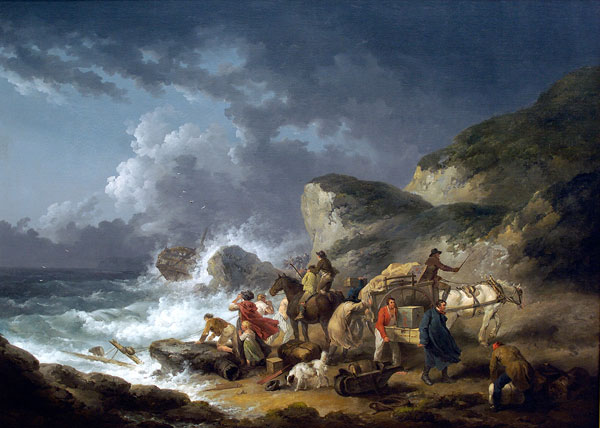
The image below, a late-eighteenth-century painting by George Morland, describes a somewhat brighter version of the dark setting of Smyth’s opera.
Morland_George_Wreckers.jpg
George Morland The Wreckers 1790-1799

[first image from de.wikipedia; second image from the National Gallery of Canada via sandstead]

the “war on terror” has reduced us to slaves

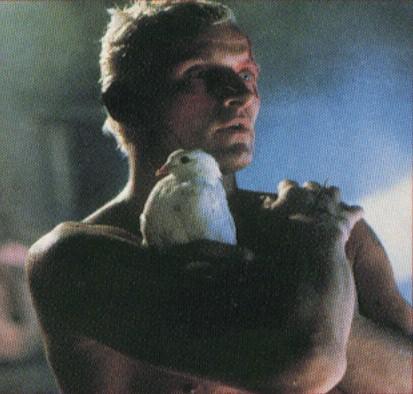
Batty_Roy_dove.jpg
Roy Batty‘s epiphany

Last night I spent far too much time worrying about how to express the depth of my broader frustration and despair before posting the latest version of my regular fulminations over Guantanamo. I should have waited until this morning, when I opened Newsday, and read John Anderson’s review of the “Blade Runner: The Final Cut”.
Anderson ends his report on what is billed as the director Ridley Scott’s definitive version of the dark 1982 classic with this:

One of the its more chilling moments foreshadows our current climate with a kind of clairvoyance.
“Quite an experience to live in fear,” says Rutger Hauer’s rampaging Replicant, for whom we have no small amount of sympathy. “That’s what it’s like to be a slave.” Here, “Blade Runner” not only foreshadows a post-industrial world, but seems to critique the post-9/11 world as well.

[image from cogeco]

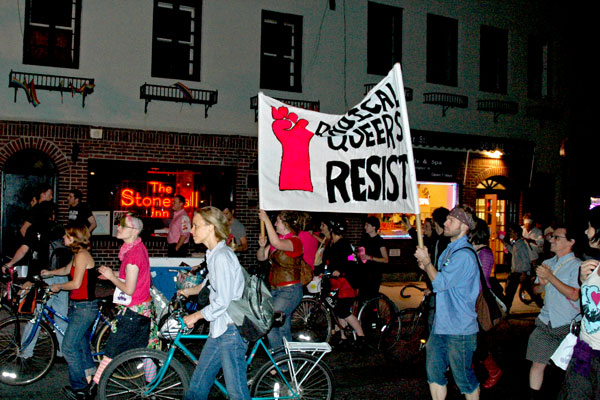
PWOP 2: last night’s second “Parade Without A Permit”

PWOP2_2_drummers.jpg
drum corps section
PWOP2_vanguard.jpg
the vanguard
PWOP2_Stonewall_2.jpg
past the Stonewall site
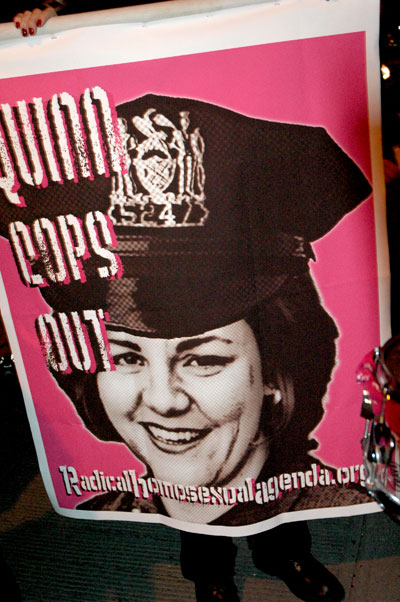
PWOP2_Quinn_cops_out.jpg
the campaign theme
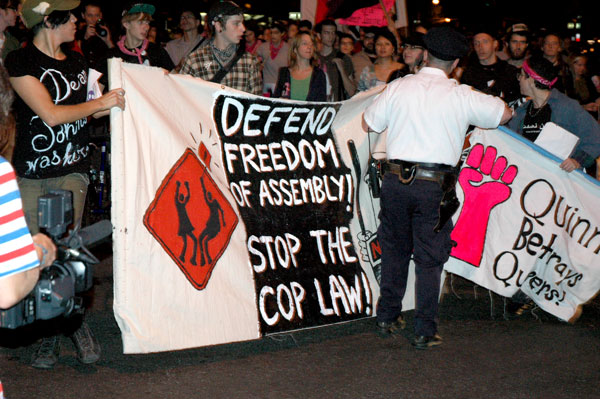
PWOP2_altercation.jpg
not as bad as it looks
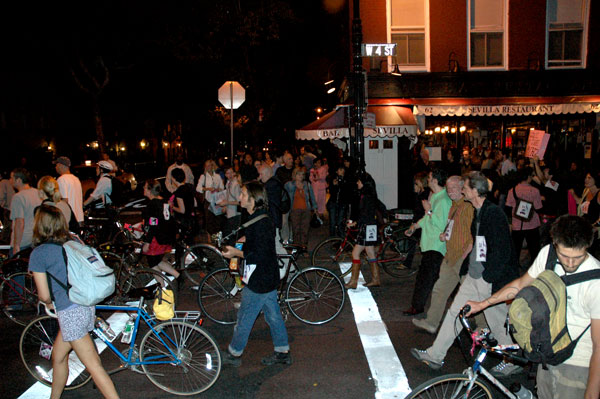
PWOP2_spectators_W_4th.jpg
the curious gather on the sidewalks

We’re saying the First Amendment isn’t just for the homos.
It was a fabulous party. First, it was safe (no assaults and no arrests), but it was really fun, it was beautiful, it broadcast the issue, and on top of another event earlier this week, it looks like that issue now has real momentum.
Last night’s Parade Without A Permit, put together by The Radical Homosexual Agenda [RHA] and its allies, was the second in what is likely to be a continuing series.
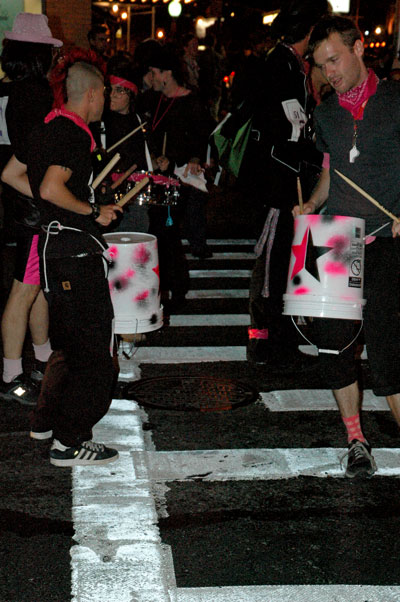
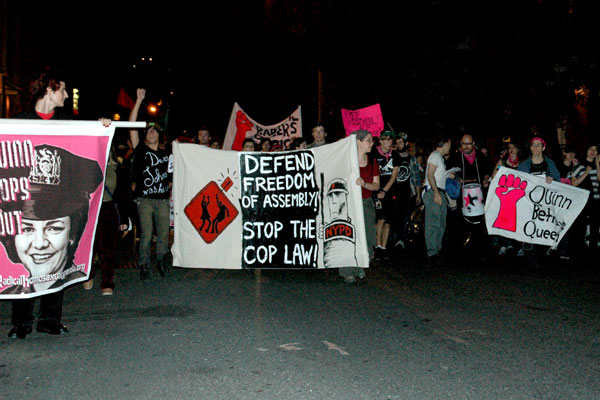
Progressing through streets filled with surprised and delighted diners and party goers enjoying the warm evening air of a Saturday in autumn, somewhere between 150 and 200 colorful and energetic activists broadcast the word about City Council Speaker Christine Quinn’s support of new NYPD rules restricting free assembly. The group started inside Washington Square Park, accompanied by signs and outrunners with informative pink paper flyers and led by banners and a snappy percussion section. The party wound its way through the West Village, Quinn’s own district, for more than two and a half hours before dispersing from Pier 45 at Christopher Street.
Surprisingly the “unpermitted” assembly, was neither broken up nor even seriously provoked by the police. In fact the few uniformed people visible last night performed the kind of martial duties which groups like ACT UP have historically assigned to themselves, halting vehicle traffic for the protest’s passage across streets and then, most remarkable of all, letting it take most of the width of Eighth Avenue all the way to 15th Street. At that point the parade turned left and then left again to head back into the Village. The police disappeared at about the same time.
Did the NYPD get the word from Quinn’s office to see that nothing untoward would happen to the queers and their friends, or was the Department’s low-key handling of the event just part of its historical and notorious pattern of arbitrary enforcement of the law? Also, “good cop” one day, “bad cop” the next, was something we experienced throughout the years of ACT UP’s biggest actions. You never knew when you were safe, and you don’t today, especially if no one is watching.
One of the most striking images of the evening was presented early on, when the ragtag (I mean that in the very best sense) procession passed the site of Stonewall Inn, where the modern homosexual movement began.
The pictures above and on Flickr and on other sites show the diversity of the protesters, in age, gender, sexuality, race and mobility, one of the most satisfactory elements of a evening of empowerment.
Not only is the First Amendment, and freedom from an arbitrary police force in general, not just for homos, these rights must not be secured only for a queer elite and “decent citizens” of other descriptions. Reflecting today on what was accomplished last night, Andy Podell, a member of RHA, warns:

We have used our position as relatively-privileged queer activists to advocate for freedom of assembly and against police harrassement of queers and activists. At some point our rallying cry of last night, “We don’t need a permit”, becomes a little easy and self-indulgent. We don’t need a permit because at this time a city councilperson doesn’t want to fuck with us because we’re queer and have connections and it would be bad publicity for her.
Like the well-connected SRLP [Silvia Rivera Law Project], the intervention of Quinn in getting the charges dropped against Wed’s night’s arrestees does not mean that the NYPD will stop harrassing trans people or people of color or queers. I’d like to see the RHA up the ante in connecting with people who get picked on by Quinn or the NYPD outside of the eye of the queer media (it might not even be queers).

It’s probably just a (very minor) fantasy of my own, and it will probably stay that way, but for the next parade I’d love to see a pink and black fife player added to the excellent drum corps: For me it’s the original Revolution image, but this second one might just be led by queers – of every description.

I’ve put more images of the evening on Flickr.
apparently Sylvia Rivera still scares the cops

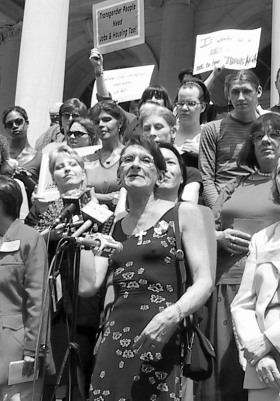
SylviaRivera.jpg
Sylvia at New York City Hall, with the community she helped create, in an undated photo

“Hell hath no fury like a drag queen scorned” [Sylvia Rivera, 1995].

At the Sylvia Rivera Law Project’s after-party following its fifth anniversary celebration and fundraising event Wednesday night, two members of the community were violently arrested and others were pepper sprayed by police without warning or cause.
I’m betting the cops were frightened.
The Project, named for the fierce and indomitable queer and trans rights pioneer, provides free legal services, advocacy and other support for low-income people of color who are transgender, gender non-conforming, or intersex. For details on the incident and continuing updates, see the SLRP site.
When will the savagery stop? How long will we have to put up with this stupidity and this thuggery?
Especially in a city as dynamic and sophisticated as this one is, no one should have to fear assault and arrest by the police simply because of who she or he may be.
I don’t expect most members of the NYPD to understand New York, since their ranks are drawn from a fairly-narrow pool of communities, each of which tends to fear the heterogeneity and eccentricities which are the lifeblood of this metropolis, and because increasingly neither officers nor their bosses even live inside the city they patrol and monitor.
Incidentally, in spite of what some people may think and say, including officials who should know better, the police are not supposed to “control” us or our “situations”. The police are public servants, entrusted and paid to keep us safe, not to tell us what we may or may not do.
I cannot imagine why sad stories like this one, and especially the even more dramatic and deadly episodes of police violence which litter our recent history, would not be an incredible embarrassment to the force itself, to the politicians to whom its leaders must report, and ultimately to every New Yorker. Who is responsible for making the NYPD look so damn stupid? Do they want us to be like Los Angeles, a city with a police force better known for its ruthlessness than for its skills?
There’s no way to assign the precise proportions of the blame various people share for the continuing shame of this Police Department, but our mayors, commissioners and chiefs, and at least one council member and speaker, would all have long rap sheets if we were to try for a real accounting.
But each time there’s another incident of brutality I think about how little we actually pay the police we send into the streets. I’m not suggesting we reward incompetence, unnecessary violence or arbitrary enforcement more generously, but rather that we should generate greater competence, more appropriate physical restraint and responsible enforcement by attracting better people with better pay, and then training and educating them better. With as many billionaires as we harbor in these boroughs we can certainly afford a truly professional force, at every level.
Also, this isn’t about throwing money at NYPD executives. It hasn’t served the officers on the beat or the citizens who rely on them to have those who occupy the top desk jobs in the Department routinely negotiate the terms of their own compensation at the expense of rookies and the lower ranks.
It’s probably unreasonable to hope that anything might change in the hottest real estate markets in the city, but can I at least dream that a pay scale proportionate to a demand for real professionalism (and appropriate to the extraordinary physical risks) might mean that most of our neighborhoods at least could be watched over by officers who actually live in those neighborhoods – and who wouldn’t be parking their SUVs and Pickups on our sidewalks?

[some of the points made above originated with Barry in a conversation today; image from Miami Dade College]

RHA asks Speaker Quinn about 1st Amendment, police rules

Quinn_Stonewall_Democrats.jpg
the RHA visits Speaker Quinn at the Stonewall Democratic Club open meeting

Yesterday the junta in Burma invoked a colonial-era section of the nation’s criminal code under which the government can use police or military force against any group of people who have not been granted a permit to assemble. The rule’s threshold is any assembly of more than five. Burma and the world is once again witness to the open violence with which undemocratic authority will inevitably try to maintain itself. At this hour fourteen people are known to have been killed by soldiers and police.
Back in New York people are starting to make connections. Tim Doody is a member of the Radical Homosexual Agenda [RHA] and a constituent of Council Member Christine Quinn, who this year promulgated a New York City rule making illegal any “unpermitted” assembly of 50 or more people. Responding to news of Burma’s emergency proclamation restricting citizen assembly, or what most of the media is referring to as Burma’s “curfew”, today Doody asked,

Does Speaker Quinn really believe the difference between a junta and a democracy is 45 people?

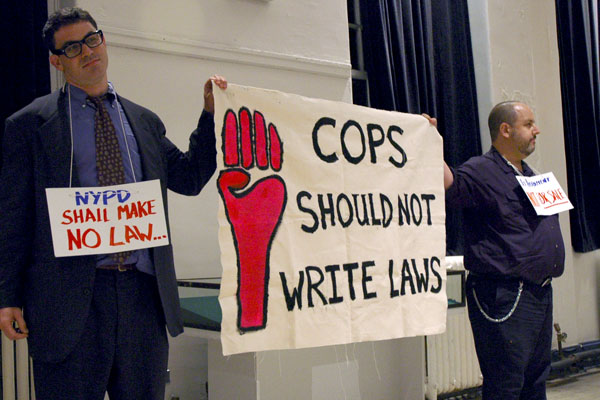
Last night members of the RHA attended an open meeting of the Stonewall Democratic Club, held in the LGBT Community Center, where Speaker Quinn had been asked to speak. The RHA held up two banners on the sides of the room calling attention to the First Amendment issue of arbitrarily-formulated Parade Rules which will inevitably be arbitrarily enforced. When the Q&A session was closed, and the host had not called on anyone who might have asked the Club’s distinguished visitor about the elephant in the room, one of the guests who was not a member of the RHA asked that the question be solicited, adding that it would reflect very badly on the people in the room if the signs displayed so prominently went unexplained.
Quinn now graciously sought out a raised hand and the question came from the floor, ‘Would you explain to the constituency in this room your support of and your role in the promulgation of the unconstitutional, so-called Police ‘Parade Rules’?”
There was nothing new or revealing in her response, and I myself still honestly have no idea why she got herself into a law-and-order posture so contrary to anything she ever stood for. Her argument remains rather circular and her logic vague or obsfucatory, but in this venue there was no way to carry on a discussion or venture an appeal to reason, something thus far lacking in her defense of the police rules.
She never lost her composure and she even offered to “come back here [the Stonewall Democratic Club or the LGBT Center?] any time” to specifically discuss the issue. There were two real surprises, I think, each possibly suggesting a chink in the blue wall to which she seems to have attached herself. One was the fact that at least twice she said that the assembly rules were “an ongoing conversation”, and the other was an interesting throwaway line something to the effect, “If in the future legislation is produced . . . .”, suggesting that the Council might still get involved in the issue and hold open public hearings, as it surely ought to.
In the meantime the conversation will continue on the only stage the powerless have available to them: that constructed on free assembly and speech. On Saturday at 7 o’clock, a second “Parade Without A Permit”, a joyous party celebrating those fundamental rights, will assemble at the fountain in Washington Square Park and progress through the West Village, the streets of the Speaker’s own district.

[the small sign on the right reads, “1st Amendment not for sale”]