
This t-shirt was designed by the legendary activist artist collective Gran Fury 17 years ago.
Today South Africa has national health care.
A lot of people still think they can do something to help drag our own country into the [twentieth] century. Some of them know they have to ACT UP to get there. But activists also know how to party, and sometimes a little cash is needed to help make a stink, so ACT UP is throwing a $20 celebration/benefit bash this evening, and everyone is welcome.
The doors of Manhattan’s LGBT Center at 208 West 13th Street (just west of 7th Avenue) will open at 7 pm. The program will start at 8 or 8:30 and will feature readings/performances by Pulitzer-prize winning author Michael Cunningham, the notorious Church Ladies for Choice, Mark Hannay (formerly of the Hot Peaches), and fabulous downtown performance artist Penny Arcade. The evening ends with a dance party that goes until midnight.
[image via ACT UP]
Category: Queer
ACT UP renewed, and transformed

across from the Stock Exchange yesterday
If yesterday’s ACT UP twentieth-anniversary action demonstrated anything, it was the coalition’s own renewal, and its transformation from an AIDS activist group once largely made up of young middle-class queer white males into one devoted to the this country’s larger, evolving healthcare crisis and composed of a much broader community of people who have realized we are all directly affected by both AIDS and a medical system completely inadequate to address it or other health needs.
In New York yesterday every age group and every community in this hugely-diverse city appeared to be represented in the crowd which gathered in and around the Wall Street area. They hurled chants at a powerful corporate medical, insurance and political establishment, reached out in conversations to regular passersby, they brandished both printed and hand-lettered signs addressing an aloof, fortress-minded establishment, and they carried or dragged with them some 50 bulky black body-bag props as they wound through the narrow downtown streets in a band of roughly a thousand souls. At the site of the bull statue near Bowling Green some 30 people were arrested for civil disobedience while lying down in the street amongst those bags.
The NYTimes did not consider the event worthy of a single word or image. See See Andy Humm in Gay City News for the best account of the day.
The new ACT UP appears determined to be only the nucleus [or perhaps, this still being ACT UP, really only the trigger] for re-igniting an enormous popular movement, coinciding with the run-up to the 2008 election, directed toward finally securing this nation’s adoption of a single-payer healthcare system after something like one hundred years of broken dreams and promises.
What follows are a few scenes from the struggle as renewed just yesterday.

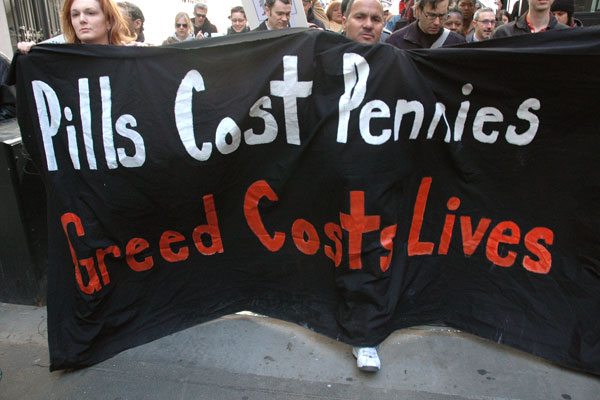
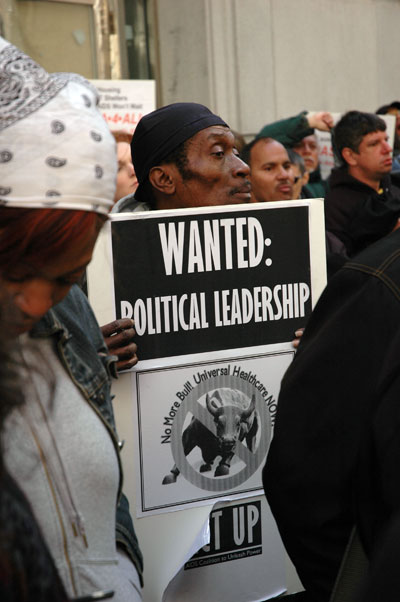


ACT UP back to the Wall, this time for single-payer healthcare
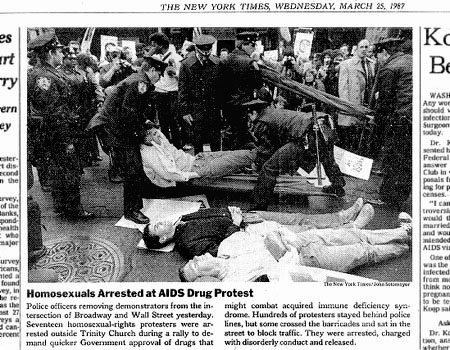
going back for more, 20 years later
Apparently as a nation we can accept throwing away something like half a trillion dollars (and counting), and very likely some 700,000 lives, on a remote elective war whose only accomplishment was a second term for the regime of the biggest Big Brother we’ve ever had, but we [or at least our media and our elected representatives] still think a single-payer healthcare system means handing over too much power to government.
ACT UP has always supported a single-payer health care system, and its members have always understood the role of war in thwarting its achievement. Tomorrow morning, Thursday, at 11:30 this remarkable and unfortunately still indispensable activist group of stalwarts will be marching on and in Wall Street to mark its twentieth anniversary and the beginning of its campaign to make access to healthcare for all, including single-payer insurance and drug price controls, a major issue throughout the 2008 election campaigns.
Anyone who is able to make it is welcome to join us as we gather for the march at 11 am. We will be stepping off from the Federal Building downtown, on the east side of Broadway at Worth Street, just above Chambers Street.
Twenty years on, the press will no longer be labelling us all “homosexuals”, as did the NYTimes in its coverage of the first action, shown in the image above, although it was exactly that powerful picture and its caption which sucked me into the group. As far as tomorrow is concerned, while it should be assumed that only those who have decided to commit some form of civil disobedience could be arrested, there is less certainty about that than there ever was in our present terrifying, and terror-stuck, political climate.
I’m bringing my camera, for surveillance purposes.
An editorial in the current issue of The Nation is an excellent tribute* to the historic accomplishment of ACT UP and a reminder that neither the role nor the actors have yet disappeared. Excerpting the last three paragraphs of the editorial:
During the years that followed, ACT UP stormed the National Institutes of Health, the FDA and the Centers for Disease Control to protest their shortcomings. On the local level, Catholic dioceses and boards of education were targeted for blocking HIV information in public schools; city governments for failing to provide care and housing; jails and prisons for setting up segregation units. Some ACT UPers set up guerrilla needle-exchange programs; others staked out the entrances to junior highs to distribute condoms directly to students. Just as essentially, ACT UP members became self-taught experts in such arcane fields as virology and patent law and in so doing rewrote the patient-doctor relationship and helped put the idea of universal healthcare–now favored by a majority of Americans–on the political map.
Along the way, ACT UP borrowed strategies from other radical movements: antinuke protesters for techniques on civil disobedience, antiapartheid campaigners for bringing political funerals to the streets. Many of its tactics–videotaping demonstrations as protection against police brutality, coordinated but autonomous affinity group actions–have become standard fare in the global justice movement, as has ACT UP’s deeply democratic tradition.
ACT UP is now a shadow of its former self, but its alums have gone on to found Health Gap, a driving force for global treatment access; the Treatment Action Group, which continues to push the AIDS research agenda; and Housing Works, which has won housing for thousands of New York City’s HIV-positive homeless. And true to form, the organization will mark its twentieth anniversary with a march on Wall Street March 29 to demand single-payer healthcare for all.
*
including a candid apology for the progressive journal’s own historic neglect: “Though barely noticed in the pages of this publication, ACT UP would revolutionize AIDS research and treatment, as well as inject new life into the gay movement and infuse the tactic of direct action with its own style of theatrical militancy.”
[image from actupny]
ADAA in the Park Avenue Armory

Jim Hodges what’s left 1992 white brass chain with clothing, dimensions variable [large detail of installation]
The Art Show of the Art Dealers’s of America Association [ADAA] hosted a press reception early this afternoon in the Park Avenue Armory. I hadn’t personally expected it to be the most exciting of the eight or more shows being held in Manhattan this week, if only because its concentration was definitely not on emerging art, but as it turned out, I was pretty impressed with the quality of the (mostly twentieth-century American) work displayed. Although it was all available for purchase by enthusiasts with deep pockets, for us lesser mortals it was like a good trip to a good museum, or perhaps 70 museums. I didn’t even mind that because it’s a collection of separate (and disparate) individual shops there isn’t a hint of the kind of organization which would be expected in a museum or even a regular gallery show. This “armory show” has more than a little bit of the charm of a very good flea market, and I mean that in a good way.
Most of the exhibitors looked like they were just showing off their stuff rather than their curatorial restraint, but a few should be congratuated for presenting a concept rather than a catalog, and some should be praised for refusing to hold back on more edgy work just because of the spiffy profile of the event.
CRG Gallery gets laurels for its intelligence and courage on both scores. The Chelsea gallery showed only one artist, Jim Hodges, and a very limited number of his works, and each of them related to a form of vigorous, transgressive sexuality which is still able to frighten the horses.
Of the other booths, some of my favorites, in a quick run-through and in no particular order, were those of Knoedler & Company (New York), Rhona Hoffman Gallery (Chicago), Peter Freeman (New York), Matthew Marks (New York), Adler & Conkright Fine Art (New York), Brooke Alexander (New York), Barbara Krakow (Boston), and Andrea Rosen Gallery (New York).
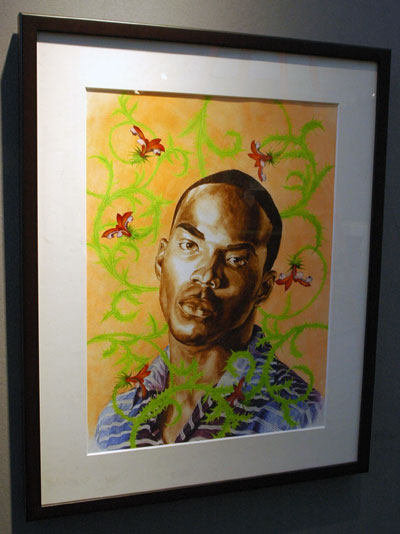
Kehinde Wiley Keyon II (study) 2002 oil wash on paper 30″ x 23″ paper size [installation view] {Rhona Hoffman}
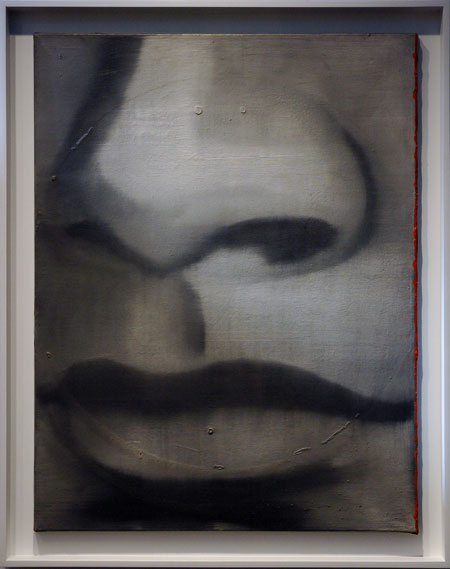
Gerhard Richter Nase [Nose] 1962 oil on canvas 30.75″ x 23.5″ {Peter Freeman}

Ellsworth Kelly Orange Curve I 1982 64″ x 150″ [installation view] {Matthew Marks}
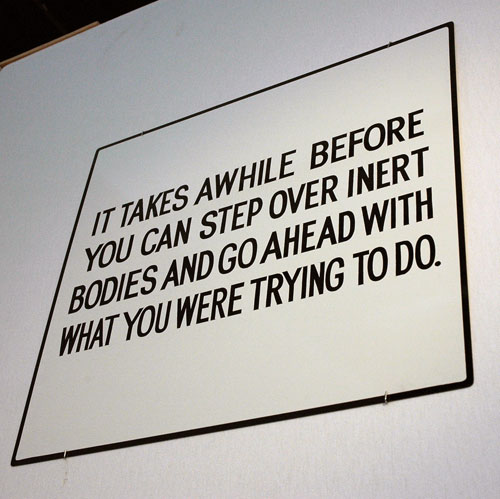
Jenny Holzer FROM THE LIVING SERIES: IT TAKES AWHILE 1981-1982 enamel on metal 21″ x 23″ [installation view] {Barbara Krakow}
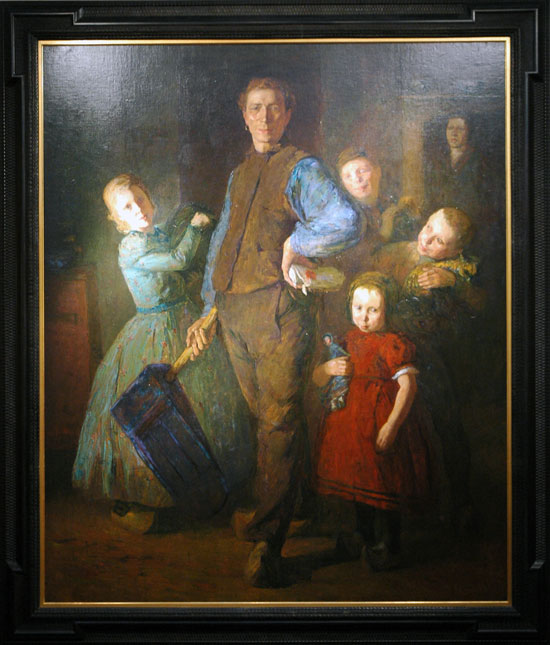
Joseph Raphael The Town Crier and his Family 1905 78″ x 66″ {Montgomery Gallery (San Francisco)}

[detail]
See Bloggy for more.
Homeless Museum at home to guests this Sunday

Filip Noterdaeme THE NEWEST� 2006 model (plexiglass, LED screens, figurines, remote-controlled robotic system) [installation view]*
The Homeless Museum (affectionately referred to as HoMu by both adoring fans and its own creators) will be welcoming visitors once again this Sunday. I don’t think anyone could describe this incredible institution as well as the creators themselves do on the museum’s website, and I’m certainly not going to try:
A product of New York City’s cultural decline, the Homeless Museum (HoMu) is a budget-and-staff-free, unaccredited arts organization that enables and engages cultural dialogue practiced at the intersection of the arts and homelessness.
Originally established mostly as a concept, two years ago the museum found a home in the fifth-floor walkup the founder shares with his partner Daniel Isengart. Once a month they open their doors to guests by invitation. Visitors are encouraged to email (info@homelessmuseum.org) or call (718-522-5683).
The NYTimes has found out about it and last month Dan Shaw wrote an excellent account of its mission and its work. The Believer has an extended article by Samantha Topol in the December/January issue.
I highly recommend a visit to the museum. Barry and I were there several weeks ago and we were charmed by the wit and sincerity of our hosts and delighted with the museum experience. We had first encountered what I’ll call the creative humanism of Filip Noterdaeme’s projects two years ago when we read about his campaign to shame the Museum of Modern Art (called MoMa by both supporters and critics, with little warmth from either) for its introduction of a compulsory $20 admission charge. Noterdaeme encouraged and inspired visitors to pay the entire amount in pennies, making it necessary for the museum to place buckets beside the station of each ticket clerk.
The admission at HoMu itself is determined on the basis weight (1�/lb.), cash only. The Times article describes its membership policy:
The museum raises money for the homeless with a twist on the usual cultural memberships. ”We encourage visitors to become members,” Mr. Isengart said. ”We tell them they can choose from any levels, from $5 to $125, and that they must give the money to a homeless person of their choice directly. We do it this way so that 100 percent of their donation goes to the homeless.”

Filip Noterdaeme Spoon, 1/8 Iroquios drawing
“Spoon, 1/8 Iroquios” is in the museum’s collection. It is part of a series which represents a kind of empathetic curating concern absent from any museum of my experience. From the HoMu website:
The One-on-One Collection is a deeply felt and authentic engagement with the grim and stultifying lives of countless homeless adults who yearn for love, but instead must settle for broken dreams, abuse, and danger.
What began as a fascination with the sex lives of homeless men and how they fulfill their sexual desires has inspired this collection of body prints that are reminiscent in style of Yves Klein’s Anthropometries. Paintings on paper made by the imprint of naked bodies previously drenched in “Homeless Orange” provide a range of erotic connotations, addressing taboos such as homelessness, public sex, and homosexuality. For example, in “Spoon, 1/8 Iroquois”, two silhouettes suggest a hurried sexual encounter between two men.
What’s the tie-in between HoMu’s championing of the homeless and its critique of the museum? I think it lies in a profound awareness of the contrast between the outlandish sums of money and attention devoted to the increasingly-elaborate (and increasingly-inaccessible) temples in which we house the high-end items branded as our official cultural idols, and an incredibly wealthy society’s neglect or spurning of its own most-forsaken things and people, including its own material detritus but above all the homeless, the outsider, and the uncompromised artist. Noterdaeme and Isengart bring it all home with their phenomenal mix of minimalist panache and compassion.
The open house is Sunday from 1 to 6, on Clinton Street in Brooklyn Heights.
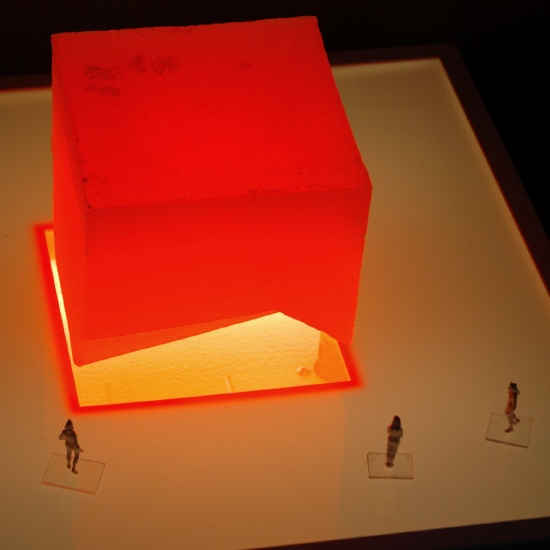
Filip Noterdaeme ISM (The Incredible Shrinking Museum) 2004-2006 model (glycerin soap) [installation view]*
*
descriptions of the two works shown in model form above, adapted from material furnished by the artist:
“The Newest�” presents itself as a new contemporary art museum. Viewed from the front, it appears to be a building that is inundated by visitors whose silhouettes can be seen moving about behind its see-through fa�ade, outfitted with several slogan-flashing LED screens. But a look behind the scene reveals the effect to be a choreographed deception: The Newest� is not a building but an oversized stage-set simulating a building front. The visitors turn out to be dummies circulating on conveyor belts and rotating platforms. The machinery is controlled from a computer operated by a single person, the museum director.
“ISM (The Incredible Shrinking Museum)” is a project for an interactive museum consisting of a sixteen-foot cube of glycerin soap. The cube is subject to constant change through exposure to the elements. In addition, visitors will be invited to exploit the structure like a mine until is it is used up, the goal being to reach out to a new audience and challenge visitors to think about their role as active participants in the shaping and destruction of culture through direct participation in the realization and, ultimately, the deconstruction of a museum.
[image of “Spoon” from HoMu]
Abbé Pierre, the excessive priest

“holy anger”
Abbé Pierre died yesterday. If there is such a thing as a “saint”, this man clearly deserved the title, but he will never be canonized by the Church. Too excessive.
He wrote that as a young priest, he had sex with a woman, and further infuriated Roman Catholic authorities by advocating gay marriage.
Even Jeanne d’Arc, who finally made saint after waiting 600 years, had never talked that kind of nonsense.
This and (almost) everything else in this remarkable NYTimes obituary of a 20th-century St. Francis almost reads like pure invention; it describes the perfect French or even universal hero of the poor, the homeless, the disenfranchised. And there’s recycling in there too!
ADDENDUM: In doing a little searching I’ve just discovered that l’Abbé was a good friend of this dangerous man.
[image of Jacques Nadeau from Le Devoir]
Marsden Hartley’s “Cleophas and His Own”
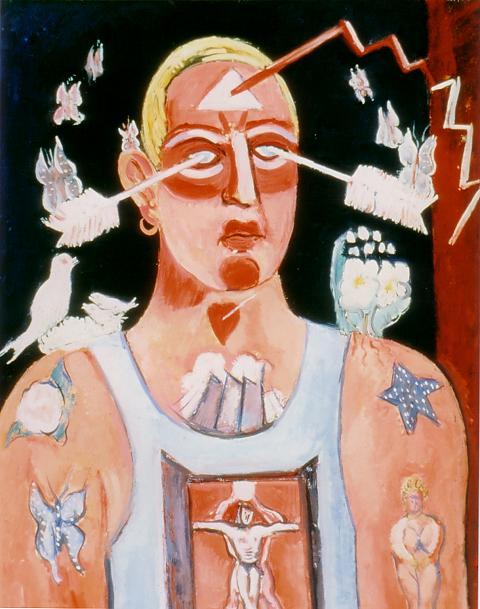
Marsden Hartely Sustained Comedy 1939 oil on academy board 28.5″ x 22″
Marsden Hartley’s vigorous expressionist art is clearly a part of today’s world more than it was while he lived, and the man himself is today less a mystery* to the world than he was, perhaps even to his friends, while he was still alive. At the same time the largely pre-industrial world where, very late in his life, his painting flourished so robustly, and where we now know his capacity for love was generously requited, disappeared long ago, even in quiet coastal pockets populated by communities of honest and loving fishers.

In the film, “Cleophas and His Own”, Michael Maglaras plays Marsden Hartley while sitting inside a reconstruction of Hartley’s 1943 studio
We try to experience the shape and the feel of lost worlds through our imagination and our art, and sometimes our success will seem to rival the actual experience of the dead. The filmmaker Michael Meglarus has resurrected Hartley’s stay in isolated communities in Maine and Nova Scotia during the last seven or eight years of his life in his poetic film, “Cleophas and His Own“. His creative tools are his rich, mesmerizing voice and his acting and directing skills, the beauty of the land itself (shown here only in crisp black and white), and the artist’s paintings (their breathtaking color a magnificent contrast). Hartley’s surprisingly-good and surprisingly-neglected poetry composes the actual episodic screenplay in a reading, also by the auteur, which recreates the rhythm and accents of early 20th-century Down East speech. Subtlely-introduced strands from Richard Strauss (“Death and Transfiguration”), Charles Ives, an old protestant hymn (“In the Sweet Bye and Bye”), and one exquisite song by Schubert enrich long, exquisite languors within the text and flow through white rooms, above the sea and along the rocks of the shore.
It’s a very long film, and the luxury of its slow pace almost seems to mock the “movie” form itself. “Cleophas and His Own” will have limited popular appeal, but any single one of its bells would probably have been sufficient to draw me into its graces. Those tags, generally representing something specific in my own past beyond just an interest or curiosity, start with Marsden Hartley of course and continue through the idea of the solitary outsider, New England (and Nova Scotia), forbidden homosexual passion and love, homosexual passion and love embraced, language, the simple built aesthetic, the survival of ealier social forms, domestic arrangements, subsistence farming, beautiful people and good souls, history, anthropology vanished worlds, spoken poetry, the sea, and coastal New England.
“Cleophas and His Own” will be shown in New York at 7 pm on January 17 at Sunshine Cinema. The DVD is available from the film’s generously complete website, www.two17films.com.
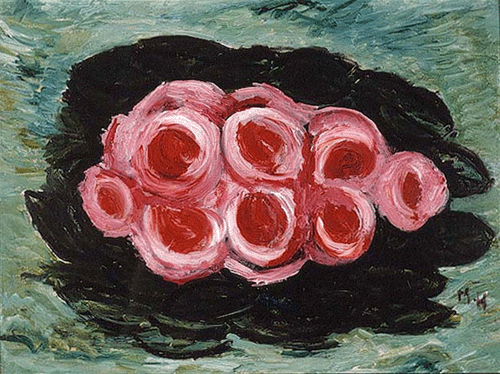
Marsden Hartley Roses circa 1936-1938 oil on board 12″ x 16″
This image has been described as Hartley’s represention of his beloved Mason family.
When Cleophas said ‘Fine large morning,’ it sounded as if a page of Blake had been blown open by the wind. – Marsden Hartley
*
The image at the top of this post is a remarkable self-portrait, described here on the Artcyclopedia site by Joseph Phelan:
“Sustained Comedy”, a self-portrait that was never publicly identified as such, is the most astonishing [of Marsden’s late likenesses]. This work transforms the aging, homely and shy Hartley into a young bleached blonde gay stud complete with earrings, butterfly tattoos and a pumped up torso bedecked with a tank top. Contemporary taste has finally caught up with Hartley’s revelation of himself.
The image shown just below was painted at about the same time as the self-portrait. The subject is Hartly’s last great love, Atly Mason, who was drowned together with his brother and his cousin during a hurricane in the summer of 1936.
Sunday morning. And the boys still not home. – Marsden Hartley
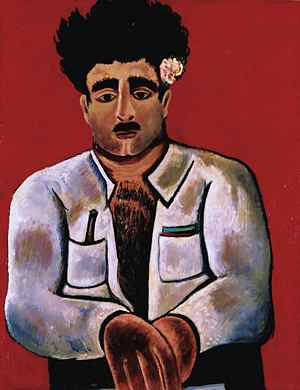
Marsden Hartley Adelard the Drowned, Master of the “Phantom” circa 1938-1939 oil on academy board 28″ x 22″
[image of “Sustained Comedy”, belonging to the The Carnegie Museum of Art, from artcyclopedia; image of “Roses” from Barridoff Galleries; film still from 217 Films; image of Adelard, belonging to the Weisman Art Museum, from The Crocker Art Museum]
this is not a gay film not a a gay film a gay film
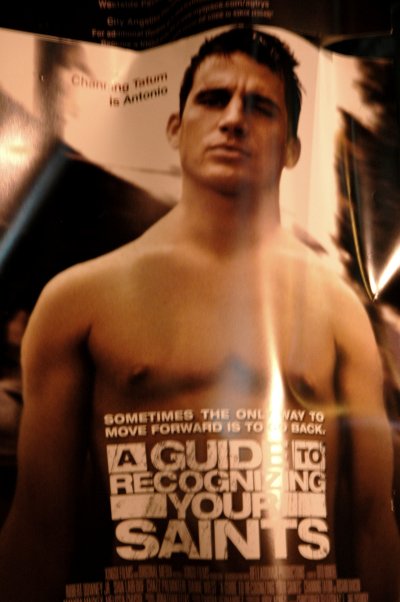
I was shocked I was
I went to a presentation by the artists and book signing at Aperture on Thursday night, and this is one of many duplicate posters I found clipped up and down parking signs and light posts along West 27th Street when I left to go home. This particular block is all about commercial businesses and galleries during the day and straight clubs late at night.
The sexy bills are part of a marketing blitz for “A Guide To Recogizing Your Saints” which, regardless of its merits or demerits, is apparently not actually a “gay film”.
the American Airlines homo scare: even worse than reported
UPDATE ON THE AMERICAN AIRLINES INCIDENT:

the airline’s straights-only security rules don’t fly
I have now heard from our friend David Leisner, who was quoted in the The New Yorker story I wrote about on Thursday evening. David was one half of the couple which witnessed the threats delivered to two other passengers seated in front of them, a homosexual couple, by (successively) the flight attendent, the purser and the captain of an American Airlines flight en route from Paris to New York. Both he and his partner Ralph Jackson were quoted in the magazine, but David has added some perspective and one damning fact which makes the airline’s confrontation even more outrageous than initially reported.
David writes, in part:
You can assure anyone that questions the degree of affection these guys were showing that it was very innocent – hand-holding, resting one’s head on the other’s shoulder and repeated kissing (but not French kissing!). Nothing disturbing about it at all, unless it had been a straight couple :-).
Also, the New Yorker writer got the punchline wrong: what the captain said to one of the couple was that he would divert the plane not if the arguing continued, but if he heard any more reports of such behavior (kissing). [my italics – JAW] It made an increasingly weird situation even more surreal and disturbing.
[image from pedalcarzone]
it flies differently in The Netherlands
Terence has two fathers, and that’s good
This amazing video excerpt from an ordinary Dutch children’s TV show sings and speaks for itself, but following upon the story about the American flight diversion threat appearing just below this post it just about explodes on the screen!
We love the Dutch.
[many thanks to Slava for the tip]