Category: Uncategorized
on listening to Frank O’Hara
I sometimes wonder if my own voice already sounds like it’s from another era than this one, at least to the ears of friends who are much younger. Regional accents, or those of class, are not the only distinctions in common speech. Most people never think of the rich history of accents that have been determined by time. It’s only in the last 100 years or so, with the invention of recording devices, that we can actually feel how the human voice changes even within the span of a normal lifetime, and be able to enjoy some of this great treasury.
Now these riches can only cumulate, as we move through more changes in one of the attributes that makes us distinctly human.
This post was inspired by hearing Frank O’Hara reading from his own work; remarkably, the recording is only 50 years old. Long ago, while listening to older films, early radio broadcasts, and later re-watching the 40s and 50s television of my own youth, I began to be aware of changes in speech patterns. I suppose I mean the sound, or perhaps the rhythm, more than anything else.
I’m always thinking of the geographical and historical contexts of everything I experience, and I know it’s something most people don’t share, but I think my observations on the subject are real.
My mother’s great grandfather grew up in the 18th century, and arrived in the U.S. in the early-to-middle 19th; her grandfather lived into the 20th, her father was a part of that century and half of the 20th; she herself was entirely of the 20th, and my life straddles that and the 21st; even if we all had always lived in the exact same area, our speech patterns would still have been very different from each other. I wish I had recordings of each of their voices today, even if, because of the German spoken by the first three, the sounds would be of little use in illustrating the point I’ve been making here.
[image is from Cambridge Extra]
on ice
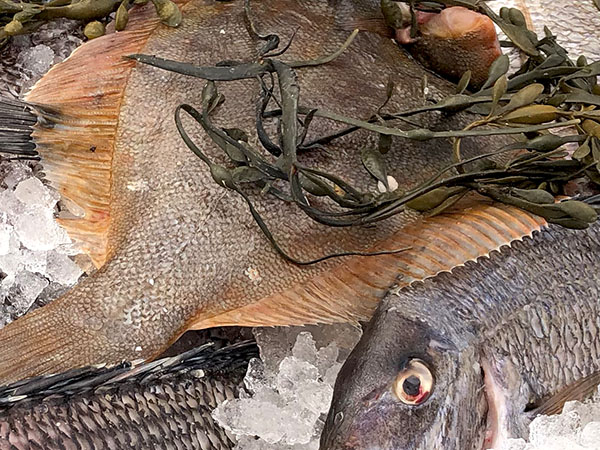
untitled (fisheye) 2017
These bass and blackback flounder were chilling in an America Seafood bucket at the Union Square Greenmarket this afternoon.
east 18th street gathering
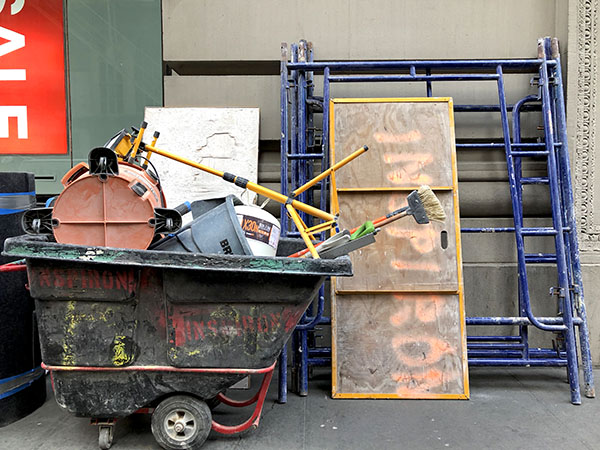
untitled (INSPIRON) 2017
And it wasn’t a laptop sale: the sign belongs to a store next door.
night garden
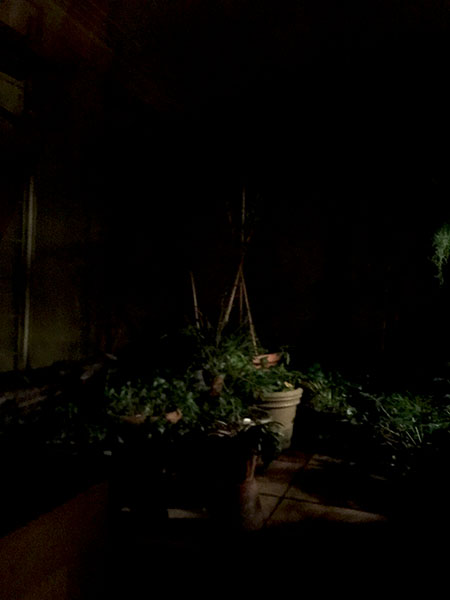
untitled (night) 2017
Outside the night kitchen: This is an image of our small roof garden, after sunset, lit only by the ceiling light inside the breakfast room.
walk-up, and down
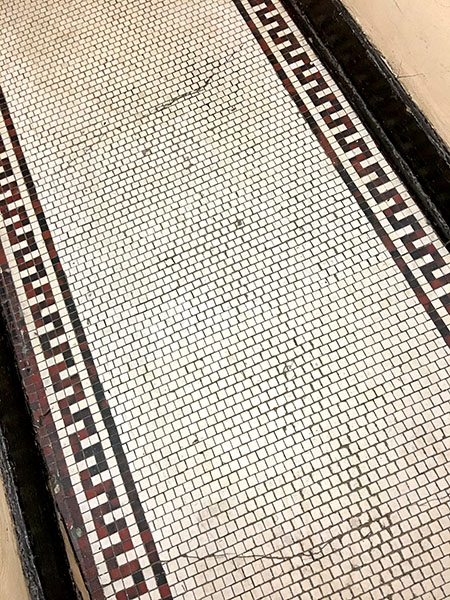
untitled (mosaic) 2017
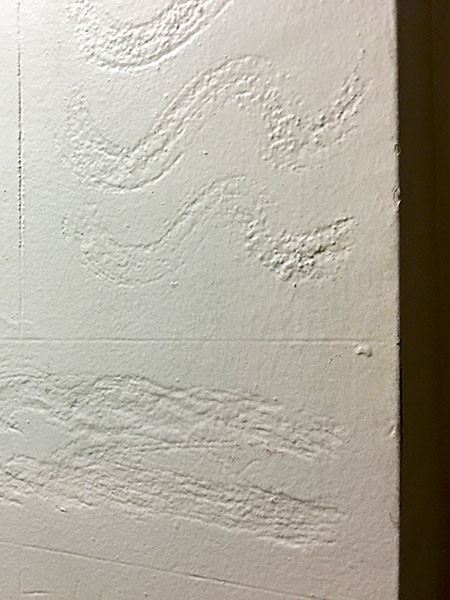
untitled (rustication) 2017
These images, of a section of the building’s original floor and wall, were taken on our way down from a terrific dinner party on the 6th floor of a classic Manhattan walk-up on Mulberry Street.
I was probably too focused on the exertions of the walk up to notice what later jumped out at me on the way down.
Disclosure: My first apartment was a 4th-floor walk-up (at the very bottom of the island, views forever), and I regularly carried my bike and groceries up those stairs, but then I was over 30 years younger then.
to nie jest kolażem
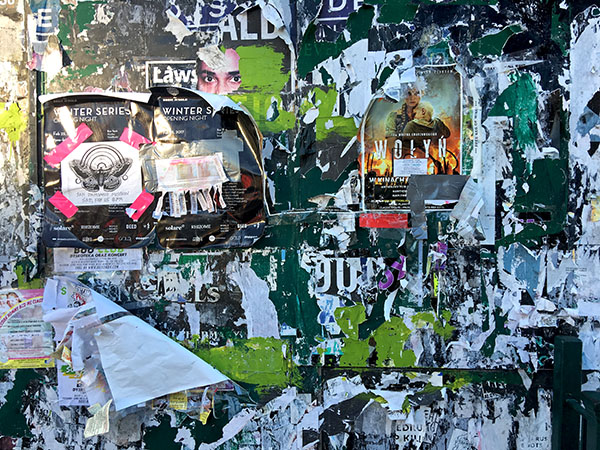
untitled (Greenpoint wall) 2017
The wall shone in the late afternoon light while we awaited a bus on Manhattan Avenue, insisting I capture it before it moved on.
what is to be done? (Obama version)
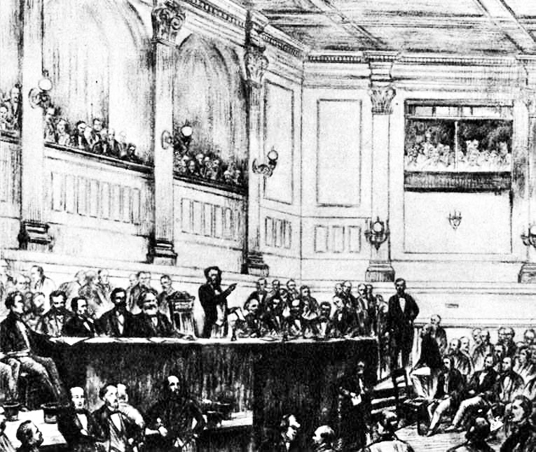
What is to be done? Not much, if we’re asking what the current administration can do before January 20. Obama has had eight years to do – and not do – the things which really had to be done.
As I understand it, anything substantive he might now accomplish, with an executive order or interim appointment, would be erased as soon as he’s gone.
The only concrete thing he could do which would survive him is to pardon existing whistleblowers (although this would not protect the next ones, or the republic, going forward).
He actually could shut down Guantanamo (before it becomes an off-shore political prison for Americans). Since its existence itself is a war crime, executive fiat is enough for the task.
There are any number of moves he could make while still president, including immediately halting his ramped-up deportation programs and the use of drones in countries with which we are not at war, but the relief they could offer, while hugely welcome to the victims, would only be temporary.
He could speak out, and not just to help dress in sheep’s clothing the monster he condemned until just two days ago (and who did what he could to rob him of his humanity).
There are plenty of things he could say to us all, beginning with, ‘forgive me’.
In the last few days we may have learned that much of Obama’s popularity was a fiction, potentially minimizing the effect of a bully pulpit, even one delivered from a dying administration. Yet if he were he to address the nation now, with honesty, transparency, and contrition, on the policies with which he abandoned his most fervent constituencies, and, presumably, his own principles, for eight years, he would at least leave office with personal integrity.
Most of these are merely nostrums, unlikely to have a long-range effect on the survival of the republic – and by extension, the world – but there is one thing Obama could do.
The Democratic party has still less popularity than he does, and also should be recognized as the greater culprit. It should be dismantled altogether.
Obama should immediately summon a major, transparent, national gathering of true progressives, with large minds and great hearts, an assembly which would be open to public input, to discuss, found, and organize a replacement, one which would eschew the failings, the remoteness, and the fatal dysfunction of the one which has now been spurned by the people it has itself spurned for so long
The image is of Karl Marx speaking before at assembly which founded the International Working Men’s Asociation, at a St. Martin’s Hall meeting, London, 1864.
[the image is from The Socialist Review]
Berlin, May 29, 2016
We had dinner at a creative restaurant, Thermroc, in Mitte, on Torstraße.
Kristen Jensen at Wallspace
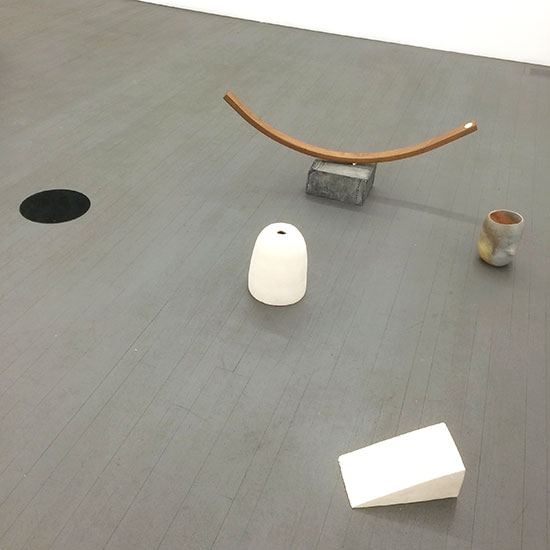
Some of Kristen Jensen‘s sculpture is currently part of an interesting group show, ‘The Curve‘, at Wallspace Gallery in Chelsea. The works are shown above, almost certainly in the artist’s own elegant arrangement. They are made of porcelain or stoneware, with the exception of the piece on the left, whose materials are described as campfire ashes and brass. They are titled, clockwise from the left, ‘Portable Black Hole’, ‘Steady, Steady Man’, ‘Dad Nose’, ‘Shim’, and ‘Bell’.
The other artists in the show, which closes January 14, are Jan Groover, Zachary Leener, Rebecca Morris, Monique Mouton, and Matt Paweski.