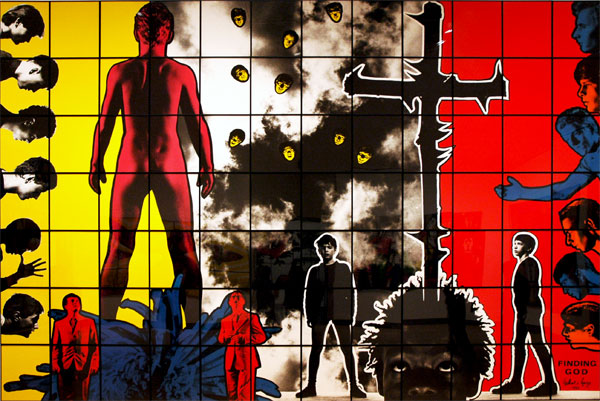
Gilbert & George Finding God 1982 eighty four hand dyed photographs mounted in metal frames 166.5″ x 238.5″
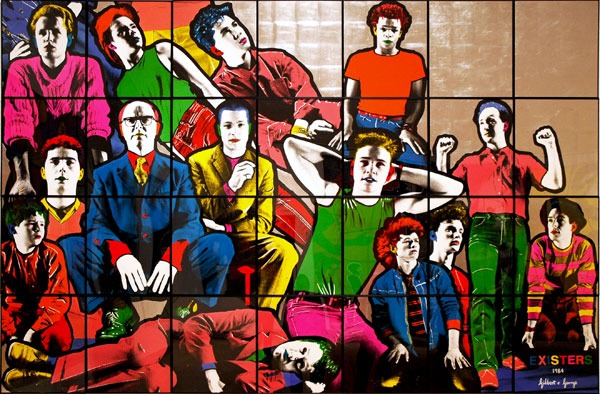
Gilbert & George Existers 1984 mixed media 95.25″ x 139″
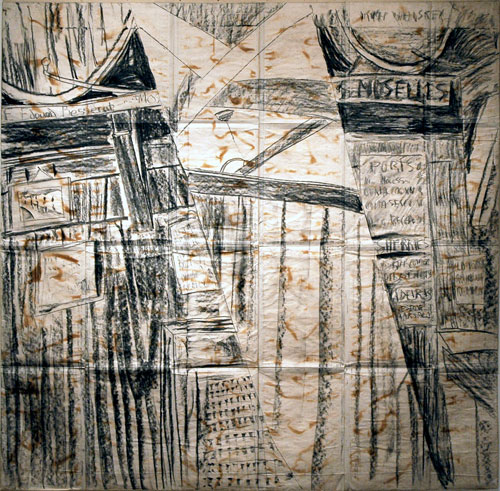
Gilbert & George The General Jungle or Carrying on Sculpting 1970-1974 [one enormous panel, from a set of twenty-three, in charcoal on canvas-backed paper]
We visited the Brooklyn Museum with some friends from the borough across the waters on Saturday afternoon. We picked the date at least partly because it was one of the institution’s monthly Target First Saturdays, and the first of a new year. On these days the museum is open until 11, and from 5 in the afternoon there is no admission charged and there are special programs of art and entertainment. The caf� serves sandwiches, salads, and beverages and there’s a cash bar with wine and beer. I have no precise way of pinning down the demographic, but I’d be willing to bet that most of the happy crowd, of every level of sophistication, which we saw devouring the art on each floor were Brooklynites happy to be sharing their great museum with friends and family.
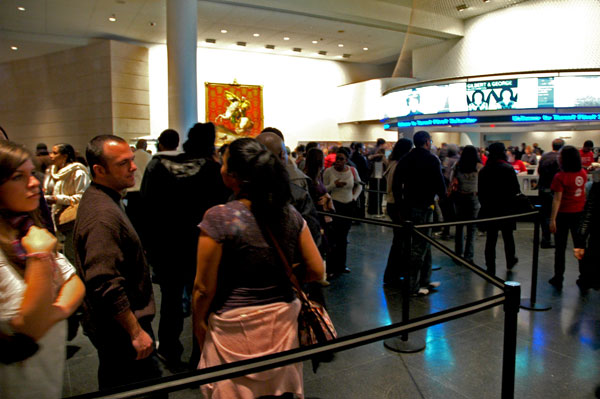
museums are hot
We went because it’s one of the best museums in the country, but I’m doing this post because I love that the institution is so serious about engaging with its community and because, more than any other New York Museum, the Brooklyn appears to be committed to enlarging the scope of the free use of photography within its galleries whenever possible.
We wandered through many of the exhibition spaces, but we were anxious not to miss two installations in particular. One was Jesper Just‘s gentle exhibition of four films, billed with the title of the artist’s latest film, “Romantic Delusions”, and the other was the huge Gilbert & George retrospective installed on two floors. The Just closed yesterday, but the traveling Gilbert & George show will be here through Sunday.
I’ve been a fan of Just for years, but I think I had earlier found the work to be somewhat more enigmatic than it should have been. Being able to see these four works in one installation significantly expanded my appreciation of his explorations.
It was pretty embarrassing to be reminded of how ignorant I was about the career of that most excellent pair, Gilbert & George, but following my visit with these “living sculptures” I felt somewhat enlightened, very impressed, and absolutely charmed.
A final note: Not until after we had left the Museum did it occur to me that each of these temporary exhibitions had at least referenced the complex workings of cross-generational male/male affection. It’s not one of the more frequently-encountered themes in art; I’m sure it’s appearance here was only an odd coincidence. Still, I don’t know how it can have gone entirely unnoticed by everyone but me, and I do know that I’m reminded once again that I’m definitely a long way from Kansas . . . er, Michigan.
Jesper Just Bliss and Heaven 2004 still from video
[image at bottom from Witte de With]
Category: Uncategorized
Obama

“Let the great work begin.”*
*
with due and humble respect for Tony Kushner’s “Perestroika”
[image from willowtreehome]
did I say that?
Over six years ago, inspired by an earlier series of financial scandals dominated by those redolent names, “Enron”, “Global Crossing”, “Adelphia” and “WorldCom”, I did a post which included this:
Now I know I shouldn’t necessarily be gleeful at the possible or impending sudden disappearance of or depressive shift in the cycle of this “system”, since it would mean havoc perhaps even exceeding the evil it does now. Moreover, as someone living on a fixed income produced by, no, not the sweat of my brow, but by years of borrrre-dom, I should have a selfish interest at stake. And in the end, we know the ones who will suffer regardless of how this all works out will not be the very rich. BUT, I will admit I’m absolutely fascinated by what’s happening right now.*
Now that it’s finally all come down around us all, I’m still fascinated; I’m just surprised it took so long.
And angry? I was already there.
*
I know what I meant, but I sure hope I’d be able to express it better today, at least on a good day.
[image from the band COLLAPSE]
photo, light, chance, design: John Wallbank’s studio
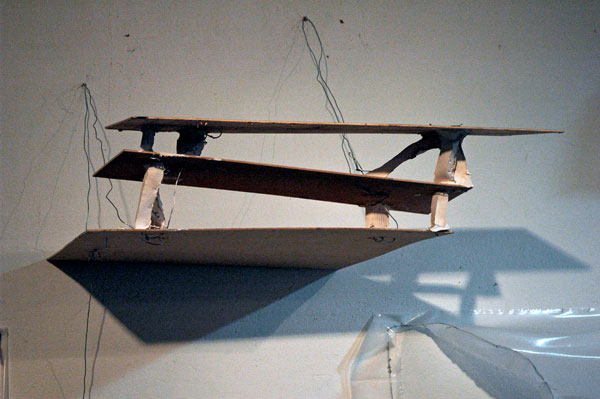
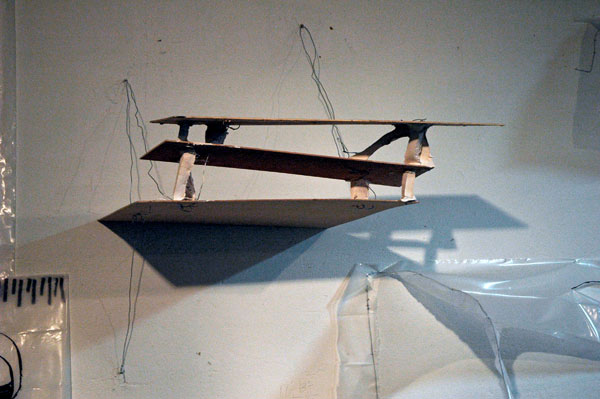
two images of the wall in John Wallbank‘s studio
A photograph of a work of art, or for that matter a visual or sound recording of a work of art, is never the art which it tries to represent, even if it might in some extraordinary instances become art in its own right.
And yet photographs have a life of their own. If only because of a physical distance from the object and the fact that they’re quite separate and distinct from the eye, mind or voice of its creator, the photographer’s own eye, mind and ears always introduce something to any work of art, whether a visual, performance or musical piece. This is the case even for a more casual viewer unencumbered with a recording device of any kind: Every viewer sees something a little different. Photographs of works of visual art, qua documents, are not the works they describe, but they can frequently add an additional dimension, sometimes aesthetic, sometimes intellectual, to what the artist has left us.
In the case of the odd dynamic of the light in the images above, an arguably happy accident which I couldn’t at first explain has added a ghostly element to what I intended to be only a document of John Wallbank’s sculpture as I encountered it several days after my first visit to his space in the Triangle Arts studio program. After taking the first image I looked at the small screen on the rear of my camera. On that scale I couldn’t identify what the fog-like area was. Thinking it was light bouncing around my lens, I took three more shots, but the same hazy area showed up on each one and I shared them and my puzzlement with Wallbank. Only this afternoon, while looking at all of the images on my laptop screen, did I see that the lighter-colored areas on the lower right were simply the part of the wall not shaded by the sculpture’s thin plywood platform. They represented a more direct light coming from the window out of the camera frame on the right.
I deny any conscious responsibility for the cubist display in these pictures. Although I thought until a few moments ago that it was the accident of an unusual play of light which happened to be very friendly to both Wallbank’s use of found materials and to his wonderful creations, I now imagine that in some way the artist anticipated the effect – and many others like it not recorded here.
Either way, the work would not look the same to the next person who saw it or photographed it, or even to the artist himself, as I expect he and most artists would admit.
“Park(ing) Day NYC”, a little like Brigadoon?
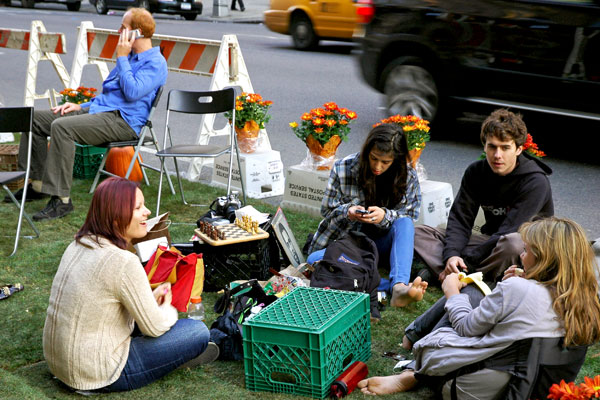
park yourself down where iron monsters usually lie
I went down the block to our local Whole Foods market yesterday afternoon, and as I turned the corner onto the avenue from 24th Street I stopped in my tracks. I must not have been reading my emails with any care, because I was taken entirely by surprise to find one of the 50 sites of what was the second “Park(ing) Day NYC“. The “Seventh Haven” chapter had unrolled some real turf and living potted plants onto what is normally a vehicle parking lane. From this refreshing green oasis they greeted passersby and invited them to share their outdoor furniture and reading materials, the greenery and the ease.
“Brigadoon” is the story of a mysterious Scottish village that appears for only one day every hundred years. These little parks may appear with greater frequency, but they are no more permanent than a view of that enchanted Highland valley – in the New York case, even for the cheery inhabitants we might meet there.
It was almost exactly one year ago that these activists had first introduced us to the possibilities which would open up if we took a hard, humanistic look at our current transportation priorities. Sadly, the “park” I saw yesterday looked no more permanent than the one I had seen the year before. I’d like to believe we might expect more from our City planners than to simply continue countenancing these annual exercises.
inspirational wall hanging
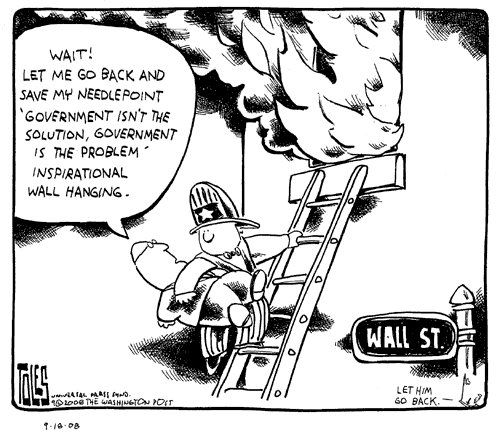 It looks like I’m obsessed with cartoons this afternoon, so one more may not be a surprise, and this one is really fresh.
Alexander Cockburn: election is a missed opportunity
Alexander Cockburn knows how to turn a phrase – or two. In a piece in the current The Nation titled “Fatal Distraction” he outlines what the “miraculous conception” [my phase] of Sarah Palin as VP candidate has done to the ordinary high level of American political campaign discourse [just kidding, folks]. He dismisses the circumspect MSM accounts of what happened to Fannie Mae and Freddie Mac, and offers his own. I have to remind myself that he’s writing this before the financial crash news of the last few days.
He begins by saying that the MSP has been far too circumspect in describing “the misleading procedures identified by Treasury accountants scrutinizing Fannie and Freddie’s ledgers”.
In cruder language the operators of these two giants had been engaged in the pleasant activity of cooking the books by borrowing at low-interest government rates, selling the repackaged mortgages at a higher-interest markup and then lying about their actual exposures. “Fannie and Freddie were almost single-handedly supporting the junk mortgage market that was making Wall Street rich,” economist Michael Hudson told CounterPunch the Monday after the takeover, protecting themselves from regulatory harassment by shoveling campaign contributions at the relevant lawmakers sitting on the financial committees in Washington.
Now the Treasury is refloating these two huge casinos and sending them down the river again, so that Wall Street can stay happy and China and the other overseas lenders can be assured that the money they’re lending the United States to finance activities like strafing Afghan children from the air is at least partly secured.
He’s tough on the money handlers and their Republican enablers, but neither Barack Obama nor his party are spared Cockburn’s scorn. Several paragraphs earlier he argued that idealistic younger voters, whose turnout is needed on November 4, are being distracted by the more ludicrous aspects of Palin’s weird story:
. . . from unpleasant reflections on the candidate of hope and change, whose prime foreign policy commitment is to increase the US military presence in Afghanistan and hence the certainty that Afghan children will be shot from the air or blown up by US gunships in steadily increasing numbers.
The peace candidate has disappeared.
But the ball is being dropped at home as well. Cockburn suggests the Democrats are dead on arrival in the area of domestic change as well, particularly in the financial area:
The problem is that co-conspiring in Gramm’s [Phil Gramm, McCain’s “unoffical” financial advisor] deregulatory rampages in the late ’90s was the Clinton Administration, spurred on by the Democratic Leadership Council. On the ticket with Obama is that lifelong serf of the banks, Joe Biden. Obama himself has been heavily staked by Wall Street.
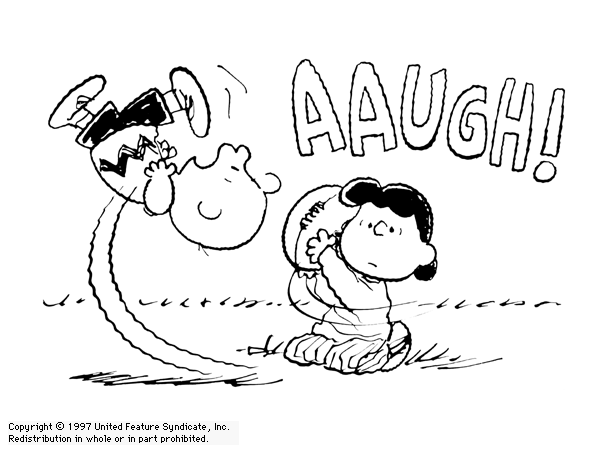
It happens every time. Progressives are eternally hopeful, but as soon as it looks like we might prevail, we run into the same closed door. I think this time it might have been our last chance. I feel like Charlie Brown, and the system I’m working with is Lucy and that football.
Cockburn’s article ends on a note a measure less lugubrious than my own – but not by much:
When they look back on it, people will surely see this election as one of the larger missed opportunities in the nation’s history for scrutiny and shake-up of our economic and imperial arrangements: an unpopular war abroad, brazen thievery by the rich and powerful at home, widespread discontent of huge slabs of the electorate, beleaguered by debt, low wages and joblessness. How easy it should have been for a politician as eloquent and intelligent as Obama to create an irresistible popular constituency challenging business as usual. But what’s positively eerie is the cautious sensitivity of his political antennas, alerting him time and again to the risks of actually saying or pledging anything substantive by way of challenge to present arrangements. Small wonder it’s hard to remember much that he says, because so little that he does say is ever substantively memorable or surprising or exciting; no wonder that Sarah Palin is proving so successful a distraction.
[image from bodie25]
Brooklyn Bridge towers from tidal strait
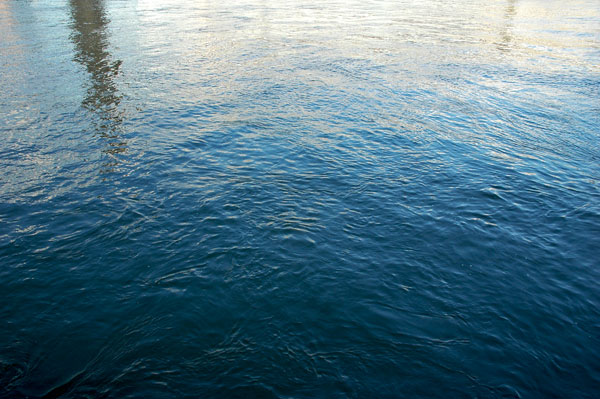
untitled (towers) 2008
Both towers of the Brooklyn Bridge are reflected in the waters of the East [er, . . . tidal strait] at the top of this photograph. The picture was taken yesterday from the deck outside the Spiegeltent on Pier 17. Later in the evening those outdoor spaces were the site of the presentation of The Bessies.
And, yes, the water you see here was moving north at a good clip.
Hadron Collider going after the primordial fire
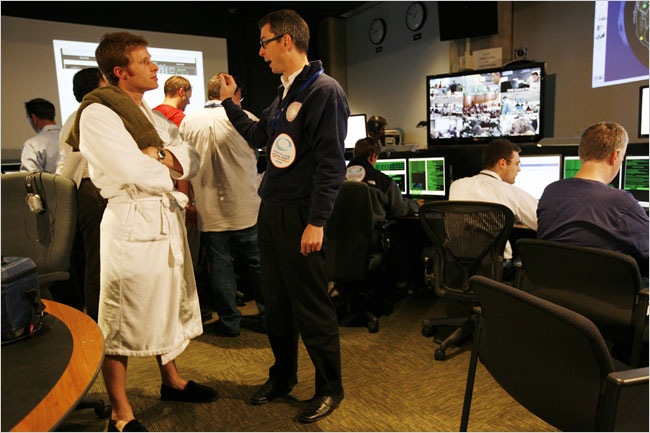
Fermilab scientists in Illinois hold pajama party celebrating activation of collider near Geneva
I love this story. I had tears in my eyes before I had barely begun reading it, and they’re still there as I’m typing this. Very good journalism, and the photos are absolutely wonderful.
An ocean away from Geneva, the new [Hadron] collider’s activation was watched with rueful excitement here at the Fermi National Accelerator Laboratory, or Fermilab, which has had the reigning particle collider.
Several dozen physicists, students and onlookers, and three local mayors gathered overnight to watch the dawn of a new high-energy physics. They applauded each milestone as the scientists methodically steered the protons on their course at CERN, the European Organization for Nuclear Research.
Many of them, including the lab’s director, Pier Oddone, were wearing pajamas or bathrobes or even nightcaps bearing Fermilab “pajama party” patches on them.
Outside, a half moon was hanging low in a cloudy sky, a reminder that the universe was beautiful and mysterious and that another small step into that mystery was about to be taken.
I’ve only read the hard copy story so far, and since I’m listening to a dramatic, late (wartime) symphony by Nikolai Myaskovsky right now, I’ll wait to watch the video on the NYTimes site.
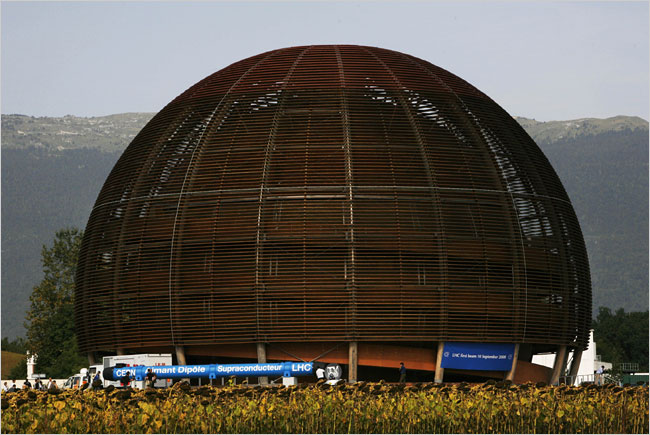
entrance to the underground Cern Laboratory near Geneva
The wooden 2002 Palais de l’Equilibre [architect Herv� Dessimoz, construction engineer Thomas B�chi], the icon of the 2002 Swiss National Exhibition, performs as the public face of the laboratory. It’s now been dubbed, “Globe de l’Innovation”, but I prefer the sound and the idea of the original name. Its shape and its current placement are surely a tribute to �tienne-Louis Boull�e‘s theoretical, monumental designs, in particular his “C�notaphe a Newton” (1784). For a discussion of the architecture of the underground lab itself, see this Charles Jencks essay, “Ultimate architecture: Cern’s partical detector”.
[first image by Peter Wynn Thompson from the NYTimes, the second by Anja Niedringhaus from Associated Press via NYTimes]
before the storm
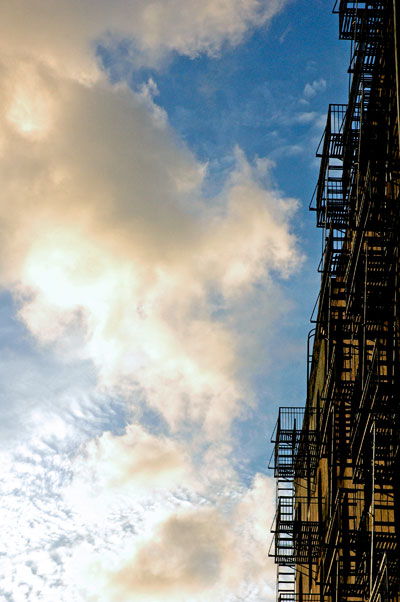
This is what the sky looked like above a mid-nineteenth-century warehouse on a breezy West 27th Street around 7 o’clock last night. The rains arrived hours later.