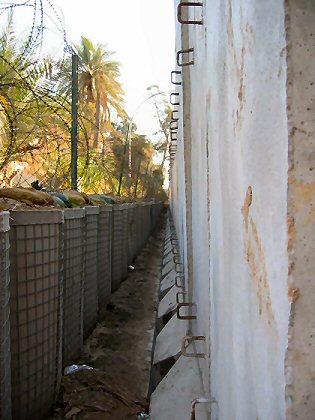
no hanging garden, this [a section of the Green Zone perimeter]
I’m tired of the media’s [continuing] misleading descriptions of last week’s flight by Bush to Baghdad International Airport and the Green Zone. If I thought it was just a question of semantics, I’d leave it alone, but words are important, especially when they are instruments of propaganda and they are going unexamined.
He didn’t “visit Iraq”.
He didn’t “visit Baghdad”.
He visited a god-damned super-bunker sheltering people who call him sir.
Even at that our heroic conqueror’s departure for his five-hour stop-off inside a fortified headquarters (“the Ultimate Gated Community”) shared by his victorious army of pacification and a more-or-less client local government had to be kept secret from his own staff. Also, what does it say about this stunt that Nouri al-Maliki, the Iraqi Prime Minister and Bush’s host, didn’t know the President of the United States was coming until virtually the moment he showed up at the door?
[image from Rich Galen’s Mullings]
Category: War
Guantanamo suicides a ‘PR move’* [to draw attention]
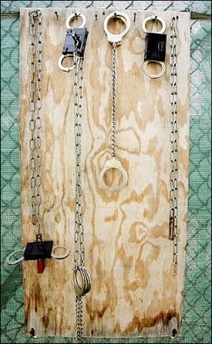
no, unfortunately this image is very real, and not Trompe l’oeil [the Yahoo! News caption for the picture begins: Leg irons and hand cuffs hang on a board at Camp Delta at Guantanamo Naval Base in Guantanamo, Cuba, in 2004.]
*
So reads the headline on the lead story on the BBC at the moment. The attribution for the description of the deaths of three prisoners in our Cuban concentration camp is the United States Deputy Assistant Secretary of State for Public Diplomacy [my italics].
Colleen Graffy told the BBC the deaths were part of a strategy and “a tactic to further the jihadi cause”, but taking their own lives was unnecessary.
We’re expected to listen to our “public diplomat” explain their deaths as a bad career move, but we aren’t allowed to know who any of these folks are?
[news tip from Barry; image, credited “AFP/Pool/File/Mark Wilson”, from Yahoo! News]
Abu Musab ab-Zarqawi, dead or dead
Now we’re finding out he wasn’t killed by the 500 lb bombs we dropped. He had to be dispatched afterwards, more or less manually.
We sure wouldn’t have wanted him to be able to talk. Somebody might actually have learned something. But then he might have been able to incriminate members of the government. Oh, of course I’m only referring to our security zone Baghdad allies; who else?
Jenny Holzer at Cheim & Read and Yvon Lambert
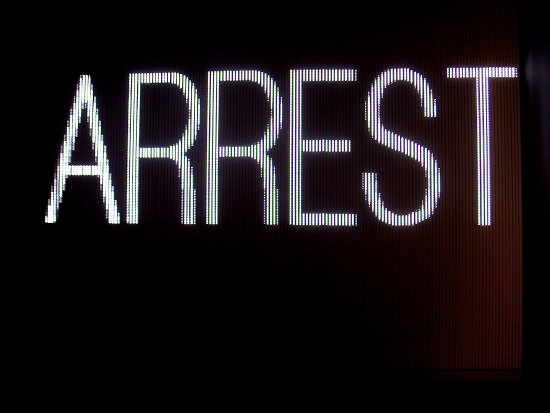
Jenny Holzer WHITE 2006 Nichia white LED’s mounted on PCB with aluminum housing 192.25″ x 216.5″ x 5.25″ [capture from moving light of installation]
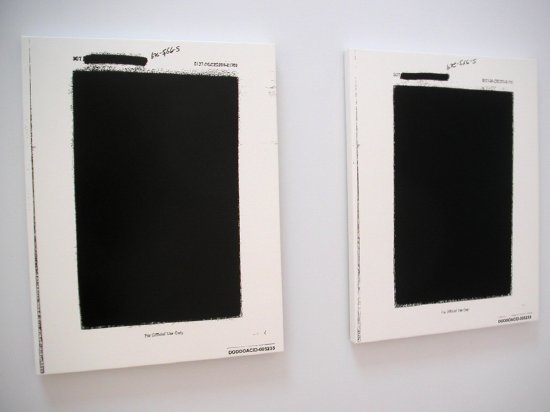
Jenny Holzer HAND yellow white 2006 oil on linen in eight panels 33″ x 25.5″ each panel [detail of installation]
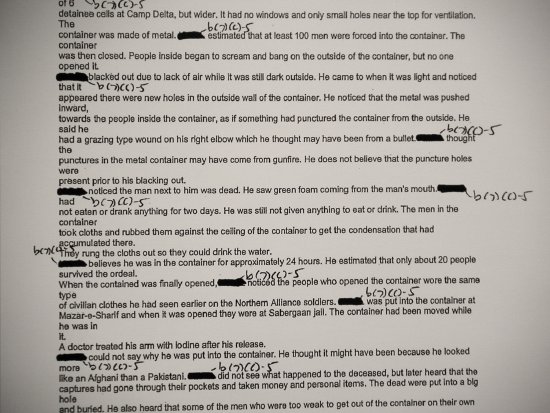
Jenny Holzer BIG CONTAINER yellow white 2006 oil on linen triptych 103.5″ x 80″ each panel [detail of installation]
Jenny Holzer shows us what “freedom of information” looks like in a show at Cheim & Read. It’s not pretty, but its more compelling than a car wreck. The installation is part of a collaboration with Yvon Lambert, across 25th Street, where “Night Feed”, a series of very different text-based works has been installed.
From the Cheim & Read press release:
In her newest work, Holzer negotiates the political landscape after 9/11 and traces the debate over covert operations, ghost detainees, prisoner abuse, and war tragedies in Iraq, Afghanistan, and Guantanamo Bay through the directives, emails, and testimonies of policy makers, soldiers, and prisoners. The documents, many of which were classified at the time they were written, originated in United States government and military agencies and have been made part of the public record through the landmark Freedom of Information Act.
It’s almost impossible to imagine how banal, or how horrible, are the parts which our government will not let us see.
Holzer’s art will not let us stop trying – to imagine, yes, but more importantly, to free the information.
swimming in Iraq
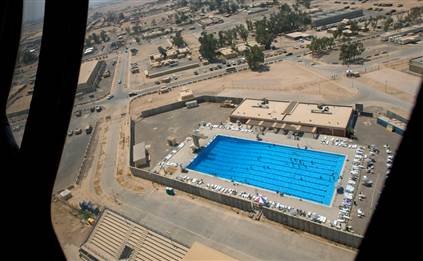
swimming on our aircraft carrier in the desert
Not many people will get to read my post or the original The Nation article available only in the print edition, but maybe a color image and the accompanying story from MSNBC will stir up some dust in the American political desert.
The huge base we’re constructing on the sight of the former Iraqi Air Force academy at Balad is one of a handful of similar imperial projects being installed inside a prostrate Iraq. No wonder we haven’t had the time or money or men to help the Iraqis. Also, none of these installations have anything to do with fighting an insurgency or preventing or reducing the severity of a civil war.
Away from the flight lines, among traffic jams and freshly planted palms, life improves on 14-square-mile Balad for its estimated 25,000 personnel, including several thousand American and other civilians.
Theyve inherited an Olympic-sized pool and a chandeliered cinema from the Iraqis. They can order their favorite Baskin-Robbins flavor at ice cream counters in five dining halls, and cut-rate Fords, Chevys or Harley-Davidsons, for delivery at home, at a PX-run dealership. On one recent evening, not far from a big 24-hour gym, airmen hustled up and down two full-length, lighted outdoor basketball courts as F-16 fighters thundered home overhead.
Balads a fantastic base, Brig. Gen. Frank Gorenc, the Air Forces tactical commander in Iraq, said in an interview at his headquarters here [today’s MSNBC dateline: “BALAD AIR BASE, Iraq”].
. . . .
In the counterinsurgency fight, Balads central location enables strike aircraft to reach targets in minutes. And in the broader context of reinforcing the U.S. presence in the oil-rich Mideast, Iraq bases are preferable to aircraft carriers in the Persian Gulf, said a longtime defense analyst.
Carriers dont have the punch, said Gordon Adams of Washingtons George Washington University. Theres a huge advantage to land-based infrastructure. At the level of strategy it makes total sense to have Iraq bases.
Both the White House and the Pentagon have basically denied everything which suggests a long-term or permanent status for these installations.
The AP image at the top is dated Aug. 25, 2005. Our press, which has apparently had every opportunity to see the truth for itself, has basically and characteristically cooperated in the deceit – at least until now.
[image by Jacob Silberberg from the AP via MSNBC]
‘Permanent Bases’ and Rachel Corrie, both in The Nation
There are few issues more important to our own survival and that of the entire world than the state of Israel and the war in Iraq. In two consecutive issues this month The Nation‘s contributors offer enlightenment in these areas to even the most knowledgeable reader.
I usually skip the many articles which only reflect what I already know or suspect, but I couldn’t do without those which highlight this magazine’s ability to reliably report or sensibly argue what what I’m unlikely to find anywhere else. These two fill that description in spades.
Unfortunately only one of these two particular reads are available on line, but you’re depriving yourself, The Nation, and the nation if you aren’t already a subscriber.
An excerpt from Tom Engelhardt’s”Can You Say ‘Permanent Bases’?“, which is not on line:
To this day, those Little Americas [at least four “super-bases”] remain at the secret heart of “reconstruction” policy in Iraq. As long as [Halliburton] keeps building them, there can be no genuine withdrawal. Despite recent press visits, our super-bases remain in policy silence. The Bush Administration does not discuss them (other than to deny their permanence). No plans for them are debated in Congress. The opposition Democrats generally ignore them.
An excerpt from Philip Weiss’s “Why These Tickets are Too Hot for New York“, which is available on the magazine’s website:
As George Hunka, author of the theater blog Superfluities, says [about New York Theatre Workshop’s cancellation of the play, “My Name is Rachel Corrie”], “This is far too important an issue for everyone to paper it over again, with everyone shaking hands for a New York Times photographer. It’s an extraordinarily rare picture of the ways that New York cultural institutions make their decisions about what to produce.”
Hunka doesn’t use the J-word. Jen Marlowe does. A Jewish activist with Rachelswords.org (which is staging a reading of Corrie’s words on March 22 with the Corrie parents present), she says, “I don’t want to say the Jewish community is monolithic. It isn’t. But among many American Jews who are very progressive and fight deeply for many social justice issues, there’s a knee-jerk reflexive reaction that happens around issues related to Israel.”
“Sophie Scholl-The Final Days”
Nothing is so unworthy of a civilized nation as allowing itself to be governed without opposition by an irresponsible clique that has yielded to base instinct. It is certain that today every honest German is ashamed of his government. Who among us has any conception of the dimensions of shame that will befall us and our children when one day the veil has fallen from our eyes and the most horrible of crimes – crimes that infinitely outdistance every human measure – reach the light of day? If the German people are already so corrupted and spiritually crushed that they do not raise a hand, frivolously trusting in a questionable faith in lawful order of history; if they surrender man’s highest principle, that which raises him above all other God’s creatures, his free will; if they abandon the will to take decisive action and turn the wheel of history and thus subject it to their own rational decision; if they are so devoid of all individuality, have already gone so far along the road toward turning into a spiritless and cowardly mass – then, yes, they deserve their downfall.
– from the first leaflet of the White Rose
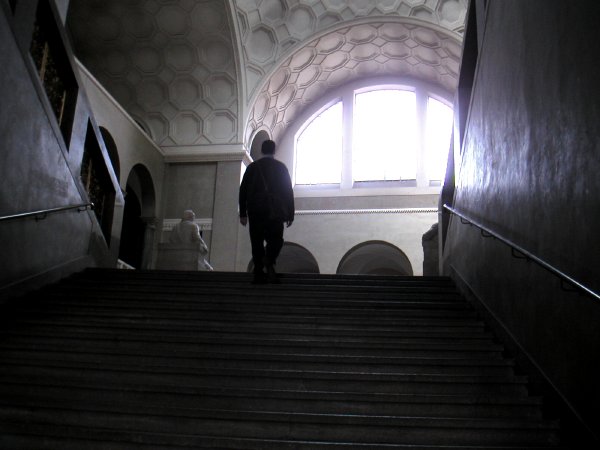
Barry climbing the stairs of the light court in Friedrich von Gärtner’s 1840 main building of Munich’s Ludwig-Maximilians-Universität*
The German film “Sophie Scholl-The Final Days” will be at the Film Forum at least through next Thursday. I don’t have to draw too much of an analogy here (it will come naturally enough to anyone who sees the movie), but it should not be missed by anyone sensitive to what is going on around us today.
Sure, we don’t yet have a provocation equal to that which created the White Rose inside wartime Nazi Germany, but today the almost non-existent opposition to the current regime in Washington is still embarassingly out of proportion to the evil it represents.
Even without official government controls our press is dead, and even though they haven’t been put in a camp as a threat to the state, the Democrats have been voting Republican for years. Both “estates” have been doing the work of the regime unbidden, giving it an apparance of legitimacy it would otherwise lack entirely.
In Germany sixty-three years ago political opposition was punishable with death. At the university in Munich a handful of courageous students and one professor decided that even the record of their resistance was worth such a sentence. They had few illusions that their work might bring down the governement or impact it in any significant way.
Today in the U.S. we haven’t yet been complicit in the death of millions, although such big numbers are totally irrelevant to a single grieving mother or child. Our own political murders are real enough already. But are any of us be able to match the morality and the courage of Sophie Scholl and her friends? The overwhelming evidence of the extraordinary extent of our cooperation with this deadly, pathological White House gang, or at best our indifference, lethargy and even our incompetence as its opponents on any level, appears to give us an answer.
*
In 2002 Barry and I visited the university, where I had spent some time in the early 60’s. I lived on Willi-Graf-Straße. This image shows the central hall where Hans and Sophie Scholl stacked most of their leaflets and strew the remainder over the railing onto the floor below.
[the text at the top was taken from The Shoah Education Project]
nobody in charge

I think I can speak for a lot of people on the Left if I say that for a long time we’ve been in a state of despair because of our belief that the radical Right was pretty much in absolute control of things at the top.
But today, as I stare at the national and international news stories now unfolding regularly, each headline topping the outrageousness of its predecessor, I’m thinking it should be pretty clear to all of us that absolutely nobody is in charge in Washington [and I suspect this isn’t what Republicans meant by small government].
Somehow I’m not feeling better yet.
May the luck of the simple fool save us from total annihilation, since it’s clear we won’t make it with our cleverness.
[image from History of Magic]
Plamegate updated and illustrated
Juan Cole cuts through all the mendacity this morning: He describes, in the clearest possible fashion [and richly illustrated] the crimes of Bush, Cheney, Libby and Rove as they relate to the Valerie Plame story.
Cole’s good, but it’s really all over now, except for some of the shouting. Even after the revelations in today’s news, I see his account primarily as a lesson in why it was so important to get Alito appointed.
Listen to the administration’s assertions of the legitimacy of their own spying ever since the wiretapping story broke. They know that everything they have done and will yet do really is perfectly legal and constitutional, because the Supreme Court, as Bush has now constituted it, will end up ruling so.
And don’t think that this crew will ever have to surrender their power. Everything has finally been put in place for the perpetuation of a one-party state.
And we can’t do a thing about it.
Those who have refused to play along have to be asking how much time they will have to get out of the country.
the cartoon war, and Thomas Hirschhorn at Gladstone
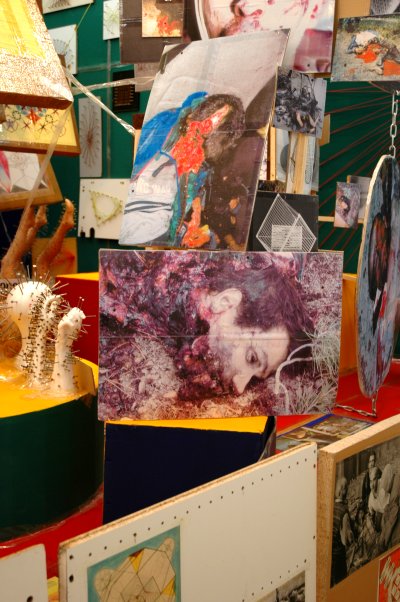
Thomas Hirschhorn Superficial Engagement 2006 [detail of installation]
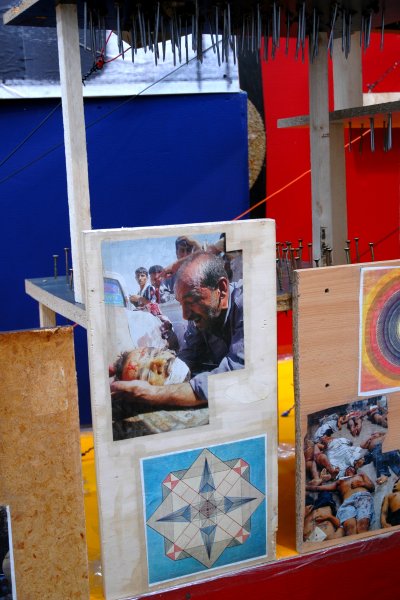
Thomas Hirschhorn Superficial Engagement 2006 [detail of installation]
Most of the commercial media has decided that Americans shouldn’t be shown the drawings which seem to have made the world go crazy over the past week, but this absurd delicacy is only the latest, and certainly not the most outrageous, insult to come from those who do a pretty thorough job of controlling access to the outside world for all but the most curious of our compatriots.
Americans, unlike almost all other peoples on the planet, have not seen the notorious Danish cartoons, but, even more importantly, they also have not seen the messy images of burnt, ground-up, chopped-up and gutted bodies which have haunted and angered people everywhere around the world for years.
We are being treated as children and we’re doing a pretty good job of justifying the censorship and restrictions to which children are subject. Of course I have to admit that as a nation we haven’t actually shown much real maturity in the last five years, but heavily insulating an already embarassingly-provincial people who make up the most powerful and most war-like state on the planet just doesn’t seem like a good idea.
Where are these notes going? Well, I’m trying to tie together the two experiences which have so disturbed my mind and my sanity this week. I haven’t been able to do any art posts for days because I’ve become so depressed following developments in the cartoon war, but most of all because of finally being confronted with crude photo reproductions of the most obscene and grotesque scenes of death as inflicted both by our oh-so-innocent selves and a lot of people who see us quite otherwise.
On my first visit to Thomas Hirschhorn‘s extraordinary installation at Barbara Gladstone last week, I was so overcome with the power of the piece that I was unable raise the camera I was carrying aound in my right hand. Several days later I decided I had to make my way back in and try to get something I could upload here, if only for the sake of anyone unable to make the pilgrimage to West 24th Street by this coming Saturday. I felt like I was profaning a sacred grove; I was nervous as hell, and I got in and out as quickly as I could.
Is it the pictures downloaded from the internet or is it what the artist has done with them? Why is moving through the groteque clutter of this gallery space so moving an experience? I don’t think I can answer the question, at the very least because as an American who hasn’t been surfing on line for these images what I saw on Saturday is still too much of a shock, even though all along I’ve considered myself pretty well informed and had thought that nothing about cruelty could shock me, short of being placed personally in its midst.
See Jerry Saltz’s “Killing Fields” for more questions and a few answers.
I will say that it is surely the most courageous show in the city right now, and that I admire both Thomas Hirschhorn and Barbara Gladstone for bringing it to us.
How can we match such a gift? We could start by growing up and putting the censor out of business.
ADDENDUM:
This note arrives with the clarity of the next morning. In a much better world it could even form the basis for reconciling the irreconcilable.
I admit that as an atheist I’m hardly in a position to preach here, but with all respect it seems to me you’re missing the point if, in the name of avoiding the dangers of idolatry, you make the unseen image into a fetish.
The real obscenity is the evil which produced these photographs, and the blasphemers come in every description.