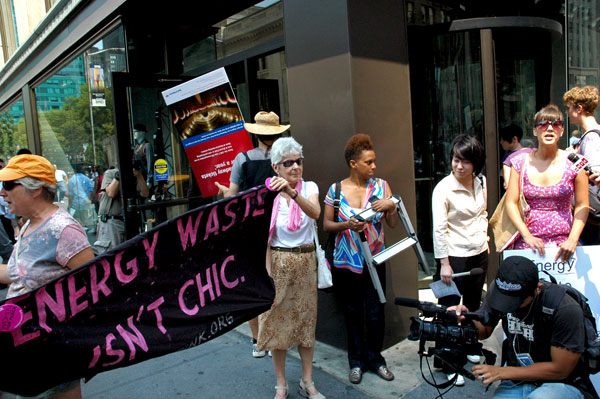
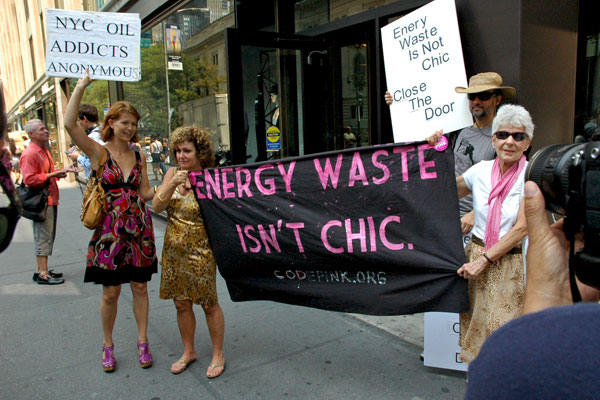

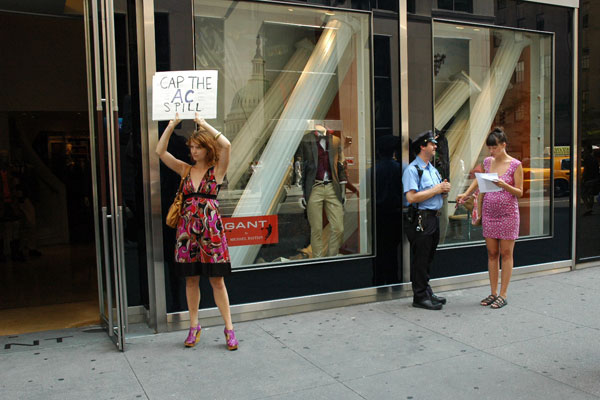
Code Pink visits NYC oil addicts (shops) on Fifth Avenue

Dana_outside_Zara.jpg

at_Zara_with-press.jpg

Zara_banner.jpg

Dana_pointing.jpg

Sally_cop_Dana.jpg

Continuing their “Action Against Illegal Energy Waste”, members of Code Pink returned today to some of the Fifth Avenue stores they had visited July 23rd, once again acting as a part of the international mutual aid movement, “NYC Oil Addicts Anonymous“.
This is an excerpt from the text of an email sent out this week by Code Pink:

Two years ago, the New York City Council passed a very reasonable law prohibiting large stores from cranking their air conditioning and leaving their doors open. But they still do it – one retailer was quoted in the New York Times as saying, “It’s business; sometimes you got to do what you got to do.” As consumers, we have to show these businesses that we’re disgusted, not enticed.
Leaving the doors open cranks their electricity use by 25% during peak hours, overloading the power grid, making blackouts more likely, and increasing the oil and nuclear demand in New York. It makes as much sense as leaving gas pumps flowing onto the sidewalk when you’re not using them. And as conscious women working for peace and justice we see the direct links between resource wasting, addiction to oil, wars for oil and on and on!

I joined the group on the door-shopping trip up Fifth Avenue which began at noon today, gamely juggling two protest signs, my not-so-lightweight camera, and several sturdy bags I was going to need later at the Union Square Greenmarket.
There was no shortage of targets from the very start, but most of the stores closed their doors very soon after our banner and signs appeared outside, and the chants began. When we got to the Gant Store however we encountered more than a little resistance: Not only did the manager refuse to close the two large doors (through which, incidentally, I could feel the store’s cold air as I stood behind the banner about 20 feet across from the opening, its fabric coming down only to my knees), but she called the police, who arrived with remarkable alacrity.
I wasn’t a part of the conversation which our excellent guides, Sally Newman and Dana Balicki, had with the two or three officers, but it was clear they wanted us to leave, and they definitely refused to do anything about the open doors. In all fairness to them, the cops may have been aware that our City Council had passed a statute (two years ago) whose enforcement responsibilities were placed in the hands of the understaffed Department of Consumer Affairs.
Eventually they decided we cold remain, as long as we did not obstruct the door or the passage of any pedestrians (in fact, we had not been a threat to either, from the beginning).
Before I decided to go today I thought about the scale of the action. There are so many huge problems, more dramatic and immediate crises than that which provoked the response of which I was to be a part, but I said to myself that this is clearly a no-brainer. We only have to bring the issue to the attention of the merchants. There can’t be any rational excuse for leaving doors wide open while you’re pumping cooled air produced by polluting and non-renewable fossil fuels through your store, sending even more hot air out the other end of the system.
I was right: It is a no-brainer. Apparently there are just fewer brains out there these days.

ADDITIONAL COVERAGE:

  • Lewis Dodley, with video, on NY1
  • Daniel Tucker, writing on WNYC News Blog
  • Jennifer Glickel reporting for DNA info
  • Natural Resources Defense Counsel staff blog post by Eric Goldstein
  • Rebecca Myles, interviewing Sally Newman Friday evening, on WBAI Evening News (starting 3 minutes into the broadcast)
  • Catalina Jaramillo writing in El Diario
  • Fuji News Network, covering the issue and the action on Saturday
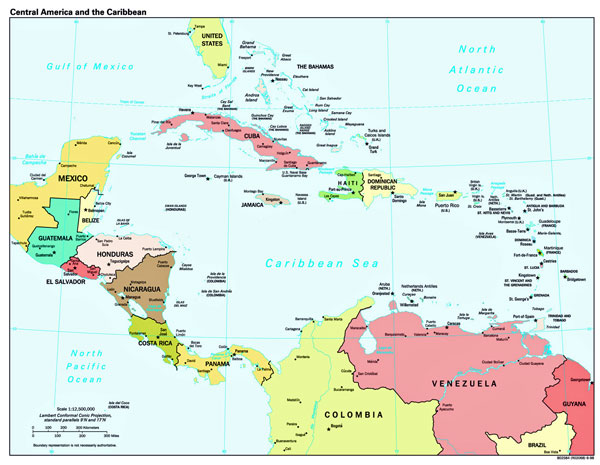
Costa Rica followup: Monroe Doctrine means it’s all ours

centralamerica.jpg
America’s backyard

We still haven’t heard one peep from the commercial media/entertainment news corporations (even the simple fact that something’s happening), but Mark Vorpahl has written an articulate and persuasive description of what’s really behind the U.S. flotilla en route to the southern Caribbean (Mare Nostrum, or our “Fourth Shore”), “The U. S. Military Moves Into Costa Rica“.
I am entirely in agreement with his conclusions. Anyone who would prefer not to be completely surprised by another shooting war, or the next U.S.-backed coup attempt, should read what he has to say.
An excerpt:

Most of these measures [recent U.S. military operations in Central and northern South America] have been justified on the grounds of combating drug trafficking, including the military buildup in Costa Rica. However, they have not curtailed this problem at all. Such U.S. military buildups have generally been accompanied by an increase in drug trafficking, as has happened in both Columbia and Afghanistan. Based on this record it can only be concluded that the “War on Drugs” rationale is a red herring for public relations consumption, not the actual motivation.
This military build up in Costa Rica is the latest in a series of moves the U.S. has made in Latin America that seeks to use threats and arms to reverse the strength of popular anti-imperialist forces across the region. The U.S. is playing with the possibility of erupting a continental conflagration for the sake of corporate profits.
While it is doubtful that the U.S. wants to directly engage in a military conflict with, most likely, Venezuela right now, preparations for this possibility are being made. What is more likely in the short term is that the U.S. military will use its forces to engage in sabotage and intimidation in hopes of reversing support for the nations aligned with ALBA. It is also very possible that the U.S. military will help to support proxy armies, such as Colombia’s, in military conflicts that align with U.S. interests. However, this is a dangerous game. Even in the short term, the U.S. ruling class may drag the nation into another direct conflict, in spite of their intentions, that could spread to involve numerous other nations.

[image from Map of the United States (the irony was not likely intended)]

Costa Rica asks for U.S. invasion; U.S. media silent

coca.jpg
Coca (Erythroxylum coca)

ADDENDA:
This extended discussion on Upside Down World, published July 15, includes a statement that the idea of the U.S. military presence did not originate in a request from Costa Rica; rather it was initiated by the U.S. in a diplomatic request from the US Embassy made on July 1.
Also, in its own post on the Costa Rican story [in Spanish, but easily translated], the Comisi�n Intereclesial de Justicia y Paz describes the operation as “continuing the process of the militarization of Central America” and refers to it as a part of the continuing U.S. agenda for Latin America, which has recently seen the establishment of seven bases in Colombia, intensified militarization in Honduras and Haiti, the announcement of new bases in Panama.

On July 2nd the Congress of Costa Rica authorized the entry of 46 U.S. warships capable of carrying 200 helicopters and warplanes, plus 7,000 U.S. Marines “who may circulate the country in uniform without any restrictions”, plus submarine killer ships, to the Costa Rican coast for “anti-narcotics operations and humanitarian missions”.
Where’s the outrage? Actually, where in fact is the news?
I have not found a single line on this story anywhere in the MSM.
I think the media silence is probably the first thing which should be questioned (have we all, including the world at large, become inured to yet another attestation to the expanding American imperial lust?).
But I am just as shocked by the news itself. Why is this happening?
Is it because we’ve done so well with both our former and continuing foreign wars and interventions? Is it because we’ve done so well with our internal war on drugs, or because our impact on the drug traffic in other countries has been so benevolent?
Or does it actually have nothing to do with interventions, or drugs? I’d like to hear from people who are familiar with Costa Rica and have followed the events about which we currently hear nothing.
So far Costa Rica is only asking for “help”, but remember how “helpful” our innate imperialist impulse has been elsewhere for two centuries. I can’t imagine why any Latin American country would actually welcome the arrival of the U.S. military, unless of course there were banana kings running things at the top, or at least a right-wing regime, and they/it were worried about losing control. Oh, wait, bananas are still a major Costa Rican export, and the government, while enlightened, is still composed of members of an entrenched oligarchy, and by most accounts its biggest concern lately has been “security”.
The current president, Laura Chinchilla Miranda, who follows the modest centrist welfare policies of the National Liberation Party and promises to continue the free-trade policies of her predecessor, �scar Arias, is a social conservative who opposes abortion and gay marriage. But, more significant to the story of her nation’s call for U.S. Military help, she ran on a platform which promised to be tough on crime, and it included a larger and more professional law enforcement establishment. Sworn in two and a half months ago, one of her first acts was to create the nation’s first anti-drug “czar”, whose office is a part of the cabinet.
For half a century Costa Rica had enjoyed peace and political stability, and, overall an impressive growth in economic prosperity and social welfare systems, but beginning in the 90’s the country began to witness the rise of its own version of American neo-liberalism, which threatens the moderate socialism built up in the previous decades. It all sounds very American to me. The only thing missing was a security panic of their own and an indigenous drug war, and they’ve just ordered both.
But not everyone in Costa Rica is happy.

For a good discussion of the issues (with some reservation about a mostly-irrelevant postscriptive remark about the brave and unselfish volunteers in uniform), go to Costa Rica Blogger.

[all thanks to artist Pedro Velez for the Comisi�n Intereclesial de Justicia y Paz post alert]

[image from Wikipedia]

June 28 again, and all not so quiet on the eastern front

All_Quiet_On_the_Western_Front.jpg
the enemies finally come face to face

We watched the restored version of “All Quiet on the Western Front” at home late last night. Before yesterday I had neither read the book nor seen the film. This early talkie, an eighty-year-old masterpiece, has survived, both as art and as a surprisingly strong piece of theater. It’s terrifying, when it’s not heart-braking, and there’s nothing maudlin or melodramatic about it.
It’s an extraordinary film; don’t wait for the remake.
As if it just watching “Front” were not already enough of a profound and moving experience, today we learned that the event that precipitated The Great War. The conflict that inspired Remarque’s seminal anti-war novel, and Russian-born Louis Milestone’s 1930 film of the same name which was based on the world-wide best-seller, occurred exactly ninety-six years ago (still within living memory – of at least a very few). While today is the anniversary of the assassination in Sarajevo of the heir to the Austro-Hungarian throne, It’s also the anniversary of the Versailles Treaty which officially ended the hostilities between the remaining major combatants. That accord was signed ninety-one years ago today.
The war was supposed to be “the war to end all wars”, the phrase a perverse, but catchy rationalization which was actually invented early on by its most enthusiastic champions.
It’s clear however that, as the direct heirs of its horrors, which include the Second World War, among others, we haven’t learned a thing in the intervening years. This is in spite of the hopes of the remarkable German author of “Front” and most of the people connected with the film, including its fictional chief protagonist, Paul B�umer, and the very real pacifist actor who played him, Lew Ayres.
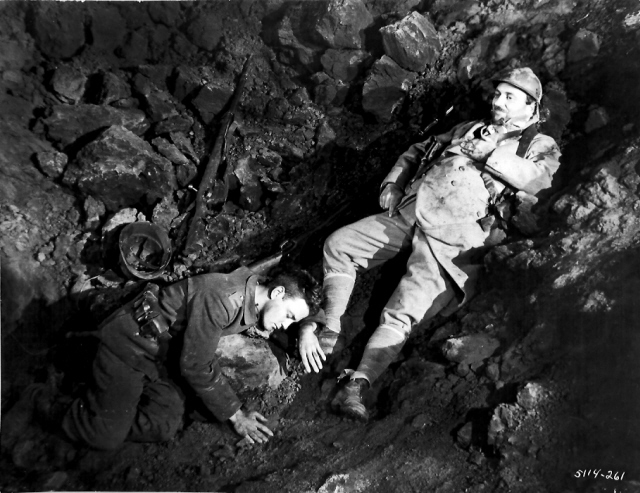
In the image above Paul is lamenting the death, by his own hand, of a French Soldier who had lept into his trench in the chaos and heat of a particularly violent infantry battle.
In the Turner Classics commentary supplied with the DVD, film historian Robert Osborne sincerely and persuasively proposes that subtitles be created in every language, that the film be shown to people all over the world, and that they should see it again and again, once every year.
But today a country whose people mistakably believe themselves to be the most peace-loving on earth, have created two optional, trillion-dollar, asymmetric wars, killing fields inside dirt-poor nations which have no working governments, on the other side of the planet, and it seems we can give no justification for our continuing these wars other than the fact that we are at war(s). In retrospect, a century later, even the fools and jingoes who marched off in 1914 don’t look so singularly absurd as we once thought they did.
Besides, while the number of casualties in 1914-1918 certainly dwarf the total of all losses in the Middle East, that war was at least brought to a halt in four and a quarter years. Our own, current madness has already gone on twice that long.

[image from leftofcybercenter]

the real meaning of Memorial Day (or Decoration Day)

decoration-day-civil-war-holiday-patriotic.jpg
but where’s the gray, and, for that matter, the colors of our countless other fallen foes?

And it’s not for generals.
It seems Memorial Day is not supposed to be just about hot dogs, the Indianapolis 500, or summer whites. In fact the holiday formerly known as Decoration Day (the official name by Federal law until 1967) wasn’t even originally owned by war veterans. While today it commemorates Americans who died in any war throughout our extraordinarily-aggressive, warlike history, it was first enacted in response to the horrors of a civil war. The date itself, now established as the last Monday of May, was originally determined by the month of the final surrenders which marked the conclusion of the American Civil War.
But its disjointed history is actually far from the tidy story which an official declaration might seem to suggest.
What became Decoration Day, and eventually Memorial Day, had many separate origins. Towns in both the North and the South were already memorializing their recent war dead, and “decorating” their newly-dug graves, in spontaneous observances in the years before the 1868 official proclamation by General John Logan, the last national commander of the Grand Army of the Republic, in his “General Orders No.11”.
The holiday the general created was first observed on May 30, 1868. Flowers were placed on the graves of both Union and Confederate soldiers at Arlington National Cemetery. That cemetery, incidentally, was located on land the U.S. government had appropriated from Robert E. Lee at the beginning of the war, a development likely to have made an significant impression on the defeated South as much as on the Lee family itself.
Within two decades or so all of the northern states were observing the new holiday, but the South refused to acknowledge it. This should not have surprised anyone, either then or since. Even though the date May 30 had been picked precisely because it was not associated with any battle or anniversary, the observance itself was tainted by its association with the victorious and hated Union.
The various states of the old Confederacy continued to honor their own dead, on separate days, until after World War I, when the holiday was broadened to include not just those who died fighting in the Civil War but Americans who died in any war. Even then, most of the states of the old South still maintained separate days for their own dead, and do so to this day, although with varying degrees of enthusiasm.
I checked into this history yesterday when I was trying to decide whether I could honorably display the antique 48-star flag I’ve had for almost 40 years (antique in fact when I acquired it). I had kept it in a Chinese camphor-wood trunk for decades because our flag had come to be associated almost entirely with American jingoism; it had been hijacked by the crazies on the Right. Although I still had my doubts about the direction of this country even after Obama’s 2008 victory, I pulled the old banner out and hung it in the apartment last year, on the day of his inauguration, and again a few months later on July 4th.
Bush’s wars have now become Obama’s wars, and my very tentative interest in flag-waving, even flag-hanging, has (please excuse the choice of word) sort of flagged, although I still find things to love about this increasingly dysfunctional country.
When do we get a holiday celebrating the peacemakers? Of course that’s entirely a rhetorical question, coming from a citizen of a country which has almost never not been at war somewhere.
I went to Wikipedia in my search for a quick answer to my question about the original significance of the day we celebrate today mostly as just another excuse for a long weekend. There I learned that one time the holiday many originally associated with uncomplicated patriotic sacrifice did not mean the same thing for everyone, even in the 1860’s. In the Wikipedia entry for “Memorial Day: History”, I found this very moving and evocative window onto an America which was cursed to know war far better, and was far more weary of and horrified by it than our own:

At the end of the Civil War, communities set aside a day to mark the end of the war or as a memorial to those who had died. Some of the places creating an early memorial day include Sharpsburg, Maryland, located near Antietam Battlefield; Charleston, South Carolina; Boalsburg, Pennsylvania; Carbondale, Illinois; Columbus, Mississippi; many communities in Vermont; and some two dozen other cities and towns. These observances coalesced around Decoration Day, honoring the Confederate dead, and the several Confederate Memorial Days.
According to Professor David Blight of the Yale University History Department, the first memorial day was observed by formerly enslaved black people at the Washington Race Course (today the location of Hampton Park) in Charleston, South Carolina. The race course had been used as a temporary Confederate prison camp for captured Union soldiers in 1865, as well as a mass grave for Union soldiers who died there. Immediately after the cessation of hostilities, formerly enslaved people exhumed the bodies from the mass grave and reinterred them properly with individual graves. They built a fence around the graveyard with an entry arch and declared it a Union graveyard. The work was completed in only ten days. On May 1, 1865, the Charleston newspaper reported that a crowd of up to ten thousand, mainly black residents, including 2800 children, proceeded to the location for included sermons, singing, and a picnic on the grounds, thereby creating the first Decoration Day

So, the real meaning? I don’t think we have agreement even now, and for myself I haven’t yet decided whether to pull that faded old cloth from the trunk tonight.

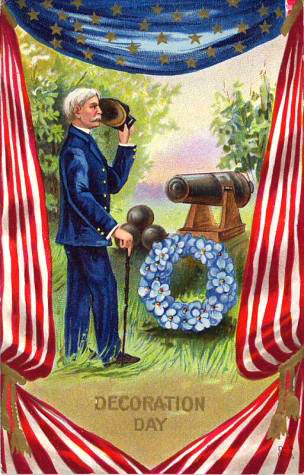
[image of pre-WWI Decoration Day postcard from vintagepostacards]

8th anniversary of jameswagner.com

eighth_anniversary.jpg

Today is the eighth anniversary of this blog.
I said it last year, and I’m delighted and incredibly privileged to say it again: This is also the anniversary of what turned out to be the most important event in my life, the night Barry and I met (now nineteen years ago).
Last year I also wrote, looking at the world outside our circle of close friends, that I was “more upbeat about the world” than I had been the year before, the eighth year of our second Bush, adding, “but only a bit”. That hasn’t changed, a bit.
And happy birthday, Paddy Johnson!

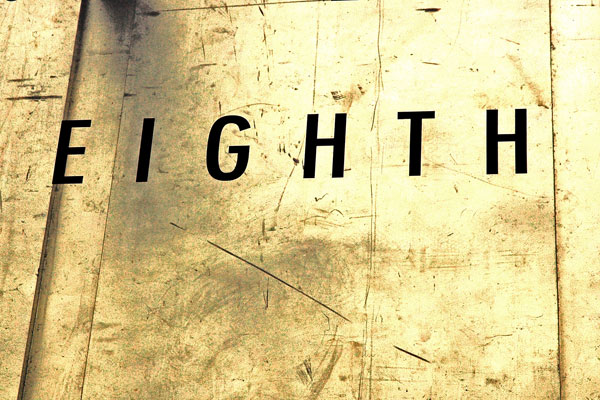
[the image is of a portion of the street number on the glass above one of the Art Deco entrances of the former Port Authority Commerce Building (1932), 111 Eighth Avenue the wall seen several feet behind the glass is covered with gold leaf]

BHQF’s “We Like America” at Whitney 2010 Biennial

Bruce_High_Quality_We_Like_America.jpg
Bruce High Quality Foundation We Like America and America Likes Us 2010 vehicle and educational implements, dimensions variable [detail of installation]

ADDENDUM: [April 30, 2010] The entire sound video projected onto the inside of the windshield can be viewed here on vimeo, although as the April 20 comment at the bottom of this post (which alerted me to the link) says, it’s not quite the same isolated from the ambulance/hearse; the experience of the darkness of the installation itself, the imperfect acoustic of the space, and the murky projection, can’t really be reproduced on a computer screen.

I feel good about the Whitney 2010. While I like excitement, I resist hype like the plague. This Biennial has been accompanied by neither, which at the very least gives visitors a better chance to experience the individual works for themselves, and unencumbered with a theme. There is some very good, even awesome work on the three floors of the exhibition I saw at the preview (the floors not devoted to favorites from earlier years), but for me none of them had so fundamental an impact as the Bruce High Quality Foundation installation, “We Like America and America Likes Us”.
In “Art Class“, a 2007 piece published on Artnet, Ben Davis had described Picasso’s “Guernica” as “the most successful political image of the 20th century”. His argument was that isolated artistic gestures cannot resolve social contradictions “without any social movement backing them up to give them force”, continuing:

This does not mean that art or artists cannot play any political role; it is just that some model besides the middle-class one of “my art is my activism” is necessary, one based on concrete solidarity and practical action. Picasso�s Guernica is the most successful political image of the 20th century. Guernica, in fact, embodies the fact that art�s political value is determined in its relation with mass struggle, not in its individual content — the imagery of the painting, moving as it is, is completely drawn from a vocabulary of forms Picasso had already developed in previous work. Yet, during the Spanish Civil War, after its appearance at the Spanish Republic�s booth at the 1937 World�s Fair, Guernica was literally removed from its stretchers, rolled up and toured internationally to win support for the Republican cause. In England, visitors brought boots to send to the front.

The Bruce High Quality Foundation seems to be taking a different route with its own institutional, social and political critique, probably one more suited to our own politically-lethargic times. Bruce’s confrontations with our own tropes have been found just about everywhere: on our streets, our waters, our public plazas, even inside the galleries and expositions of the system they speak to.
I have to confess to a penchant for political art, and to a number of years spent in sort of a groupie relationship to this arts collective, and yet “We Like America and America Likes Us” is one of the most affecting works, in any genre, I’ve ever encountered. Where do we bring our allegorical boots?
We are all wounded, wrapped in felt. Are we inside an ambulance or a hearse? What is to be done?
Like much of what Bruce does, it’s not conventionally “beautiful” – except as truth is beauty, and yet the incredibly elegiac recorded remembrance of “America” which accompanies the fast video montage of heterogeneous clips projected onto the tall Cadillac windshield is riveting, and profoundly moving.
I don’t know the length of the loop (and there was no indication on the museum’s wall text); but for all I know it could be as long as the melancholy story it tells.
Especially for those who will not be able to visit the Whitney, I have some excerpts. The text, recited by a luscious, soothing female voice, begins:

We like America. And America likes us. But somehow, something keeps us from getting it together. We come to America. We leave America. We sing songs and celebrate the happenstance of our first meeting � a memory reprised often enough that now we celebrate the occasions of our remembrance more often than their first cause.

And a little later I listened as the gender pronouns slithered over each other in ecstasy, and in sorrow:

We wished we could have fallen in love with America. She was beautiful, angelic even, but it never made sense. Even rolling around on the wall-to-wall of her parents� living room with her hair in our teeth, even when our nails trenched the sweat down his back, and meeting his parents, America stayed simple somehow. He stayed an acquaintance, despite everything we shared. Just a friend. We could share anything and it would never go further than that.
No one really knows how love begins. A look on his face one time after we�d made love � a text message too soon after the last one. When did we become a thing to hold on to rather than just something to hold? We didn�t know America was in love with us until it was too late. Maybe we couldn�t have done anything about it anyway. America fell in love with the idea of us, with some fantasy of us, some fantasy of what America and us together would be, before we had a chance to tell him it could never work, we weren�t ready for a relationship, we weren�t comfortable being needed, we didn�t have the resources to be America�s dream.
It wasn�t easy letting America down. As we stuttered through our rehearsed speech we watched the change on her face. We could see the zoom lens of her attention clock away. We could feel ourselves receding back into the blur of the general population.

The last lines are:

There was a time we thought we were nothing without America. When she left, we realized all the excuses we�d been making. All the problems we�d been trying not to address. We drunk dialed our memory of America just to hear what we were thinking. We worked late and we told ourselves we had to, that the work came first, that this was an important time in our lives and that love could wait. Just wait a little longer and we�d fix everything, we�d say. Solving the America problem, our lack of attention, our disinterest in sex, our never being home, our thinking of her as a problem � it would have to wait.

Bruce_High_Quality_We_Like_America_rear.jpg
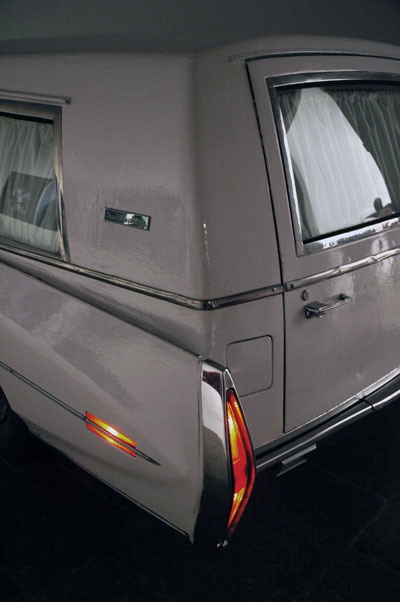
[installation view of the rear of the curtained 1972 Miller-Meteor ambulance/hearse]

[text from the audio of the installation courtesy of the artists]

our security lies not in the TSA, but in ourselves

William_Blake_Hecate.jpg
William Blake Hecate or the Three Fates 1795

“The fault, dear Brutus, is not in our stars, but in ourselves, that we are underlings.”
[Cassius, in “Julius Caesar”, Act I, Scene II]

The stars, the fates, Hecate, Parcae, Fata, the norns, the three sisters, they’re us, and we should start acting like we know it.
The Transportation Safety Administration can’t give us security; it’s in our hands. All of the grotesque, costly, and invasive measures the TSA has already introduced, or might still introduce, are only reactive, and cannot match the efficacy of the initiatives which a look at the broader geopolitical picture would demand. We should also remember that all the current fuss is about passenger air travel, which is only a tiny portion of our national security responsibilities.
The only comprehensive security measure that makes any sense, and which incidentally would be acceptable to, if not applauded by, the entire world (including air travelers everywhere) would be an elimination of the cause, not a continual search for the effect of the intense resentment and hatred behind suicidal and other terrorist acts.
We should begin by looking at ourselves as others see us. We should end all of our current, totally optional wars, close the U.S. military bases and operations currently located within�well over 130 countries, and begin to show a decent respect for the cultures of other peoples.�
Of course it would also be helpful if we could actually bring ourselves to extend real foreign aid, not military hardware, and only where it can be constructive, not where we believe we can buy love or increase our own wealth.�

[image from poor old dirt farmer]

the last soldier to die for Obama’s image

HOW DO YOU ASK A SOLDIER
TO BE THE LAST SOLDIER TO DIE
FOR A PRESIDENT’S POLITICAL IMAGE?


I’ve taken some liberty with David Sirota’s phrasing in the title of his blog post today, but I’m totally with his meaning, having pounded on that wall myself two days ago.
After discussing and then easily dismissing alternative explanations for Obama’s decision to extend and expand our eight-year-long military effort to subdue or occupy Afghanistan, and before asking the question contained in his headline, Sirota poses and answers his own question about the President’s Afghan “surge”:

Is it really worth putting 100,000 Americans at risk for the next few years exclusively to protect the political image of a president? More specifically, is it worth putting those 100,000 American lives on the line so that President Obama can fulfill the media and political establishment’s artificial definition of “strength”?
I certainly don’t think so, and I think it’s an almost unprecedented level of immorality [my emphases].

[this is the first post in a very, very long time for which I have not uploaded some image, either my own or that of someone else, which I would credit within these brackets; this time I felt that the subject itself was too obscene, its implications to graphic, to be captioned with anything so direct, and yet so particular, as a picture, and I thought no image could match the imagination of the reader]

so it’s to be more war.

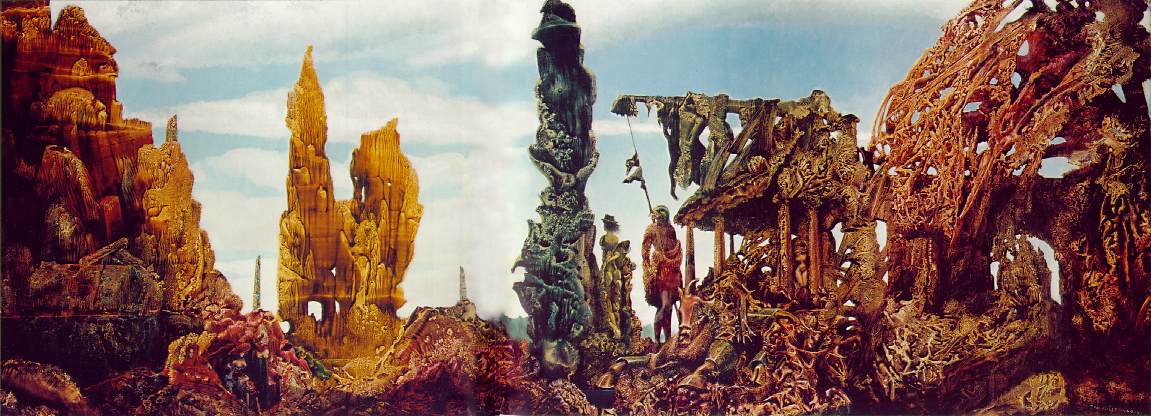
Max_Ernst_europe_after_rain.jpg
Max Ernst Europe After the Rain II 1940-1942 oil on canvas 21.5″ x 58.25″

It’s what we do.
For a while, I actually had hope he might do the right thing, although I realize now I had no reason to think so. Consequently, when the news finally came it made me physically sick: There will be more war, much more war. And the reason we’re being given? Because we’re at war.
Does he think we’re all fools? Are we?
It was entirely fake: The endless reports over the past four months which had some of us believing that Obama was agonizing about what to do with the war in Afghanistan. I don’t believe he ever intended to end this nation’s disastrous, and possibly fatal, misadventures in Afghanistan (and where will we go next?), and there’s no reason to believe he ever considered anything other than the mindless policy of escalation General McChrystal ordered his faint-hearted commander to undertake four months ago. The fact that it took Obama so long to order tens of thousands of additional troops to join one more Western fools mission in the Middle East does not reflect intelligence, judgment or compassion, only cowardice, not least since the order was given even before the grand public announcement he will deliver at West Point tonight, that sacred heart of the military establishment (shades of Bush – but what is this President afraid of?).
I wrote here about my distrust of our newly-elected President over a year ago. Eventually my skepticism grew into disgust, and I wrote about Obama’s disastrous record as President, listing dozens of the promised, anticipated or implied reforms that were to come with the new administration but which were not accomplished. I stopped counting the “un-change” months ago, and I’ve seen nothing that might alter my opinion of our President’s incompetence, or wrongheadedness (I’m not sure which it is).
I think the latest and best assessment of our Chief Executive, now as a public officer who has failed the crucial test of a Commander-in-Chief, is contained in this awesome piece by Michael Brenner.
The first and last paragraphs are:

The sham Afghanistan strategic review is now revealed for the empty exercise it always was. Escalation was inescapable, for Obama’s staunch promotion of a ‘necessary war’ precluded a serious reappraisal of stakes and risks. Reversing himself would have demanded the kind of courage that is wholly foreign to him. So we are left with an open-ended commitment to an unwinnable war. That outcome speaks volumes about the failings of Obama as a leader as much as his impaired judgment.
. . . .
The country is ill served by a president who fails to meet his responsibility for the rigorous, open debate on matters of great consequence that he pledged and that is imperative for avoiding more dismal failure. What is the value of a 150 I.Q. when bereft of wisdom or conviction to guide it? Obama’s audacity in pursuing his ambition is one thing; political and intellectual courage is quite another.

Bob Herbert’s column in today’s Times explains why weak politicians can’t be trusted when they talk (publicly) about war.

[painting from the Wadsworth Atheneum collection; image from different.com]