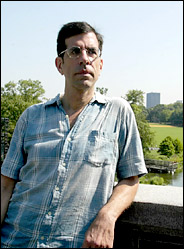
Bill Dobbs

dobbs.jpg
“life could be beautiful”

I really like him. Those who know William K. Dobbs know that’s not so easy to say, but now that he’s become the subject a modest but delightful profile in the NYTimes, written by Michael Brick, it may be easier for me to explain why.
Sure, from the very first time I heard him speak in front of an ACT UP meeting in the late 80’s I’ve always respected him, as virtually without equal among some really tough competition, even if early on that also meant hoping I could stay out of the line of his fire, the kind of fire usually associated with biblical prophets. In the years since however I’ve managed to overcome some of my timidity and the rewards of knowing him just a bit better include (and he’d laugh at me for this) real affection.
He was admired for his mind and his integrity throughout the activist community from the very beginning, but he could be intimidating. His devotion to principle was uncompromising. We may have been wrong, but most of us had the strong impression that he would not be easy to know personally. Saints can be extremely tough to live with.
Dobbs stayed around. Within the AIDS and Queer movements the authority of his stentorian voice and his facile pen represented a strong focus and a highly-intelligent conscience within groups with many rivals for those roles, but few equal to or even faintly resembling Bill. I think we were all fascinated with our mysterious intellectual Clark Kent. There were certainly many crushes.
Today Brick describes Dobbs as “a main organizer and the official spokesman of United for Peace and Justice.” How did he get to opposition to the Iraq war, the Bush administration and eventually both major political parties from the more narrow focus of his earlier activism? It’s not a big step for for many of us, but here’s Dobbs’s account:

“Gay is the lens that I look at life through,” he said, sitting recently in a diner near Madison Square Garden, the convention site. “Is there a connection between that and antiwar work? I feel a connection, but it’s not easy to articulate. It’s about power. It’s a visceral need to stop war based on the lessons I’ve learned as a gay man.”
. . . .
Mr. Dobbs says he is motivated to protest by the cruelty of fate, the nature of power and the virtue of free expression. “Life could be beautiful, but it won’t,” he says, paraphrasing Lily Tomlin. “What’s wrong with the world?”

OK, but like Bill himself, we’re still going to keep trying to make a difference. Let’s get out there this weekend (and stay out there for as long as it takes), let’s make it very colorful and let’s keep it very safe.

[image from the NYTimes]

the police occupation of Chelsea

policepost.JPG
Area frozen!
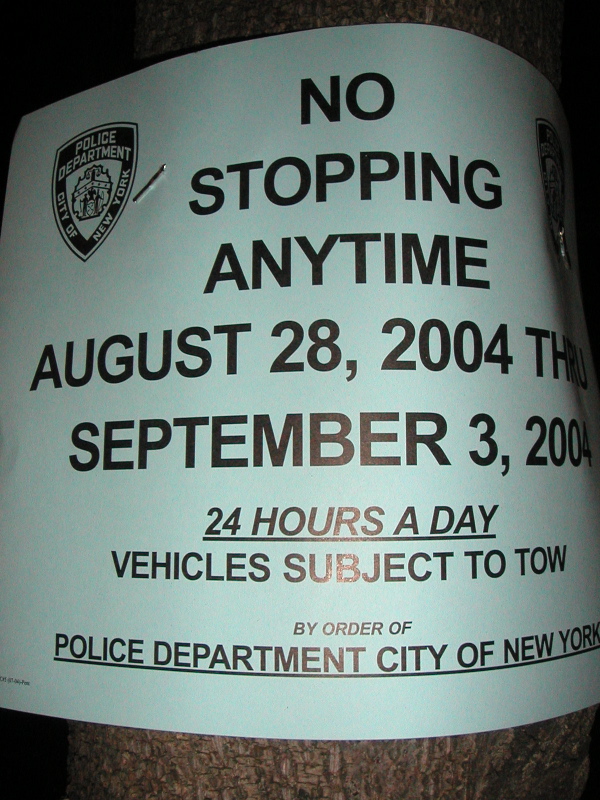
We arrived back at the apartment tonight at midnight after an evening in Williamsburg and the first thing we spotted as we exited our friend’s car was this sign.
How much of New York are the Republicans going to need? Even as of this morning we were still being told that few streets other than those immediately surrounding Madison Square Garden (which occupies the two blocks between 31st and 33rd Streets) would be impacted by police security measures for the Republican Convention. In fact, even the closing of 8th Avenue from 23rd Street to 34th Street was to be effective only during the hours the Convention was in session.
These signs are posted every few feet on both sides of the broad crosstown course of 23rd Street, at least along the block where we live, between 7th and 8th Avenue (I haven’t yet looked further afield; maybe tomorrow).
Are we going to find a military staging area set up outside our windows on Saturday morning?

the enemy is here, not in Iraq

The judge has just said no to the coalition, United for Peace and Justice, but no judge can tell individual free Americans and their friends to stay out of Central Park on a Sunday afternoon.
It’s still our park, not Bloomberg’s, and we’re going to be there four days from now.
At the end of the march up 7th Avenue, after the crowd passes the site of the Convention, the police may be successful in dispersing half a million people in every direction. Tens and hundreds at a time may be diverted east and west as they arrive at 34th Street, but everyone knows Central Park is the destination. Half a million people will end up in the Park, but now half a million people will have to obstruct more than just one avenue as they make their way north to our great public Commons.
What cannot be known is whether and to what extent this passage will be accomplished without police violence. While it would be of no comfort to liberty, to the movement or to individuals who might feel it physically, any violence will be the fault of one incredibly myopic mayor.
The war has finally come home, but the enemy isn’t in Iraq.

FOOTNOTE:

Justice Jacqueline W. Silbermann wrote in her ruling that the protesters’ group, United for Peace and Justice, was “guilty of inexcusable and inequitable delay” in bringing its case against the city, according to The Associated Press.

In fact, UfPJ applied to the City for the Central Park permit early last year, but received no reply until this past July.

talking back to the little man in the White House

Even when I try to just do a “culture” post these days I often find I have to add it to the “political” category as well. But it’s a sign of our dangerous times, and if I have a complaint, it’s about the times, not the signs.
Last night we visited the oddly festive, and certainly very social, opening of “amBUSH!” at the Van Brunt Gallery, recently installed on Washington Street in the former meat market district below 14th Street.

Historical note:
The clean, well-lit space occupies almost the exact site of the legendary 1970’s-80’s gay sex club, the Mineshaft.

In a routine which has become familiar in Bloomberg’s New York, while we were with the crowd inside we were suddenly joined by several uniformed police (we seem to have a surfeit of these in the last few years, and especially this summer, but at least they weren’t carrying assault rifles this time) who were very concerned about guests sipping wine outside the packed rooms and obstructing free passage on the sidewalk.
I never saw the police there on my rare visits around twenty-five years ago, but if they ever did make an appearance then, it would not have been the wine or the sidewalk which attracted their interest. On the other hand, decades ago there wouldn’t have been a dozen miniature cameras documenting cops while they talked to the proprietor of the establishment. We love cameras.
The sensual goodies available last night, and available continuing through September 18th, were of a special kind. One of the show notices had announced, “The message of this exhibition is simple: Bush must go!” Some 36 artists exhibited twice as many angry works, with varying kinds and degrees of success, none of them leaving any doubts about their passion or commitment. For visitors who won’t be satisfied with a passive political role even inside an art gallery, there are a number of participatory stations throughout the show. Raise some creative hell, or just tell the White House what you think.

jonesneal.JPGjonesnealscreen.JPG
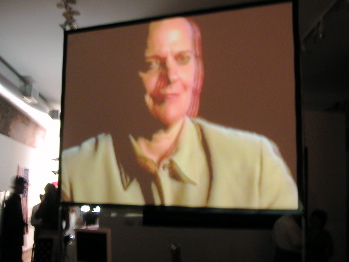
Some time after 8 o’clock an additional dimension was supplied by a musical and video performance, “TERRORVISION,” created and performed by Bill Jones & Ben Neill.

First screened/performed at Exit Art, Spring 2004, it consists of four linked computers–a “Power Book band”–that merge Neill’s three-belled, computer interfaced mutantrumpet, keyboards, and other instruments with live MIDI controlled digital video. They play the moving pictures to create “video remixes” breathing life into real-time and recorded video. Expect everything from deep ambient soundscapes to funky electronic breakbeats.

Exactly.

engler.JPG
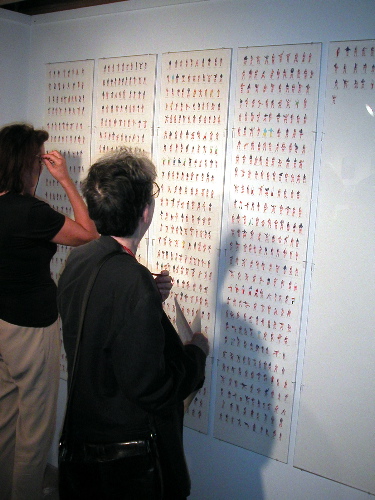
Elise Engler showed a pencil-drawing quintych, “Wrapped in the Flag,” begun last year, which now represents 1087 dead soldiers in Iraq, although it’s unfortunately a continuing work.

Smit.jpg
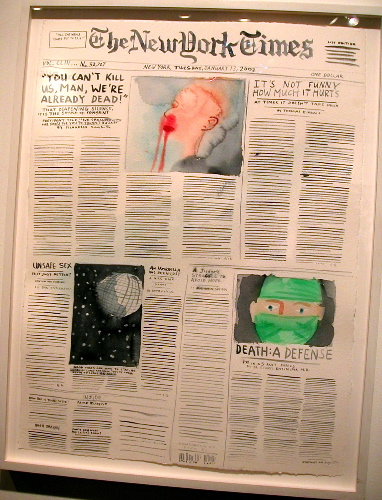
Guy Richards Smit included “You Can’t Kill Us, Man, We’re Already Dead,” in a statement still obvious to only a few Americans.

blackboxAFOne.JPG
Associated Artists for Propaganda Research, with their installation, “The Black Box (Downing of Air Force One),” may be the most incendiary contribution. Phew.

HumphreyBush.JPG
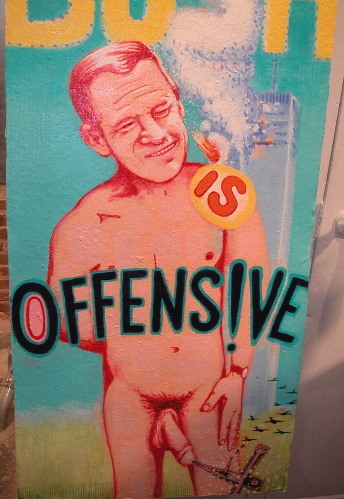
David Humphrey‘s cardboard sign, “Bush is Offensive,” might be considered in arguable taste in some circles, but it will be eminently practical in others, especially this week and into the next: It’s equipped with a convenient handle.

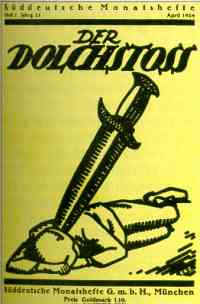
our own “Dolchstoßlegende”

Dolchstoßlegende.jpg
but we won’t let go of our own myth

Thirty years on, the Viet Nam War still has the power to enrage both those who survived its battles and those who stayed at home, and it now seems that a new generation may have inherited its unreason. The War remains a particular obsession for the American Right, and its memory is a fundamental component of the ideology of today’s neoconservatives as well as a very useful political instrument.
We don’t seem to have learned a thing.
It only took the Germans 25 years to get over their own stab-in-the-back legend (Dolchstoßlegende), even if 40 million people had to die first. In the U.S. our own version of the betrayal myth has already survived 36 years, and it has performed an ugly role in every major election since 1968. While we haven’t scored numbers nearly as big as the old German militarism did beginning in 1939, the great and endless war declared after September 11 offers all kinds of opportunities for the future.
The beautiful new world I saw created by the end of the 1960’s by what seemed to be a new Enlightenment seemed to be confirmed in its success with the victory of the antiwar movement and the end of the Viet Nam War. We had finally come to our senses in our politics both at home and abroad. I thought at the time that the absolute rightness of the movement had ensured the success, and would guarantee the permanence of both Liberalism and the Peace Movement.
Only a few years later, some time after emerging from living in a place and a period on the other end of the earth and of modern times (1970’s Apartheid South Africa), I was shocked to find that virtually all that had been accomplished by the 60’s was being gradually reversed by a new, subtle Reaction. I confess that although I had studied history almost all my (then) young life, my loyalties and my naivety allowed me to imagine things would just get better and better.
But even then I did not notice the degree to which this country had been unable to resolve the problem of Viet Nam. Of course I myself no longer saw any problem. Today however, because of the most recent absurd developments in the current Kerry/Bush campaigns, I believe that national divisions over that war are likely to survive even the death of the last participant, not unlike the way its nearest relation, the Civil War, remains an enormous presence almost 150 years after it began.
May we somehow still be saved from demagogues, fools and our own ignorance.

[image from Städtisches Louise-Schroeder-Gymnasium]

but can we survive even a Kerry victory?

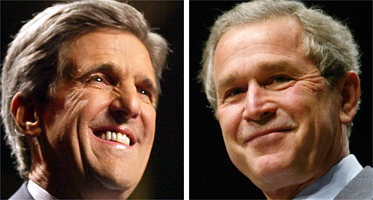
bushkerry.jpg
Tweedledumdee

That’s it! I’m not voting for Kerry. The man wants to be remembered as a hero, and with good reason, but he wants to hide the one part of his history which finally distinguished him as a truly great hero, his noble efforts to end the Viet Nam War. And the reason is that he’s desperate to establish credentials as the same kind of warrior who thirty and more years ago ran the insane conflict from which he was fortunate to escape with his life. On war, including apparently even the War in Southeast Asia, and on just about every other subject he has addressed during his candidacy his position is almost indistinguishable from that of George W. Bush.
I have to admit that it’s only because New York State has absolutely no chance of awarding its electoral votes to Kerry’s Commander-in-Chief that once again I will not have to contribute to the end of the American experiment by voting for either of the Right-wing candidates held up by our two Right-wing parties.
Of course if I were unfortunate enough to find myself registered in one of those confused realms whose voters four years ago didn’t seem to understand what was happening to them, I would probably find myself holding my nose tightly with one hand while I flipped the lever or touched the screen for the Democratic Party’s candidate on November 2, hoping it might help my state swing toward Mr. Anything.
Kerry and the Democratic Party offer little more than somewhat inferior copies of what Bush and the Republican Party already represent very well. Most progressives would like to ignore this, operating on the now-familiar and almost universal, desperate principle of “Anything But Bush.” Alexander Cockburn writes in The Nation this month,

Can someone win the presidency entirely on the basis of a negative asset? I wouldn’t have thought so, but here’s John Kerry, just about 90 days shy of election day, promoting himself as a man of presidential caliber entirely on the basis that he’s the Anyone in “Anyone But Bush”. Aside from the flag wagging , that’s what it comes down to, unless you take the probably realistic view that when it comes to war-fighting in the service of Empire he’s far more bloodthirsty. Come next January the Anyone behind the desk in the Oval Office may be a bit taller. There’ll be medals on the book shelf showing he killed Vietnamese in the service of his country. Most everything else will stay the same. Kerry’s been pretty clear about that, letting his core constituencies know that as President Anyone he’s not going to cut them any favors.

One more, very prococative thought, and I’ll close down for the night. In the same article Cockburn reports the real concern which Andy Stern, head of the Service Employees International Union, expressed to the Washington Post‘s David Broder on the floor of the Democratic Convention. Cockburn describes Stern as saying, “another four years of Bush might be less damaging than the stifling of needed reform within the party and the labor movement that would occur if Kerry becomes president.”
Stern later recanted, but I don’t think I’m the only one who wonders about the wisdom of his conversion.
Ralph Nader was there first, and he hasn’t left, bless him.

[image from MSNBC]

It’s about RIGHTS, Mr. Bloomberg, not your privilege

“A REPUBLIC, IF YOU CAN KEEP IT” – Benjamin Franklin

The Mayor is playing with fire.
Michael Bloomberg has dug in his heels, insisting that hundreds of thousands of New Yorkers and their guests will not be given a safe or appropriate venue for a protest rally scheduled for less than two weeks from today. Americans don’t need a “free speech zone” to assemble or speak freely, but everyone would be better off if the police weren’t positioned out there as an enemy army on a quiet Sunday in August.
I’d like to think that the Mayor will come to his senses and, contriving to show that he is fair, find some way to recognize that for a group of the size anticipated that day only an assembly in Central Park can protect liberties he has sworn to protect.
Make no mistake, there will be a march, and its route has been “approved” by the Mayor and the Police Department. But at this point in time, as indicated by the map on the site of United for Peace and Justice (UFPJ, facilitators for the coalition organizing the August 29 march and rally), the route of the march begins at 23rd Street and 7th Avenue, above a huge asembly area, and ends at Madison Square Garden, the site of the Republican Party’s own rally.
This means that although it was never intended that it would stop with 34th Street, at the moment the march route “sanctioned” by the police is only ten or eleven blocks long, enough room for only a few thousand people. Members of the coalition say they will procede to Central Park. The City authorities say they will not be permitted to do so. Those worthies are led by a Republican mayor who wants to “make nice” for the Republican Convention, and he says he won’t budge in his opposition to un-Republicans’ right to dissent.
In fact, yesterday Bloomberg declared,

“People who avail themselves of the opportunity to express themselves … they will not abuse that privilege,” he said at the John Jay College of Criminal Justice. “Because if we start to abuse our privileges, then we lose them, and nobody wants that.”

He seems to have learned well from the scoundrels in Washington who have already converted fundamental Constitutional rights into privileges available only at an executive’s discretion.
But since very few in New York are going to roll over for Bloomberg or the Republican carpetbaggers for whose patronage he has paid so dearly, the Mayor and his friends are playing a very dangerous game.
Already in March, in testimony before the City Council Public Safety Committee, the Manhattan District Attorney Robert Morgenthau said that he expects 1000 arrests per day before and during the Convention, and that his office would be hard-pressed to handle the dramatic increase.
The police are studying a specially-published guidebook on dealing with “dangerous” demonstrators, and they have been infiltrating the meetings of protesters and march and rally planners.
Only some demonstrators planning to appear August 29th will be aware that a little-reported exceptional court ruling will allow Morgenthau’s office to introduce previously court-sealed records of prior arrests for civil disobedience in order to award harsher penalties to those arraigned for activity during the Convention.
For many weeks, beginning even before the Democratic Convention in Boston, the FBI has been terrorizing dissent through its questioning of potential political demonstrators, and their friends and their families, about their plans to protest, issuing subpoenas in some cases.
All of these statements and activities have a chilling effect on legitimate expressions of dissent, but they also have the effect of radicalizing both the police and demonstrators who will not be easily discouraged.
Public authorities charged with protecting life and property have assembled the ingredients for an extremely volatile situation. If there is a disaster twelve days from now, does the Mayor think anyone will be served – other than a radical Right which, having picked this town for the site of its celebrations in order to profit from New York’s 9/11 grief, now somewhat disabused of the expectation that plan would work, may see advantage only in scenes of rioting or police confrontations?
Is provoking these confrontations, and possibly much more serious consequences, really part of someone’s plan? Is Bloomberg’s and his Party’s current course in New York, and the outrageous activity of the police and the FBI, a way of keeping down the numbers of protesters, of making sure that nobody comes out on the day of the march and rally except the most radical? There seems to be no other explanation for these absurd restrictions on freedom of speech and assembly.
Finally, if it already seems like the streets of New York on August 29th may end up looking and feeling something like many German cities did in the early 1930’s, then we won’t be surprised when the contemporary equivalent of fascist Brownshirts arrive that weekend to engage the protesters.
But it doesn’t have to be that way.
New York has no great square. Virtually every other city in the world has a major, central, open plaza which functions as the heart and soul of its people, and which has occasionally been the site of the greatest popular assemblies in its history, both glorious and mourned, but New York was historically always too busy or too greedy (ok, to put a good light on it, maybe just not autocratic enough?) to set aside a large piece of real estate just because it might come in handy. Times “Square” is only an intersection, after all. We do have Central Park however, and Central Park is our great Commons. It must be permitted to function as such on August 29th, and for the safety of every man, woman and child who will be out that day, and for the sake of their freedoms, Bloomberg and the Parks and Police departments must do what they can to make it go smoothly.
Those of us who will be there speaking with our bodies and our words will do our part.
We just want to show that we are still here; we must show that we are still here. Bill Dobbs, media spokesman for UFPJ, describes August 29th as one of only two opportunities we will have to say what we think of George W. Bush. We cannot miss either of them.

You can make a difference even before August 29

Bloomberg can’t be suicidal. He may still listen to reason. Let him know how you feel about the rights of speech and assembly.
NOT IN OUR NAME reminds us, “It’s not about the grass” (actually that was originally Dobbs’s call) and suggests we “politely” protest the city’s denial of a permit for the rally in Central Park on August 29 by emailing Mayor Bloomberg or by calling his office at 212-788-3000, and send a fax to 212-788-2460. Also let the Parks Commissioner, Adrian Benepe, know how you feel by calling his office at 212-360-1305.
have mass demonstrations become irrelevant?

CRIE DE COEUR

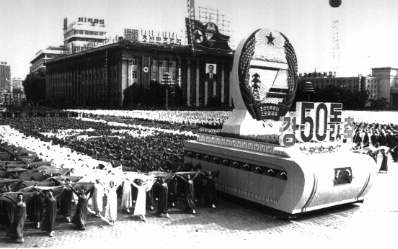
Koreandemo.jpg
the future of political demonstration?

I won’t represent or recommend anything other than non-violence on August 29, but I can’t help wondering how we could expect a peaceful (if we’re very lucky) demonstration involving 250,000 people, or even several times that number, to impact the Bush administration or the November U.S. elections. A year and a half ago, in sub-freezing cold, close to a million people marched in New York alone, joined by millions more around the world on the same day, demanding that the U.S. not engage in a pre-emptive war. Washington ignored us, the American media barely covered the phenomenon, and a few weeks later the Bush cabal invaded Iraq.
Like many others who watched these events, I’m wondering if traditional mass demonstrations have become irrelevant in a post-democratic society composed of a fat citizenry and a diseased media, and run by a corporate cabal. If so, what can we come up with instead? How can we effect change before the Republic is beyond repair if it is not already too late? I don’t think we have the half century some of our older, more patient sages suggest it will take.

[image from The People’s Korea]

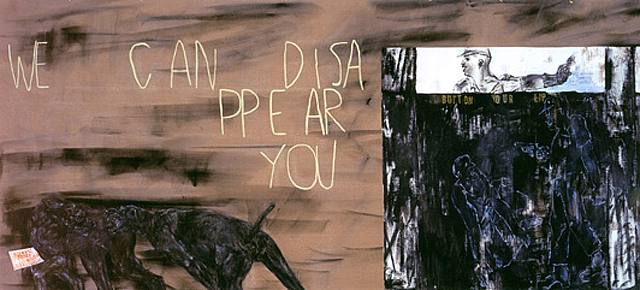
Leon Golub

Golub.jpg
Leon Golub Disappear You acrylic on linen 77″ x 165.9″

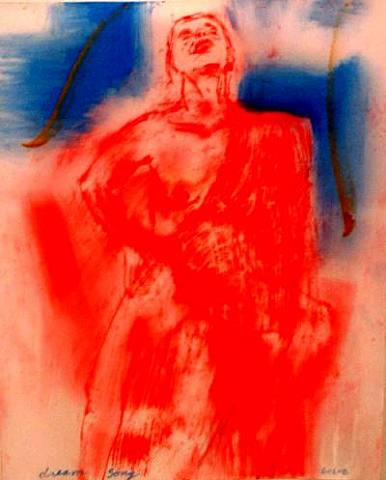
An artist who created “heroic-scale figures,” but also a man of heroic-scale human commitment, Leon Golub died on Sunday. Holland Cotter memorializes him in today’s NYTimes.

Leon Golub, an American painter of expressionistic, heroic-scale figures that reflect dire modern political conditions, died on Sunday in Manhattan. He was 82 and lived in Manhattan.
. . . .
His [work] was firmly rooted in a critically engaged version of Western humanism and in the tradition of history painting.
His subject was Man with a capital M – as a symbol of social and spiritual ambition, often irrational and destructive, depicted in paintings of monumental scale.

The work won’t disappear.

Golub2.jpg
Leon Golub Dream Song Oil stick and ink on Bristol 10″ x 8″

[images from artnet]