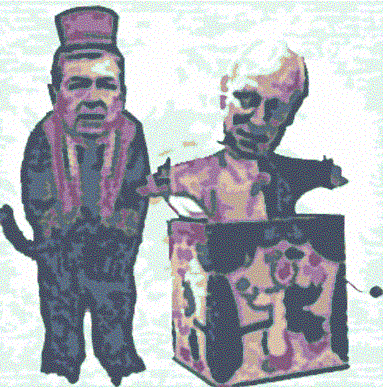
I wrote late last night about Ashcroft’s marketing visit to New York next week, and I titled the post, “talk to Ashcroft Tuesday.” While I was at it, I might also have mentioned that although he has declined to grace us with the Chief Monkey’s presence at “ground zero” on Thursday, Dick Cheney himself will be coming instead.
At this point across the breakfast table the Barry reminds me that it was Cheney’s Halliburton which, right up to Cheney’s appointment as vice president, did big business with Saddam Hussein, who of course was responsible for 9/11, according to Cheney. Sublime.
[The Fort Wayne paper begins its news story on Bush’s no-show with, “Wait till next year,” reminding us that in 2004 Bush “will accept his party’s nomination for reelection at the GOP convention in New York City nine days before the third anniversary.” Later the article frankly discusses the virtual certainty that Bush would now have gotten booed in New York. Wait till next year.]
Were I not sufficiently awed and affrighted by the terms of their “Patriot Act,” I would have written not about talking to Ashcroft, and now Cheney two days later, but rather about driving them both out of our city and back to their war bunkers, which should then be sealed forever.
But I didn’t say that. Nope.
[image from The Upsidedown Culture Collective]
Category: War
Saudi flight(s) a thoughtful White House gift
Over 3000 people are killed in one day in a vicious terrorist attack on our own shores, frightening most of the rest of the country absolutely out of their wits, and directing them toward an enthusiasm for domestic and foreign violence remarkable even by their own unhappy standards, both consequences from which the country has not recovered to this day.
In one of its first responses to the events, the White House immediately arranges for seven score foreign residents, VIPs from just one nation, to flee the country on special flights, this well before the Oval Office had allowed flight restrictions to be lifted for the general public, and before much was known (publicly) about those who had planned them.
We already knew about the flight(s) of the 140 Saudis and their families. The real news today is a report about the direct involvement of the White House. Whats still not part of the news is why it was done, and why those people in particular were spirited out of the country in secret.
Richard Clarke, who ran the White House crisis team after the attacks, but has since left the administration, said today, The White House feared that the Saudis could face retribution for the hijackings if they remained in the United States.
The NYTimes article, which only appears on page A19 of today’s edition, does not explain why or even point out that in the days immediately after the attacks, the White House was apparently only concerned for the safety of certain wealthy Saudi citizens, even to the exclusion of all other nationals, regardless of their origin. Of course this was happening while the same Bush team was busy rounding up people from every Middle Eastern or Central and South Asian country but Israel. None of these people were given plane tickets that week.
Interesting that and on both counts. Im referring to the White Houses interesting decision two years ago and the Times decision to focus their report today so narrowly.
The story appears in an article in Vanity Fair out today. I haven’t seen it yet, but perhaps theres more in that notorious, lefty political style mag than the oh-so-responsible Times found fit to print. In any event, I think the fallout from this story has only begun.
also somewhat unspeakable
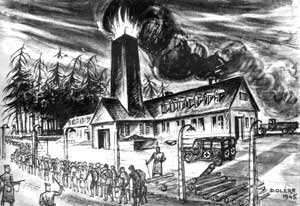
Illustration by David Olére, a Sonderkommando who survived nearly two years at Auschwitz
Anybody feel funny about this announcement?
The Israeli Embassy in Warsaw said three Israeli jets piloted by descendants of Holocaust survivors would fly over the former [Auschwitz death] camp at noon on Thursday. They were to be joined by two Polish MIG-29 jets.
Well, the authorities of the museum there do.
“It’s a cemetery, a place of silence and concentration,” a museum spokesman, Jaroslaw Mensfelt, said. He called the planned flyover “a demonstration of military might which is an entirely inappropriate way to commemorate the victims.”
[image from The Danish Center for Holocaust and Genocide Studies]
“rest of the world may be crazy, but it ain’t stupid”
It’s too delicious. Today there’s more from Daily Kos on the embarassment of what passes for the American government. He’s done his homework, citing the reaction of several sources around the world to the administration’s call this week for other nations to contribute money and blood to its own disaster in Iraq.
First, here’s part of his own excerpt from a Guardian guest piece by Richard Perle which appeared the day after the “war” began:
Saddam Hussein’s reign of terror is about to end. He will go quickly, but not alone: in a parting irony, he will take the UN down with him. Well, not the whole UN. The “good works” part will survive, the low-risk peacekeeping bureaucracies will remain, the chatterbox on the Hudson will continue to bleat. What will die is the fantasy of the UN as the foundation of a new world order. As we sift the debris, it will be important to preserve, the better to understand, the intellectual wreckage of the liberal conceit of safety through international law administered by international institutions […]
Salon, snappier than some media sites, contributes these lines, among many more:
In other words, the rest of the world is to send its troops to get killed so that a U.S. president it fears and despises can take the credit for an invasion it bitterly opposed.
The rest of the world may be crazy, but it ain’t stupid.
But much of the world, including many in this country, while welcoming the comeuppance of the Bushites, has no wish to see Iraq suffer. We will have to hold our own evil-doers responsible, through our voices, our feet, the media, our votes, and definitely through impeachment and trial.
But there is no agreement about an alternative to the current U.S. involvement in Iraq, and in fact I haven’t seen any real alternatives proposed. Like so much else wrought in domestic and foreign policy by this stolen White House, the move was so unprecedented, the violence done was so great, resolution cannot be accomplished simply through interdiction.
We may never recover ourselves. How can we expect Iraq to do so?
“Give us your money and blood,
but Halliburton is still in charge.”
Daily Kos gets it right – as usual. [We should all be reading him regularly.] The entire post:
US tells UN to screw off, but give us money and troops first
I can’t be too surprised about this, but it’s still shocking:The United States went to the United Nations Wednesday to seek help with troops and money for Iraq, but said it would not give up command of military operations or its dominant role in the country.
Translation: Give us your money and blood, but Halliburton is still in charge.
Germany is unlikely to be swayed, as they want the UN to take control of the operations. And France wants a hard deadline for ending the occupation (which to be honest is a silly requirement). Russia seems to be sitting back enjoying the castration of the mighty US military.
We suddenly don’t look so tough anymore, huh?
Don’t do it UN’uns!
“the situation” trumps all

Kalandia crossing
“I have been thinking a lot about the separation, the general ignorance between average Palestinians and Israelis, and while the gap is indeed large, the ignorance is a choice that functions as an excuse to do less. This is also one of the reasons so many Israelis support the wall/fence, not for security reasons, but just because it will allow them not to have to deal with the Palestinians; while they hardly see them now, you can’t see through walls.”
Before ending her working and activist summer in the Middle East, Ellen writes another report.
Hi friends,
I finished filming with my cameraman, Chris Romeike, yesterday and I will just follow-up this week with a few bits and pieces. It was very intensive, lots of interviews, lots of locations, lots of travel. Chris was great to work with though, very helpful and really into the surroundings and soaking-it-all-up. I am exhausted at this point, looking forward to returning home for a bit and putting all the pieces together again, mentally and otherwise.
Yesterday Chris and I were at the Kalandia crossing near Ramallah and it seems the soldiers were particularly nasty and brutal. They were harassing some woman and her 15 year old son as he did not have the proper permit to cross the checkpoint, Chris and I went to see what was happening and as we came with the camera, they left them and swarmed around us, yelling no camera, no filming. I told Chris to keep rolling as we worked-out whether or not they had the right to tell us not to film. I argued (of course!) and they were pretty unfriendly. One young soldier told me he could arrest me, bring me in for questioning blah, blah. I have learned from Ezra, not to let them intimidate. They talk a lot of bullshit, without a lot of authority behind them. Of course this is how they function daily to the Palestinians, but without any monitoring, they run lawlessly to some degree. They make threats, they invent rules and then they do as they please to the population. It is actually amazing to watch democratic principles be thrown out the window at will.
I have been witnessing a great deal of this occurring within both Israel and Palestine of late. The use of the excuse the situation and for security seems to supersede all, and not just at the high court levels where decisions are made daily in relation to security concerns overriding civil rights, but in the street, in these meetings with soldiers or anyone wearing a security badge. I was working on an interview, following one of my subjects to her workplace, and it so happens that as we were filming her walking, we passed the back of the American Embassy, to get where we were going. An Israeli security guard comes racing over demanding our ID’s, practically our tape, what we are doing etc. I just said, what are you talking about? This has nothing to do with you, or the embassy. And, if the embassy has a problem with anyone with cameras in the vicinity, it should have a sign saying no filming, not that we were filming anything related to you anyway This seemed to be of no consequence to this guy who continued to demand out ID’s. Chris and I handed him our Canadian passports and he turned and said I’ll be back in a few minutes. I said No way, you’re not going anywhere with my passport and I don’t have time for your issues. I told him to give me the passports back right away, he looked at them, hesitated and handed them back, after a five second check. But if I wasn’t aggressive, who knows how long we would have waited. We were talking about it afterwards in relation to the US’s Homeland Security regulations overriding civil rights as well. I suppose what feels significant is how one experiences these things here daily, it is quite blatant and the Middle East’s only democracy is quite far from that in so many ways.
We traveled a lot with Ezra, to Hebron area again this week and the closures of Palestinian roads connecting villages to towns are endless. A farmer can’t get to his field, and certainly not with a tractor, people can’t get to medical centres, crossing the Jewish road results in fines and punishments. I saw all these people running across the road, one after the other, as if they were running from someone chasing them, lots of people. I asked Ezra what he thought was going on? He told me that they were simply running as they were not allowed to be crossing the road. Can you picture it? Working people of all ages, running across a highway, fleeing. They are indeed being chased.
And for a drastic contrast, Chris and I went from there to Tel Aviv (about an hour and a half drive). We had dinner at a Nouvelle Cuisine Yuppie restaurant and then off to a gay bar for some filming. What a contrast from sitting in a tent in the Hebron hills with a family that could barely afford to feed itself and are not allowed to graze there sheep in most of their old grazing lands as they are surrounded by hostile settlers and are cut off by the roads they are not allowed to cross. The shepherds seem to be walking in circles. These people shared their food with us, as we walked around looking at the destroyed caves that they used to live in. The army had come and blown the caves to bits because they represent a permanent residence, yes, a cave, and they are not allowed to build there. They tried to put some rudimentary housing together after that, but those have been destroyed too, permanent structures you see. They have been allowed to reside in tents although this has been a problem for them as in the winter it is too cold, unsheltered, and the snow leaks into the tents. The meal they prepared for us was much better than the one in Tel Aviv, honestly.
I won’t bore you with the details of the gay bar, it looked like every gay bar in the Western world; lots of tank tops, lots of cruising etc. I met one young guy who was happy to talk to the camera as Chris behind it seemed to be of interest to him. He was a soldier he told me, and Israelis just wanted peace and love, and that they would love the Arabs if only they could know which ones are good and which ones are not, so many are terrorists, so we cannot have peace. Luckily, I met some more engaging guys across from him who were lawyers it turns out. We talked about gay marriage in Canada for a bit but the conversation of course turned to Israel Palestine. One stayed on to talk, the other left for another gay bar. The one who stayed was telling me that he was currently trying to get out of his upcoming reserve duty which was to be at an army prison (for Palestinians), in the North. He told me how horrible it is, how the reserve soldiers, as they tend to be nicer and more civilized, are forbidden to engage at all with the prisoners. He is to be kept in a guard tower. Tel Avivians may try to stay far mentally from the Occupation but it seems you can’t really run too far in the end.
I have been thinking a lot about the separation, the general ignorance between average Palestinians and Israelis, and while the gap is indeed large, the ignorance is a choice that functions as an excuse to do less. This is also one of the reasons so many Israelis support the wall/fence, not for security reasons, but just because it will allow them not to have to deal with the Palestinians; while they hardly see them now, you can’t see through walls.
Well, that’s this week’s update and my last. I should be home by Sept 8th. I suppose this means summer is officially over, I feel relieved this time.
Peace to you all,
love,
Ellen
[image from BBC news]
Steve Quester and Blue Stockings
Steve, who returned last week from a summer in Palestine, will be speaking on Wednesday at 7 o’clock in Bluestockings Bookstore in the East Village.
It sounds like he will be with other activists from Jews Against the Occupation (JAtO), to report on the present situation in Palestine and their work with the International Solidarity Movement.
Bluestockings Books is a wonderful, spunky little independent bookstore on the east side of Allen Street, between Stanton and Rivington, just one and a half blocks south of Houston Street.
For those outside of New York who have been following his reports, or for anyone interested in the issues who would like to arrange a forum in their own community, Steve writes that he is more than anxious to speak, show slides and to provide other speakers as well.
“I’ll speak at your church, synagogue, or mosque, in your living room, at your yoga center, or wherever you can gather a few people together.
If you’re outside the New York area and would like ISMers [members of the International Solidarity Movement] to come speak, let me know. There may be folks in your area, or a speaking tour coming through.”
You can contact him through JAtO: jatonyc@yahoo.com, voicemail (212) 539-6683, or by sending an email to me.
Bluestocking’s phone number is 212-777-6028.
“Millions Stand Behind Me”
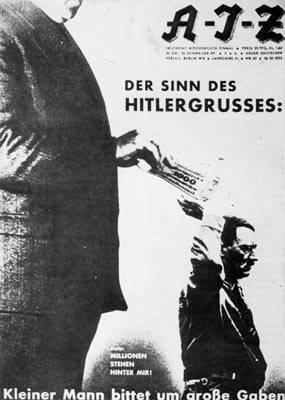
Illustration by John Heartfield on cover of Arbeiter-Internationale-Zeitung (Workers International Newspaper), October 1932.
There is no war on terror; there is only the terror of war. One of the top stories on Reuters at this minute:
“Our war on terror continues,” Bush told about 600 supporters at a lunch in Minnesota that raised $1.2 million for his 2004 re-election bid.
‘Nuff said.
____________________
Translation of the Heartfield text:
Der Sinn des Hitlergrusses
The real meaning of the Hitler salute
Kleiner Mann bittet um grosse Gaben
The little man asks for big gifts
Millionen stehen hinter mir!
I’ve got millions standing behind me
solving the problem
“With a people denied so many basic rights for so long, the only way to stop the terrorism (of the few) is to end the suffering (of the many).”
For an understanding of what actually is the thinking within the beleaguered Palestinian community, both that of the different leadership groups and that of the population generally, read Anees’s description posted last night.
“Let’s talk about terrorism!”
“The villagers can’t get to the schools or the medical centers. They are surrounded by settlements, extremly aggressive ones, and are not allowed to travel on the Jewish roads. Yes, the Jewish roads. Palestinians are not allowed to travel on the road that goes right past their own villages and towns. They are also not allowed to use their own roads as they have all been blocked. No passage. No movement. If they are caught driving on the Jewish roads, they are fined, jailed or beaten. Sometimes all of the above. They cannot get to work, they cannot get to hospitals, schools, etc. There were hundreds of men walking along the road as we drove, they were walking because they cannot drive and there is no transportation for them. Coming back from what work they manage to keep. They are walking because their roads are blocked and they cannot use the Jewish roads.”
Our friend the activist and filmmaker Ellen Flanders writes today from a tiny, almost totally isolated Palestinian village near Hebron.
Hi folks,
well what can I tell you? The situation once again has spun out of control, dead people everywhere, ongoing violence and no-end in sight. Spending time in the West Bank and Gaza as opposed to Tel Aviv and Jerusalem is of course night and day. I read all the reports various others send out and few people who are here doing solidarity work seem to move between both, perspective however, is everything.
Even city to city, village to villlage, it is important to draw the distinctions and the realities of daily life. Leaving Jerusalem for the day and heading to Ramallah in the morning, back to Jerusalem, and then to the Hebron area in the evening, gave me a chance for some of this perspective and perhaps wide-angle lens. I met with a gay Palestinian-American man who was kind enough to take me and my cameraman, Chris, on a little tour of the road from Jerusalem to Ramallah. I was wanting to try and find a visual way of describing this journey and landscape. Words are insufficient and I find that comparing it to Apartheid or ghettos, or anything like that not all that useful in the end. This place has its distinct appearance and history, much of it grisly and worthy of its own terms. I can only try and describe it as I have seen it both over the years and presently. It’s funny you know, because in some ways while I know this place and spent some years growing-up here, there are many ways that I do not know it or the people at all. I know slogans, ideologies and symbols. I know the landscape from one angle and then another. But people, take a lifetime to know. And people are what *place* is in the end. And while I have forged friendships here, both Israeli and Palestinian, we have not grown-up together, lived together, or shared in each others lives daily over the years. So I will continue to know this place from anew everytime, which can both be a benefit and a loss.
I will try to describe for you some of the things that seemed both new and old in the past days: The roads leading from Jerusalem to Ramallah are often named in the most honest and blatent of terms. At some point we were on the *Okef Ramallah Road.* Okef means to go around, hence it was the road that bypassed Ramallah. As an Israeli, one does not want to be anywhere near Ramallah, one does not want to see what is happening there. Ignorance is serving the Israeli population all to well. It is amazing how many Israelis I talk to that know NOTHING of these towns, nothing (well, except that they are dangerous). The road leads to all the settlements surrounding Ramallah from Jerusalem. The settlements are spreading like a tangled web, getting longer, wider and more populous. They are sometimes quaint, sometimes more like small cities. They surround the nearby Palestinian villages and towns, cutting them off from their fields and taking the surrounding agricultural land as their own. This then impoverishes the Palestinian villages/towns, as they now have no means of income. They take the water, 80% of it, and control whatever flows in and out of the Palestinan towns. And the electricity. Visually, when you stand high above the settlements you can see them virtually strangling these places. It is quite clear. And then we passed the outposts and the new settlements being built. What? You say there has been a halt on settlement activity? No fear! They are growing rapidly, often attaching the new settlement to one right next to it, so hence now it is a *suburb* of the former settlement. Using it’s name allows the Israelis to claim that no new *legal* (although all are in fact illegal), settlements are being built. Then there are the ones that we don’t even talk about, as they slip under the radar screen of all press and media, not to mention general public interest.
When you look at the network of settlements you think, this is not going anywhere. These *facts on the ground* that have been established long ago, so incredibly strategically, and continue to do so, does not give me much hope. When the mainstream Israeli peace group, Peace Now, says *dismantle the settlements,* most of the individuals (the few that are left there anyhow), have no idea what would really be involved in this and how intricate and intrinsic they have become (hece there has never been a real plan in place to do this removal). How they choke and clog all that they surround and at the same time have families, trees, yards, dogs, schools, shops etc many who have been lead here by a government offering many benefits, easing the economic burdens they would experience elsewhere. I read this over and over, but a walk around brings it home again differently everytime.
Now contrast this with the lovely cafe that Chris and I sat in for lunch in Ramallah, talking to our neighbours about what we are doing there etc. It all can seem like anywhere else in those moments, lunch, drinks, cafe, conversation and a beautiful breeze. Nasser, who is at the next table inquiring what we are doing here, teaches at Beir Zeit University. He starts to give me a lot of pointers about all the politics and surrounding areas etc. When he realizes however that I seem to be quite in the know, he asks me how I know what I do? Am I local? I tell him, no, but I did grow-up in Jerusalem for years in my youth and so I am somewhat familiar. He asked me if my father was a diplomat or something? I said no, they were Jews, Zionists, coming to live in Israel. He was stunned for a moment and then said *Really? so you are a Jew?* *Really,* I said, I am a Jew. *And you are here, talking about Occupation?* Yes, there are many others like me, I am by far unique I told him. But nonetheless Nasser was shocked. And I continue to have this experience. There are only two sides to this conflict heavily endorsed by the media, there is us and them. The people are all but removed.
We leave Ramallah via the Kalandia crossing and it takes us an hour to cross. We sit in the car with the smell of garbage all around, the dust flying and a view of the new fence cordoning off Ramalla. The soldiers are rude by the time we get to the checkpoint and wave us through. We were lucky, some people saw that we had a camera and obviously wanting this documented, told us to go ahead of them. It is bedlam and it causes such frustration that you think you are going to lose it. But here, everyone does this daily. Humiliation does not begin to describe what it is like to be at the mercy of these 18 year olds that decide whether you pass or go back.
We then pick-up Rauda in Jerusalem, one of the women in my film, a Palestinian lesbian and poet, who is joining me and Chris and Ezra, another character in my film, to head down on the road to Hebron. Ezra has been working with this one tiny village that has had their access to the nearest Palestinian town completely cut off. He helps them to remove roadblacks, only to be replaced the next day. The villagers can’t get to the schools or the medical centers. They are surrounded by settlements, extremly aggressive ones, and are not allowed to travel on the Jewish roads. Yes, the Jewish roads. Palestinians are not allowed to travel on the road that goes right past their own villages and towns. They are also not allowed to use their own roads as they have all been blocked. No passage. No movement. If they are caught driving on the Jewish roads, they are fined, jailed or beaten. Sometimes all of the above. They cannot get to work, they cannot get to hospitals, schools, etc. There were hundreds of men walking along the road as we drove, they were walking because they cannot drive and there is no transportation for them. Coming back from what work they manage to keep. They are walking because their roads are blocked and they cannot use the Jewish roads.
We got to the village to help open one of the blockades by removing a steel highway barrier and by removing enough of the mound of dirt that had been piled high to cut off access, to get one car through. Ezra says this is the third time in a week he has done this as the army or the settlers come and reblock it daily. We worked at night, in the dark mostly, with the hood up on my car, pretending whenever a settler of army jeep passed that we were having car trouble. If anyone from the village is caught doing this, they are severly punished.
After, when we were invited to sit for tea with the villagers, I was told horror stories. The settlers coming into the village and chasing the women and children in jeeps, beatings of old and young (the head of the village’s mother who is 80 was beaten by nine settlers and had to be hospitalized). Ta’ayush, a Palestinian-Israeli peace group, brought a tent to the village where they set-up activites for the kids (as they couldn’t get to school). They were chased from the tent and told, the children that is, by settlers and army, that if they have anything to do with peace groups or go near that tent again, they will come in the night and chop their heads off. Needless to say, the children did not return. I was talking to a little girl who was about three and was asking her about her sisters etc. She turned to her mum after our chat and asked her if the army would come and slice her head off that night because she was speaking with me. They sleep on the roofs of their houses in the summer because of the heat and the ants. The settlers come by at night and throw rocks as they sleep. They have torn down some of their few olive trees, destroyed their few vegtable patches, drive their jeeps through the village, terrorizing them, especially as they have now had contact with peace groups. Let’s talk about terrorism!
The village has no electricity or water beacause the settlements will not allow them to run a wire or a pipe. The village has about 20 houses.
Again, I read these stories as you must as well, from others who are spending time working here, but truly words are insufficent to describe how horrific it is. When you are sitting there, listening, you are also trying to figure-out what these people have done to deserve this lot? To be treated as less than human, as people without children, without elderly or illness, without any needs. I am sitting by the light of the kerosene lamp under the most incredible desert sky and I am paralyzed. I am helpless and my rage surges. I can see how easy it is to want revenge, to want to take a machine-gun and terrorize these bullies back, to take away their rights and dignity. I climb down the stairs to my car, the dogs of the settlers are barking in the night and their towns glow from above in the most menacing of ways. I try not break-down and leave most reluctantly, both wanting to stay and help and flee at the same time.
That was just one day, and I get to go home.
That’s the update for this week,
with love,
Ellen
Ellen Flanders
Graphic Pictures