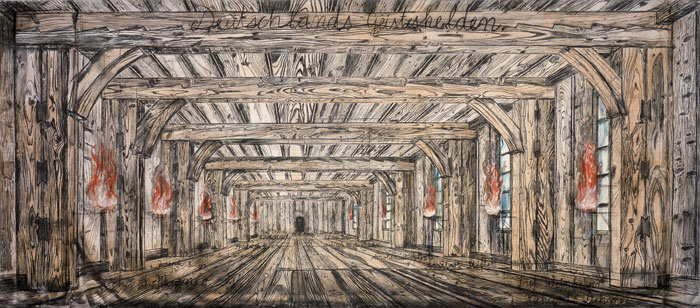
Anselm Kiefer Deutschlands Geisteshelden (Germany�s Spiritual Heroes) 1973 oil and charcoal on burlap, mounted on canvas 121″ x 268.5″
Still a home for Dichter und Denker
Schicksalstag.
Five major events in German history* are directly connected to November 9, the most recent being the fall of the Berlin Wall, twenty years ago today. Whatever else we make of it, the anniversary of this latest in a series of fateful moments should be a timely reminder, in our contemporary obsession with the present, that everything has a story, if not a reason. Of course I’m talking about history.
“The German Problem”.
Historians don’t record statesmen and diplomats ever speaking of an enduring “French Problem” or a persistent “English Problem” (although I believe Americans should be more aware than we are that the rest of the world is increasingly thinking of an intensifying and abiding “American Problem”), but over hundreds of years, even two thousand years, for the Romans, the Byzantines, the Carolingians, all the Slavs, the French, Poles, the Danes, the Belgians and the Dutch, the Russians, the Balts, even the Spanish, and, irregularly, the British, there was always something on the order of what would eventually be known as “the German Problem”.
The problem was recognized or imagined by non-Germans as the perceived threat of a large and vigorous people without natural borders. The danger was to be minimized by means of policies which would contain the Germans geographically, limit their economic authority, and, by the later nineteenth century, assemble and maintain counterweights to their real or potential power in a united nation-state. It worked pretty well while “Germany” consisted of hundreds of mostly-independent realms (Reiche), and especially during periods when Germans were enduring or recovering from plagues and dynastic battles. The horrible ravages of the Thirty Years War were mostly visited on central Europe (viz., the Germans), but in the midst of the impressive economic and cultural resurgence which followed those religious “crusades” a new player, Prussia, equipped with a modern bureaucracy and a highly-trained standing army, appeared on the field, almost out of nowhere, eventually to succesfully engage with, or seduce, the cultural forces of nationalism in founding the Second German Reich.
Whatever the merits of the proposition, for much of the planet the most important lesson to be learned from two twentieth-century world wars was the imperative of eliminating “the German Problem” once again, and this time for good.
Then suddenly the unexpected, the inexplicable happened, confounding everyone’s expectations. The Berlin wall fell, the Soviet bloc and its system collapsed, Germany was peacefully reunited.
New York Times Berlin Bureau Chief, Nicholas Kulish, in a piece in the paper two days ago quoted Robert E. Hunter, senior adviser at the RAND Corporation and an ambassador to NATO under President Bill Clinton. Hunter was able to describe the profound significance of what happened in 1989. After recalling the fears of those observing from the outside that the sudden appearance of “this thing in the center of Europe, if it were allowed to become unified, was going to be a cancer once again and lead to Act III of the great European tragedy.” Instead, he continued, “the German problem, which emerged with the unifying of Germany beginning in the 1860s, is one of the few problems in modern history that has been solved.�
Okay, now my eyes were too wet to immediately read further.
Four months after the proclamation of the united German Empire inside the Hall of Mirrors of the occupied Palace of Versailles, the German Austrian composer Johannes Brahms completed a large-scale piece for chorus and orchestra.
Tonight I’m going to be listening to a recording of Brahms’ Schicksalsied to accompany thoughts of the deep sadness and unbridled joy linked with this date. Brahms wrote it after reading a poem by H�lderlin which was included in the author’s 1797 novel of letters, “Hyperion”. The poet had been inspired by the freedom struggle of the Greeks and in these lines he contrasted the glorious world of their ancient gods with a mankind continually threatened by Schicksal (destiny).
The text appears here, in both German and an English translation.
I’ve just now listened to a sample of the Brahms on line and I was reminded of how much of it relates to the music of his near contemporary, the German German composer Richard Wagner, represented at the time of its composition as Brahms’ musical antithesis, that is, defined so by the passionate factions of each. Together they created the Brahms-Wagner “War of the Romantics”, which disfigured musical life in the second half of the nineteenth century, but which, so far as I can tell, resulted in no fatalities.
*
the symbolic collapse of the Revolution of 1848, the collapse of the monarchy in 1918, the 1923 Beer Hall Putsch, Kristallnacht in 1938, and the fall of the Berlin Wall in 1989
[image from lacma]
Category: War
Obama given Nobel Peace prize? I thought it was a joke
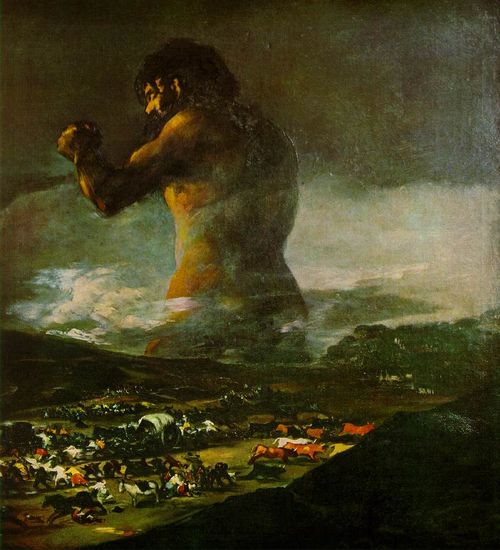
“Coloso” is more than a condemnation of war; it’s an allegory of French imperialism, and as such it also condemns every previous or succeeding imperial crusade, regardless of the real or professed idealism of their apologists
NOTE: Obama had been president for less than twelve full days before nominations for the Nobel closed on February 1.
War is not peace.
I looked at my mail today while I waited for my browser to load, and there I read a note from a friend in Buenos Aires who knows me very well. He was effectively warning me that I should sit down before looking at today’s news. Once securely seated, I went to my news page where I saw the announcement, “President Barack Obama wins Nobel Peace Prize”. I thought it was a joke. Totally.
What peace? He’s adopted every one of Bush’s wars, extended some, and if you look closely, he’s not even talking about ending them.
It’s an insult to those who have received the honor in the past, many of whom risked their lives for peace and who did not ride around in armored cars while commanding the greatest arsenal of weapons in the history of the human race – and using them.
It’s like giving the mayor’s son a Ph.D soon after he’s started his freshman year, because he’s said he’s somewhat interested in reading. He’s been tossing everyone’s books into a dumpster since he arrived, but maybe the sheepskin will turn things around. Disgusting.
ADDENDUM: On his own site, candidate for mayor Reverend Billy Talen writes eloquently of the Obama peace prize: “So – it has come to this. War has finally captured Peace. “.
Predator drones will be released tonight destroying the word we always depended on. The flying bomb will go out over the villages, sailing over the sleeping children and prayers and friends stopping for a laugh. The bombs will float and hesitate and change direction from computers in Florida and Missouri and the soldiers at the computers will know that Obama has been awarded the Nobel Peace Prize. And so they will be consumers of a war that is now being marketed as a product named Peace.
[image of “Coloso” (painted by Goya or by one of his friends and pupils) from redstateelectric]
NASA pokes at the moon
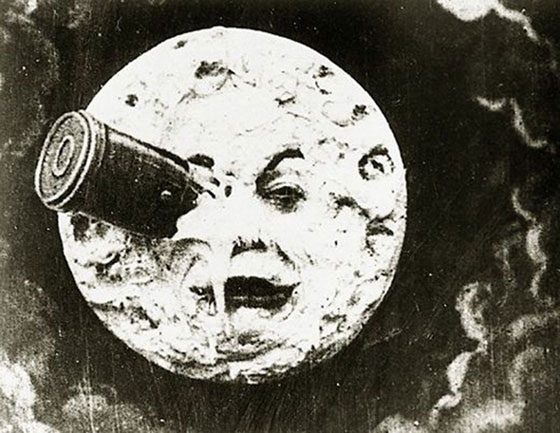
still from “Le voyage dans la lune“, a 1902 film by George Méliès
Barry came across the story on Twitter late yesterday, but this is an excerpt from The Huffington Post report:
NASA is launching a dramatic mission to bomb the moon.
The LCROSS (Lunar CRater Observing and Sensing Satellite) mission will send a missile traveling at twice the speed of a bullet to blast a hole in the lunar surface near the moon’s South pole.
Scientists expect the impact of the Centaur rocket to be powerful enough to eject a huge plume of debris from the moon. The moon dust should even be large enough to be seen from earth through telescopes 10-to-12 inches and larger, says NASA.
I don’t know, it might actually be a worthy cause, and the idea of bombing stuff is very American, but attacking heavenly bodies just seems so unfriendly, . . . so, warlike.
It’s just too bad the incursion is unlikely to be exciting enough to distract our armchair warriors in Washington – and elsewhere around the country – from blowing up people and stuff here on Earth.
Okay, my second thought is how come we hadn’t heard about this dramatic mission earlier? Is the NASA’s public relations department that lame? Maybe they were deliberately trying to keep it low key, perhaps to avoid street demonstrations, although by now we’ve all learned that liberal and progressive protest never works in this country.
image from momlogic, found while Googling]

Obama’s wars

Anti-war protesters demonstrate in Times Square October 7, 2001 in New York City. Thousands of marchers participated in the rally on the same day that the US and Britain commenced air strikes against the Taliban regime in Afghanistan. [Huffington Post caption]
It could have gone much differently.
I was in the streets eight years ago today, but with a characteristic mid-western idealism continually renewed without any justification, I didn’t believe we were actually going to war. It was just so stupid and wrong, so eighteenth century.
Today some of us mourn the eight years (and still counting) of the wars without end begun by George W. Bush and embraced by Barack Hussein Obama.
They are all Obama’s wars.
Woodrow Wilson’s war, announced as the “war to end all wars”, lasted 19 months. Our participation in the Second World War lasted a little over three years and eight months. Our current series of insane, counter-intuitive, self-destructive, illegitimate, racist, imperial, immoral, and finally perpetually self-propagating wars, waged under the rubric, “Operation Enduring Freedom“, have been programmed from the very beginning to go on forever.
[image, otherwise uncredited, from Huffington Post]
Jason Hanasik at +Kris Graves: “He Opened Up”
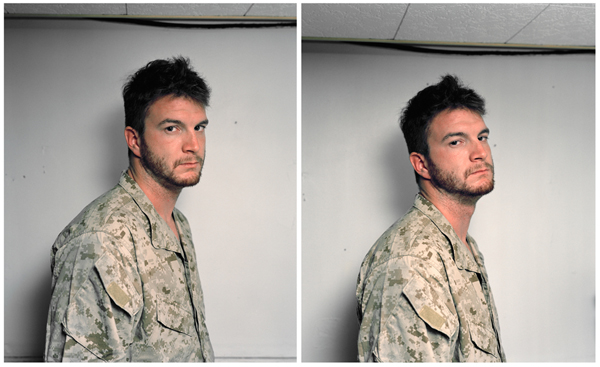
Jason Hanasik Steven Two-Faced 2007 digital C-print

Jason Hanasik Steven’s self-portrait #2 2008 digital C-print

Jason Hanasik Steven’s photograph of a man carrying two bottles of piss 2008 digital C-print

Jason Hanasik Patrick (Welcome) 2005 digital C-print

Jason Hanasik Steven (turn) 2008 digital C-print
I think it’s about the fact that guys often have trouble functioning as full human beings, but sometimes they’re offered an opportunity and they grab it; and then sometimes they lose it. I’d say this is true of both hets and homos.
The artist himself describes his project as
.
. . a photography, video, and installation project which engages image making as a platform to intervene inside Western culture’s traditions and expectations as they relate to masculinity, sexuality, and class.
We, the men of these images and me, might not sit at an equal distance from the center, but we all have a complicated relationship to what is considered normal — to our benefit and our destruction.
Jason Hanasik‘s show at +Kris Graves in DUMBO, with the (not quite) enigmatic title, “He Opened Up Somewhere Along the Eastern Shore”, is an extremely moving exercise in storytelling with photographs, mostly the artist’s own and some (not quite) “found”.
Nine images are hung along one wall of the gallery and two more hang on a section of another wall to the left, with a final object, a hand-written letter reproduced as an inkjet print, at the near edge of a third wall on the right. Most of the photographs are dominated by the figure of a young male; some of the subjects appear several times. They are all marines.
Partly because the size of the prints varies and because they are each mounted at a different height, they appear to dance in front of the visitor, but without a real beginning – or an end; this is not going to be a simple narrative.
The images in the photographs bounce around in time and in space, and touch many emotions as they do so, as does their “story” itself; it’s a story which could be written in many ways, and we can each find our own. Hanasik’s materials provide a documentation of some intense, probably under-expressed, male friendships. They remind us of the difficulty we all have in characterizing the more heartfelt qualities of these friendships, whether we are parties to them or only observers.
The men photographed by the artist are brothers. Jason Hanasik grew up in Virginia knowing both Steven and Patrick, but he became a very close friend of Patrick, the older (his BFF, in fact). Jason and Patrick played football together in High School. Jason at first hardly knew Steven, who had his own best friend. His name was Josh, and he does not appear in these images. Their relationships, especially that of Jason and Patrick, were made more complicated as they grew older and each of them gradually became aware of Jason’s homosexuality (including Jason himself), but Jason and Patrick’s friendship survived, survived even the nightmares of Iraq, from which Patrick described this affectionate daydream in a letter to Jason:
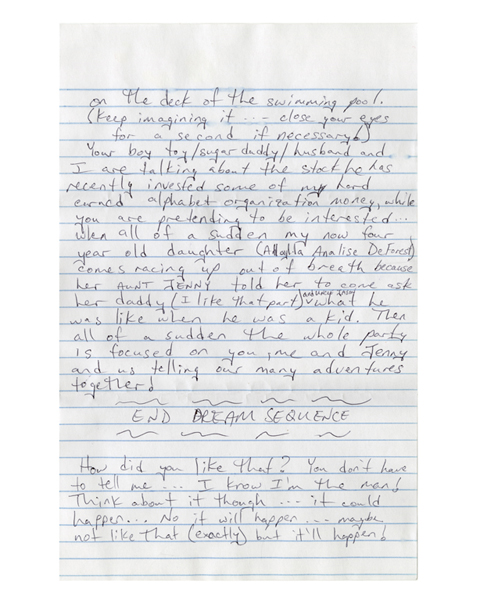
Jason Hanasik 11Mar04 2009 inkjet print 10″ x 8″
Jason was the only one of the four who did not join the marines and so was the only one who did not go to Iraq, where Steven was a part of a tragedy (the death in combat of his friend Josh on what had been the first “tour” for both of them) he was unable to share with his comrades. Then, on the first leg of an impulsive road trip with Steven something happened that changed Jason’s relationship to his best friend’s more taciturn sibling.
The title of the gallery exhibition refers to the catharsis Steven experienced while Jason and he were driving from Virginia to visit Patrick and his wife in upstate New York, Steven opened up, and it made possible a real friendship between the two for the first time. Like that shared by Jason and Patrick its emotional intimacy didn’t fit the simple antithetical forms we’re told are the only ones we can expect from male relationships.
Three of the photographs in the show were taken by the straight-identifying Steven while he was in Iraq. The two that are not self-portraits, in particular, are witness of just how inscrutable male emotions, and male sexuality, still remain to the understanding of all of us, male or female, straight or queer.
The installation also includes a video taken with a pocket camera or cellphone. It appears on the gallery wall as a smallish, faint, projected image, a short loop, and it shows two beautiful, smiling young marines dancing a tango, complete with dips, on the balcony of a barracks courtyard inside Baghdad. There is no sound.

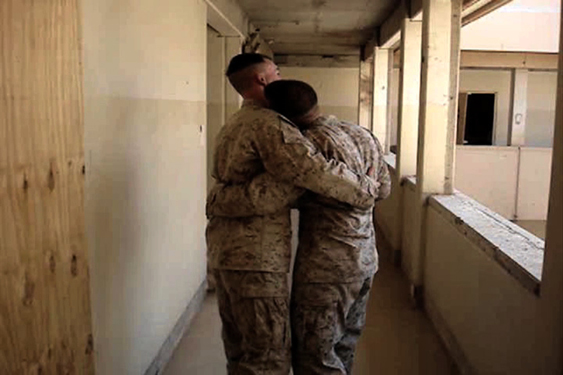
Jason Hanasik In the Green Zone: November 2007 digital video 2008 [two stills]
The video too is by Steven.
I remember, but only as someone who was able to watch from a safe distance, the horror of Vietnam, and what it did to the men and women of my generation: And the silence; all kinds of silence. It’s excruciating to see it happening all over again.
After only a few minutes inside the gallery last week, I was already almost in tears, and at the time I had even less information than I am able to share in this post. Barry and I were fortunate to be able to hear more about the work in two conversations with the artist himself. Although at first I was somewhat reluctant to ask about the context of the project, Hanasik was generous in his replies.
I found that the images stand up either with or without much of a “background”. Having seen them on line before talking to Hanasik and before we visited the gallery I know they can pretty much speak for themselves. That’s why I had to get to the gallery: I wanted to hear them up close.
ADDENDUM: There is now a loop of the video, “In the Green Zone: November 2007” imbedded on the artist’s site here.
[images provided by the artist]
Obama is a disaster for the hopes of real progressives
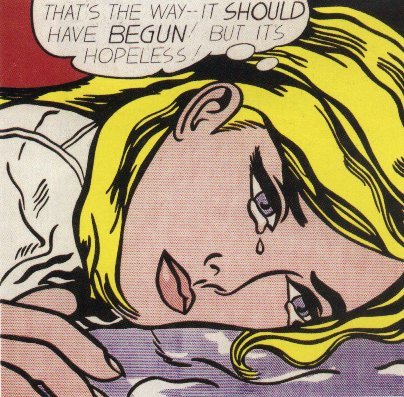
Roy Lichtenstein Hopeless 1963
Obama is a disaster, and I say that because his failure may mean that the kind of reform which could have saved America may never be possible again.
His time appears to have run out (I’m not sure he would be interested in doing anything with it even if he were given an extension). He has utterly failed to do what he said he would do, what his supporters voted for him to do. His election, following the disastrous failure of his predecessor, and coinciding with that of a Democratic House and Senate, created an extraordinary momentum and an extremely rare political opportunity for advancing a progressive agenda. It was an environment, a moment, which we’re unlikely ever to see again. In the six months since we’ve witnessed the shocking success of the scurvy machinations devised by a radical Right which had been reported displaced and in serious disarray. They’ve given us an indication of what to expect going forward.
Our politics are a complete fraud: Any principled engagement in politics has become an absolutely futile exercise and this will remain the case unless we are able to take the system out of the hands of the plutocrats and the corporations that own it. I see no possibility of that happening.
If such a possibility were moral, or even real, I would be tempted to adopt a status of “inner emigration”*. I can say at least that I no longer argue with any American who says they don’t vote; a decision not to go through the motions which might help legitimize a fake democracy appears to be pretty reasonable in the circumstances of the present.
Although I had started to worry about the future of Obama’s “change” myth as early as late last November (see this entry), I held off publishing a more definitive list of complaints until now, finally deciding to pull it out of the “drawer” where I keep my drafts, because I just couldn’t stand looking at the subject line any longer.
In a post written only days after the election I expressed my reservations about whether Obama would be able to pull off the revolution that it would take to undue the damage which Bush administration had done, but I concluded that I believed he really would pull it off.
I was wrong. While I could turn out to be wrong again and would welcome it, today I feel certain that he won’t be able to pull off any reform and, looking at what David Sirota has called his Team of Corporate Zombies and checking off the list of the things he has done and the things he has not done, I have some real doubts about whether he ever intended to.**
For months I’ve been talking to friends about my despair over Obama’s administration, challenging anyone to point to anything which it has actually accomplished. At first most people seemed shocked by my criticism, but if they gave me any argument it would usually only be a comment about something Obama has said he would do. I’ve not been registering any shocked responses in recent weeks, and I’m hearing no arguments, so while this post’s downbeat argument might have really stood out earlier, maybe its novelty has been overtaken by events.
But I still think it’s worth taking stock of what we have lost, so here’s a partial list:
1. The Patriot Act remains almost intact
2. “State secrets” remain state secrets, and the administration argues that the privilege is rooted in the Constitution
3. The prisoners in Guantanamo, even if it the concentration camp is decommissioned, will remain prisoners; they and anyone our government rounds up in the future can be “detained” indefinitely, without charge or trial
3. The administration refuses to release prisoner abuse photos from years ago
4. The policy of rendition will continue
5. We now have an accelerated war in Afghanistan and Pakistan, and our troops remain in Iraq
6. The administration shows no interest in addressing ENDA
7. Obama’s Justice Department has argued that the state has an interest in defending marriage as meaning a contract between a man and a woman
8. The administration shows no interest in addressing “don’t-ask-don’t-tell” (service people are still being discharged for being gay)
9. Addressing climate change appears to be a low priority (and coal is still being extracted through mountain-top removal)
10. Universal health care is off the table, opening the way for even more complicated for-profit systems which won’t even address rising costs
11. Recognition of needle exchange programs is going nowhere
12. Financial regulatory reform, where it is alive, has been put in the hands of Wall Street insiders
13. The measures used to address the economic meltdown and bank failures, the stimulus and the bailout, were designed by and for the individuals and banks who were responsible for the Great Recession in the first place, and have neglected foreclosures, loss of home equity value, and unemployment (and underemployment)
14. No back-to-work program which might be aimed at greening American technology
15. Continued neglect of the infrastructure
16. Continued neglect of meaningful public transit programs
17. The ill-conceived and obscenely wasteful “Clunkers” program and the distraction from real, constructive change which it presented
18. Failure to reinstate the ban on assault weapons
19. “Flexibility” on the call for a halt to the illegal Israeli settlements on the Left Bank
20. Maintaining Bush-era procedures allowing the government to search (without suspicion of wrongdoing) traveler’s laptops, cellphones, or other electronic devices
21. Obama’s vaunted “Transparency” has become a joke
22. Maintaining the FISA spying-on-citizens protocols
23. Extending a free pass to Bush, Cheney and Rice for their clear violations of the Geneva Conventions
24. Expanding both the scope and power of the “faith-based” initiatives introduced by the Bush White House [added to the list Sept. 8]
ADDENDA (post-publication):
25 And now (revealed September 15) asking Congress to in fact extend three key provisions of the Patriot Act, which would otherwise expire at the end of the year
26. Unlike the last four presidents, Obama has not replaced the prior administration’s district attorneys wholesale, but has instead left in place “the majority of the Bush administration DA’s who had survived Rove’s purges intended to make sure they were loyal Republican apparatchiks” [quoted from Ian Welsh], an alarming realization for anyone whose politics are to the Left of Attila the Hun
27. [the words of Ian Welsh once again:] “Obama has not cleaned out the administration in general of Bush-era appointees and plants; indeed he has filled less spots than either Clinton or Bush II had by this point in their terms–and no, it’s not because the Senate won’t confirm them.”
28. The despicable private army formerly known as Blackwater remains in Iraq today, and the Obama administration recently extended the company’s contract there indefinitely; the firm, whose owner has styled himself a Christian crusader, also has contracts in Aghanistan
29. Once again employing the argument of “National security”, the administration is trying to weaken the “media shield” bill, designed to protect reporters against being forced to testify, which is currently working its way through Congress
One wonders just what have they been doing since moving into the White House, besides worrying about how not to offend their political enemies. Did everyone else notice that Van Jones, the man Obama threw to the dogs late Saturday night (an interesting news-hour calculation for the announcement), was one of the only genuine progressives in the White House, a real community organizer (like POTUS, before he got religion) and not a political hack like everyone else, including, I now believe, the boss?
*
Innere Emigration describes the the choice of some intellectuals, certain artists and writers, to remain in Germany (and, after the 1938 Anschluss, in Austria) during the era of National Socialism, although they were in opposition to the Nazi regime. It assumed a complete withdrawal from public life.
**
I notice that last November I included a footnote saying that in the end his race had proved to be no barrier to Obama’s achievement of the White House; today, if I weren’t in despair of Obama’s competence or even his commitment, I could easily add a footnote about the fact that from the beginning race has however proven to be behind his opponents’ mindless campaigns against every policy he has proposed: It’s almost all about that uppity negro.
[image of Lichtenstein’s “Hopelesss” from theheretik]
Port Authority strews 9/11 junk around the country
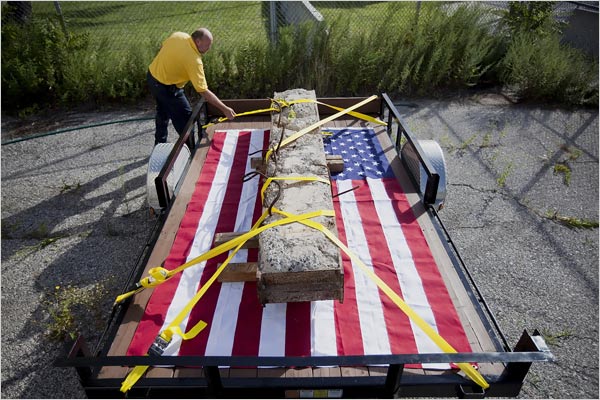
Dennis Klingensmith of Prospect Hill Cemetery in York, Pa., prepares to haul away a beam that will become part of a memorial. Recipients of the wreckage pay for transporting it. – NYTimes caption
Ludicrous or baleful? The Port Authority is giving away WTC junk (in both senses) more or less in our name.
As the anniversary of the attacks of Sept. 11, 2001, approaches on Friday, pieces of the World Trade Center rubble from that day have never been more accessible. A new campaign is under way to speed up the process and increase the volume of giving away pieces of steel big and small from the debris.
The Port Authority of New York and New Jersey, which owns the steel, will invite police and fire departments and mayors and other leaders of cities and towns throughout the country to ask for pieces for memorials.
When I looked at the article on the front page of the NYTimes this morning my first response was, “this is still going on? I’d thought we were over that, especially considering how well our response to 9/11 had gone.” I turned to Barry and said, “we’re going to have jingoistic shrines made of crushed ambulances and twisted steel columns in every town in the country – in perpetuity”, and he added, “to remind us that Saddam Hussein will not get away with it, and that the fight for cheap oil will never end”.
[image by Michael Nagle from The New York Times]
Duke Riley’s “Those About to Die Salute You”
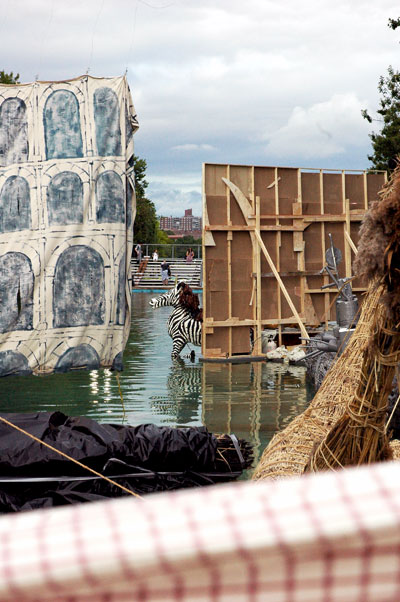
backstage at 6 pm: the battleships await their crews
Duke Riley’s rich, seriously-ambitious, aggressively-unprecious but still whimsically-theatrical large-scale piece of interactive art, “Those About to Die Salute You“, unfolded across the plains and the seas of Flushing Meadows on Thursday night, managing to exceed all expectations, probably including those of the artist himself.
The Queens Museum of Art commissioned the work from Riley earlier this year and this resourceful, heterodox (and genuinely-communal institution) got just about exactly what we saw described in the event’s press release:
Those About to Die Salute You, a battle on water wielded with baguette swords and watermelon cannon balls by New York’s art dignitaries, will take place on Thursday, August 13, 2009 at 6 pm in a flooded World’s Fair-era reflecting pool in Flushing Meadows Corona Park, just outside of the Queens Museum of Art. Various types of vessels have been designed and constructed by artist provocateur Duke Riley and his collaborators: the galleons, some made of reeds harvested in the park, will be used to stage a citywide battle of the art museums in which representatives from the Queens Museum of Art, the Brooklyn Museum, Bronx Museum of the Arts, and El Museo del Barrio will battle before a toga-clad crowd of frenzied onlookers.
And the people came.
No words can do more than begin to describe what they saw – and what they contributed themselves. There are already enough images posted around the blogosphere to make anyone who wasn’t there feel a bit like what now seems to have been the handful of people who didn’t get to Woodstock forty years ago. I missed Bethel myself, but, especially since I had been following Riley’s projects for several years, I wasn’t about to miss Corona Park, only one transfer away on the subway. Besides, as a student of the classics, I just couldn’t, and if I had given it a pass, when could I expect another invitation to a Naumachia?
Barry and I got there a bit before 6, as all the announcements had suggested, but after we had checked out the boat yards at one end of the flooded “lake”, we learned that the sea battle itself wouldn’t begin until after 8 o’clock.
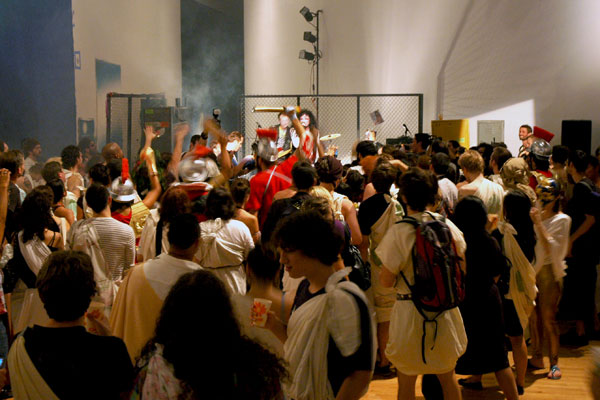
Populi entertained by Hell-Bent Hooker, including band-engineered special effects
We headed for the Museum, where an artist friend, one of Duke’s “herohelpers”, invited us to visit the now-nearly-empty and very dusty 40,000 sq. ft. “studio” where the battleships had been constructed. We stood next to an incongruously-shiny large black motorcycle with a box of cookies balanced on its seat: “Take some cookies; a nice Italian lady with her kids left these for us,” offered a long-haired gentleman with a deep, froggy voice just before he headed off to the other end of the space. I later recognized him as the lead in the metal band which was the evening’s early entertainment. We took two cookies, and they were the best: delicate, chewy macaroons.
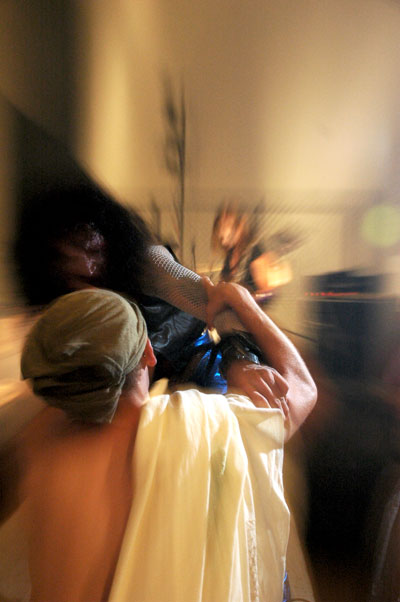
La-Vein Hooker (Hell-Bent Hooker vocals) and affectionate Roman fan
I guess we spent too much time mingling with all the Romans eating and imbibing in and around the Queens Museum and enjoying a bit of the evening serenades offered by Hell-Bent Hooker, so it was already twilight when we finally headed back to the site of the featured event (so featured that there was a box to one side, designated ESPN, where the faux anchorman for the proceedings was ensconced). There we found another huge crowd, and unfortunately all the spaces close to the water and the powerful spotlights had already been taken. In the end, while our late arrival meant I couldn’t capture any decent documentary images, it also meant that I saved my camera from encounters with water balloons, ripe tomatoes and rotten melons.
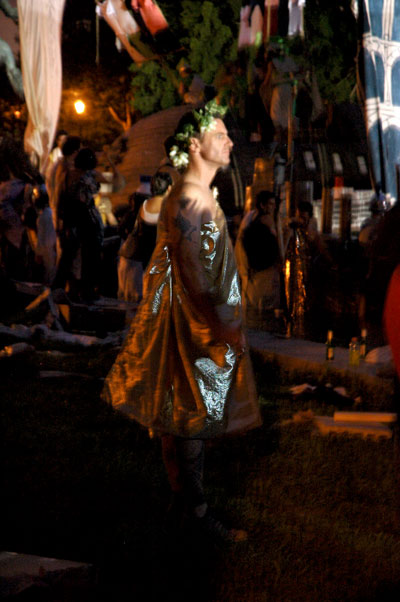
Duke-emperor, artist and prime mover, observing from the darkened wings
I’ve included a few of the pictures I took with available light while holding the camera high above my head. They’re pretty “impressionistic”, but the blurriness may convey a small bit of the excitement of the spectacle.
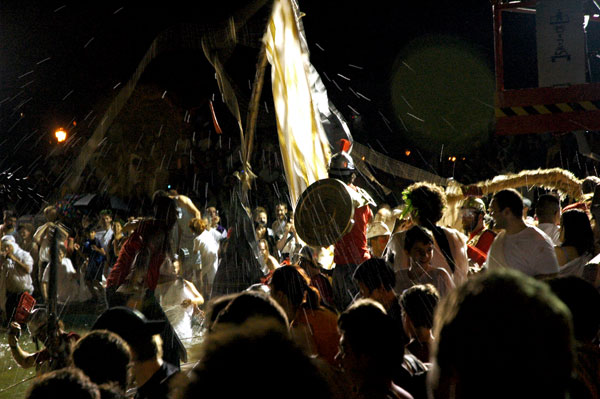
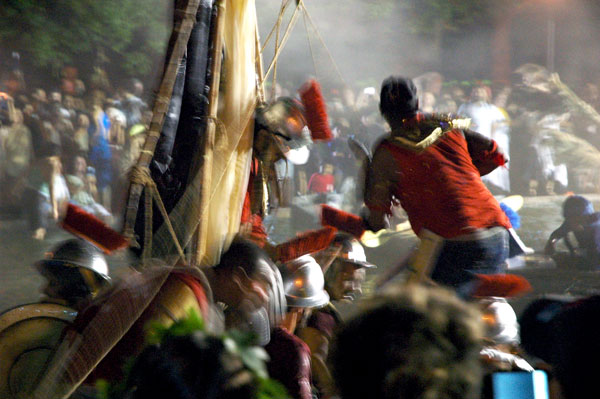
Queens Museum battleship and crew, later to be declared the victors
I’m not sure what’s going on in the next image (the camera saw much more than I did, and it can’t talk to me), but it looks a bit like a victory celebration.
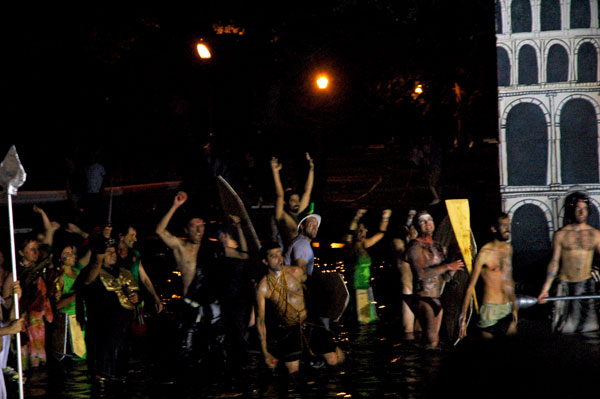
Neptune’s rowdy crew?
That whoopee came just after the sinking or withdrawal of the last manned and womanned battleships, and just before a reed-and-paper-constructed Queen Mary 2 slowly glided toward the head of the lake. Riley and the Queen have a history: When the artist tried to maneuver his one-man submarine near that vessel while it was docked in Red Hook he was arrested and his own ship was temporarily seized. Two nights ago Riley oversaw the replica go up in flames amid spectacular fireworks – turn over, and sink.
The crowd, which for several minutes seemed to be somewhat in shock and awe as they saw and heard the Roman candles going off, then went wild.
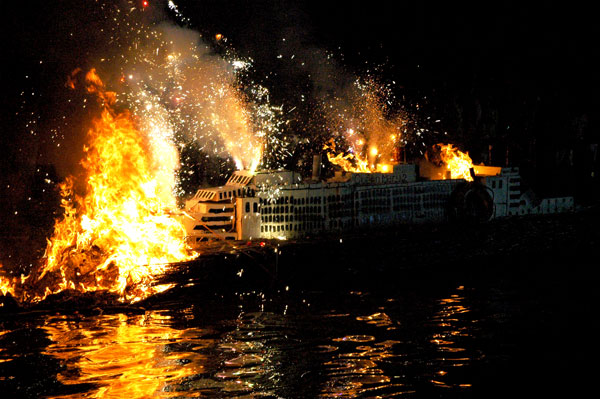
but no one’s suggesting actual sorcery is involved
old media and the Iran crisis
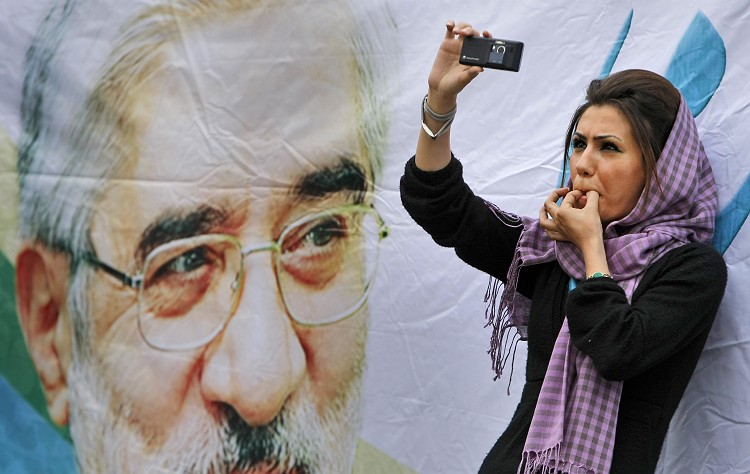
The Iranian protest movement is using social media in innovative ways to organize and get their message across. In this June 9 photo, a supporter of Mir Hossein Mousavi films an election rally. – Spiegel Online
The exigencies of the continuing crisis in Iran have eclipsed the importance of traditional media institutions virtually overnight.
Because of a frightened theocracy’s police controls and its effectiveness in blocking both access to and the filing of news, the role for television, radio and newspaper news reporting during the unraveling of one of the most important stories of the decade has fallen into a new category: In the telling of the story the traditional news organizations now occupy a middle position, in time and distance, somewhere between actual news reporting and what we will eventually find in the accounts of historians.
We have all become the reporters, in a gradual development whose significance is made clear and dramatic in the way in which we are learning about what is going on in the streets and homes of Iran this month, where it is new media which is keeping a popular revolution alive. Long live new media!
The impotence of old media may look like merely the consequence of a single emergency, but at the moment it’s an emergency without a denouement. Also, because there are certain to be others like it, and because our social media tools are only going to become more accessible and more ubiquitous, it’s looking like an impotence from which it may never completely emerge.
Together with the many past and continuing criminal failures of our news establishments and my excitement in watching the human and technological drama of a growing popular role in creating and reporting the news, I have to balance my treasuring a modest early experience in print journalism and my enduring pleasure in reading the best work of journalists published in hard copy. For that reason I have complex feelings while watching what may be the imminent demise of these hoary, once-great institutions which are already-so distressed: It’s pretty sad, and I confess to feeling embarrassed for all of us when I read postings, on the BBC, the New York Times or the Guardian sites for instance, apologizing for not being able to get a story from their own reporters and camera crews.
The television, radio and print news media may soon be left with merely a secondary role (if any) sifting, analyzing and commenting on information provided by outside and structurally independent reporters on the scene who are using the latest personal technology.
[image caption and otherwise uncredited image from Spiegel]
Iran’s people just might win this one

some of the hundreds of thousands of Mousavi supporters marching in silence today in central Tehran (green was the signature color of the opposition’s campaign)
I think they’re going to make it. There will be more demonstrations tomorrow, and the protests are likely to be more broadly-based and increasingly countrywide. A general strike has been called for the same day.
Iran’s twentieth-century political history is a complex story, and the second half especially includes a far-from-innocent involvement on the part of the U.S. [fed first by our lust for oil and Cold War hysteria – okay, it was actually pretty disgusting], but today it suddenly appears that the people who created and maintained one of the greatest civilizations in human history just may be about to emerge from the tyranny of a crude religious fanaticism which had briefly hijacked both their own best hopes and the world’s admiration for their magnificent culture.
I’d like to add that I wish that ordinary U.S. citizens had the kind of political courage being displayed on the streets of Iran today; We could certainly use it. Beginning last November I’ve been expressing my doubts about whether we were going to get what we had voted for. I should be writing more about my increasing fear and disgust, but I’ll wait for another occasion.
ADDENDUM: I just saw this Ted Rall cartoon. Although I said I wouldn’t go into Obama’s failures now, I couldn’t resist the adding this note. I do this even though Rall doesn’t address our hope-and-change President’s equally disturbing failure to address the economic meltdown (instead handing over the government to Wall Street), and his cynical reversals on gay rights issues.
[image, from the Guardian, by Abedin Taherkenareh/European Press Photo]
