Gates As a Form of Collective Punishment
Jayyous, Wednesday, August 20, 2003
Ras Atiyah’s gate has been closed since the
demonstration last Friday. The people of Ras e-Tira,
Dab’a and the other communities walled in with Alfe
Menashe have been cut off from Palestinian life,
apparently as punishment for their daring to hold a
peaceful demonstration in favor of children’s access
to school.
Today, every gate in the Apartheid Wall in the West
Bank, from Tubas to Jenin to Tulkarm to Qalqilya to
Mas’ha, is chained shut. Thousands of Palestinian
farmers are unable to reach their land. The reason?
A member of Islamic Jihad from Hebron in the southern
West Bank, in retaliation for the Israeli army’s
assassination of an Islamic Jihad activist in Hebron
last week, carried out a dastardly attack on
ultra-Orthodox Jewish worshippers in Jerusalem
yesterday. The connection with Palestinian farmers in
Jayyous? Absolutely none.
None of the 35 farmers who lined up at the gate in
Jayyous this morning had anything to do with events in
relatively far-off Hebron and Jerusalem. Most of them
probably condemn the attack in Jerusalem, as well as
Sharon’s provocations. But all of them were kept off
of their land, as were farmers up and down the
northern West Bank.
The idea here is of course not to make Israelis safer.
Preventing a farmer in Jayyous from planting his
seedlings carries no benefit for Jews in Jerusalem
wishing to return home safely from the Western Wall.
What the closure does is make life in Palestine that
much more unlivable, Palestinians’ access to their
land and water that much more tenuous, “voluntary”
ethnic cleansing that much closer to reality.
That’s the real purpose of locking the gates in the
Wall.
I’m sorry I haven’t been in touch for a while. Here’s
my journal for the last ten days. No photos – the
computers in the Internet cafe in Jayyous won’t let me
attach.
–Steve
Jayyous, Sunday, August 10, 2003
“Nabil”, ISM coordinator from Tulkarm, is in Jayyous
for a visit. He told us a hair-raising story last
night. He was taken from his house and imprisoned at
age 17œ during the waning days of the first Intifada.
He said that the Israeli forces used to target the
top students for arrest. He was only in jail for 21
days, a very short term compared to most of the
Palestinian men I know, but during that time the
guards went from underground cell to underground cell,
opened a hatch in the very heavy metal door, and
dropped in a half kilo of powder with an action like
tear gas, only stronger. (I assume that the Jews
reading this journal have the same horrible
association that I have with this image, even though
the substance in question here is not Zyklon B and is
usually not lethal.) Nabil says that it took about
80 hours for the irritant to dissipate. “Rashid”,
head of the Prisoners’ Club in Qalqilya, had told us
about the same process in all 3 of the Israeli prisons
he was in. Last week, about 100 prisoners at Ashqelon
Prison were injured while being gassed in their cells,
9 of them critically.
Gabriel and I went to the Falamiya Gate this morning,
and then walked over to the Jayyous Gate with John.
Very few farmers passed through either gate.I wonder
if a lot of them are sleeping in their fields beyond
the wall these days? The Border Guard was patrolling
and there were security at the Jayyous gate where
workers with heavy equipment (Caterpillar, natch) were
digging a trench, but we didn’t see any harassment.
It’s a tough call deciding whether or not to do Gate
Watch.one doesn’t want to get up at 5:30 in the
morning to waste one’s time, but we’d be devastated if
there were another incident at a time that we could
have been there.
Walking back up to the village, a man stopped us and
told me about his 70 dunums of land taken from him by
the Wall. He referenced boulders on his land and the
nearby settlement of Tsufim, so his land must be near
the quarry. He said, “Can you help me?” I can’t, of
course, and we both walked away feeling pretty bad.
A new crop of ISM activists came into Jayyous
today-all Jews, including Liat, a staff member of
Jewish Voices for Peace in San Francisco, Ora from
JAtO/NYC, and Rann, an Israeli who lives in Britain.
Qalqilya, Monday, August 11, 2003
Today, ISM activists from all over Palestine once
again converged on Qalqilya for a big demo against the
Wall. The demo was called by the Qaliqilya political
parties in response to Democratic members of the U.S.
House of Representatives who visited Israel as guests
of the American Israel Political Action Committee.and
who didn’t visit the wall. It was the usual
Underground Railroad scenario, and all of us, each in
a small group, managed to slip in undetected. We
spent a lot of time making signs and props for the
demo. (There are two ways to get media: someone gets
shot, or activists get creative. We prefer the
latter.) One activist drew a picture of Qalqilya
being hanged by a noose (representing the Apartheid
Wall that surrounds it), with an Israeli soldier
holding the noose. The soldier was drawn as an evil
looking guy with a big nose and Stars of David on
him.it looked more like a Nazi propaganda poster than
a sign for Palestinian freedom. David from JAtO/NYC
pointed it out to me, I said something, and the sign
was trashed.
Tracie called me from Jayyous to say that some farmers
came to the house to look for us-there’s a bulldozer
in the orchards beyond the fence knocking down lemon
trees. One of the farmers stood in front of the
bulldozer and stopped the work for the afternoon.
Tracie, Michelle and David went out to the orchards,
where an elderly farmer was holding branched of a
ruined lemon tree and wailing “Allahu akbar” over and
over again.
Jayyous, Tuesday, August 12, 2003
Today was the 2nd big Qalqilya demonstration at the
wall. In the morning, we heard on the news about the
attacks in Rosh Ha’ayin and Ariel (undoubtedly a
response to the much deadlier Israeli army attack on
Askar Refugee Camp on Saturday night), and prepared
ourselves for soldiers with a hair trigger. The
Israeli authorities in the meantime closed Qalqilya
checkpoint, meaning that no media could get in to
cover our action.
We had many more participants from Qalqilya than last
time. We marched to the vicinity of the military gate
in the southwest corner of what’s left of Qalqilya,
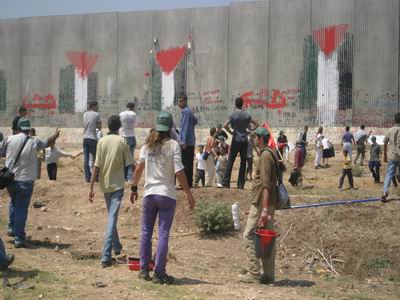
just like last time. This time, instead of hoisting a
giant banner with balloons, we used paint rollers on
very long poles to paint giant Palestinian flags up
above the graffiti from July 31. We also tied strings
of names of prisoners to tennis balls, and threw them
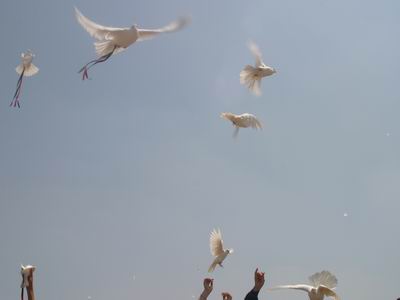
over the wall, and girls from Qalqilya released doves.
Check out www.palsolidarity.org for photos.
Our two negotiators, Lisa from Italy and Sam from the
U.S., were awesome. At one point, a few boys from
Qalqilya threw stones in the direction of the troops
who were watching the demonstration with guns cocked.
Despite the fact that older boys and men from Qalqilya
exposed themselves to the troops by running out front
and literally tackling the stone throwers in order to
stop them, the Israeli soldiers began throwing sound
grenades at us (not exactly a de-escalatory tactic).
The usual Israeli army tactic is to follow the sound
grenades with tear gas, then rubber bullets, and
eventually live ammunition. Sam and Lisa, however,
who had positioned themselves among the soldiers from
the beginning of the demo, convinced them to stop
throwing the grenades and allow the demo to wind down
naturally. There were a few speeches and we withdrew.
As we left, Israeli soldiers were spotted in hiding
in the orchards off to the side (something the
commander denied to our negotiators), which was a
provocation that sparked more stone throwing and tire
burning. Fortunately, the army, withdrew, and no
Palestinian boys were hurt.
Tel Aviv, Wednesday, August 13, 2003
In the morning, Rann and Ora and I from ISM went down
to the gate in the Apartheid Wall near the village of
Falamiya-the next gate to the north after Jayyous’s
gate. The gate was open (although, ominously, the
same chain and lock that had recently appeared on
Jayyous’s gate was hangin on this one), farmer traffic
was very light, and there was no military presence in
evidence. We chatted with a farmer working on is
trees right inside the Wall, who spoke with us in
Hebrew. He said that there would be a process
regarding the Wall and its gates: first the gates are
always open. Then the gates are always open, but
there’s a lock and chain hanging on it. Then they’re
locked at night. Then they’re locked during the day
as well, except for certain hours. Finally, the gates
are locked for good, paving the way for the
confiscation of all the land outside the fence. We’ve
heard these same predictions from a number of farmers;
when you’ve lived under occupation for 36 years, you
tend to know the ways of the occupier.
Later in the afternoon, the internationals from ISM
and Ahmed and Farouq from Jayyous Peace Activists went
down to the orchards where lemon trees were being
bulldozed. It seems that a farm road is being paved
and widened-for reasons we can’t understand and quite
against the wishes of the farmers whose trees are
being destroyed. The farmers we met, however, asked
the Jayyous Peace Activists and ISM not to mount a
demonstration. They noted that the workers widening
the road are Palestinian, and were being careful not
to damage irrigation pipes or trees other than the
hundreds in the path of the widened road. They felt
that any protest against this unnanounced invasion of
their land would cause the contractors to replace the
Palestinian workers with Druze or Jewish workers who
would carelessly destroy anything in their path. They
were also afraid that any protest would lead to a
retaliatory locking of the gate; now that the
Apartheid Wall is up, the Israeli army has enormous
control over Palestinians’ behavior just by holding
the keys to the gate.
A group of us New Yorkers spent the evening in Tel
Aviv (the privilege to pass freely between Israel and
the West Bank of course being one that our Palestinian
friends and hosts don’t have). We went to the Tel
Aviv Beer Festival because D.A.M., a Palestinian
hip-hop artist from Haifa whom we admire for his
political songs, was scheduled to appear on the
Israeli hip-hop and reggae stage. We spent a few
hours there, but were so disgusted by the acts that
preceded D.A.M. that we had to leave. Some were just
amateurish and stupid, but others were pro-occupation
hip-hop artists who rapped about crushing Gaza among
other things, and who were introduced as having “blue
and white flowing in their veins”. Ugh.
Jerusalem, Thursday, August 14, 20003
I went up to Jerusalem early in the morning for an ISM
Core Group meeting in El-Ram, a Palestinian West Bank
community illegally annexed to Israeli Jerusalem. It
was wonderful to see Lysander from New York’s Direct
Action Palestine there; I hadn’t seen her since she
was arrested in Mas’ha and banned from the West Bank.
The meeting was long and involved; ISM is an ambitious
international project committed to grassroots
democracy and consensus process. I had to miss the
second day of the meeting because of my region’s
scheduled action in Ras Atiyah.
Jayyous, Friday, August 15, 2003
Early in the morning I got on a bus chartered by Yesh
Gvul, a 20-year-old Israeli organization for military
refusers, to go to a demonstration in Ras Atiyah
organized by the Committee Against the Wall/Committee
Against the Settlements with ISM participation. It
was interesting to talk with Itai, an organizer from
Yesh Gvul, during the ride. He downplayed the time he
and others have spent in jail for refusing their
Israeli military service, noting that it’s the
Palestinians who live in a jail all the time.
I also talked with other ISM internationals on the bus
about the previous night’s house demolition in Askar
Refugee Camp in Nablus, where I spent time last year.
The house demolished was under ISM’s protection, and
the internationals in the house chose to stay with the
family when the family decided to evacuate (as per the
orders of the Israeli soldiers who arrived in the
middle of the night). It was hard news to take for
the many Nablus ISM members who would have wanted to
be there to help, but were in Jerusalem either to
attend the Core Group meeting, or because of their
arrest in Mas’ha.
As I’ve written here before, Qalqilya is entirely
surrounded by the Apartheid Wall. South of Qalqilya
is a corridor outside the wall that allows passage
from Israel to the illegal settlement of Alfe Menashe,
east of Qalqilya. South of that are the villages of
Habla and Ras Atiyah, themselves surrounded by the
Wall. The Wall has been constructed in such a way
that 3 Palestinian villages and 2 Bedouin settlements
have been walled in with Alfe Menashe. 1000 people in
these 5 communities have been cut off from access to
the rest of the West Bank, but forbidden to enter
Israel. The stage is set for ethnic cleansing there.
Ras e-Tira is one of those 5 communities in the Alfe
Menashe enclave created by the Wall. Children from
Ras e-Tira go to school in Ras Atiyah, which is in the
Habla-Ras Atiyah enclave created by the wall. The
school in Ras Atiyah is right next to the Wall
(children painted slogans against the Wall’s
construction on the school), and the kids from Ras
e-Tira have to pass through a gate there in order to
reach the school. They are often prevented from doing
so, and the demonstration was planned to call
attention to Ras e-Tira’s lack of access to education.
We were met at the demonstration site by the usual
private security paid to guard the construction of the
wall. They were their usual aggressive selves, but we
were able to put a protective line of internationals
and Israelis in front of the Palestinian demonstrators
who held signs, chanted, sang, and made speeches
against the Wall. The security called the army and
the Border Guard, who showed up and demanded that
everyone withdraw inside the gate. We were asked by
the organizers not to give up the gate, because it
would be closed and locked, stranding the
demonstrators from Ras e-Tira. It was pretty tense
for a while, as soldiers and Border Guard gave us five
minutes to disperse before they began using force, but
our negotiators were wonderful, and Palestinian and
international demonstrators showed incredible
discipline in the face of verbal and physical
provocations by the soldiers, Border Guard, and
security. The Israeli demonstrators were not as
disciplined, and one got into a verbal confrontation
with a security guard that ended with the guard
slapping the activist, after which the activist
(natch) was arrested. They also tried to arrest
Jackie, a videographer from New York, but we swallowed
her up into the crowd (but not before a soldier
grabbed and broker her camera).
As the time for Friday prayers approached, the
Palestinian activists prayed in the schoolyard rather
than going to the mosque, which put the soldiers and
Border Guard in a bind. When they were done, Ras
e-Tira demonstrators were permitted to cross the gate
and return to their village. Jackie crossed too,
since her bags were in Ras e-Tira, and the Border
Guard tried again to arrest her. Fortunately, she got
away. We then withdrew into the schoolyard, and the
Israeli soldiers closed and locked the gate.
The Jayyous Peace Activists were really happy with the
demonstration, and we’re looking forward to more work
with the villages south of Qalqilya. One suggestion
from a member of the Land Defense Committee in Ras
e-Tira is that we set up a fence in the schoolyard in
Ras Atiyah to help ensure kids’ access once school
starts on September 1.
At 7 in the evening, a boy came to our door to tell us
that the gate in the Wall had been closed and locked,
and many farmers were stranded outside. We walked
down the hill, and found Abu Ali there among the
others, waiting to get out to his lands to spend the
night. He called the mayor, who called the Israeli
army District Commanding Officer, and at about 8:30
soldiers came by and opened the gate for the people
waiting to get in and out. I took a flask photograph
while they were re-locking the gate behind the last of
the farmers, which enraged the commander of the
soldiers. He demanded repeatedly to know who I was,
but I was long gone.
The soldiers said that they’d be opening the gate for
a few hours each morning and evening from now on.
It’s hard to describe how humiliating the whole
experience was, with farmers on their own land locked
out of their own homes by a capricious and vindictive
foreign army, an army that’s been here for 36 years.
Jayyous, Saturday, August 16, 2003
I descended to the gate four times today, as it was
locked, unlocked, locked and unlocked again, each time
with a different story of what hours it would be open.
Tracie and Michelle, ISM Jayyous, told me about our
friend “Mortaza” and why he stays away from the gate
and from demonstrations-he was arrested, held tied to
a chair for 72 days, and then imprisoned for 17
months. He was never charged. He’s been told that if
he’s seen “causing trouble”, he’ll be reimprisoned.
On Gate watch I chatted with “Abd el-Wahid”, who told
me about his grandfather’s land, now in Tel Aviv, and
how he still has the Ottoman deed to it. Tracie and I
also had tea with Khaled, a shepherd who was taken by
the army a month ago while tending his flock outside
the fence, and taken to Jaljulya checkpoint and
released at 3:00 in the morning.
Liat (of the Bay Area’s Jewish Voices for Peace) and I
went to visit the Bedouin family trapped outside the
Wall. We were pretty worried about walking through
Jayyous’s south gate, since Palestinians and
internationals have been threatened and shot at for
passing through, but we thought it was important to
check on the welfare of this family. The mom and some
of the kids were home, and they enthusiastically
welcomed us and served us tea as we sat and talked
amongst their rabbits and chickens (dad was out with
the sheep). They’re running low on water, because the
pump in the nearby village of Azzun is broken. That
pump directs water from the aquifer to villages all
over the area. People in the village buy water ($150
for 11 cubic meters), but they can’t get the tank
delivered from the other side of the Wall (not to
mention the obstacle of the money). The mom has
diabetes, and had medical papers indicating her
permission to pass through to Qalqilya for treatment,
but the security guards ripped up her papers and
denied her passage. She was also worried about the
kids’ ability to pass through the gate to get to
school next month.
We committed to having internationals walk the kids to
and from school each day starting in September, on the
assumption that the security, soldiers and Border
Guard would hesitate to harass them with
internationals present. We also went back to the
Jayyous peace activists, who said they’d talk to the
mayor about trying to get permission from the District
Commanding Officer to have a tractor with the water
tank cross the gate. We committed to raising the
money.
When we returned to the gate, we saw that boys who had
seen us walk through the gate ventured to do the same
themselves, and set tires on fire in the road. We
were pretty mad about it, because of the danger it put
us in, but the boys were nowhere to be found. We
passed through the gate unmolested.
The farmers were locked out of Jayyous again tonight,
and the mayor had to call the DCO to send soldiers to
open briefly.
Qalqilya Sunday August 17, 2003
During Gate Watch this morning, some Palestinian
construction workers who are building the Apartheid
Wall sat down with us to chat (needless to say,
they’re not from Jayyous). I kept my distance from
them. Israel’s economic war on Palestine is so severe
that some Palestinians will build their own cages for
a daily wage. Later in the day, a reporter and
photographer from a regional newspaper in the Sharon
region of Israel came to interview people, see the
Wall, and met the Bedouin family. When the two
journalists, accompanied by a group of Jayyous Peace
Activists and internationals, tried to return to the
village, we found the gate closed and blocked by one
of the security guards. After we stood in the sun
arguing with them for a while, a jeep came along and a
soldier ordered the security guard to open the gate.
He told the two Israeli journalists (he didn’t know
that one of the internationals is also Israeli) that
they couldn’t go back into Jayyous without permission.
This is nonsense, of course; Jayyous is in Area C
according to the Oslo Accords, which means that there
are no restrictions on Israeli access. Nevertheless,
the journalists chose not to go back to Jayyous with
us.and accepted a ride with the soldiers in the jeep.
Now I understand why Palestinians distrust Israeli
journalists. What would we think if a Daily News
reporter interviewed people in Red Hook about police
brutality, and then got a ride out of there in a
police car?
In the evening we were called to Qalqilya to help with
a situation there. A giant military bulldozer had
shown up with a surveyor, attempting to destroy all
the greenhouses, sheds, and farmlands within 50 meters
of the 8-meter high wall on the west side of Qalqilya.
The bulldozer stopped working and left when
internationals arrived on the scene, but was expected
to return during the night or the next day. ISM
activists converged on the city to block the
destruction. We decided that we would not allow tear
gas, rubber bullets, or threat of arrest keep us from
blocking the bulldozer.
Jayyous Monday, August 18, 2003
We waited at a greenhouse by the Wall in Qalqilya,
watching a military bulldozer work outside of the
Wall. It never came in to destroy the lands within 50
meters. I heard that the political establishment in
Qalqilya wants a third Wall action, which I was
delighted about. The group assembled decided to stay
at the greenhouse, day and night, but John and I chose
to return to Jayyous.
Jayyous Tuesday, August 19, 2003
At Gate Watch this morning, I asked Abu Ali why there
were so few farmers going out to the fields. (Most of
the people who passed were workers on the Wall.) He
said that many farmers were now living on their land,
a development he heartily approves of. He feels that
when farmers live on the land, the power of the Wall
and its gates is neutralized. This is tricky
business, though. If any farmer builds a shed that is
too comfortable or sturdy, it will be demolished by
the Israeli army because the land is zoned for
agriculture and not residence. We had long talks with
our closest partners in Jayyous today about how the
mood in the village had changed since last year, when
the olive trees were first being uprooted to make way
for the Wall. Ahmed said that people are now in
despair; the village united in a campaign of
non-violent resistance, and the Wall was built anyway.
Now the Israeli government has a noose in place,
which it’s slowly tightening around Jayyous’s neck.
I’m convinced that the goal is not land and water
theft, it’s ethnic cleansing. The Israeli government
wants to make the Palestinian communities within 5 or
6 kilometers of the Wall unlivable, forcing the
thousands living there to move deeper into the West
Bank or into another country. Perhaps the plan is
then to repeat this process a little further in, until
the West Bank is virtually Arabrein from the Green
Line to the Jordan River. Sharon’s governing
coalition includes parties that support expulsion of
all Palestinians from Palestine; it seems that the
“moderates” have the same plan, but wish to make it
appear voluntary.
No bulldozer in Qalqilya again today-the oppressor is
patient.