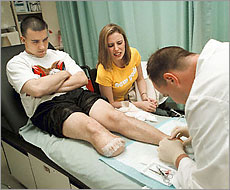
so, what are they thinking?

“Peaking too soon?”
Gary Trudeau had Mark on the phone to Iraq yesterday.
Are we “supporting our troops,” or are we afraid to admit that our government is one of idiots and spoilers, and that we personally share in that idiocy, but without sharing the spoils? Can we close our eyes forever?
Can a government which clearly doesn’t know what it’s doing long survive, at least if the people notice?

The issue of soldiers’ tours [of duty] has been contentious, with troops and their families posting missives on the Internet criticizing the their government for keeping them in Iraq.
Some express concern about “mission creep,” in which what begins as a swift war turns into a long-term occupation that could cause heavy American casualties as Iraqis become more and more skeptical of U.S. promises to let them govern themselves.

No, not too soon, and maybe not too late.

actually, talk isn’t cheap after all

Is our current philosophy of government killing our troops and abusing Iraq? Paul Krugman says the mess in Iraq isn’t just about poor planning and mismanagement.
The Bush administration’s mixture of penny-pinching and privatization (both pursued for reasons of ideology and profit) is more than just an embarassment for our military, for our government and for ourselves. In fact it’s become absolutely fatal for many.

In general, the “support our troops” crowd draws the line when that support might actually cost something.
The usually conservative Army Times has run blistering editorials on this subject. Its June 30 blast, titled “Nothing but Lip Service,” begins: “In recent months, President Bush and the Republican-controlled Congress have missed no opportunity to heap richly deserved praise on the military. But talk is cheap — and getting cheaper by the day, judging from the nickel-and-dime treatment the troops are getting lately.” The article goes on to detail a series of promises broken and benefits cut.

Troops in Iraq are still subsisting on M.R.E.’s, “the dreaded meals ready to eat,” in Krugman’s words, and there are serious shortages of water in the field.

An American soldier died of heat stroke on Saturday; are poor supply and living conditions one reason why U.S. troops in Iraq are suffering such a high rate of noncombat deaths?

We’re not willing to pay what we must to support our fighting forces, but the greater scandal may be that the money being paid to corporations, in a shift of many tasks traditionally performed by soldiers, is money that is being wasted, and costing lives.

According to the Newhouse News Service, “U.S. troops in Iraq suffered through months of unnecessarily poor living conditions because some civilian contractors hired by the Army for logistics support failed to show up.” Not surprisingly, civilian contractors — and their insurance companies — get spooked by war zones. The Financial Times reports that the dismal performance of contractors in Iraq has raised strong concerns about what would happen in a war against a serious opponent, like North Korea.

Even the enormous and essential task of rebuilding what we have destroyed in Iraq is being compromised in the name of ideology and patronage.

In Iraq, reports The Baltimore Sun, “the Bush administration continues to use American corporations to perform work that United Nations agencies and nonprofit aid groups can do more cheaply.”

The bizarre experiment which we refer to as the current administration in Washington is sustained only at enormous human and material expense – ours and Iraq’s.

Israel moves to destroy another family

Omigosh, James is asking for money now. No I’m not! I think the story in this post is important by itself, especially if you have been following Steve‘s reports from Palestine regularly included on this blog since last summer. However, if you do have any spare funds they would abviously be very useful in saving one good family in the occupied West Bank, and they might even help to establish a precedent which could help others.
The entire segment below is from Steve, but in fact his own words are only in the introduction to the letter from Tracie.

Folks,
I hope you can help out in the case of Nasser Quzmar. Please read Tracie’s letter below, and let me know if you have any questions.
Steve
Dear Friends,
I am writing on behalf of a man by the name of Nasser Quzmar. Nasser is a 32 year old Palestinian man who is a farmer in the village of Izbat Salman in the Qalqilya District of The West Bank, Palestine. Izbat Salman is a village of 690 people on 4,800 dunums of land (1 dunum = 1/4 acre). Of these 4,800 dumuns, 4,000 have been isolated or bulldozed for the wall. Last September, on our tour of the villages, Nasser was one of the farmers whose story we were told. His greenhouses were slated for destruction and his land for confiscation. Of course, his families’ source of income historically has come from agriculture. Nasser is the breadwinner for a family of six. Their ages range from 2 months to 8 years old. Once a farmer with 27 dunums of cultivated lands of olive, citrus and vegetables, as well as greenhouses, he has lost almost everything due to the wall surrounding his village.
All the papers, documents and evidence that Nasser collected to demonstrate his ownership of the land would not spare him and his community from the devastation. He filed legal complaints through a law office that deals with a number of cases about the wall. The clearest response he got was the arrival of bulldozers to his land. Another response he got was imprisonment. In the middle of the night, approximately 2 months ago, the Israeli Defense Forces entered the home of Nasser and took him away. At the time of his arrest, Nasser’s wife was 9 months pregnant.
He has not been charged with anything. Nor has his wife been able to communicate with him since his imprisonment. Nasser was not involved in any political act at the time of his arrest, nor has he ever been. One can only surmise that it was due to his legal complaints and documentation that he may have become a target. He is a simple farmer who carries on the tradition in his family. In the eyes of the IDF, he defied them by continuing to work on his land. It has become increasingly difficult for the family to subsist with Nasser out of the home. It is possible that he will be in prison for years. In the words of Nasser Quzmar, “I never imagined that I would helplessly watch as my land was destroyed.”
Nasser was formally arrested today after two months in administrative detention. He will be charged on Thursday, and it is likely that the charges will attempt to link him to terrorism. One of the ways that the Israeli government tries to quell non-violent resitance is to lump those resisters together with armed groups. This, we believe, is what is happening to Nasser.
Of course, there are many stories like this throughout the Occupied Territories of Palestine. Because this is a family who graciously accepted us into their home on two occasions, we feel a special connection and a duty to do what we can to offer assistance. The family is not in a position to pay for legal services. We have been able to lcoate an excellent attorney who is willing to represent Nasser. He is an Israeli Lawyer by the name of Shamai Liebowitz (do we want to put this in the letter?). The cost for his services is NIS 5000 (approximately $1180 US dollars).
We are asking for people to make contributions to the legal fund for Nasser Quzmar. Any money that is raised beyond the NIS 5000 will go to the ISM legal fund. Because our goal is to get Nasser back to his family as soon as possible, we are asking for people to donate today. We ask that you consider sending a check for $100, although any offering will be most appreciated! You can make checks payable to Gabriel Ash and write “Nasser Quzmar” in the memo section of the check. Gabriel is an activist with SUSTAIN who is with us in Palestine and will put the money up now to be paid back through your generous donations. Please send your donations to:
Jews Against the Occupation
Prince Street Station
PO BOX 494
New York, NY 10012
Please send an email to Tracie at pnut119@nessanphotography.com with the amount you are donating so we can keep track while here in Palestine.
Thank you for your assistance and on behalf of the Quzmar family, I thank you.
Sincerely,
Tracie De Angelis
NOR CAL ISM
From The Occupied Territories
West Bank, Palestine
01197267723326 (from the states)

report from Palestine August 9, 2003


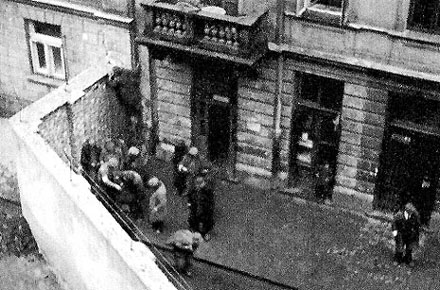
Warsaw, 1940’s
“Does this remind you of anything?” [the text of a sign held, while standing on the scoop of a frontloader, by one of several dozen youg Israeli peace activists trying yesterday to obstruct the construction of the Apartheid Wall at Mas’ha]

Palestine, 2000’s
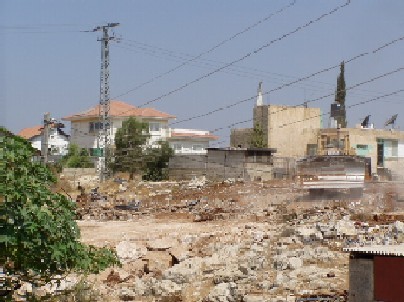
The [new, white] houses in the background are in
the illegal Israeli settlement of Elkana. The house
in the middle ground is the house to be isolated by
the Apartheid Wall. And the bulldozer in the
foreground has just demolished the family’s hen house
to make room for the Wall.
[from Steve’s text below]
Steve has been in Qalqilya, Jayyous, Mas’ha and Tel Aviv. The letter is very long, but it’s not dull, you won’t read anything like it in the media, and it absolutely must be recorded as witness to the horror we and our Israeli instruments visit on Palestinians every day.
The report itself [followed by Steve’s attachment of an Israeli Peace group’s media alert about an action tonight, which includes an eyewitness account of an Israeli raid of a Palestinian camp near Nablus]:

Jayyous August 5, 2003
I was sad to leave Qalqilya yesterday. The checkpoint
was the usual humiliating experience. The border
guard didn’t know that I could understand the abusive
things he was shouting at me in Hebrew and Arabic as
he demanded to inspect my backpack. Sometimes
internationals are spared the abuse. Palestinians
never are. Then I had to quickly jump into an illegal
taxi to take me to my new home. The Israeli
government policy seems to be to criminalize any kind
of Palestinian movement, knowing full well that
Palestinians will still move, but painting a veneer of
“rule of law” onto military harassment of Palestinian
civilians.
The next time I go to Qalqilya, we’ll have to activate
the Underground Railroad that our local coordinators
and local volunteers have developed. Israelis
(whether Jewish or Palestinian) and internationals
just don’t get through the checkpoint.
As always, I had to change taxis at the roadblock at
the village of Azzun. A week earlier, on the way back
from the Jayyous action to bring supplies to the
trapped Bedouin family, we had watched soldiers and a
military bulldozer (Caterpillar, natch) pile more dirt
and boulders and concrete blocks onto the roadblock.
It’s hard to describe how degrading the scene was. An
elderly taxi driver told me that tomorrow, vehicles
would be making their way around the roadblock
again.he said it was like Tom and Jerry. A soldier
told me to tell my friend (Ryan, who was passing
behind the bulldozer to photograph it) to be careful,
remember what happened to “that girl”. He was
referring to Rachel Corrie. My blood ran cold. I
looked at him and said, “That wasn’t an accident.” He
shrugged.
Jayyous is lovely, despite the ugly scar that runs
across its lands where the Apartheid Wall has been
built. Lately, Border Guards have been coming in at
night and shooting water tanks on people’s roofs. My
landlord here, a local activist I’ll call Saleh,
overheard them saying to each other, “shoot the white
ones [the hot water tanks], they’re more expensive to
fix.”
Jayyous, population 6,000, is not connected to the
Israeli power grid. The illegal Israeli settlements
that surround it of course are connected to the grid.
Power here comes from a generator, is astoundingly
expensive, and is switched off every evening from
5:00-7:30 and every morning from 2:00-8:00. Cell
phone coverage is poor, it’s hard to keep phones
charged with daily power outages, and the Internet
café is slow as molasses (when the power is on-no
Internet of course when the power is off). It’s hard
to stay connected here.
We watched the sunset over the olive groves. Jayyous
is on top of a hill, with a good view of its lands,
and of the densely populated coastal plain of Israel
beyond. Saleh, a mild-mannered and always polite
English teacher, told us that this was the spot from
which he used to throw rocks during the first
Intifada, because it was hard for the Israeli soldiers
to shoot kids from their position on the road below.
We had dinner at the home of Abu Ali, leading Jayyous
activist. He is a farmer, and served us the most
amazing figs I’ve ever tasted. The best ones, he
explained, are the ones the birds have pecked at. I
ate one. It was so sweet, it made my teeth hurt.
(For the record, Jayyous mangoes are pretty tasty too.
I’m looking forward to the prickly pears and guava,
also in season.) Abu Ali just built a house for
himself and his wife; up to now, he spent all his
money sending his children to university, medical
school, and the like.
Abu Ali camped out in front of Abu Mazen’s office to
get him to start talking about the Apartheid Wall.
Today, he’s meeting with President Arafat to demand a
number of services for Jayyous’s beleaguered farmers.
All of Jayyous’s spring-fed lands are on the “Israeli”
side of the wall (any one think that’s an
coincidence?), and he wants the Palestinian Authority
to build pipes to bring that water to Jayyous’s
rain-fed lands inside the Wall. Of course, the PA
can’t go near a project like that without Israeli
cooperation.
Early this morning, Israeli-American New York
Palestine activist Gabriel and I took an early taxi to
the village of Mas’ha, 5 kilometers east of the Green
Line (West Bank-Israel border). Mas’ha has been the
site of a peace camp for several months, a place where
Israelis, Palestinians, and internationals came
together in dialogue and shared rage about the
Apartheid Wall and the ever-expanding settlements it
“protects”. Over the past days, it became clear that
the Apartheid Wall was going to run east of the
westernmost house in Mas’ha, trapping the family in
that house between the Apartheid Wall to the east and
the fence around Elkana settlement to the east. This
plan symbolizes to me the sheer brutality of the Wall
project; it exists only to serve the interests of
Jewish Israelis, and Palestinian people are just so
many obstacles in the way.
Palestinian, Israeli and international non-violent
activists had gathered to prevent the continued
construction of the Wall at that point, and we had
word that the army was coming at 7 this morning to
clear them out. Gabriel and I were late because the
taxi we had booked stood us up, and by the time we
arrived 47 activists were in the custody of the Border
Police. They arrested everyone with a camera first,
followed by all the people who were sitting in the
path of the bulldozers, followed by the people who
showed up during the arrests and began filming. They
kicked people, and they dragged them by the hair.
Most of the Israeli, and surprisingly, Palestinian
activists have been released, but about 40
internationals remain in custody at Ariel police
station (Ariel is an illegal Israeli settlement of
25,000 people, many of them Russian immigrants).
ISM’s Freedom Summer will be decimated if they’re all
deported.
I stayed in Mas’ha about half the day, watching the
Israeli government’s destruction. Check out the
attached photo: the houses in the background are in
the illegal Israeli settlement of Elkana. The house
in the middle ground is the house to be isolated by
the Apartheid Wall. And the bulldozer in the
foreground has just demolished the family’s hen house
to make room for the Wall.
I chatted with Mohammad, the owner of the house in
question. He is absolutely committed to staying in
his house, no matter how impossible the Israeli
government makes it for him. We waited hours for a
chance to get into the house to retrieve the backpacks
of the arrestees; the construction company’s private
security tried to prevent us, shoving around some
fierce Israeli anarchists who showed up to help. We
got all the bags out eventually, and returned to
Jayyous. The future of Mohammad’s family, or of the
Mas’ha peace camp, is unsure.
Several of the Palestinian men I spoke with in Mas’ha
indicated the construction of the Wall going on and
said that Israel doesn’t want peace. I hear that
often from Palestinians, at checkpoints, during
incursions, at scenes of destruction: Israel doesn’t
want peace.
Jayyous, Friday, August 08, 2003
In the wee hours of Wednesday morning, the activists
arrested at Mas’ha were released. The internationals
had the condition attached to their release that thet
not return to the West Bank; as far as I know, they’re
still in Jerusalem. Of the three who were charged
with assault, the Israeli Jew was release after being
charged, the Italian was released on the condition
that she leave the country immediately, and Maher, the
Palestinian from Mas’ha, was kept in jail with a
hearing scheduled for 8 days later. 3 people, all
arrested in the same place at the same time doing the
same thing, all facing the same trumped up charge,
with 3 different sets of rules applied to them based
on who they are. This is Israeli apartheid.
Fortunately, intense pressure from ISM and from our
lawyers resulted in Maher’s release yesterday
afternoon.
I did Gate Watch on Wednesday morning with John, a
75-year old Englishman from Ecumenical Accompaniment.
We waited at the gate that allows Jayyous farmers to
pass through the Apartheid Wall to their lands. The
gate was the site of harassment and beatings by the
construction company’s security guards prior to the
institution of Gate Watch, but is quiet now. Only a
few farmers passed through the gate, since it was
blocked by boulders placed there by the construction
company more than a week earlier, making passage with
anything more complex than a donkey cart impossible.
Afterward, Gabriel and I rushed back to Mas’ha, on
word that Israeli activists were about to stage a
surprise action there. About 24 young Israeli Jews
arrived, held onto the scoop of a front loader, and
stood on a giant drill, forcing work to stop. They
then occupied the front loader. Their signs were all
in Hebrew, and said things like “Separation Wall=Land
Theft=Death”, “This isn’t a fence, it’s a ghetto”,
and, chillingly, “Does this remind you of anything?”
They chanted “No to the fence, no to transfer.”
A couple of settlers watched the scene from their roof
in Elkana, right next door. I wanted to yell at them,
“Aren’t you ashamed? Look at what is being done so
you can have what you have!”
I’m told that many of the people living in West Bank
settlements now are Russian immigrants. They arrive,
the Ministry of Absorption tells them, “You will live
in Ariel (Elkana, Shaarei Tikva, etc.), and voila!
Instant settlers.
Had they been Palestinians, they would have been met
with live fire immediately. Had they been
internationals, they would have been quickly and
brutally arrested (Freedom Summer’s campaign
coordinator). But as Israelis, they were permitted to
stay for a few hours, were then presented with an
official order of a Closed Military Area (how a
residential area can be a Closed Military Area I don’t
understand), and then given 30 minutes to leave.
Finally, soldiers removed them, not gently, but
without apparent brutality, and they were bussed to
Ariel for arrest. Ragheb was arrested along with
them; he was inside the house that is going to be
isolated, photographing the scene for AP. He was
released that evening, and given a paper allowing his
return to Qalqilya (the checkpoint is closed at
night), but his photos were confiscated. The
government of Israel really doesn’t want light shone
on what it’s doing. The police on the scene tried to
arrest us for taking pictures, but we scrambled to the
Mas’ha side of the roadblock, which they were
unwilling to cross (jurisdictional issues, I think).
While the Israeli demonstration was going on, some of
the men from Mas’ha, including the owner of the house,
got into a heated argument with the head of the
security staff on the scene and some of his men. The
security guy told the owner of the home, that he, the
Palestinian, belonged to the past, and that all he
cared about was money. Meanwhile, the owner of the
surveying firm was on the scene, fuming that work had
stopped, and dynamite went off behind us as the
construction company continued to clear land further
south.
Gabriel and I proceeded to Tel Aviv, where Ady and
Nirit had organized a commemoration of An-Nakba, the
Palestinian Catastrophe of 1948, for the eve of the
Jewish Fast Day of Tisha B’Av. We took a bus that
wound through several illegal Israeli settlements,
each of them accessible through one gated entrance
with an armed guard, each of them transformed from the
arid landscape around them to lush irrigated suburbs,
each of them far more luxurious than most Jewish
residential areas inside the Green Line. One of them
was Shaarei Tikva, the settlement I had seen from the
outside suffocating the villages of Beit Amin and
Azzun Atme. From the inside, the development had been
designed in such a way that the adjacent villages were
invisible.
In Tel Aviv, the commemoration went well, with a
number of Israeli activists participating and thanking
JAtO/NYC for taking the initiative. We lit yahrzeit
candles and arranged them to spell the number of
villages destroyed in 1948, and then we read the names
of all the villages. I stayed in Tel Aviv, because
one can’t return to Jayyous at night.
John reported from Gate Watch this morning that a path
had been opened up in the boulders at the gate (the
way had still been blocked when we took an American
visitor there yesterday afternoon), but that the gate
was closed for the first time. He was able to open
it; we’ll see what develops in the days ahead.
Jayyous, Saturday, August 9, 2003
Yesterday afternoon Abu Ali picked up Saleh (his
nephew, turns out), me, John, Gabriel and David for a
night on his farm. We were able to pass through the
gate on his tractor thanks to the small gap in the
boulders in the road. We noted however with alarm
that the gate now has a chain and a lock on it, ready
to be shut tight at the whim of the Border Guard or
the private security. My guess-the authorities will
wait until the international attention to the Wall
dissipates, and local Palestinian activists are
pacified by the fear that escalation will limit
access, and then they will start locking the gate from
time to time, perhaps more and more often, perhaps
demanding permission from farmers to be on their own
land as they already have started doing in nearby
Qalqilya.
Abu Ali’s farm is right next to a giant ugly quarry
gouged out of land confiscated for the settlement of
Tsufim on the hilltop above. The crater is surrounded
by signs in Hebrew that say “Danger, building here.”
I changed one to “Destroying here.” Abu Ali showed us
the blast holes that have been filled in by court
order when he sued about the damage they were doing to
his water tank right next door. He told us about his
8-year successful legal fight against the confiscation
of his farm. He told us about the soldier who put a
gun to his head to get him to stop planting during
that court fight, in front of his 8-year-old daughter,
and the counseling and medication she needed as a
result of the trauma.
The night on the farm was lovely-our own 5000 star
hotel-and Abu Ali went out and picked up dinner and
breakfast (supplemented by his wife’s homemade
goat-milk yogurt cheese). In the morning, we visited
a couple of other farms, and heard stories about
recent beatings of farmers at the gate at the
neighboring village of Falamiya. Farmers with cars or
trucks have been taking a big detour to use the
Falamiya Gate since they still can’t pas through the
Jayyous Gate (the space in the boulders is only big
enough for a tractor). Tomorrow morning and
afternoon, we’ll expand Gate Watch to Falamiya Gate,
and see what happens.
We passed by one of the water pumps, whose operator
was targeted by the Israeli army and jailed without
charges for a 4 1/2 year term as part of the Israeli
government’s economic war on Palestine. David showed
me where they installed a meter to make sure that on
only a certain amount of water is pumped each month,
while on the Jayyous lands across the Green Line that
were confiscated in 1948, cotton, among the thirstiest
of crops, is grown by the land’s Jewish owners using
unlimited water from the same aquifer.
Farmers are urging us to open the path to Jayyous
Gate, and John, 75-year-old British Quaker, is itching
to take a sledge hammer to those boulders. But Abu
Ali is urging us to wait, while he demands that the
Border Guard remove the boulders as promised.
Abu Ali told me this morning that all international
solidarity activists add to the struggle, but that
Israelis are the most valuable, and foreign Jews the
second most valuable. He’ll be pleased to learn that
a second Israeli is joining us tomorrow from the ISM
training.
We had lunch back at Abu Ali’s farm, and were joined
by 3 French and Swiss solidarity activists, as well as
a Swedish diplomat and some Palestinian activists.
Needless to say, lunch conversation was stimulating.
Back up in the village, David’s been telling me about
last month, when Border Guard were shooting at
children, threatening Saleh’s life, and shooting up
water tanks as noted above. Things are quiet here
this week, but now that Israel has broken the cease
fire…
Take a look at this media alert about a vigil tonight.
The vigil was called by one or more of the Israeli
peace groups, I believe, and the eyewitness account
is, I think, by an ISMer in Askar Camp, where I was
last year.
Peace and rage,
Steve

The media alert and the eyewitness account:

Media Alert – Join Us
What: A vigil to protest the recent invasion to Nablus
When: Tonight, Saturday, 18:00 o’clock
Where: In front of Ministry of Defense (Hakirya),
Kaplan Street,
Tel Aviv
Early morning yesterday, the Israeli Military invaded the Askar
Refugee Camp in Nablus in a so-called “arrest” operation. During the invasion, four Palestinians were killed and two more are critically
wounded. “We didn’t mean to shoot him, we just wanted to arrest him.”
Yes, we clearly understand that it takes seven tanks, three jeeps, a helicopter and dozens of soldiers to arrest one man.
The attack is yet another of Sharon’s attempts to destroy the hudna and goad the Palestinians into another battle.
According to “Haaretz” even senior military officers admit that Hamas is not, right now, busy with preparing suicide attacks, but is complying with ceasefire plans.
The Sharon government is not interested in de-escalation or any sort of cease fire. He is interested in agitating for violence, so he can use it as a much-needed excuse to continue Israeli’s illegal occupation and complete construction of the Apartheid Wall
Here’s a description of what happened by an eyewitness who lives in Askar.
At 2:30 in the morning I heard a lot of people moving in the streets of the camp. Then I discovered that these people are soldiers or special forces after I heard some Hebrew words. 20 minutes later strong gunfire started, suddenly a lot of tanks, jeeps and one helicopter started to arrive to the area followed by a bulldozer.
The gunfire continued. I started to hear the bombs from time to time, during all this time I didn’t leave my bed. After 4:30, the jeeps started to impose the curfew. After that, I received a call from my father asking me to leave my place and to join the family.
His fears were: in case the army started to search from house to house, having me by myself in the house would give them the chance to do what ever they want to me, as we do have long list of people who been beaten by the occupation forces taking the chances that no witnesses around. I joined my family went up to the roof to have a clear vision about what’s going on, the gunfire, bombs continued, then I heard strong bombing followed with a lot of smoke.
After calling the neighbors to figure out what’s happening, I had been told that the house of the Dwaikat family was shelled by tanks, and they destroyed the fourth and the third floor. The jeeps kept driving the streets imposing the curfew. By six in the morning, the people started to break the curfew going out to the streets. Then confrontations started between the kids, youth, men, women, and the Army, and the army opened fire using live ammunition for the purpose of killing us.
Around 10:00 am I heard huge bombing. Then it was clear that they bombed the entire building. The confrontations kept going on, and the bulldozer started to work to be sure that no one was still alive after bombing the building.
Around 11:30 am, the army left the camp. It was very clear there was no need for releasing the curfew as everybody was outside. I went out to see the area where the operation happened. We been told that the army took the body of the martyr Khamis abu Salim, 22 years old, whilst the people were trying to get some stuff out from under the destroyed house, they found the body of the martyr Fayez Al Sadar 28 years old.
All the people carried him on their shoulders toward the ambulance, everybody went home preparing himself for next day demonstration for the two martyrs. 3 hours later, 2 of the 9 who were injured in the confrontations died; Fawzi Al Alami 45 years old, and Mohammad al Tek 17 years old, and by this new news everybody started to re calculate tomorrows demonstration with four bodies instead of two!

Join us tonight. We have to stop the occupation and the murder.
report from Palestine August 4, 2003


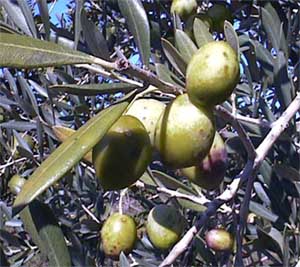
Olives are almost as important to this story as they are to Palestinians generally.
Steve‘s been mostly staying out of trouble the last few days:

Not a lot to report, and no photo this time. I’ve
been helping with organization here in Qalqilya while
members of the Qalqilya action group have been
traveling back and forth to Mas’ha. It is the
intention of the Israeli government and their
contracted construction company there to trap one
house between the Apartheid Wall and the fence
surrounding the neighboring Israeli settlement. The
Palestinian people living in the house would be
trapped in a no-man’s land, and I’m told by a member
of the International Women’s Peace Service that the
army is proposing to give them permission to leave
their home 3 times a day.
Israeli, Palestinian, and international activists have
been gathering there to prevent the continued
construction of the fence and resulting isolation of
the wall. I expect to join them tomorrow. Check out
www.palsolidarity.org for updates.
Yesterday we received 6 new activists in Qalqilya–one
Dane (half Palestinian and fluent in Arabic), one
Swede, one Brit, one Australian, and two Italians.
They’re a fantastic group, and are off and running
with our farmers’ project. I will work on the
farmers’ project from Jayyous–perhaps we’ll have a
march from Jayyous to Qalqilya, across the lands that
seem to be slated for Israeli expropriation.
I’m off to Jayyous now–will write next from there.
Peace,
Steve

____________________
For background to the situation in Qalqilya and Jayyous, check this Guardian story from last November.
There’s an extraordinarily sensitive and beautiful Flash photo story link on this article from the St. Petersberg Times.
For hundreds of images which help to make real what is going on in Palestine, see the ISM photos and videos page.

report from Palestine, August 2, 2003


Jayyous food delivery, July 28
Steve writes from the West Bank:

Qalqilya
Aug. 2, 2003
At 3:00 last Friday morning, I was awakened by Kevin,
a member of the ISM Qalqilya action group, and a local
photojournalist I’ll call Ragheb, and told that the
Israeli army had again entered Qalqilya. Four of us
went out to see what was happening. After the
shocking attack on a house earlier in the week, we
felt that it was important that we be present, albeit
at a distance, visible, and out of the line of fire,
in the hope that international witnesses might inhibit
the Israeli army from their worst excesses.
We proceeded to the main street, and spoke to a few
people who were out. An old man said to me, “Why do
you want to drink from that cup?” Others called out,
“Thank you for what you’re doing.” Some young men
told us that the soldiers had been firing into the
air.
A jeep and an armored personnel carrier (APC) entered
the road from a side street. Both were completely
enclosed, with tiny reinforced windows, so that it was
impossible to see the human beings inside. The APC
stayed at a distance, and the jeep stopped with its
bright lights on us for a long time. Then they sped
away.
We continued down the street in an attempt to find the
house(s) being raided. The jeep and APC returned, and
stopped a block away. We’re pretty sure we were
visible to the jeep. A few shots were fired. A
volley of machine gun fire followed, and in the dark
we couldn’t tell if the gunfire was directed at us, at
the buildings opposite the vehicles, or in the air.
I said, “This is how Brian Avery got shot.” We got
out of sight of the army, and returned to our house.
We continued to hear sporadic gunfire as the two
vehicles sped up and down the street. On Friday
evening, we all had a long talk about going out at
night when the army is in town, and decided that we
would only consider going out if we had specific
information about where the army was and what they
were doing. Marwan, our local coordinator, said that
there’s nothing we can do if the army has come to
arrest someone, but if they’re planning to demolish a
house, we might be of use.
On Friday afternoon we visited two of the houses that
were raided. In the first, the wanted man was not
present, and we saw the usual scenes of gratuitous
destruction, although the house was not riddled with
bullets like the one we saw previously. As usually
happens in these situations, there were children in
the family who were eager to take us from room to room
to show us the damage and to bring us spent shell
casings. The family had “Peace Now” stickers in
almost every room, and the soldiers had tried to rip
one of the stickers off the wall.
The adults in the family told us that a large number
of jeeps and soldiers had shown up, and that the
entire family had been made to stand outside for
hours. Apparently, the one jeep and one APC we saw
shooting up downtown were distractions designed to
keep folks scared and in their houses. I wonder if
the soldiers were wearing white sheets.
At a second house that was raided we were invited to
stay and drink tea and coffee. Their son was taken,
and they didn’t know where. We gave them the number
for HaMoked, an Israeli human rights organization that
tracks Palestinian detainees.
In the news in the United States, we hear about the
three-month cease fire. It seems to be that the
Palestinians are the only ones holding their fire.
I got a couple of hours of sleep after we returned
from our failed intervention, and then headed out for
a day in the villages south of Qalqilya with Samir, of
the State Information Service (sort of a statistics
and publishing office) and Courtney, Lysander and Lisa
from our action group. Samir is from Habla, a village
immediately south of Qalqilya. His family came there
from Arabia in the 17th century, and was the first
family in Habla. He can name every other family in
the village, and where they came from (usually other
places in Palestine).
We needed to walk through another farmers’ gate – it’s
now had hurricane fencing installed, so that one can
no longer crawl through it. We waited until an APC
drove away, then tried to open it, but couldn’t figure
out the mechanism. We stepped back to figure out what
to do, when a little boy on a bicycle flipped open the
gate. We ran across the 100 meters of empty space to
the Israeli army’s gate on the road into the village
of Habla. Samir was waiting for us there.
Samir took us around the nurseries there, and a
nursery owner told us the now-familiar story of the
ruin of his once thriving business. We had tea and
grapes with Musa, a cousin of Marwan, our local
coordinator. He told us how Israeli soldiers had come
to him while he was working and demanded to see a
permit to be working the land.even though he owns that
land himself.
The construction site of the “security fence” wound
around this area of nurseries, orchards, and farms,
cutting it off from Habla and from Qalqilya. At one
point, we walked right up to the Green Line (the
border between Israel and Jordan between 1949 and
1967), and crossed over it. The fence doesn’t
separate Israel from the West Bank at all; it annexes
West Bank land to Israel. A farmer with a tomato field
just over the Green Line into the West Bank showed us
how his crop had been ruined when Israeli settlers
released pigs into his field two weeks earlier.
Samir brought us to a spot where a front loader and a
number of workers on foot were putting up the fence at
breakneck speed. He explained that this was his land,
now all consumed by the fence. The workers on foot
were Palestinian.work is so hard to come by for
Palestinians that they will take jobs building their
own prison. Samir is a gentlemanly and businesslike
man, but when we were on his ruined land, he seethed.
We took photos of his irrigation pipes, dug up and
tossed aside by the front loader.
Ragheb took a photo of the Jewish Israeli operator of
the front loader, and armed security showed up and got
right up in his face, screaming at him in Hebrew and
demanding his camera. He didn’t give it up, and they
didn’t lay a hand on him.perhaps because Courtney,
Lysander, Lisa and I were there.
We went to look at a centuries-old mosque in Habla.
The security fence was just feet away from the mosque,
with an Israeli settlement across the road. Samir
explained that this particular portion of the fence
had been built in 1996, four years before the
beginning of the Al-Aqsa Intifada.
We spent midday at Ras Tira, a hilltop village across
the ravine from the sprawling Israeli settlement of
Alfe Menashe. Opened in 1982 and expanding
constantly, Alfe Menashe now has 40,000 inhabitants
and sits on top of the region’s main aquifers (one
Jewish Israeli West Bank settler is allotted twenty
times as much water as one West Bank Palestinian
resident). At the bottom of the ravine, Israeli
soldiers hold military exercise, and when villagers
attempt to approach their olive trees further down the
slope, soldiers shoot at them.
Ras Tira is one of several villages, with a combined
population of 1000, being fenced in with Alfe Menashe
and cut off from any other West Bank communities.
They have been given until 2005 to accept Israeli ID
cards or leave the village. Many of them have ID
cards now that list a place other than Ras Tira as
their home. I doubt those people will be given the
option of Israeli ID.
Ras Tira has already been erased from Israeli
government databases.
We stopped at a giant road block next to the
Israeli-only highway that cuts through Habla on the
way to Alfe Menashe. The only way to pass from one
side of Habla to the other is on foot. I stood at the
side of the road for a long time, looking at the faces
of the drivers passing by, trying to will them into
realizing that everything they have is at the direct
expense of someone else.
We went to Samir’s home for a sumptuous lunch. He and
his wife both work in Qalqilya, and keep an apartment
there because the passage to and from Habla is too
difficult to do every day. Habla is a few hundred
yards from Qalqilya.
When we got back to the gate into Qalqilya, it was
locked (no army around), and lots of people were
milling around on the Habla side. Then a boy-he must
have been about 10-opened the gate, and all of us,
men, women, kids on bikes, someone on a horse, rushed
through before soldiers showed up. The kid seemed
delighted when each of us stopped to thank him.
On Saturday, we were invited to the end-of-summer-camp
presentation of the Palestine Red Crescent Society.
One of the skits was about an ambulance stopped at a
roadblock as the patient dies. The little kids who
played the mean Israeli checkpoint soldiers were
intense.
On Saturday night, Basem, an ISM volunteer, invited
the men among us to celebrate his having passed the
tawjihi, the extremely rigorous end-of-twelfth-grade
comprehensive set of exams. The party was in what
looked exactly like a Brooklyn wedding palace, and was
absolutely packed with deliriously happy young men
dancing to traditional Arab music. At one point, they
began chanting as they danced “kus uchtak yaa Sharon”
(fuck you, Sharon). They were thrilled when we joined
in. After the party, we went for a midnight swim at
one of Qalqilya’s 2 pools-men only, of course.
On Monday, while four from the Qalqilya action group
(including Dena and Eric from JAtO) were participating
in the “break the gate” action in Annin, outside
Jenin, that got international attention, another four
of us (including me and Ryan from JAtO) met up with
David and Nirit from JAtO, other internationals from
ISM, Boston to Palestine, and others, and activists
form Jayyous in another delivery of supplies to the
Bedouin family trapped outside the Jayyous fence. The
army stayed away, realizing, I think, that they had
provided the media with unfavorable photo ops the week
before. The delivery went off successfully, but it
was incredibly sad to see an old woman from the family
standing at this enormous fence, waiting for handouts.
She allowed the media to interview her and photograph
her, and while she was talking to them I saw that she
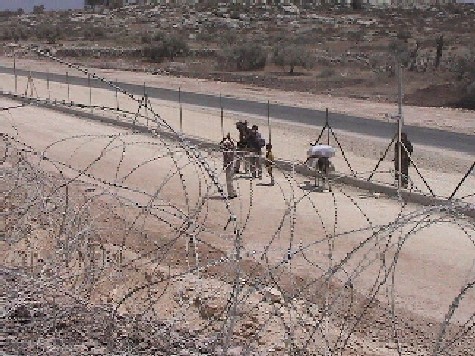
was crying. In the attached photo, she’s on the
right. A man and boy from the family are loading up a
donkey with the supplies thrown down to a Jayyous
activist. All three entered the no man’s land between
the razor wire and the fence for the purpose of the
delivery. I don’t know the names of anyone in the
Bedouin family. I couldn’t speak to them. I was
behind the razor wire barrier with everyone else.
Again, the land “inside” the fence in this picture is
in the West Bank. The land “outside” the fence is
also in the West Bank. This is not a border fence
between Israel and the territory it’s occupied for 36
years. Those of us opposed to the fence believe it
has a two-fold purpose: incorporate valuable land and
water resources outside the fence into Israel,
decreasing the resources available to (and therefore
the viability of) a future Palestinian state, and to
pursue a policy of ethnic cleansing of areas inside
the fence, as Palestinians, deprived of income, are
forced to leave. The more Palestinians leave, and the
more Israeli Jews arrive as settlements are expanded,
the more occupation becomes annexation.
On Wednesday, international activists arrived in
Qalqilya from Ramallah, Jenin, Tulkarm, Jerusalem,
Nablus, Jayyous, and elsewhere to participate in the
Qalqilya face of the week’s Wall actions. None were
allowed through the checkpoint. Some snuck through
the checkpoint when soldiers were otherwise occupied.
Some crawled under a farmers’ gate in the fence. Some
snuck through another gate. Some stayed overnight in
a nearby village after failing to get in (and nearly
getting arrested), and succeeded upon trying again
early in the morning. And some were unable to enter
at all. Ady (JAtO) and Tim from our action group were
also able, with help from arrangements Marwan made and
accompaniment from Ragheb, to get 8 big helium tanks
(!) into town.
Thursday was the big day – the payoff after
approximately one million planning meetings with
everyone in Qalqilya from the mayor on down, and with
each other, after creating a giant banner (“No
apartheid wall” in English, Hebrew and Arabic)
designed to fly 15 meters above the ground, after
filling countless balloons with oil paint to fling at
the wall (and then discovering that oil paint corrodes
latex-oops), and after browbeating the press from Tel
Aviv to Toronto (they usually wanted to know if there
was going to be bloodshed). We marched from the
municipality in the center of town-50 internationals,
and Qalqilyans from the Prisoners’ Club, local
government, the PFLP, the Peasants’ Union, and many
others-to the point at which the wall meets the fence,
joined by a military gate and a sniper tower. It was
a beautiful site as activists flung paint balloons at
the hated wall, and covered its surface (the lower
half, at least) with messages of liberation. We were
met by soldiers in jeeps who had their guns at the
ready, but when they saw that the line of
internationals facing them was neither advancing on
them nor heeding their orders to disperse, they chose
restraint. It’s entirely possible that restraint was
a policy insisted on from above, considering that the
photo of soldiers teargassing activists in Annin on
Monday went all over the world.
The giant banner flew only briefly before the balloons
popped, but long enough for some good photos. It will
now hang from Ash-Sharqa Girls’ School next to the
Wall, a school that has been teargassed in the past by
the Israeli army while the students were present.
There was a fair-sized crowd of Israeli activists from
Gush Shalom and other groups outside the military
gate. They got short notice from us about the demo,
but filled a bus for their companion demo nonetheless.
We ended with Noura, Palestinian-American from ISM,
delivering a message of peace to them (which was
permitted after a lot of wrangling with the soldiers0.
A lot of the Qalqilyans I’ve spoken with are very
pleased about the demonstration, although some had
hoped for a larger turnout of locals. I think that,
now that we’ve proven ourselves, we’ll have a bigger
turnout next time.
Yesterday (Friday) activists in Tulkarm succeeded in
removing the razor wire in front of a gate there, but
were unable to tear down the gate before the Israeli
army opened fire with rubber bullets. There were a
number of injuries among activists, but none serious.
I stayed in Qalqilya, holding down the fort as it
were. I joined the Prisoners’ Club at the Qalqilya
Zoo (the only zoo in the West Bank) for a party for
the children of prisoners, and in the evening, after
the rest of the group returned from Tulkarm, we
participated in another loud, spirited, multi-party
march through town in support of prisoners. It seems
that yesterday prisoners in Ashkelon Prison were tear
gassed while locked in their cells, resulting in 100
injuries, 9 serious. The president of the Prisoners’
Club named for me the 3 prisons in which he was tear
gassed while locked in his cell.
Today, Saturday, we’ll be talking about our work in
the surrounding villages. I may be moving to nearby
Jayyous, in which case my telephone service will be
spotty (but not nonexistent). I’m not sure about
email access there…I’ll check it out when I arrive
(assuming the move happens).
That’s all for now.
–Steve Quester

report from Palestine, July 24, 2003


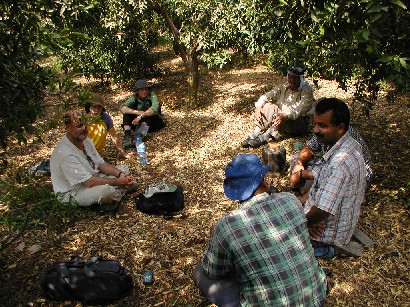
Steve and friends in an olive grove near Jayyous
Steve has been characteristically busy, but he writes home:

Qalqilya, Occupied Palestine
Thursday, July 24, 2003
On Monday night we learned that a time bomb had been
found by security near the farmers’ gate, and was
detonated by the Israeli army. As a result, the area
around the gate was closed by the army and was
crawling with troops. We decided not to attempt
access to the lands west of the fence on Tuesday.
There has been speculation here that the Israeli army
planted the time bomb in order to justify widening
their off-limits zone on either side of the fence.
Tuesday morning, we participated in a demonstration
organized by all the political parties in Qalqilya in
support of Palestinian political prisoners in Israeli
prisons. We started with a short talk at the Qalqilya
branch of the Palestine Prisoners’ Association, a very
important group made up of former prisoners (i.e. just
about any Palestinian man) which provides support for
prisoners and for their families. They explained to
us that their current focus is to have 3 prisons
located on army bases (Howwara, Salem, and I can’t
remember the third) closed because the conditions
there are so harsh as to violate not only
international law, but Israeli law as well.
The demonstration was in the Qalqilya demonstration
style: loud, colorful, and short. ISM was there with
banners and signs (a picture of us made it into the
Palestinian daily Al-Ayyam today), and we’re told that
people were really happy to see us there. There was a
group of boys in front of us-little boys, not
teenagers-who were chanting energetically without
apparent adult guidance. I was struck by how these
boys see themselves as empowered members of the
resistance to Israeli occupation and injustice.
There were family members of prisoners at the demo
carrying photos of their imprisoned loved ones-some of
the people carrying photos were little kids.
The demo went from the city circle to the office of
the International Committee of the Red Cross/Geneva,
where Lysander and I joined the officers of the
various political parties and the head of the
Prisoners’ Association to present letters to the ICRC
with our concerns. The ICRC representative was an
Australian who could only talk about ICRC policy,
passing on concerns to the Jerusalem and Tel Aviv
offices, etc. The official meeting was interrupted by
some women who demanded to know why they were being
denied permits to visit their sons, and wanted to know
what ICRC was going to do about it. One has two sons
in prison, and had been denied a permit as a “security
risk”. She wanted to know how she, an old woman,
could be a security risk? Another also had two sons
in prison, had been granted a permit to visit one, and
was deemed a security risk when she applied for a
permit to visit the other. She wanted to know how she
could be eligible for a permit for one visit, yet a
security risk for the other. They represented Israeli
policies about family visitation as cruel and
arbitrary, and expressed frustration at the ICRC’s
apparent impotence.
In the afternoon, we met with Faris, the local
coordinator for a village called Mas’ha, and 5 from
our action group (3 from JAtO) volunteered to go there
for a couple of days. Mas’ha has hosted a peace
encampment along the fence for months now, and it has
become a place for Israelis, Palestinians and
internationals from all walks of life to come together
in dialogue and in opposition to the fence. The 5
return tomorrow, and I look forward to hearing more
about Mas’ha Camp.
I was talking with a little boy in front of our
building, and one of the adults pointed out to me that
his father was killed by the Israeli army. There are
6 children in the family.
Late in the evening, some local Muslim leaders came
over to talk with us about Islam. They are people who
dedicate their lives to the service of Allah and the
duty to be a good person, and I was thinking about how
painful it must be for them to hear Islam slandered by
political and religious leaders in the U.S., Israel,
and elsewhere. Their talk was a little too much like
a visit from the Jehovah’s Witnesses for my taste, but
they were well-intentioned, and we had a good time
just shooting the breeze after they were done with
their spiel.
I was awakened at 3:00 yesterday morning by Jihad, a
young man who spends time with us internationals. He
was alarmed that Israeli army jeeps had entered the
city, and a couple of internationals walked him home.
We then bolted our door, and I didn’t sleep very well
as I waited for the alarm to ring at 5:00. At 6:00
[the hours seem to be accidently transposed in these
few lines – JAW] I saw a jeep driving right near our
apartment, and quickly ducked inside.
I was up at 5:00 for attempt #3 to go out with the
farmers – successful this time!! There were no
soldiers or security at the farmers’ gate, and we high
-tailed it into the fields west of the fence. We
ducked behind some trees as construction vehicles and
security sped past, and were not spotted.
We were horrified, however, to see that the Israeli
army had dug a trench between the gate and the road
from Qalqilya, and piled the dirt and boulders up
before the trench. Passage into the lands outside of
the fence, impossible by car, truck, or tractor for
months, is now impassable by donkey as well. Farmers
must bring in their crops on foot. Some of the trees
immediately west of the fence and its attendant jeep
road had been destroyed by a tank or a bulldozer.
Mohammad from the Peasants’ Union took us around the
lands of Qalqilya and Jayyous all morning. We stopped
and talked with many farmers (and drank tea, natch).
The scene was idyllic – carob, loquat, orange, avocado,
fig, berry, and olive trees, grape vines, fields of
cauliflower, tomatoes, cucumbers, peppers, and
eggplant, lovely little farmers’ day huts, and a huge
chicken house. But the idyll was marred by the fence,
this awful gash that cuts across Palestinian farmers’
lands. We passed many dried up fields and abandoned
greenhouses belonging to farmers who just can’t get
through the security at the gate. We encountered
numerous road blocks; many dirt roads within this
agricultural area have been rendered impassable by the
Israeli army. Some of the lands are on the other side
of a settlement bypass road put in during the Oslo
process, and no Palestinian agricultural roads are
allowed to intersect with this Israeli-only West Bank
highway built on confiscated Palestinian land.
Farmer after farmer told us about the assaults on
their livelihood caused by the fence. One man has a
property that was cut in half by the fence. He used
to go from one olive grove to the next by walking a
few meters. Now he has to walk half an hour to the
farmers’ gate, and half an hour back. Another has a
number of farm vehicles at home. He can get none of
them onto his land. He has to bring in his crops by
donkey cart, and then unload them by hand onto a
vehicle at the roadblock. Some farmers have taken to
sleeping in the fields during the week, because the
way home has now been made so circuitous and long. To
make matters worse, Israel has declared economic war
on Palestinian areas during this Intifada, no longer
allowing Palestinians to export, and using roadblocks
and checkpoints to impede commerce within Palestine.
Qalqilya was once the bread basket of the West Bank,
with exports to Jordan and Iraq as well. Now, all
produce goes to market in Qalqilya, at a fraction of
the price.
The attached photo shows me, Andrea from California,
and Eric from Sweden sitting with Mohammad and 3
farmers from Jayyous in an olive grove, talking about
the difficulties of harvesting caused by the fence.
We crossed back through the farmers’ gate quickly and
without incident. There was a security vehicle there,
but no personnel. We went to the farm of Ziad, also
of the Peasants’ Union, for lunch. He and his son
made a delicious feast for us, cooking everything with
vegetables he picked as he cooked. While we waited
for lunch to be ready, Mohammad told me about reading
Angela Davis’s book about prison in the U.S. while he
was in prison in Israel, and talked about how similar
the conditions are. He also told me about the little
girl in Qalqilya who’s named Angela, after Angela
Davis.
Ziad’s farm is breathtaking, but his property, which
used to extend further than it now does, is abruptly
cut off by the fence. The contrast between the beauty
of well-tended fields of tomatoes and cauliflower, and
rolls of accordion wire blocking entrance to the ditch
in front of the fence, is enough to make one cry.
Back in town, we visited a house that had been visited
during the night by the Israeli army (hence the jeeps
we saw). There were eleven people in the house: 3
women, one 13-year-old boy, and the rest little girls
(one a baby). We saw hundreds and hundreds of bullet
holes in the house outside and inside, including in
one of the women’s dresses in her closet. It’s a
miracle that no one was shot or killed, and I can’t
imagine how frightened the children must have been.
One little girl (I can’t say how old she is; I usually
underestimate the age of Palestinian children because
they look so small. Perhaps it’s malnutrition?) was
eager to show us the damage, and they all welcomed the
attention. The teenage boy lay in a fetal position on
a mat, having had his stomach stomped on by Israeli
border guards in an attempt to force him to say where
they can find the man they were looking for. They
never found the wanted man, so they took another man
from the family, 26 years old, beat him, and arrested
him. He may be facing 6 months of administrative
detention now; under Israeli law, no charges have to
be laid for administrative detention to occur.
For the past 2 days our action group has been meeting
with community members about our proposed action at
the Qalqilya wall on Wednesday. This morning I
participated in meetings at the Palestine People’s
Party with someone from the Farmers’ Union, and at the
Chamber of Commerce with the Chamber’s president.
Everyone has the same story – total economic devastation
as a result of closure and the wall. The rest of the
day has been preparation for the action – it’s a giant
undertaking, but we hope it will be spectacular.
Tomorrow morning I’m off to document the plight of the
villages south of Qalqilya, which have themselves been
encircled by the wall.

Then President Bush’s canon will come back to us: “You’re either with us or with the terrorists.” Those words hang in time like icicles. For years to come, butchers and genocidists will fit their grisly mouths around them (“lip-sync,” flimmakers call it) to justify their butchery.
Arundhati Roy
September, 2002

And with that he closes for the night.
For more news, from the International Solidarity Movement (ISM) site itself, see the story, “Palestinian Farmers Break Gate in the Wall.”

crippling more than bodies and minds


When war is created by a leader for his own purposes of revenge, greed or power, it is unspeakable, but we’re Americans, and we’re going to speak anyway. We can’t help it.
No one could speak of the personal, American impact of this war more eloquently than Anne Hull and Tamara Jones do in a two-part series in the Washington Post this week. The still photographs and video which accompany the story on the Post‘s “Nation” page are ineffable.
For each antagonist, war wounds or destroys both individuals and societies. Viet Nam was horrible and stupid. Iraq is horrible and calculated. Calculated is worse.
Point of information: Worthy as any account of the cost of this war may be, I’m disturbed by the fact that most of the media seem to be concerned only with tabulating the cold numbers of [Americans] who have died in Iraq, before or even after “Mission Accomplished.” The absurd impression is given that the casualty numbers are something like 150 (or 226), and everybody else is safe – and sound.
The military hospitals can’t bury the injured, maimed and mentally deranged, even if we do.
And don’t even mention the Iraqi dead and injured. Nobody here does, unless we’ve murdered someone in Bush’s deck of playing cards.

state murder


This is barbarism.
Think about it.
Barry shot out, “It’s no wonder this administration is opposed to the International Criminal Court!” Or any court, apparently.
For a take takes not in debt to any gosh darn mainstream media interest known to humanity, see dKos.