what he did this summer

[updated July 18 to include contact information for Steve this summer]
Our friend Steve Quester is back in the Middle East. I posted his reports from Palestine in the spring and summer of last year, and I expect to be able to post all of his current dispatches from today.
This is Steve’s first email this summer, sent just after he arrived to resume work with the International Solidarity Movement (ISM). The text appears here with edits only eliminating his contact information – for his security and that of others while he’s there.
Steve’s suggestion for reaching him his summer:

While I prefer not to receive email while I’m away, I love to get phone calls on my cell phone here. If you’re in the eastern United States, the best time to call is when you wake up in the morning; since we’re 7 hours ahead, that corresponds to mid-afternoon here. To call me, dial the international access code (011 if calling from the U.S.), followed by country code 972, mobile phone code 67, and telephone number 308-192. There is voice mail on my cell phone in case I can’t pick up or am in an area without coverage.

lockquote>I’m in Tel Aviv at the moment. Got into Israel without too much fuss; it helped to be traveling with an Israeli. There was a young Palestinian man on the plane with his wife and baby. He was whisked off to the police at the airport while his wife held the baby and waited.
We’re staying with a couple who are members of Black Laundry*, Israel’s queer anti-occupation movement. One of them described being pulled aside and interrogated when she tried to enter the U.K.; for some reason she
was profiled along with 2 Palestinians and 4 Pakistanis. She described how infuriating and humiliating the experience was, and also how important
for her, as an Israeli, to be on the receiving end of profiling for once. As an anti-occupation organizer, she had always understood how terrible the practice is, but had never felt it herself.
Tomorrow we’ll attend the trial in absentia of an American member of ISM who was arrested and deported. We leave from Jerusalem on Friday morning to attend the two-day ISM training in an as yet undisclosed West Bank city.
*
See these sites for New York information about and Tel Aviv photos of the amazing group which call itself “Black Laundry,” for the phrase’s perverse combination of English and Hebrew meanings related to “black sheep” and “dirty laundry.”
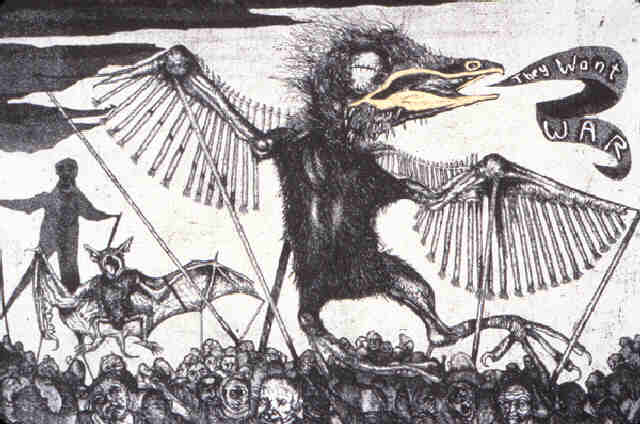
the highest crimes and misdemeaners


Sue Coe, “What a Golden Beak! (They Want War)” (1999)
The White House lied in order to get its war. More evidence has just emerged, and from one of its own.
As usual, it’s not an embarassment for Bush, who is beyond shame [the idiot thought he could be president, for chrissakes!], but for all Americans who ever lived or will yet live.

A former U.S. ambassador, who was hired by the CIA to investigate reports that Saddam Hussein bought uranium from Niger, has gone public with his anger that his findings discrediting the reports were ignored by the Bush.
Joseph C. Wilson IV, who was ambassador to Gabon from ’92 to ’95, traveled to Niger at the request of the CIA in February 2002, and found no evidence that any uranium sale had taken place.
Nonetheless, the White House cited Iraq’s alleged purchase of uranium as evidence that Saddam was pursuing nuclear weapons – one of President Bush’s justifications for toppling the brutal Iraqi dictator. The uranium-sale accusation turned out to have been based on a forged document.
“If they’ll lie about things like this, there’s no telling what else they’ll lie about,” Wilson, who is now an international business consultant, told The Post from his Washington home. Wilson first aired his frustrations in an Op-Ed piece in today’s New York Times.

[It’s interesting that there’s a news story on the Post site, but no news story in the NYTimes.]
The ambassador’s statement ends with the somber words of a moderate man.

America’s foreign policy depends on the sanctity of its information. For this reason, questioning the selective use of intelligence to justify the war in Iraq is neither idle sniping nor “revisionist history,” as Mr. Bush has suggested. The act of war is the last option of a democracy, taken when there is a grave threat to our national security. More than 200 American soldiers have lost their lives in Iraq already. We have a duty to ensure that their sacrifice came for the right reasons.

But solid evidence for Bush’s mendacity is already all over the place. There has never been a president guilty of higher crimes and misdemeaners, more worthy of impeachment and removal from office, and yet we know it will never happen.
How did we get to this?

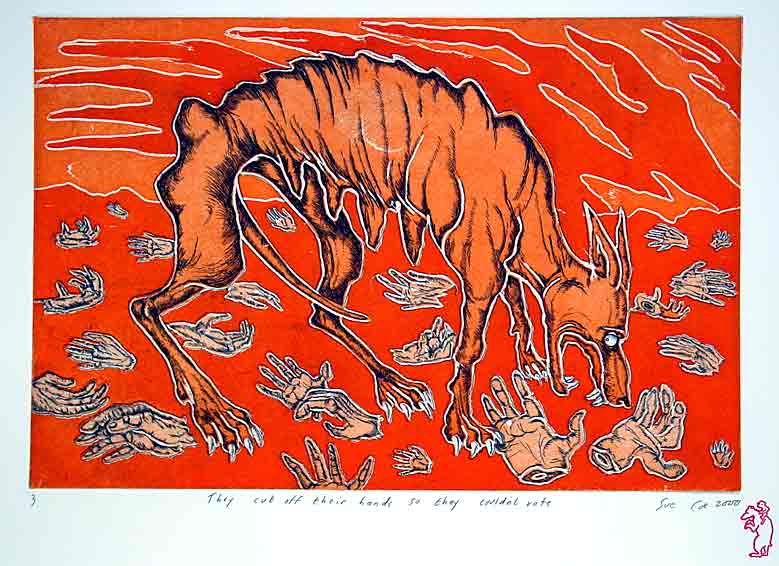
Sue Coe, “They Cut Off Their Hands So They Couldn’t Vote” (2000)

no profit in Iraq?

We’re not going to last in Iraq.
It’s not working. Not surprisingly, we are being blamed for everything bad that happens there, which these days may be most everything, and that country appears to be literally up in arms [curious that a well-armed citizenry, traditionally just a fetish of the American radical right, did not save Iraq from tyranny]. I don’t expect we will hold out very long. We don’t seem to have a plan, we almost certainly don’t have the commitment needed, and we don’t even have the advantage of the kind of [courage of conviction?] which was able to maintain the last Iraqi dictatorship for so long.
They don’t love us.
Americans, incredibly uninformed or misinformed anyway, are increasingly confused about what’s going on over there, and now even military families are getting very upset, although their anger is not focused or directed at a target – yet.
The administration didn’t tell them that we wouldn’t be welcomed with open arms, that we weren’t going to spend much money or manpower on rebuilding what we destroyed, that the world wouldn’t support our unilateral invasion and wouldn’t bail us out in our occupation duties afterward, especially since we look increasingly like sitting ducks, that the lights would still be out in much of the country months after we decided we won, that the numbers of Americans being maimed and killed would accelerate as time passed, that we would end up fighting an insurgency which might never end, that this was not Japan or Germany in 1945.
Perhaps most important, it’s certainly unlikely the administration told its corporate backers that, since we could not make friends or even keep order in a country we boasted we had liberated, in the end there would be no fortunes made in Iraq, and this may ultimately be the decisive factor when we decide to abandon our self-appointed role.
At least it’s clear once again that for this administration it was never about “nation building.” The Bushies did not change their tune as they marketed the wars on Afghanistan and Iraq with generous promises of liberation gifts. The talk about democracy, schools, health care and repair of infrastructure was domestic and foreign Realpolitik, mouthed as cover for the cynical objectives of national power and party advantage.
It’s just not working out the way the White House thought it would. Unfortunately that may not be any better news for Iraq than it is for an American republic now corrupted and compromised, perhaps beyond repair.

U.S. bars election, limits speech, jails party workers

Tell us all once again why we had to bomb Iraq.
Yesterday in a town 150 miles south of Baghdad, even the local American military commander, together with his officers and the soldiers and marines under them, were disappointed with U.S. heavy handedness.

American marines had built makeshift wooden ballot boxes. An Army reserve unit from Green Bay, Wis., had conducted a voter registration drive. And Iraqi political candidates had blanketed the city with colorful fliers outlining their election platforms — restore electricity, rehabilitate the old quarter, repave roads.
But last week, L. Paul Bremer III, the head of the American military occupation in Iraq, unilaterally canceled what American officials here said would have been the first such election in Iraq since the fall of Saddam Hussein. Overruling the local American military commander, Mr. Bremer decreed that conditions in Najaf were not appropriate for an election.
Several days later, American marines stormed the offices of an obscure local political party here, arrested four members and jailed them for four days. The offense, the Americans said, was a violation of a new edict by Mr. Bremer that makes it illegal to incite violence against forces occupying Iraq.
Mohammed Abdul Hadi, an official in the party, the Supreme Council for the Liberation of Iraq, accused the United States of a double standard.
“Why do you apply these constraints on us in Iraq,” he said, “and they are not being applied by the American government on Americans?”
The events here exposed an uncomfortable truth of the American occupation. For now, American officials are barring direct elections in Iraq and limiting free speech, two of the very ideals the United States has promised to Iraqis. American officials have said it may take up to two years for an elected Iraqi government to take over the country.

“Jewish-only” road

Yea! Anees, our Palestinian friend living in East Jerusalem now has his own blog up and running.
One of his first posts concerns the construction of a totally redundant road to nearby Jewish settlements (on occupied Palestinian land) which Israel is building outside his family’s home.

I bet when completed it will be a road suspended high above with side walls that hide ‘us’ from view, and keep ‘us’ away. In one such ‘Jewish-only’ road which hovers high above nearby Bir Nabala, a small Arab village, the high side walls are even painted with scenery, simulating a landscape view free of Arab existence.

Have they no shame?

destroying homes can only destroy everyone’s security

I don’t know how a figure could be strictly defined, even if one could somehow be located on the record, but while a friend who has spent time in Israel and Palestine reported anecdotally that the number of homes which have been destroyed by the Israelis in the Gaza Strip is 80 percent, any percent would be an abomination.

. . . there was no record of the Za’anin family having heard a nearby explosion, in a street controlled by tanks and armored personnel carriers, at around 6 P.M. that day. About 20 minutes later the family, which was sitting in the living room, heard the noise of the churning bulldozers.
“Suddenly we saw Jews in the house,” said Amana Za’anin. An officer and soldiers entered through a breach they opened in the wall of the house. They aimed their weapons at the family, and ordered them out. According to the family, they were not allowed to take anything with them. Not even the mother’s head covering. The student daughter cried she didn’t want to leave without her books and notebooks. Her parents said that they had to drag her away from “under the bulldozer.”

[Anees found this]

have we made Iraq “A land fit only for flies?”

What does Baghdad look like today?
The strongest account I’ve read succeeds where even pictures have failed.
An excerpt:

And then you drive back, through the centre, and see what has happened to the ministries and powerhouses that used at least to keep some of the country alive, and realise that they have not merely been looted but invaded, lobotomised, trepanned. The Americans are hardly in evidence, and soon it will be dark again, and the guns will begin again: and you can’t help but wonder how, when we managed to get the surgical excision of Saddam so right, we have apparently managed to get everything else so wrong in this country. An old and an interesting country, and one in which everyone has been unfailingly, unaccountably courteous and helpful, apart from the ones who are trying to shoot you. They welcomed me into one mosque for Friday prayers, this know-nothing Westerner whose country had just helped bring their city to a halt, careful as they washed their feet not to use too much water. Prayers were all-male: women have stopped coming out for the moment.
Others offered me their bottled water, as they always offer it to each other. It is sweet to see the way in which old men unembarrassedly hold hands on marches, quick to pull each other out of the way of traffic (or perhaps it’s just in case they’re hit by one of the cacophony of toots: they laugh, here, about their drivers’ propensity for the horn, and call it ‘Baghdad music’.) A kindly and spectacularly ravaged people, and I’m not sure quite what’s about to happen to them.
. . . .
Baghdad has turned into Afghanistan faster than Afghanistan. As I write this, the UN weapons inspectors are going back in to see whether the looting of the city’s main nuclear power station has given Baghdad a radioactive water supply. Could this really imaginably be, in the minds of those who went to war for even the best intentions, the preferred legacy? A land where all the children smell of petrol? A land fit only for flies?

[thanks to Anees]

“it’s show business”

As the truth becomes more available, and indeed more unavoidable, (at least in the alternative and foreign media), “For the time being,” Paul Krugman writes “the [American] public doesn’t seem to care – or even want to know.” He does his part by listing some of the news developments which are beginning to unravel the monumental mendacity of the White House.
[for more on the subject of lies and the American media’s complicity in lies, see Bloggy today]
Krugman begins his column by citing the script of Barry Levinson’s 1997 movie, “Wag the Dog,” for its parallels to the reality of the last two years.

An administration hypes the threat posed by a foreign power. It talks of links to Islamic fundamentalist terrorism; it warns about a nuclear weapons program. The news media play along, and the country is swept up in war fever. The war drives everything else — including scandals involving administration officials — from the public’s consciousness.
. . . .
So what’s the problem? Wars fought to deal with imaginary threats have real consequences. Just as war critics feared, Al Qaeda has been strengthened by the war. Iraq is in chaos, with a rising death toll among American soldiers: “We have reports of skirmishes throughout the central region,” a Pentagon official told The Los Angeles Times.
Meanwhile, the administration has just derived considerable political advantage from a war waged on false premises. At best, that sets a very bad precedent. At worst. . . . “You want to win this election, you better change the subject. You wanna change this subject, you better have a war,” explains Robert DeNiro’s political operative in “Wag the Dog.” “It’s show business.”

Americans still seem to be eager to buy tickets.

memorials

Shouldn’t we ask, “why?” each time there is a call for war?
The Vietnam War continues today for many. Some of its service victims lived for decades with major physical injuries to accompany the psychological pain. Some live still. Neither they and other, luckier, survivors nor those who stayed at home have ever gotten answers. Some couldn’t have heard them anyway.

Specialist Rogers was 20 years old, almost through his one-year tour, on Dec. 14, 1968. That day, while on a patrol near the Cambodian border, his unit came under fire and he was struck in the head by several pieces of shrapnel.
“Death would have been a blessing,” his brother Joseph of Waynesville said this week. But instead of dying, James Rogers lived on in twilight for almost 22 more years.
“He was helpless,” his brother said. “There wasn’t anything he could do.”
James Rogers was hospitalized for a year before their parents, Joseph and Flora Rogers, brought him home. Sometimes, he seemed to recognize his parents and four siblings. He might hold up a finger in response to a question.
But as for how much he really understood and felt, “nobody knows for sure,” his brother said.
James’s wife divorced him, and the Rogers family did not blame her. James could not eat or drink without help. His food was blended. He had to be propped up on the toilet. “If you could envision a 180-pound infant,” his brother said, voice trailing away.
Despite heavy doses of tranquilizers, James had frequent seizures, so violent that his thrashings once broke a wheelchair. “He suffered unbelievably,” his brother said. “I can’t describe what he went through.”
His end, at least, was peaceful. James Rogers died in his sleep on Nov. 14, 1990. He was 42.

And this and the other stories in the this NYTimes article are only those of guys on “our” side.
Why do we let our old men tell us that using boys and young men to kill other boys and young men is the only way to stop the evil done by other old men?
Look at the small slideshow on the site linked above.

loving neither peace nor freedom

It’s Memorial Day weekend in America, and we should be remembering the people who have died in over 200 wars we have fought since 1776.
Today however we read that the Bush regime is about to begin another one (it’s fourth, if we include the “war on terrorism,” which will be eternal).

WASHINGTON (Reuters) – The Bush administration has cut off contact with Iran, and Pentagon officials are pushing for action they believe could destabilize the government of the Islamic republic, The Washington Post reported in its Sunday edition.

Still think this is a peace-loving nation?
What about our boast that we are a freedom-loving nation? A week ago a Pulitzer Prize-winning reporter returned to his alma mater, Rockford College, a mid-western liberal arts school with a progresive history, to deliver the commencement speech.

[Chris] Hedges, a war correspondent, criticized military heroic ideals that grow during war. The fervor sacrifices individual thought for temporarily belonging to something larger, he said.
Hedges sympathized with U.S. soldiers. He characterized them as boys from places such as Mississippi and Arkansas who joined the military because there were no job opportunities.
“War in the end is always about betrayal. Betrayal of the young by the old, of soldiers by politicians and idealists by cynics,” Hedges said in lecture fashion as jeers and “God Bless Americas” could be heard in the background.

His microphone was unplugged twice, he was booed and jeered, fog horns drowned his words, and the college president told him to wrap it up.
Go here for the full text of the speech, at least as delivered.
Hedges is the author of “War is a Force That Gives Us Meaning.” This is from a review in Publishers Weekly:

In [his book] Hedges draws on his experiences covering conflicts in Bosnia, El Salvador and Israel as well as works of literature from the Iliad to Hannah Arendt’s The Origins of Totalitarianism to look at what makes war so intoxicating for soldiers, politicians and ordinary citizens. He discusses outbreaks of nationalism, the wartime silencing of intellectuals and artists, the ways in which even a supposedly skeptical press glorifies the battlefield and other universal features of war, arguing not for pacifism but for responsibility and humility on the part of those who wage war.