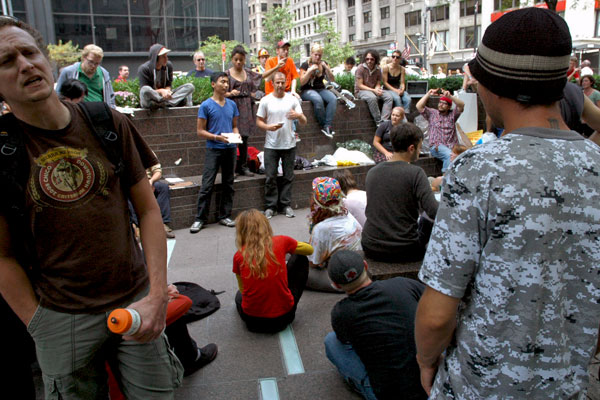
general assembly, with facilitator in white tee, speaker in blue, one repeater left front
#occupywallstreet is onto something. We are witnessing, or at least those who are paying attention are witnessing, the birth of an extraordinarily important movement for fundamental change in political and economic arrangements which we have been told are not just normal, but unassailable. Unfortunately the current brutal and oligarchical order has also been protected by the sad reality that many who might otherwise support change are pretty comfortable with things as they are now, or at least think they are. People are afraid of losing what they have, and change is scary anyway. Many are not willing to cross an employer – or any other authority – and many just won’t chance reaching for an alternative to what already exists, even if they belong to what the movement for change describes as the 99 percent of the population crushed by the greed and corruption of the other 1 percent.
While this is only the beginning, this is not a children’s crusade and must not be dismissed as one. Regardless of one’s take on Michael Moore or Keith Olbermann, it’s worth thinking about what the oft-self-described ‘comic’ told the pundit today of the unholy and disastrous alliance of Wall Street, government and the media: “They think they’re going to get away with it [and] believe me, they’re not done yet . . . ” Also: “There will be riots in the streets . . . what you see on Wall Street [i.e., specifically #occupywallstreet] will be known as ‘that’s where it began'” [my emphasis].
Today some of the most noble and courageous members of the multitudes included in “the 99 percent” continue to occupy Liberty Plaza (called “Zuccotti Park” before the current protest began), to the surprise of most observers, including many of their sympathizers. They remain there even in the rain and in the darkness, forbidden by the NYPD the use of any cover or electricity. Yesterday Barry and I visited their “encampment” for the second time.
Once again we happened to have picked a pretty quiet moment, the police who surround them being content for a time with sequestering their superior numbers and sheathing their brute strength. Of course there was also the implied violence of that monstrous elevated surveillance tower overhead. But people inside the park were not all idle. While some rested or were in engaged in discussions, others were talking to pedestrians who had stopped to learn what was going on. Some were being interviewed by the press, and throughout the hour or so we were there a large group was seriously engaged in the process of an extraordinarily open and democratic “general assembly”.
The NYPD had forbidden the, from using an amplified bullhorn. On that subject, the statute forbidding the use of electric amplification for speech, like all New York laws, is applied selectively, and all activists know it. Social and political protests are not permitted to use even portable battery bullhorns without a permit (try getting one), and I’ve seen cops get pretty violent when they saw they were being employed, as they did inside this camp on Monday. I’ve also seen the police totally ignore stores and other commercial use of bullhorns on the sidewalk. Naturally the restriction either does not apply to religious institutions, or else it’s just not invoked.
The volume of ambient sound found in Liberty Plaza makes it impossible to hear anyone at any distance, and certainly impossible to carry on a conversation in a reasonable-sized group. In order to be able to conduct any kind of assembly the group had had to improvise a system which required more than just a facilitator. A number of hand and arm signals were established; they represented the simplest and most common moves or requests which might be expected from the “floor” (like ‘point of order’). Also, because they wanted to keep the noise down (yeah), people were asked, should they want to approve or applaud what they heard, to raise their arms and “jazz hands”. Most remarkably, there were also a number of “repeaters” positioned at some reasonable distance from the speakers who were asked to speak from a designated area in the front of the assembly. The repeaters’ assignment was to dutifully repeat in unison each phrase uttered by the speaker, who for that to work would have to regularly break up her or his address, thus facilitating its broadcast to the larger group.
Wow.
I was impressed. I was more than impressed, even if only an hour later I thought to myself, ‘what about an old-fashioned cheerleader megaphone?’. But while I was still witnessing this phenomenon at the base of the skyscrapers I thought only of its beauty. Standing near the front and hearing this beautiful call and repeat process continuing for so long, my mind sort of boggled, and my heart swooned. I thought of what it meant to have to pause and interrupt something important you wanted to say after every short word construction, but I also felt that it somehow resulted in a more profound delivery and a more thoughtful response than normal discourse, at least in these circumstances.
I could barely take in the awesomeness of what I was experiencing (ACT UP had only needed facilitators!). I slipped into reverie. I was witnessing the communal resonance of some ur-language; the long-distance conversation of some remote mountain people; a fully-engaged and over-the-top Greek chorus. It seemed like the most natural thing in the world, as if these people had been doing this all their lives – or had prepared all their (mostly) young lives for the moment when they would be called to do this.
One of the people who spoke lived in the area and had asked to speak in order to complain about the noise of the encampment (in particular, as it turned out, that of the night before, when there had apparently been an unplanned response to the murder of Troy Davis which violated their own noise curfew). The seriousness, respect and detachment with which the repeaters broadcast to the group (of which they were a part) the complaint being made against it, and effectively against the importance of everything the group was doing, dramatized for me the awesomeness of what it was accomplishing with this free and open, heroically-democratic process being exercised only blocks from the dark canyons of Wall Street.
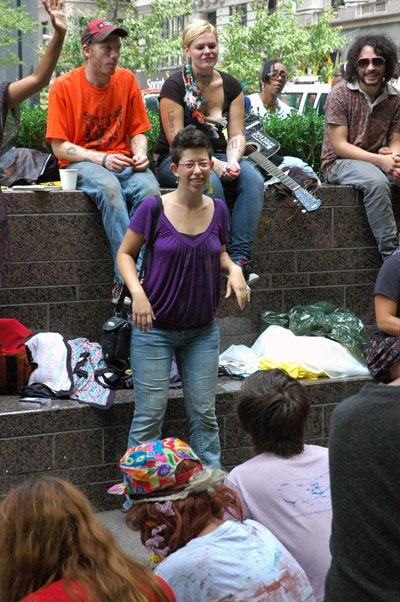
the fun/arts & culture working group announced “formal Friday” for the next day
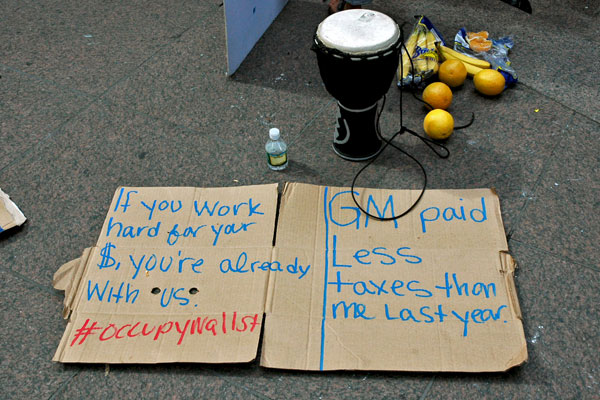
sign, at rest for now
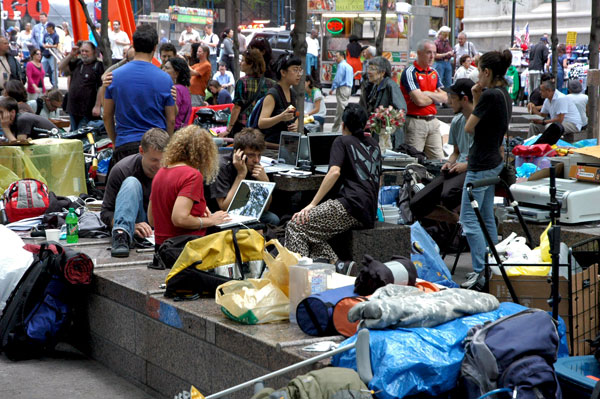
central media department
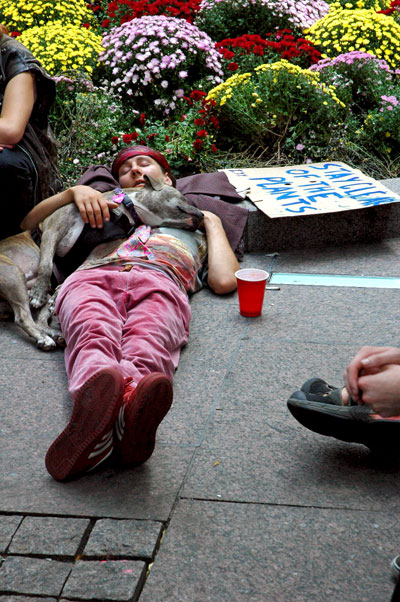
staying clear of the planting beds
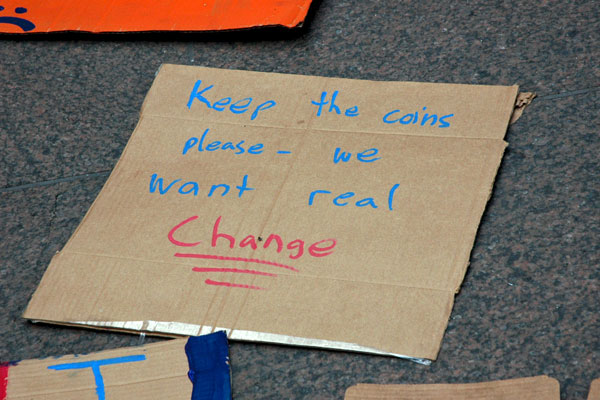
pretty focused
#OccupyWallStreet: will this be the U.S. Fall?
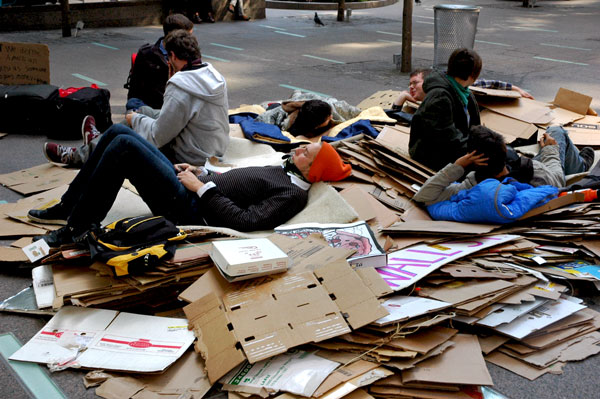
are we watching the beginning or the end? (relaxing in Zuccotti Park early this afternoon)
#OccupyWallStreet is now in its second day, and no one knows where or when it will end.
It seems to be in the nature of grass-roots political uprisings that there should be neither leaders nor defined objectives, and it is clearly true of this one. This should be not be a surprise, and it unlikely to be a liability, especially in the early stages of a popular street protest.
But this one just might become something more than just another protest which will once again frustrate its authors and participants and be ignored or endured by its targets wielding economic and political power.
The remarkable thing about uprisings of any kind – and in any place – may be the fact that they happen at all, and we who enjoy (or do not enjoy) a system which has always seemed impervious to revolution may now be in for a big shock: The Arab Spring may now have become the U.S. Fall. There is clearly general unrest throughout the country, and its physical expression has begun with political action outside the institutions which have frustrated and even defied the wants and needs of most of its citizenry. We do not know how far it will go, but unlike the case of the dissent provoked by the last, Great Depression, this time there appears to be no Roosevelt around to save either the institutions or the citizenry.
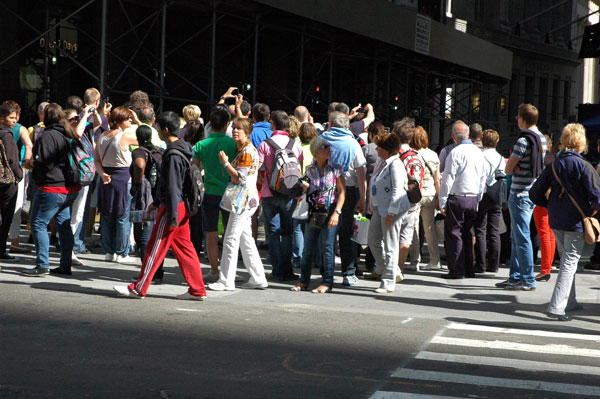
tourists staring down Wall Street, flummoxed by the security services’ decision to shut down all the streets which approached the shrine
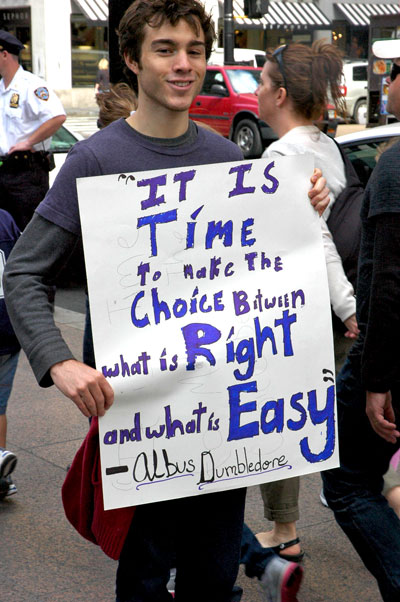
a particularly dangerous-looking revolutionary, and not atypical of the people gathered inside the park
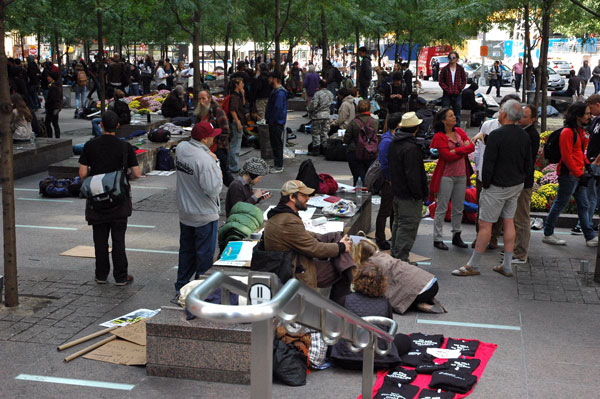
all quiet in the park this afternoon: signs, t-shirts, food, meetings
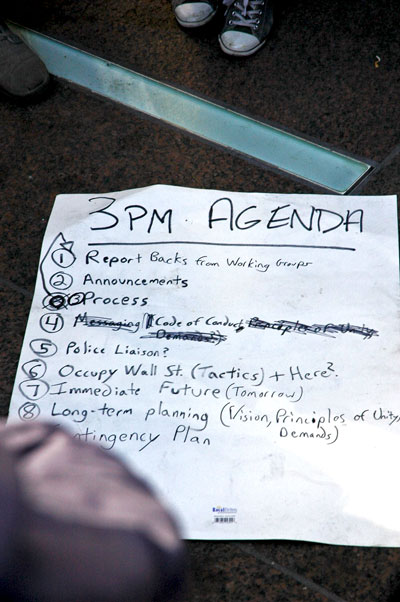
the agenda for the general assembly just ended
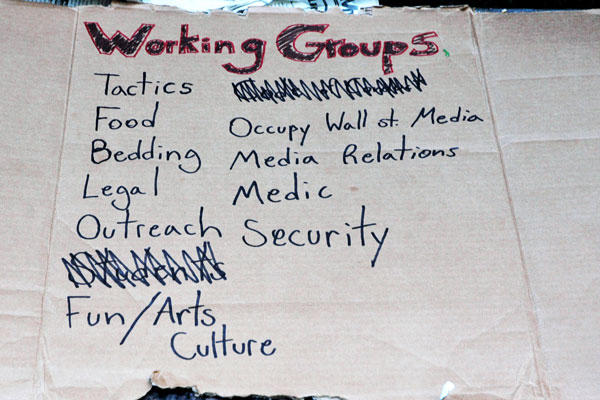
and working groups too
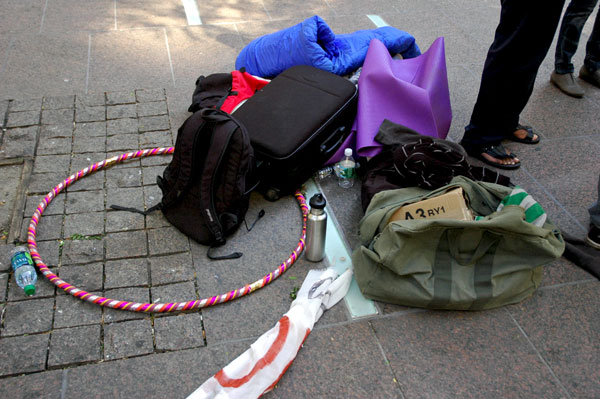
were there hula hoops in Tahrir Square?
the Wall: remnant of full fabric of 20th-c German history
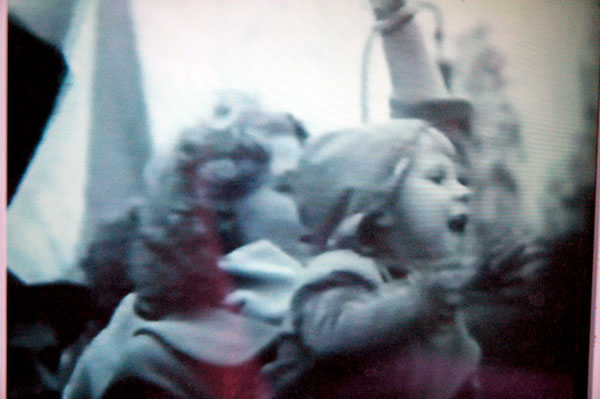
woman and child at the Wall, waving from West to East, 1961 (from a video on a stele at the Wall Memorial)
ADDENDUM: two images have been added within the original set below [on August 21, 2011]
I find myself nearly choking up as I write this. Yes, it’s been a very long time since I’ve blogged anything on this site, but my emotion has nothing to do with having been absent so long from a “post”. The reason I’m feeling a bit fragile right now is that I’ve been looking lately at a lot of images attached to the history of the Berlin Wall, memorialized yesterday exactly 50 years after it was installed. There are also my own memories of the Wall, and of Berlin, which begin in late spring of 1961, a few months before it even existed.
I returned to Berlin several times during the years the wall stood (but not often enough, as I still regret), and I’ve been back three times since it was torn down in 1989.
I suppose it’s natural that at this time there should be more and more attention being paid to this piece of German and Western history, more perhaps than that currently being focused on the Nazi regime and its so much greater horror. At least two generations have been born since 1945, and Germans today are well-educated about the country’s darker legacy, and fully-conscious of both the origins and the deeds of the twelve-year regime which ended in a Berlin bunker. Over 65 years later Germany is a very different country, the Germans a very different people, and almost no one survives today who could be said to have played an important role in the horrors which accompanied the first half of the last century.
The story of a divided Germany, a divided Berlin, however remains very much alive – and insufficiently known or documented. It’s also the story of a divided people, and much of that division remains today. Both victims and tormentors survive, certainly in numbers sufficient to attract the curious social observer or documentarian.
Peter Schneider wrote in the Times two days ago that when he first began investigating the Wall 30 years ago his progressive friends thought his interest was weird, that the subject should be of interest to the Right: “The left held that the split was the price Germans had to pay for the crimes of the Third Reich.” I can back him up: I was aware of something like that attitude among the Germans I knew decades ago.
Even today it seems there’s not even the beginnings of a consensus about what happened between 1961 and 1989, or how it happened.
The Wall was one of the last remnants of a social and political struggle which began before 1933 and continued after 1945; it was a part of a much broader panorama of German history, and not just a product of an East/West Cold War (which had been germinating for several generations, not merely years). Much of the suspicion and passion of the struggle which created the wall is still with us, even if disguised and diffused.
I have been obsessed with German history all my life, and especially with the 25 years fateful years of the Weimar and National Socialist eras, but in the last decade or so I have become increasingly interested in the story of divided Germany, and especially divided Berlin (subjects my teachers would have called “current events”). Part of the reason for my fascination and hunger for information could be the fact that Barry and I have stayed, on our last two visits, in what had been East Berlin. There is nothing like affection for an adopted neighborhood – even a temporary one – and proximity to the subject to inspire interest in its history. But I’m sure I would find the subject fascinating even at a greater distance, and it offers virtually unlimited opportunities for discovery.
I took these pictures while we were in Berlin in May of this year. I’m using, welcoming, the anniversary of the Wall as the occasion and an inducement to publishing them here now. We stayed just one street away from the Berlin Wall Memorial, which begins roughly at the Nordbahnhof, on Gartenstrasse, and runs along Bernauerstrasse. The memorial service held yesterday was held one street in the other direction from our apartment. These photographs were captured in half-light, as we returned to our base on our first full day in the city.
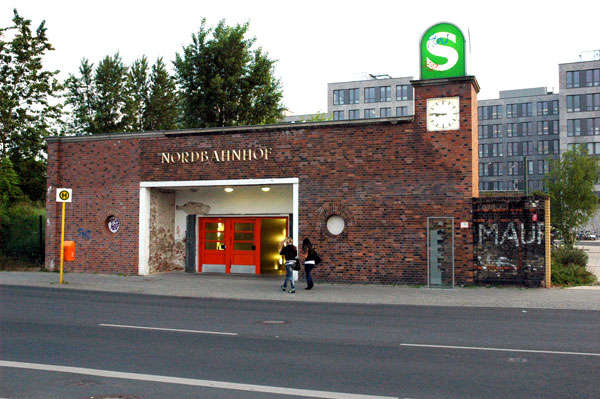
The S-Bahn stop, Nordbahnhof, closed between August 13,1961, the day the Berlin Wall went up, and September 1, 1990, is at the southwestern edge of the Bernauerstrasse section of the Wall Memorial; it includes an extensive, and evocative, “ghost stations” exhibit; this same building, by Richard Brademann, was constructed in 1936 and survived war (bombs, flooding), the postwar division of the city, and finally the Wall which destroyed its function
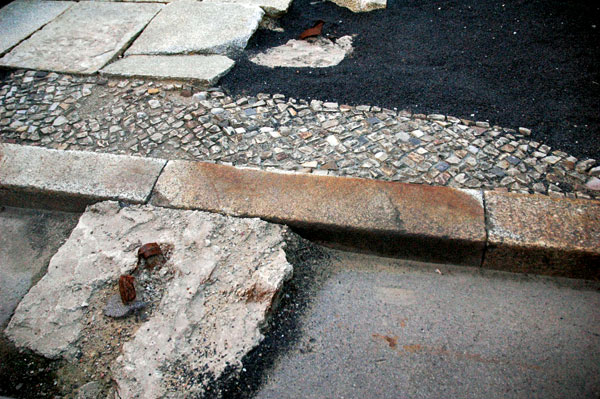
looking not unlike a street in Pompei, the archeological remains of Bergstrasse, showing the curb, paving stones and stumps of metal fence poles which were a part of the wall system
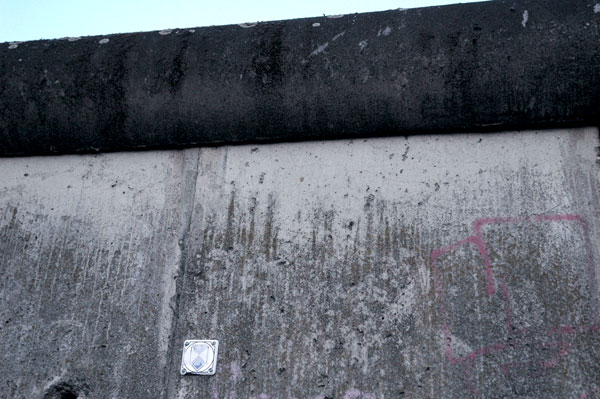
a section of one of the last surviving pieces of the Wall, on Bernauerstrasse, showing the small international Denkmalplakette, or monument emblem, established by the 1954 Hague Convention to identify “movable or immovable property of great importance to the cultural heritage of every people,” to be protected in the event of armed conflict.
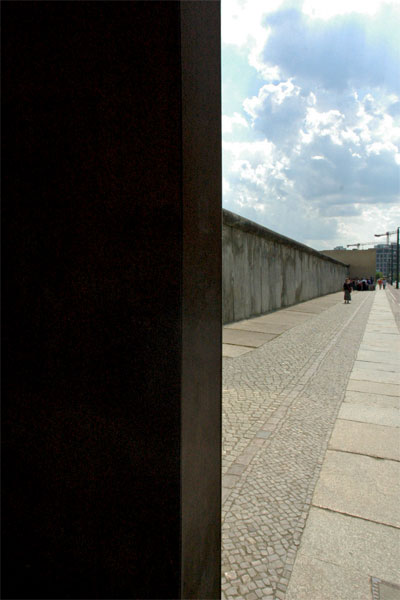
a view of one of a section of the concrete “Grenzmauer 75” (restored to its original condition), and in the left foreground the edge of the steel side wall designed by the memorial architects, the Stuttgart firm Kohlhoff & Kohlhoff, so that the polished surface of one of its sides would give an impression, artistically and optically, of the sheer length of the original barrier, most of which does not survive; the Gedenkst�tte has not yet been completed in its entirety
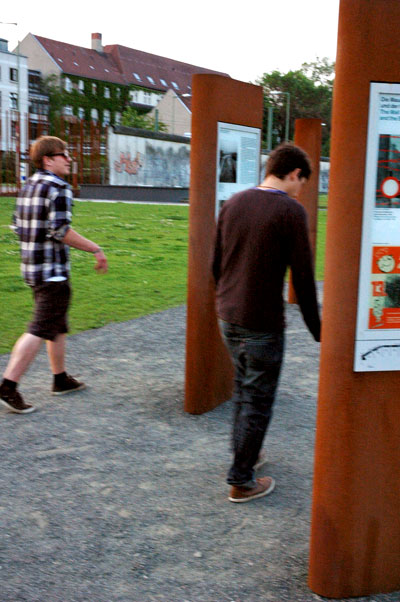
two Berlin youths visiting the still-under-construction Memorial Grounds on Bernauerstrasse, at dusk; we were near them while they watched one of the video screens imbedded in a stele, and when then-B�rgermeister Willy Brandt was seen speaking to the crowd at the wall, only three days after the closure (criticizing what he described as President Kennedy’s empty rhetoric, asserting “Berlin expects more than words. It expects political action”), one of the two uttered respectfully – and affectionately, “Der Willy,” in the way Germans often modify a friend’s given name.
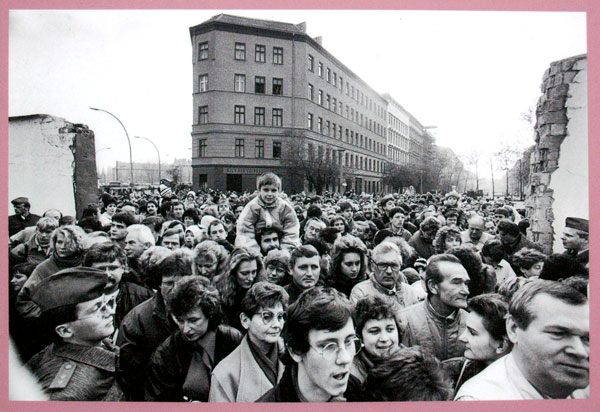
an image included in the wall of memorial materials located along Ackerstrasse, about one kilometer east of where this crowd of happy, stunned(?) East Berliners crossed to the West from Eberswalderstrasse into Bernauerstrasse the morning of November 11, 1989, through the first new street opening
More on the Wall, pictures and texts, from German sites, in English:
Germany marks 50 years (Deutsche Welle)
Before and After Photos of Germany’s East-West Border (Der Spiegel)
‘West Berliners Felt Abandoned and Powerless’ (Der Spiegel)
retired truck tire shelters Williamsburg flora
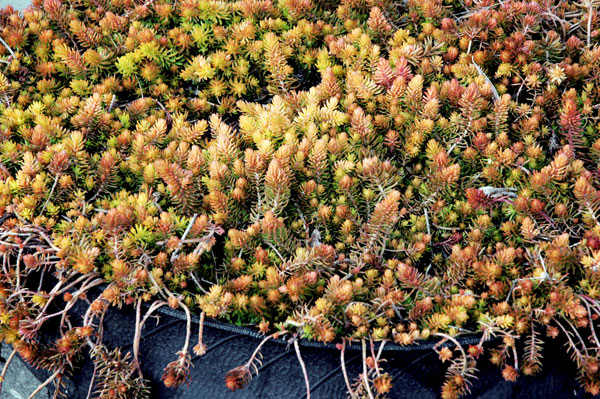
untitled (truck tire) 2011
I spotted this miniature landscape in the front of a house on Graham Avenue in WIlliamsburg, and captured it in an unwitting homage to Harry Callahan.
Zodiac Heads: Ai Weiwei wasn’t at the Plaza today
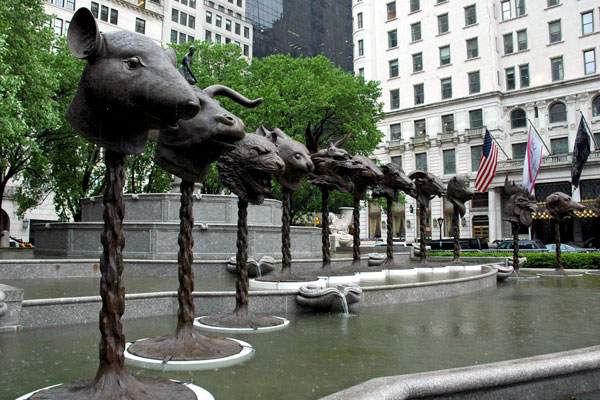
the sculptures terrassed
Okay, I love Ai Weiwei, and all his creatures, perhaps more than anyone I know, but I’m going to be a little grumpy here. I left the apartment early today, much earlier than I am want to (or ever want to) in order to be a part of the unveiling of “Circle of Animals/Zodiac Heads,” the artist’s installation at the Pulitzer Fountain in front of the Plaza Hotel. I’m an incorrigible activist, and I think of Ai as an activist as much as as an artist. I thought I would be joining a crowd of fellow enthusiasts dedicated to the artist and to what he has come to stand for all over the world (even before he was “disappeared,” which is now more than a month ago).
I didn’t expect a huge throng, and since it was raining, I told myself I wasn’t going to be too disappointed if the numbers were modest. But I didn’t expect to be disappointed, as I very much was, both by the installation and by the event. When I arrived I saw that the subject of numbers had become irrelevant; I was able to enter the establishment precinct surrounded by steel barricades only by identifying myself as a member of the press. I didn’t know I would otherwise have had to have an invitation.
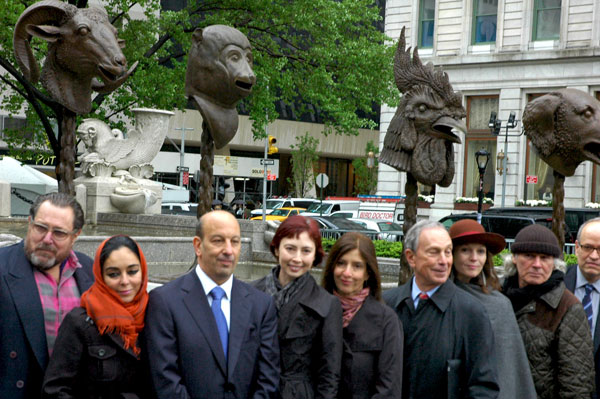
Zodiac Heads and talking heads
It was described several times during the ceremony as Ai Weiwei’s first public art installation, but the public was not permitted to be a part of the event (apparently only “dignitaries” and the press were allowed in).
The occasion was supposed to be a celebration of a youthful, bold and courageous artist, but there were only suits and a few older pros in the temporary shelter with the Mayor (twelve of them had been asked to recite short excerpts from Ai’s writings).
The work means nothing outside of its conceptual element, but there was no mention of that. The public talk was only about its eye-appeal and importance, whatever that may have actually meant to the speakers during the ceremony and in the Q&A after.
The title of the piece is “Circle of Animals/Zodiac Heads,” but oddly there was no circle.
The artist was absent from the event, hosted by the city which he loved and which we shared with him for over ten years, only because of his magnificent activism, but there was no room today for activism, aside from that of Susan Henoch, who was holding two hand-written signs (“where is weiwei!” and “free weiwei”) just outside the police barricades.
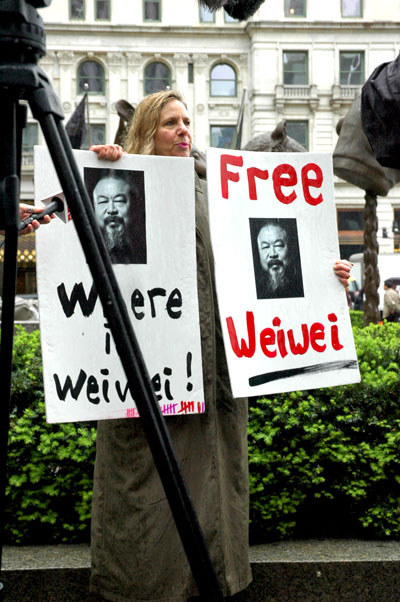
the demonstration, outside the barricades
Ai Weiwei’s work was there, but the artist was not. Of course this was not the fault of the organizers or of the well-meaning folks who took part in the event, but I missed any sense of loss, or urgency, in the conventional procedures to which we were witness. It felt like a ribbon-cutting ceremony on some dull, secure site not accessible to ordinary people. It wasn’t only uninspiring; it was lifeless.
Actually, maybe Ai Weiwei’s work wasn’t really there. I know I didn’t feel it. For an event intended to celebrate an artist and his art, maybe the most damning verdict I could hand over was, for me, the surprising absence of art in the scene on Grand Army Plaza today, and only part of that was the fault of the gracelessness in the placement of the 12 zodiac heads*. I have to believe Weiwei would have had it all very much otherwise.
*
They are supposed to be installed in a circle, and ideally, I think, around a fountain, but their arrangement here, in an arc stepping up and across the lower terraces of the Pulitzer Fountain, seemed a bit like my childhood memories of church, when the florist would arrange huge flower baskets in front of the altar on the occasion of some important wedding (or funeral).
ABC No Rio benefit May 3
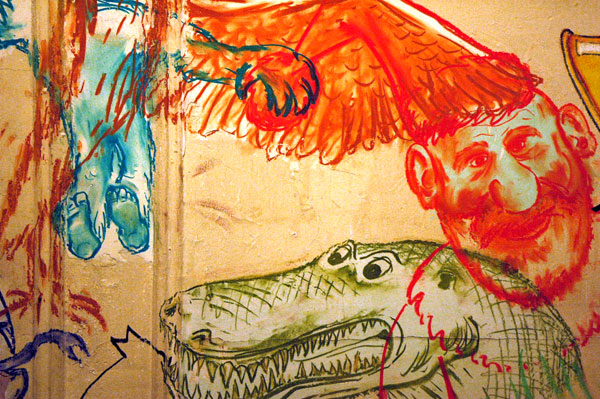
just like those in the Chauvet-Pont-d’Arc Cave, maybe these walls belong to the ages (detail of 1998 mural done by Chris Benfield to which other artists later made additions – customary practice in the ABC No Rio space – but those elements are not shown here)
Barry and I are going to be at the ABC No Rio benefit on May 3rd at Allegra LaViola on the Lower East Side. We’re both really looking forward to it, for the interesting company, the beer and the food, a great silent art auction, and guest DJs including Anna Kustera, Doug McClemont, and Kembra Pfahler.
But the occasion is also about the opportunity to help out, in at least a very modest way, one of the most interesting arts institutions in the city, an activist (and tenacious) DIY art, performance and community space on the Lower East Side (156 Rivington Street), a “collective of collectives,” with an awesome past, a dynamic present, and an exciting future.
The current building is a monument, but it’s pretty distressed structurally, and in a serious state of disrepair. Restoration would cost nearly as much as a creative new design offering more space and significantly-enhanced facilities, and it could be constructed on sustainable design principles. The decision was made: Start from scratch.
While I love a snappy new building as much as the next guy, it’s going to be tough watching the old ABC No Rio go down. I think there will be an effort to salvage some of the bold murals created – in layers – over the last three decades: The image at the top of this post is just one of a number I captured last month on a tour of the old tenement on Rivington Street.
The institution is now well on its way toward realizing a handsome new Green home, designed by Paul Castrucci, to be built on the same site. Anyone can help it along by attending the party next Tuesday, or if unable to do so, by making a donation of any size.
Full disclosure: Barry and I are on the benefit committee. Details here. Tickets start at $50.
ninth anniversary of jameswagner.com
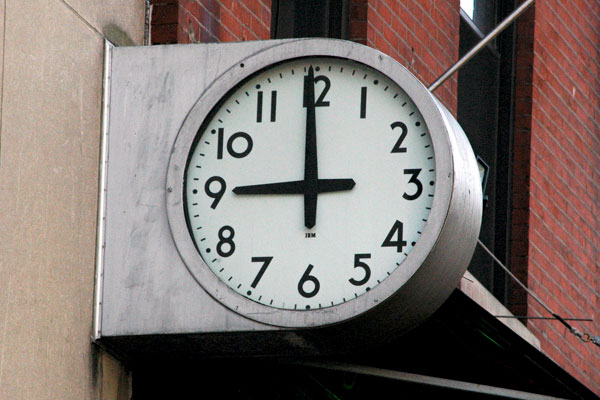
this clock has been stuck on nine for some time; I’m moving on to ten
Today marks the ninth anniversary of this blog. It began when, finding myself totally frustrated with the idiocy and brutishness of my country’s response to the events of September 11 and feeling almost totally isolated in my disgust, I started sending a series of emails to people I knew well, sharing my thoughts and my anger. A few months later I started jameswagner.com, intending it to be a more structured and more widely broadcast form for the kinds of unelicited rants which were testing the patience of my friends. It was also intended to include ruminations on subjects in which I thought others might share my interest.
Almost from the start there were entries on politics, the arts, queerdom, history, New York and the world, and within a year they began to be accompanied by images and photographs. Many of the latter have been my own.
April 27 marks another anniversary for me, one infinitely more important than the launch of this modest little blog: I met Barry, my perfect partner in everything, and Wunderkind webmaster, exactly twenty years ago today.
[the image is that of a beautiful clock mounted high on the outside of the handsome bank located across the street from our apartment, the modernist West 23rd St. building constructed for The Broadway Savings Bank in 1948; the architect was Harold R. Sleeper]
Ai Weiwei has not really disappeared, or been silenced
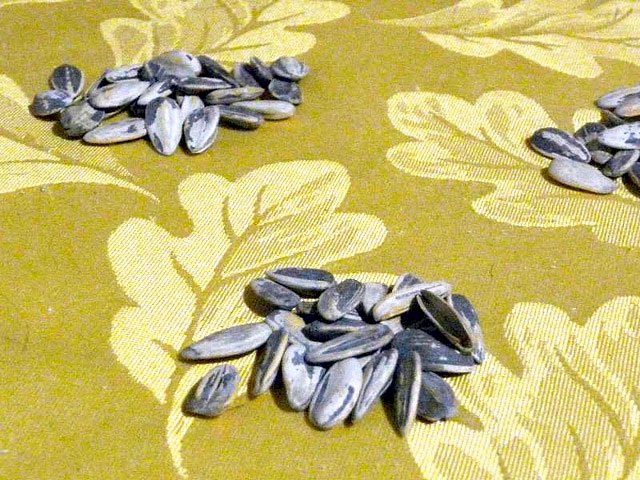
real sunflower seeds waiting for fertile soil
There are all kinds of artists, millions of ways to create art, and all of them must be respected, but Ai Weiwei is The Compleat Artist, as much as anyone else now on earth, particularly because he is a social activist as well. I call him a saint.
I really haven’t been able to completely stop thinking about this man since I first became aware of his art. I was almost immediately astonished by the signs of his courage and the size of his heart, and my admiration for the artist and the man has only grown with each report of his comings and goings. Six days ago the reports stopped. We know that the artist has been “disappeared,” and that the man has been silenced, but ironically the frightened regime responsible has ensured by its cruelty and stupidity that an important part of the artist-activist’s work continues, and his voice might actually now be louder than ever, thanks to his friends, millions of admiring strangers everywhere, and the power of the modern connectivity on which he doted – and thrived.
I cannot imagine a China, indeed a modern world, without his presence, his conscience and his art. If we deserve the art we get, the government we get, we will have to do everything in our power to see Ai Weiwei return to the people of China, and the world.
[image by An Xiao from anxiaostudio flickr]
“Anomalistic Urge” at Vaudeville Park, going, going . . . .
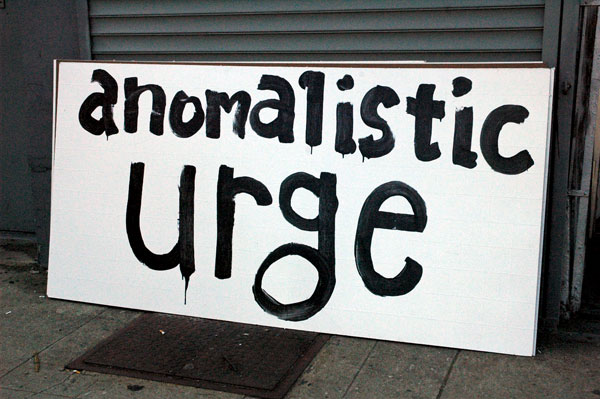
show sidewalk shingle
I wanted to get this post published before it was too late to send anyone to see this wonderful short-run (only ten-days) group show of sculpture in Williamsburg. Barry and I stopped in at Vaudeville Park last Sunday to see “Anomalistic Urge.” intrigued by the siren of a new space and a new curator. Some of the artists were very familiar to us; some of them were not (although maybe we should be embarrassed to admit that).
Courtney Tramposh, whose work we had not encountered before, gathered together gorgeous and exciting pieces by some 30 sculptors for this show. Tramposh is a sculptor herself and for this show she created the room environment as well as the unconventional but aesthetically sympathetic platforms on which the works are displayed. She describes the installation as “a tabletop sculpture show.” For a large group sculpture show, it’s contained within a fairly small space, but it all works. “Anomalistic Urge” is her first outing as a curator, and it’s a doozy.
Courtney was anxious to point out all of the other artists’s work, but never mentioned she had a piece of her own in the show. I thought we had already stayed past closing time, so unfortunately we didn’t quite see everything, and I didn’t snap an image of her own work (outside of its supporting roles).
The complete list of artists includes Justin Adian, Michael Berryhill, Shawn Bluechel, Strauss Borque-LaFrance, Sung Jin Choi, Tania Cross, Ben Dowell, Stacy Fisher, Jashin Friedrich, Joachim “YoYo” Friedrich, Gerald Giamportone, Susana Gaudencio, Hiroshi Tachibana, Rachel Higgins, James Hyde, Kristen Jensen, Michael Johnson, Tom Kotik, Denise, Kupferschmidt, Emily Noelle Lambert, Colin O’Con, Jonathan Peck, Courtney Puckett, Nathan See, Emma Spertus, Madeleine Stern, Jennifer Sullivan, Raphael Taylor, Courtney Tramposh, and Austin Willis.
Vaudeville Park is as much a (very interesting) music and performance space as anything else, and so we’re not surprised to hear that there will be a closing party and “sound performance” this Sunday, April 10, from 6 to 9 (not to mention some quirky contemporary classical music tonight, and “feral chamber music” on Saturday).
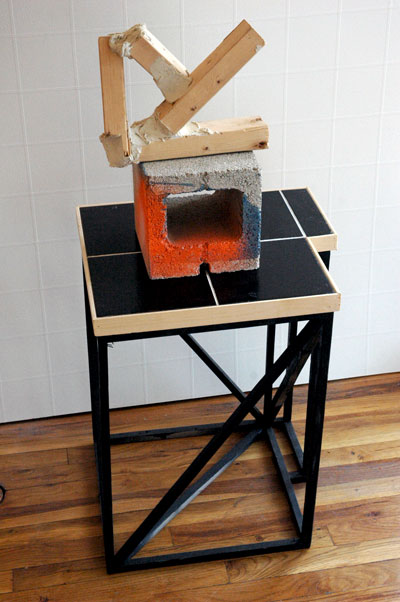
James Hyde OR 2008 Parex on wood 24″ x 12″ x 12″
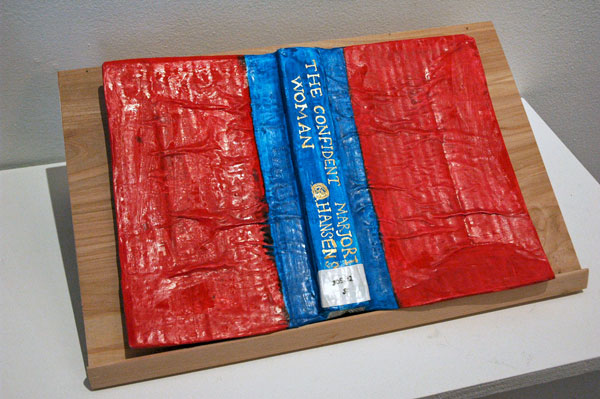
Jennifer Sullivan Borrowed Confidence 2008 gouache, ink, collage on cardboard 10″ x 16″
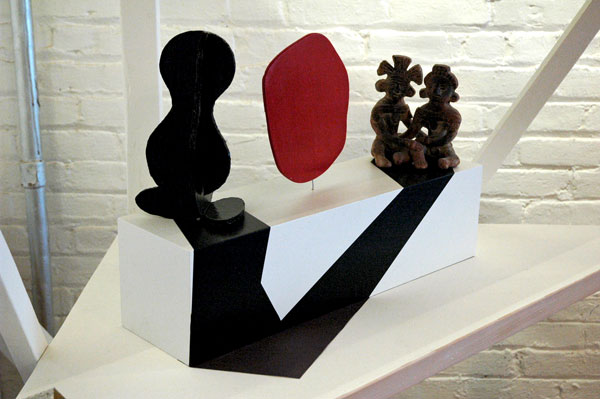
Nathan See The Triumph of Logic 2011 clay figurine, wood, cardboard, paint, paper
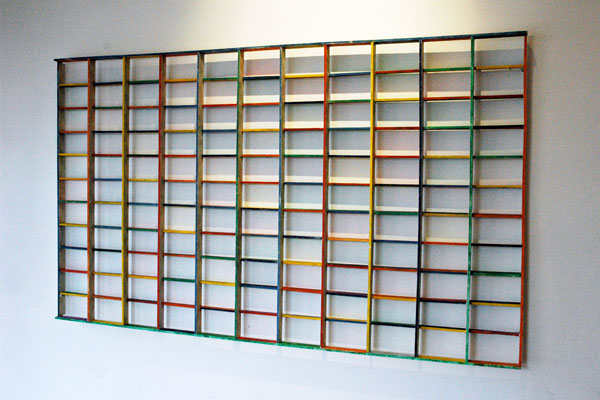
Joachim “YoYo” Friedrich Untitled 1976 oil on wood 2′ x 4′
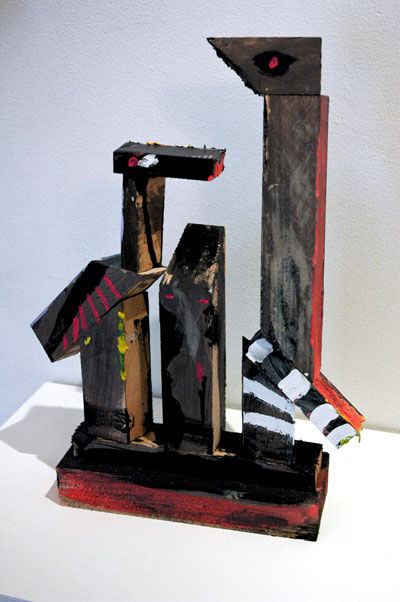
Emily Noelle Lambert Flock 2010 paint on wood
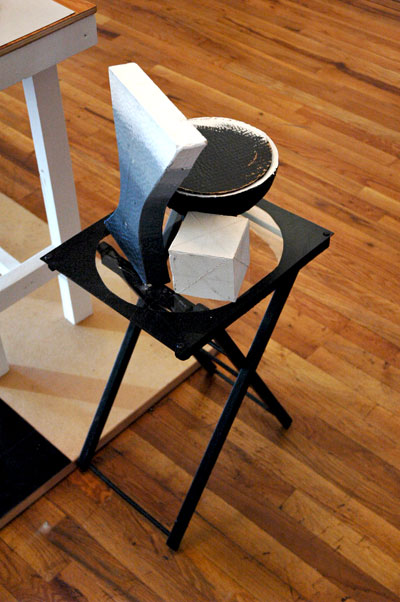
Denise Kupferschmidt Vase, Bowl, Block 2011 cement, plaster, paint, string, plexiglass, wood
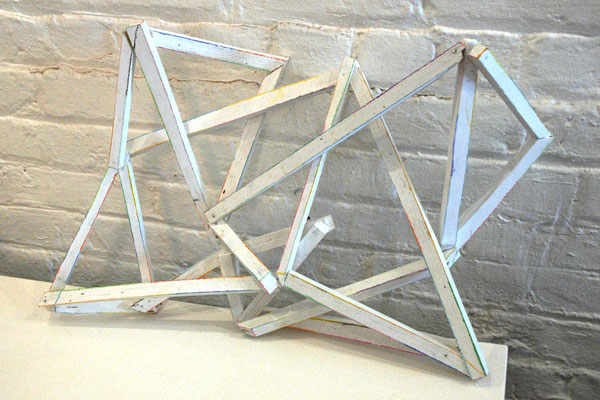
Hiroshi Tachibana untitled 2009 hand-cut plywood, latex paint and oil pastel 16″ x 24″ x 6″
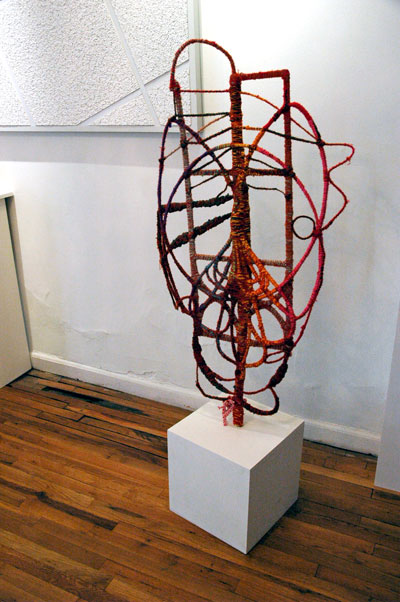
Courtney Puckett Bug 2010 wood, wire, string 5′ x 1′ x 1′ [with detail of Raphael Taylor’s “Designer 737 02/21/11 13:11, #1”]
Elliott Sharp, Steve Horowitz, and friends play Disklavier
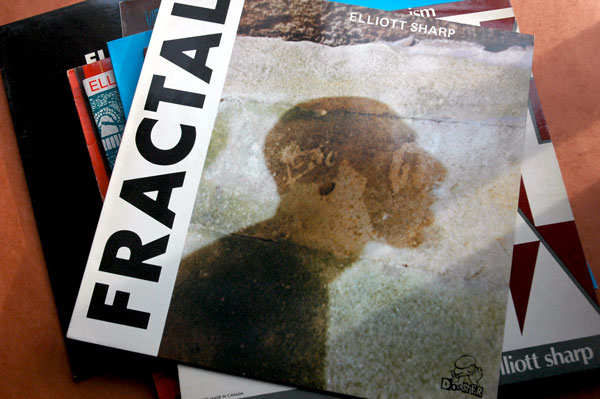
very sharp
I’m not sure what we’re in for tomorrow (April 1), but when I heard Elliott Sharp and Steve Horowitz were involved, I was already half there.
Over three days this weekend, beginning with a Sharp-curated evening of performance on Friday at 8 pm, the Electronic Music Foundation (EMF) is presenting what it calls “The Extended Piano Festival: Works for the Disklavier.” It looks like the music, in addition to its considerable performance art elements, may be accompanied by a certain amount of visual art throughout the Festival.
Some of the other names in the press release include, but are not limited to, Claudio Ambrosini, Dan Becker, Anthony Coleman, Nicolas Collins, Michael Evans, Fred Frith, Annie Gosfield, Seth Horvitz, Dafna Natali, Veniero Rizzardi, Frank Rothkamm, Carl Stone, and Hans Tammen.
Many of these have works being performed tomorrow (and/or will be performing it themselves), including Sharp, R. Luke DuBois, Jenny Lin, Stefano Bassanese, Viniero Rizzardi, Miya Masaoka, Pamela Z, Nicolas Collins, and Lukas Ligeti.
Steve Horowitz, has the space pretty much to himself (and the Disklavier) for a CD release performance the next night, Saturday.
Meanwhile, during daylight hours on Saturday and Sunday (April 2 and 3) people will be able to visit “a body of installed works for the Disklavier” curated by Sharp and Horowitz, composed or “performed” by Claudio Ambrosini, Dan Becker, Anthony Coleman, Diego Dall’Osto, Carl De Pirro, Fred Frith, Annie Gosfield, Seth Horvitz, Dafna Naphtali, Veniero Rizzardi, Frank Rothkamm, Carl Stone, Paulo Troncon and Hans Tammen.
I have to thank a good number of the artists whose names I’ve mentioned above for finally pulling me to New York from Providence in the 1980s; the other half may have been born after I arrived, and for that none of us can take any responsibility. By 1985 I had already assembled a huge collection of recordings by the giants of what at that time I and others called New York “downtown music,” or “noise music.” There was also the designation, “experimental music,” but none of these terms seemed to help much when it came time to approach a record store’s bins. When I moved to Manhattan I was shocked to often find myself sitting (sometimes standing) in live performances where there might be as few as ten other people in the audience – this when I might have half a dozen of that performer’s records at home – and everyone but me seemed to be a musician and friend of the performer(s)!
All Festival performances and music installations are at White Box, 329 Broome St. Yes, the music is still pretty much downtown.
For more information, go to EMF or White Box.