of shirtwaists and straitjackets: labor and Republicans

shirtwaist_names.jpg
Don’t let the Republican barons bring back their “good old days.”

I was downtown on Friday afternoon at the corner of Greene Street and Washington Place, at 4:45, the exact moment one hundred years earlier when a fire began inside one of the three floors occupied by the Triangle Waist Company. In 1911, less than an hour after the fire began, 146 garment workers were dead, most of them young women and girls (the youngest were 14), either from the fire itself or because they had jumped a hundred feet and more to their deaths. The factory owners had locked the exits on each of three floors, to ensure that their hundreds of pawns (600 female workers, and about 100 male) could not leave their work stations, in violation of even the rudimentary safety statutes in effect before the horrific disaster which changed everything. Well, not everything, and not quite overnight.
Also, appallingly, today we see increasingly bold attacks on unions and governmental regulatory authority of any kind, which, if successful, would straitjacket all working people, even Republicans not yet become rich: The party is maneuvering to roll back everything which was won by organized labor in the years after 1911, including both safety and living wage rules.
The Republicans want to be able to lock the exit doors, just like they used to.
The Triangle Waist Company factory fire should be remembered as a tragedy dividing an age of capitalist barbarism from an age of enlightened, direct government interest in the welfare of the governed. Instead today there are ominous signs that it may be remembered as only one more horror inspiring only a temporary improvement in the condition of the powerless.
shirtwaist_funerary_bunting_skirts.jpg
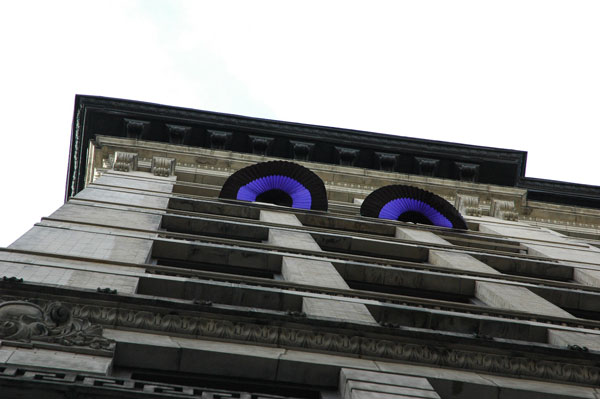
On the 100th anniversary of the tragic – and criminal – fire which engulfed the top three floors of the building which once housed the Triangle Waist Company factory, an installation on the eighth floor, visible from the street below, suggested both funerary bunting and the parachuting skirts of young women jumping to their deaths.
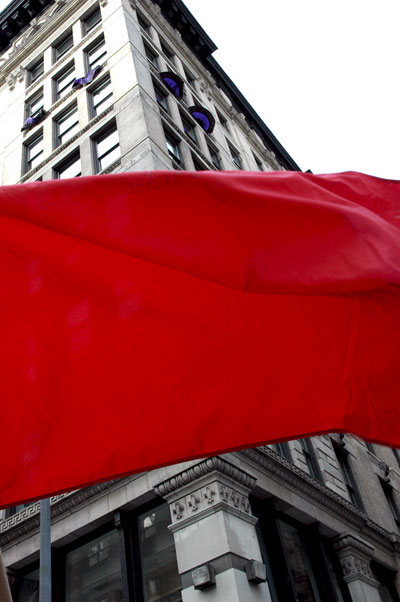
shirtwaist_red_socialist_party_flag.jpg
One man, a member of the Socialist Party USA, waved a brave red flag, telling everyone in hearing, “We were there!” He’s right.
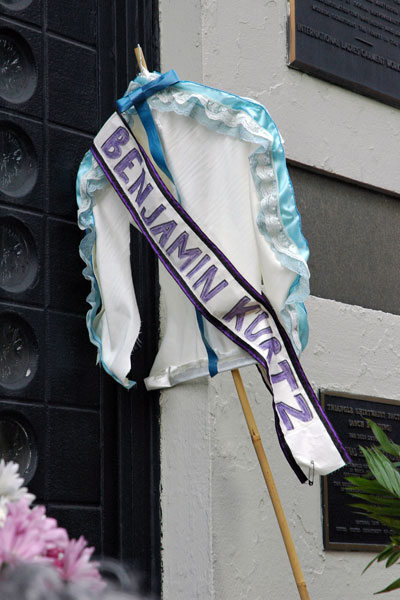
shirtwaist_Benjamin_Kurtz.jpg
Benjamin Kurtz, 19, was one of the few male victims of the fire, represented here by one of the shirtwaist replicas which was carried to the site in a procession earlier.
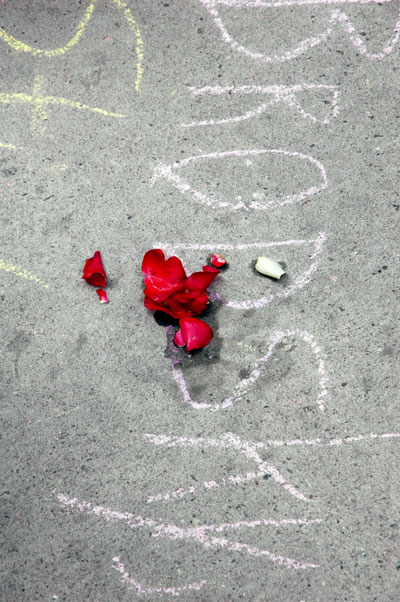
Shirtwaist_rosewater.jpg
On Friday, one woman in the crowd explained that the most common name among the dead was “Rosie.” She carried a large bowl of rose water and rose petals into which people were invited to dip their hands and caress the side of the building or the pavement.
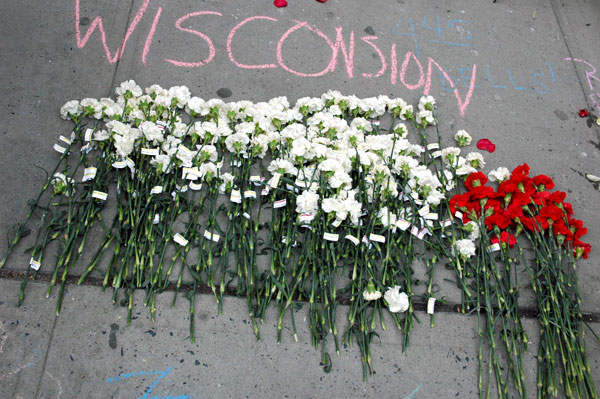
Wisconsion.jpg
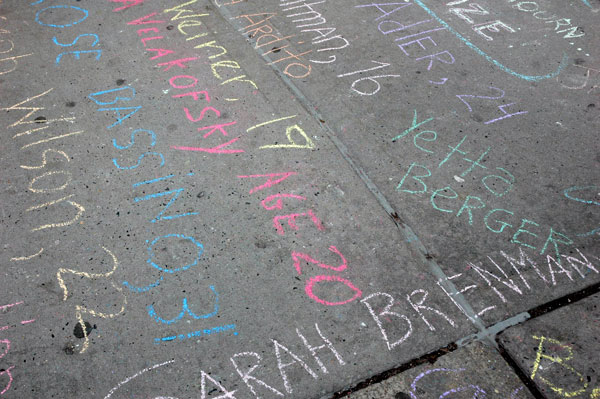
The names of those who had perished had been written in oddly-festive, parti-colored chalk onto the sidewalk, and here the name “Wisconcion” alluded to the unravelling of both hard-fought workers’ rights and industry regulations currently underway in Wisconsin and elsewhere in the U.S. Even in New York today, the sweatshop itself survives.

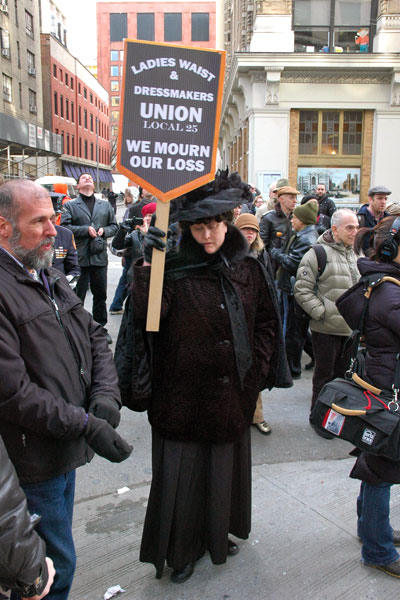
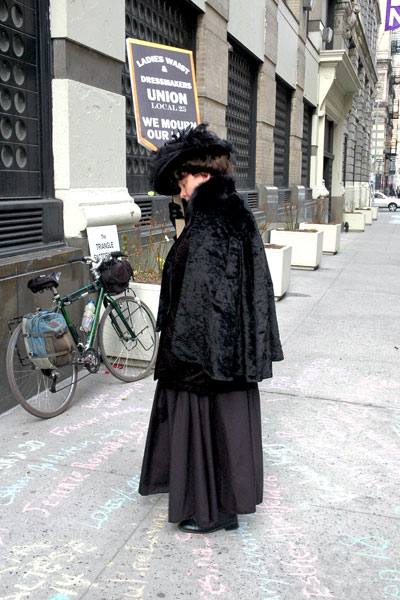
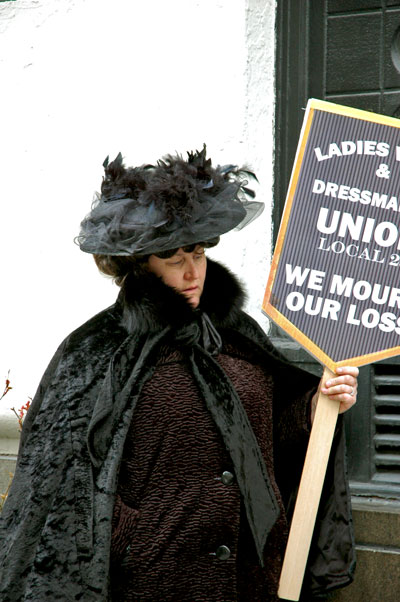
While I was standing about and photographing the group and the visual props gathered on this historic corner, I noticed in the near distance a woman dressed all in black, of brave proportion and stately manner, perfectly-costumed in the manner of a hundred years back. She carried an old-fashioned sign, and moved slowly on the edge of and eventually right through the crowd. At first it seemed that no one else had noticed her, but eventually it was clear she just couldn’t be ignored.
I felt a cold shiver and my knees weakened when I first spied her, and I thought about her heroic models and at least a century of noble antecedents. Did she represent one of the founders of the International Ladies Garment Workers Union (ILGWU) or local 25* specifically, to which the Triangle workers belonged? Since she seemed very well dressed, perhaps she was a patron, like Mary Dreier, Alva Vanderbilt Belmont, Anne Morgan (J. P. Morgan’s daughter), or any of a number of wealthy and influential women who worked to share their privilege with their sisters.
As I was leaving, I heard the sad phantom speak to the crowd for the first time: She began by asking, “Are any of you members of a union?”
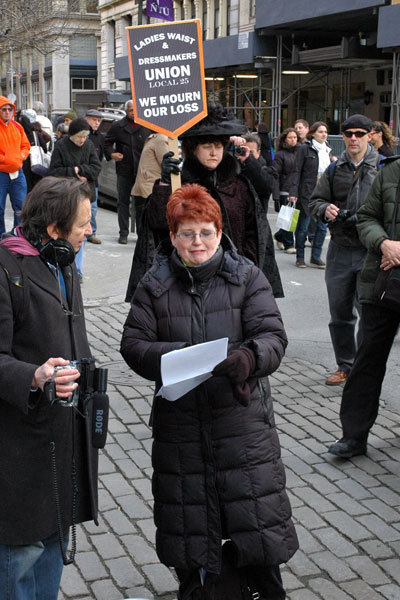
shirtwaist_spectre_appears.jpg
Union_patron_appears.jpg
union_patron_looks_at_names.jpg
union_patron_near_wall.jpg

The figure I’ll call our conscience seemed to appear out of nowhere, perhaps with a warning: The robber barons are back.

*
The New York State Archives has this to say about Local 25:

Local 25 [of the ILGWU] was known for its militant members. These members led the famous 1909 Uprising of 20,000 in which workers walked out of the Triangle Shirtwaist Factory. The uprising eventually sparked a widespread walkout among shirtwaist workers throughout the city. Many shops met the union’s demands while others including the Triangle Shirtwaist Factory did not. Strengthened by a post-strike spike in membership, the workers remained active. The tragic Triangle Shirtwaist Factory fire of 1911 further spurred the union’s growth, finally establishing the local’s position in the New York garment industry.

In its account the archive addresses the particularly-energetic radicalism of Local 25. There were communist sympathizers in all ILGWU locals, but the more conservative union leaders, regarding 25 as the hotbed, decided to divide its workers into two new locals. It didn’t quite work, but eventually, reflecting the history of the American labor movement generally, the union was able to keep genuine leftists out of it leadership entirely.
Manning’s torture: preventive war on open government

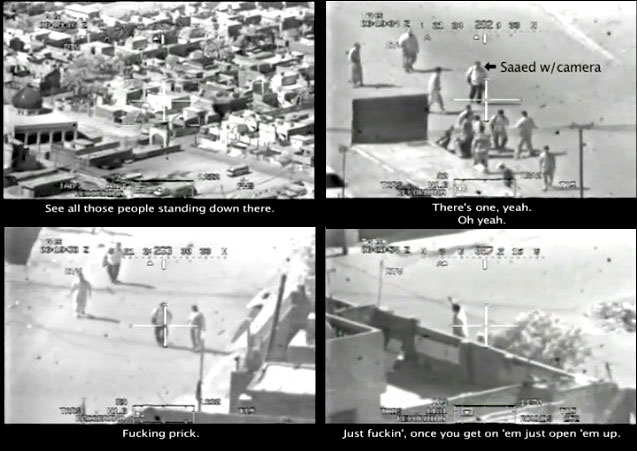
apache_video.jpg
stills from 2007 video posted by Wikileaks showing a US Apache helicopter firing on civilians in Baghdad

Are we doing the government’s own, dirty work?
I just now got it. I’d searched my mind for weeks, probably months, trying to figure out why the U.S. government (and the British terrier) has come down so hard on Bradley Manning and Julian Assange. Sure, no institution wants its endemic practices of deception to be broadcast to the world, and there is no institution more powerful than the U.S. government, but the aggressive offensive it has launched on these two men appears to be all out of proportion to what it might gain from any likely outcome.
While lying in bed this morning listening to the BBC I was pondering if or when we will learn the story behind the UN resolution which approved foreign intervention in Libya: How did the most gung-ho elements in the most gung-ho countries arrange it? That is, how did they ensure that no members of the Security Council would vote nay (including two with absolute veto power)? And why? I mean, what do they think is in it for them? Then, as my mind went back to Bradley Manning’s parlous plight in a Marine Brig,* I realized that we may never know more than we do now; the leaks may have been fixed, the taps plumbed tight.
I don’t think the U.S. has any intention of trying and sentencing either Bradley or Assange. Aside from the fact that it would be too messy, for many reasons (including more revelations?), our entrenched oligarchy, that brutal mob, already has what it wants. It’s frightened the whistle blowers.
This is all part of an full-out war on open government.
The extraordinary damage Manning has done to exposing the lies of the war regime in Washington, beginning shortly before the world saw the Apache helicopter video, can’t be reversed now, but he’s certainly not going to be handing over more evidence. As for Assange, our government doesn’t even really have to have him physically in its hands: The role of the WikiLeaks editor is to hand off to other media, and publish on his own site, information furnished him by others, and even if Assange now has some worthy imitators, anyone who might be thinking of leaking to the public more information about illegal and criminal government acts of any kind will now be reconsidering the cost of acting with moral integrity and fighting for open government. The lesson seems to be: Don’t fuck with the military; don’t cross the bosses. You’re not going to survive the war.
So it would seem to follow that when we write about and demonstrate against what has been done to Bradley Manning we are doing what the anti-whistleblowers want: Warning of the dangers in working for truth and open government.
But that would be true only if they are expected to win, and we can’t let that happen.

*
Manning has been imprisoned without trial, shackled, tortured and drugged, for almost ten months. He was not charged with any crime until 7 months after he was locked up. He has undergone prolonged isolated confinement and total idleness, and he is now forced to go naked inside his tiny cell much of the time and during daily inspections by his guards while standing outside of it. He is subject to sleep deprivation because of repeated nighttime physical inspections, and not permitted to sleep during the day. He is constantly drugged with antidepressants. He is unable to exercise in any ordinary way and never in his cell, but only after being moved to an empty room where he is allowed to do nothing other than walk in circles or figure eights for one hour (or less, if he decides to stop). Manning’s cell has no window or any natural light. He is permitted no pillow or sheets and his “blanket” sounds like it’s a stiff carpet (can’t be fashioned into a noose). He has been stripped of the glasses he needs to read, and is shackled whenever he leaves the cell. No trial has been scheduled. I can’t imagine how he could survive intact as a human being.

[image from BoingBoing]

we’re “good Germans,” Bradley Manning’s the real thing

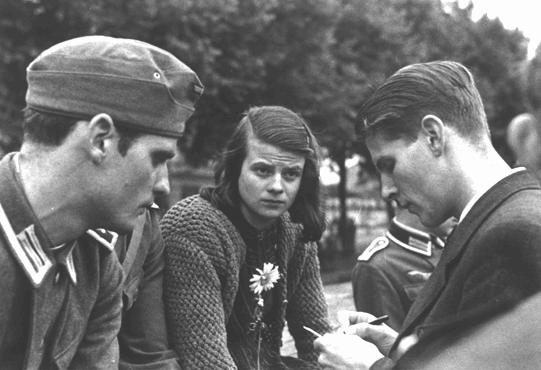
WhiteRose.jpg
surely we can hold ourselves to a higher justice than that which condemned them

The Six core members of Die Weisse Rose (The White Rose), a non-violent resistance group in Nazi Germany, were arrested by the Gestapo, tried and executed in 1943. Some of the male members had been activated for military service and been witness to atrocities, both on the battlefield itself and against civilian populations. The group had become known over the eight months prior to the arrests for an anonymous leaflet campaign describing what the government was doing and calling for resistance. The text of their sixth and final leaflet was smuggled out of the country and copies of it were dropped over Germany by Allied planes.
Today the members of the White Rose and others who opposed the Nazi regime, including those inside the government and the military who revealed the plans of the Nazis to other governments both before and after the war began, are honored as some of Germany’s greatest heroes. They acted from conscience and spoke truth to power; almost all of them paid for it with their lives.
Pfc Bradley Manning is their heir. Having learned about government and military lies, official war crimes, and having even been asked to contribute to them, he could not claim ignorance, or deny his moral responsibility to expose and to put an end to the hypocrisy and the atrocities.
Manning is the real thing.
Manning is a hero, not merely for what he did, which is only what morality and codes both command, but because doing it is still today an exceptional act for anyone within government or the military. He is also a hero because he is being punished horribly for doing it – by the real criminals themselves. Finally, and perhaps most discouragingly, he is a hero because, although he has not been tried or convicted of any crime, most Americans seem to believe he is a traitor, or much worse.
The shy young army private did precisely what all members of the armed forces are supposed to do, and have been instructed to do, at least since the 1946-1947 Nuremberg Trials. Those processes established that the traditional military defense of just following orders, the “Superior Orders” plea, isn’t enough to escape punishment.
These trials established the “Nuremberg principles,” which provided the basis for all subsequent prosecutions, anywhere in the world, for crimes against the peace, war crimes, crimes against humanity, and genocide. They continue to stand even if most Americans do not believe this sort of thing could apply to them. They are encouraged in maintaining this perverted self-deception by their most exalted leaders: When he was asked about the possible prosecutions for American torture practices, our current President says he’s “a strong believer that it’s important to look forward and not backwards.”
In fact, most of us share directly in the guilt for American crimes at home and abroad. We’ve been waging wars on the other side of the planet – shamefully – for almost ten years. My partner Barry ended a 2007 post on American electoral politics: “Americans didn’t exactly reject the Bush administration in 2004, when we had all seen the images of Abu Ghraib, and knew that they had no legitimate evidence of Iraqi WMDs. When Americans . . . say the people of countries like Germany under the Nazis were guilty, what does that say about us?”
Any individual or group choosing to describe and oppose criminal U.S. policy on ethical or moral grounds is without honor in this country today, this in the nation which was so instrumental in destroying Nazism and creating the document which set guidelines for determining what constitutes a war crime. Manning’s experience confirms this.
The most salient muckraker in the country today is now the least visible to his fellow citizens.
Manning remains locked in solitary confinement, ten months after being arrested for allegedly passing a mountain of digital “U.S. secrets” to WikiLeaks. He awaits his kangaroo court. Meanwhile, inside the Marine brig he is subject to no-touch-torture regimens which include being stripped naked each night and forced in the morning to stand outside his cell naked for “inspection.” After the revelations about American prisoner treatment over the last ten years, I think we know what that’s all about.
Meanwhile the real criminals, inside government, corporations, or the military, are free to continue the practices which were the subject of Manning’s whistle-blowing (no 5 am naked inspections for them). Those at the top have flourished and become rich, but those who would point out their crimes are ignored, punished, or imprisoned (and in at least one extraordinary case, fired for speaking out).
Ours may be the least responsible government in the West. Its elected (a generous adjective) officials do not pursue even in the most general terms the policies which the voters enjoin on them, and the mainstream media doesn’t cry foul. It’s the height of idiocy for citizens of a modern republic to believe in the first place that they could trust the paid officers of an unrepresentative and irresponsive oligarchy to know what is best for them, but to permit them to properly administer the affairs of the citizenry in secrecy is more dangerous still. The secrets, in any event, belong to the people. Bradley Manning is the agent of their retrieval. He is our tribune.
We know that as a nation we’ve been bad, very bad; an impenetrable cocoon of silence at the top means that no one with any political power will admit it; but worst of all, too many “good Americans” also refuse to admit that we might be guilty of anything.
Surely we’ve never engaged in optional wars, tortured the state’s “enemies,” or killed incalculable numbers of innocents in the nations we’ve invaded. Nor have we enslaved many of our own people, or placed others in concentration camps solely on the basis of race, and we’ve never corrupted our own constitution or judicial systems in the name of “national security.”
Or if we have done those things (we have, and we’re still doing some of them today), maybe we stay silent because we didn’t do them on a Nazi scale. Or maybe it’s because we think our shit don’t stink.

David House
David House is Manning’s support team. He is a friend, and a computer scientist now a researcher at MIT, who visits him in jail twice a month, one of the very few people permitted to do so. On December 23, 2010, House appeared on MSNBC’s Dylan Ratigan Show, guest-hosted by Jonathan Capehart, to describe his latest visit. I transcribed a section of his statement in a video shown on Firedoglake (FDL), specifically, Firedoglake TV:

After commenting that there are laws protecting whistel blowers in the United states, Capehart asked House, “Do you think Bradley Manning did anything wrong?” He replied: “If the allegations against Bradley Manning are true, I think he is an ethical giant of our generation. I think perhaps in this case America has judged him in the press much too quickly, and we should really reconsider why we keep alleged whistle blowers locked up in solitary confinement.”
When he was asked if he holds Assange resposnsible for the situation in which Manning finds himself, House responded that he would have to have information about whether they had a relationship, adding that all information to that effect is coming out from one very unreliable source [Adrian Lamo]. “So I don’t think that’s something I could speculate on now.” Capehart then suggested they talk about House’s thoughts on what Assange has done with the information that he has released via WikiLeaks. House: “So I think that the underlying principles of the WikiLeaks organization are actually principles which are very much in line with most American ideals, the principles of open government, the principles of government transparency; so at least from an abstract, 30,000 foot perspective, I think the actions of WikiLeaks are very much in line with the principles of the American people.

I can’t imagine a better spokesperson. House is awesome.

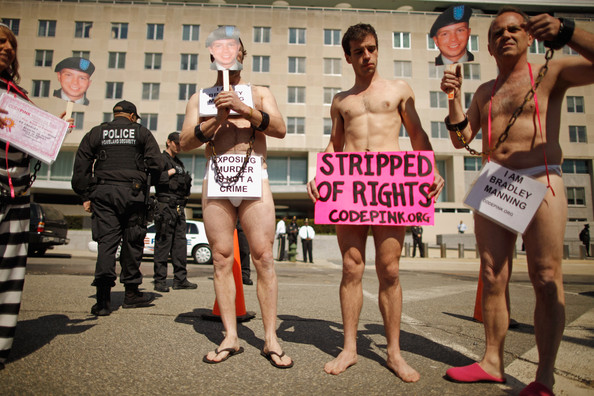
EXPOSING WAR CRIMES IS NOT A CRIME!, reads the banner on the home page of the Bradley Manning support site. There are demonstrations of support planned for Manning all over the world tomorrow, March 20. The site has information for all of them. The gathering in New York will be at 2 pm in Union Square. Clothing optional.

Jay+Marx+Supporters+Army+Pfc+Bradley+Manning+7Jd5U-Tuvs6l.jpg
supporters of Army Pfc Bradley Manning at a rally at the State Department March 14th
(SF activist Logan Price, in the pink sign, writes on FDL about why he got naked)

APPENDIX I: Manning was, and still is, a very young man (only 21 when he first started transferring classified data into his personal computer). He was not a sophisticated undercover agent. It seems to me that he was in the place where he found himself, where he had incredible access to government documents, because he was smart and because he was a techie, in fact a computer geek. I also can’t help noticing that, since Manning is gay (openly for I don’t know how long), the army may have chosen neither to ask nor to tell; there just may not be enough straight men who answer that description and are also willing to serve their country, as Manning was when he enlisted (and is now more than ever, as we see). But all of that, including the impact upon Manning’s story of DADT is the subject for another discussion altogether.

APPENDIX II: [This account of how Manning met House is taken from the Wikipedia entry for Manning] While he was at Fort Drum in New York, Manning regularly traveled to the Boston area to visit his then boyfriend, Tyler Watkins, who was studying neuroscience and psychology at Brandeis University. At Brandeis he “was introduced to Watkins’s network of friends, and the university’s hacker community, as well as its ideas about the importance of information being free. He visited the university’s “hackerspace” workshop, and met David House, the computer scientist and MIT researcher who has been allowed to visit him in jail twice a month, the only person apart from his lawyer with permission to do so.”

[first image from Wikipedia, the second from Jay Marx’s Zimbio photostream]

John Blee returns to DUMBO

John_Blee_Jewel_Return_1982.jpg
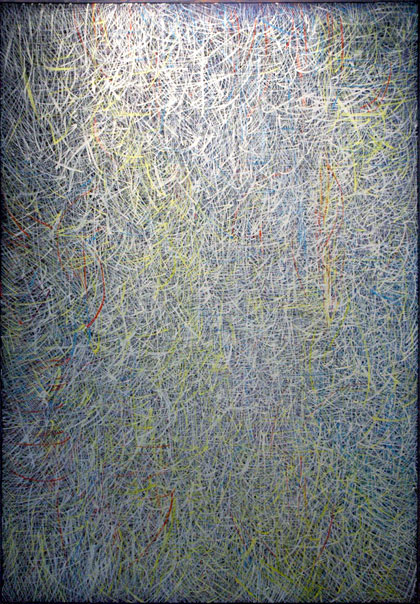
John Blee Jewel Return 1982 acrylic on canvas 48″ x 33″

I met our friend John Blee soon after I had moved to New York in 1985. I knew him first as a brilliant mind and an engaging conversationalist. I quickly found out that he was a painter and was relieved, and delighted, to learn that I really liked his work. It might not be too much of a stretch to attribute much of my ensuing engagement with the New York art world to our friendship in the 80s. John moved to D.C. years ago, much to my sorrow, but we never lost touch.
At the time we first knew each other he shared an incredibly vast unfinished loft with several truly tonic friends in what was just beginning to be referred to as “DUMBO” It faced Manhattan, and its windows overlooking what I used to call the “electricity factory,” where a transformer would occasionally act up, lighting the night sky. Of course it made me think of the paintings.
John is still in Washington, but he’s having a show this weekend in DUMBO, in the gorgeous apartment (with incredible views) of Norma Jean Markus. It’s a return of sorts to the neighborhood which gave birth to so many beautiful canvases, even if the neighborhood itself has changed dramatically. For one thing, a visitor from Manhattan will no longer be the only one on the street after the end of the day shift.
Event Details:

Reception: Sat., March 12, 4 – 7 pm and Sun., March 13, 1 – 4 pm
Location: 70 Washington Street #12G, DUMBO, Brooklyn
To visit by appointment: Contact Norma Jean Markus at 917.446.7234

As Barry writes on Bloggy, many visitors to our apartment have admired the two paintings we have of John’s. The larger one was actually one of the first works of art I had bought for the apartment. In Brooklyn this weekend you can see a range of his work from the 1980s to the present.
Related blog post: Art Wrap.
Below is an essay by writer and art critic David Matlock on John’s work.

John Blee in DUMBO
As the 100th anniversary of Kandinsky’ s breakthrough approaches, it is fair to ask: what
has been achieved? Are abstract paintings today repeating what has already been said–
and with each repetition, fading in strength? Or do they have something new to say, both
from a technical standpoint and in terms of meaning?
At the beginning, abstraction exploded. Kandinsky himself tried to consolidate a more
controlled language and connoisseurs still argue about his degree of success. When the
Abstract Expressionists adopted the language on a larger scale, canvases exploded again
in shamanic frenzy. Success was hit or miss, all too dependent on possession.
John Blee’ s first mature paintings, dating from the early 1970s, were also shamanic,
painted on the floor, and dependent on force and a possessed dancing. In a career of 40
years, the man has achieved total control over paint and, more importantly, now owns
his meditative inscape. He owns the land that earlier painters had to burst into by force.
His paintings are deliberate acts of self-intoxication. (It is worth noting, that although he
came of age in the 1960s, he has always disdained the use of recreational drugs.) The
Hindu and Buddhist art he experienced as a child and adolescent in India were formative;
as was the medieval sculpture in the caves of Ajanta and Ellora; and the work of Indian
modernists in the National Museum. Blee responds to Asian art as an insider–someone
who was shaped by the culture before he received his American inheritance.
The paintings on display are easy to enjoy but difficult to understand. From a technical
standpoint, the rendering of space is unique. There is nothing arbitrary or ” atmospheric”
about the backgrounds–they are architectonic–that is, they create a definite space in
which ” painterly event” unfolds. It is easy to take pleasure in the paint–casual admirers
often remark, ” What a painterly painter! What a colorist!” without suspecting the hidden
narrative. I strongly suspect the hieratic ” Sphinx” (2009) is one of Blee’ s dogs, posing
nobly on the grass–the humorous title a reference to the difficulty of knowing what the
animal is really thinking. These paintings are truthful because they begin from within
and encompass the outside world in an ecstatic veil of paint. Earlier abstract painters
discovered a new continent; John Blee is traveling inland and is providing a faithful
record of what he finds.
John Blee studied with Helen Frankenthaler, Robert Moskowitz, and Robert Motherwell.
His paintings have been shown in Paris, Moscow, Boston, Washington DC, and New
York City (including the Andre Emmerich Gallery). His work is in the Museum of
Modern Art and the Los Angeles County Museum.
He currently living in Washington DC.
– David Matlock

Reproducing the subtleties of a painting is always a challenge, one which can never be met fully, but I hope John won’t be too unhappy with shot at this wonderful painting. I photographed it with an available (overhead) light while it was hanging on the wall of the Brooklyn apartment where it can be seen this weekend. It also appears here on the artist’s own site, more evenly lit, but on a smaller scale.

anticipating spring, with small golden cups

yellow_crocus_2011.jpg

It may not be New York’s first crocus of spring, but it’s something of an event here. On the very first day of March I looked at the plant pots outside our north-facing breakfast room window and was surprised to see several yellow buds had already appeared from within the tight bunches of grass-like leaves I’d been watching for weeks as they pushed above the surface of the soil.
We never have even a sliver of direct sunlight show up on our roof terrace, even around the summer solstice, but last year I had read that flowering bulbs have stored the sun within their corms, and so can be expected to flower the spring after they are planted even if they fail to see it, or feel it, as the days become longer and the soil begins to warm.
Right now however it looks to me that they actually do miss our great golden star: I’m sure I planted white and purple examples as well as gold last fall, and not one of those has shown up yet; also, the dozen or so flowers that have appeared are certainly scrawnier than those seen in better environments, but after this (or surely any) winter, they are certainly welcome, however imperfect.

Armory Arts Week 2011, a few personal impressions

Dependent_New_York_Fine_Arts.jpg
The Dependent, where boundaries blurred (here the New York Fine Arts room)

I’ve found my art fair. “Armory Arts Week” worked this year: Institutions often don’t age any better than people, and maybe the secret of life for old art shows is in the spawning of the new.
The Armory Show itself was, well, armorial, although there were pockets of real humanity.
Independent, which was such a hit last year on its first outing, was definitely more cerebral than both the Armory itself and even its own first manifestation. But there was little eye candy or energy, and it felt surprisingly stiff and corporate. I’m certain many individual conceptual projects would open up if only I could hang around some more, but on a frustratingly-short weekend of compelling attractions there’s almost never enough time.
Speaking of candy, Daniel Reich hosted a modest, slightly roguish party inside his gallery on Friday afternoon. A salute to the 60s and the current gallery installation, Jack Early’s Ear Candy Machine, it included continuous live music performances. it will probably remain one of my personal highlights of the week, and only partly for its odd folksy character (and Daniel’s inimitable conversation).
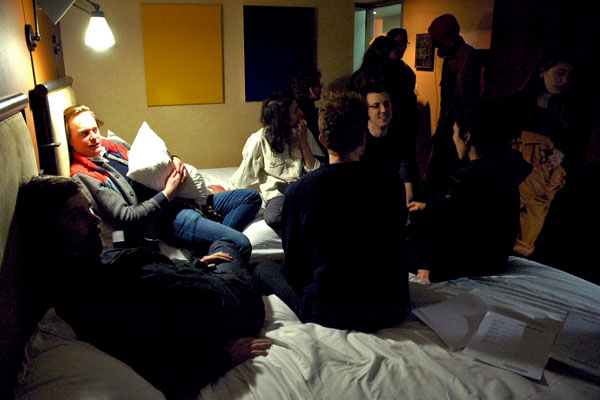
The Dependent was the event I had most anticipated since I first heard about it, and I wasn’t disappointed. Last night the Gramercy Fair (The Gramercy International Contemporary Art Fair), the 1994 progenitor of the modern Armory Show, was resurrected for a few hours. This was no sterile reproduction however, but a brilliant, exciting original. On the basis of the magic created last night, may have already created its own legend. It was “let’s put on a show,” and the results were pretty compelling, beginning with the contagious enthusiasm of the crowds on both sides of the “proscenium,” and continuing through the marvelous blur of boundaries between art, environment, artists, viewers and listeners. The dozen or so exhibitors were given one hour to arrange their installations inside an equivalent number of smallish rooms (inside the Sheraton Hotel on West 25th Street) before the doors were opened at 4 pm. The show was supposed to end five hours later, but the crowds were still lined up outside when we left at nine o’clock.

The Armory Show 2011: a surprising warm ambiance

CANADA_Armory_2011.jpg

I tried resisting the lure, and I almost didn’t go to The Armory Show this year. So I think I was feeling a little grumpy in the first hour or so at the preview last night (it didn’t help that Barry had once again refused to make the trek with me).
My personal best experiences with the West Side piers will almost certainly remain history, as they involved embarking and debarking from great ocean liners – or just “cruising,” while today the most they can offer are trade shows.
I hate the getting to and the coming from when it comes to the the Armory Shows on these piers, and even being there is a strain. It’s a desert over there: Nowhere else in New York do I feel I have to bring supplies with along me or I might starve or die of thirst. It’s worse than the Chelsea gallery “neighborhood,” and that’s saying something. Because of the lines and the logistics, those piers are always barren of refreshments, even when the organizers claim to have made food and drink available. I couldn’t even find a water fountain last night. Four hours in I was saved, just in time, by Pommery, thanks to a friendly dealer.
My enthusiasm for some of the art which hundreds of handlers had arrayed on the far West Side above the Hudson gradually picked up after the first hour or so. I ended up seeing some good work, and I had a great time, but the big reward, for me, came when I arrived at the CANADA stall. I always look forward to visiting the gallery – and visiting with the art keepers themselves – but last night, in the midst of so much intensive marketing up and down those long aisles, their space felt more than ever like an oasis of sweetness and light.
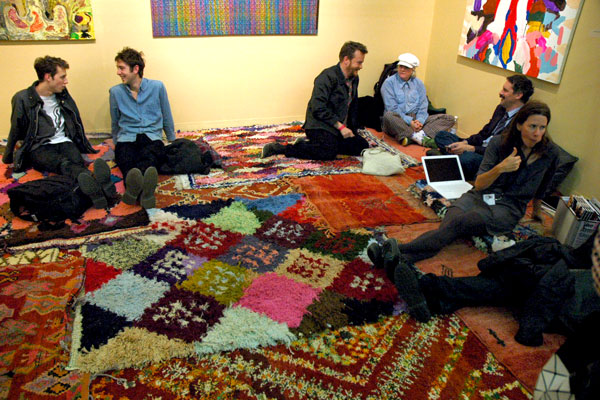
Of course Katherine Bernhardt‘s gorgeous thick Moroccan carpets helped, but they probably wouldn’t actually have been necessary to establish the ambience that was drawing visitors so easily. I think I was there for almost an hour.
The image at the top includes, from the left, lower portions of paintings by Michael Williams, Xylor Jane, and Katherine Bernhardt. The work hanging on those warm umber walls can be expected to change throughout the show.

IDIOM announces IDIOMbooks

IDIOM_staff_photo.jpg
Stephen, Jessica, and friends

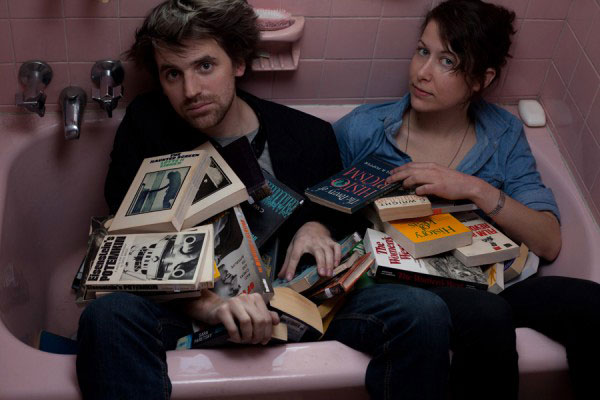
When I first saw this terrific image by Kristianna Smith I thought, “the only thing missing here is the cute puppy.” In fact however both the photo and this post are all about the books. IDIOM, which we describe as our online magazine of artistic and cultural practice, has just launched a book section, IDIOMbooks.
We’re very excited about it, not least because of our confidence in the folks you see conferring above. Stephen Squibb is the overall editor of IDIOM and Jessica Loudis will be editing IDIOMbooks.
We’re also announcing the appointment of Kristianna as Staff Photographer (Yay!), the redesign of IDIOM itself, and a lot of goodies in the form of new articles in both sections of the site.

[image by Kristianna Smith]

the 2011 Egyptian Revolution: end of colonialism?

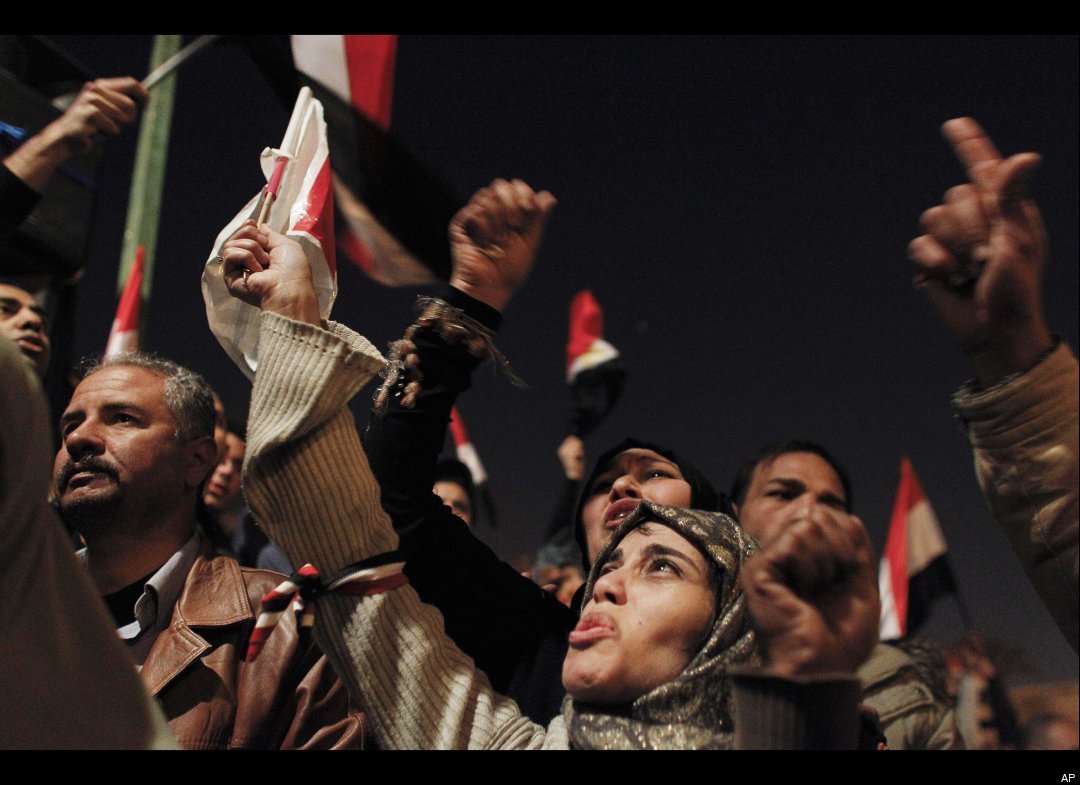
Cairo_crowd_Mubarak_gone.jpg
today in Tahrir Square, “Egyptian people greet selves as liberators”*

While the victory of the Egyptian people is a major problem for authoritarian governments throughout the Middle East, it’s a bonanza for virtually everyone else, one which could be world-changing: Last night I heard Ayman Mohyeldin, speaking on Rachel Maddow’s show (before the announcement of the resignation of Mubarak), say that their success was Osama Bin Laden’s worst nightmare:

It might take a day or two or a week or two. They have already won. But this scene of winning peacefully the way they have, this is Bin Laden’s nightmare. What we’re seeing here is Bin Laden’s nightmare.

If the Egyptian protests are copied elsewhere, and successfully, it would not only put Bin Laden out of work, it would put an end to his and others’ hopes for the world governed by Sharia law which they envision.
And President Obama couldn’t see that? Actually, he may still not see it.
I propose that even now the Egyptian Revolution may be viewed by our own government as a disaster, regardless of the tardy words of support and congratulation coming from Washington. Mohamed ElBaradei, in an Op-Ed piece published in today’s New York Times, also before Mubarak’s resignation, makes this comparison:

The United States and its allies have spent the better part of the last decade, at a cost of hundreds of billions of dollars and countless lives, fighting wars to establish democracy in Iraq and Afghanistan. Now that the youth of Cairo, armed with nothing but Facebook and the power of their convictions, have drawn millions into the street to demand a true Egyptian democracy, it would be absurd to continue to tacitly endorse the rule of a regime that has lost its own people’s trust.

The Americans in possession of enormous power and access to the ordinary taxpayer’s money (or mortgaged futures) did not engage in these foreign wars in order to bring about the kind of world which the peaceful and triumphant Egyptians are about to carve for themselves after over half a century of military dictatorship and heroic exertions over the past weeks. It’s hard to imagine even the least astute of our dull politicos having any illusions about the efficacy of Imperial American war policies in planting freedom and democracy by force and intimidation.
I’m often tempted to think of almost all of our post-war foreign policy as just a game played by boys who never grew up, but it’s probably more useful to understand it as the work of a military industrial and media complex, in it for the money and the power; its lip service to freedom and democracy was always cant, and talk of a communist, and later a fundamentalist threat, only a cover.
May the Egyptians now safely secure the awesome accomplishment of popular revolution – and incidentally save Americans from themselves.

*
The phrase in quotes was tweeted by David Waldman today, in negative tribute to Dick Cheney’s 2003 prediction that the Iraqis would welcome us with open arms and greet us with flowers (or some such words) when we invaded their country.

[image (uncredited on the site) from Huffington Post]

the army in Egypt

soldier_kisses_protester.jpg
a complicated relationship*

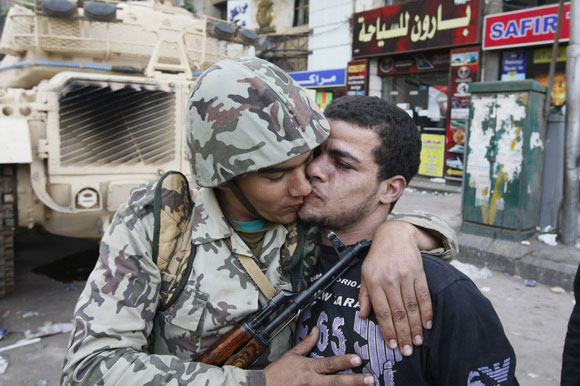
Egyptians have a complicated relationship with the army. While we are told over and over that it occupies a high status within Egyptian society, largely because of perceived (early) success in the Yom Kippur War, if we take a longer look, it’s clear that it has a problematic history when it comes to the welfare of the Egyptian people. Today as well, while vaunted for its restraint over the last two weeks, the army has not been truly impartial.
While we are still awaiting events, even in a first draft, the 2011 Egyptian Revolution may already be writing the most definitive statement of the army’s position within Egyptian society.
We’ve been hearing for weeks that the enemy of the popular protests isn’t the army, that the army is close to the people, that the army would not turn on the people, and that the conscripts, at the very least, are identified with the people and have the same interests as the people.
At the beginning of the Egyptian street demonstrations these sentiments and judgments were being expressed in a context which showed that the police, on the other hand, were not close to the people, would turn on them, were not conscripts and therefore not identified with the people in the streets – or their interests.
Today concern with both the physical presence and threat of the police has been overshadowed, even replaced by considerations of the army, lower ranks of which now share, sometimes even intimately, the spaces occupied by the protesters. Today it is the posture of the army that is being discussed. Early on, when the more reflective protesters talked about the army not being the enemy I always suspected that much of their expression of comfort was strategic, with the object of helping to engage the support of the military, at all levels.
All of this is the context which will determine how the revolution will respond to a possible military replacement for Mubarak – and Suleiman, even it is described as temporary.
In the end Egyptians will make that call (and perhaps they have already). Even the youngest revolutionaries are almost certainly aware of the army’s chronicle, at least starting with the end of the Muhammad Ali Pasha dynasty and continuing to this week.* *
It was a cadre of high military officers who staged the coup which brought down King Farouk in 1952, and every president since then has been a high military officer, as has virtually every key figure in every government, including the one currently disintegrating.
If Mubarak steps down, and Suleiman exits as well, turning over authority to the army, absolutely nothing will have been accomplished by the revolution. The army will merely be continuing its almost 60-year ascendancy. I’m sure the streets know this.
I saw this re-tweeted on Mona Eltahawy’s feed this morning:

To All Egyptian youth: It’s YOUR country ,YOUR revolution NOT the army’s. GO CLAIM YOUR RIGHTFUL TROPHY

*
The published caption reads:

An Egyptian civilian kisses an army soldier after troops took position at major junctions in central Cairo on January 29, 2011 as thousands of anti-regime demonstrators continue to pour onto Cairo’s streets, demanding President Hosni Mubarak stand down the day after the veteran leader ordered the army to tackle the deadly protests.

* *
Egypt is five to seven thousand years old, but in its modern history as a state (from 1805) it has had only two regimes: the Muhammad Ali Pasha dynasty, and that of the generals. The generals have been operating under a state of emergency since 1952 (and not 1981, as the media reports).
It is interesting that the “state of emergency” (emergency for whom?) was originally provoked by a successful military coup (eliminating King Farouk and installing Naguib and then Nasser, both high military officers), and fully-institutionalized by the assassination of one president (Sadat, a high military officer), also by military officers (an army major, a lieutenant and four enlisted men) and the succession of another high military officer, Mubarak.
So what is the current regime talking about when the say they fear the disruption of the state from below, and warn they will call upon the military to protect that state? I think everyone now knows the answer.

[image by Mohammed Abed – AFP/GETTY IMAGES from NewsObserver]