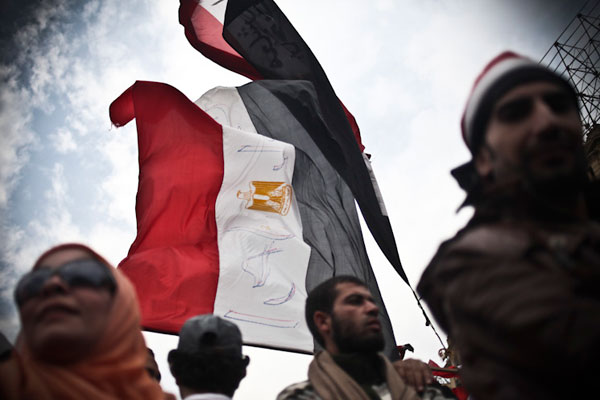
Tahrir Square, the afternoon of February 6
Is it racism?
In Egypt and elsewhere in the Middle East the U.S. is acting like the plantation owner who is certain that his negroes don’t really have the same sensibilities and capabilities as he and his kind do: The poor darkies are incapable of fully rational behavior, they certainly can’t govern themselves without the slave driver or overseer, and they’re there to support his civilization and keep him rich and comfortable. Today the same patronizing attitude could be laid at the door of most Western governments, if not all.
Massa never went away; he now strides the world and he still wants it his way.
Unless I’m reading it wrong, at the moment Egyptian policy for European and American leaders alike, what they would like to see happen, seems to reflect the desire of their peoples. While they may be operating as democracies to that extent, there appears to be no wish that the world should share their blessings.
The Western establishment have made accommodation with the existing but now seriously threatened “stability” in the Middle East, and they want to preserve this corrupt old order at all costs, even at the expense of a genuine stability.
An indigenous, popular, secular, non-partisan and cross-generational protest has been initiated in the country which forms a keystone in the arab and muslim world. It represents an awesome, unprecedented, beneficent opportunity for all of the Middle East and for the world. It was handed over to Western democracies and the world, freely, without strings, and with love. We all hit the jackpot, and we hadn’t had to lift a finger. That opportunity is now being lost, and we will live to regret it.
With notable exceptions, and in spite of occasional lip service to their ideals, people outside Egypt don’t actually seem to want democracy there. It is seen as a threat to their own comfortable world, and they haven’t the courage of their advertised convictions. If there has to be change, their arguments generally describe a slow process, perhaps a very slow process, one which should be under the control of the existing government (a brutal dictatorship which has repressed all political reform for 30 years under a spurious emergency decree).
From the beginning of the Egyptian protests two weeks ago our own “change” President was extremely slow to speak up or act, and when he did he was always seen to be trailing events (not unlike his partner, or client, Mubarak). Eventually it seemed that Obama had started to get it. Judging from statements which have come from the administration over the last few days however, incredible as it may seem, he’s now backpedaling from whatever support he seemed to be giving to the protests. My guess is that he swallowed premature reports that the movement had begun to weaken, and decided he was now off the hook.
Yesterday an AP AP story by Matthew Lee reported this:
“A question that that would pose is whether Egypt today is prepared to have a competitive, open election,” State Department spokesman P.J. Crowley said. “Given the recent past, where, quite honestly, elections were less than free and fair, there’s a lot of work that has to be done to get to a point where you can have free and fair elections.”
That was hardly the line in 1989.
Twenty-two years later it may be cynical calculation, if extraordinarily shortsighted, but it’s definitely racist.
The Washington Post editorial board thinks Obama is being played a fool. I think he knows exactly what he’s doing, and it’s just plain wrong.
ADDENDUM: Then again, could Obama be acting as a double agent? Not likely, I think, but I just watched a February 6 New York Times video by Rob Harris, David D. Kirkpatrick, and Enas Muthaffar, titled “Egyptians React to U.S. policy.” After showing shots and statements of protesters angry or disappointed about Obama’s support of the regime, the reporter’s voice-over says, “Still others saw American support for their cause as a liability, bolstering the state’s portrayal of the protesters as tools of foreign powers.”
One young man questioned in Tahrir Square [looking much like one of the of the movement’s attractive “kind of scruffy intellectuals” described earlier in the video] is recorded saying, “Barack Obama being against our agenda here is something good for us.”
One thing is clear: These people are not going to be anybody’s patsies.
[image from Andrew Burton, who has many more great Cairo shots here; plus some personal thoughts on a revolution]
Cairo: “With soup pots into the fray”
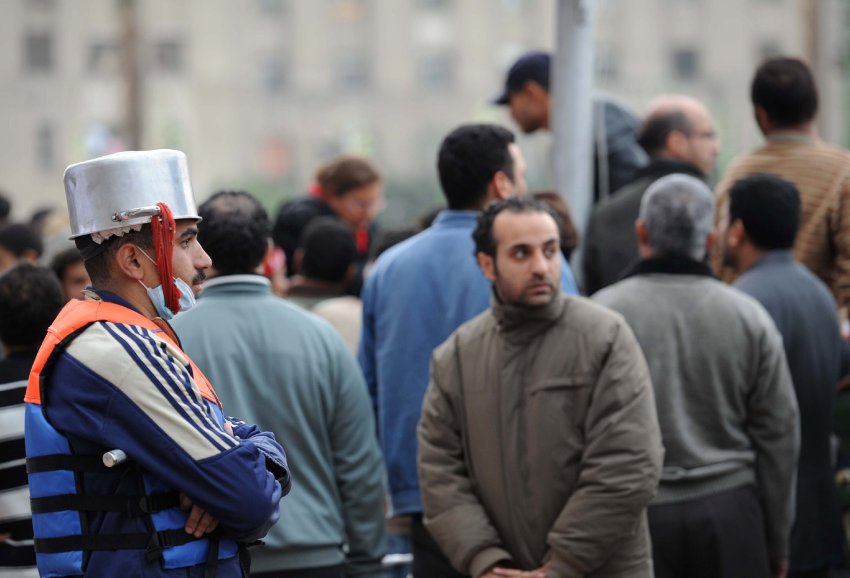
It’s now the twelfth day, and even if some of us are thousands of miles away from the magnificent heroes in Egypt, I think we’re all pretty stressed out. Maybe it’s time for a tribute to the Egyptian soul and sense of humor – with a bit of soul and humor from, you guessed it, the Germans!
The image above is from a Der Spiegel page of 14 totally enchanting (is that too irreverent? I don’t think so) images from the demonstrations in Cairo, headlined “Mit Suppent�pfen ins Get�mmel” [With soup pots into the fray]. I love the German language!
The article is about the need of the protesters in Tahrir Square for homemade helmets as protection from the violent attacks of paid Mubarack supporters, and their improvised solutions. The pictures don’t even require translated captions.
I have absolutely no doubts that these wonderful people are going to be able to successfully defend their revolution.
NOTE: Except when they are my own, I always credit the source of the images I use on this blog, and I include the name of the photographer when I can find it. Especially in consideration of the horrible circumstances under which all photographers are operating at this time in Egypt, I am very disturbed that there was no name attached to these images. I can only hope that the explanation has to do with the personal protection of their author.
[image from Der Spiegel (Agence France-Presse)]
today, we are all Egyptians!
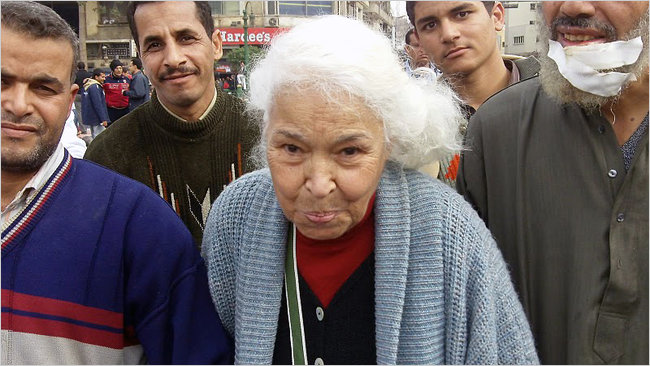
Dr. Nawal El Saadawi, a leading Arab feminist, with protesters in Tahrir Square.
ADDENDUM: scroll to the bottom
Innaharda, ehna kullina Misryeen!* Today, we are all Egyptians! writes Nicholas Kristof today from Cairo. All of us, that is, except for Obama; Obama still appears to be waiting for the revolution to be crushed.
I saw this CNN twitter Thursday morning while still lying in bed with my laptop on my chest:
[Update 4:07 p.m. in Cairo, 9:07 a.m. ET] “We are mindful of the violence that we’re now seeing in the Middle East,” President Barack Obama said Thursday at the National Prayer Breakfast. “We pray that the violence in Egypt will end, and that the rights and aspirations of the Egyptian people will be realized, and that a better day will dawn over Egypt and throughout the world.”
What does he mean, “the violence”? And prayer is the answer? This was his statement the morning after peaceful protesters in Cairo and Alexandria were brutally attacked by forces unleashed, supplied and paid for by the Mubarak regime. No god is going to lift a finger for the Egyptians, and apparently neither is our president, except in prayer.
Then very late tonight (after 1 am in New York), as I sat at home feeling like I was in a scene from “War and Peace,” awaiting the dawn and a battle which might change the world, I saw Kristof tweet this:
A video I did of undaunted courage in #Tahrir, not least that of women’s leader N. Saadawi http://nyti.ms/f37sHh
I immediately went to the video link he had cited. It was a short interview with the legendary Egyptian human rights activist, feminist, psychologist, and former political prisoner, Dr. Nawal El Saadawi. I’ve transcribed their conversation here:
Kristof had encountered her in Tahrir Square today, Feb 3rd, and he tellis us that she is 80 years old, and out there every day.
Kristof: “Saadawi, tell us why you are here today.”
Saasawi answers: “I am here because, I feel I am born again. It’s a very spontaneous revolution, not related to the Left or the Right or the Muslim Brotherhood. As you see [turning around toward the crowd behind her], they are ordinary people, ordinary young students, women and men who’ve never known politics, so this is a real revolution.”
Kristof continues: “It is striking that there are many women here in Tahrir, who are also pushing for more democracy. Do you think women are coming out of the margins of society to demand their case?” Saadawi answers; “Most of the women never came out of their houses [before]. Some of them are veiled, some of them with the niqab. They came out of the [the last word is indistinct, but accompanied by her cupping her hands and throwing them before her].”
[another camera cuts to the crowd chanting, “We will not leave until you leave!”]
Kristof’s blog post, “Today, we are all Egyptians!,” includes a description of this encounter, telling us that Saadawi plans to sleep in the square tonight. The New York TImes correspondent also shares some other experiences and impressions of his day in Cairo.
*
colloquial Egyptian (Masri Arabic)
ADDENDUM: If you’re like me, now you just can’t get enough of Saadawi. Amy Goodwin interviewed her a few days ago for Democracy Now!
[image from Nicholas D. Kristof/The New York Times]
why the Egyptian army sleeps, or does it?
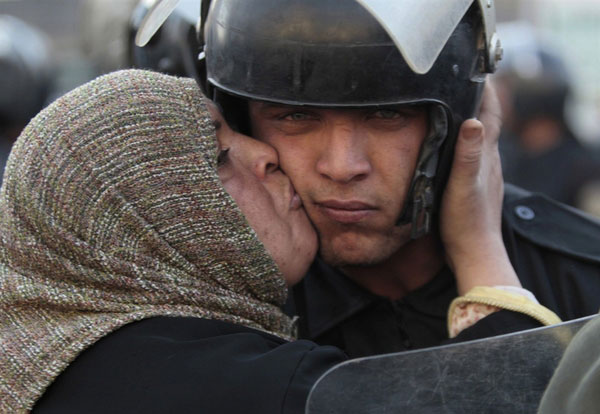
protester and riot policeman, Cairo, Friday, January 28, 2011*
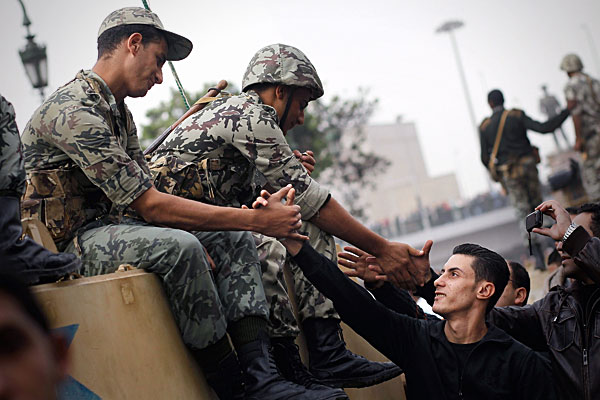
protesters and soldiers, Cairo, Saturday, January 29, 2011
NOTE: This post was composed just after 6 pm today, Wednesday; since then (it’s now 11 pm in New York) its thesis has become reality.
So what is the story? Will it be kisses and handshakes?
The police, uniformed or plainclothes, have largely been discounted as a significant factor in how the events in Egypt will unfold, although that story is still to be told, but the position of the army is definitely not yet resolved. To me it’s looking more and more like the army is working toward the same end, although not to identical purpose, as what passes for the Mubarak regime right now: Every president of Egypt since King Farouk was overthrown in 1952 (by generals) has been a high-ranking army officer. Whatever their relationship may have been before last week, the upper echelon of the military is presumably no longer fully vested in Mubarak. Yet it’s unlikely that it would want to see their general-in-a-striped-suit completely disgraced; an orderly departure of an old comrade would almost certainly be preferred.
Here’s my further argument:
The officers are more likely to prefer Suleiman to the unknown that’s represented by what surely looks to them as a still-leaderless mob, and in fact they may themselves have created his new vice-presidential office as a transition device, although not a transition to democracy.
The fact that the army is not fighting the protesters in Tahrir or elsewhere should not be taken as clear evidence of its indifference to the outcome; in fact it may be part of a cynical plan shared with the Mubarak administration (and possibly Obama’s as well): Extended, and even increasing, chaos in the streets just may look to them like an opportunity for the restoration of order, under the authority of more or less the same interests which made up the old regime (and those of Washington).
Even the army rank and file, conscripts said to be unlikely to want to fire at the protesters, might come around to an accommodation with some kind of crackdown. This would especially be likely if they and other Egyptians come to look upon the revolutionaries, their numbers reduced by fear and attrition, as the enemies of Egypt.
Win-win: Everyone saves face; everyone saves power. The people? They never had it, and look what they would do with it if they did.
Last week I watched spellbound as Egyptians did what no one thought possible. I thought removing Mubarak was a done deal, and that the world, or the best of the world, wished them well.
I think I was mistaken. It now seems that the revolution is alone.
Today I realize how very much more will still be demanded of the heroic defenders of Egypt’s ancient honor, and future greatness. I wish them well; I wish us all well.
*
For a discussion of this image, see Garance Franke-Ruta in The Atlantic, “Why the Kiss Picture Is So Radical.”
[first image from Greenerblog (Lefteris Pitarakis / AP); the second image from CNBC]
the U.S. has more blood on its hands
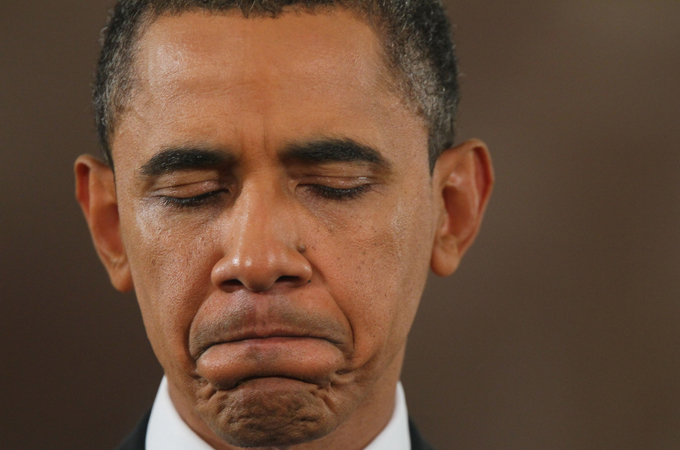
The shameful U.S. role in the 2011 Egyptian revolution will never be forgotten, above all in the Middle East.
The Mubarak regime (and the army?) has clearly planned and executed today’s violent confrontations in Tahrir Square and in Alexandria in order to retain power. It hopes to create a situation where it will be able to depend upon the loyalty of the lower military ranks when it orders the army to do its duty to protect the nation from those the regime portrays as its enemies, and it has to attract support from those, including some people who have supported the protests so far, who have become frightened by the violence initiated by its paid thugs and mustered civil servants.
Part of the plan is to silence the foreign journalists, who are the only source of information for people both within and outside Egypt (obviously the state monopolization of broadcast news and the continued shutdown of internet and cellphone service wasn’t enough).
The execution of this plan began today.
But Mubarak has help. The Obama administration, like governments around the world, remains complicit in the crimes of an Egyptian government which had already lost its legitimacy, but today joins the ranks of regimes which will be forever associated for their iniquity.
In addition, Obama’s neglect of the Mubarak regime’s assault on the press and communication systems has not gone unnoticed (note: many have suggested that our own government is working on a “kill switch” which would allow the White House to disconnect the Internet and all electronic communications at its will, “for security purposes”). “Many people make the very important point: Obama made NO mention of internet and mobile phones. The silence is deafening.,” tweeted Evan Hill (yesterday evening, New York time), responding to the President’s statement earlier. Even if Obama wanted to argue that what happens in Egypt is up to the Egyptians, silence is not a neutral act: The government’s monopoly of all means of communication is a huge advantage for reaction and repression.
None of this was necessary; none of this would have happened had our democratically-elected President done something more than ask “both sides” to avoid violence.
The MSM seems obsessed about the fact that the Egyptians in the streets have no leader; why isn’t it interested in the fact that neither do the Americans?
Mark LeVine has a very, very wise and beautifully-articulated piece on the Opinion page of the Al Jazeera site, “It’s time for Obama to say Kefaya!,” answering the question of why we persist in a disastrous foreign policy. I hadn’t read it yet when I borrowed the image at the top for my own post. Now I’m totally depressed: It seems only a revolution could alter our posture in the world. This is LeVine:
Such a position [supporting the status quo in the Middle East] is as tragic as it is stupid, as the president has been offered an unprecedented and until a few weeks ago unimaginable opportunity to back radical but peaceful change that is not stained by Western intervention in a region that everyone believes must undergo such change in order to prevent it becoming even more of a hotbed for terrorism and anti-Western sentiments.
. . . .
So the question really needs to be asked – whose interests is President Obama serving by remaining silently supportive of the status quo when he could, and by any measure, should, be lending vocal, public support for the peoples of the Arab world as they finally rise up against their leaders?
Is it companies like Lockheed Martin, the massive defence contractor whose tentacles reach deep into every part of the fabric of governance (as revealed by William Hartung’s powerful new book, Prophets of War: Lockheed Martin and the Making of the Military Industrial Complex)?
Is it the superbanks who continue to rake in profits from an economy that is barely sputtering along, and who have joined with the military industrial complex’s two principal axes-the arms and the oil industries-to form an impregnable triangle of corrupt economic and political power?
It’s hard to think of any other candidates at the present time.
[image of President Obama during the 2011 State of the Union speech from Al Jazeera (GALLO/GETTY)]
fears now for our own revolution, not the Egyptian
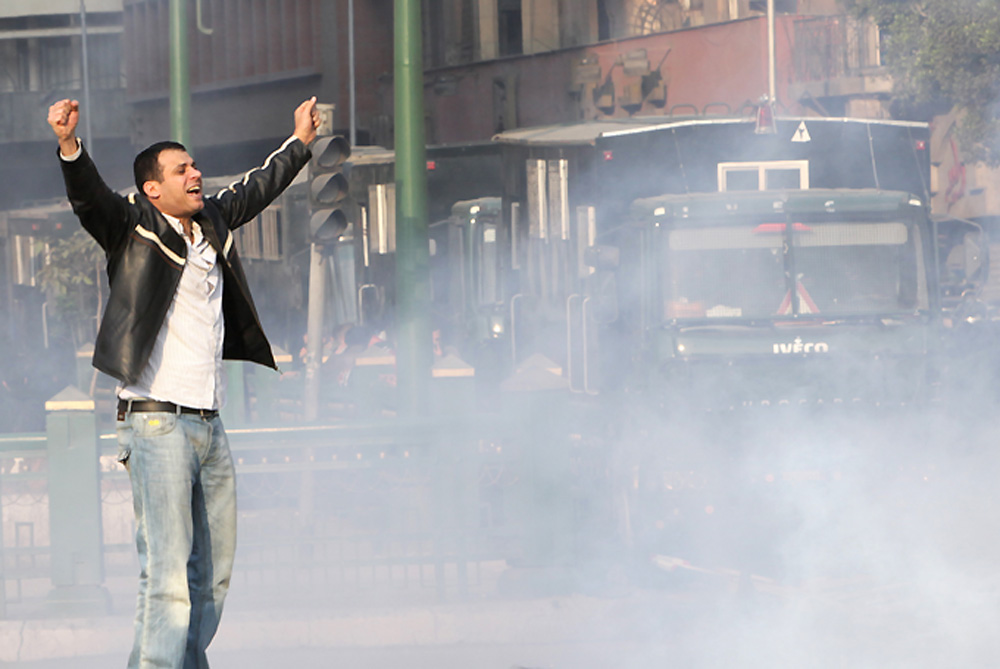
It’s now pretty clear that the Egyptian people are going to succeed in freeing themselves entirely without the help of the U.S. Today I’m not worrying as much about whether their courage and nobility will enable them to defend their magnificent, popular revolution as I am about the consequences of its brilliant success for the U.S. Their achievement is one which I fully expect to be repeated elsewhere in the Middle East – and beyond – one in which my government, it will be remembered, had no part, offered no help or encouragement, and in fact was only a hindrance.
Is Obama nuts? Who’s the terrorist now?
It’s as if the U. S. government was not satisfied with the degree of disgust with which much of the world holds its imperial presence, military adventures and reactionary foreign policy, and now President Obama has decided to further inflame the hatred by giving people in the Arab and Muslim world, and elsewhere, even more reason for their distrust, confirming the worst suspicions of some and making new enemies of others.
For us in the U.S., and for the world, the danger of this policy, whether authored by stupidity or narrow national calculation, should be obvious. Not only will we be hated and reviled, but the threats, both real and perceived, which since 9/11 have torn our political economic and social fabric apart, may now prove fatal to everything we ever thought we stood for. The nation which once appeared as a beacon of freedom for people around the world is now on the losing end of history, and those who have inherited so much from its founders can expect to find themselves in history’s dustbin.
Read Nicholas Kristof, writing now from the streets of Cairo:
Yet one thing nags at me. These pro-democracy protesters say overwhelmingly that America is on the side of President Mubarak and not with them. They feel that way partly because American policy statements seem so nervous, so carefully calculated — and partly because these protesters were attacked with tear gas shells marked “made in U.S.A.”
The upshot is that this pro-democracy movement, full of courage and idealism and speaking the language of 1776, wasn’t inspired by us. No, the Egyptians said they feel inspired by Tunisia — and a bit stymied by America.
Everywhere I go, Egyptians insist to me that Americans shouldn’t perceive their movement as a threat. And I find it sad that Egyptians are lecturing Americans on the virtues of democracy.
“We need your support,” pleaded Dr. Mahmood Hussein, a physiology professor. “We need freedom.”
Ahmed Muhammad, a medical student, told me: “Egyptian people will not forget what Obama does today. If he supports the Egyptian dictator, the Egyptian people will never forget that. Not for 30 years.”
I don’t think Americans can be reminded enough that the events in Egypt are not about them, but we’ve been so invested in the dictatorial regime now being leveled by a popular, nonpartisan national revolt that we cannot claim we had nothing to do with it in the past, cannot pretend we’re not involved in what’s happening now, and cannot expect to be isolated from its consequences.
More from Kristof, in a post done today:
I also fear that this choreography – sending former diplomat Frank Wisner (whom I admire) to get Mubarak to say he won’t run for reelection — will further harm America’s image. This will come across in Egypt as collusion between Obama and Mubarak to distract the public with a half step; it will be interpreted as dissing the democracy movement once again. This will feed the narrative that it’s the United States that calls the shots in the Mubarak regime, and that it’s the United States that is trying to outmaneuver the democracy movement. In effect, we have confirmed to a suspicious Egyptian public that we are in bed with Mubarak and trying to perpetuate his regime (even without him at the top) in defiance of a popular democratic movement.
[image from Al Jazeera (EPA)]
free Egypt
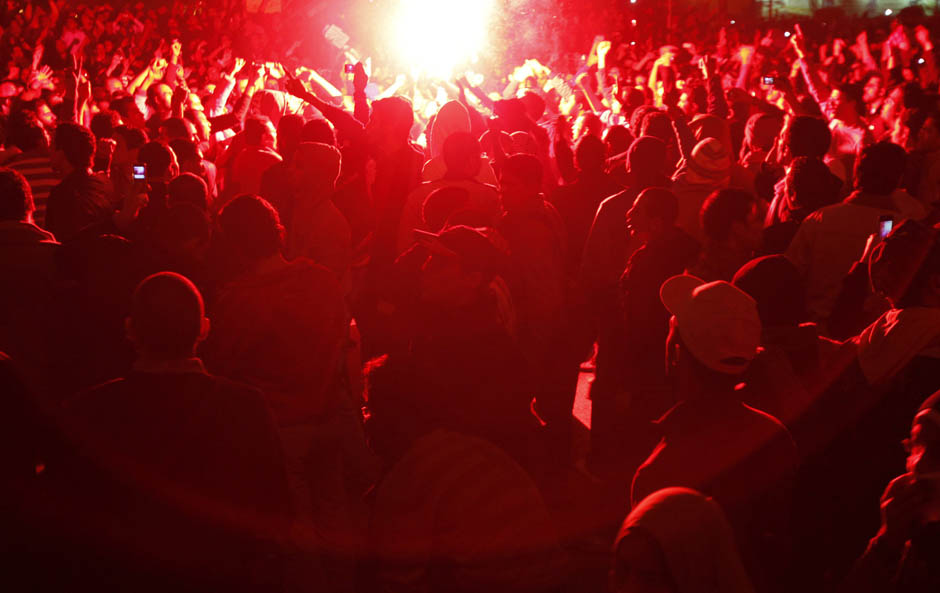
flares of anti-government protesters in Tahir (Liberation) Square January 25
ADDENDUM [the first five paragraphs below]:
The patronizing West, and the U.S. in particular, has always backed dictators in Arab countries because it sees such regimes as the only alternative to fundamentalism, and yet over and over again that policy has produced the fundamentalist regimes it fears most.
We’re now seeing that there is a third possibility, and we all better start supporting it before its too late everywhere.
By the way, I’ve just learned (from the Egyptian paper, Al-Masry Al-Youm) that The Pentagon is hosting senior Egyptian military leaders for annual bilateral defense talks this week, and that Pentagon Press Secretary Geoff Morrell, commenting on the talks, said: “That’s just one example of how engaged we are with the Egyptians, even as these developments have taken place on the streets of Cairo and elsewhere.”
No, I’m not making this up.
The same article describes the financial history of our relationship with the Mubarek regime:
Since its 1979 peace deal with Israel, Egypt has become the biggest recipient of US military aid after Tel Aviv, receiving nearly $36 billion in military assistance in annual installments of $1.3 billion.
I was up much of the night (January 26-27) scrambling about the internet, looking for more information (in English) on what is happening in Egypt. I was amazed at how much is out there, including video and audio recordings.
I want to share with others interested in the remarkable events of this week just some of the news sources I have found. These are just a few of the most accessible, most useful, and least hysterical sites for the unfolding events (note that some of the links may change location or even disappear):
SOME LINKS ADDED January 28
The English-language online site of a progressive Egyptian paper, Al-Masry Al-Youm
The English-language site of Al Jazeera
Mona Eltahawy (Egypt-born, New York-based columnist), anywhere you find her (heard on NPR)
The Guardian’s “Egypt” coverage
The Guardian live updates
Jack Shenker’s site (reporter for the Guardian)
the NYTimes’ blog, “The Lede” (edited by Robert Mackey)
Huffington/AP has live updates
The Times has a good perspective/analysis piece in this morning’s edition
And, finally, may the press gods bless the New York Review of Books for this
Juan Cole, oddly silent until the last few days
Democracy Now! has some good phone interviews
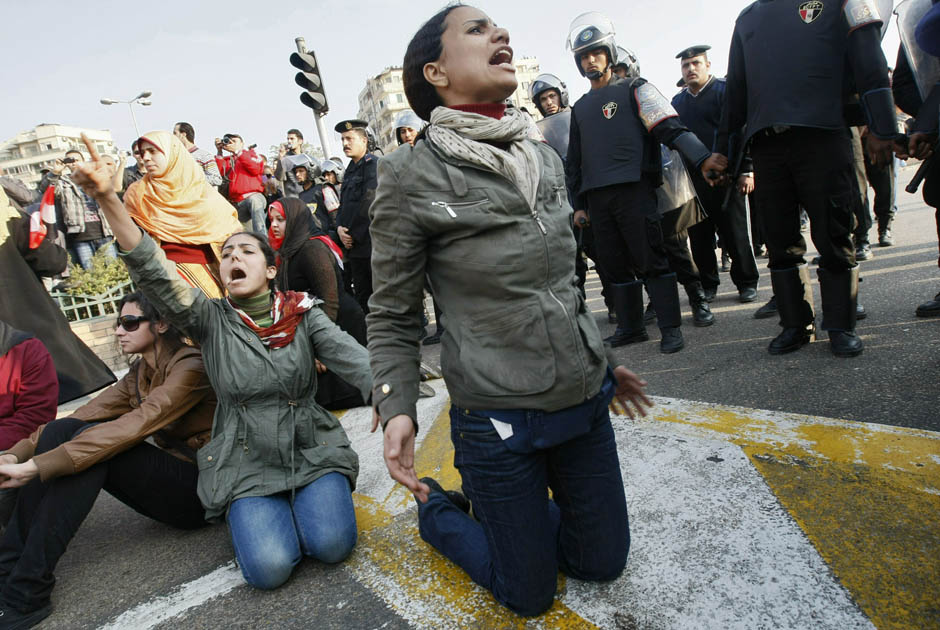
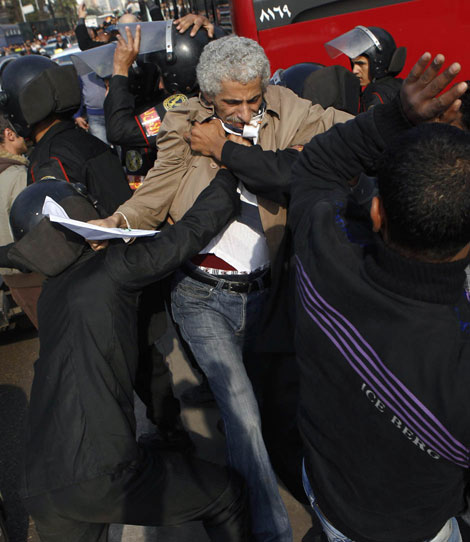
the demonstrations, while dominated by young men, are clearly diverse
[first image by REUTERS/Asmaa Waguih, the second by Mohammed Abed/AFP/Getty Images, the third REUTERS/Amr Abdallah Dalsh; all three from National Post]
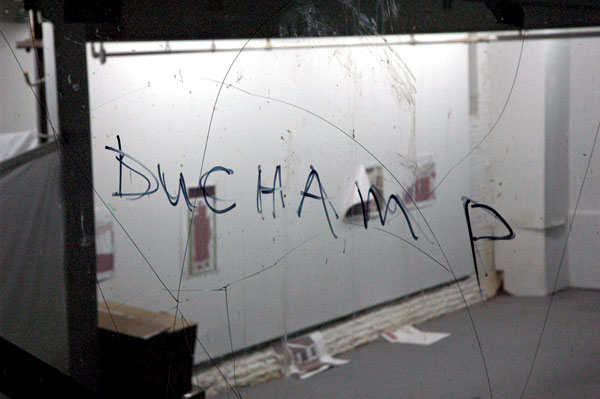
Duchamp haunts old White Box
“Battle of the Brush,” encamped in Bryant Park
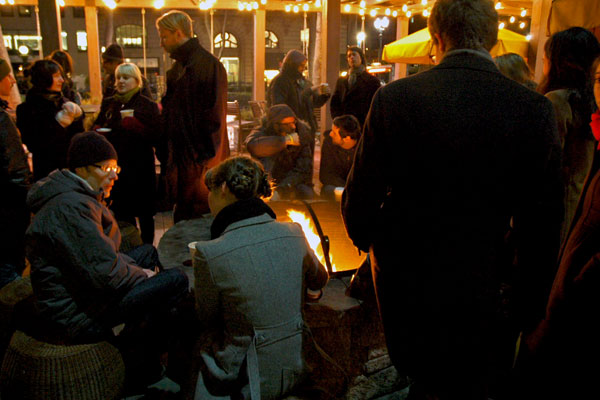
this is not a reenactment
It looks a bit like a hobo encampment, but the group huddled around the fire in the picture above is actually a part of the very jolly crowd attracted to the opening of “Battle of the Brush” in Bryant Park Thursday night. The occasion was one of the oddest openings of the year, to one of the most creative art shows of the year.
Great idea: Bring the art to the street (or at least the park); adapt an existing venue; and still end up with a clean, white space.
The work is on view in closed, retrofitted and climate-controlled vitrines (actually, two of the booths which had recently housed The Holiday Shops at Bryant Park). Visitors will be able to see the art, en plein-air, until February 2.
I suppose it could have been even colder on the “opening night,” but normally I don’t find myself standing still outside on a wintery night in January. I thought it was pretty frigid, especially after I had to remove my gloves to operate the camera.
The burning wood was a boon (boonfire?) however, as were the bottomless cups of hot chocolate proffered by the freezing ‘wichcraft folks. Incredibly, overhead heating lamps actually made it possible for some of the crowd to lounge about in the Adirondack chairs we normally associate with summer – or ski resorts.
The crowd was great. I had a ball.
I think the full title of this small painting show, organized by Alex Glauber‘s Corporate Art Solutions, is “Battle of the Brush: A Civil Reenactment of Two Painterly States.” The reference to “battle” is perhaps less than half-serious, but it pretends to describe a clash between current abstract and realist styles of painting. Located where it is, the exhibition draws upon Bryant Park’s history as an encampment for soldiers during the Civil War. Ironically, the eight paintings in the show, by eight painters, are installed in two enclosed kiosks , or “camps”, and are arranged across from each other on a terrace dominated by a fountain dedicated to the Progressive reform leader and adopted New Yorker, Josephine Shaw Lowell, who spent much of the Civil War nursing the wounded.
The participating artists include:
REALISM REGIMENT: Alison Blickle, Tom Sanford, Nicola Verlato, Eric White
ABSTRACT REGIMENT: Justin Adian, Anoka Faruqee, Patricia Treib, Roger White
Because of the unusual ambient light, the plexiglas reflections, and the cold, the two images below are less than ideal, even by my own modest standards. I argued with myself about whether I should include any picture at all, other than the one showing the huddled fanatics, but I decided to go for some art as well, since that’s what it’s all about.
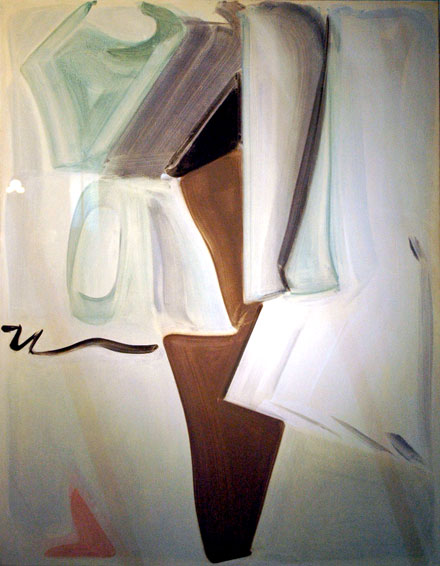
Patricia Treib Armless Sleeve 2010 oil on canvas 56″ x 50″
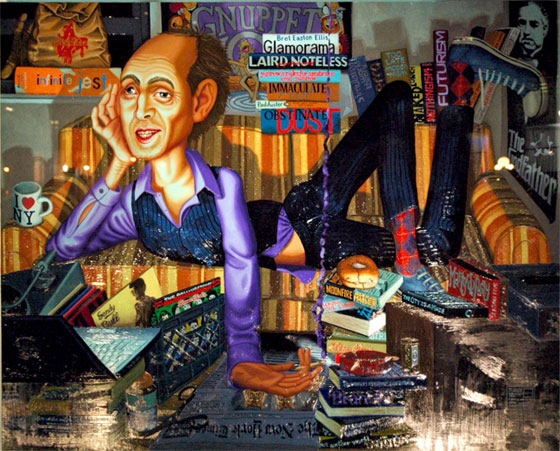
Tom Sanford Perkus Tooth 2010-2011 oil on wood panel
Captain Honors pulled from carrier’s Afghan tour
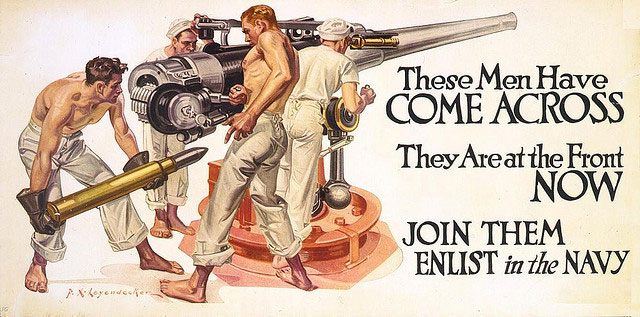
Join the Navy and see yourself made a laughingstock. How’s that unit cohesion thing work?
The captain of the USS Enterprise (not the starship), Owen Honors, has reportedly been temporarily relieved of his command because of the controversy over the stupid and raunchy videos he produced and broadcast to the ship in 2006 and 2007.
I don’t know why this is happening only now, three and four years later; the offending videos had been seen by thousands on board while the carrier was on two six-month Middle East deployments. It may have something to do with the beginning of our finally disabling DADT, although the videos were arguably equally offensive to women, who are allowed in the navy – even if they’re free to be asked and tell. In any event, Captain Honors will not be in command of the Enterprise and its compliment of nearly 6000 men and women (both het and homo) when it leaves for Afghanistan this month.
While looking online for images of queerdom in the Navy I came across this intriguing 1918 poster by queer artist Frank Xavier Leyendecker; he was doing his part for the war effort in the way he knew best, eroticizing the product with his illustrations.
I have a passion for history, and I just couldn’t drop this image. I decided to use it as an excuse to give a tiny bit more context to the continuing nonsense coming from supporters of those who are still scared witless there might be homos in the military.
F.X. Leyendecker’s brother, Joseph Christian, was an equally-skilled illustrator, and equally homo. I used one of his illustrations in a post I written two years back, also grumpy.
J.C. also admired the navy:
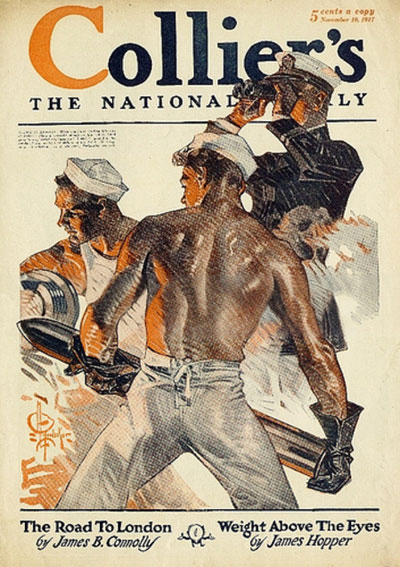
[top image from Joan Thewlis’ photostream; image at bottom form bilerico]