untitled (casement ice) 2010
Greek tycoon rents Guggenheim Bilbao to show his stuff
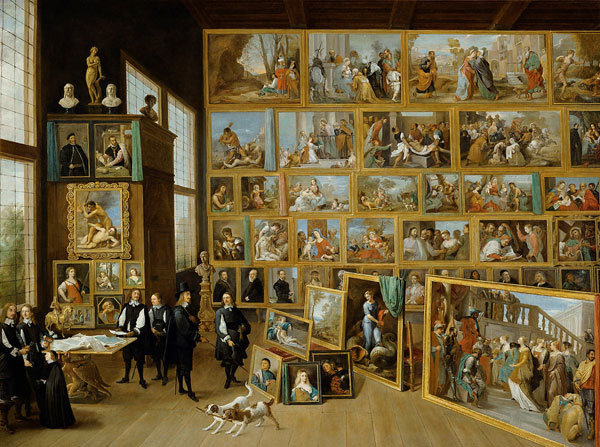
David Teniers the Younger Duke Leopold Wilhelm in his [own] gallery in Brussels (ca. 1651)
We’ve been through this thing before, and it doesn’t go down easier the second time: Another Greek tycoon has rented (at no charge) the museum of which he is a trustee, in order to showcase his expensive art hoard.
Fifteen months ago I was the first to complain about the New Museum’s judgment and ethics when it announced that it would be hosting “Skin Fruit”, a show of work owned by Dakis Joannou.
I don’t think I’m the first to complain this time*, since the news was reported by New York Times’ Carol Vogel (once again the messenger, as she was for NuMU’s plans) a week ago. That article reports the basic facts, that in the coming spring the Guggenheim Bilbao will be hosting “The Luminous Interval”, a show of work owned by Dimitris Daskalopoulos, Unlike the article she wrote in 2009, this one asks questions, or rather it appears that the museum itself anticipated questions, defending its decision and arranging for their friendly big-deal collector to be available for a statement.
I’m not satisfied with the answers. While there may be no law against it, the ethical problems are obvious: installing a private collection exhibition in a public museum is just wrong, unless ownership of the work has already been transferred to the museum.
Museum directors should know this.
I know I may sound like a scold, but when it comes to the art world I really don’t normally go out of my way to look for things to criticize. My experience of the last year or so has saddened me however, as I watch our museums making some very bad decisions. I’d rather be looking at art, or listening to or watching a performance, but it seems to me that museums are “acting up” (and not in the good way) a lot these days.
Maybe it’s because of the ubiquity and curiousity of the internet that so many ethical missteps are being exposed within institutions we really cherish. Perhaps we’re just more impatient with custom or superciliousness then we once were. It’s even possible we’ve given up believing we can influence government behavior and so look to our own neighborhoods, our own family. Whatever it is, it’s not easy to ignore these institutional failings, or the cant which tries to disguise them.
We have the right to expect better of the people who guard our heritage and our sacred spaces. Philip Kennicott, in his excellent Washington Post commentary on “Hide/Seek”, published yesterday, describes the extraordinary importance of the museum to people who do not worship in a church, temple, mosque, or forest:
“The museum has become a quasi-sacred space, with rules as complicated and inviolate as any church liturgy. People who don’t find the meaning of their existence in churches are often passionate about museums, where a set of fundamental values – openness, fearlessness, truthfulness – are celebrated with all the historical trappings.
ADDENDUM: Whoa! ARTINFO had the story two months ago. I’m sorry I missed both their scoop, and their complaint about how the Guggenheim stonewalled them:
When preparing the original scoop, “IN THE AIR” [an ARTINFO blog] contacted the Guggenheim for comment, which the museum declined to provide – relegating the news to “rumor” status despite multiple well-placed sources confirming the story, and the now-evident accuracy of its substance.
[image from Wikipedia]
thrown out of Gagosian for addressing Kiefer’s art
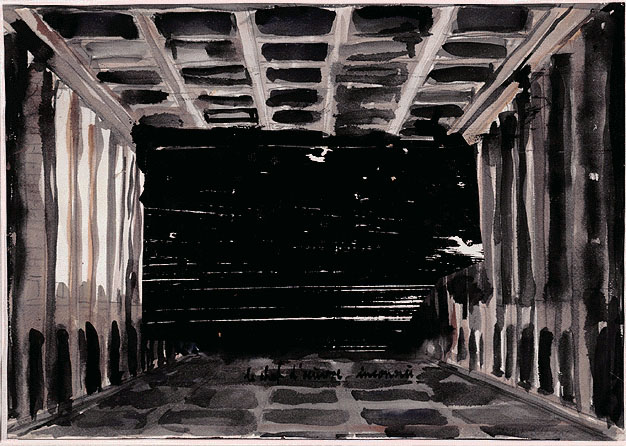
Anselm Kiefer le chef d’oeuvre inconnu (“unknown masterpiece”) 1982
“This is private property,” a gallerista in towering heels shot back. “We’re here to sell art.”
A small group of activists were thrown out of the Gagosian Gallery on West 24th Street this past Saturday on the final day of Anselm Kiefer‘s solo show, “Next Year in Jerusalem”. Claudia Roth Pierpont reports from the New Yorker’s online News Desk that a woman in her late fifties was swept up in the fracas which resulted when New York police officers called by the gallery arrived to evict the last four of the group (they had originally numbered eight). They had explained to gallery representatives that they had wished to participate in the conversation initiated by Kiefer’s work, and identified themselves as part of U.S. Boat to Gaza. Ingrid Homberg, who was visiting the exhibition independently, and who had tried to discuss it with the activists, was injured and fell when one of the officers dragged her out of the gallery.
It’s worth reading the Gagosian press release for the show, for the ironies provoked by Kiefer’s steely, overprotective New York gallery alone. The text includes these words, describing the central piece of the exhibition, “Next Year in Jerusalem”:
This imposing structure contains Kiefer’s provocative act, literally and imaginatively, to remind [us] of what has happened and what can still happen in the world. Occupations [the name of the piece, begun in 1969] is a visceral confrontation between history and the present that is lodged in the stuff of memory
.
ADDENDUM: The artist and writer Mira Schor has more information, and a wise, ruminative essay, “Anselm Kiefer@Larry Gagosian: Last Century in Berlin“, on her own blog.
[image (of a work not included in the Gagosian show) from Deutsche Bank]
Smithsonian/Wojnarowicz censorship protest, NYC
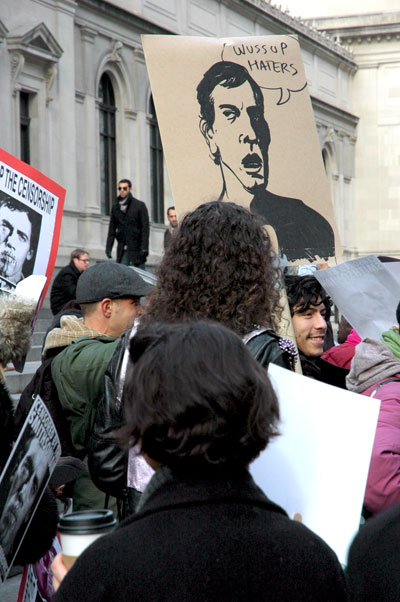
what would David think?
Sunday’s march up Museum Mile attracted around 400 to 500 people to the Smithsonian’s Cooper-Hewitt Museum to demand the return of David Wojnaroowicz’s video, “A Fire in My Belly,” to the National Portrait Gallery (NPG) exhibition, “Hide/Seek.”
I’ve uploaded here a few images from my experience of the rally; they are arranged in chronological sequence.
Committed artists, writers, thinkers and other citizens demand that the Smithsonian, which controls the NPG, restore the work so the public can see the exhibition as the curators intended. G. Wayne Clough, the Secretary of the Smithsonian and the man who cowardly pulled the art from the show one month after it opened, must apologize to the entire country, and to the people of all the first, second and third world countries which should be able to expect of the United States something other than institutional and governmental censorship and the pandering to demagogues and the benighted.
The arbitrary suppression of words and images inconvenient to those who wield power cannot go unchallenged.
We attracted a lot of press coverage both before and after the protest. The issue and our demands have been broadcast to a lot of people, but even as I headed uptown on Sunday I was wondering if, in defending light and reason, we might also be helping the devil. Those thoughts disturbed me then and they still do.
It’s like this: Bill Donohue is dumb, and although John Boehner and Eric Cantor may be little smarter, none of these hollow men is too dim to know that when they and other self-appointed censors and moralists pull these publicity stunts they only ensure that more people get to see what they think they shouldn’t.
So while Donovan and the others make lots of money off of their bullying and intimidation, they and others drawn into encouraging and supporting this transparently-cynical chicanery continue to do so because of both the illusion and reality of power produced by the wide media attention it draws. What discourages me most is the thought that the more public the blowup today, the more successful the censorious attacks of the wacky Right may be tomorrow, intimidating future victims from doing anything which might offend the morality police. These rows may actually inhibit free speech and expression going forward, and we have already seen that the leaders of our institutions are spectacularly lacking in courage.
While I’d rather not dwell on these gloomy thoughts, unfortunately the National Portrait Gallery show remains expurgated as I write this, with no sign of any change. Of course the whole thing is ridiculous, but are the censors winning? We have to know what we are up against if we hope to defeat them.
Since the demonstration on Sunday I’ve come across two links which may help explain to those who first came across this old war story only this month: They describe the issues, relatively unchanged in over two decades, and their historical context.
James Romberger, David’s collaborator, writes about his friend. And this 1990 video, showing the artist talking about the right-wing backlash against the NEA and arts funding, helps us to realize how much we lost when David’s voice was silenced, in the end not by the bigots, but by AIDS.
A printed excerpt from the video, David speaking:
And the thing that makes me laugh is that in the last twenty years images and words that artists or writers make have had absolutely no power, given that we’re essentially competing against media, you know, in order to create something that reverberates in those image or words. And the fact that, if at this point the images and words that can be made by an individual have such power to create this storm of controversy, isn’t that great?
It means the control of information has a crack in its wall.
Recent national and international stories, involving an explosive challenge to the dominance of corporate and government news sources, suggest that the crack can be protected, and enlarged, only if we’re willing to work at it.
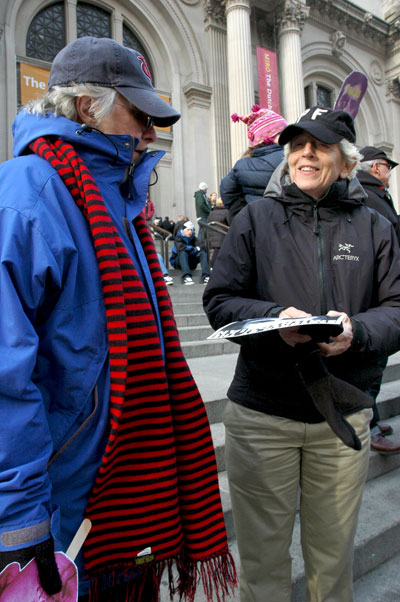
Betsy Crowell and Louise Fishman on the steps of the Metropolitan
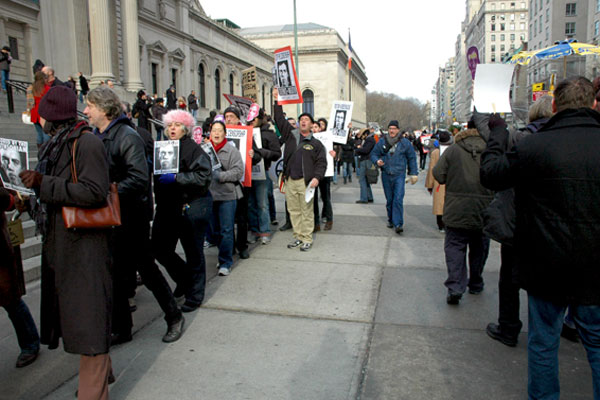
the picket forming on Fifth Avenue
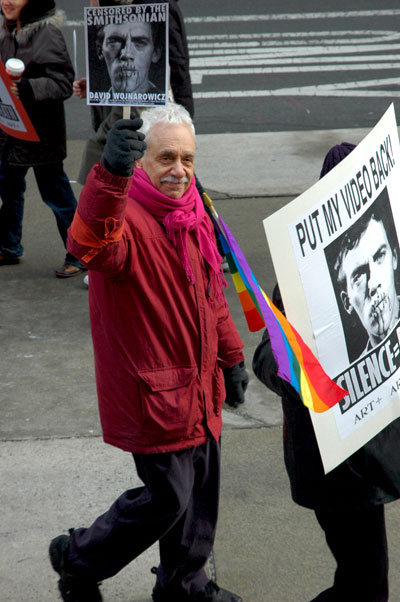
Jonathan “Ned” Katz below the steps
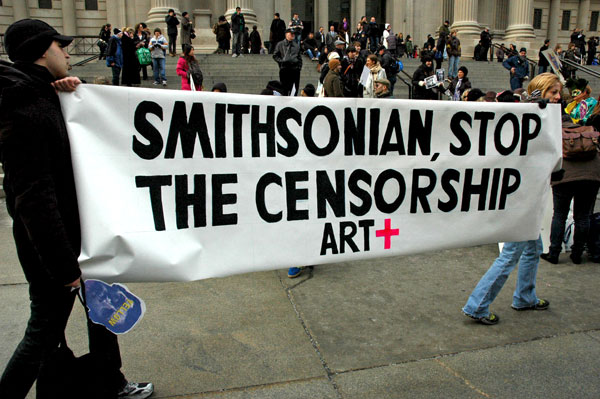
our spanking-new ART+ banner
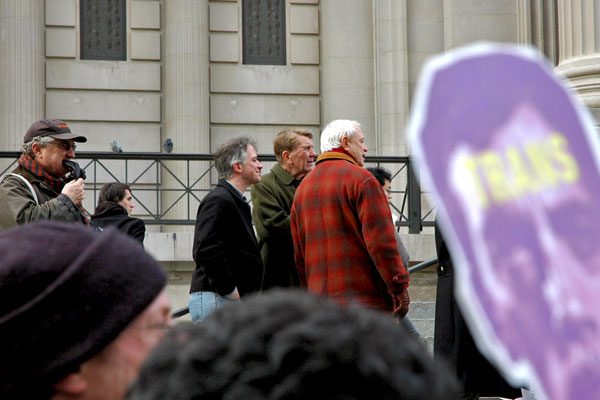
A-list establishment queers, plus one random journalist, checking out the scene
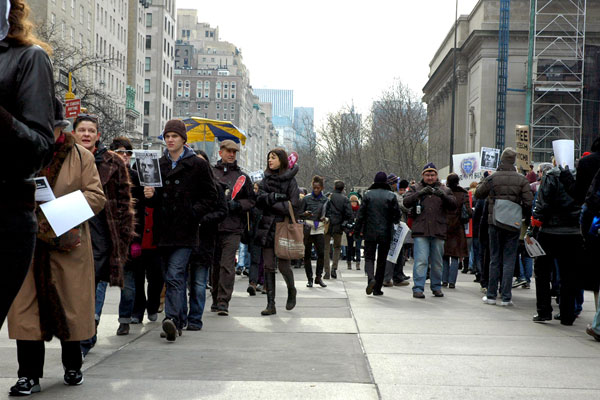
the picket about to head north
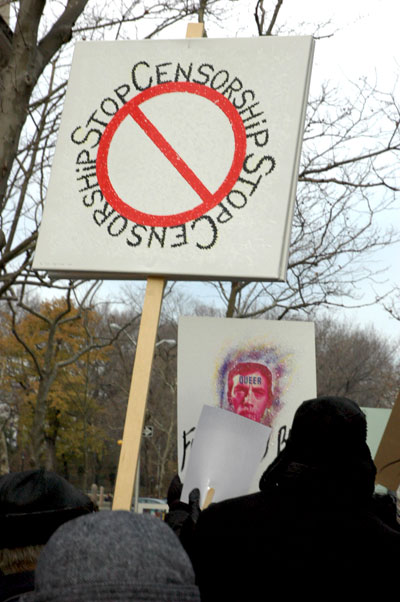
international sign
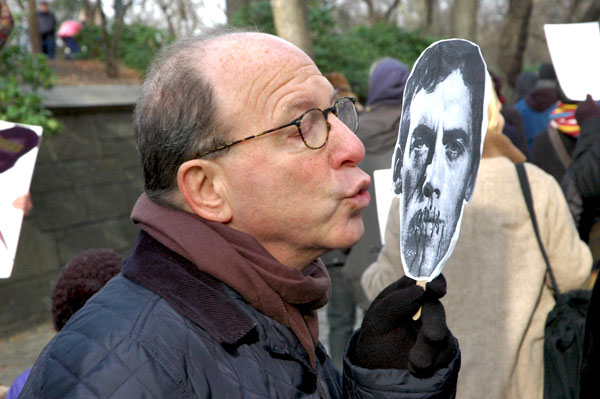
Jerry Saltz loving David
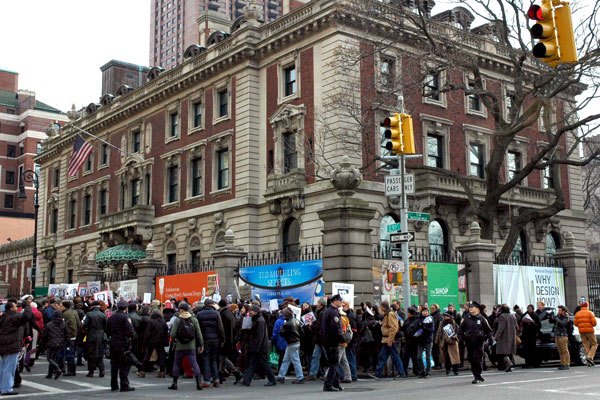
target Smithsonian, here its Cooper-Hewitt satellite
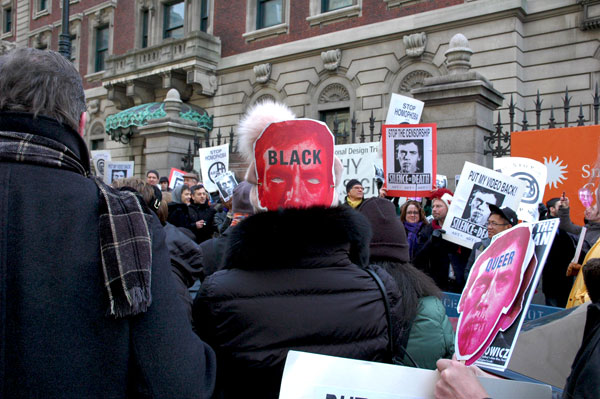
masks as epithets designating “the other” (black, red, yellow, queer, female. etc.)
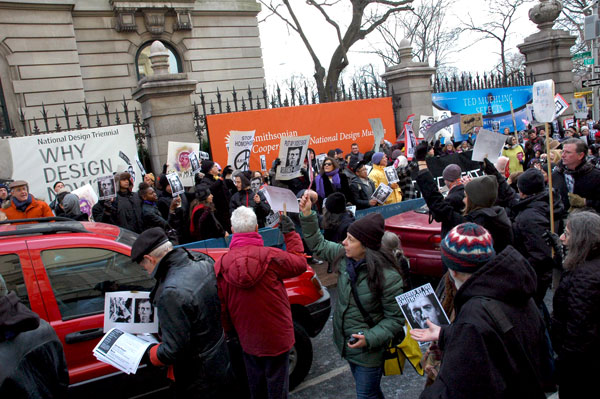
on 91st Street, haranguing the Smithsonian
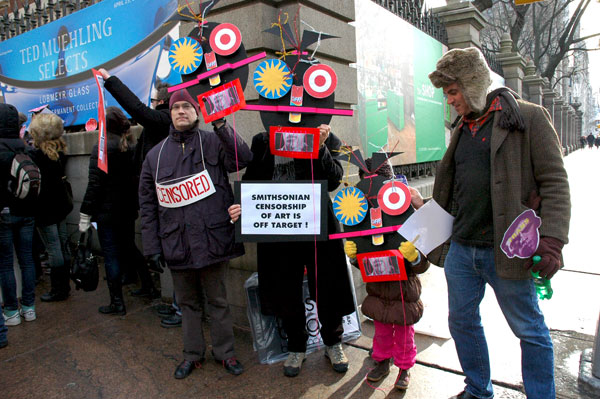
family of art ants outside the museum (Target is a major funder of the Smithsonian)
ADDENDUM: Philip Kennicott has a smart, even electrifying piece in the Washington post, “After removing video from ‘Hide/Seek,’ Smithsonian chief should remove himself“.
censorship and homophobia, AIDS, sex, art, religion
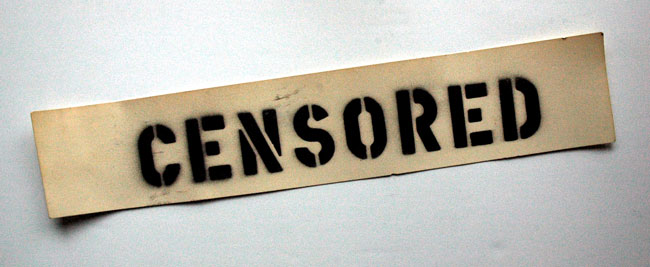
I never thought we’d still be doing this 20 years on. The image above is of a thin stenciled sign I held up on the steps of the Metropolitan Museum of Art August 1, 1989.
I thought of it as a work of art; I was thinking of both the sign and the afternoon.
I didn’t make the sign. Along with a lot of others just like it, and any number of other images and texts, it was a small, elegant part of a powerful New York demonstration protesting the Corcoran Gallery of Art’s cancellation of the D.C. exhibition of the show, “Robert Mapplethorpe: The Perfect Moment” and the Helms Amendment. The amendment was designed to prohibit the National Endowment for the Arts (NEA) funds from ever being used for so-called “obscene” or “indecent” materials, descriptions that at the time had repeatedly been applied to much of Mapplethorpe’s art, and to that of Andres Serrano, who had also become a target in what was being called the American “culture wars.”
While the artists attacked became more famous than ever, neither the NEA nor our other cultural institutions ever recovered from the assault on their artistic integrity and independence. I’m reluctant to employ the war metaphor (we’re going off in every direction with real wars already), but I think most people would say that, whatever it is called, a fundamental culture struggle continues today: There are too many frightened people in this country, and too many anxious to profit from that fear.
Bill Donohue is a vile and disgusting little opportunist with a computer and a fan base which he regularly whips up to get them to send checks his way. A retrogressive darling of the crazy Right, he invents issues and targets which can attract enough visibility to provoke the fears and hatreds of ignorant older Catholics, allowing him to draw a very generous salary of some $400,000 a year. His primary targets are gays, jews, women, progressives of any kind, and all news media (excepting the just-pretend one, Fox).
While Donohue does not represent the Catholic Church, officially or otherwise, he operates within its comfort zone. He may be the crazy ranting uncle everyone would like to ignore, but the Church hierarchy has never disavowed anything he has said; and they all go to the same banquets.
I thought that the kind of primitive depravity he represents had been pretty much squished twenty years ago, but on the 1st of December, which was, whether incidentally or not, World AIDS Day, the head of the Smithsonian, institutional parent of the National Portrait Gallery, pulled the David Wojnarowicz video, “A Fire in My Belly.” from the excellent NPG exhibition, “Hide/Seek,” and apologized for its contents. The show had already been open for an entire month when complaints from Donohue’s Catholic League, several Right-wing House Republicans, and Fox News [sic] resulted in its peremptory censorship, or debasement.
So we have a professional gay-bashing Catholic fanatic leaning on two fellow political and social fundamentalists, House Republicans John Boehner and Eric Cantor, to blackmail a great museum by threatening to cut its funding if it did not remove a work of art to which the Catholic nut objected. Viz. ants on a crucifix. We know it’s not about ants: Donohue and his own coterie are unhappy about everything that has happened in the West since the suppression of the Spanish Inquisition. His Republican fellow-travelers may be in it for power, but their sympathies may actually be sincere, however warped.
I hate to do anything to give more visibility to Bill Donohue, or his Congressional altar boys, but this madness has now been covered by the media everywhere, and roundly condemned in as many places, and the Smithsonian has so far failed to reinstall the art it was so anxious to agree with the nasty little man was offensive.
PUT IT BACK – NOW!
A lot of people are going to be on Fifth Avenue this Sunday demanding that the Wojnarowicz video be returned to the National Portrait Gallery. We will be demonstrating as colorfully and dramatically as we can that we care about censorship and homophobia.
We have to be there, at one o’clock on the steps of the Met, Fifth Avenue and 82nd Street. And why the Met? Because it’s the front porch of the art world, because there’s plenty of space and a grandstand of sorts. From there the group will march up to the Cooper-Hewitt Museum, which actually is a part of the Smithsonian.
The 1989 demo included the ACT UP group “Art Positive” (broadcasting a double meaning for the second word); the primary target then was homophobia and censorship. The 2010 demo will include members of the 1989 collaborative, and the entire demonstration has been designated “ART+” (only a slightly altered written form of the 1989 name); the primary target is essentially, and shockingly, the same, homophobia and censorship.
But since we’re talking about the public treatment of work by an artist closely identified with a disease which as a nation we still haven’t fully confronted, the subject of AIDS must not be left out of the discussion. Silence does equal death.
Finally, because we are dealing with people identifying themselves as representing the interests of the Catholic Church, we also have to understand that the targets of their assault necessarily include all women everywhere.
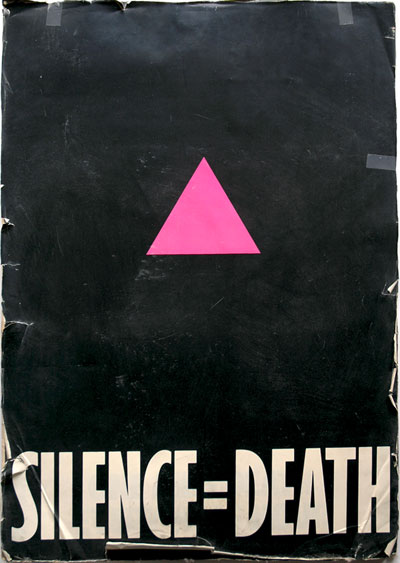
And there’s more: America’s continuing failure as a society to deal with what it thinks of as the very scary subjects of sex and art (and not only when they are combined, or ignited by the inclusion of AIDS) is inseparable from the ignorance and fear which prevents it from addressing our newest, and rapidly-mushrooming real problems.
In this country the public conversation always gets back to religion (if it ever leaves it in the first place). Organized and intensifying public religion gums up the works of virtualy every institution and increasingly ties our hands when we have to deal with impending national and planetary disasters. We may never grow up enough to understand the damage it has done and continues to do, but there’s a slim hope that a larger percentage of the next generation will be able to think for itself.

For more information on the censorship outrage:
ART+ [the demonstration site]
Modern Art Notes [Tyler Green – one of many posts]
NEWSgrist [Joy Garnett – see many posts]
Diamanda Gal�s [Washington City Paper, Arts Desk]
[the second image is of a slightly-battered veteran ACT UP foamcore-mounted sign which spends its retirement leaning on a wall in our apartment, a constant reminder; the third photograph includes, in addition to the Sontag volume and an old ACT UP “Stop the Church” button, the cover of “Seven Miles a Second“, a posthumously-completed graphic novel written by Wojnarowicz in collaboration with James Romberger and Marguerite Van Cook, and a small globe turned toward Africa]
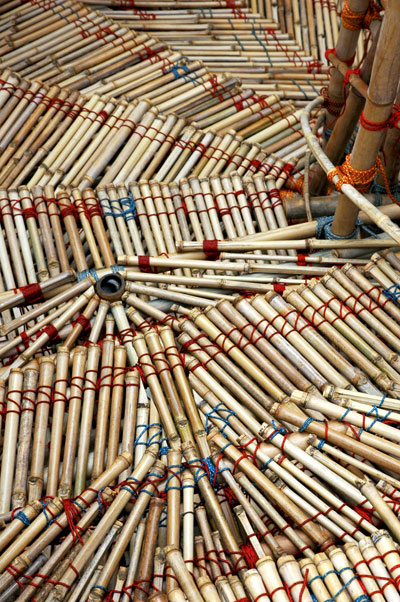
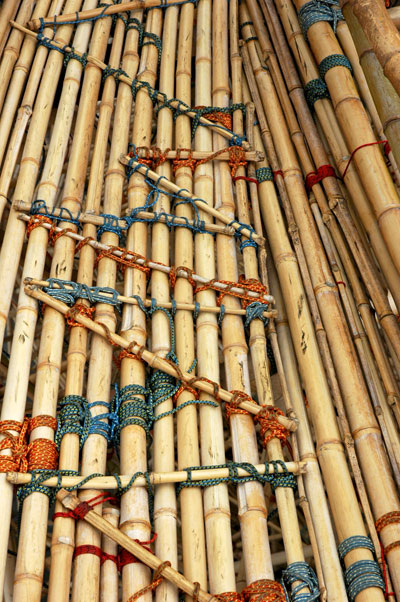
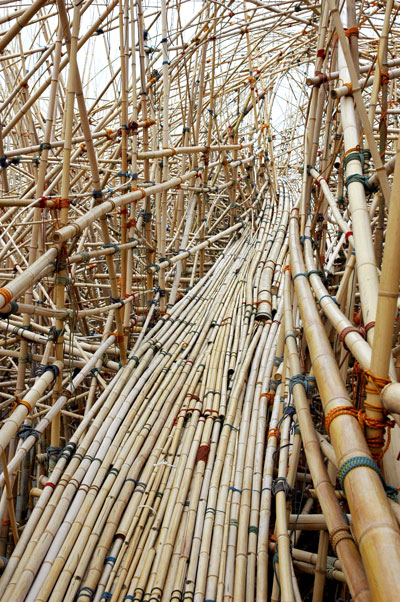
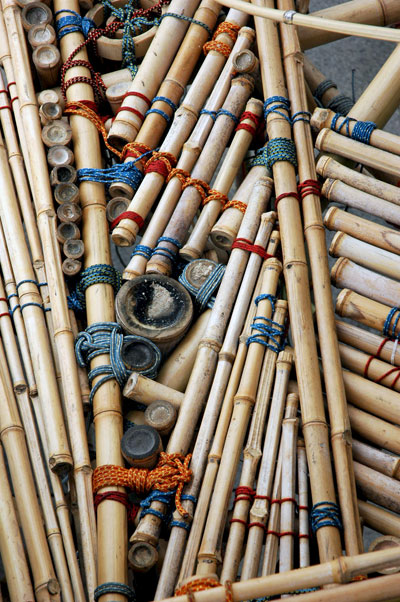
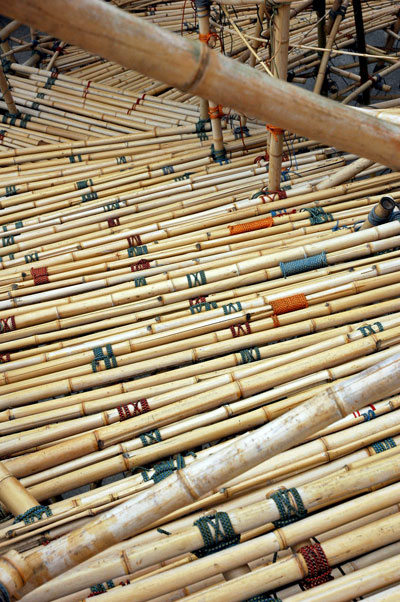
finally, almost the entire “Big Bambú” experience
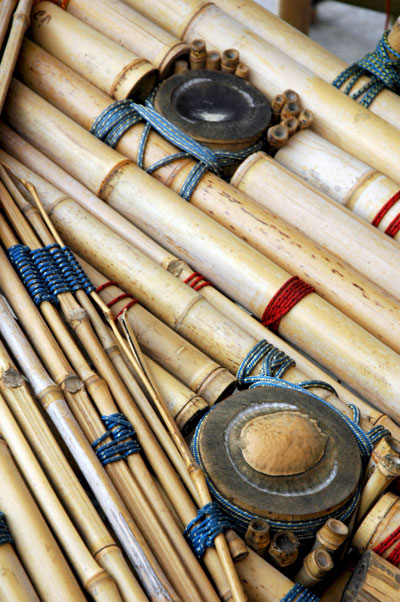
The last time we were on the roof of the Metropolitan Museum we were partially rained out, even if it was not quite raining. It was the press preview of the completed first stage of Brothers Mike and Doug Starn‘s extraordinary installation, “Big Bambú” (the Museum closes the beautiful bamboo gates if the surfaces are too wet). We were only able to admire the “forest” from below and, staring up, we could only imagine the experience of actually walking along its ascending, curving, elevated trails.
We were back for another try last Monday, four months later, also to see how much more had been completed by the artists and their team of rock climbers in the interim. Since it had been raining earlier in the morning our chances for getting any higher than we had in April didn’t look good, but we were eager to chance it (it was another press preview and we would be able to record the work with our cameras).
We did check roof conditions with the Communications Department before we left, and it sounded promising. By the time we arrived at two the rain had long stopped and a favorable zephyr had done much to dry the reeds. The rewards of our gentle climb were those of being able to see the beauties of the work’s more functional forms close up, and the thrill of knowing we were walking where no one would have been able to before this spring, and would not be able to again after this fall.
Once up in the air, born by the squeaky bamboo and its nylon bindings, seduced by the rhythms and the patterns of the paths, and listening to the sound of birds on a misty afternoon, I found it very difficult to come back down. Only the sight of two hawks circling high above, visible through a clearing of the tapering verticals, could remind me of my customary attachment to the earth.
We slowly retraced our steps to the roof surface, and still we lingered.
Oh, by the way, “Big Bambú” is big, and getting still bigger: It’s probably about the size of the Temple of Dendur downstairs. Maybe bigger.



Code Pink visits NYC oil addicts (shops) on Fifth Avenue
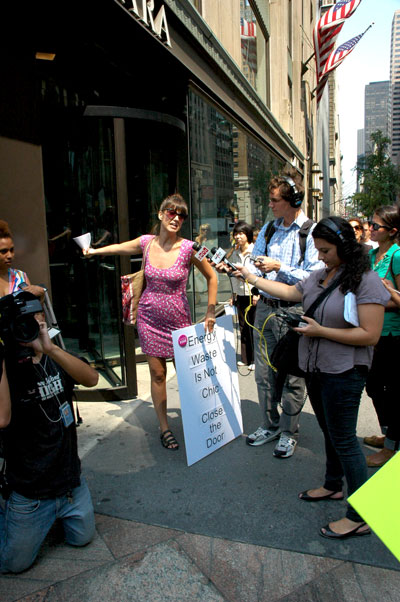
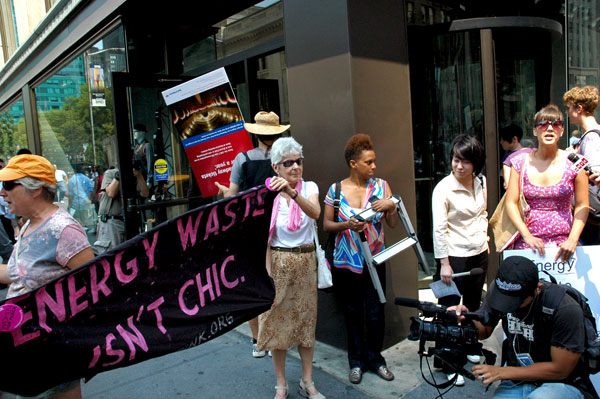
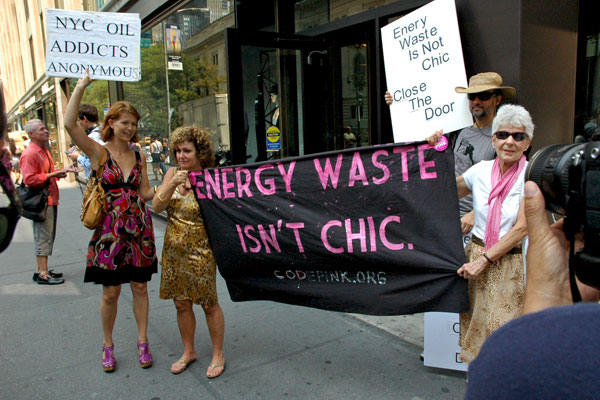
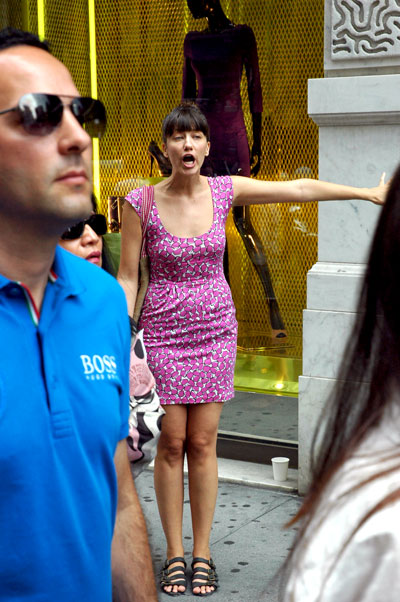
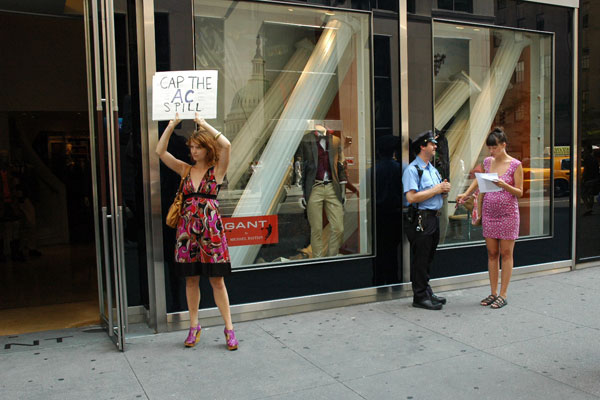
Continuing their “Action Against Illegal Energy Waste”, members of Code Pink returned today to some of the Fifth Avenue stores they had visited July 23rd, once again acting as a part of the international mutual aid movement, “NYC Oil Addicts Anonymous“.
This is an excerpt from the text of an email sent out this week by Code Pink:
Two years ago, the New York City Council passed a very reasonable law prohibiting large stores from cranking their air conditioning and leaving their doors open. But they still do it – one retailer was quoted in the New York Times as saying, “It’s business; sometimes you got to do what you got to do.” As consumers, we have to show these businesses that we’re disgusted, not enticed.
Leaving the doors open cranks their electricity use by 25% during peak hours, overloading the power grid, making blackouts more likely, and increasing the oil and nuclear demand in New York. It makes as much sense as leaving gas pumps flowing onto the sidewalk when you’re not using them. And as conscious women working for peace and justice we see the direct links between resource wasting, addiction to oil, wars for oil and on and on!
I joined the group on the door-shopping trip up Fifth Avenue which began at noon today, gamely juggling two protest signs, my not-so-lightweight camera, and several sturdy bags I was going to need later at the Union Square Greenmarket.
There was no shortage of targets from the very start, but most of the stores closed their doors very soon after our banner and signs appeared outside, and the chants began. When we got to the Gant Store however we encountered more than a little resistance: Not only did the manager refuse to close the two large doors (through which, incidentally, I could feel the store’s cold air as I stood behind the banner about 20 feet across from the opening, its fabric coming down only to my knees), but she called the police, who arrived with remarkable alacrity.
I wasn’t a part of the conversation which our excellent guides, Sally Newman and Dana Balicki, had with the two or three officers, but it was clear they wanted us to leave, and they definitely refused to do anything about the open doors. In all fairness to them, the cops may have been aware that our City Council had passed a statute (two years ago) whose enforcement responsibilities were placed in the hands of the understaffed Department of Consumer Affairs.
Eventually they decided we cold remain, as long as we did not obstruct the door or the passage of any pedestrians (in fact, we had not been a threat to either, from the beginning).
Before I decided to go today I thought about the scale of the action. There are so many huge problems, more dramatic and immediate crises than that which provoked the response of which I was to be a part, but I said to myself that this is clearly a no-brainer. We only have to bring the issue to the attention of the merchants. There can’t be any rational excuse for leaving doors wide open while you’re pumping cooled air produced by polluting and non-renewable fossil fuels through your store, sending even more hot air out the other end of the system.
I was right: It is a no-brainer. Apparently there are just fewer brains out there these days.
ADDITIONAL COVERAGE:
- Lewis Dodley, with video, on NY1
- Daniel Tucker, writing on WNYC News Blog
- Jennifer Glickel reporting for DNA info
- Natural Resources Defense Counsel staff blog post by Eric Goldstein
- Rebecca Myles, interviewing Sally Newman Friday evening, on WBAI Evening News (starting 3 minutes into the broadcast)
- Catalina Jaramillo writing in El Diario
- Fuji News Network, covering the issue and the action on Saturday
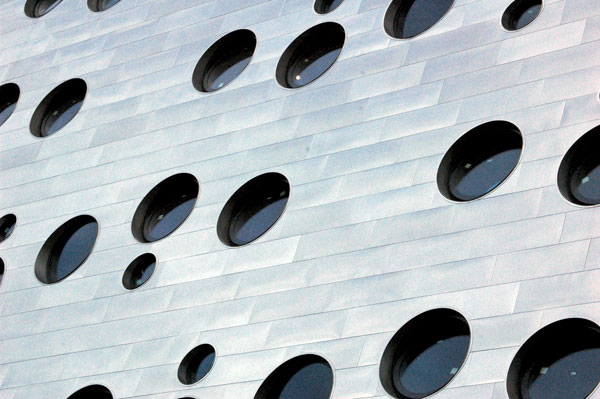
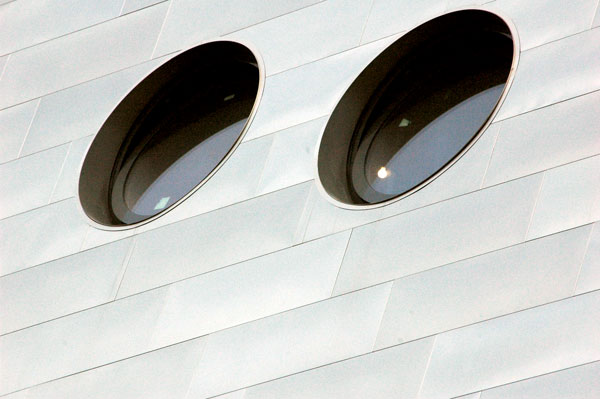
downtown “Dream Hotel” shows off its portholes
Because I believe so strongly in preserving an interesting building’s integrity, and an artist’s vision, I find it hard to say this, but what’s happening to the building that once housed Fr. Bruce Ritter‘s Covenant House shelter for homeless and runaway youth may just possibly be an improvement over the original concept – and execution.
I’ve now seen what looks to be the almost-finished “Dream Hotel Downtown” of hotelier Vikram Chatwal, located at 346 West 17th Street. It is a refitting of a building designed and constructed for the Maritime Union half a century ago to accommodate medical and recreational facilities for its members. The 11-story building is located behind the re-conceived Maritime Hotel, and both eccentric structures were designed by a young architect named Albert Ledner.
I remember the buildings when they were new, and the excitement they created, and I’m delighted that at least two of this architect’s trio of Village commissions has survived at all.
I say that the new building may be an improvement because, while I’ve always loved its perfect round windows, along with their beautifully-crafted frames and hopper-like opening mechanisms, the new dancing pattern punched out by the current design team, Handel Architects LLP, in two different sizes of openings, really makes me smile. Also, the building’s original tiny ceramic tiles were replaced by stucco years ago, probably because of problems inherent in the materials, and the way the horizontal lines of the (tile-like) rectangles composing the new shiny (hull-like) metal skin wrap around the tilted corners of the main facade, and dip down along the sides, showcases a very different effect, one at least equal to the 1960’s original.
The overall building shape remains unchanged.
Now if only somebody would change that name: “Dream Hotel” scares me silly.
NOTE: Except for its romance-novel appellation, I think I could love this building, but now I’m wondering if it’s already a doomed affair: While looking for additional information on the building’s design and construction, and searching, sometimes fruitlessly, for links to incorporate in this blog, I got the impression that the project may be on hold. There are some indications that the “dream” may be trouble, because of problems related to money, the health of the principal, or (perhaps the least daunting challenge) engineering problems, and I notice that the hotel web site itself is still “under construction”.
showy vine on Jefferson Market Garden fence

Ipomoea alba
I was walking about the West Village this afternoon when I spotted this gorgeous plant garlanding the high metal fence surrounding the lush Jefferson Market Garden. I immediately thought of one of my childhood favorites (and always a guaranteed gardening success), the Morning Glory, although this was clearly not my Michigan friend.
Just now I Googled “vine with large white flowers” and discovered I had seen and photographed a “Moon Vine”, or “Moonflower” (Ipomoea alba). It’s “a species of night-blooming morning-glory”, according to Wikipedia, where I also learned that it may grow to 100 feet, given the appropriate host.
But the plant isn’t just a pretty face and a tall drink of water: Ipomoea alba played an historic role in the history of rubber:
The ancient Mesoamerican civilizations used the Ipomoea alba morning glory to convert the latex from the Castilla elastica tree and the guayule plant to produce bouncing rubber balls. The sulfur in this morning glory served to vulcanize the rubber, a process pre-dating Charles Goodyear’s discovery by at least 3,000 years.
*
But why is a tall person a “tall drink of water”? I’ve noticed a lot of silly ideas about this very-old-fashioned expression on line, but the phrase (one of my favorites) was always pretty clear to me, even as a child: Obviously if a very tall person took a drink of water, it would have a lot longer to go to reach the stomach.
Saint-Gaudens’ “Hiawatha”, and Manifest Destiny
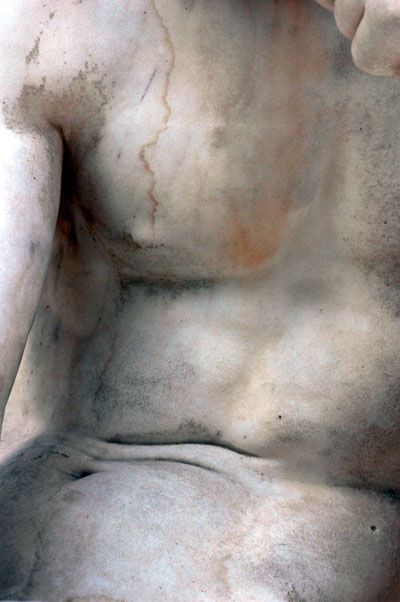
Augustus Saint-Gaudens Hiawatha in clay, 1871-1872; this marble carving, 1874, 7 feet 9 inches high, including pedestal [detail]
Barry and I were leaving the Metropolitan Museum cafe in the American Wing yesterday when we passed the Saint-Gaudens marble “Hiawatha”. I must have passed it any number of times before, but now I found myself zeroing in on the beautifully-modeled torso of this noble young man, created by an artist who was only about 23 himself when he began the work in clay. Then, thinking about the date, 1870, I thought about the time and geography of the work’s origins.
In the very midst of the beginnings of the last segment of our protracted Indian wars, a very young Augustus Saint-Gaudens, fled Paris, where he had studied for three years, on the outbreak of the Franco-Prussian War. He settled in Rome in late 1870 where he began work on “Hiawatha”, his first full-length statue. His inspiration was the legendary Chippewa chief and founder of the Iroquois confederacy who was the main protagonist in Henry Wadsworth Longfellow’s enormously popular 1955 poem, “The Song of Hiawatha“*.
In 1870 Saint-Gaudens’ native country was still nursing the wounds of the Civil War; France and Germany were engaged in a duel which quickly realized the end of one empire and the birth of another, both with enormous consequences which continue today; the Italian army had crossed the papal frontier (finally completing the wars for unification), in the same month the artist arrived in Rome. Saint-Gaudens however was otherwise engaged.
The War Between the States may have ended (he had been too young to participate), but there was hardly going to be any peace on the other side of the Atlantic, where twenty more years of wars directly impacted – in fact completely devastated – the people represented in his early masterpiece.
Americans were eager to settle the lands which had been opened up in the west, and Civil War veterans, adventurers and misfits were volunteering to secure their right to be there, defending it from the legitimate claims of the peoples we were already making into legends and heroes. The United States was determined to fulfill its own peoples’ “manifest destiny” and would not allow what remained of native American civilizations to stand in the way of its claim to the “Land of Many Uses“. In spite of occasional sensational – and hugely popularized – news events like “Custer’s Last Stand”**, the full horror of these last Indian Wars was largely removed from the consciousness of Americans back east, much as in the case of our own wars today.
It was all over by 1890: Providence had made the entire country safe for the American Empire, but the devil had taken the hindmost; the Indian was now almost gone, and almost forgotten, except where and how it served the victors to remember him.
But it is a beautiful statue.
*
The fame and legend attached to both the poem and its subject continued well into the 20th century: I remember my class being told in grade school to memorize the trochaic tetrameter of this Longfellow poem, and we barely questioned the assignment (I never got beyond a few stanzas).
**
When my own family drove west in the big Buick on a long vacation 55 years ago, the Little Big Horn ranked extremely high on our own list of “must sees”, and in fact, I’ve never forgotten my impressions of that sad, and then still very desolate, little-visited place.