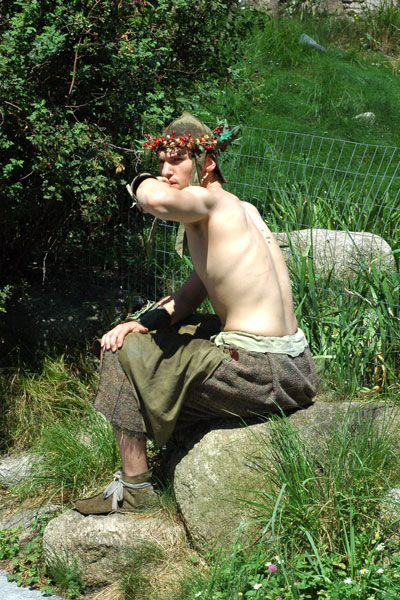
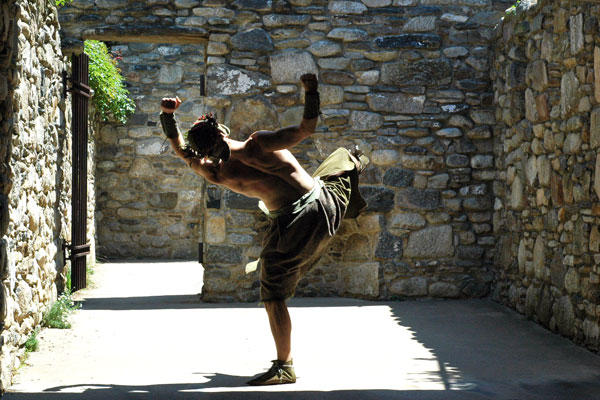
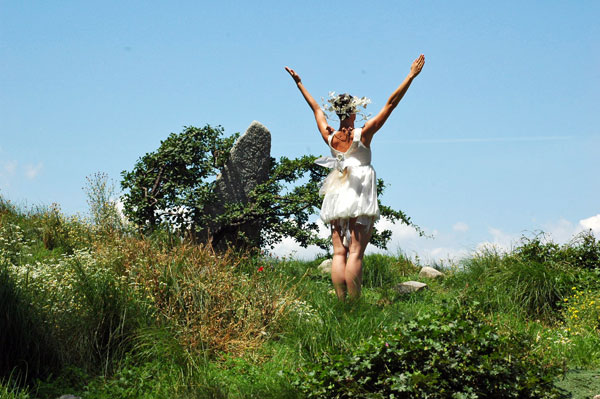
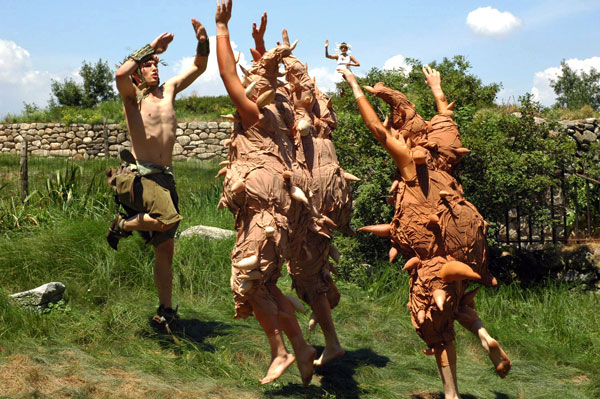
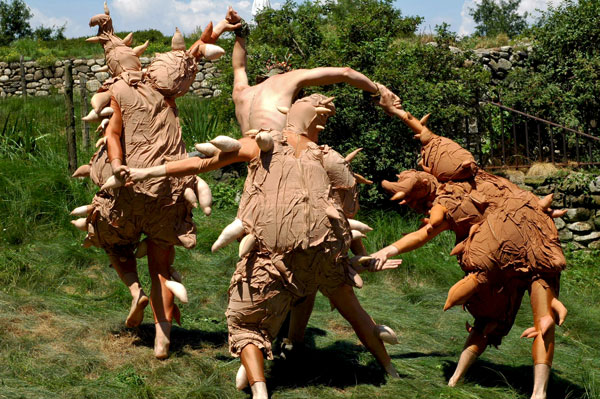
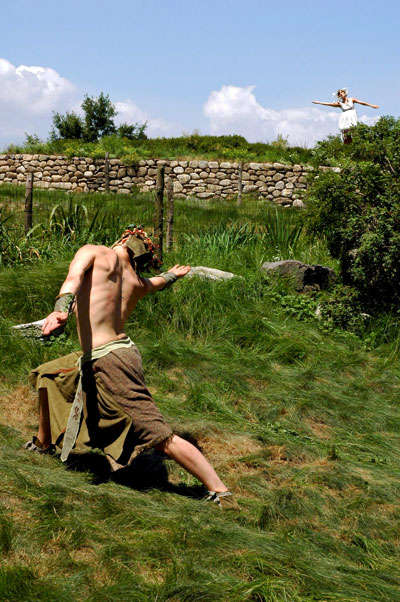
Barry and I headed for the Irish Hunger Memorial shortly after noon on Monday (after my visit to City Hall Park) to see an excerpt of “The Voyage of Garbhglas“, choreographed by Christopher Williams and presented, courtesy of the Lower Manhattan Cultural Council, as a part of the River To River Festival.
It was a total delight, a magical allusion to ancient Irish faerie lore performed in a magical Irish place on a beautiful afternoon, and I recommend it to anyone who can make downtown for the two performances remaining, Wednesday and Thursday, at 12:30 each day. The Memorial is located inside Battery Park City, 290 Vesey Street at North End Avenue, an easy, almost straight walk west from the World Trade Center stop of the E train.
The performers were Ursula Eagly, Kira Blazek, Caitlin Scranton, Michael Ingle, Sydney Skybetter, Moses Kaplan, and Andrew Smith. I believe Michael Ingle was the celtic youth, and the three other male dancers were what I’ll call “the tubers”. Christopher Williams himself and Matthew Tutsky played troubadour harps of different sizes, and the music was by Gregory Spears, who can be seen in some of the images directing the singers.
Barry has posted a video, on Bloggy, of a short segment of the 30-minute performance and has a link to his Flickr set.
As someone who tries to take advantage of what New York has to offer culturally, I think a lot about how everyone who would like to see art in performance (in any medium) can find a way to do so without having to deal with discouraging lines, fifth-balcony-in-the-rear seats, or even sold-out notices. In my own case it helps that I’m usually interested in work that most people are unlikely to even be aware of, and I’m lucky to have the leisure to seek it out. But what happens when something really good becomes well known, and suddenly everyone wants to see or hear it?
I was considering this subject with Barry when we left the performance of “Garbhglas”. His answer was that the ideal would be that there would be so much art out there, and really good art, that there would never have to be a line or a crowd. We’d all have so many options that we wouldn’t have to keep bumping into each other, or fight for tickets. Of course that ideal assumes we all think and feel for ourselves and aren’t seduced by the inevitable hype – including, I suppose, in this case, my own modest efforts at making a ballyhoo.
This time the subject had come up because in Monday’s surprisingly intimate, georgic performance by Williams’ dancers and musicians, while everything took place outdoors, it seemed that there was really room on the Memorial’s platform for only about a hundred people to fully experience it, not including whatever the numbers were for those standing on the street below.
While I imagine there must be other things to do at lunch time Wendsday and Thursday, if you go, maybe it wouldn’t be a bad idea to plan on getting to “Garbhglas” early for its final two performances.

Time’s Up! makes City Hall Park a community garden
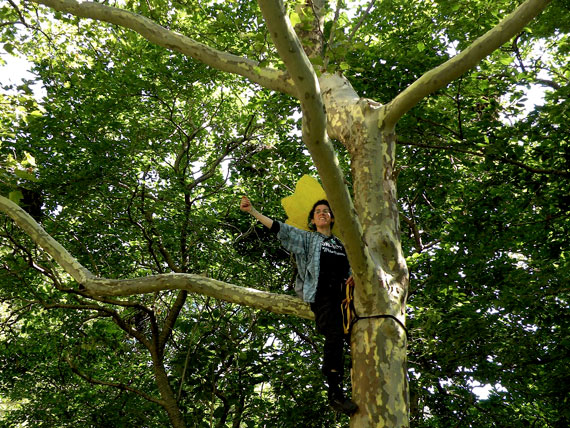
Jessica Sunflower planted in CIty Hall Park
UPDATE: A public hearing concerning the City’s proposed new rules will be held next Tuesday, August 10 at Chelsea Recreation Center, 430 West 25th Street, at 11:00am. It should be very colorful. The New York City Community Garden Coalition (NYCCGC) is urging its supporters to testify about the importance of making community gardens permanent. Information can be found on the Coalition�s web site, including the proposed rules themselves, the expiring 2002 agreement, and a history of the evolution of New York City community gardens.
New York City appears to have officially abandoned its efforts to preserve the 500 community gardens which have been protected from development since 2002 by the Spitzer Agreement (“Preservation Agreement“). That compact, which ended a hard-fought battle begun more than 20 years earlier, saved hundreds of community gardens, but it expires on September 17 this year.
Proposed Department of Housing and Preservation (HPD) rules will permit these precious urban green spaces to be legally transferred for commercial development. These popular and flourishing bootstrap gardeners’ oases had replaced neighborhood vacant lots where buildings had been abandoned by landlords following the flight of residents to the outer boroughs and the suburbs during the sixties and seventies.
These older structures, neglected and often torched, but ultimately leveled in any case, all eventually became city property. The City hoped to profit from their sale and the tax revenues which would follow their development, but there was no commercial interest in the properties until residents, both old and new, had worked hard to successfully rebuild and improve their neighborhoods.
The communities which have fought for these spaces and nurtured them for years are understandably very angry. Yesterday Jessica Sunflower and some friends decided to bring the Time’s Up! campaign to preserve these gardens down to City Hall itself. The precise venue chosen was City Hall Park, on the doorstep of both the Mayor’s office and the City Council Chamber. Sunflower managed to climb into a tree planted in the Mayor and Council’s own official “garden”, and she was joined on the ground by some serious community advocates.
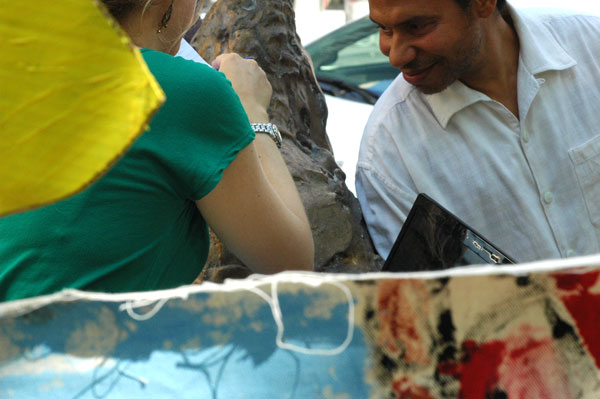
modern activism: back on the ground, even as Sunflower was being ushered into a police vehicle, supporters were busy broadcasting the action from a laptop resting on the plinth of a bronze sculpture at the edge of the park
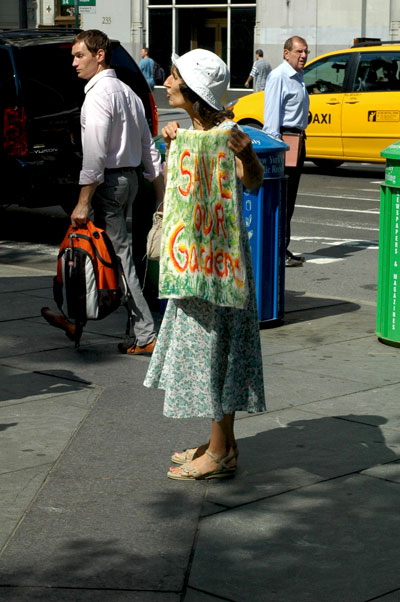
the voice of one crying in the City Hall wilderness – will it be heard?
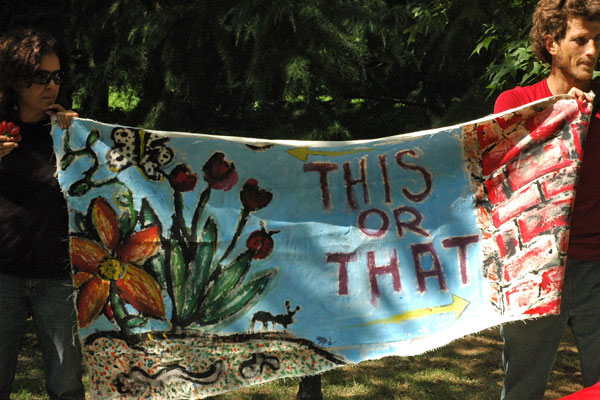
for thirty years, the communities have chosen gardens over brick
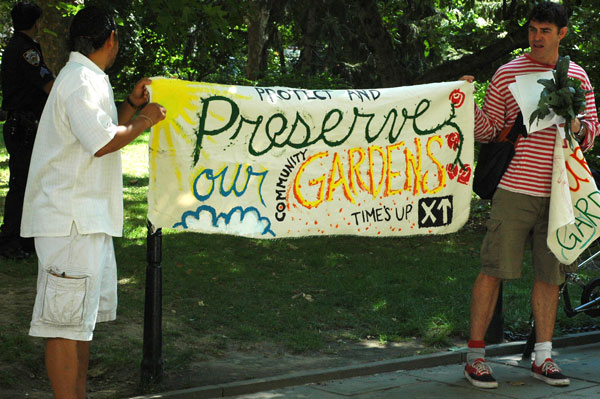
kale bouquet: the Times once described New York’s more successful community gardens as “spectacular stretches of kale-toned respite”
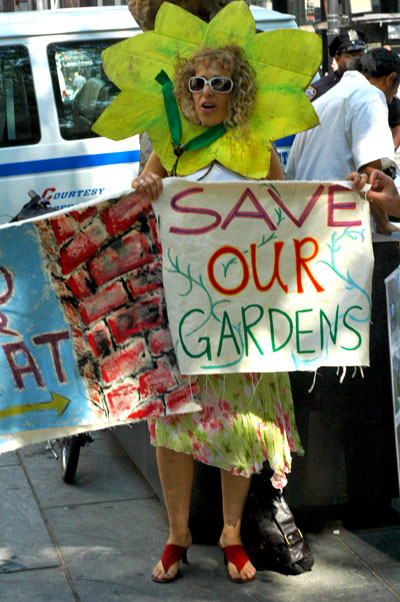
the sunflower petals abandoned by the prisoner while she was being removed from the tree were quickly salvaged and recycled back on the ground
[image at the top by Rebekah McCabe, from a Flickr set uploaded by Barbara Ross]
“Other Spaces” at Center 548

Kristof Wickman Untitled 2008 laminate, mixed media 28″ x 18″ x 22″ [installation view, including a floor section of a work by Jorge Pardo]
“Other Spaces“, an elegantly-installed two-week-long show of work by seven artists, curated by Jayne Drost, is located inside Center 548, the latest designation for the former Dia Center for the Arts space on West 22nd Street.
The small temporary gallery has been carved out of a section of the museum’s former book store, which had itself been reconfigured in 2001 by the artist Jorge Pardo.
The artists in the show are Palma Blank, Leah Dixon, Sam Falls, Left Coast, Daniel Turner, Timothy Uriah Steele, Kristof Wickman.
I was there at the opening on July 18. Because of the crowd, this image of Wickman’s tender, anthropomorphic, warm/hard sculpture was the only clear shot I was able to get with my temporary replacement lens*.
“Other Spaces” closes tomorrow, Friday, at 7.
*
I’m using my Nikkor 60mm macro (equivalent to 90mm on a 35 mm film camera) while my jammed 18-70 zoom is being repaired; I love the macro. It’s a terrific instrument, and for years I used it as a standard lens on my old FM, where it really was a 60, but it just doesn’t work if I want to document art inside galleries and studios, especially with the digital Nikon box I use now.
Sonoma County settles out of court with Clay Green

George Tooker Landscape with Figures 1965-1966 egg tempera on pressed wood 25.5″ x 29.5″
we are alone . . . but we are not alone
Their nightmare began only two years ago, and no one can undue the psychological damage done to Clay Green and Harold Scull or return to the surviving spouse the home and virtually all the property and personal possessions the two men had shared for 20 years, but their injuries have finally been acknowledged.
Last Friday, just two days before his suit would have been opened in court, California’s Sonoma County, agreed to a settle Greene’s complaint out of court, for the amount of $653,000. Greene will retain $275,000, his lawyers will take $300,000*, and Scull’s estate will be given the remainder. It was announced in the San Francisco Chronicle that the nursing home will pay $53,000, but it was not made clear where it will end up.
Greene’s suit against Sonoma had claimed that his sexual orientation was the reason social workers had separated him and his dying partner and why the county had summarily sold off their belongings, including shared personal mementos.
Under the terms of the agreement Sonoma County did not admit it had discriminated against the two elderly men, but the county’s lawyer, Gregory Spaulding admitted that there had been �procedural errors� in the disposal of the property.
The Sonoma County Press Democrat** reports that Spaulding said that the error had led to policy improvements at the Public Guardian’s office regarding property disposition and case management, but that he had also spoken on the subject of the Harold and Clay’s own status before the law:
He said the dispute might have been avoided if the men had been able to be legally married or if they had registered as domestic partners. Because they weren’t, their funds were viewed as separate, he said.
�Marital status played a role in what options were available to them,� Spaulding said.
In my April post I pointed out that, while Harold and Clay may not, and today could not, have been married, they had been a couple for 25 years and “. . . had taken the precaution of naming each other both beneficiaries of their respective estates and agents for medical decisions, and the authorities still proceeded as if they had no personal or legal relationship.”
Barry and I know any number of heterosexual couples as friends, and we occasionally ask them whether they have ever had to prove they were married. They inevitably answer no, that they are never asked to furnish copies of their marriage certificates. Some of them in fact had never actually married, and yet they have been able to take advantage of all of the perquisites which are attached to a state which is supposedly carefully circumscribed by law.
People like Harold and Clay – and Barry and James, our friends Jill and Gabriella and others, and millions of other couples around the world – don’t even get to be asked.
*
The National Center for Lesbian Rights in San Francisco had represented Greene, and Amy Todd-Gher was his lawyer, so I’m wondering about this compensation figure.
**
I and a number of other bloggers had complained months ago that like most of the commercial media, the Sonoma County, New York Times-owned paper, the Press Democrat, had long refused to cover this story altogether. The paper has finally acquitted itself with its coverage of the settlement, but this excerpt from the paper’s July 22 post however is a bit disingenuous:
The case grabbed national media attention with its shocking claims of abuse at the hands of those meant to protect the frail and vulnerable. Gay rights groups pummeled county officials with strident e-mail and some threatened a boycott on county tourism and wines.
Although the suit was filed in August 2009, it didn’t become widely known until a report about it ran in April on the website of the National Center for Lesbian Rights.
[image from eric reber]
Costa Rica followup: Monroe Doctrine means it’s all ours
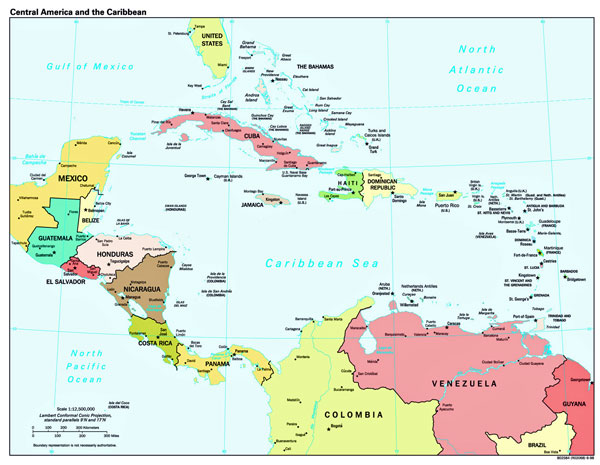
America’s backyard
We still haven’t heard one peep from the commercial media/entertainment news corporations (even the simple fact that something’s happening), but Mark Vorpahl has written an articulate and persuasive description of what’s really behind the U.S. flotilla en route to the southern Caribbean (Mare Nostrum, or our “Fourth Shore”), “The U. S. Military Moves Into Costa Rica“.
I am entirely in agreement with his conclusions. Anyone who would prefer not to be completely surprised by another shooting war, or the next U.S.-backed coup attempt, should read what he has to say.
An excerpt:
Most of these measures [recent U.S. military operations in Central and northern South America] have been justified on the grounds of combating drug trafficking, including the military buildup in Costa Rica. However, they have not curtailed this problem at all. Such U.S. military buildups have generally been accompanied by an increase in drug trafficking, as has happened in both Columbia and Afghanistan. Based on this record it can only be concluded that the “War on Drugs” rationale is a red herring for public relations consumption, not the actual motivation.
This military build up in Costa Rica is the latest in a series of moves the U.S. has made in Latin America that seeks to use threats and arms to reverse the strength of popular anti-imperialist forces across the region. The U.S. is playing with the possibility of erupting a continental conflagration for the sake of corporate profits.
While it is doubtful that the U.S. wants to directly engage in a military conflict with, most likely, Venezuela right now, preparations for this possibility are being made. What is more likely in the short term is that the U.S. military will use its forces to engage in sabotage and intimidation in hopes of reversing support for the nations aligned with ALBA. It is also very possible that the U.S. military will help to support proxy armies, such as Colombia’s, in military conflicts that align with U.S. interests. However, this is a dangerous game. Even in the short term, the U.S. ruling class may drag the nation into another direct conflict, in spite of their intentions, that could spread to involve numerous other nations.
[image from Map of the United States (the irony was not likely intended)]
Costa Rica asks for U.S. invasion; U.S. media silent

Coca (Erythroxylum coca)
ADDENDA:
This extended discussion on Upside Down World, published July 15, includes a statement that the idea of the U.S. military presence did not originate in a request from Costa Rica; rather it was initiated by the U.S. in a diplomatic request from the US Embassy made on July 1.
Also, in its own post on the Costa Rican story [in Spanish, but easily translated], the Comisi�n Intereclesial de Justicia y Paz describes the operation as “continuing the process of the militarization of Central America” and refers to it as a part of the continuing U.S. agenda for Latin America, which has recently seen the establishment of seven bases in Colombia, intensified militarization in Honduras and Haiti, the announcement of new bases in Panama.
On July 2nd the Congress of Costa Rica authorized the entry of 46 U.S. warships capable of carrying 200 helicopters and warplanes, plus 7,000 U.S. Marines “who may circulate the country in uniform without any restrictions”, plus submarine killer ships, to the Costa Rican coast for “anti-narcotics operations and humanitarian missions”.
Where’s the outrage? Actually, where in fact is the news?
I have not found a single line on this story anywhere in the MSM.
I think the media silence is probably the first thing which should be questioned (have we all, including the world at large, become inured to yet another attestation to the expanding American imperial lust?).
But I am just as shocked by the news itself. Why is this happening?
Is it because we’ve done so well with both our former and continuing foreign wars and interventions? Is it because we’ve done so well with our internal war on drugs, or because our impact on the drug traffic in other countries has been so benevolent?
Or does it actually have nothing to do with interventions, or drugs? I’d like to hear from people who are familiar with Costa Rica and have followed the events about which we currently hear nothing.
So far Costa Rica is only asking for “help”, but remember how “helpful” our innate imperialist impulse has been elsewhere for two centuries. I can’t imagine why any Latin American country would actually welcome the arrival of the U.S. military, unless of course there were banana kings running things at the top, or at least a right-wing regime, and they/it were worried about losing control. Oh, wait, bananas are still a major Costa Rican export, and the government, while enlightened, is still composed of members of an entrenched oligarchy, and by most accounts its biggest concern lately has been “security”.
The current president, Laura Chinchilla Miranda, who follows the modest centrist welfare policies of the National Liberation Party and promises to continue the free-trade policies of her predecessor, �scar Arias, is a social conservative who opposes abortion and gay marriage. But, more significant to the story of her nation’s call for U.S. Military help, she ran on a platform which promised to be tough on crime, and it included a larger and more professional law enforcement establishment. Sworn in two and a half months ago, one of her first acts was to create the nation’s first anti-drug “czar”, whose office is a part of the cabinet.
For half a century Costa Rica had enjoyed peace and political stability, and, overall an impressive growth in economic prosperity and social welfare systems, but beginning in the 90’s the country began to witness the rise of its own version of American neo-liberalism, which threatens the moderate socialism built up in the previous decades. It all sounds very American to me. The only thing missing was a security panic of their own and an indigenous drug war, and they’ve just ordered both.
But not everyone in Costa Rica is happy.
For a good discussion of the issues (with some reservation about a mostly-irrelevant postscriptive remark about the brave and unselfish volunteers in uniform), go to Costa Rica Blogger.
[all thanks to artist Pedro Velez for the Comisi�n Intereclesial de Justicia y Paz post alert]
[image from Wikipedia]
gay or black in the garden state: is it still 1953 in NJ?
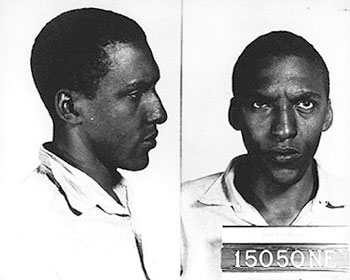
Bayard Rustin’s 1953 mug shot*
The CEO of an Atlanta credit union, on a visit to New Jersey for his 30th high school reunion, has been shot and killed in a Newark park by an undercover policeman. The alleged sex-related incident ended in the senseless death of an unarmed man, DeFarra Gaymon, a successful businessman and a married father of four.
The official explanation, delivered by the acting Essex County prosecutor (that the officer, trying to arrest Gaymon for lewd behavior, had fired in self-defense), makes no sense, and even if the pieces could be fitted together they suggest a world I thought had disappeared decades ago: I remember what many urban parks looked like after dark half a century back, I know that the police played them for sport, and I know the combination could destroy lives, but it’s now 2010. This Essex County park is located in a state which by most accounts ranks at the very top in the nation in laws extending equality and civil rights to both the gay and black communities (yes, the victim was black), and I thought we now had better uses for our constabulary – and that we could still afford real uniforms.
Actually, 57 years ago Bayard Rustin got off much easier than DeFarra Gaymon, whatever the unfortunate Atlanta businessman was doing in the park last Friday night.
According to the New York Times story, “The officer, whose name was not released because of his undercover work, had been on what is not usually a particularly dangerous assignment, scouring the park, in northern Newark, for men seeking sex.” The Times also tells us: “The officer and his partner were patrolling the park in plain clothes, part of an operation that has been going on for years, said Mr. [Robert D.] Laurino, the prosecutor.”
And that would be, . . . an assignment to arrest men who have no interest in frightening the horses. In the email he sent out before dawn this morning my friend, the activist Bill Dobbs, reminds us that “Those who seek hookups in such locales traditionally shield their activities from uninterested parties.”
The Essex County sheriffs have been very interested for years. May we ask why?
The whole incident stinks, and the only hope for justice, and reform of current police tactics, is the power of the presumed outrage of both Gaymon’s family and the community or communities targeted by a law enforcement agency.
In his letter, Dobbs asks:
What exactly was this undercover officer doing in a park known for cruising? Uniformed cops are safer and more effective for such situations � less danger when an arrest is made since cops identities are clear. Who approved this undercover operation? Was it a �sting� operation, enticing men and then arresting them? Was the cop given this assignment considered attractive to other men? Were there backup officers involved? What does the NJ gay lobby think about this? The only person who seems to be quoted on NJ matters gay, Steven Goldstein, is so rabidly and single-mindedly pro-gay marriage – will he and the state-wide gay political group Garden State Equality speak about an alleged sex-related incident that ended in the death of an unarmed African American man? According to the Star Ledger newspaper several hundred arrests have been made in that park over a year and a half, where has Garden State Equality been? How much money has been wasted on this operation?
Additional links:
*
The image at the top is of Bayard Rustin’s mug shot. His Wikipedia entry reads, in part:
In 1953, Rustin was arrested in Pasadena, California for homosexual activity. Originally charged with vagrancy and lewd conduct, he pleaded guilty to a single, lesser charge of “sex perversion” (as consensual sodomy was officially referred to in California then) and served 60 days in jail.
[image from GBMNews]
Johannes Wieland’s roadkill at Dance Theater Workshop
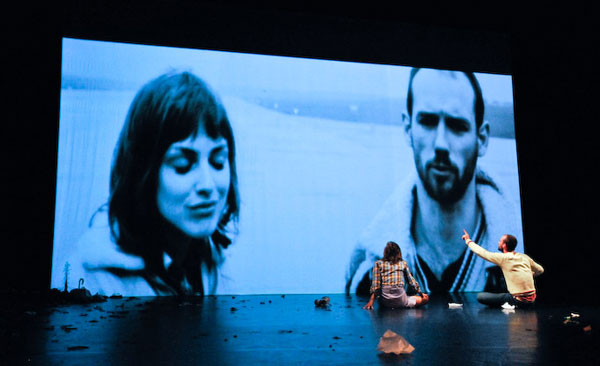
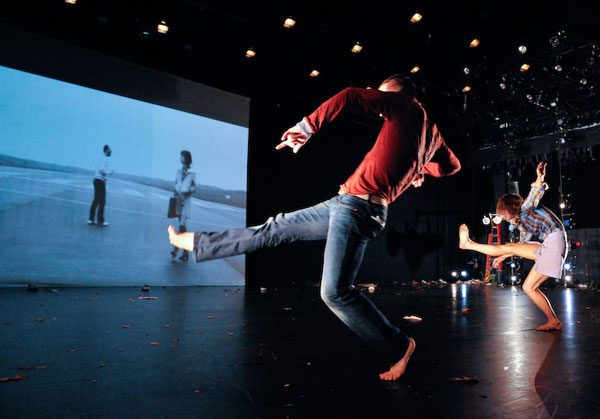
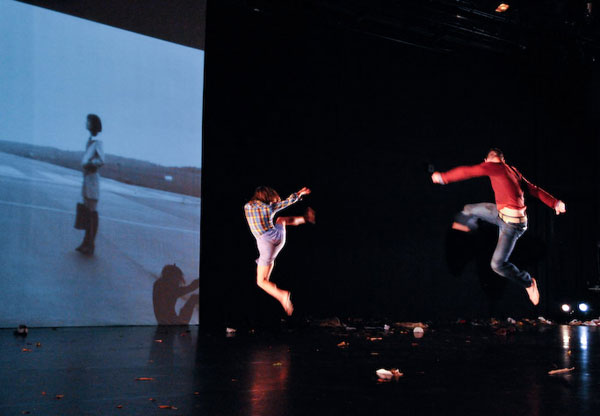
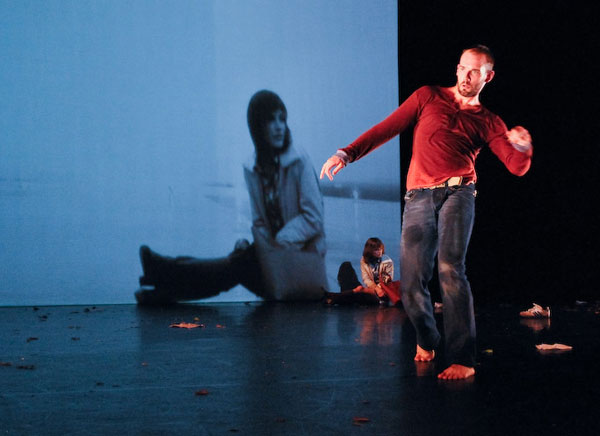
Barry and I went to Dance Theater Workshop [DTW] last night for a performance of “roadkill”, a dance, text, video and music work choreographed by Johannes Wieland. The performers were Ryan Mason and Eva Mohn. They were doubled by their own moving images in the huge projection which dominated half of the far wall. It was a video by Wieland, who was also responsible for the text, the set and the costumes. The music was by Ben Frost.
The piece itself was phenomenal, even by the standards of DTW, and the performers were incredible.
Mohn is an extraordinary dancer and actor (and musician, and one of the most hauntingly beautiful women I’ve ever seen. Mason was no less beautiful, with an incredibly elegant athleticism. He seemed to be in almost constant motion, leaping and spinning in midair, frenetic but disciplined, much of the time dressed in some serious layers of clothing. We watched his body do things I had I would not have thought possible for a mere mortal. Barry said it almost seemed like they both could turn their waists 360 degrees.
The music perfectly matched the dance and the theater; Frost was clearly a full partner in the success of the work.
Don’t miss it.
At the beginning of the performance, a young man and woman in ordinary street clothes are seen stranded on a barren airplane landing strip which is suggested on the stage by random weeds and paper debris. The two people, who appear � quatre, on a real runway through the magic of light, are alternately delighted and frightened by the sudden bizarre circumstances in which they have suddenly found themselves.
I experienced the piece largely as an abstraction, but its recurring and richly-drawn suggestions of narrative and purpose were probably as tantalizing for me and the rest of the audience as they were for the the fictive couples on the floor and on the screen. The press release offers this clue:
As foreigners in their own lives, they awaken with the touchdown of reality.
Delighted in their surreal circumstances, they watch the inevitable chaos of life unfold.
There is a “trailer” of sorts on the DTW site, but it’s just a teaser; in this video of Mason in an excerpt from “Second Hand Luck”, another piece choreographed by Wieland, the dancer does what YouTube label describes as his “underpants dance”. It’s over the top.
These are the “roadkill” performance details:
Performances are tonight, Friday, and Saturday at 8 p.m., Sunday at 5 p.m.
Tickets are $15; $12 for students
The location is Chelsea, 219 West 19th Street
(212) 924-0077
dancetheaterworkshop.org
While we waited for the lights to go down (Mohn and Mason were already hugging the masonry to the right of the screen, with their backs to the audience), I overheard a phrase spoken by someone sitting behind us, something to the effect of, “it’s German, so it will be dark”.
I’m going to step over the basis for that premise here (I’m referring to the common and unaccountably tenacious fallacy about the heaviness, even dismalness, of all things German), but not before I say that it describes a prejudice which I have never been able to share. Mostly because I am pretty familiar with things German, including both historic and contemporary Germanic culture, as well as the people who preserve it and continuously shape it anew, I know there is plenty of both the dark and the light, and everything between as well.
And by the way, “roadkill” isn’t dark. Like all art, it asks only for involvement.
Wieland is a native German, although the dancers and much of the creative team are not. The most German part of the production and the company is probably the form of its patronage: Wieland is fully appreciated as an artist in his own country, and he’s generously supported, by the state.
He originally established his company in New York, in 2002. He’s gone on to amass a large resume with work in the U.S., but in 2007 he was appointed artistic director/choreographer for the resident theater company at the State Theater of Kassel, a town of less than 200,000 people in Hesse, a state with just over 6 million. There he has the full support of the local government, serving the culture at large. Because of this largesse he is able to undertake productions with 30 or more performers, with live musicians, and full orchestras, on all three stages of a modern destination theater.
Kassel, a modest town on the Fulda River, which for over 50 years has played host to Documenta, has an impressive record of support for theater and performance. The history of the State Theater began with the Ottoneum, built in 1604. It was the first purpose-built theater on the continent.
[images provided by the artist Sebastian Lemm]
Book bargains to benefit homeless LGBT Youth
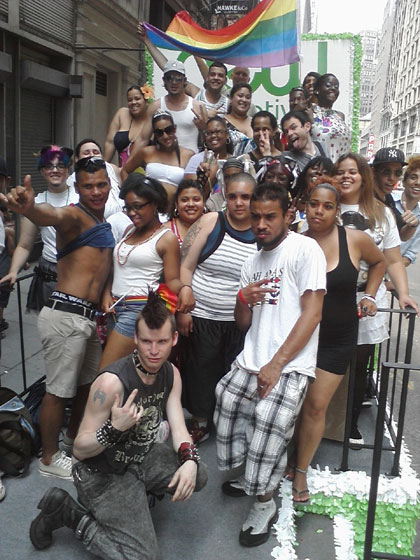
New Alternatives marched in the 2010 NYC Pride Parade last month
A July 10 benefit for New Alternatives for LGBT Homeless Youth will offer both some incredible book bargains and the opportunity to do something for some of the most vulnerable (yet spunkiest) folks in New York. The organization was founded by activist Kate Barnhart, whom I first met some 20 years ago, when she was just about the youngest and most fearless member of ACT UP (and there was serious competition for both roles). She hasn’t slowed down since.
These are the details of the benefit:
Huge Book Sale on July 10
At LGBT Community Center on West 13th Street
Will Benefit Homeless LGBT Youth
�Buy a book, save a young life� fundraiser
Offers ten thousand new volumes on sale
For $10 per shopping bag
NEW YORK, NY, June 28, 2010 � A huge sale of more than ten thousand new and used books will take place in the West Village on July 10, with the proceeds going to charity. The event, called �Buy a Book, Save a Young Life,� will take place on Saturday, July 10 from Noon-6pm at the LGBT Community Center on 13th Street.
The books on sale encompass every subject and genre, including children�s, art, classic and modern literature, as well as collectables and rarities. These books were donated by veteran bookseller Robert Warren, who recently closed his landmark New York bookstore, Skyline Books. Admission is free to this event, and people can fill a shopping bag full of books and pay $10 per bag.
All proceeds of the �Buy a Book, Save a Young Life� sale will benefit New Alternatives, the East Village program based at Middle Collegiate Church. New Alternatives provides desperately needed services to LGBT homeless youth, including hot meals, emergency housing referrals, case management, and life skills training.
There will be a special pre-sale on July 10 for dealers and collectors. For an admission fee of $25 (also going to New Alternatives), shoppers can get a jump on the crowd from 11am-Noon. Admission includes one free bag of books. Additional bags of books will be $25 each.
For hardcore bargain hunters, from 5pm to the 6pm closing, the price plummets to $1 per bag of books.
To match New Alternatives goals of promoting HIV awareness and safer-sex education, each bag of books comes with free condoms, and New Alternatives promises a fun festive atmosphere. In addition to great book bargains the event will include performances from queer and queer-friendly acts such as Circus Amok, Rude Mechanical Orchestra, and The Church Ladies for Choice. Expect music, stilt walking, juggling and a good vibe to abound.
ADDENDUM: See Karen Ramspacher’s brief description of the group in her comment on Bloggy
[image from New Alternatives]
cherries, cherries, cherries, also van Buren and nativism

This image includes only one segment of a vast checkered display set up in the Union Square Greenmarket last Friday by Samascott Orchards, of Martin van Buren‘s Kinderhook, New York. The cherries were going fast.
Speaking of van Buren, I just learned that the bewhiskered knickerbocker, incidentally the first president from New York (and the first born in the U.S.), was the first one for whom English was not a first language. We’re still waiting for the second, and, if we all survive, there should be many more.
The boy went far. If he were alive today, what do we think he’d say about our modern Know Nothings? But maybe there’s no real parallel, since his family, and many other Dutch settlers, had been busy, and dominant, in the upper Hudson valley since the early 1600’s, before English, or the English had subsumed all. Also, the Dutch were pretty white, and definitely not Catholic. Today’s Know Nothings have to find a way to get around the fact that if there are any “illegals”, it’s the people who stole the West, indeed the entire Western Hemisphere, from those who were there first.